Bill· HRH.R. 8191 (118th)referred
CROWN Act of 2024
United States · United States Congress · 30 April 2024
The world's political record
Person
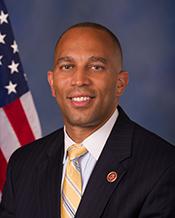
United States · Official source
1,718 records where Rep. Jeffries, Hakeem S. [D-NY-8] is listed as a sponsor, author, or other actor. Search with topics and years
United States · United States Congress · 30 April 2024
United States · United States Congress · 21 March 2024
This resolution expresses support for initiatives to build the Black workforce and equip the Black community in the United States with the necessary tools to compete for stable jobs in every career and at every career level. It also expresses support for the goal of expanding economic opportunity, equity, and wealth creation for Black people in the United States at every socioeconomic level, in every industry, and in every residential setting.
United States · United States Congress · 18 January 2024
Access to Family Building Act This bill provides a statutory right to access assisted reproductive technology (e.g., in vitro fertilization). Specifically, under the bill, individuals have the right to access assisted reproductive technology, and to retain all rights with respect to the use or disposition of reproductive genetic materials (e.g., eggs or sperm), without prohibitions or unreasonable restrictions. Health care providers and insurers also have the right to provide and cover these services, respectively. The bill does not affect state or local health and safety regulations that achieve their purpose in the least restrictive manner possible. The Department of Justice may bring civil actions against states, localities, or government officials or entities that enact or enforce limitations or requirements that violate this bill. Individuals and health care providers who are affected by violations may also bring civil actions for relief.
United States · United States Congress · 3 January 2024
This resolution congratulates Kappa Alpha Psi Fraternity, Inc., on 113 years of achieving and serving local communities and enriching the lives of collegiate men throughout the United States. Additionally, the resolution supports the designation of a Kappa Alpha Psi, Fraternity Inc., Day. The resolution also supports the goals and ideals of Kappa Alpha Psi Fraternity, Inc.
United States · United States Congress · 13 December 2023
Roberto Clemente Commemorative Coin Act This bill directs the Department of the Treasury to mint and issue coins in recognition of the life of Roberto Clemente, baseball player and human rights activist. All sales of coins issued under this bill must include a surcharge to be paid to the Roberto Clemente Foundation.
United States · United States Congress · 11 October 2023
This resolution states that the House of Representatives stands with Israel as it defends itself against the barbaric war launched by Hamas and other terrorists, reaffirms Israel's right to self-defense, and condemns Hamas' brutal war against Israel. The resolution also reaffirms the United States' commitment to Israel's security, supports emergency resupply and certain other types of assistance to Israel, and urges full enforcement of sanctions against Iran to prevent Iran's funding of terrorist groups.
United States · United States Congress · 10 October 2023
This resolution states that the House of Representatives stands with Israel as it defends itself against the barbaric war launched by Hamas and other terrorists, reaffirms Israel's right to self-defense, and condemns Hamas' brutal war against Israel. The resolution also reaffirms the United States' commitment to Israel's security, supports emergency resupply and certain other types of assistance to Israel, and urges full enforcement of sanctions against Iran to prevent Iran's funding of terrorist groups.
United States · United States Congress · 19 September 2023
John R. Lewis Voting Rights Advancement Act of 2023 This bill establishes new criteria for determining which states and political subdivisions must obtain preclearance before changes to voting practices may take effect. Preclearance is the process of receiving preapproval from the Department of Justice (DOJ) or the U.S. District Court for the District of Columbia before making legal changes that would affect voting rights. A state and all of its political subdivisions shall be subject to preclearance of voting practice changes for a 10-year period if, during the previous 25 years: 15 or more voting rights violations occurred in the state; 10 or more violations occurred, at least 1 of which was committed by the state itself; or 3 or more violations occurred and the state administers the elections. A political subdivision as a separate unit shall also be subject to preclearance for a 10-year period if three or more voting rights violations occurred there during the previous 25 years. States and political subdivisions that meet certain thresholds regarding minority groups must preclear covered practices before implementation, such as redistricting. States and political subdivisions must notify the public of changes to voting practices. The bill authorizes DOJ to require states or political subdivisions to provide certain documents or answers to questions for enforcing voting rights. The bill outlines factors courts must consider when hearing challenges to voting practices, such as the extent of any history of official voting discrimination in the state or political subdivision.
United States · United States Congress · 4 August 2023
This resolution recognizes the importance of Chicano Heritage Month and asserts that Mexican Americans enhance the diversity and strength of the United States.
United States · United States Congress · 27 July 2023
United States · United States Congress · 26 July 2023
This resolution recognizes the 50th anniversary of hip-hop and the contribution of hip-hop to American art and culture. Further, it encourages local governments to build partnerships with local hip-hop entities and other members of creative arts.
United States · United States Congress · 18 July 2023
Freedom to Vote Act This bill addresses voter registration and voting access, election integrity and security, redistricting, and campaign finance. Specifically, the bill expands voter registration (e.g., automatic and same-day registration) and voting access (e.g., vote-by-mail and early voting). It also limits removing voters from voter rolls. Next, the bill establishes Election Day as a federal holiday. The bill declares that the right of a U.S. citizen to vote in any election for federal office shall not be denied or abridged because that individual has been convicted of a criminal offense unless, at the time of the election, such individual is serving a felony sentence. The bill establishes certain federal criminal offenses related to voting. In particular, the bill establishes a new criminal offense for conduct (or attempted conduct) to corruptly hinder, interfere with, or prevent another person from registering to vote or helping someone register to vote. Additionally, the bill sets forth provisions related to election security, including by requiring states to conduct post-election audits for federal elections. The bill outlines criteria for congressional redistricting and generally prohibits mid-decade redistricting. The bill addresses campaign finance, including by expanding the prohibition on campaign spending by foreign nationals, requiring additional disclosure of campaign-related fundraising and spending, requiring additional disclaimers regarding certain political advertising, and establishing an alternative campaign funding system for certain federal offices.
United States · United States Congress · 12 July 2023
Social Security 2100 Act This bill modifies the Social Security system, particularly with respect to benefit calculations, fund administration, and beneficiary resources. For example, the bill temporarily increases the primary insurance amount for Social Security benefits for all individuals (from 90% of a certain portion of average indexed monthly earnings to 93%). It also modifies benefit calculations for certain individuals, including by temporarily (1) increasing benefits for widows or widowers in two-income households; and (2) allowing children of a deceased, disabled, or retired worker to remain eligible for benefits through age 25 if they are full-time students. Additionally, the bill temporarily eliminates (1) the government pension offset , which reduces Social Security benefits for spouses, widows, and widowers who also receive government pensions of their own; and (2) the windfall elimination provision , which reduces Social Security benefits for individuals who also receive a pension or disability benefit from an employer that did not withhold Social Security taxes. The bill also modifies the financing and administration of the Social Security trust funds. For example, the bill (1) subjects income over $400,000 to Social Security payroll taxes, and (2) combines the Federal Old-Age and Survivors Insurance Trust Fund and the Federal Disability Insurance Trust Fund into a single Social Security Trust Fund. Finally, the bill establishes requirements relating to Social Security services and resources, including by prohibiting the closure of field offices unless certain conditions are met (e.g., public hearings).
United States · United States Congress · 21 June 2023
Equality Act This bill prohibits discrimination based on sex, sexual orientation, or gender identity with respect to businesses, employment, housing, federally funded programs, and other settings. Specifically, the bill expands Title II and Title VI of the Civil Rights Act of 1964 to prohibit public accommodations and federally funded programs, respectively, from discriminating based on sex, sexual orientation, or gender identity. It also includes stores, transit services, recreational facilities, and establishments that provide health care, accounting, or legal services as public accommodations under Title II. The bill also expands Title IV (desegregation of public schools) and Title VII (employment discrimination) to specifically include sexual orientation and gender identity. (The Supreme Court held in Bostock v. Clayton County that Title VII's prohibition of employment discrimination based on sex also prohibits employment discrimination based on sexual orientation or gender identity.) The bill similarly expands the Fair Housing Act (discrimination in public and private housing) to include sexual orientation and gender identity. It also prohibits discrimination based on sexual orientation or gender identity by creditors and with respect to jury selection. The bill defines sex for purposes of the aforementioned provisions to include sex stereotypes, pregnancy, childbirth, sexual orientation, gender identity, and sex characteristics.
United States · United States Congress · 15 June 2023
American Dream and Promise Act of 2023 This bill provides certain non-U.S. nationals ( aliens under federal law) with a path to receive permanent resident status and contains other immigration-related provisions. The Department of Homeland Security (DHS) or the Department of Justice (DOJ) shall provide conditional permanent resident status for 10 years to a qualifying individual who entered the United States as a minor and (1) is deportable or inadmissible, (2) has deferred enforced departure (DED) status or temporary protected status (TPS), or (3) is the child of certain classes of nonimmigrants. The bill imposes various qualifying requirements, such as the individual being continuously physically present in the United States since January 1, 2021, passing a background check, and being enrolled in or having completed certain educational programs. DHS shall remove the conditions placed on permanent resident status granted under this bill if the alien applies and meets certain requirements, such as completing certain programs at an educational institution, serving in the military, or being employed. Furthermore, DHS and DOJ shall provide lawful permanent resident status to certain individuals who had TPS, were eligible for TPS, or were eligible for DED status on certain dates. Such individuals must meet certain requirements and apply for such status within three years of this bill's enactment. DHS may not use information from applications filed under this bill or for Deferred Action for Childhood Arrivals status for immigration enforcement purposes. This bill also repeals a restriction that bars a state from providing higher education benefits to undocumented individuals unless those benefits are available to all U.S. nationals without regard to residency in the state.
United States · United States Congress · 14 June 2023
Right to Contraception Act This bill sets out statutory protections for an individual's right to access and a health care provider's right to provide contraception and related information. Contraception refers to an action taken to prevent pregnancy, including the use of contraceptives (i.e., a device or medication used to prevent pregnancy), fertility-awareness based methods, and sterilization procedures. Generally, the bill prohibits measures that single out and impede access to contraception and related information. However, a party may defend against a claim that a measure violates the bill's prohibitions by demonstrating, through clear and convincing evidence, that the measure significantly advances the safety of contraception and cannot be achieved through less restrictive means. The bill also specifies that the prohibition preempts inconsistent state and local laws and applies in spite of other federal laws, including the Religious Freedom Restoration Act of 1993. The Department of Justice, individuals, or health care providers may bring a lawsuit to enforce this bill, and states are not immune from suits for violations.
United States · United States Congress · 13 June 2023
This resolution recognizes the historical significance to the nation of Juneteenth Independence Day (commemorating the end of slavery in the United States).
United States · United States Congress · 7 June 2023
American Family Act This bill provides for a new fully refundable child tax credit and monthly advance payments of credit amounts.
United States · United States Congress · 23 May 2023
This resolution calls on elected officials, faith leaders, and civil society leaders to condemn and combat antisemitism. The resolution also (1) urges that all possible steps be taken to ensure the safety and security of Jewish American communities, and (2) calls on the Executive Branch and civic leaders to identify and educate the public on the contributions of the Jewish American community.
United States · United States Congress · 9 May 2023
This resolution recognizes the significance of Jewish American Heritage Month as a time to celebrate the contributions of Jewish Americans to American society and culture, and calls on elected officials, faith leaders, and civil society leaders to condemn and combat antisemitism.
United States · United States Congress · 13 April 2023
Preparing Regulators Effectively for a Post-prohibition Adult-use Regulated Environment Act of 2023 or the PREPARE Act of 2023 This bill directs the Department of Justice to establish the Commission on the Federal Regulation of Cannabis to study a plausible and prompt pathway to cannabis regulation.
United States · United States Congress · 6 April 2023
This resolution supports the designation of Kimchi Day (November 22, 2023). Kimchi is a traditional dish in Korean cuisine.
United States · United States Congress · 30 March 2023
Women's Health Protection Act of 2023 This bill prohibits governmental restrictions on the provision of, and access to, abortion services. Before fetal viability, governments may not restrict providers from using particular abortion procedures or drugs, offering abortion services via telemedicine, or immediately providing abortion services if delaying risks the patient's health. Furthermore, governments may not require providers to perform unnecessary medical procedures, provide medically inaccurate information, or comply with credentialing or other conditions that do not apply to providers who offer medically comparable services to abortions. Additionally, governments may not require patients to make medically unnecessary in-person visits before receiving abortion services or disclose their reasons for obtaining services. After fetal viability, governments may not restrict providers from performing abortions when necessary to protect a patient's life and health. The same provisions that apply to abortions before viability also apply to necessary abortions after viability. Additionally, states may authorize post-viability abortions in circumstances beyond those that the bill considers necessary. Further, the bill recognizes an individual's right to interstate travel, including for abortion services. The bill also prohibits governments from implementing measures that are similar to those restricted by the bill or that otherwise single out and impede access to abortion services, unless the measure significantly advances the safety of abortion services or health of patients and cannot be achieved through less restrictive means. The Department of Justice, individuals, or providers may sue states or government officials to enforce this bill, regardless of certain immunity that would otherwise apply.
United States · United States Congress · 10 March 2023
Paycheck Fairness Act This bill addresses wage discrimination on the basis of sex, which is defined to include pregnancy, sexual orientation, gender identity, and sex characteristics. Specifically, it limits an employer's defense that a pay differential is based on a factor other than sex to only bona fide job-related factors in wage discrimination claims, enhances nonretaliation prohibitions, and makes it unlawful to require an employee to sign a contract or waiver prohibiting the employee from disclosing information about the employee's wages. The bill also increases civil penalties for violations of equal pay provisions. Additionally, the Equal Employment Opportunity Commission (EEOC) and the Office of Federal Contract Compliance Programs must train EEOC employees and other affected parties on wage discrimination. The bill directs the Department of Labor to (1) establish and carry out a grant program to provide training in negotiation skills related to compensation and equitable working conditions, (2) conduct studies to eliminate pay disparities between men and women, and (3) make available information on wage discrimination to assist the public in understanding and addressing such discrimination. The bill establishes the National Award for Pay Equity in the Workplace for an employer who has made a substantial effort to eliminate pay disparities between men and women. It also establishes the National Equal Pay Enforcement Task Force to address compliance, public education, and enforcement of equal pay laws. Finally, the bill requires the EEOC to issue regulations for collecting from employers compensation and other employment data according to the sex, race, and national origin of employees for use in enforcing laws prohibiting pay discrimination.
United States · United States Congress · 1 March 2023
9/11 Responder and Survivor Health Funding Correction Act of 2023 This bill modifies the funding of, expands eligibility for, and makes other changes to the World Trade Center Health Program. This program provides medical monitoring and treatment to responders and survivors who suffer from health conditions related to the terrorist attacks on September 11, 2001. Specifically, the bill provides additional funding for the program through FY2033 to cover program costs. It also sets out a new formula to determine funding amounts for the program from FY2034 through FY2090. Additionally, the bill expands eligibility for the program to include members of the Armed Forces and federal employees and contractors who provided rescue, recovery, demolition, debris clean-up, or related services in response to the attacks at the Pentagon and in Shanksville, PA on September 11, 2001. The bill limits the enrollment of newly eligible individuals in the program to 500 at any given time. Other changes in the bill include (1) allowing certain health care providers other than physicians to determine whether an individual's health condition is related to an attack, and (2) making the program administrator (rather than the centers that collect and analyze health data generated from the program) responsible for establishing criteria for credentialing health care providers that participate in the program.
United States · United States Congress · 28 February 2023
This bill provides for the presentation of a Congressional Gold Medal to the Freedom Riders, in recognition of their contribution to civil rights by fighting for equality in interstate travel.
United States · United States Congress · 28 February 2023
Richard L. Trumka Protecting the Right to Organize Act of 20 23 This bill expands various labor protections related to employees' rights to organize and collectively bargain in the workplace. Among other things, it (1) revises the definitions of employee , supervisor , and employer to broaden the scope of individuals covered by the fair labor standards; (2) permits labor organizations to encourage participation of union members in strikes initiated by employees represented by a different labor organization (i.e., secondary strikes); and (3) prohibits employers from bringing claims against unions that conduct such secondary strikes. The bill also allows collective bargaining agreements to require all employees represented by the bargaining unit to contribute fees to the labor organization for the cost of such representation, notwithstanding a state law to the contrary; and expands unfair labor practices to include prohibitions against replacement of, or discrimination against, workers who participate in strikes. The bill makes it an unfair labor practice to require or coerce employees to attend employer meetings designed to discourage union membership and prohibits employers from entering into agreements with employees under which employees waive the right to pursue or a join collective or class-action litigation. The bill further prohibits employers from taking adverse actions against an employee, including employees with management responsibilities, in response to that employee participating in protected activities related to the enforcement of the prohibitions against unfair labor practices (i.e., whistleblower protections). Such protected activities include providing information about a potential violation to an enforcement agency, participating in an enforcement proceeding, initiating a proceeding concerning an alleged violation or assisting in such a proceeding, or refusing to participate in an activity the employee reasonably believes is a violation of labor laws. Finally, the bill addresses the procedures for union representation elections, provides employees with the ability to vote in such elections remotely by telephone or the internet, modifies the protections against unfair labor practices that result in serious economic harm, and establishes penalties and permits injunctive relief against entities that fail to comply with National Labor Relations Board orders.
United States · United States Congress · 17 February 2023
Eliminating a Quantifiably Unjust Application of the Law Act or the EQUAL Act This bill eliminates the federal sentencing disparity between drug offenses involving crack cocaine and powder cocaine. Currently, different threshold quantities of crack cocaine and powder cocaine (e.g., 28 grams of crack cocaine and 500 grams of powder cocaine) trigger the same statutory criminal penalties. This bill eliminates the lower quantity thresholds for crack cocaine offenses. Under the bill, the same threshold quantities of crack cocaine and powder cocaine trigger the same statutory criminal penalties. The change applies to future cases and cases pending on the date of enactment. With respect to past cases, the bill authorizes resentencing of a defendant who was convicted or sentenced for a crack cocaine offense before the date of enactment.
United States · United States Congress · 17 February 2023
Shirley Chisholm Congressional Gold Medal Act This bill provides for the posthumous presentation of a Congressional Gold Medal in commemoration of Shirley Chisholm, in recognition of her activism, independence, and groundbreaking achievements in politics, including election as the first African American woman in Congress.
United States · United States Congress · 17 February 2023
Congressional Tribute to Constance Baker Motley Act of 2023 This bill provides for the award of a Congressional Gold Medal posthumously to Constance Baker Motley in recognition of her contributions and service to the United States in advancing civil rights as an attorney, elected official, and judge.
United States · United States Congress · 10 February 2023
Prime Minister Golda Meir Commemorative Coin Act This bill directs the Department of the Treasury to mint and issue not more than 50,000 $5 gold coins, 400,000 $1 silver coins, and 750,000 half-dollar clad coins in commemoration of Golda Meir, former Prime Minister of Israel, and the 75th anniversary of the United States-Israel relationship. All surcharges received by Treasury from the sale of such coins must be paid to the American Friends of Kiryat Sanz Laniado Hospital Inc.
United States · United States Congress · 12 January 2023
Rosa Parks Day Act This bill designates Rosa Parks Day as a federal holiday.
United States · United States Congress · 9 January 2023
Washington, D.C. Admission Act This bill provides for the admission of the state of Washington, Douglass Commonwealth into the United States. The commonwealth consists of all the territory of the District of Columbia (DC), excluding certain federal property. The excluded property shall be known as the Capital and serve as the seat of federal government; it includes the principal federal monuments, the White House, the Capitol Building, the Supreme Court Building, and the federal office buildings located adjacent to the Mall and Capitol Building. In addition, the bill maintains the federal government's authority over military lands and specified other property and prohibits the commonwealth from taxing federal property except as permitted by Congress. Within 30 days of this bill's enactment, the DC mayor must call for the election of two Senators and one Representative for the commonwealth. The commonwealth shall be admitted into the United States upon a presidential proclamation announcing the results of that election. The bill applies current DC laws to the commonwealth and continues pending judicial proceedings. It also continues certain federal authorities and responsibilities, including regarding employee benefits, agencies, and courts, until the commonwealth certifies that it is prepared to take over those authorities and responsibilities. Further, the bill provides for expedited consideration of a joint resolution to repeal the Twenty-third Amendment to the Constitution (which allows DC citizens to vote in presidential elections). The bill also establishes a commission to advise the President, Congress, and DC and commonwealth leaders on the transition.
United States · United States Congress · 3 January 2023
United States · United States Congress · 3 January 2023
United States · United States Congress · 3 January 2023
United States · United States Congress · 15 November 2022
This resolution elects a designated Member of the House of Representatives to the Committee on Foreign Affairs.
United States · United States Congress · 21 September 2022
This resolution condemns the actions of a White supremacist mob that drove Black residents out of Atlanta, Georgia in 1906 and supports the designation of a national day of remembrance for the victims of forced migrations of Black Americans.
United States · United States Congress · 14 September 2022
This resolution elects (1) Representative Morelle to the Appropriations Committee, (2) Representative Ryan of New York to the Armed Services Committee, and (3) Representative Peltola to the Natural Resources Committee.
United States · United States Congress · 6 September 2022
Competitive Prices Act This bill makes a consciously parallel pricing coordination (i.e., a tacit agreement among two or more persons to raise, lower, change, maintain, or manipulate pricing for the purchase or sale of reasonably interchangeable products or services) a prohibited form of price fixing.
United States · United States Congress · 2 September 2022
Expanding the Voluntary Opportunities for Translations in Elections Act or the Expanding the VOTE Act This bill expands access to voting materials for individuals with limited proficiency in the English language, including by establishing incentive grants for states and political subdivisions to provide translated voting materials. Additionally, the bill directs the Government Accountability Office to study the impact of (1) reducing the threshold requirement under Section 203 of the Voting Rights Act of 1965, and (2) expanding the definition of language minorities to include native speakers of additional languages.
United States · United States Congress · 9 August 2022
Afghan Adjustment Act This bill expands eligibility for special immigrant visas to certain Afghan nationals (and accompanying spouse and children) and addresses related issues. The Department of Homeland Security may provide such visas to Afghan nationals who provided qualifying service as a member of the Afghan Air Force or other specified entities and meet eligibility requirements, such as passing a background check. Currently, special immigrant visas for Afghan nationals are generally only available to those who were employed by or on behalf of the U.S. government in Afghanistan. Such visas shall also be available to an Afghan national who is a qualifying relative of a veteran or member of the U.S. Armed Forces. The bill also modifies procedures for providing lawful permanent resident status to certain classes of Afghan nationals, such as by (1) providing a streamlined process with specified vetting requirements for certain individuals, including those who provided support to the U.S. government in Afghanistan; and (2) preserving the eligibility of certain battered spouses whose eligibility for such status stemmed from a marriage that has terminated. Furthermore, the Department of State (1) must respond to inquiries from Members of Congress about specific applications from Afghan nationals seeking special immigrant or refugee status; and (2) establish an office in Afghanistan to perform certain tasks, such as issuing visas, if no U.S. embassies are operational in Afghanistan. The President must establish a task force to develop and implement a strategy to assist Afghan nationals who qualify for admission to the United States.
United States · United States Congress · 5 August 2022
Trafficking Survivors Relief Act of 2022 This bill establishes a process to vacate convictions and expunge arrest records for certain criminal offenses committed by victims of human trafficking that directly result from or relate to having been a trafficking victim. It defines the offenses eligible to be vacated or expunged and sets forth procedures for filing a motion. The bill directs the Government Accountability Office to assess the impact of this process, including the number of human trafficking survivors who file motions to vacate convictions or expunge records. The bill permits certain grants for legal representation to be used to seek post-conviction relief. Finally, the bill establishes a rebuttable presumption that certain offenses were induced by duress if the defendant establishes by clear and convincing evidence that he or she was a victim of human trafficking at the time of the offense.
United States · United States Congress · 2 August 2022
Student Loan Literacy Act of 2022 This bill provides funding for and establishes a grant program for community-based nonprofit student loan consumer assistance programs. Specifically, the bill directs the Department of Education (ED) to award grants to states for establishing, expanding, or providing support for community-based nonprofit student loan consumer assistance programs. These programs must provide assistance to borrowers of federal student loans, including by educating borrowers about their rights and responsibilities with respect to federal student loans. ED must (1) make publicly available through its website a list of programs receiving grant funds; and (2) ensure that each holder, servicer, and collector of federal student loans provides at least one federal student loan liaison to communicate with such assistance programs on various issues, including the handling of borrower complaints.
United States · United States Congress · 27 July 2022
Restoring Artistic Protection Act of 2022 This bill limits the admissibility of evidence of a defendant's creative or artistic expression against the defendant in a federal criminal case. The term creative or artistic expression means the expression or application of creativity or imagination in the production or arrangement of forms, sounds, words, movements, or symbols, including music, dance, performance art, visual art, poetry, literature, film, and other such objects or media.
United States · United States Congress · 27 July 2022
Shirley Chisholm Congressional Gold Medal Act This bill provides for the posthumous presentation of a Congressional Gold Medal in commemoration of Shirley Chisholm, in recognition of her activism, independence, and groundbreaking achievements in politics, election as the first African American woman in Congress, and campaign to be the first African American to gain the nomination of a major political party for President of the United States. Following its award, the gold medal shall be given to the Smithsonian Institution where it shall be available for display and research.
United States · United States Congress · 26 July 2022
This resolution recommends that the Department of Health and Human Services declare a public health emergency to respond to the spread of monkeypox in countries, including the United States, where the disease is not endemic. (Monkeypox is a viral disease that is endemic to parts of Africa and causes symptoms similar to, but less severe than, smallpox.)
United States · United States Congress · 21 July 2022
This resolution supports the designation of Kimchi Day (November 22, 2022). Kimchi is a traditional dish in Korean cuisine.
United States · United States Congress · 20 July 2022
Renewing Immigration Provisions of the Immigration Act of 1929 This bill expands eligibility for a program that authorizes the Department of Homeland Security to, at its discretion, provide lawful permanent resident status to certain long-term residents of the United States, including individuals who are unlawfully present. Currently, this program, sometimes referred to as the Registry program, is only available to eligible non-U.S. nationals ( aliens under federal law) who entered the United States before January 1, 1972. The bill removes this entry cutoff date and opens up the program to eligible individuals who have resided in the United States for at least seven years. Existing requirements (e.g., the individual must not be inadmissible or deportable due to certain grounds related to crime or terrorism) continue to apply.
United States · United States Congress · 18 July 2022
Respect for Marriage Act This bill provides statutory authority for same-sex and interracial marriages. Specifically, the bill replaces provisions that define, for purposes of federal law, marriage as between a man and a woman and spouse as a person of the opposite sex with provisions that recognize any marriage that is valid under state law. (The Supreme Court held that the current provisions were unconstitutional in United States v. Windsor in 2013.) The bill also replaces provisions that do not require states to recognize same-sex marriages from other states with provisions that prohibit the denial of full faith and credit or any right or claim relating to out-of-state marriages on the basis of sex, race, ethnicity, or national origin. (The Supreme Court held that state laws barring same-sex marriages were unconstitutional in Obergefell v. Hodges in 2015; the Court held that state laws barring interracial marriages were unconstitutional in Loving v. Virginia in 1967.) The bill allows the Department of Justice to bring a civil action and establishes a private right of action for violations.