Bill· HRH.R. 2736 (119th)referred
Public Service Freedom to Negotiate Act of 2025
United States · United States Congress · 8 April 2025
The world's political record
Person
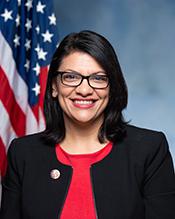
United States · Official source
3,594 records where Rep. Tlaib, Rashida [D-MI-12] is listed as a sponsor, author, or other actor. Search with topics and years
United States · United States Congress · 8 April 2025
United States · United States Congress · 8 April 2025
United States · United States Congress · 8 April 2025
United States · United States Congress · 8 April 2025
United States · United States Congress · 8 April 2025
United States · United States Congress · 7 April 2025
United States · United States Congress · 7 April 2025
United States · United States Congress · 7 April 2025
No Tax Breaks for Union Busting (NTBUB) Act This bill excludes from the tax deduction for ordinary and necessary business expenses amounts paid or incurred to influence employees with respect to labor organizations or labor organization activities. The bill also imposes information reporting requirements related to such expenses and imposes penalties for failure to comply. Under the bill, amounts paid to influence employees with respect to labor organizations include amounts paid (including wages and other costs) in connection with an action that results in a complaint or settlement related to an unfair labor practice or a finding of interference, influence, or coercion related to railway employees’ rights to organize and bargain collectively; for any meeting or training attended by employees and at which labor organizations are discussed; and that require certain employer disclosures and financial reporting. (Some exceptions apply.) The bill requires employers to file a return reporting certain information related to expenses paid to influence employees with respect to labor organizations and imposes a penalty for noncompliance. The amount of the penalty is the greater of (1) $10,000, or (2) $1,000 multiplied by the number full-time equivalent employees. Additional penalties apply for violations that continue for more than 90 days. The bill also imposes information reporting requirements on persons conducting activities on behalf of another person to influence employees with respect to labor organizations. The bill allows certain penalties for noncompliance with the reporting requirements to be waived if noncompliance is due to reasonable cause and not willful neglect.
United States · United States Congress · 7 April 2025
United States · United States Congress · 7 April 2025
United States · United States Congress · 3 April 2025
Federal Firearm Licensee Act This bill establishes new security requirements and expands recordkeeping and reporting requirements for federally licensed dealers, importers, and manufacturers of firearms (i.e., federal firearms licensees, or FFLs). The bill also broadens the authority of the Bureau of Alcohol, Tobacco, Firearms and Explosives (ATF) to administer federal firearms laws and enforce violations. Specifically, bill requires FFLs to implement and comply with a plan to secure their business premises, conduct quarterly physical checks of their business inventories, maintain video surveillance of the area where firearms are sold or transferred, and initiate firearms-related background checks for employees. Additionally, the bill requires FFLs to report to the ATF any inventory firearm that is lost, stolen, or unaccounted for and to notify the ATF about default-proceed transactions (i.e., allowable firearm transfers to an unlicensed person prior to the completion of a background check when the submitted background check remains incomplete after three business days). Finally, the bill removes limits on the ATF's authority to conduct activities related to the administration of federal firearms laws. It enhances the ATF's inspection authority, including by removing the limit on the number of annual compliance inspections (currently, one), requiring inspections of high-risk FFLs, and authorizing an additional 650 investigators. Finally, the bill directs the ATF to deny an application for a federal firearms license if it would endanger public safety or if the applicant is unlikely to comply with the law.
United States · United States Congress · 2 April 2025
United States · United States Congress · 2 April 2025
United States · United States Congress · 2 April 2025
United States · United States Congress · 2 April 2025
United States · United States Congress · 1 April 2025
Workplace Violence Prevention for Health Care and Social Service Workers Act This bill requires the Department of Labor to address workplace violence in health care, social service, and similar sectors. Specifically, Labor must issue an occupational safety and health standard that requires certain employers to take actions to protect workers and other personnel from workplace violence. The standard applies to employers in the health care sector, in the social service sector, and in sectors that conduct activities similar to those in the health care and social service sectors. Among other elements, the standard must require each employer to (1) develop a workplace violence prevention plan, (2) promptly investigate incidents of workplace violence, and (3) provide relevant training and education to employees. The bill requires certain hospitals and skilled nursing facilities to comply with this standard as a condition of Medicare participation.
United States · United States Congress · 1 April 2025
United States · United States Congress · 1 April 2025
Protect America's Workforce Act This bill nullifies the Executive Order titled Exclusions from Federal Labor-Management Relations Programs (issued on March 27, 2025), which excludes specified executive agencies and subdivisions from the Federal Service Labor-Management Relations Statute. The statute authorizes federal employees' participation in collective bargaining and enforces collective bargaining rights. The bill also specifies that a covered collective bargaining agreement in place as of March 26, 2025, shall have full force and effect through the stated term of the agreement.
United States · United States Congress · 1 April 2025
United States · United States Congress · 1 April 2025
Train Noise and Vibrations Reduction Act of 2025 This bill directs the Government Accountability Office to develop and submit to Congress a report containing (1) recommendations to reduce train noise and vibrations near homes, and (2) estimates of the costs and benefits of such recommendations.
United States · United States Congress · 1 April 2025
United States · United States Congress · 1 April 2025
Reentry Act of 2025 This bill allows for Medicaid payment of medical services furnished to an incarcerated individual during the 30-day period preceding the individual's release. The Medicaid and Children's Health Insurance Program (CHIP) Payment and Access Commission must report on specified information relating to the accessibility and quality of health care for incarcerated individuals, including the impact of the bill's changes.
United States · United States Congress · 1 April 2025
United States · United States Congress · 31 March 2025
Hunger-Free Future Act of 2025 This bill prohibits any reevaluation or update to the Thrifty Food Plan (TFP) by the Department of Agriculture (USDA) that results in an increase in food insecurity (i.e., an increase in the number of households that lack adequate food as a result of having insufficient money and other resources to acquire food). As background, USDA created the TFP (the cost of purchasing a nutritionally adequate low-cost diet), which is used to determine maximum monthly benefits under the Supplemental Nutrition Assistance Program (SNAP). USDA calculates the cost of the TFP (i.e., the market basket of goods) each year to account for food price inflation. Under a provision of the 2018 farm bill, USDA must reevaluate the market basket of goods every five years based on current food prices, food composition data, consumption patterns, and dietary guidance.
United States · United States Congress · 31 March 2025
This joint resolution prohibits a proposed foreign military sale of certain defense articles and services to Israel.
United States · United States Congress · 31 March 2025
United States · United States Congress · 31 March 2025
Nutrition Counseling Aiding Recovery for Eating Disorders Act of 2025 or the Nutrition CARE Act of 2025 This bill provides for Medicare coverage of medical nutrition therapy services for individuals with eating disorders. Such services must be furnished by a registered dietitian or nutrition professional pursuant to a referral from a physician, psychologist, or other authorized mental health professional.
United States · United States Congress · 31 March 2025
This joint resolution prohibits a proposed foreign military sale of certain defense articles and services to Israel.
United States · United States Congress · 31 March 2025
United States · United States Congress · 31 March 2025
United States · United States Congress · 31 March 2025
Arts Education for All Act This bill expands arts education and programming for children in early education, K-12 students, and juveniles and adults in the criminal justice system. Specifically, the bill allows Child Care and Development Block Grant funding to be used for additional activities, including arts programming. Additionally, the bill addresses arts programming in elementary and secondary schools by directing each state educational agency to include information on arts programming in its state plan, including how it will integrate arts education instruction into the curriculum and increase the number of arts teachers in schools; requiring state report cards to include information on arts courses; requiring local educational agency (LEA) plans to describe how the LEA will encourage the use of arts education to improve student achievement; and allowing certain funds to be used for professional development for arts teachers. The bill directs the National Center for Education Research to carry out research on the use of arts and arts education in elementary and secondary schools, including in low-performing schools. Further, the National Center for Education Statistics must compile data on arts education. The National Assessment of Educational Progress must include a specified arts assessment. The bill requires a state's juvenile justice and delinquency plan to describe how the state will coordinate services and activities for juvenile justice and delinquency prevention with arts agencies and arts organizations. Additionally, grants for adult offender reentry demonstration projects may be used for facilitating arts education.
United States · United States Congress · 31 March 2025
This joint resolution prohibits a proposed foreign military sale of certain defense articles and services to Israel.
United States · United States Congress · 31 March 2025
Hot Foods Act of 2025 This bill expands the Supplemental Nutrition Assistance Program (SNAP) to permit the use of SNAP benefits to purchase hot foods or hot food products ready for immediate consumption.
United States · United States Congress · 31 March 2025
United States · United States Congress · 31 March 2025
Sarah Katz Caffeine Safety Act This bill establishes labeling and disclosure requirements for caffeinated food, beverages, and supplements. Specifically, the bill requires foods and dietary supplements that contain more than 10 milligrams of caffeine to be labeled with (1) their total caffeine content, (2) a statement of whether the caffeine is naturally occurring or is an additive, and (3) an advisory statement indicating that the recommended daily limit of caffeine for healthy adults is 400 milligrams. Further, in restaurant chains with 20 or more locations, menus must indicate that an item contains high caffeine where the item contains added caffeine and has a total caffeine content of at least 150 milligrams. Restaurants must place the statement “high caffeine” or a similar indication adjacent to the name of a covered item on the menu. This requirement applies to both standard and temporary menu items. For standard menu items, the bill also expands the nutritional information that restaurants must make available to consumers in written form to include the number of milligrams of caffeine in an item. The Food and Drug Administration (FDA) must review the safety of caffeine and other stimulants in food, beverages, and dietary supplements and determine whether caffeine should be generally recognized as safe (GRAS) for healthy adults. (Currently, the FDA considers caffeine as GRAS for cola beverages up to a level of 0.02%.) Finally, the Government Accountability Office must study and report to Congress on the marketing of caffeinated beverages in restaurants, stores, and online.
United States · United States Congress · 31 March 2025
United States · United States Congress · 31 March 2025
United States · United States Congress · 31 March 2025
Alleviating Barriers for Caregivers Act or the ABC Act This bill requires federal agencies to review and modify the administrative processes related to Medicare, Medicaid, the Children's Health Insurance Program (CHIP), and Social Security programs in order to streamline these processes for family caregivers. Specifically, the Centers for Medicare & Medicaid Services (CMS) and the Social Security Administration (SSA) must review processes related to eligibility determinations, applications, forms, and communications for these programs and identify ways to simplify and streamline these processes for family caregivers (e.g., reducing the need for family caregivers to submit the same information for multiple programs). The CMS and SSA must solicit input from family caregivers and state and regional organizations, implement any identified improvements, and report on these efforts to Congress. In addition, the CMS must issue a letter to state Medicaid and CHIP programs that encourages states to conduct a similar review and that provides potential improvements.
United States · United States Congress · 31 March 2025
This joint resolution prohibits a proposed foreign military sale of certain defense articles and services to Israel.
United States · United States Congress · 27 March 2025
Manufactured Housing Tenant's Bill of Rights Act of 2025 This bill requires manufactured home communities and home parks to meet minimum consumer protections to be eligible for certain federally-backed loans for the construction, substantial rehabilitation, or purchase of these communities. Specifically, the Department of Housing and Urban Development is prohibited from insuring such a loan, and Fannie Mae and Freddie Mac are prohibited from purchasing such a loan, unless a borrower provides specified tenant protections, including one-year renewable lease terms, unless there is good cause for nonrenewal; at least a 60-day advance notice of any increase in rent, or of a sale or closure of the community; a five-day grace period for rent payments; and a right for a tenant to sell a manufactured home within a reasonable time period after eviction. The bill sets forth penalties for violations of these protections. The bill also establishes the Manufactured Home Community Lending Standards Commission to propose additional consumer protection standards.
United States · United States Congress · 27 March 2025
United States · United States Congress · 27 March 2025
United States · United States Congress · 27 March 2025
United States · United States Congress · 27 March 2025
United States · United States Congress · 27 March 2025
United States · United States Congress · 27 March 2025
United States · United States Congress · 27 March 2025
United States · United States Congress · 27 March 2025
United States · United States Congress · 27 March 2025
United States · United States Congress · 27 March 2025
No Hungry Kids in Schools Act This bill directs the Department of Agriculture (USDA) to establish an option for states to utilize a statewide Community Eligibility Provision (CEP) for USDA school meal programs. As background, the CEP allows eligible schools, groups of schools, and school districts the option to offer free breakfast and lunch to all enrolled students without collecting household applications. Specifically, USDA must establish a statewide CEP option that may be used by a state agency. The state agency must provide state (nonfederal) funding to local educational agencies to reimburse applicable schools at the free reimbursement rate for 100% of the meals served. Eligibility for the statewide CEP must be based on a statewide calculation of the percentage of identified enrolled students, regardless of a school's local educational agency. Further, the bill lowers the CEP participation threshold for a statewide CEP to an identified student percentage (ISP) of zero, from a minimum of 25% under current regulations. The ISP is the percentage of students who are eligible for free school meals without a household application, primarily those who are directly certified through the Supplemental Nutrition Assistance Program (SNAP). In addition, the bill specifies that the reimbursement multiplier for school meals remains at the current level of 1.6. The reimbursement multiplier is used to calculate how many meals will be reimbursed at the free meal rate.