Law· HJRESH.J.Res. 168 (98th)enacted
A joint resolution to designate the week beginning May 27, 1984, as "National Tourism Week".
United States · United States Congress · 2 March 1983
Designates the week of May 29, 1983, as National Tourism Week.
The world's political record
Person
United States · Official source
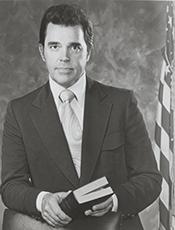
2,329 records where Rep. Applegate, Douglas [D-OH-18] is listed as a sponsor, author, or other actor. Search with topics and years
United States · United States Congress · 2 March 1983
Designates the week of May 29, 1983, as National Tourism Week.
United States · United States Congress · 1 March 1983
Amends the National Labor Relations Act to authorize the Secretary of Labor to prohibit the awarding of Federal contracts to persons who have violated certain judicial orders or orders issued by the National Labor Relations Board. Limits the period of such ban to not more than three years after the Secretary has certified the identify of such person to the Comptroller General. Permits the awarding of Federal contracts to such person during the period of the ban if the Federal agency or department, after notice and opportunity for hearing to all interested parties, certifies to the Secretary that there is no other source for the material or services furnished by such person.
United States · United States Congress · 28 February 1983
Designates the square dance as the national folk dance of the United States.
United States · United States Congress · 24 February 1983
Railroad Retirement Solvency Act of 1983 - Title I: Benefit Adjustments - Amends the Railroad Retirement Act of 1974 to make certain disabled railroad employees eligible for disability insurance benefits under the Social Security Act. Sets forth formulas for determining annuities for certain individuals who retire before the age of 62. Sets forth the annuity formulas for spouses of such individuals and spouses of disabled employees. Makes such annuities comparable to benefits payable under the Social Security Act. Revises the computation of railroad annuities with respect to cost-of-living adjustments made under the Social Security Act. Changes annuity beginning dates to conform to such dates under such Act. Eliminates post-secondary school students from eligibility for survivors' annuities. Repeals certain provisions to preserve the financial solvency of the Railroad Retirement Act. Title II: Revenue Increases - Amends the Internal Revenue Code to increase the tier II tax on railroad employees, employers, and employee representatives and to extend such tax from July 1, 1984, until June 30, 1986. Provides for adjustments of such tax rates after July 1, 1986, depending upon the tier II benefit deficit and the average Railroad Retirement Account balance requirements imposed by this Act. (Defines "tier II benefit" as benefits paid from the Railroad Retirement Account other than social security equivalent benefits). Requires that social security equivalent benefits of railroad employees be taxed like social security benefits, and that tier II benefits be taxed as benefits received under employer plans. Provides for the transfer of revenue increases to the Railroad Retirement Account. Title III: Borrowing Authority Adjustments - Directs the Secretary of the Treasury to transfer to the Railroad Retirement Account from the general fund such amounts as are determined necessary by the Railroad Retirement Board after the end of each month beginning in October 1983. Amends the Railroad Unemployment Insurance Act to authorize advances to the railroad unemployment insurance account from the Federal unemployment account in the Unemployment Trust Fund. Requires an advance to the railroad unemployment insurance account in an amount sufficient to repay amounts due the Railroad Retirement Account. Title IV: Other Amendments - Changes the maximum percentage of amounts that may be transferred from the Railroad Retirement Account to the Dual Benefits Payments Account to such amount as determined necessary by the Board to pay dual benefits for a particular month. Provides for the transfer of amounts owed to the Railroad Retirement Account for unfunded dual benefits previously paid. Makes technical and conforming amendments.
United States · United States Congress · 24 February 1983
Authorizes the Secretary of the Army, acting through the Chief of Engineers, to construct a shoreline protection project for Maumee Bay State Park, Lake Erie, Ohio. States the non-Federal share of the cost of such project.
United States · United States Congress · 23 February 1983
Amplitude Modulated Broadcast Station Experiment Act of 1983 - Directs the Federal Communications Commission to: (1) conduct an experiment to test the feasibility of establishing extended broadcasting hours for amplitude modulated broadcast radio stations having only daytime operating licenses; and (2) report the results of the experiment to Congress.
United States · United States Congress · 23 February 1983
Modified Dairy Price Support Program - Amends the Omnibus Budget Reconciliation Act of 1982 to repeal the 50-cent milk producer assessments. Decreases milk price supports from $13.10 per hundredweight to $12.10 per hundredweight for the period from April 1, 1983 through September 30, 1984. Permits increases of up to $1 if Commodity Credit Corporation (CCC) purchases fall below specified levels. Bases milk supports on a parity formula (sliding scale of 61 to 83 percent of parity based on CCC purchase estimates) as of October 1, 1984. Sets Class I milk prices (3.5 percent milk fat) at not less than $12.56, as of April 1, 1983, or enactment of this Act.
United States · United States Congress · 22 February 1983
Repeals provisions of the Internal Revenue Code relating to the reporting by employers of tips in the case of certain food and beverage establishments.
United States · United States Congress · 15 February 1983
Natural Gas Import Policy Act of 1983 - Suspends an order issued under the Natural Gas Act authorizing the importation of natural gas unless: (1) the price and terms of the applicable import contract have been renegotiated to be responsive to current market prices and demand; and (2) the renegotiated contract and tariff adjustments have been filed with the Secretary of Energy and the Federal Energy Regulatory Commission (FERC). Provides that in the case of any terminal or attendant facility located in the United States and constructed for the importation of Algerian natural gas (the authority for which is suspended by this Act), FERC shall permit recovery of the costs prudently incurred in connection with the construction of such facility to the same extent and in the same manner as if such facility were used and useful for the importation and transportation of natural gas (without regard to the suspension under this Act of importation authority). Prohibits FERC from permitting any rate of return on such costs. Includes "liquefied natural gas" within the term "natural gas" for purposes of this Act.
United States · United States Congress · 10 February 1983
Veterans' Education Assistance Act of 1983 - Establishes a new educational assistance program for the all-volunteer force. Excludes graduates of service academies from eligibility for such assistance. Entitles veterans who are graduates of a secondary school and who have served in the armed forces on continuous active duty for at least three years to basic educational assistance. Entitles veterans of the Selected Reserve who are graduates of secondary school and who have served at least two years of continuous active duty in the armed forces and at least four years of continuous duty in the Selected Reserve to basic educational assistance. Sets forth the formula for determining the length of such assistance based on the length of time served. Entitles such veterans to a monthly assistance allowance of $200 for a full-time approved program of education. Permits the Secretary concerned to establish a higher rate of assistance, but not more than $400 a month, for individuals possessing a skill or specialty designated as being in critical shortage. Permits enrollment, if eligible, in a program of education while an individual continues to perform his duties. Entitles veterans who have served five or more consecutive years of active duty in addition to those required for basic educational assistance to supplemental educational assistance. Entitles veterans of the Selected Reserve who have served two or more consecutive years of active duty and four or more consecutive years of duty in the reserves in addition to that required for basic educational assistance to supplemental educational assistance. Entitles such veterans to a monthly supplemental assistance allowance of $100 a month. Permits the provision of assistance at a higher rate, but not more than $300 monthly, to any individual entitled to basic educational assistance who has a skill or specialty in which there is a critical shortage of personnel. Permits the Secretary of Defense to authorize specified individuals to transfer to a dependent part or all of such individuals' entitlement to educational assistance. Sets forth the conditions under which transferred benefits may be provided. Establishes a ten year delimiting period for educational assistance. Excludes time spent as a prisoner of war subsequent to discharges and time spent physically or mentally disabled. Limits educational assistance to individuals being furnished subsistence to the amount an institution would charge similarly circumstanced nonveterans. Prohibits participation in more than one program of educational assistance. Allocates the administration and costs of such programs to the Veterans Administration, the Department of Transportation, and the Department of Defense Education Benefits Fund. Requires the Secretary of Defense and the Administrator to submit to Congress a biennial report on the operations of such programs. Amends the Post-Vietnam Era Veterans' Educational Assistance Act of 1977 to terminate the right to enroll in the Post-Vietnam Era Veterans' Educational Assistance Program after December 31, 1981. Directs (rather than permits) the Secretary of each military department to establish a program to provide educational assistance to members of the Selected Reserve who agree to remain in such Reserve for at least six years. Sets forth the amount of such assistance. Requires that such assistance be given for pre-degree work at an institution of higher learning. Sets forth further eligibility requirements for such assistance. Establishes a delimiting period of ten years from the date of entitlement or from the date of separation from service, whichever comes first. Prohibits the provision of assistance to any member already receiving assistance as a member of the Senior Reserve Officers' Training Corps program or a member who fails to perform satisfactorily in training. Expands the penalties for failure to participate satisfactorily in such program to include orders to active duty. Designates the Veterans Administration to administer such program. Directs the Secretary of Defense to report to Congress annually rather than quarterly on its operation. Establishes in the Treasury a Department of Defense Education Benefits Fund to be administered by the Secretary of the Treasury for the accumulation of funds to finance Department education liabilities on an actuarially sound basis. Directs the Secretary of the Treasury to transfer amounts from the Fund to the Administrator of Veterans Affairs and to the Secretary of Defense as necessary to make required payments. Establishes in the Department of Defense a Department of Defense Education Benefits Board of Actuaries to: (1) report annually to the Secretary on the actuarial status of the Fund; (2) report not less than every four years to Congress and the President on the valuations and status of the fund; and (3) determine the present value of future benefits payable from the Fund. Directs the Secretary to: (1) make periodic actuarial valuations of the educational programs; (2) determine an amortization methodology and schedule for the liquidation of gains or losses to the Fund; and (3) determine the amount necessary to be appropriated for the Fund for each fiscal year. Sets forth other terms and conditions for administering such Fund. Permits the Secretary concerned to grant an eligible member a leave of absence of not more than two years for such member to pursue a program of education. Sets forth the terms and conditions for such leave. Requires the Secretary concerned to provide individual predischarge counseling which includes a discussion of educational benefit entitlements.
United States · United States Congress · 10 February 1983
World War I Veterans Special Pension Program Act of 1983 - Directs the Administrator of Veterans Affairs to pay (in addition to any pension already paid) a monthly pension of $150 to each veteran of World War I who meets specified service and income requirements.
United States · United States Congress · 10 February 1983
Acidic Deposition Study and Ecosystem Mitigation Act - Amends the Clean Air Act to provide for a program of acidic deposition analysis and mitigation. Directs the Administrator of the Environmental Protection Agency to study and report, within the five-fiscal- year period following the submission of the final comprehensive research plan under the Acid Precipitation Act of 1980, on acidic deposition to specified congressional committees. Sets forth required inclusions and procedures for such report. Authorizes the Administrator to make grants to any State or interstate agency to develop and implement on-site methods of mitigating the harmful effects on ecosystems resulting from high acidity which may be due to acidic deposition. Limits such grants to 75 percent of project costs. Authorizes appropriations to the Administrator for the five fiscal years following the enactment date of this Act for the preparation of such report and the making of such grants.
United States · United States Congress · 10 February 1983
Increases the survivors' benefits for surviving spouses and children of veterans of a period of war.
United States · United States Congress · 10 February 1983
Increases from $60 to $75 the amount of military pension a veteran without dependents being furnished domiciliary care by the Veterans Administration may receive.
United States · United States Congress · 10 February 1983
Requires a presumption of service connection for veterans with syringomyelia developed to a ten percent or greater degree of disability within seven years after separation from active wartime service for purposes of veterans' disability compensation.
United States · United States Congress · 10 February 1983
Includes the service-connected loss or loss of use of a kidney or lung among the conditions for which war veterans may receive additional monthly disability compensation.
United States · United States Congress · 8 February 1983
National Commission on the Improvement of America's Infrastructure Act of 1983 - Establishes the National Commission on the Improvement of America's Infrastructure to conduct an inventory of existing major public improvements by major city, region, and State. Includes among major public improvements bridges, highways, roads, railroads, airports, mass transit systems, locks and dams, water systems, and sewer systems. Requires the Commission to develop a National Public Improvements Plan, based on such inventory, which ranks all major public improvements on the basis of need for replacement or major repair. Requires the inclusion in such plan of recommendations with respect to: (1) financing such replacement or repair and routine maintenance; and (2) necessary changes in Federal, State, or local laws to sustain national economic development or to achieve equity among regions in the quality of major improvements. Sets forth procedures for the submission of such plan to the President and Congress. Terminates the Commission the day after it submits such plan. Authorizes appropriations.
United States · United States Congress · 8 February 1983
Critical Waterways Improvement Act of 1983 - Directs the Secretary of the Army, acting through the Chief of Engineers, to construct: (1) a lock and dam (to be called Grays Landing) to replace lock and dam numbered 7, Monongahela River, Pennsylvania; and (2) a lock and abutment (to be called Point Marion lock) to replace the lock and abutment at lock and dam numbered 8, Monongahela River, Pennsylvania. Requires construction of such projects to be carried out on an expedited basis and according to specified recommendations. Authorizes and directs the Secretary, acting through the Chief of Engineers, to rehabilitate the Gallipolis Dam and to replace the Gallipolis locks on the Ohio River, Ohio and West Virginia, according to specified recommendations. Directs the Secretary to mitigate fish and wildlife habitat losses resulting from such construction by purchasing, at Federal expense, specified land. Authorizes the Secretary to transfer such land to the State of West Virginia for operation and maintenance. Authorizes the Secretary, acting through the Chief of Engineers, to construct a specified multipurpose lock and dam project to replace the William Bacon Oliver lock and dam, Black Warrior River, Alabama. Authorizes the Secretary, acting through the Chief of Engineers, to replace the Winfield locks on the Kanawha River, West Virginia. Establishes procedures for the submission of final environmental impact statements to Congress for the navigation projects authorized by this Act. Sets forth procedures concerning the judicial review of such environmental impact statements. Authorizes appropriations.
United States · United States Congress · 8 February 1983
Amends the Federal-State Extended Unemployment Compensation Act of 1970 to revise State trigger provisions to provide that extended benefits will be payable in any State in which the seasonally adjusted rate of regular unemployment averaged seven percent or more for the most recent three calendar months for which data are available. Permits States to pay extended benefits on the basis of area triggers.
United States · United States Congress · 8 February 1983
Increases from 50 to 60 the maximum number of associate members of the Board of Veterans' Appeals in the Veterans Administration.
United States · United States Congress · 8 February 1983
Designates the week beginning September 25, 1983, as National Adult Day Care Center Week.
United States · United States Congress · 7 February 1983
Domestic Commodity Assistance Act of 1983 - Requires the Secretary of Agriculture to distribute surplus Commodity Credit Corporation (CCC) stocks to eligible agencies (as defined in this Act). Requires the CCC to pay for commodity processing with funds or with in-kind payments to the processor. Requires the Secretary to publish an annual announcement of such anticipated surplus stocks for the coming three-year period. Provides that up to 2,000,000 metric tons of wheat available under the Food Security and Wheat Reserve Act of 1980 may be used for domestic purposes. Requires the CCC to use any additional reserves to replenish such stocks. Provides for State distribution of commodities under this Act. States that if a State agency cannot meet the requests for a given commodity such agency shall give special consideration to organizations that serve low-income and unemployed persons. Requires the Secretary and the States to work with private companies and recipient agencies to make it easier for recipients to process such commodities into end use products. Directs the Secretary to use moneys saved on storage and spoilage to process commodities into food products for agencies serving low-income and unemployed persons.
United States · United States Congress · 7 February 1983
Appropriates otherwise unappropriated Treasury funds for FY 1983 for agricultural commodity distribution among the States under the Community Services Block Grant Act. Sets forth a distribution formula based on unemployed and poverty-level persons and FY 1982 agricultural distributions. Permits unused funds to be used for food programs for unemployed and low-income people.
United States · United States Congress · 7 February 1983
Expresses the sense of Congress that the Administrator of Veterans Affairs should be a member of and full participant in all activities of the Cabinet.
United States · United States Congress · 3 February 1983
United States Academy of Peace and Conflict Resolution Act - Establishes the United States Academy of Peace and Conflict Resolutions as an independent nonprofit corporation. Permits the Academy to use "United States" or "U.S." or any other reference to the United States Government or Nation in its title, corporate seal, emblem, or other mark of recognition in any fiscal year only if there is an authorization of appropriations for the Academy for such fiscal year provided by law. Sets forth the powers and the duties of the Academy, including establishment of an Endowment of the United States Academy of Peace and Conflict Resolution. Authorizes the Academy to: (1) conduct research on the causes of war and the elements of peace; (2) provide peace education and research programs; (3) conduct training in conflict resolution; (4) disseminate information on peace learning; (5) establish a Center for International Peace; and (6) establish a United States Medal of Peace and other medals or honors. Authorizes the Academy to refuse research requests of Federal agencies for reason of cost or of inappropriateness to the Agency's purpose or independence. Prohibits the Academy from undertaking to influence the passage or defeat of any Federal, State, local, or United Nations legislation, but permits Academy personnel to testify or make other appropriate communication when formally requested to do so by a legislative body, committee, or member thereof. Provides for appointment of members of the Academy's Board of Directors. Sets forth grounds for removal of Board members. Permits Board meetings to be closed only in exceptional circumstances. Sets forth provisions for Academy officers, employees, procedures, and records. Provides that, with certain exceptions, the Academy shall not be considered a department, agency, or instrumentality of the Government. Prohibits the use of any political test or political qualification with respect to personnel actions of the Academy or financial assistance by the Academy. Authorizes appropriations in a specified amount for an Academy principal office capitalization fund. Authorizes appropriations in specified amounts for FY 1984 and 1985 for Academy programs and administration. Requires that Academy expenses in connection with the United States Medal of Peace or the accompanying cash award be paid out of the private funds of the Endowment. Restricts contract-making authority under this Act to the extent and amounts provided in appropriation Acts. Directs the Chairman of the Board of Directors of the Academy to report to the Congress and the President, beginning two years after the enactment of this Act and at two-year intervals thereafter. Directs the President to transmit to the Congress the recommendations of the appropriate Federal agencies with respect to such report and to any legislation concerning the Academy. Requires the appropriate congressional committees to hold hearings to review such report and recommendations.
United States · United States Congress · 3 February 1983
Federal Capital Investment Budget Act of 1983 - Amends the Budget and Accounting Act, 1921 to require the President to include with each Budget submitted on or after January 1, 1984, a special analysis for the ensuing fiscal year which shall identify and summarize for each function, category, agency, and program in the Budget the amount of appropriations and expenditures which may be classified as public infrastructure investments. Sets forth other information to be included in such analysis. Requires the President also to include with each Budget, on or after January 1, 1985, a capital investment budget which shall identify by State the amount of appropriations and expenditures classifiable as public infrastructure investments. Declares that any appropriation or expenditure shall be classified as a public infrastructure investment to the extent that it will be used for the construction, rehabilitation, or repair of any civilian public facility in the United States. Amends the Public Works and Economic Development Act of 1965 to require the Economic Development Administration to prepare an inventory of civilian public facilities in the United States and an assessment of their physical condition. Requires the Secretary to make a report of such inventory and assessment to Congress not later than January 1, 1985, and to update such report annually.
United States · United States Congress · 3 February 1983
Competitive Shipping and Shipbuilding Act of 1983 - Requires that, by 1984, five percent of all bulk cargoes imported into or exported from the United States by water be carried on U.S.-flag ships. Requires yearly one percent increases until the percentage of bulk cargoes carried on U.S.-flag ships reaches 20 percent. Provides for credit to importers and exporters for the use of U.S.-flag ships for the transportation of bulk cargoes between foreign ports. Authorizes the Secretary of Transportation to provide relief from the requirements of this Act upon a finding that U.S.-flag ships are not available within guideline rates. Sets forth factors which the Secretary shall consider in determining the extent of relief granted. Requires the Secretary to establish and publish guideline rates for the carriage of bulk cargoes subject to this Act. Requires the Secretary to assure that such rates take into account certain objectives. Requires the Secretary, in order to establish guideline rates, to estimate the current cost of operating U.S.-flag ships in the foreign bulk trades of the United States and of constructing such ships. Requires such cost estimates to be published within six months after enactment of this Act. Requires such estimates to be revised annually. Requires that such rates: (1) be reviewed and adjusted at least annually; (2) not reflect costs greater than the estimated current costs; and (3) be the maximum rates which may be charged for the charter of U.S.-flag ships for the transportation of bulk cargoes governed by this Act. Requires the Secretary to establish and publish interim guideline rates in the first calendar year following the enactment of this Act. Sets forth factors to be taken into account in determining such rates. Requires the Secretary to appoint and consult with an advisory committee to establish and review U.S.-flag ship operating costs, shipyard construction costs, guideline rates, and regulations. Requires anyone engaged in importing or exporting bulk commodities in U.S. foreign commerce whose business volume exceeds $1,000,000 annually to report to the Secretary on the percentages of such person's exports and imports carried on U.S. flag ships. Requires anyone who fails to transport the required percentage of U.S. bulk cargoes to use exclusively U.S. flag ships until the deficiency has been recouped, unless Secretarial relief has been granted. Establishes civil penalties for violations of this Act. Sets forth procedures for the investigation, prosecution, and judicial review of violations of this Act.
United States · United States Congress · 3 February 1983
Declares that the presidential certification submitted to the Congress with respect to sending military aid to El Salvador is null and void. Directs the President to immediately suspend such assistance. Requires the suspension to remain in effect during 1983. Prohibits the President from making another such certification until Congress enacts a joint resolution declaring that El Salvador has met specified conditions.
United States · United States Congress · 2 February 1983
Grants a Federal charter to the Catholic War Veterans of the United States of America, Incorporated.
United States · United States Congress · 2 February 1983
Housing Finance Opportunity Act of 1983 - Amends the Internal Revenue Code of 1954 to permit the continued issuance of tax-exempt (interest excluded from gross income) mortgage revenue bonds after December 31, 1983.
United States · United States Congress · 2 February 1983
Fair Practices in Automotive Products Act - Sets forth for all motor vehicle manufacturers which produce over 100,000 motor vehicles for ultimate retail sale in the United States "minimum domestic content ratios" (the domestic value, including labor and parts, of the manufacturer's production costs of all automotive products sold in the United States). Requires all vehicle manufacturers producing more than 100,000 motor vehicles for sale in the United States to provide information to the Secretary of Transportation for the purpose of administering this requirement. Establishes penalties for a vehicle manufacturer who fails to meet the minimum domestic content ratio. Directs the Secretary of Transportation and the Federal Trade Commission to investigate and prepare a written report regarding policies and practices of vehicle manufacturers used to persuade U.S. motor vehicle dealers to favor foreign made parts rather than domestically produced parts.
United States · United States Congress · 2 February 1983
Amends the Export Administration Act of 1979 to exempt from the termination provisions of such Act provisions relating to the export of domestically produced crude oil.
United States · United States Congress · 2 February 1983
Designates February 1984 as American History Month.
United States · United States Congress · 2 February 1983
Expresses the sense of the Congress that funding for community service employment programs for senior citizens under title V of the Older Americans Act of 1965 for FY 1984 and subsequent fiscal years should be provided at levels sufficient to maintain or increase the number of employment positions provided under such programs.
United States · United States Congress · 1 February 1983
Directs the Administrator of Veterans Affairs to establish an Advisory Committee on Women Veterans to advise the Administrator or on the administration of benefits for and needs of women veterans. Directs Committee to report annually to the Administrator on the activities of the Veterans Administration pertaining to women, together with assessments of needs and recommendations for future action. Directs the Administrator to submit such report to Congress.
United States · United States Congress · 1 February 1983
Grants a Federal charter to the National Association of State Directors of Veterans' Affairs, Incorporated.
United States · United States Congress · 1 February 1983
Amends the Surface Mining and Reclamation Act of 1977 to permit a registered professional land surveyor (in addition to an engineer or geologist) to prepare and certify maps or plans for use in an application for a surface coal mining and reclamation permit.
United States · United States Congress · 31 January 1983
Amends the Tax Equity and Fiscal Responsibility Act of 1982 to delay the effective date of provisions requiring the withholding of tax on interest and dividends until 1984. Repeals provisions authorizing the Secretary of the Treasury to delay the application of such provisions for certain payors.
United States · United States Congress · 27 January 1983
Amends the Highway Revenue Act of 1982 to repeal: (1) the 12 percent retail tax on heavy trucks and trailers; (2) the increase in the heavy truck highway use tax; and (3) the increase in the excise tax on heavy tires. Amends the Internal Revenue Code to extend the ten percent manufacturers excise tax on trucks until 1988. Increases the excise tax on diesel fuel from nine cents per gallon to 12 cents per gallon. Sets the rate of tax on tires at 9.75 cents per pound in excess of 40 pounds. Repeals the 1984 floor stocks tax on tires.
United States · United States Congress · 27 January 1983
Urges the United States Postal Service to issue a postage stamp commemorating members of the uniformed services who have been prisoners of war or missing in action especially those missing as a result of the conflict in Southeast Asia.
United States · United States Congress · 26 January 1983
American Conservation Corps Act of 1983 - Directs the Secretary of the Interior, in cooperation with the Secretary of Agriculture, to establish and administer a public lands conservation, rehabilitation, and improvement program called the American Conservation Corps. Requires the Secretary to provide assistance to program agencies (any Federal or State agency responsible for the management of public lands) to establish and operate residential and nonresidential conservation centers to implement program projects. Describes the types of projects which will receive program preference. Limits program projects to those on public lands or Indian lands, except where projects on nonpublic lands provide documented public benefits. Sets forth requirements for establishing conservation centers and eligibility criteria for enrollees in the program. Makes persons eligible for enrollment and employment in the program if they are: (1) unemployed; (2) between the ages of 16 and 25 years; and (3) citizens, lawful permanent residents, or lawfully admitted alien parolees or refugees. Provides that, in the selection of enrollees for the program, preference shall be given to economically, socially, physically, and educationally disadvantaged youth and youth residing in areas having substantial unemployment. Requires program agencies to provide services, facilities, supplies, and equipment for conservation centers as the Secretary deems necessary. Authorizes the Secretary to award grants to, or enter into agreements with, program agencies for the funding and operation of conservation centers. Authorizes appropriations for FY 1983 through 1989. Requires that such appropriations come from specified Treasury receipts. States that program enrollees shall not be deemed Federal employees, except for certain purposes. Directs the Secretary to establish pay rates and to coordinate the program with related Federal, State, local, and private activities. Directs the Secretary to submit a report to Congress, within one year of enactment of this Act, on the feasibility of allowing enrollees who have completed two years in the program an exemption from training and service under the Military Selective Service Act. Directs the Secretary to make arrangements with educational institutions to award academic credit to enrollees for competencies developed under this Act. Authorizes program agencies to make arrangements with such institutions for academic study by enrollees during nonworking hours. Requires program agencies to provide certification of skills acquired by program participants and to provide job guidance and placement information as necessary. Directs the Secretary to submit an annual report to the President and Congress detailing the activities carried out under this Act. Entitles to an appeal to the Merit Systems Protection Board any Federal employee displaced rightly or wrongly by activities under this Act. Grants similar appeal rights to the employees of any contract grantee similarly displaced.
United States · United States Congress · 26 January 1983
Confers U.S. citizenship on Corporal Wladyslaw Staniszewski, posthumously.
United States · United States Congress · 26 January 1983
Amends the Fair Labor Standards Act of 1938 to prohibit the employment of any blind person, or person with impaired sight, at less than the applicable minimum wage under such Act.
United States · United States Congress · 26 January 1983
Social Security Benefit Termination Reform Act of 1982 - Amends title II (Old Age, Survivors and Disability Insurance) of the Social Security Act to provide that monthly insurance benefits shall be paid for the month in which a beneficiary dies. Requires that the amount of such benefits be proportionate to the number of days of such month preceding the date of the beneficiary's death.
United States · United States Congress · 26 January 1983
Directs the President to designate the week beginning February 13, 1983, as Big Brothers/Big Sisters Appreciation Week.
United States · United States Congress · 26 January 1983
Authorizes and requests the President to designate the week beginning March 11, 1984, as National Surveyors Week.
United States · United States Congress · 26 January 1983
Authorizes and requests the President to designate the week commencing with the third Monday in February of 1983 as National Patriotism Week.
United States · United States Congress · 25 January 1983
Temporary Natural Gas Market Correction Act of 1982 - Declares that any contract for the first sale of natural gas shall be deemed to include a volume adjustment option with respect to any natural gas the first sale delivery of which could occur pursuant to such contract at any time after the effective date of this Act and before November 1, 1983. Defines a volume adjustment option as a contract provision under which the purchaser may elect to refuse to take delivery under such contract of any volume of natural gas without incurring an obligation to pay any fee or charge with respect to the natural gas not delivered pursuant to such election. Provides, subject to certain exceptions, that the purchase by any natural gas pipeline company of any natural gas which is delivered on any day after the effective date of this Act and before November 1, 1983, at an excessive price shall be considered as fraud, abuse, or similar grounds for purposes of the Federal Energy Regulatory Commission (FERC) reviewing cost passthroughs. Considers the price of natural gas delivered to any natural gas pipeline company on any day excessive if that price exceeds the price of any other natural gas not delivered to such pipeline company on that day but which could have been acquired by such pipeline company for delivery on that day under any contract to which the pipeline is a party. Requires every natural gas pipeline company to file monthly with FERC: (1) a statement concerning the volume adjustment clause, as well as steps it has taken to achieve the lowest possible weighted average acquisition cost of natural gas; and (2) a modification of the costs to be recovered by the pipeline under a purchased gas adjustment clause (as defined in the Natural Gas Act), if the weighted average acquisition cost of natural gas by the pipeline is lower because of the volume adjustment option or because of other steps taken by the pipeline.
United States · United States Congress · 25 January 1983
Prohibits the removal of an area from wilderness study area status on the grounds that such area comprises less than 5,000 contiguous acres if such area is: (1) contiguous with land formally determined to have wilderness or potential wilderness values; (2) contiguous with an area of less than 5,000 acres administered by an agency authorized to study and preserve wilderness areas, and the combined total of the two areas is 5,000 acres or more; or (3) subject to strong public support for wilderness identification and is of a size practicable and suitable for wilderness management. Prohibits the removal of an area designated as a wilderness study area before December 31, 1981, from wilderness study area status: (1) on the grounds that such area lacks the requisite wilderness characteristics if it may possess such characteristics when considered in association with contiguous lands administered by an agency other than the Bureau of Land Management; or (2) on the grounds that such area overlays nonfederally-owned mineral rights. Prohibits the Secretary of the Interior from modifying or revoking the inventory of public lands subject to review and designation as wilderness under the Federal Land Policy and Management Act of 1976 without express congressional approval.
United States · United States Congress · 25 January 1983
Declares it to be the policy of the Government that: (1) Federal procurement should be accomplished on a competitive basis wherever possible through the General Services Administration (GSA); (2) the use of multiple award schedules should be restricted to cases where competitive single awards are not feasible, sales volume justifies centralized procurement, and a valid need exists for functionally similar items with different prices and features; and (3) where the volume of products purchased is too low to provide a price advantage and commercial "off-the-shelf" products can be substituted for products designed to Government specifications, individual agencies should purchase items locally subject to review by GSA. Directs the Administrator of GSA to implement such policy, the recommendations on procurement contained in the Comptroller General's report of May 2, 1979, and the policy statement prepared by the Office of Acquisition Policy in response to such report. Directs the Administrator, within 60 days after enactment, to issue transitional regulations governing purchases from any multiple award schedule. Requires that such regulations: (1) include the requirement that whenever any agency procurement officer or employee determines that an item in such a schedule is available from a commercial source in the area at a lower cost and under conditions which are no less favorable to the Government than is the case under the schedule, the item shall be purchased from that source; and (2) establish procedures for the audit and review of any such purchase and the enforcement of such regulations by GSA. Repeals such regulations on the effective date of the regulations which are issued to implement the procurement policy declared by this Act and which apply to any item on a multiple award schedule. Requires the Administrator to submit to Congress periodic reports on actions taken, and legislation needed, to carry out this Act.