Bill· HRH.R. 8200 (93rd)referred
A bill to deauthorize permanently the recently halted Cross-Florida Barge Canal.
United States · United States Congress · 29 May 1973
Deauthorizes halted Cross-Florida Barge Canal, authorized by Federal law.
The world's political record
Person
United States · Official source
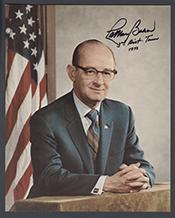
164 records where Rep. Baker, LaMar [R-TN-3] is listed as a sponsor, author, or other actor. Search with topics and years
United States · United States Congress · 29 May 1973
Deauthorizes halted Cross-Florida Barge Canal, authorized by Federal law.
United States · United States Congress · 23 May 1973
Disaster Preparedness and Assistance Act - Title I: Findings, Declarations, and Definitions - Sets forth Congressional findings, declaration of purpose and the definitions of the terms used in this Act. Title II: Disaster Assistance Administration - Provides that all requests for disaster assistance from the Federal Government under this Act shall be made by the Governor of the affected State. Authorizes the President to coordinate, in such manner as he may determine, the activities of all Federal agencies providing disaster assistance. Authorizes any Federal agency charged with the administration of a Federal assistance program, if so requested by the applicant State or local authorities, to modify or waive, for the duration of a major disaster, such administrative procedural conditions for assistance as would otherwise prevent the giving of assistance under such programs if the inability to meet such conditions is a result of the disaster. Provides that the Federal Government shall not be liable for any claim based upon the exercise or performance of or the failure to exercise or perform a discretionary function or duty on the part of a Federal agency or an employee of the Federal Government in carrying out the provision of this Act. Provides that any individual willfully violating any order or regulation under this Act shall be fined not more than $10,000 or imprisoned for not more than one year or both for each violation. States that any individual who violates any order or regulation under this Act shall be subject to a civil penalty of not more than $5,000 for each violation. Provides that whoever wrongfully misapplies the proceeds of a loan or other cash benefit obtained under any section of this Act shall be civilly liable to the Federal Government in an amount equal to one and one-half times the original principal amount of the loan or cash benefit. Title III: Emergency Assistance - Sets forth the presidential authority in providing emergency disaster assistance. States that emergency work or services for purposes of this Act shall not extend beyond thirty days following the President's initial determination that emergency services are required, except that this limitation may be waived by the President where he deems extraordinary circumstances warrant such waiver. Title IV: Disaster Loans - Authorizes the President to make or guarantee disaster loans to individuals, business concerns, and other legal entities in a major disaster area to replace, restore, or repair private property damaged or lost in the disaster, to the extent it is not covered by insurance. Authorizes the President to make or guarantee loans to small business concerns for working capital and operating expenses, to the extent that a major disaster has created a need for such loans. Authorizes the President to make or guarantee disaster loans to any industrial, commercial, agricultural, governmental, or other enterprise that has constituted a major source of employment in an area suffering a major disaster and is no longer in substantial operation as a result of such disaster. Authorizes the President to make disaster loans to any local government that demonstrates a need, as a result of a major disaster, of financial assistance in order to perform its governmental functions. States that the amount of any such disaster loan shall be based on need, and shall not exceed 10 percent of the annual operating budget of that local government. Sets forth the terms and conditions for such loans. Creates within the Treasury a separate fund which shall be available to the President without fiscal year limitation as a revolving fund for the purpose of this Act. Authorizes to be appropriated to the fund from time to time such amounts as may be necessary for the fund. Title V: Disaster Grants for Needy Families - Authorizes the President to make a grant to any State in a major disaster area for the purpose of assisting the State in indemnifying the uninsured property losses of needy families, and thereafter, to aid such families in meeting such other extraordinary disaster-related expenses as the State may recognize. States that the amount of such grant shall be determined by the President on the basis of evidence supplied by the Governor of the affected State as to the number of low-income families affected by the disaster; but the grant to the State shall not exceed an amount equal to $3,000 per low-income family. Provides that the actual disbursement of the funds made available to the State under this Act shall be made by the Governor or his designated representative according to eligibility requirements to be determined by the Governor or his designated representative. States that no family shall receive payments under this Act in excess of $4,000. Title VI: Grants to States - Authorizes the President to make grants to States for the benefit of persons or parties adversely affected by a major disaster, for the following purposes: (1) provision of essential human needs and services, including but not limited to food, communications, water, clothing, utility services, and public transportation; (2) replacement, restoration, repair, or construction of specified facilities; and (3) debris and timber removal from public or private lands and waters, when in the public interest. States that the amount of funds to be granted under this Act shall be based upon 75 percent of the estimated cost of relief for losses sustained as a result of the major disaster in the categories of assistance specified in this Act. Sets forth the administrative operation for such grants. Title VII: Disaster Preparedness Assistance - Authorizes the President to establish a program of disaster preparedness that utilizes services of all appropriate agencies. States that upon application by the States, the President is authorized to make grants, not to exceed $250,000, for the development of plans, programs, and capabilities for disaster preparedness. Provides that such grants shall be available for a period of one year from the date of enactment. Title VIII: Miscellaneous Provisions - States that as a condition of any disaster loan or grant made under the provisions of this Act, the recipient shall agree that any repair or construction to be financed therewith shall be in accordance with applicable standards of safety, decency, and sanitation and in conformity with applicable codes, specifications, and standards, and shall furnish such evidence of compliance with this Act as may be required by regulation. Provides where an existing timber sale contract between the Secretary of Agriculture or the Secretary of the Interior and a timber purchaser does not provide relief from major physical change not due to negligence of the purchaser prior to approval of construction of any section of specified road or of any other specified development facility and, as a result of a major disaster, a major physical change results in additional construction work in connection with such road or facility by such purchaser with an estimated cost, as determined by the appropriate Secretary, (1) of more than $1,000 for sales under one million board feet, (2) of more than $1 per thousand board feet for sales of one to three million board feet, or (3) of more than $3,000 for sales over three million board feet, such increased construction cost shall be borne by the United States. Authorizes funds to be appropriated for the purpose of this Act.
United States · United States Congress · 22 May 1973
Requires that an increase made by the Tennessee Valley Authority in its rates for power be made on the basis of proceedings which give an opportunity for oral hearings. (Amends 16 U.S.C. 831n-4(f))
United States · United States Congress · 17 May 1973
Clean Elections Act - Title I: Federal Elections Commission - Creates a six-member independent Federal Elections Commission: 2 members appointed by the Speaker of the House of Representatives, 2 members appointed by the President pro tempore of the Senate, and 2 members appointed by the President. Specifies that the Commission shall have full legal powers. Authorizes the Commission to use the personnel and facilities of the General Accounting Office. Requires the Commission to submit its budget directly to Congress along with any recommendations it may have for legislation. Transfers specified functions of the Secretary of the Senate, the GAO and the Clerk of the House to the Commission. Requires each candidate for Federal office to have a central campaign committee through which all reports must pass. Requires the central committee to file its report with the Commission. Specifies that reports contain all contributions in excess of $100 and that cash contributions of $2,500 or more be reported within 24 hours. Requires a financial report to be filed 10 days before an election. Title II: Federal Matching Payment Entitlement Fund - Establishes on the books of the Treasury of the United States the Federal Matching Payment Entitlement Fund to remain available for expenditure without fiscal year limitation. Entitles candidates for Federal office or an official national party committee or an official congressional campaign committee to payments from the fund, during any calendar year, in an amount equal to the cmount of each contribution received by such candidate or committee not in excess of $50. Requires that the candidate or committee submit matching payment entitlement vouchers including the full name of the contributor together with the date, the exact amount of the contribution, and the complete address of the contributor. States that the Secretary of the Treasury shall make a payment from the fund to the candidate or the treasurer of the committee in the amount certified by the Commission. Sets forth the limitations on certification by the Commission. Title III: Limitations on Political Contributions - Declares a limitation on contributions, made by an individual and expenditures of not more than $2,500 in the case of a candidacy for President or Vice President or not more than $1,000 in a congressional campaign. Title IV: Tax Incentives for Contributions to Candidates for Public Office - Allows a maximum credit for a taxable year for contributions to candidates for public office of $50 ($100 for a joint return). Title V: Voter's Time - Provides for a schedule of televised political broadcasts by candidates for Federal office. Requires the television networks to make prime time available to the candidates at roles not exceeding the prevailing unit charge of the station for the same amount of program time in the same time period. Authorizes the Secretary of the Treasury to pay fully all certified bills for Voter's Time not more than 10 days following receipt from the Registry of Election Finance.
United States · United States Congress · 16 May 1973
Employee Strike Vote Act - Provides that it shall be unlawful and an unfair labor practice for a labor organization or its agents to call, continue or resume a strike if a majority of the employees have voted in a secret ballot referendum to accept the employer's current offer or if such a referendum has been requested before the strike begins and the result thereof has not been accepted. Provides that such a referendum may be requested by the involved labor organization and the employer or 10 percent of the members of such bargaining unit. Requires that no such referendum may be held until at least thirty days have elapsed following any prior referendum. (Adds 29 U.S.C. 158(b)(8))
United States · United States Congress · 15 May 1973
States that a household shall not participate in the food stamp program while any of its members is on strike. Provides that such ineligibility shall not apply to any household that was eligible for and participating in the food stamp program immediately prior to the start of such strike, dispute, or other similar action in which any member of such household engages. (Amends 7 U.S.C. 2014, 2012)
United States · United States Congress · 8 May 1973
Schoolbus Safety Act - Directs the Secretary of Transportation to establish standards which require schoolbuses be equipped with seat backs of sufficient height and design to prevent, to the extent possible, any injury to each seated passenger and the driver. Makes standards applicable to buses manufactured after June 30, 1972. Authorizes the Attorney General to commence a civil action in the United States district courts to obtain a temporary or permanent injunction restraining any person from violating the Act. Authorizes the Secretary of Transportation to make grants to nay State or political subdivision thereof or to any school system to pay all or part of the cost of complying with the Act. Authorizes to be appropriated such sums as may be necessary to carry out the Act. (Amends 15 U.S.C. 1392, 1395)
United States · United States Congress · 19 April 1973
Health Programs Extension Act - Title I: Amendments to Public Health Service Act - Extends appropriations through fiscal year 1974 for the following programs under the Public Health Service Act: (1) health services research and development, (2) national health surveys and studies, (3) public health training, (4) migrant health (5) comprehensive health planning and services (6) assistance to medical libraries (7) Hill-Burton programs for construction of medical library facilities (8) training in the allied health professions, (9) regional medical programs, and (10) population research and family planning. Title II: Amendments to the Community Mental Health Centers Act - Extends appropriations through fiscal year 1974 for the following programs under the Community Mental Health Centers Act: (1) construction assistance for mental health centers, (2) staffing assistance for mental health centers, (3) alcoholism programs (4) drug abuse programs, (5)consultation services, and (6) mental health of children. Title III: Amendments to the Developmental Disabilities Services and Facilities Construction Act - Extends appropriations through fiscal year 1974 for construction, services, and planning under the Developmental Disabilities Services and Facilities Construction Act. Title IV: Funding Assurances - Extends appropriations through fiscal year 1974 for programs under the Medical Facilities Construction and Modernization Amendment of 1970.
United States · United States Congress · 18 April 1973
Establishes the National Flag Commission to study and make recommendations necessary to codify and clarify the laws, customs, and conventions governing the use and display of the flag of the United States. Authorizes the Commission to hold hearings, take testimony, and receive evidence within the U.S., and to secure information directly from any department or agency of the U. S. States that the Commission's recommendations are to be submitted to the President and Congress no later than January 1, 1975.
United States · United States Congress · 18 April 1973
Permits, under title II of the Social Security Act (Old-Age, Survivors', and Disability Insurance), the payment of benefits to a married couple on their combined earnings record where that method of computation produces a higher combined benefit.
United States · United States Congress · 12 April 1973
Authorizes the Secretary of Agriculture, because of natural disaster to a farm or portion thereof, to transfer land alloted to peanut acreage to another farm in the county when each crop cannot be timely planted or replanted in such year. Authorizes the Secretary of Agriculture to transfer all or a part of the rice acreage allotment for any farm in the county or adjoining county affected by natural disaster.
United States · United States Congress · 12 April 1973
National Catastrophic Disaster Insurance Act - Establishes a program of Federal insurance against catastrophic natural disasters and other such disasters utilizing the private insurance industry, particularly risk-sharing pools of insurance companies, while preserving State regulation. Establishes, within the office of the Federal Insurance Administrator in the Department of Housing and Urban Development, the position of Assistant Insurance Administrator for Disaster Insurance, who shall head an office of Federal Disaster Insurance. Authorizes the Secretary of the Department of Housing and Urban Development to: (1) impose and collect an insurance premium surcharge which may not exceed 5 percent and may vary on a statewide regional, country wide basis, or any combination of these; (2) determine and prescribe the terms, conditions, and limitations of the catastrophic disaster insurance program as provided under this Act; (3) purchase reinsurance to the extent deemed appropriate and available; (4) make such disbursements from a special fund established in the U.S. Treasury for operations under this Act in order to reimburse insurance companies in full for claims paid by them for covered losses under the Act's program and for other operating expenses incurred by such companies under the program; and (5) make other disbursements and take other actions necessary to carry out the purposes of the Act. Extends as mandatory the coverage of castatrophic disasters in each property insurance policy now in effect or hereafter issued, other than motor vehicle insurance policies. Establishes in U.S. Treasury a fund to be used by the Secretary for operating and capital expenses under this Act. Forbids coverage of new catastrophic disaster insurance where in violation of State or local laws or where the Secretary determines an area to be of special catastrohpic disaster risk. Prohibits the duplications of benefits where loss is covered by a valid claim paid under catastrophic disaster insurance under this Act. Provides for the termination of the Act's program no later than June 30, 1975 if catastrophic disaster insurance equal or increased coverage is provided by private insurance companies.
United States · United States Congress · 12 April 1973
Vocational Rehabilitation Amendments - Authorizes to be appropriated $697,482,000 for fiscal year 1973, $700,096,000 for fiscal year 1974, and such sums as may be necessary for fiscal year 1975, to carry out the Vocational Rehabilitation Act. Authorizes the Secretary of Labor to make grants: (1) to public or nonprofit private, agencies for paying part of the cost of planning, preparing, and initiating programs to provide vocational rehabilitation services to individuals with spinal cord injuries or to low-achieving deaf individuals; and (2) to any State agency designated pursuant to a plan approved under the Act, or to any local agency participating in the administration of such a plan, for paying part of the cost of pilot or demonstration projects for the provision of vocational rehabilitation services to handicapped individuals who are migratory agricultural workers, and to members of their families. (Amends 29 U.S.C. 34) Provides that whenever the Secretary determines that any amount of an allotment to a State for any fiscal year will not be utilized by such State in carrying out vocational rehabilitation services the Secretary may allot to one or more other States to an amount the extent he determines such other State will be able to use such additional amount during such year for carrying out such purposes. Authorizes grants for such services to the Virgin Islands, Puerto Rico, and Guam. (Amends 29 U.S.C. 32) Includes American Samoa, and the Trust Territories of the Pacific Islands within the definition of "State" under the Act. (Amends 29 U.S.C. 41) Requires a State plan for vocational rehabilitation services to provide satisfactory assurance to the Secretary that the agencies administering such plan will take into account, in connection with matters of general policy arising in the administration of the plan, the views of individuals who are recipients of such services, the views of individuals who represent citizen groups, individuals who represent professional groups, and individuals who are providers of vocational rehabilitation services. (Amends 29 U.S.C. 35(a)) Increases to $30 the minimum training allowance to people participating in such service programs under the Act. (Amends 29 U.S.C. 41(b)) Increases to $3,000,000 the annual amount which may be expended for the evaluation of the vocational rehabilitation program under the Act. (Amends 29 U.S.C. 37(a)) Repeals the provision for grants for innovation of vocational rehabilitation program under the Act. Provides for advance funding of programs under the Act. Provides that an individual who, as a part of his rehabilitation under a State plan, participates in a program of work experience in a Federal agency, shall not be considered to be a Federal employee or to be subject to the provisions of law relating to Federal employment.
United States · United States Congress · 12 April 1973
Constitutional Amendment - Provides that nothing in the U.S. Constitution shall abridge the right of persons lawfully assembled, in any public building which is supported in whole or in part through the expenditure of public funds, to participate in voluntary prayer.
United States · United States Congress · 10 April 1973
Food Supplement Amendment - Defines the term "food supplement" for purposes of the Federal Food, Drug, and Cosmetics Act to mean food for special dietary uses, and defines the meaning of "special dietary uses" as particular uses of food for man which meets specified requirements. Provides that in administering such Act the Secretary of Health, Education, and Welfare: (1) shall not limit the potency, number, combination, amount, or variety of any synthetic or natural vitamin, mineral, substance, or ingredient of any food supplement unless such article is intrinsically injurious to health in the recommended dosage; and (2) shall not require a warning label on any food supplement unless such article is intrinsically injurious to health in the recommended dosage.
United States · United States Congress · 9 April 1973
States that a household shall not participate in the food stamp program while any of its members is on strike. Provides that such ineligibility shall not apply to any household that was eligible for and participating in the food stamp program immediately prior to the start of such strike, dispute, or other similar action in which any member of such household engages. (Amends 7 U.S.C. 2014, 2012)
United States · United States Congress · 3 April 1973
Rehabilitation Act - Declares that it is the purpose of this Act to provide a statutory basis for the Rehabilitation Service Administration; to establish within the Department of Health, Education and Welfare an Office for the Handicapped, and to authorize specified programs. Establishes within the Department of Health, Education, and Welfare a Rehabilitation Services Administration which shall be administered by a Commissioner. Provides that the Commissioner shall carry out and administer all programs and direct the performance of all services for which authority is provided to the Secretary of H.E.W. under titles I through III of this Act. Creates within such administration a Division of Research, Training and Evaluation which shall be responsible for carrying out programs and projects under title III of this Act. Authorizes the inclusion of appropriations under this Act in appropriations for the fiscal year preceding the fiscal year for which they are available for obligation. Provides that where funds are provided for a single project by more than one Federal agency to an agency or organization assisted under this Act, the Federal agency principally involved may be designated to act for all in administering such funds. Sets forth definitions of terms used in this Act. Title I: Vocational Rehabilitation Services - States it to be the purpose of this title to authorize grants to assist States to meet the current and future needs of handicapped individuals, so that such individuals may prepare for and engage in gainful employment to the extent of their capabilities. Authorizes to be appropriated $660,000,000 for fiscal year 1974, $700,000,000 for fiscal year 1975, and $710,000,000 for fiscal year 1976 for the purpose of making grants to States to assist them in meeting the costs of vocational rehabilitation services. Authorizes to be appropriated $35,000,000 for fiscal year 1974, $40,000,000 for fiscal year 1975, and $45,000,000 for fiscal year 1976, for the purpose of making grants to States and public and nonprofit agencies to assist them in meeting the costs of projects to initiate or expand services to handicapped individuals. Sets forth the requirements of State plans to be submitted and approved for participation in programs under this title. Authorizes judicial review in United States district courts of decisions by the Commissioner of the Rehabilitation Services Administration affecting State plans. Provides that the Commissioner shall insure that the individualized written rehabilitation program required in a State plan in the case of each handicapped individual shall be developed jointly by the vocational rehabilitation counselor or coordinator and the handicapped individual. Defines vocational rehabilitation services provided under this Act as any goods or services necessary to render a handicapped individual employable, including, but not limited to, the following: (1) evaluation of rehabilitation potential; (2) counseling, guidance, referral, and placement services for handicapped invididuals; (3) vocational and other training services for handicapped individuals; (4) physical and mental restoration services; (5) maintenance, not exceeding the estimated cost of subsistence, during rehabilitation; (6) interpreter services for the deaf, and reader services for the blind; (7) recruitment and training services for handicapped individuals; (8) rehabilitation teaching services and orientation and mobility services for the blind; (9) occupational licenses, tools, equipment, and initial stocks and supplies; (10) transportation in connection with the rendering of any vocational rehabilitation services; and (11) telecommunications, sensory, and other technological aids and devices. Provides a formula for the allotment and payment of funds to States for providing rehabilitation services under this title. Directs the Commissioner to pay to a State or, at the option of the State, to a public or nonprofit organization or agency a portion of the cost of planning, preparing for, and initiating special programs under the State plan to expand vocational rehabilitation services. Title II: Special Federal Responsibilities - Authorizes the Commissioner to make grants and contracts for fiscal years 1974-76 to assist in meeting the costs of construction of public or nonprofit rehabilitation facilities, initial staffing, and planning assistance. Authorizes the Commissioner to make grants to States and public or nonprofit organizations and agencies to pay up to 90 percent of the cost of projects for providing vocational training services to handicapped individuals, especially those with the most severe handicaps, in public or nonprofit rehabilitation facilities. Authorizes to be appropriated for such grants and contracts $10,000,000 for fiscal year 1974, $12,000,000 for fiscal year 1975, and $15,000,000 for fiscal year 1976. Authorizes the Commissioner to make grants to States and public or non-profit agencies and organizations for paying part of the cost of special projects and demonstrations: (1) for establishing facilities and providing services which hold promise of expanding or otherwise improving rehabilitation services to handicapped individuals, especially those with the most severe handicaps; and (2) for applying new types or patterns of service or devices. Provides that the Commissioner may make contracts or jointly finance cooperative arrangements with employers and organizations for the establishment of projects designed to prepare handicapped individuals for gainful and suitable employment in the competitive labor market under which such handicapped individuals are provided training and employment in a realistic work setting and such other services as may be necessary for such individuals to continue to engage in such employment. Authorizes the Commissioner to provide technical assistance to rehabilitation facilities, and for the purpose of removal of architectural and transportation barriers, to any public or nonprofit agency, institution, organization or facility. Provides for a special study by the Secretary of the needs of severely handicapped persons who would otherwise be ineligible for services under this Act. Authorizes appropriations to establish national centers for spinal cord injuries. Establishes in the Department of Health, Education and Welfare a National Advisory Council on Rehabilitation of Handicapped Individuals consisting of twenty members appointed by the Commissioner. Provides that the council shall: (1) provide policy advice and consultation on the planning, conduct, and review of programs authorized under this Act; (2) review the administration and operation of vocational rehabilitation programs under this Act, make recommendations with respect thereto, and make annual reports to the Secretary and the Commissioner for transmittal to the Congress; (3) advise the Secretary and the Commissioner with respect to the conduct of independent evaluations of programs carried out under this Act; and (4) provide such other advisory services as the Secretary and Commissioner may request. Sets forth requirements for applications for assistance for construction projects under this title. Title III: Research and Training - Provides that the commissioner may make grants to, and contracts with, State public and nonprofit organizations to pay part of the cost of research projects which bear directly on the provision of services under this Act. Authorizes the Commissioner to make grants to pay all or part of the cost of specialized activities including the establishment and support of Rehabilitation Research and Training Centers and Rehabilitation Engineering Research Centers. Authorizes the Secretary to pay part of the cost of projects for training, traineeships, and related activities designed to assist in increasing the numbers of personnel trained in providing vocational and comprehensive rehabilitation services. Authorizes appropriations to carry out the purpose of this title. Title IV: Administration and Program and Project Evaluation - Sets forth the functions of the Commissioner in carrying out his duties under this Act. Authorizes the Secretary to conduct studies, investigations and evaluations of programs authorized by this Act. Provides that the Secretary shall measure and evaluate the impact of all programs authorized by this Act in order to determine their effectiveness in achieving stated goals. Requires the Secretary to submit an annual report on such determination and review to the appropriate committees of the Congress. Authorizes appropriations to conduct such program and project evaluations. Requires the Secretary to submit an annual report to the President and to the Congress on the activities carried out under this Act. Provides for a study of the role of sheltered workshops in the rehabilitation and employment of handicapped individuals. Title V: Office for the Handicapped - Establishes an Office for the Handicapped within the Office of the Secretary in the Department of Health, Education and Welfare. Provides that the Office shall be headed by a Director, who shall serve as a Special Assistant to the Secretary. Sets forth the functions of the Office. Authorizes to be appropriated for the purposes of this title such sums as necessary. Title VI: Miscellaneous - Provides for the repeal of the Vocational Rehabilitation Act 90 days after the date of enactment of this Act. Establishes an Architectural and Transportation Barriers Compliance Board to investigate problems of handicapped persons in the areas of architecture and transportation, and to make legislative recommendations to the President and the Congress. Requires any contract in excess of $2500 entered into by any Federal department or agency for the procurement of personal property and nonpersonal services (including construction) for the United States to contain a provision requiring that, in employing persons to carry out such contract, the party contracting with the United States shall take affirmative action to employ and advance in employment qualified handicapped individuals. States that no otherwise qualified handicapped individual in the United States shall, solely by reason of his handicap, be excluded from the participation in, be denied the benefits of, or be subjected to discrimination under any program or activity receiving Federal financial assistance.
United States · United States Congress · 29 March 1973
Requires that any building codes or other local ordinances which cover federally-assisted housing shall not restrict the utilization of improved technology and materials. Provides for civil suits by those persons aggrieved by such a code or ordinance in conflict with this Act.
United States · United States Congress · 29 March 1973
Authorizes the Commissioner of Education to make grants to assist elementary and secondary schools to carry on programs to teach moral and ethical princples. Authorizes to be appropriated $5,000,000 for fiscal year 1972, and for each of the two succeeding years, to carry out this Act.
United States · United States Congress · 29 March 1973
Provides that a person shall be subjected to the penalty of death for any offense prohibited by the laws of the United States only if a hearing is held in accordance with this Act. States that when a defendant is found guilty of or pleads guilty to an offense for which one of the sentences provided is death, the judge who presided at the trial or before whom the guilty plea was entered shall conduct a separate sentencing hearing to determine the existence or nonexistence of the factors set forth in this Act, for the purpose of determining the sentence to be imposed. Provided that the hearing shall not be held if the government stipulates that none of the aggravating factors set forth in the Act exists or that one or more of the mitigating factors set forth in the Act. Provides that in the sentencing hearing the court shall disclose to the defendant or his counsel all material contained in any presentence report, if one has been prepared, except such material as the court determines is required to be withheld for the protection of human life or for the protection of the national security. Sets forth rules of evidence to be used in such hearing. States that the jury or, if there is no jury, the court shall return a special verdict setting forth its findings as to the existence or nonexistence of each of the factors set forth in this Act. Provides that if the jury or, if there is no jury, the court finds by a preponderance of the information that one or more of the aggravating factors set forth in the Act exists and that none of the mitigating factors set forth in this Act exists, the court shall sentence the defendant to death. States that if the jury or , if there is no jury, the court finds that none of the aggravating factors exists, or finds that one or more of the mitigating factors exists the court shall not sentence the defendant to death but shall impose any other sentence provided for the offense for which the defendant was convicted. States that the court shall not impose the sentence of death on the defendant if the jury or, if there is no jury, the court finds by special verdict as provided in the Act that at the time of the offense there existed one of the specified mitigating factors. Lists the mitigating factors which the courts are to recognize. Sets forth specified crimes and circumstances which shall be considered aggravating factors for the purposes of this Act. Makes conforming technical amendments.
United States · United States Congress · 27 March 1973
Extends eligibility for coverage under Servicemen's Group Life Insurance to: (1) a person on active duty, active duty for training, or inactive duty training in the uniformed services in a commissioned, warrant, or enlisted rank or grade,or a cadet or midshipman at the United States Military Academy, United States Naval Academy, United States Air Force Academy, or the United States Coast Guard Academy; (2) a person who volunteers for assignment to the Ready Reserve of a uniformed service and is assigned to a unit or position in which he may be required to perform active duty, or active duty for training, and each year will be scheduled to perform at least twelve periods of inactive duty training that is creditable for retirement purposes, (3) a person assigned to, or who upon application would be eligible for assignment to, the Retired Reserve of a uniformed service who has not received the first increment of retirement annuities or has not yet reached sixty-one years of age and has completed at least twenty years of satisfactory service creditable for retirement purposes, and (4) a member, cadet, or midshipman of the Reserve Officers Training Corps while attending field training or practice cruises. Provides that an insurance policy for a member of the Ready Reserve shall cease 120 days after separation or release from such assignment unless on the date of separation the member is totally disabled or has completed 20 years of service creditable for retirement purposes. Continues the insurance policy of a member of the Retired Reserve until such time as the member receives the first increment of retirement annuity, or the member's sixty-first birthday, whichever occurs earlier. Makes provisions for the conversion of Servicemen's Group Life Insurance following termination to a policy with a participating life insurance company. Provides for the payment of premiums by a deduction from the pay of a member of the reserve or Ready Reserve. Authorizes the Secretary of the Army or the Secretary of the Air Force, as the case may be, to allow a member of the National Guard who is not on active duty to make allotments from his pay for the payment of premiums under a group life insurance program sponsored by the military department of the State in which such member holds his national guard membership or by the national guard association of such State. (Amends 38 U.S.C. 765-771; Adds 37 U.S.C. 707)
United States · United States Congress · 27 March 1973
Extends until November 1, 1978, the existing exemption of the steamboat Delta Queen from vessel laws requiring fire-retardant material to be used in the construction of large vessels. (Amends 46 U.S.C. 369(b))
United States · United States Congress · 21 March 1973
Provides for the observance of Memorial Day on May 30 and for the observance of Veterans' Day on November 11 of each year and makes such days legal holidays. (Amends 5 U.S.C. 6103(a))
United States · United States Congress · 21 March 1973
Provides criminal penalties for kidnapping by seizing an aircraft of terms of years or life, if the death penalty is not imposed. Establishes an air transportation and security force. Outlines its responsibilities, including: (1) to detain and search any person to determine whether such person is carrying dangerous weapons, explosives or other destructive substances; (2) to search and inspect any property at any airport which is intended to be placed upon any aircraft; (3) to arrest any person for reasonable cause; (4) to carry firearms. Provides for the training of State and local law enforcement personnel, and the utilization of the air transportation security force to carry out purpose of this Act. Vests overall responsibility for this Act exclusively in the Administrator of the Federal Aviation Administration.
United States · United States Congress · 14 March 1973
Omnibus Fire Research and Training Act - Authorizes the Secretary of Commerce to develop and carry out a comprehensive fire research and training program designed to provide more effective measures of protection against the hazards of death, injury, and damage to property resulting from fire by the widest possible use of new approaches and improvements in fire prevention and control. Establishes, within the Department of Commerce as a part of the National Bureau of Standards, a Fire Research and Safety Center which shall provide additional scientific and technical knowledge applicable to the prevention and reduction of fires; conducting medical research aimed at improving the performance of men in fighting fires and at the healing of victims of fires; and in the operating of a comprehensive fire data and information system. Provides that the Director of the Center shall perform studies into the operational and managerial aspects of fire departments and services using quantitive techniques, including operations research, management economics, and cost effectiveness studies. Establishes, within the Department of Commerce, as part of the National Bureau of Standards, a United States Fire Academy which shall advance the professional development of fire service personnel; and conduct such development, testing, and demonstration projects as are deemed necessary to introduce new technological standards, operating methods, command techniques, and managerial systems into use in the fire services of the nation. Authorizes the Academy to conduct courses and programs of training and education in the basic techniques of fire prevention, fire inspection, firefighting and the administration and management of fire departments and fire services. Provides for the education and training of local fire units and departments, state and local governments, and private institutions through the establishment of fire training courses and programs in fire engineering at junior colleges and universities. Provides for the inclusion of fire prevention and detection technology and practices in the education and professional practice of architects, builders, city planners engaged in the design and planning affected by fire safety problems. Provides that the Superintendent shall admit to the Academy individuals who are members of the firefighting forces with due regard to an adequate geographic representation. Authorizes the provision stipends to students attending Academy courses and programs in amounts not to exceed 75 percent of the cost of attendance. Authorizes the Superintendent to make payments to institutions of higher education for loans to individuals enrolled on a full-time basis in recognized undergraduate or graduate programs in fire research or engineering not to exceed $2,500 per academic year for any individual. Requires the Secretary of Commerce to appoint a 12 member Board of Visitors to the United States Fire Academy to review annually the program of the Academy consisting of two members of the Senate, two members of the House of Representatives, and eight individuals designated by the Secretary from persons representative of the fire service community. Authorizes the appropriation of $1,000,000 for the fiscal year 1974 to establish the Academy. (Amends 15 U.S.C. 278g)
United States · United States Congress · 12 March 1973
Makes it the sense of the House of Representatives that should United States gold be offered for public sale, the sale of such gold must be restricted to the domestic market and American citizens for a period of 30 days before being offered on the world market.
United States · United States Congress · 6 March 1973
Deletes from the National Labor Relations Act the exception to the right-to-work provisions which authorizes agreements requiring membership in a labor organization as a condition of employment. (Amends 29 U.S.C. 157, 158)
United States · United States Congress · 6 March 1973
National Healthcare Act - Title I: Findings and Declaration of Purpose - Declares the purpose of this Act to be to improve the organization, delivery, and financing of health care for all Americans by increasing health personnel, promoting ambulatory care, strengthening health planning, establishing national standards of health care benefits, including coverage for medical catastrophes, encouraging provisions of such benefits through comprehensive health care insurance, and by assisting persons of low income or in poor health to secure that insurance. Title II: Provisions to Increase the Supply and Improve the Distribution of Health Care Personnel - Allows a medical student to borrow the lesser of the sum of the full cost of tuition, fees, and reasonable amounts for room, board, books, supplies, and other related costs, or $5,000. Authorizes $100 million a year for fiscal years 1975, 1976, and 1977 for this purpose. Grants loans to student nurses covering the lesser of the sum of the full cost of tuition, fees, and reasonable amounts for room, board, books, supplies and other related costs, or $3,500. Authorizes $75 million a year for fiscal years 1975, 1976, and 1977 for this purpose. Provides that scholarship grants may, in accordance with regulations of the Secretary of Health, Education, and Welfare, be awarded, according to the needs of the individual, up to the full cost of his tuition, fees, books, equipment and living expenses. Authorizes for this purpose $50 million a year for fiscal years 1975, 1976, and 1977. Allows loans for students in the allied health professions covering the full cost of tuition fees, and reasonable amounts for room, board, books, supplies, and other related costs. Provides that up to half of the loan may be forgiven at the rate of 20 percent a year for service in a public or nonprofit private institution or agency and that up to 100 percent of the loan may be forgiven at the rate of 33 1/3 percent a year for appropriate service in an area designated as having a substantial shortage of allied health professionals. Authorizes $40 million for fiscal year 1975, $60 million for fiscal year 1976, and $75 million for fiscal year 1977 for this purpose. Includes junior colleges, colleges and universities which offer training in health care center administration or curriculums providing the allied health-professionals needed to operate comprehensive ambulatory health care centers within the training grant provisions of the Public Health Service Act. Establishes a new program of special project grants to help education institutions meet the cost of developing curriculums and training programs to develop the skills needed to administer and staff comprehensive ambulatory health care centers. Authorizes $40 million for fiscal year 1975, and $50 million a year for fiscal years 1976 and 1977 for this purpose. Establishes a program of Federal grants to medical personnel in return for service in urban and rural areas of critical need to alleviate the distribution of health care personnel. Authorizes the Secretary of Health, Education, and Welfare to contract with individual health professionals, nurses, or allied health professionals who agree to provide health care services for a period of at least two years in an area designated by the Secretary as having a critical need for those services. Provides that the amount of the grant is that amount which, when added to the recipient's income from providing health care services for each contract year, provides a total income equal to 110 percent of the national annual median income for persons of comparable education and training, or 110 percent of his earnings from providing health care services in the previous year, whichever is greater. Provides that in determining the precise amount of the grant the Secretary may consider such factors as he deems relevant, including: (1) the national median annual income for the applicant's profession; (2) the cost of living in the area of need; (3) the background, training, and education of the applicant; (4) the amount of income the applicant can reasonably expect to receive from service in the area; (5) the number of persons of applicant's profession needed in the area; and (6) where appropriate, cost of equipment, supplies, and facilities. Title III: Provisions to Encourage Comprehensive Ambulatory Health Care Centers - Provides grants to comprehensive ambulatory health care centers. Sets up a special category of grants to comprehensive ambulatory health care centers. Revises the declaration of purpose of title VI of the Public Health Service Act to recognize specifically the concept of a comprehensive ambulatory health care center. Provides that for fiscal years commencing after June 30, 1973 there is authorized an additional $200 million in grant authority to be used for the construction of comprehensive ambulatory health care facilities. Provides this sum through a new allotment category which is separate from existing allotment categories for construction and modernization of hospitals and other medical facilities. Provides that a portion of the funds available for grants hereunder be used to assist nearly-constructed facilities to pay initial start-up and operation expenses during the first three years of operation of such centers. Directs that funds available for the construction and modernization of comprehensive ambulatory health care centers will be allotted to the several States on the same basis as allotments now made for construction of hospitals and other medical facilities. Provides that transfers from allotments for the construction and modernization of comprehensive ambulatory health care facilities to allotments for the construction of other types of facilities are not authorized. Permits carryovers of unused allotments from one fiscal year to the other. Requires that priorities for awarding grants to comprehensive ambulatory health care centers be given to proposed facilities in densely populated areas now lacking such facilities. Provides that, in its evaluation of the health needs of its citizens, the State health planning agency would be required to determine as part of its planning process the number of comprehensive ambulatory health care centers needed in the State and a plan for distribution of such centers. Requires the adoption of a program providing for construction of those comprehensive ambulatory health care centers identified as needed in its State plan, or for modernizing such existing facilities. Adds comprehensive ambulatory health care centers to the list of types of health facilities from which recovery of Federal funds may be made by the Federal Government from facilities which no longer qualify. Adds comprehensive ambulatory health care centers to the list of types of facilities which qualify for Public Health Service Act loans, guarantees and interest subsidies for construction or modernization of health facilities. Defines comprehensive ambulatory health care centers to encompass only facilities which provide a wide range of preventive, diagnostic and treatment services for ambulatory patients. Title IV: Provisions to Strengthen Health Care Planning - Provides that the President shall make a health report to the Congress no later than July 1 of each year on the status of the nation's health needs and health care system with a program for meeting those needs. Creates a three-man Council of Health Policy Advisers in the Executive Office of the President, its members appointed by the President with the advice and consent of the Senate. Authorizes the Council to hire officers, employees and such experts and consultants as may be needed. Requires the Council to make an annual health report to the President not later than April 1 of each year to be transmitted to the Congress as a supplement to the next Health Report of the President to the Congress. Provides that in its first report to the President the Council shall specifically review and advise the President on health programs. Requires the Council to develop and recommend goals for a national health policy to promote efficiency, eliminate waste and duplication in the utilization of health facilities and resources, and to recommend specific programs to streamline and consolidate health manpower programs. Directs the Council to consult with the National Advisory Health Council, and other advisory councils or committees as well as such representatives of the private sector as it deems advisable and to utilize the services, facilities and information of other public and private organizations to the fullest extent to avoid unnecessary overlapping or duplication of effort. Provides that the Chairman shall be compensated at the rate of Level II and the other members at the rate of Level IV of the Executive Schedule Pay Rates. Authorizes such sums as are needed to enable the Council to function, not to exceed $1 million in any fiscal year. Requires every agency of the Federal Government to include, to the fullest extent possible, in each report on proposals for legislation or other major Federal action significantly affecting health or the health care system, the impact of the proposal on the nation's health care system, adverse effects, alternatives, the relative priority established by the Council of Health Policy Advisers, and any irreversible or irretrievable commitments of resources involved. Provides that in order to qualify for the comprehensive health planning grants that a State plan for comprehensive State health planning must, in addition to existing requirements, provide for the project certification procedures established by this Act. Increases the funds authorized for project grants for areawide health planning to $100 million for fiscal year 1975. Directs that to be eligible for the grants the agency must be prepared to function as the "appropriate comprehensive health planning agency" for the area or region. Requires the agency to be prepared to play a strengthened role in coordinating areawide health affairs, including the determination of health needs, capital expenditures programs, cooperative use of facilities, optimum use of available manpower and improved management techniques. Requires the agency to provide for consultation with the areawide health planning council and other groups, for the representation of health care facilities and physicians for enlisting public support, and for educating the public concerning the proper use of facilities and services available. Provides that, in the case of applications for Federal grants, loans, or other financial aid involving more than $100,000 which require certification by the appropriate comprehensive health planning agency, the application may be approved by the Secretary only after he is satisfied that the review provisions of this title have been met. Requires that the agency have reasonable opportunity to review and comment on the application and has certified to its essential need and high priority. Provides that if the "appropriate comprehensive health planning agency" is a metropolitan or other local planning agency, that agency, after reviewing the application, must have communicated its comments to both the applicant and the State agency. Directs the State planning agency to make its own determination that the application fits in with the State's overall needs and priorities as expressed in the State plan. Requires that if two or more States are involved, each State agency must make a separate certification as to the need and priority of the project in its State. Provides that in the case of a project affecting an entire State, the appropriate comprehensive health planning agency is the agency designated in the State plan. Provides that in the case of a project affecting a region, metropolitan area, or other local area, the appropriate comprehensive health planning agency is the areawide comprehensive health planning agency or such other public or nonprofit private agency determined in accordance with regulations to be performing the required health planning functions. Title V provisions to make comprehensive health care insurance available to all requires that benefits paying for not less than the health care required under the minimum standards must be included in private or State established health care plans as a condition of eligibility for the Federal tax or other public financial assistance accorded under this bill. Permits additional benefits and allows a qualified private health care plan to provide for a covered individual's payment of medical expenses exceeding established deductible and co-payment standards. Permits qualifying health care plans to include various other optional provisions. Assures that the minimum standards of health care required to be provided to needy and uninsurable individuals will be no less than those required for others. Assigns one of three "priority designations" to each of the benefits covered and requires benefits in the several priority categories to be phased-in in accordance with a schedule prescribed in the law. Authorizes the President, under restricted conditions stated in the law, to defer the scheduled time for phase-in benefits under this title. Specifies the initial minimum standard healthcare benefits for individuals covered under qualified private plans and those for individuals covered under qualified public plans. Revises the Internal Revenue Code to restrict the Federal income tax deduction otherwise allowable to an employer for any amount paid or incurred by the employer for medical care of any employee or his dependents. Restricts this deduction to 50 percent of the described expense for the medical care of the employee if the amount is incurred in 1975, 75 percent if the amount is incurred in 1976, and 100 percent thereafter. Provides that if the employer establishes and maintains a qualified employee healthcare plan the restriction will not apply, and 100 percent of the described expense is deductible. Applies such provision to taxable years after December 31, 1974, except that, in the case of any employer plan providing medical care for employees which was established pursuant to a collectively-bargained agreement, the restrictions on the deduction will not apply until the expiration of the agreement, or December 31, 1977, whichever occurs first. Requires that each qualified employee healthcare plan provide at least the minimum standard healthcare benefits described in this Act and be in writing, adopted by the employer, and communicated to his employees. Requires that a coordination of benefits provision be included in a qualified plan to avoid costly duplication of coverage and the plan must permit eligible employees to seek coverage instead from any approved health maintenance organization in cases where specified conditions are satisfied. Allows 100 percent of medical care insurance premiums as an income tax deduction, if such expenses are paid by an individual who is covered by a qualified individual healthcare plan, a qualified employee healthcare plan, or a qualified state healthcare plan. Requires that each qualified individual healthcare plan provide at least the minimum standard healthcare benefits described in this Act. Requires that a qualified individual insurance contract contain provisions which obligate the insurer to renew the policy, and allows covered dependents to continue their coverage under the policy after the death of the insured as if he were still alive. Adds a new title XX to the Social Security Act to provide for the establishment of publicly subsidized health care insurance plans on a State by State basis. Provides that each State will have a health insurance pool, which all private entities in that State (both profit and non-profit) which currently indemnify the cost of health care would be required to underwrite. Directs that one or more private insurance carriers will be designated by the State to administer the State plan on a retention accounting basis. Provides that these State plans will guarantee that minimum standard healthcare benefits are made available to individuals and families who previously were unable to purchase health care insurance, either because of their low income or their extremely poor health. Provides that, in order to encourage a State to establish a plan, Federal appropriations otherwise payable to the State pursuant to titles V and XIX of the Social Security Act are conditioned on the State having in operation a Qualified State Healthcare Plan. Provides that individuals or families who are eligible to receive public cash assistance under a program financed in whole or in part by Federal funds will be enrolled in the State plan automatically, and without cost. Permits those individuals who are financially capable of procuring health insurance, but who are uninsurable because of poor health, to enroll in the State plan at their own expense; however, these individuals may not be charged more than the established rate for other individuals enrolled in that State plan. Provides that enrollment of other individuals and families who had low incomes the previous year (less than $4,000 for single individuals, less than $6,000 for a family of two, and less than $8,000 for a family of three or more) is voluntary. Allows such individuals and families to elect to be enrolled once each year and requires them to make contributions toward the cost of insuring their own health care, depending on the size of their family and the amount of their income. Provides that the premiums to be charged for each policy year under a State plan will be actuarially determined in each State, and for each family size risk category. Directs that if the established premiums are found to be unjustified within a particular State, the Secretary of Health, Education, and Welfare may direct a reduction in the Federal appropriation for that State's premium cost. States that each State has the primary obligation to provide the uncontributed premium cost for its plan; but if the State implements and utilizes controls which are designed to promote the delivery of lower-cost, higher-quality institutional health care services, if it exempts qualified state healthcare plan transactions from State taxation, and if it eliminates discriminatory State tax treatment of health care insurers, then the State will receive Federal appropriations reimbursing it for a percentage of its total uncontributed premium cost. Provides that the base figure may be between 70 and 90 percent, depending on the State's per capita income, but further adjustments to this percentage may be made if institutional rates charged in any particular State for health care services are unjustifiably high in comparison with other States. Gives States the authority to review in advance the rates to be charged by health care institutions for their services, and to refuse to approve these rates for payment under the State plan. Provides that a professional service, otherwise covered by these State plans, shall be reimbursed only if it falls within professionally established utilization guidelines or is found to be necessary health care by a qualified peer review committee. Asserts that no charge for a necessary service shall be reimbursed to the extent that it exceeds the prevailing charge in a locality for similar services. Provides that if the premiums collected and other monies received under the State plan are not sufficient to pay the claims incurred and the other costs of operating the State plan, the private underwriters of the plan shall bear the losses to the extent of 3 percent of the premiums collected for that year. Directs the State to bear the excess losses equal to the base Federal percentage for that State's premium costs. Provides that enrollment is not available to those individuals or families covered under a qualified employee healthcare plan. Provides that applicants for enrollment in the State plan must provide and certify all information required to make an eligibility determination. States that any Federal or State agency may be required to furnish information deemed by the administering carrier to be necessary to verify eligibility. Revises title V of the Social Security Act (Maternal and Child Health and Crippled Children's Services) to avoid unnecessary and costly duplication of federally subsidized health care programs. Excludes payment for items and services now covered under title V of the Social Security Act if they also would be covered under a qualified state healthcare plan. Provides that title V will continue to pay for items and services which are not covered by qualified state healthcare plans. Revises title XVIII of the Social Security Act to remove existing limitations on Medicare Part B enrollment which prevent otherwise eligible State plan enrollees from qualifying for qualified State healthcare plan to pay the premium for supplementary medical insurance benefits under Part B of title XVIII of the Social Security Act for individuals and families who are eligible to enroll in the Part B program and who are also eligible to receive public cash assistance under a federally financed program. Revises title XVIII to allow a State to enter into an agreement with the Secretary of Health, Education, and Welfare pursuant to which all of these indigent State plan enrollees will be enrolled under the program established by Part B of title XVIII. Revises title XIX of the Social Security Act (Grants to States for Medical Assistance Programs) to avoid unnecessary and costly duplication of federally subsidized health care programs. Provides that on July 1, 1975, or upon a State's establishment of a qualified State healthcare plan, whichever occurs first, payment for items and services now covered under title XIX would be excluded if they would be covered under a qualified state healthcare plan. Directs that title XIX will continue to pay for items and services which are not covered by qualified State healthcare plans. Establishes standards for the quality and cost to enrollees for health care service provided by physicians or other medical practitioners and for health care services rendered to State plan enrollees in health care institutions. Provides that these standards shall apply to determine "reasonable cost" under the existing federally subsidized health care programs established by title V, XVIII, and XIX of the Social Security Act. Requires that the premiums and other monies received pursuant to the operation of a qualified State healthcare plan will, to the extent feasible, be invested by the administering carrier in interest-bearing obligations and other income-yielding securities. Exempts this interest or other income from Federal income taxation. Requires insurance carriers to pool their efforts and resources to insure that all individuals and families will receive higher-quality, lower-cost health care benefits. Provides that these carriers will not be subject to Federal or State antitrust legislation solely as a result of their efforts to comply with the provisions of this Act.
United States · United States Congress · 5 March 1973
Exempts from the income tax the compensation of members of the Armed Forces during the period of time in which they are hospitalized as a result of disease or injury incurred while serving in a combat zone, whether or not combatant activities are continuing. Exempts from the income tax the compensation of members of the Armed Forces paid during the last year in which they were in missing in action status. Permits the spouse of a serviceman or civilian missing in action as a result of service in a combat zone to file a joint return for any taxable year in which he is in a missing status. (Amends 26 U.S.C. 112(a)(2),(b)(2); 692(1); 6013(f); 7508)
United States · United States Congress · 1 March 1973
Provides criminal penalties of up to life imprisonment or death, if the jury so recommends, for kidnapping and harming a person by means of taking unlawful control of an aircraft. Establishes an air transportation and security force at airports throughout the United States. Empowers this force to: (1) detain and search any person going aboard an aircraft; (2) search or inspect any property; (3) arrest any person on reasonable cause; and (4) carry firearms. Allows the Administrator of the Federal Aviation Administration to provide training for State and local law enforcement personnel, and to utilize the air transportation security force to furnish assistance to an airport operator.
United States · United States Congress · 28 February 1973
Flood Control Act - Authorizes specified works of improvement for the benefit of navigation and the control of destructive floodwaters to be prosecuted by the Secretary of the Army, acting through the Chief of Engineers. Provides that as soon as practicable after the date of enactment of this Act and at least once each year thereafter, the Secretary, acting through the Chief of Engineers, shall review and submit to the Congress a list of those authorized projects which have been authorized for at least eight years and which he determines should no longer be authorized. Requires the Secretary to obtain the views of interested parties and of the Governor of each wherein such projects would be located. States that a project on such list shall no longer be authorized at the end of a period of 180 days of continuous session of Congress after the date such list is delivered to it. Authorizes the Secretary, acting through the Chief of Engineers, to cooperate with any State in the preparation of comprehensive plans for the development, utilization, and conservation of the water and related resources of drainage basins located within the boundaries of such States and to submit to Congress reports and recommedations with respect to appropriate Federal participation in carrying out such plans. Authorizes appropriations of not to exceed $2,000,000 annually to carry out this section. Authorizes specified projects and studies for flood protection in designated areas. Designates the Trotlers Shoals Dam and Lake, Savannah River, Georgia and South Carolina, as the Richard B. Russell Dam amd lake. Authorizes the Secretary to establish the Big South Fork National River and Recreational Area in the States of Kentucky and Tennessee for the purpose of conserving and interpreting an area containing unique cultural, historical, geologic, fish, and wildlife, archaeolgic, scenic and recreational values. Shoreline Erosion Control Demonstration Act - Directs the Secretary of the Army to establish and conduct a five year national shoreline erosion control development and demonstration program. Provides that the program shall consist of planning, construction, operating, evaluating, and demonstrating prototype shoreline erosion control devices, both engineered and vegetative. States that such projects shall be undertaken at not less than two sites on the shoreline of the Atlantic, Gulf, and Pacific coasts, at no less than one site on the Great Lakes, and at locations of serious erosion along the shore of the Delaware Bay. Establishes a Shoreline Erosion Advisory Panel which shall consist of fifteen members appointed by the Secretary. Sets forth the functions of the Panel. Requires the Secretary to submit an annual program progress report, including therein contributions of the Panel to the chairman of the Senate and House of Representatives Committees on Public Works. Authorizes to be appropriated for fiscal year 1974 and for the succeding four fiscal years $6,000,000 to carry out the provisions of this Act. Authorizes the Secretary to plan and construct projects for the control of streambank erosion in the United States and its possessions.
United States · United States Congress · 28 February 1973
World War I Pension Act - Establishes a monthly pension for qualified World War I veterans of $135 if unmarried and with no children, or $150 if married and living with or contributing to the support of a spouse or with children. Provides an additional monthly payment of $50 if the veteran is permanently homebound, or $125 if he is in need of regular aid and attendance. Provides that no pension shall be paid to a veteran who has income in excess of $3,000 if unmarried or $4,200 if married. Provides that a veteran entitled to another pension shall receive whichever amount is greater. Establishes for widows of qualified World War I veterans a monthly Pension of $100 if there is no child or $125 if there is one child, with an additional $20 for each additional child. Provides that no pension shall be paid if the total annual income of the widow with children exceeds $3,000 or $4,200 in the case of a widow with children. Establishes a monthly pension for the children of qualified Warld War I veterans when there is no widow. Sets such pension at $45 for the first child and $18 for each additional child. Requires each pension to be equally distributed among the eligible children and makes any child with an annual income, excluding earned income, in excess of $2,000 ineligible for a pension. Exempts increase in Social Security benefits, railroad retirement annuities or pensions, or Federal government employee annuities from the determination of annual income. Gives priority for hospital care to those veterans receiving a pension under the Act. (Adds 38 U.S.C. 513-515; Amends 38 U.S.C. 503, 610)
United States · United States Congress · 22 February 1973
Title I: Fund for Endangered Wildlife - Creates in the Treasury of the United States a fund to be known as the Fund for Endangered Wildlife, to be administered by the Department of the Interior. Provides that moneys for this fund shall be obtained through the issuance of a stamp by the United States Postal Service, to be purchased at a cost of $3.50 annually which stamp shall permit persons to hunt, fish, and trap in areas under the jurisdiction of any Federal agency. Provides that two-thirds of the funds collected in each fiscal year less printing costs shall be used to carry out research and investigations with respect to threatened species of fish and wildlife. Provides that the remaining funds shall be apportioned among the States in the same ratio as the total land under Federal jurisdiction within each State open to hunting, or to carry out protection programs for endangered and threatened species of fish and wildlife. Establishes a fine of not more than $5,000, or imprisonment for not more than one year, or both, for violation of any provision of this Act. Title II: Protection of Hawks, Owls, and Other Haptors - Adds "raptors" as birds to be specially protected within the United States. Prescribes a fine and/or imprisonment for violations of this provision. Allows the possession or transportation of any protected raptor lawfully taken before the effective date of this Act. Permits the capture of bald and golden eagles and protected raptors for scientific propagation, exhibition, religious, and wildlife-protection purposes, whenever the Secretary of the Interior determines that it is compatible with their preservation and the Secretary has prescribed regulation for this purpose. Title III: Endangered Species Act Amendment - Provides a punishment for importing into the United States any threatened species of fish or wildlife, for slaughtering or capturing such animals through inhumane methods, and for using such animals to stock public or private game preserves for other than determined conservation purposes. (Amends 16 U.S.C. 668)
United States · United States Congress · 22 February 1973
Designates specified lands, including the following, as wilderness, in furtherance of the provisions of the Wilderness Act: (1) certain lands in the Bankhead National Forest, Alabama; (2) certain lands in the Ouachita National Forest, Arkansas; (3) certain lands in the Ozark National Forest, Arkansas; (4) certain lands in the Appalachicola National Forest, Florida; (5) certain lands in the Chattahooche and Cherokee National Forests, Georgia and Tennessee; (6) certain lands in the White Mountain National Forest, Maine; (7) certain lands in the Mark Twain National Forest, Missouri; (8) certain lands in the White Mountain National Forest, New Hampshire; (9) certain lands in the Nantahala and Cherokee National Forests, North Carolina and Tennessee; (10) certain lands in the Monogahela National Forest, West Virginia; (11) certain lands in the George Washington National Forest, Virginia and West Virginia; (12) certain lands in the Jefferson National Forest, Virginia; (13) certain lands in the Daniel Boone National Forest, Kentucky; (14) certain lands in the Sumter National Forest, South Carolina; (15) certain lands in the Green Mountain National Forest, Vermont; (16) certain lands in the Chequamegon National Forest, Wisconsin; (17) certain lands in the Clark National Forest, Missouri; and (18) certain lands in the Hiawatha National Forest, Michigan. Provides for acquisition of such wilderness areas, except that the right of condemnation shall not exist where the tracts mentioned above are adjacent to federally owned lands suitable for wilderness management. Authorizes to be appropriated such sums as may be necessary to carry out the provisions of this Act.
United States · United States Congress · 22 February 1973
Constitutional Amendment - Requires the Congress to make no appropriation for any fiscal year if the resulting total of appropriations for such fiscal year would exceed the total estimated revenues of the United States for such fiscal year. Provides that in time of war or national emergency, as declared by the Congress, the application of the above provision may be suspended by a concurrent resolution which has passed the Senate and the House of Representatives by an affirmative vote of three-fourths of the authorized membership of each such House. Provides that such suspension shall be effective only for the two-year term of the Congress which passes such resolution. Provides that there shall be no increase in the national debt and such debt, as it exists on the date on which this article is ratified, shall be repaid during the thirty-year period beginning with the first fiscal year which begins after the date on which this article is ratified. Requires the rate of repayment to be such that one-thirtieth of such debt shall be repaid during each one-year interval of such thirty-year period.
United States · United States Congress · 21 February 1973
Federal Employees Freedom of Choice Act - Specifies that each employee of the Federal Government shall have the right, freely and without fear of penalty or reprisal, to form, join and assist a labor organization or to refrain from any such activity, and shall be protected in the exercise of this right.
United States · United States Congress · 8 February 1973
Constitutional Amendment - Prohibits the Congress from making any appropriation for any fiscal year if the resulting total of appropriations for such fiscal year would exceed the total estimated revenues of the United States for such fiscal year. Provides that, in time of war or national emergency, as declared by the Congress, the application of this Amendment may be suspended by a concurrent resolution which has passed the Senate and the House of Representatives by an affirmative vote of three-fourths of the authorized membership of each such House. Makes such suspension effective for the two-year term of the Congress which passes such resolution. Prohibits an increase in the national debt. Provides that such debt, as it exists on the date on which this article is ratified, shall be repaid during the one-hundred-year period beginning with the first fiscal year which begins after the date on which this article is ratified at the rate of one-tenth of such debt during each ten-year interval of such one-hundred-year period.
United States · United States Congress · 7 February 1973
Allows a deduction from gross income under the Internal Revenue Code, for social agency, legal, and related expenses incurred in connection with the adoption of a child by the taxpayer. (Amends 26 U.S.C. 219)
United States · United States Congress · 5 February 1973
Provides adjustment assistance to prosoners of war of the Vietnam era according to the percentage scale of the service connected disability benefits for veterans. Specifies that the rate of compensation for such persons shall be $30 per month for the period of time as a prisoner of war up to a maximum of $150 per month. (Adds 38 U.S.C.314(t))
United States · United States Congress · 5 February 1973
Provides price support for milk under the Agricultural Act of 1949, at not less than 85 percent of the parity price therefor. (Adds 7 U.S.C. 1446(d))
United States · United States Congress · 31 January 1973
Provides that the fiscal year of the United States shall coincide with the calendar year, and makes provisions for the orderly transition by all Federal Government and District of Columbia agencies to the use of the new fiscal year.
United States · United States Congress · 29 January 1973
Federal Employees Freedom of Choice Act - Specifies that each employee of the Federal Government shall have the right, freely and without fear of penalty or reprisal, to form, join and assist a labor organization or to refrain from any such activity, and shall be protected in the exercise of this right.
United States · United States Congress · 24 January 1973
Provides for the relief of Jesse McCarver, Georgia Villa McCarver, Kathy McCarver and Edith McCarver.
United States · United States Congress · 24 January 1973
Forestry Incentives Act - Authorizes the Secretary of Agriculture to develop and carry out a forestry incentives program to encourage the protection, development and management of small nonindustrial private lands and non-Federal public forest lands. Provides that the Secretary shall share up to 50 percent of the cost of forest practices on non-Federal public lands and small nonindustrial private lands. Provides that no private forest landowner shall receive cost sharing under this Act in excess of $2,500 in any one fiscal year. Requires the Secretary to cooperate with local associations or groups of nonindustrial forest owners, and to pay up to 50 percent of the cost of manpower, equipment, planting stock and other materials required to carry out essential forest management practices. Authorizes the Secretary to utilize the services of State and local committees established under the Soil Conservation and Domestic Allotment Act. Sets forth factors to consider prior to the distribution of funds under this Act. Provides that Federal funds may be allocated for cost sharing on a bid basis with priority accorded landowners contracting to carry out approved forestry practices for the smallest Federal cost share. States that the Secretary shall consult with the State forester or other appropriate official of each State in the conduct of the forestry incentives program provided for in this Act. Provides that the Secretary shall coordinate the administration of this Act with other related programs. Authorizes to be appropriated not to exceed $25,000,000 to carry out the provisions of this Act.
United States · United States Congress · 23 January 1973
Increases payments in specified amounts to veterans under non-service-connected disability pension plans. Increases pension payments to widows of veterans who at the time of death were receiving compensation or retirement pay for a service-connected disability. (Amends 38 U.S.C. 521(b),(c); 541(b),(c))
United States · United States Congress · 23 January 1973
Refers H.R. 1690, entitled "A bill for the relief of Farmers Chemical Association, Incorporated," to the Chief Commissioner of the United States Court of Claims.
United States · United States Congress · 22 January 1973
Authorizes the Commissioner of Education to make grants to State education agencies to enable them to develop and carry out program to provide, through the use of students to institutions of higher education, tutoring and instructional assistance, under the supervision of a qualified teacher, for homebound handicapped children who, though able to benefit from preschool, elementary, or secondary education, are prevented by their handicaps from attending school. Requires local educational institutions that apply for funds under this program to give special consideration to veterans qualified for vocational financial need. Requires that the compensation for participating college students shall be between the Federal minimum wage set by the Commissioner and the maximum wage set by the Commissioner. Requires that the aim of such program shall be to integrate the handicapped into society, and to avoid the development of a segregated, permanent system of educcation for the handicapped. Provides that the Commissioner shall make grants under this Act to State educational agencies on the merits of their proporsal to him which shall be submitted on such application forms and under such guidelines as he shall prescribe. Authorizes $55,000,000 for fiscal year 1974, and necessary funds for fiscal years 1975 and 1976, to carry out the purposes of this Act. Requires the Commissioner to allocate the first 25 percent of such funds to each State in proporation to the ratio that the number of children aged three to twenty-one in the State bears to the number of such children in all the States. Authorizes the Commissioner of Education to make grants to State education agencies to enable them to develop and carry out programs to provide, through the use of students in institutions of higher education, tutoring and instructional assistance, under the supervision of a qualified teacher, for homebound handicapped children who, though able to benefit from preschool, elementary, or secondary education, are prevented by their handicaps from attending school. Requires local educational institutions that apply for funds under this program to give special consideration to veterans qualified for vocational rehabilitation, and to students with greater financial need. Requires that the compensation for participating college students shall be between the Federal minimum wage set by the Commissioner and the maximum wage set by the Commissioner. Requires that the aim of such program shall be to integrate the handicapped into society, and to avoid the development of a segregated, permanent system of education for the handicapped. Provides that the Commissioner shall make grants under this Act to State educational agencies on the merits of their proposals to him which shall be submitted on such application forms and under such guidelines as he shall prescribe. Authorizes $55,000,000 for fiscal year 1974, and necessary funds for fiscal years 1975, and 1976, to carry out the purposes of this Act. Requires the Commissioner to allocate the first 25 percent of such funds to each State in proportion to the ratio that the number of children aged three to twenty-one in the State bears to the number of such children in all the States.
United States · United States Congress · 20 January 1973
Provides that no license granted for a broadcasting station operation under the Communications Act of 1934 shall be for a longer term than five years (now three years). Provides under the Communications Act that the Federal Communications Commission in acting upon the applications for renewal of broadcast licenses may not consider the application of any other person for the facilities for which renewal is sought if the Commissioner finds that the public interest, convenience and necessity would be served by granting the renewal application to the present operator. Provides that if the Commissioner determines that the renewal applicant would not be in the public interest it may deny such application and accept other applications.
United States · United States Congress · 18 January 1973
Federal Act to Control Expenditures and Upgrade Priorities - Title I: Legislative Budget - Establishes a joint committee of the Congress which shall be known as the Joint Committee on the Budget. Provides that the joint committee shall be composed of nine members of the House of Representatives and nine members of the Senate. Sets forth the administrative powers of the joint committee. States that upon the submission of the Budget by the President for each fiscal year, beginning with fiscal year 1974, the joint committee shall promptly review the budget for the purpose of formulating and submitting to the Senate and the House of Representatives, a legislative budget for that fiscal year. Provides that this budget must be submitted prior to the consideration of any bill or joint resolution appropriating or authorizing appropriations for any fiscal year. Title II: Five-Year Budget Projections - Provides that the Budget submitted by the President shall set forth estimated expenditures and proposed appropriations necessary in his judgement for the support of the Government for the ensuing fiscal year and the four years following the ensuing fiscal year. Requires the President to transmit to Congress during the first fifteen days of each regular session an alternative budget taking into account contingency plans in the event of major disasters or economic or strategic dislocations. Provides that the committee report accompanying each bill or resolution of a public character reported by any committee of the Senate or the House of Representatives (except the Committee on Appropriations of each House) shall contain: (1) an estimate, made by such committee, of the costs which would be incurred in carrying out such bill or joint resolution in the fiscal year in which it is to become effective and in each of the four fiscal years following such fiscal year, together with the basis for each such estimate; (2) a comparison of the estimate of costs made by any Federal agency; and (3) a list of existing and proposed Federal programs which provide or would provide financial assistance for the objectives of the program or programs authorized by the bill or joint resolution. Title III: Three-Year Limitation on Authorizations For Appropriations; Congressional Review of Major Expenditure Programs - Requires each committee of Congress which has jurisdiction to report legislation authorizing appropriations for a major expenditure program to conduct a major review of such program during the last fiscal year for which appropriations are authorized for such program and to submit a report thereon to the appropriate House of Congress. Includes in such report a cost-benefit analysis of the program and the committee's evaluation of the overall success or failure of the program. Title IV: Pilot Testing of New Major Expenditure Programs - Requires each bill or resolution which establishes a new major expenditure program to provide for a pilot test of such program which shall be conducted for at least two complete fiscal or calendar years. Provides that the results of such tests shall be submitted to the appropriate committees of the Senate and the House of Representatives. Provides that each such committee shall study the reports and submit a report thereon to the Senate or the House of Representatives, as the case may be. u Title V: Requirement of Annual Appropriations - States that all provisions of law permanently appropriating moneys out of the Treasury (including trust funds) shall have no force or effect and moneys may be paid out of the Treasury to defray expenditures incurred in any fiscal year only pursuant to appropriation Acts enacted for that fiscal year. Title VI: Exercise of Rulemaking Power - Enacts specified sections of this Act as an exercise of the rulemaking powers of the Senate and the House of Representatives, respectively.
United States · United States Congress · 18 January 1973
Extends the authorizations through fiscal year 1974 for the following programs under the Public Works and Economic Development Act of 1965: (1) grants for public works and development facilities; (2) public works and development facility loans; (3) technical assistance, research and information related to public works and development facilities; (4) financial assistance for projects in economic development districts; and (5) supplemental funds for Federal grants-in-aid programs for economic development regions. Provides that no area designated as a redevelopment area for purposes of the Act shall have such designation terminated or modified before June 1, 1974, unless the qualified local governing body of the county specifically requests the such action.