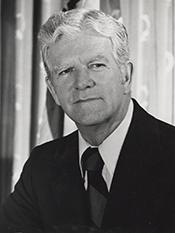
United States · United States Congress · 21 March 1979
Domestic Oil Production Policy Act of 1979 - Amends the Emergency Petroleum Allocation Act to exempt the first sale of new crude oil, and the first sale of market incentive crude oil, from regulation under such Act. Sets forth provisions for the establishment of a ceiling price on old crude oil. Exempts the first sale of tertiary crude oil from regulation under such Act. Exempts the first sale of: (1) deep stripper well crude oil; (2) stripper well crude oil; (3) high water cut crude oil; and (4) marginal offshore crude oil from regulation under such Act. Stipulates that to qualify for such exemptions a property must be producing crude oil at a maximum feasible rate throughout a 12-month qualifying period.
United States · United States Congress · 20 March 1979
Amends part A (Aid to Families with Dependent Children) of title IV of the Social Security Act to permit States to require any individual to work if such individual's needs are taken into account in determining eligibility for AFDC benefits.
United States · United States Congress · 20 March 1979
Amends the Internal Revenue Code to subject nonresident aliens and foreign corporations to a tax on the gain from the sale or exchange of farm or rural lands situated in the United States. Requires foreign corporations which hold United States farm lands comprising 20 percent of their assets to make reports on such holdings as the Secretary of the Treasury may require.
United States · United States Congress · 14 March 1979
Directs the Administrator of the Environmental Protection Agency to request the National Academy of Science to conduct a study regarding the desirability of developing a Federal policy for the determination of the potential carcinogenicity in man of chemicals tested primarily in nonhuman test systems through the standardization of certain tests.
United States · United States Congress · 13 March 1979
Declares that Zimbabwe Rhodesia has (1) demonstrated its willingness to negotiate in good faith at an all parties conference and (2) approved a constitution transferring power to a black majority government. Expresses the sense of Congress that the President (1) should determine that Zimbabwe Rhodesia is in substantial compliance with the International Security Assistance Act of 1978 and (2) should not enforce sanctions against Zimbabwe Rhodesia.
United States · United States Congress · 8 March 1979
Independent Local Newspaper Act of 1979 - Amends the Internal Revenue Code to provide for the establishment of independent local newspaper advance estate tax trusts to facilitate payment of the estate tax imposed upon the estate of a decedent who owned an interest in an independent local newspaper. Sets forth requirements for the establishment of such trusts, including requirements that such trusts: (1) be created pursuant to a plan adopted by the newspaper; (2) be governed by a written instrument which requires that contributions to and income of the trust be invested solely in obligations of the United States; (3) name as trustee a bank or another individual who is capable of administering such trust in compliance with the requirements of this Act; (4) maintain trust assets separately from other property; (5) accept contributions exclusively from independent local newspapers; (6) devote assets of the trust solely to the payment of the estate tax; and (7) distribute any excess funding of the trust to its beneficiaries or their estates. Limits an individual who owns interests in several independent local newspapers to participation in not more than one estate tax payment trust. Defines an "independent local newspaper" as a newspaper publication which is not a member of a chain and which maintains all its offices in a single city, community or metropolitan area, or, on January 1, 1979, within one State. Defines "excess funding" as the excess of the face value of the assets of a qualified trust over; (1) 70 percent of the value of a decedent's interest in an independent local newspaper which is includable in his gross estate; or (2) a decedent's estate tax which is attributable to his interest in an independent local newspaper included in his gross estate. Exempts independent local newspaper advance estate tax trusts and the individuals for whom such trusts are established from income taxation with respect to income earned by such trust. Terminates such tax-exempt status if the taxpayer's interest in the newspaper is sold, the newspaper itself is sold or ceases to qualify as an independent newspaper, or there is an excess funding of the trust. Provides that the amount of any excess funding shall be distributed to the individual for whom the trust was created and included in his gross income or gross estate. Allows an income tax deduction to local independent newspapers for contributions made to estate tax payment trusts. Limits the amount of such deduction to 50 percent of the taxable income derived from such newspaper for the taxable year. Requires the redetermination of the estate tax of an individual for whom an independent local newspaper advance estate tax trust is established and the inclusion in the gross estate of such individual an amount equal to the estate tax payment made by such trust which is attributable to the individual's interest in the newspaper, if the trust or any heir of the individual sells, within 15 years of the death of such individual, any part of the interest in the newspaper with respect to which the trust was created. Provides for the gradual phaseout of any additional estate tax which is imposed due to the premature sale of a newspaper, if the sale does not occur prior to the ten to 15 year period following the death of the individual for whom the estate tax trust is established. Permits the shareholders of an independent local newspaper who receive the stock of a corporation which the newspaper controls to exclude from their gross income any gain realized as a result of such distribution if: (1) the shareholders do not sell such stock within five years after the date of its distribution; (2) the shareholders retain control of the newspaper for five years after the date of the distribution; and (3) the newspaper and the controlled corporation each continue to be engaged in the active conduct of a trade or business through the five year period beginning on the date of the distribution. Excludes from the gross estate of a decedent the value of any interest in an independent local newspaper which he holds at the time of his death and any estate tax payment made by an independent local newspaper advance estate tax payment trust. Permits the executor of an estate which includes an interest in an independent local newspaper to pay the estate tax in two or more (but not exceeding ten) equal installments. Limits the maximum amount of estate tax that may be paid in installments to the excess of the amount of estate tax over the tax that would have been imposed if the interest in the newspaper had not been included in the gross estate, reduced by all payments of the estate tax made by an independent local newspaper advance estate tax payment trust.
United States · United States Congress · 7 March 1979
Directs the Postal Service to submit to Congress rather than to the Postal Rate Commission any proposed change in the nature of postal service which has nationwide impact. Requires any statement of proposed change so submitted to include an estimate of the impact of such change upon the public, business mail users, service levels and postal finances. Provides that no proposed change in the level of postal services shall become effective unless neither House of Congress adopts a postal service resolution relating to or prohibiting such change during the first 60 days of continuous session of the Congress, following the submission of the proposed change by the Postal Service. Sets forth procedures for congressional consideration of such solutions.
United States · United States Congress · 6 March 1979
Amends the Food Stamp Act of 1977 to remove the $75 limit on the excess shelter expense deduction in the computation of household income for households composed entirely of persons who are age 62 or older, or who receive supplemental security income benefits under title XVI of the Social Security Act. Entitles such households to a medical expense deduction to the extent that the monthly amount expended by any such household for medical or dental care exceeds the amount of the standard deduction in effect.
United States · United States Congress · 5 March 1979
Declares that the remarriage of a named individual shall be deemed to have occurred after age 60, for purposes of determining such individual's eligibility for widow's insurance benefits under the Social Security Act.
United States · United States Congress · 1 March 1979
Individual Tax Return Equity Act of 1979 - Amends the Internal Revenue Code to provide identical income tax rates for single persons, heads of households, and married couples filing jointly or separately. Establishes the zero bracket amount at $3,400 for all individual taxpayers.
United States · United States Congress · 28 February 1979
Regulatory Agency Abolition Act - Abolishes specified Federal regulatory agencies three years after enactment of this Act unless prior to such date the President and Congress study the effectiveness of such agencies and Congress thereafter adopts a resolution disapproving such abolition. Provides that each regulatory agency established after the date of enactment of this Act shall be abolished three years from the date on which it was first empowered unless the President and Congress take the steps outlined above. Directs the President to submit to Congress a plan for the orderly transfer of duties essential to the public health, safety or welfare from an abolished agency to the President or to a successor agency. Provides that all orders, rules, certificates, judicial proceedings and licenses made effective by agencies abolished by this Act shall continue in effect until repealed or superceded by the President.
United States · United States Congress · 28 February 1979
Requires that whoever uses or carriers a firearm during the commission of any felony which may be prosecuted in a United States court shall, in addition to the punishment provided for the commission of such offense, be sentenced to a term of imprisonment of five years. Requires in the case of a second or subsequent conviction the imposition of a term of eight years imprisonment. Stipulates that the imposition of any term of imprisonment under this section: (1) may not be suspended; (2) may not run concurrently; and (3) may not include parole.
United States · United States Congress · 27 February 1979
Amends the program of medical and dental care for members and certain former members of the uniformed services and for their dependents to include former spouses of members of the uniformed services. Establishes length of marriage and other requirements of eligibility.
United States · United States Congress · 26 February 1979
Prohibits the Secretary of Transportation, acting through the Administrator of the Federal Aviation Administration, from prescribing any rule, regulation, or order affecting the use of navigable airspace by civil aircraft or requiring the installation of navigational aids aboard civil aircraft as a condition for the use of navigable airspace without first explaining its purpose in an appearance before the appropriate committees of Congress in open public hearings and providing a 120-day period for public comments.
United States · United States Congress · 26 February 1979
Directs the United States to pay reasonable litigation costs, including attorney fees, to prevailing defendants in civil actions in which the United States is a plaintiff.
United States · United States Congress · 21 February 1979
Amends the Internal Revenue Code to allow an income tax deduction for tuition paid by the taxpayer for the higher education of himself, his spouse, or his dependents. Limits such deduction to tuition costs which exceed three percent of the taxpayer's adjusted gross income.
United States · United States Congress · 15 February 1979
Constitutional Amendment - Provides that total expenditures in any fiscal year shall not exceed the net amount of revenue received by the Government in that year. Authorizes the suspension of such prohibition in time of war declared by Congress or by a concurrent resolution passed by a two-thirds vote of both Houses of Congress. Stipulates that any unanticipated deficit in any fiscal year shall be considered an expenditure for the succeeding fiscal year. Directs the Congress to provide an appropriate increase in the level of total receipts if the amount of such deficit exceeds two percent of the total expenditures for the succeeding fiscal year. Authorizes the Congress to apportion any deficit over the four following fiscal years or, by a two-thirds vote of both Houses, to include such deficit in the debts of the United States.
United States · United States Congress · 8 February 1979
Amends the Administrative Procedure Act to require Federal agencies to prepare and publish in the Federal Register an economic impact analysis of all proposed and final rules subject to the provisions of the Act.
United States · United States Congress · 8 February 1979
Taxpayer Relief Amendments to Panama Treaty Legislation - Specifies that all expenses incurred implementing the Panama Canal Treaty of 1977 shall be treated as an expense of the Panama Canal Commission. Prohibits payments to Panama out of U.S. Treasury revenues. Requires the Panama Canal Company to pay its cash assets to the U.S. Treasury to be applied against its debt. Directs the Commission to continue repaying its debt to the United States. Amends the Panama Canal Code to require the Commission to pay: (1) all canal operating revenues to the U.S. Treasury; and (2) the payments required under the Treaty to Panama only with express congressional authorization. Directs the General Accounting Office to monitor all costs incurred by the Commission and report annually to Congress on the differences in costs to the U.S. taxpayer. Prohibits unless expressly authorized by Congress: (1) the use of U.S. funds to implement the Treaty; (2) the transfer of U.S. property in the Canal Zone to Panama; and (3) the cessation of the Panama Canal Company and the Canal Zone Government.
United States · United States Congress · 8 February 1979
Repeals the Davis-Bacon Act, which requires the rate of wages for workers employed on Federal public buildings by contractors and subcontractors to be based upon the prevailing wages for corresponding classes of workers employed on similar projects in the same area.
United States · United States Congress · 1 February 1979
Administrative Rulemaking Reform Act - Requires a Federal agency preparing to hold a rulemaking session to make a reasonable effort to inform those likely to be affected by the proposed rulemaking. Requires that if the affected group is large, representatives of such group must be notified. Requires, in addition to present requirements, that the notice of rulemaking include the projected effective date of the rules, the purpose of the rulemaking, the text of the proposed rules, and the technical or other studies on which the agency intends to rely in the rulemaking proceedings. Applies the requirements of this Act to all rulemaking sessions except: (1) those specifically authorized to be kept secret in the interest of national security, and (2) those relating to agency management. Requires public notice and public opportunity for comment on all rulemaking proceedings under this Act unless the agency finds that the rules to be proposed are emergency rules or are of routine or insignificant impact in which case the rule must be published with reasons for its adoption. Requires Federal agencies to give interested persons at least 45 days to participate in the rulemaking. Requires the agency to maintain a file of each proceeding to be made available to the courts, Congress, and to the public in connection with review of the rule. Limits the period for public comment to a maximum of 90 days. Requires a copy of all proposed rules to be sent to Congress. States that such rule, other than an emergency rule, shall not become effective if it is disapproved within 90 days by both Houses of Congress, or it is disapproved within 60 days by one House and no action is taken on the disapproval resolution by the other House. Provides that either House of Congress may, by resolution, require any agency to reconsider and resubmit any rule to which this Act applies. Requires that such proposed rule be repromulgated anew in accordance with all the provisions of this Act unless it is reconsidered and resubmitted to Congress within 180 days after the adoption of the resolution requiring such reconsideration. Requires the Administrative Conference of the United States to study Congressional review of agency rulemaking under this Act and report the effect of such review on such rulemaking before July 1, 1984. Authorizes to be appropriated $200,000 to finance such study. Makes this Act effective 90 days after enactment. Terminates the Congressional review required by this Act at the adjournment of the Ninety-eight Congress.
United States · United States Congress · 31 January 1979
Small Business Regulatory Relief Act - Amends the Small Business Act to direct each Federal department, agency, and instrumentality engaged in rulemaking to prepare a written analysis of whether it is legal, feasible, and desirable to exempt small businesses (or classes thereof) from a rule or whether the agency should promulgate a rule with lesser compliance standards for small businesses. Sets forth information which must be present in such analysis.
United States · United States Congress · 31 January 1979
Amends title XVI (Supplemental Security Income for the Aged, Blind, and Disabled) of the Social Security Act to provide that an individual may work without being considered as having engaged in substantial gainful activity, and thus forfeiting disability status, if such individual's earnings are at a rate that does not exceed the amount specified by this Act. Excludes from an individual's income, for purposes of determining eligibility for benefits under such title, an amount equal to the expenses which such individual incurs in earning income.
United States · United States Congress · 29 January 1979
Amends the Internal Revenue Code to provide that, for purposes of computing the allowable retirement plan exclusion and employer contributions allowance for church employees, all years of service for a church, church association, or an agency for such churches, shall be considered employment for one employer. Extends to church employees the same option presently enjoyed by employees of tax-exempt health and education organizations to elect alternative exclusion allowances for contributions to annuity contracts. Provides a minimum $10,000 allowance for annual additions to these contracts without regard to the amount of the employee's compensation.
United States · United States Congress · 29 January 1979
Amends the Federal Mine Safety and Health Amendments Act of 1977 to provide that provisions of such Act shall not apply to stone mining or sand and gravel mining operations.
United States · United States Congress · 25 January 1979
Amends the Saccharin Study and Labeling Act to extend to January 3, 1981 (or to the enactment, if earlier, of any law changing the conditions under which a food additive shall not be deemed safe) of the period during which the Secretary of Health, Education, and Welfare is prohibited from taking specified actions restricting the continued use of saccharin as a food, drug, or cosmetic. Declares void of all legal force or effect any such prohibited action which the Secretary may have taken after the expiration of the initial 18-month prohibition period.
United States · United States Congress · 25 January 1979
Requires that whoever uses a firearm during the commission of a felony over which a Federal court has original and exclusive jurisdiction, or whoever carries a firearm during the commission of such felony if an element of such felony is the use or threat of violence, shall, in addition to the punishment provided for the commission of such crime, be sentenced to a term of imprisonment of not less than five nor more than ten years. Requires in the care of a second or subsequent conviction the imposition of a term of imprisonment of not less than ten years, or to life imprisonment. Stipulates that the execution or imposition of any term of imprisonment under this Act: (1) may not be suspended; (2) may not run concurrently; and (3) may not include probation.
United States · United States Congress · 23 January 1979
Small Business Impact Statement Act of 1979 - Directs the head of each Federal agency to prepare a small business impact statement in connection with each rule made by such agency unless the agency head, with the approval of the Office of Advocacy of the Small Business Administration, determines that such rule will not have a substantial effect on a significant number of small businesses. Sets forth information which must be present in each small business impact statement. Prescribes steps which each agency head must follow in preparing any small business impact statement, including publication of the statement in the Federal Register. Requires each agency head to prepare, publish, and submit to Congress a small business impact statement for any rule having a substantial effect on small businesses which took effect after December 31, 1973. Directs each agency head to minimize the paperwork burden on small businesses in carrying out this Act. Empowers either House of Congress to disapprove any proposed rule which requires a small business impact statement.
United States · United States Congress · 22 January 1979
Removes the jurisdiction of the Supreme Court of the United States and the Federal district courts over any case arising out of any State statute, ordinance, rule or regulation, which relates to voluntary prayers in public schools and public buildings.
United States · United States Congress · 18 January 1979
Amends the Clean Air Act to postpone for one year the application of certain restrictions to areas which have failed to attain national ambient air quality standards and to delay for one year the date required for adoption and submission of State implementation plans applicable to these areas.
United States · United States Congress · 18 January 1979
Foreign Intelligence Information Protection Act of 1979 - Amends the National Security Act of 1947 by adding a new Title V: Protection of Foreign Intelligence Information. Authorizes the Director of Central Intelligence to designate information as sensitive intelligence information or to remove such designation. Establishes a maximum criminal penalty of life imprisonment and/or a $20,000 fine for the offense of espionage, defined as an unauthorized and knowing act to (1) communicate classified information to a foreign power, or (2) obtain and collect such information on behalf of a foreign power. Establishes a maximum criminal penalty of ten years imprisonment and/or a $10,000 fine for anyone who, having had lawful access to classified information, knowingly acts to disclose such information without authority. Establishes as a separate offense the knowing disclosure of sensitive intelligence information, with a penalty up to 20 years imprisonment and/or a $10,000 fine. Establishes a maximum criminal penalty of five years imprisonment and/or a $5,000 fine for anyone who without authority discloses information which identifies or could identify any individual or entity as being or having been associated with a United States agency engaged in foreign intelligence or counterintelligence activities, where such disclosure could prejudice the physical safety of the individual or entity identified. Allows prosecution for the offenses of espionage or unauthorized disclosure of sensitive intelligence information only if the Attorney General and the Director of Central Intelligence certify in writing that at the time of the commission of the offense the information allegedly disclosed was properly designated.
United States · United States Congress · 18 January 1979
Establishes a National Agricultural Cost of Production Board to review, and advise the Secretary of Agriculture concerning, the adequacy and accuracy of the cost-of-production formulas used by the Department of Agriculture in connection with the administration of its price support programs.
United States · United States Congress · 18 January 1979
Amends rule X of the Rules the House of Representatives to establish a standing Committee on Internal Security to investigate and report on Communist and other subversive activities affecting the internal security of the United States, including activities intended to overthrow or alter the form of government in the United States by unlawful means or which incite or employ violence or any unlawful means to obstruct the lawful authority of the government.
United States · United States Congress · 18 January 1979
Expresses the sense of Congress that the new Department of Labor health and safety training regulations for miners places an undue burden on small store, sand, and gravel surface mining operations and should not apply to operations with 35 or fewer employees.
United States · United States Congress · 15 January 1979
Amends the Internal Revenue Code to exempt taxpayers from the payment of interest or a penalty on tax deficiencies attributable to erroneous advice obtained in writing from an Internal Revenue Service Officer or employee acting in an official capacity.
United States · United States Congress · 15 January 1979
Provides for the arbitration of disputes between the Postmaster General and recognized organizations of Postal Service managerial personnel other than officers, postmasters, and employees engaged in personnel work in Postal Service headquarters. Identifies as subject to arbitration under this Act issues relating to pay policies, fringe benefits, and the determination of whether or not a matter is subject to participation by such organization. Establishes an arbitration board to consider a dispute upon the request of the Postal Service or such recognized organization.
United States · United States Congress · 15 January 1979
Amends the Internal Revenue Code to exclude from gross income up to $1,000 ($1,500 for joint returns, $750 for married individuals filing separately) of the interest earned from savings accounts. Reduces the amount of such exclusion, dollar for dollar, by the amount the taxpayer's adjusted gross income exceeds $10,000 ($15,000 for joint returns, $7,500 for married individuals filing separately).
United States · United States Congress · 15 January 1979
Amends the Internal Revenue Code to exclude from gross income a corporate stock distribution to a stockholder based upon the reinvestment of stock dividends in the corporation by such stockholder pursuant to his election to participate in a qualified dividend reinvestment plan, as defined in this Act. Limits the amount of such exclusion to $1,500 per year. Establishes a rebuttable presumption that a distribution made by a corporation which purchases its common stock within one year of such distribution shall not be deemed a distribution pursuant to a qualified dividend reinvestment plan.
United States · United States Congress · 15 January 1979
Regulatory Agency Abolition Act - Abolishes each Federal regulatory agency three years after enactment of this Act unless prior to such date the President and Congress study the effectiveness of such agencies and Congress thereafter adopts a resolution disapproving such abolition. Provides that each regulatory agency established after the date of enactment of this Act shall be abolished three years from the date on which it was first empowered unless the President and Congress take the steps outlined above. Directs the President to submit to Congress a plan for the orderly transfer of duties essential to the public health, safety, or welfare from an abolished agency to the President or to a successor agency. Provides that all orders, rules, certificates, judicial proceedings and licenses made effective by agencies abolished by this Act shall continue in effect until repealed or superceded by the President.
United States · United States Congress · 15 January 1979
Amends the Internal Revenue Code to allow an individual age 62 or over an exclusion from gross income of up to $3,000 of interest income that would otherwise be includible. Reduces the amount of the exclusion by one-half of the amount by which the individual's adjusted gross income exceeds $5,500.