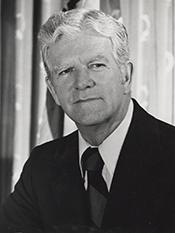
United States · United States Congress · 2 March 1977
Authorizes appropriations in specified amounts for fiscal year 1978 for the procurement of naval vessels for the armed forces. Prohibits the obligation of funds authorized under this Act for the DD6-47 guided missile destroyer program for material or components which are not suitable for use in a nuclear powered strike cruiser until the President has made certain determinations and has reported them to the Congress.
United States · United States Congress · 1 March 1977
Exempts musical and social programs and activities designed for parents and students from the prohibition against sex discrimination in federally assisted educational activities imposed by the Education Amendments of 1972.
United States · United States Congress · 1 March 1977
Amends the Education Amendments of 1972 to exempt sex segregated gymnastics classes from the prohibition against sex discrimination contained within such Act.
United States · United States Congress · 1 March 1977
Amends the Internal Revenue Code to allow employers a refundable income tax credit for 50 percent of the wages paid new employees during the taxable years for work done in the United States. Limits the credit taken to $80,000. Limits the number of employees for whom credit may be taken to ten new employees, or the maximum number of employees paid by the taxpayer during the calendar quarter ending the previous June 30th, whichever number is less. Directs the Secretary to submit reports to Congress, in 1978 and 1980 assessing the impact of this credit.
United States · United States Congress · 28 February 1977
Amends the Internal Revenue Code to allow individuals an income tax deduction for amounts paid into an employee's tax-exempt retirement trust, or for an annuity contract. Limits the allowable deduction to 15 percent of the individual's gross income, or $1,500, whichever is less, minus a specified portion of the employer's contributions and, in the case of employees exempt from self-employment, FICA or Railroad Retirement Act taxation, the amount of FICA tax liability they would have paid if they were not exempt.
United States · United States Congress · 28 February 1977
Amends the Internal Revenue Code to allow homeowners and renters who pay their gas bills an income tax credit for up to $25 of the expenses incurred in the conversion of pilot lights on gas cooking stoves, ranges and ovens to a system of manual ignition. Allows a $25 income tax deduction to other individuals and corporations for the same expenses.
United States · United States Congress · 24 February 1977
Amends the Social Security Act to provide that, if the delivery day for benefit checks under titles II (Old-Age, Survivors, and Disability Insurance) and XVI (Supplemental Security Income Program) falls on a Saturday, Sunday or legal public holiday, benefit checks for such month shall be mailed for delivery on the first day preceding such designated day which is not a Saturday, Sunday or legal public holiday, without regard to whether the delivery of such checks is made in the same calendar month for which such benefit checks are issued.
United States · United States Congress · 24 February 1977
Provides that recipients of veterans' pension and compensation will not have the amount of such pension or compensation reduced, or entitlement thereto discontinued, because of increases in monthly social security benefits. Applies these amendments to annual income determinations made for calendar years after 1972. (Amends 38 U.S.C. 415(g), adds 38 U.S.C. 503(d))
United States · United States Congress · 23 February 1977
Child Abuse Prevention Act - Prohibits the sexual exploitation of children by making it unlawful for any individual to: (1) cause or permit a child to be photographed or filmed engaged in a sexual act prohibited under this Act; (2) photograph or film a prohibited sexual act; (3) knowingly transport any film or photograph depicting a prohibited sexual act; or (4) receive for sale or sell any such film or photograph, if such individual knows or should know such film or photograph has or may be transported in such a manner as to affect interstate or foreign commerce. Imposes a fine of up to $50,000 and/or imprisonment for up to 20 years for a violation of this Act.
United States · United States Congress · 23 February 1977
Petroleum Marketing Practices Act - Title I: Franchise Protection - Prohibits a franchisor from terminating or failing to renew a franchise unless specified conditions exist. Enumerates the basis upon which a franchisor may terminate or fail to renew a franchise. Exempts trial franchises from the requirements of this Act. Requires that 90 days advance notice of termination or nonrenewal be made in writing and delivered to the franchisee. Directs the Administrator of the Federal Energy Administration to publish in the Federal Register a summary of this Act. Authorizes civil actions in a United States district court against any franchisor who violates any requirement of this Act. Provides for the preemption of State laws unless such law is the same as the applicable provisions of this Act. Title II: Octane Disclosure - Requires the Federal Trade Commission to: (1) establish testing procedures for the determination of the octane rating of automotive gasoline; (2) establish requirements applicable to refiners with respect to the testing of automotive gasoline; (3) establish a certification procedure applicable to the distribution of automotive gasoline; and (4) establish requirements applicable to retailers of gasoline with respect to display of the octane rating of automotive gasoline at the point of sale. Prohibits any person who distributes automotive gasoline from making representations respecting the octane rating of gasoline unless the gasoline has been tested in accordance with the procedures established by the Federal Trade Commission. Grants to the Commission the procedural, investigative, and enforcement powers necessary to make effective the rules required to be prescribed. Makes it an unfair or deceptive act or practice in or affecting commerce under the Federal Trade Commission Act to violate the rules prescribed by this Act. Authorizes judicial review of the rules prescribed under this Act. Title III: Prohibition on Certain Unfair Practices in the Marketing of Automotive Gasoline - Prohibits dual distribution marketers of automotive gasoline (defined in this Act as a person who markets automotive gasoline at both wholesale and retail) in or affecting commerce from establishing or maintaining retail prices which do not recover the cost of gasoline transferred to, or purchased by, retail outlets controlled by such marketer plus the cost of operating such retail outlets. Defines terms for purposes of this Title. Disallows any person engaged in the marketing or distribution of automotive gasoline in or affecting commerce from selling at retail as a loss leader unless such person operates as a franchisee through a single retail outlet. Requires gasoline marketers to maintain books and records, consistent with sound accounting principles, prescribed by the Administrator of the Federal Energy Administration. Sets fines for violations of this Title and authorizes injunctions of illegal acts under specified circumstances.
United States · United States Congress · 22 February 1977
Calls for the consideration of the relationship between the violence depicted on television and violence in society by those persons responsible for television programming and broadcasting in the United States.
United States · United States Congress · 17 February 1977
Amends the Internal Revenue Code to allow employers to take the credit for expenses of work incentive programs for wages paid new, full-time handicapped employees over the first cumulative 12 months of their employment.
United States · United States Congress · 17 February 1977
Stipulates that sales of natural gas by small, independent producers shall be exempt from regulation by the Federal Power Commission. Requires that prices of such sales be at a level which adequately compensates the seller for current costs, including an adequate return on investment. Defines the term "small producer" to include independent producers (1) not affiliated with natural gas pipeline companies or larger producers; (2) whose total sales do not exceed 10 million Mcf per year, and (3) whose average production per well does not exceed 100 Mcf per day on an annual basis.
United States · United States Congress · 17 February 1977
Amends the Internal Revenue Code to allow taxpayers to credit against the income tax specified higher education expenses, including tuition, fees, books, and supplies, incurred by the taxpayer for himself or any dependent. Limits the credit to 100 percent of the first $200 for any individual, 25 percent of the next $300, and 5 percent of the next $1,000. Limits the credit to expenses incurred by full time students at institutions of vocational and higher education, minus scholarships and veterans' benefits. Limits the total credit allowed the taxpayer to his income tax liability minus the sum of all other credits applied thereto. Disallows any deduction of educational expenses used to determine the amount of the credit allowed by this Act.
United States · United States Congress · 9 February 1977
Mobile Source Emission Control Amendments - Amends the Clean Air Act to postpone until model year 1982 motor vehicle emission standards which require a 90 percent reduction in emissions of carbon monoxide and hydrocarbons. Established the following interim emission standards for such pollutants: (1) for model years 1977 through 1979, 1.5 grams per vehicle mile for hydrocarbons and 15 grams per vehicle mile of carbon monoxide; and (2) for model years 1980 and 1981, 0.9 grams per vehicle mile of hydrocarbons and 9 grams per vehicle mile of carbon monoxide. Extends until model year 1981 the current 2.0 gram per vehicle mile interim standard for nitrogen oxide emissions from light-duty vehicles. Directs the Administrator of the Environmental Protection Agency to establish such standards as appropriated for future model years. Directs the Administrator, the Secretary of Transportation, and the Federal Energy Administration to submit separate reports to Congress regarding the consequences of such emission standards on fuel consumption. Establishes additional prohibitions and penalties for tampering with motor vehicle emission control equipment. Imposes limits on the amount of vehicle testing required of small manufacturers. Establishes procedures for review of instructions for high altitude performance adjustments for motor vehicle emission control systems by the Administrator in accordance with specified requirements. Revises warranty requirements stipulated by the Act. Specifies on 18-month or 18,000 mile warranty requirement for the useful life of motor vehicle emission control systems. Directs the Administrator to study the effects of emission of sulfur-bearing compounds from motor vehicles and aircraft. Directs the Administrator to establish emission standards for air pollutants from railroad locomotives. Directs the Secretary of Transportation to make inspections to insure compliance with such standards. Prohibits States and localities from adopting different standards. Extends the exception for disclosure of confidential information in administrative and judicial procedures to emission data upon a satisfactory showing to the Administrator that such data would divulge trade secrets. Requires that documentation, justifications, proposed drafts, and comments of other agencies on proposed motor vehicle emission standards be made available to the public once such standards are proposed. Establishes procedures for oral presentation of views, with opportunity for cross-examination, with respect to such standards. Authorizes direct review of alleged procedural errors in the appropriate United States court of Appeals. Authorizes the appropriation of $200,000,000 per fiscal year for fiscal years 1978, 1979, and 1980, to carry out the purposes of this Act other than research, development, and demonstration activities.
United States · United States Congress · 9 February 1977
Health Care Expenditures Regulation Review Act - Requires any officer or agency in the executive branch of the Federal Government to submit all proposed health care regulations to each House of Congress. Sets forth the procedure by which a proposed health care regulation shall become effective. Directs the head of any Federal department or agency to give 60 days notice to the relevant committees of the House of Representatives and Congress, prior to initial publication of any regulation which relates to: (1) costs or expenditures of, or reimbursements to, individuals or providers of health care; or (2) the fixing of any rate or charge.
United States · United States Congress · 8 February 1977
Educational Expenses Tax Deferral Act - Amends the Internal Revenue Code to allow a deferral of an individual's income tax liability to the extent it equals a limited portion of the higher educational expenses incurred for the taxpayer, his spouse and dependents. Defers payment until the year following the end of the individual's attendance at an institution of higher education, or the tenth year following the taxpayer's initial deferral, which ever is earlier. Directs the Secretaries of the Treasury and Health, Education, and Welfare to each make two biannual reports to Congress on the effects of this Act.
United States · United States Congress · 7 February 1977
Requires, under the Gun Control Act of 1968, that whoever during the commission of any robbery, assault, rape, burglary, kidnapping, or homicide (other than involuntary manslaughter), uses any firearm which has been transported in interstate and foreign commerce shall be imprisoned (1) in the case of his first offense, for not less than ten years; and (2) in the case of his second or subsequent offense, for not less than 25 years. Stipulates that the execution or imposition of any term of imprisonment imposed under this Act: (1) may not be suspended; (2) probation may not be granted; and (3) may not run concurrently with any term of imprisonment imposed for the commission of any such defense. (Amends 18 U.S.C. 924)
United States · United States Congress · 7 February 1977
Natural Gas Act Amendments - Amends the Natural Gas Act to terminate Federal Power Commission authority to regulate sales of new natural gas in interstate commerce. Stipulates that prices for offshore sales of new natural gas shall not exceed the ceiling price for sales of new natural gas produced from onshore Federal lands. Stipulates that emergency sales of natural gas to curtailed customers who qualify as essential users shall not affect such exempt status. Authorizes the Commission to terminate such exemptions on or after April 15, 1978, if they are no longer deemed necessary to protect high priority consumers of natural gas. Directs the Federal Power Commission to conduct studies and make reports regarding the nature and availability of natural gas reserves. Requires that the Commission keep current information available relating to the estimated natural gas reserves for individual fields. Establishes procedures for the establishment of ceiling prices for new natural gas produced from offshore Federal lands through December 31, 1982. Authorizes the Commission to grant exemptions to price ceilings within high-cost production areas. Establishes procedures for adjustments to price ceilings established pursuant to this Act. Directs the Commission to prohibit the curtailment of adequate supplies of natural gas for essential agricultural purposes. Directs the Commission to prohibit the use of natural gas as boiler fuel where adequate alternatives are available. Authorizes exemptions from such prohibition where necessary to comply with pollution control or environmental protection and safety standards.
United States · United States Congress · 2 February 1977
Constitutional Amendment - States that Congress shall make no appropriations for any fiscal year which exceed the total revenues of the United States for such year. Prohibits spending by, or on behalf of, the United States which exceeds the total revenue for that year. Suspends such requirements when Congress declares war or national emergency.
United States · United States Congress · 2 February 1977
Constitutional Amendment - Prohibits compelling a student to attend a public school other than the one nearest his residence. Grants Congress the power to enforce by appropriate legislation the provisions of this amendment, and to insure equal educational opportunities for all students wherever located.
United States · United States Congress · 2 February 1977
Creates a 12 member select committee to conduct an investigation of the circumstances surrounding both product liability and professional liability insurance rate increases and any related issues the committee shall determine. Directs the committee to report to the House as soon as practicable during the present Congress the results of its investigation, together with such recommendations as it deems advisable.
United States · United States Congress · 31 January 1977
Diplomatic Immunities Act - Deems void any suit or judicial or administrative process against a person or the property of a person entitled to immunity under the Vienna Convention on Diplomatic Relations. Makes Presidential determinations of entitlement to immunity binding upon governmental authorities. Requires the President to publish a list of missions and personnel entitled to such immunity. Repeals the criminal penalties for wrongful suit against an immune person. Repeals exceptions to suits against servants in the service of personnel of a foreign mission. Repeals the present criteria for determining eligibility for immunity.
United States · United States Congress · 31 January 1977
Amends Title XVIII (Medicare) of the Social Security Act to expand the coverage of the supplementary medical insurance program to include physician extender services.
United States · United States Congress · 27 January 1977
Commission on the Reorganization of the Executive Branch Act - Establishes the Commission on the Reorganization of the Executive Branch of the Government to study all instrumentalities of the Government except the judiciary and the Congress to determine what changes in the organization of such entities are necessary to eliminate duplication and improve efficiency. Requires the Commission to submit to the President and Congress an interim report of its activities by June 30, 1978, and a final report by December 31, 1978, at which time the Commission shall cease to exist. States that such final report may propose such constitutional amendments, legislative enactments, and administrative action as might be necessary to carry out the Commission's recommendations. Permits the President to submit to Congress reorganization plans to implement any recommendation of the Commission. Makes such plan effective 60 days after such plan has been submitted unless disapproved by Congress. Permits the President to submit such a plan up until January 1, 1980. (Amends 5 U.S.C. 903; 905)
United States · United States Congress · 27 January 1977
Jobs Creation Act - Amends the Internal Revenue Code to reduce the individual income tax rates. Allows a credit against the income tax up to $1,000, for ten percent of the increase in the total savings deposits and investments since the end of the previous year. Allows a limited income tax deduction by certain domestic corporations for dividends paid. Limits corporate deductions for dividends received from foreign corporations. Repeals corporate deductions for other dividends received. Allows the taxpayer to take a deduction for specified percentages of the acquisition costs of certain types of property, with a corresponding reduction in basis, in lieu of a depreciation deduction. Doubles the corporate surtax exemption to $100,000.
United States · United States Congress · 26 January 1977
Establishes as the boundaries of the Manassas National Battlefield Park, Virginia, the boundaries depicted on the map entitled "Boundary Map, Manassas National Battlefield Park" dated January 1977. Authorizes the Secretary of the Interior to acquire by donation, purchase, or exchange, lands and interests located within these boundaries, except that property owned by the Commonwealth of Virginia may only be acquired by donation. Sets forth the rights of owners of improved property within such boundaries.
United States · United States Congress · 26 January 1977
Grants a Federal charter to the United States Submarine Veterans of World War II. Stipulates that the purposes of such organization shall be: (1) to perpetuate and establish memorials to the memory of those who gave their lives in submarine warfare during World War II; (2) to award college scholarships; and (3) to make the general public aware of life aboard submarines during World War II.
United States · United States Congress · 26 January 1977
Truth in Government Accounting Act - Requires the Secretary of the Treasury to prepare and make public annual consolidated financial statements for all expenditures of the United States utilizing the accrual method of accounting.
United States · United States Congress · 26 January 1977
Amends Title II (Old-Age, Survivors, and Disability Insurance) to remove the limitation on the amount of outside income which an individual may earn while receiving benefits.
United States · United States Congress · 26 January 1977
Cost-of-Living Adjustment Act - Provides, under the Internal Revenue Code, for automatic cost-of-living adjustments, based on the Consumer Price Index, in: (1) the income tax rates; (2) the amount of standard deductions; (3) the amount of personal exemptions; (4) the amount of depreciation deductions; and (5) the adjusted basis for property. Makes cost-of-living adjustments in specified United States savings bonds and certificates and on other obligations of the United States.
United States · United States Congress · 26 January 1977
Natural Gas Temporary Purchase Act - Amends the Natural Gas Act to direct the Federal Power Commission to exempt from regulation sales of natural gas to interstate pipelines where such natural gas was not committed to interstate commerce prior to promulgation of such regulation and where the pipeline company is curtailing deliveries of natural gas supplies.
United States · United States Congress · 26 January 1977
Constitutional Amendment - Empowers each State to choose electors for President and Vice President equal to the total number of Senators and Representatives the State is entitled to in Congress. Mandates the popular election of electors. Authorizes one elector to be chosen from each electoral district, and two electors to be chosen on a statewide basis. Requires that successor electors are bound to follow the declaration of voting intention that each elector must make. Stipulates that any vote cast by an elector contrary to the declaration made by the elector shall be counted as a vote cast in accordance with his declaration. States that in case of a tie the person having a majority of votes cast by electors from electoral districts shall be President. Directs that in a situation of none receiving such a majority, the members of the Senate and House of Representatives, each having one vote, shall choose the President and Vice President from the top three votegetters. Declares a person constitutionally ineligible to be President ineligible to be Vice President. Directs each State legislature to divide the State into electoral districts equal in size, with the number of districts equaling the State's delegation in the U.S. House of Representatives.
United States · United States Congress · 26 January 1977
Declares it the sense of the House of Representatives that the Government of the United States should maintain its rights and jurisdiction over the Panama Canal and the Panama Canal Zone.
United States · United States Congress · 24 January 1977
Administrative Rule Making Reform Act - Requires a Federal agency preparing to hold a rule making session to make a reasonable effort to inform those likely to be affected by the proposed rule making. Requires that if the affected group is large, representatives of such group must be notified. Requires, in addition to present requirements, that the notice of rule making include the projected effective date of the rules, the purpose of the rule making, the text of the proposed rules, and the technical or other studies on which the agency intends to rely in the rule making proceedings. Applies the requirements of this Act to all rule making sessions except (1) those specifically authorized to be kept secret in the interest of national security, (2) those relating to agency management, and (3) those promulgating rules which are not enforceable by imprisonment, fine, civil penalty, or denial of future Federal benefits. Requires public notice and public opportunity for comment of all rule making proceedings under this Act unless the agency finds that the rules to be proposed are emergency rules or are of routine or insignificant impact in which case the rule must be published with reasons for its adoption. Requires Federal agencies to give interested persons at least 45 days to participate in the rule making. Requires the agency to maintain a file of each proceeding to be made available to the courts, Congress, and to the public in connection with review of the rule. Limits the period for public comment to a maximum of 90 days. Requires a copy of all proposed rules to be sent to Congress. States that such rule, other than an emergency rule, shall not become effective if it is disapproved within 90 days by both Houses of Congress, or it is disapproved within 60 days by one House and no action is taken on the disapproval resolution by the other House. Provides that either House of Congress may, by resolution, require any agency to reconsider and resubmit any rule to which this Act applies. Requires that such proposed rule be repromulgated anew in accordance with all the provisions of this Act unless it is reconsidered and resubmitted to Congress within 180 days after the adoption of the resolution requiring such reconsideration. Sets forth procedures for adoption of resolutions to approve, disapprove, or compel reconsideration for both Houses. Requires the Administrative Conference of the United States to study congressional review of agency rule making under this Act and report the effect of such review on such rule making before July 1, 1982. Authorizes to be appropriated $200,000 to finance such study. Makes this Act effective on the first day of the first session of the 95th Congress. Terminates the congressional review required by this Act at the adjournment of the 97th Congress.
United States · United States Congress · 24 January 1977
Administrative Rule Making Reform Act - Requires a Federal agency preparing to hold a rule making session to make a reasonable effort to inform those likely to be affected by the proposed rule making. Requires that if the affected group is large, representatives of such group must be notified. Requires, in addition to present requirements, that the notice of rule making include the projected effective date of the rules, the purpose of the rule making, the text of the proposed rules, and the technical or other studies on which the agency intends to rely in the rule making proceedings. Applies the requirements of this Act to all rule making sessions except (1) those specifically authorized to be kept secret in the interest of national security, and (2) those relating to agency management. Requires public notice and public opportunity for comment of all rule making proceedings under this Act unless the agency finds that the rules to be proposed are emergency rules or are of routine or insignificant impact in which case the rule must be published with reasons for its adoption. Requires Federal agencies to give interested persons at least 45 days to participate in the rule making. Requires the agency to maintain a file of each proceeding to be made available to the courts, Congress, and to the public in connection with review of the rule. Limits the period for public comment to a maximum of 90 days. Requires a copy of all proposed rules to be sent to Congress. States that such rule, other than an emergency rule, shall not become effective if it is disapproved within 90 days by both Houses of Congress, or it is disapproved within 60 days by one House and no action is taken on the disapproval resolution by the other House. Provides that either House of Congress may, by resolution, require any agency to reconsider and resubmit any rule to which this Act applies. Requires that such proposed rule be repromulgated anew in accordance with all the provisions of this Act unless it is reconsidered and resubmitted to Congress within 180 days after the adoption of the resolution requiring such reconsideration. Requires the Administrative Conference of the United States to study Congressional review of agency rule making under this Act and report the effect of such review on such rule making before July 1, 1982. Authorizes to be appropriated $200,000 to finance such study. Makes this Act effective on the first day of the first session of the Ninety-fifth Congress. Terminates the Congressional review required by this Act at the adjournment of the Ninety-seventh Congress.
United States · United States Congress · 24 January 1977
Stolen Property Amendments - Amends provisions of Federal law setting forth penalties for interstate or foreign commerce in stolen cattle to include stolen swine, sheep, fowl, insects, horses, mules, or carcasses thereof.
United States · United States Congress · 24 January 1977
Administrative Rule Making Reform Act - Requires a Federal agency preparing to hold a rule making session to make a reasonable effort to inform those likely to be affected by the proposed rule making. Requires that if the affected group is large, representatives of such group must be notified. Requires, in addition to present requirements, that the notice of rule making include the projected effective date of the rules, the purpose of the rule making, the text of the proposed rules, and the technical or other studies on which the agency intends to rely in the rule making proceedings. Applies the requirements of this Act to all rule making sessions except (1) those specifically authorized to be kept secret in the interest of national security, and (2) those relating to agency management. Requires public notice and public opportunity for comment of all rule making proceedings under this Act unless the agency finds that the rules to be proposed are emergency rules or are of routine or insignificant impact in which case the rule must be published with reasons for its adoption. Requires Federal agencies to give interested persons at least 45 days to participate in the rule making. Requires the agency to maintain a file of each proceeding to be made available to the courts, Congress, and to the public in connection with review of the rule. Limits the period for public comment to a maximum of 90 days. Requires a copy of all proposed rules to be sent to Congress. States that such rule, other than an emergency rule, shall not become effective if it is disapproved within 90 days by both Houses of Congress, or it is disapproved within 60 days by one House and no action is taken on the disapproval resolution by the other House. Sets forth procedures for adoption of resolutions to approve or disapprove any such rule for both Houses. Requires the Administrative Conference of the United States to study Congressional review of agency rule making under this Act and report the effect of such review on such rule making before July 1, 1982. Authorizes to be appropriated $200,000 to finance such study. Makes this Act effective on the first day of the first session of the Ninety-fifth Congress. Terminates the Congressional review required by this Act at the adjournment of the Ninety-seventh Congress.
United States · United States Congress · 24 January 1977
Declares that it is the sense of Congress that a general or blanket amnesty or pardon for persons who committed draft or military absence offenses during our Nation's military involvement in Vietnam would represent a breach of faith with those who served honorably, particularly our honored war dead and their survivors, and should not be issued or granted by the President of these United States.
United States · United States Congress · 19 January 1977
Amends the Internal Revenue Code to limit the application of the Tax Reform Act's elimination of the sick pay exclusion for persons who have not retired on total disability, to taxable years beginning after December 31, 1976.
United States · United States Congress · 19 January 1977
Authorizes appropriations in specified amounts for fiscal year 1978 for the procurement of naval vessels for the armed forces. Prohibits the obligation of funds authorized under this Act for the DD6-47 guided missile destroyer program for material or components which are not suitable for use in a nuclear powered strike cruiser until the President has made certain determinations and has reported them to the Congress.
United States · United States Congress · 19 January 1977
Requires that whoever uses or carries a firearm during the commission of a Federal felony, or whoever is convicted by a State court of a crime punishable by a term of imprisonment exceeding one year and used or carried a firearm transported in, or affecting, interstate or foreign commerce during the commission of such crime shall, in addition to the punishment provided for the commission of such crime, be sentenced to a term of imprisonment of not less than five nor more than ten years. Requires in the case of a second or subsequent conviction the imposition of a term of imprisonment of not less than ten years, or to life imprisonment. Stipulates that the execution or imposition of any term of imprisonment under this Act (1) may not be suspended, (2) may not run concurrently; and (3) may not include probation.
United States · United States Congress · 19 January 1977
Condemns terrorist activities. Declares it the sense of the House of Representatives: (1) that terrorists should be punished; (2) that the release of Abu Daoud by France was premature and unjustified; and (3) that such release should be condemned.
United States · United States Congress · 17 January 1977
Regulatory Agency Abolition Act - Abolishes each Federal regulatory agency three years after enactment of this Act unless prior to such date the President and Congress study the effectiveness of such agencies and Congress thereafter adopts a resolution disapproving such abolition. Provides that each regulatory agency established after the date of enactment of this Act shall be abolished three years from the date on which it was first empowered unless the President and Congress take the steps outlined above. Directs the President to submit to Congress a plan for the orderly transfer of duties essential to the public health, safety or welfare from an abolished agency to the President or to a successor agency. Provides that all orders, rules, certificates, judicial proceedings and licenses made effective by agencies abolished by this Act shall continue in effect until repealed or superceded by the President.