Bill· HJRESH.J.Res. 777 (94th)referred
Joint resolution to designate April 13, 1976, as Thomas Jefferson Day.
United States · United States Congress · 22 January 1976
Designates April 13, 1976 as "Thomas Jefferson Day."
The world's political record
Person
United States · Official source
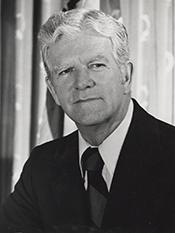
1,659 records where Rep. Daniel, W. C. (Dan) [D-VA-5] is listed as a sponsor, author, or other actor. Search with topics and years
United States · United States Congress · 22 January 1976
Designates April 13, 1976 as "Thomas Jefferson Day."
United States · United States Congress · 12 December 1975
Provides for the relief of Rodolfo Morelos.
United States · United States Congress · 11 December 1975
Declares that the Congress has not delegated to the Federal Trade Commission any authority to preempt the laws of the States or their political subdivisions.
United States · United States Congress · 1 December 1975
Provides that the total contribution of the United States to the United Nations for any calendar year after 1975 shall not exceed an amount which bears the same ratio to the United Nations budget as the total population of the United States bears to the total population of the United Nations member states.
United States · United States Congress · 20 November 1975
Truth in Government Accounting Act - Requires that the United States Government prepare and make public annual consolidated financial statements utilizing the accrual method of accounting.
United States · United States Congress · 19 November 1975
Provides that no procedures established pursuant to the collective bargaining agreements between postal workers and the Postal Service shall preclude employees from being represented in grievance by representatives of their own choosing. (Amends 39 U.S.C. 1206(b))
United States · United States Congress · 13 November 1975
Provides that in any case where a dock has been lawfully constructed on real property of the United States, the person who on the date of enactment of this Act owns such dock is granted a permanent easement for an unlimited period of time for the use of such dock.
United States · United States Congress · 10 November 1975
Provides for the payment of interest at a rate of 5 percent on excess amounts withheld from individuals' wages pursuant to the Internal Revenue Code.
United States · United States Congress · 29 October 1975
Provides for the relief of Mrs. J. Walter Jones.
United States · United States Congress · 29 October 1975
Stipulates that provisions of the Education Amendments of 1972 relating to discrimination based on sex shall not apply with respect to any scholarship or other financial assistance awarded to an individual by an institution of higher education as a result of a pageant, program, contest, or competition in which participation is limited to individuals of one sex only and the award is based, in whole or in part, upon the personal achievement, poise, or talent of such individual.
United States · United States Congress · 29 October 1975
Expresses the gratitude of Congress to Bob Hope for distinguished and meritorious service to the Nation and to the cause of freedom.
United States · United States Congress · 28 October 1975
Authorizes the Secretary of the Army to delegate to the States specified functions with respect to the location and plans for structures, excavations, dredging, or fills in or on navigable and other waters of the United States covered under the provisions of the Federal Water Pollution Control Act. Requires that a condition of any such delegation shall be the enactment by the State of legislation, and a State permit program, which is at least as effective as the Federal standards under such Act.
United States · United States Congress · 23 October 1975
National Food Stamp Reform Act - Defines "household" under the Food Stamp Act as meaning a group of individuals who are sharing common living quarters, but who are not residents of an institution or boarding house, and who have access to cooking facilities and for whom food is customarily purchased in common. Provides that the Secretary of Agriculture may not approve any plan which permits any household to simultaneously participate in both the food stamp program and the distribution of federally donated foods. Requires the Secretary to establish uniform national standards of eligibility for participation by households in the food stamp program. States that the income standards of eligibility shall be the income poverty guidelines prescribed by the Office of Management and Budget adjusted pursuant to the Economic Opportunity Act. Directs the Secretary to prescribe additional standards of eligibility which shall include, but not be limited to, the amounts of liquid and nonliquid assets. Provides that household income for purposes of the food stamp program shall be the gross income of the household less: (1) a standard deduction of $100 a month applicable to all households; (2) an additional deduction of $25 a month for any household in which there at least one member who is age sixty-five or older. Limits eligibility to participate in the food stamp program to citizens and aliens lawfully admitted for permanent residency. States that no individual shall be considered eligible for the food stamp program as a member of a household if he is: (1) over 18; (2) is enrolled at an institution of higher education; and (3) is a dependent child for income tax purposes of a taxpayer who is not a member of an eligible household. Prohibits households which transfer liquid or nonliquid assets for the purpose of qualifying for the food stamp program from becoming eligible for at least a ninety-day period. Requires the Secretary to issue photo identification cards to households certified eligible to participate in the program. States that households shall be charged thirty percent of their income for the coupon allotment issued to them. Provides that if a State agency does not comply with the provisions of the Food Stamp Act, the Secretary may refer the matter to the Attorney General with a request for an injunction, or he may direct that there be no further inssuance of coupons in the political subdivisions where such failure has occurred until such time as satisfactory corrective action has been taken. Directs the Secretary to pay to each State agency out of funds appropriated by Congress an amount equal to 75 percent of all direct costs of State food stamp program investigations, prosecutions, and State activities related to recovering losses sustained in the food stamp program. Provides for a civil money penalty of up to $10,000 for each violation of the Food Stamp Act.
United States · United States Congress · 23 October 1975
Condemns the resolution adopted by the Third Committee of the United Nations General Assembly which equates Zionism with racism, and urges the U.N. General Assembly to disapprove such resolution.
United States · United States Congress · 3 October 1975
Provides, under the Privacy Act, that individual Members of Congress may receive information from Federal agencies regarding individuals.
United States · United States Congress · 2 October 1975
Provides for the relief of John W. Wilson.
United States · United States Congress · 23 September 1975
Requires that any rule or regulation proposed by any officer or agency of the executive branch of the Federal Government to implement a law or a program pursuant to a law must be submitted to both Houses of Congress for review. States that such rule or regulation shall become effective 60 legislative days after submission if Congress neither disapproves it by resolution or passes a concurrent resolution specifically approving such rule or regulation. Incorporates the provisions of this Act into the rules of the two Houses of Congress. Establishes procedural rules with respect to the consideration of a resolution disapproving the proposed rule or regulation.
United States · United States Congress · 23 September 1975
Provides that property used in, or related to, a taxpayer's business which was acquired at no cost to him shall not be a capital asset for purposes of taxation under the Internal Revenue Code.
United States · United States Congress · 19 September 1975
Provides, under title XX (Grants to States for Services) of the Social Security Act, that the regulations prescribed by the Secretary of Health, Education, and Welfare to impose staffing standards for day care centers shall require staff-to-child ratios of one adult for each child under six weeks old and (subject to State action in specified cases) one adult for each eight children between six weeks and three years old.
United States · United States Congress · 3 September 1975
Expresses the sense of Congress that the United States Government while engaged in a lessening of tensions with the People's Republic of China, do nothing to compromise continued close relations with the Republic of China.
United States · United States Congress · 1 August 1975
Establishes as the boundaries of the Manassas National Battlefield Park, Virginia, the boundaries depicted on the map entitled "Boundary Map, Manassas National Battlefield Park" dated May 5, 1975. Authorizes the Secretary of the Interior to acquire by donation, purchase, or exchange, lands and interests including scenic easements, located within the boundaries. Authorizes the acquisition of lands adjacent to the Park if such acquisition would be a significant contribution to the historical purpose of the park. Sets forth the rights of owners of residences located within park boundaries.
United States · United States Congress · 1 August 1975
Expresses the House of Representatives strong disapproval of efforts to expel Israel from the United Nations. States that if Israel is expelled the United States should reassess its relationship with the United Nations General Assembly. Provides that such reassessment shall include possible withdrawal from that body.
United States · United States Congress · 31 July 1975
Declares that it is the purpose of this Act to provide employment for unemployed rural residents through rural conservation employment projects within rural areas of substantial unemployment. Authorizes the Secretary of Agriculture to employ rural residents over eighteen who have been unemployed for at least thirty consecutive days to carry out rural conservation projects within the National Forest System and other lands under the Secretary's jurisdiction, and in conjunction with cooperative projects on non-Federal lands. Directs the Secretary to determine rates of pay, hours, and other conditions of employment. Places a maximum wage limitation of $10,000 per year. Authorizes specified appropriations to carry out the provisions of this Act.
United States · United States Congress · 31 July 1975
Repeals the Occupational Safety and Health Act.
United States · United States Congress · 30 July 1975
Allows a tax deduction under the Internal Revenue Code for State and local public utility taxes.
United States · United States Congress · 29 July 1975
Authorizes the District of Columbia government to enter into and to amend compacts between the District and a State with the consent, by law, of the Congress.
United States · United States Congress · 21 July 1975
Animal Welfare Act Amendments - Provides, under the Federal Laboratory Animal Welfare Act, that no animals shall be delivered to any intermediate handler or common carrier for transportation in commerce unless the animals are accompanied by a veterinarian's certificate certifying that the animals are sound and healthy. States that specified animals shall not be delivered for transportation if they are less than eight weeks of age. Provides that no intermediate handler or common carrier shall participate in any practice under which the cost of such animal or its transportation is to be paid and collected upon delivery of the animal to the consignee. Imposes civil penalties for violations of this Act. Makes it unlawful to transport in interstate or foreign commerce any live dog or animal trained to participate in dog or animal fighting ventures.
United States · United States Congress · 15 July 1975
Provides that individual property owners along the Outer Banks shall be permitted access to their property through the Back Bay National Wildlife Refuge, North Carolina.
United States · United States Congress · 9 July 1975
Authorizes the President to issue a proclamation designating the week in November which includes Thanksgiving Day in each year as "National Family Week."
United States · United States Congress · 23 June 1975
National Food Stamp Reform Act - Defines the term "income" as used in the Food Stamp Act as the monthly gross income of all members of a household, including any in-kind payment, and the total value of any publicly funded assistance payments which supplement food and housing needs. Excludes specified individuals from the definition of "household. Provides for the distribution of federally donated foods to households upon the request by a political subdivision that such distribution be made to all eligible households in lieu of food stamps. Excludes households from eligibility for food stamps: (1) if the monthly household income exceeds the poverty index level of income established by the Office of Management and Budget; or (2) if the market value of liquid and nonliquid resources of a household consisting of one individual exceeds $1,500 or the resources of a multiple member household exceed $2,250 exclusive of specified resources. Excludes from eligibility households which include an able-bodied adult between the ages of 18 and 65 who is enrolled in an institution of postsecondary education and such enrollment is a substitute for fulltime employment. Declares that a refusal to work at a plant or site because of a strike or other labor dispute shall be deemed a refusal to work which makes the household of the nonworking individual ineligible for food stamps. Rejects as an excuse for refusal to accept work a condition of employment which requires an individual to join, resign from, or refrain from joining any labor organization. Directs the Secretary of Agriculture to require each household receiving benefits under this Act to report its income at least once each month. Requires food coupons to be designed with a space for the recipient to sign upon receipt and again at redemption. Requires one member of each eligible household to be issued a photo-identification card with a color photograph of the recipient. States that such card must be presented at redemption at a food store. Sets forth specific instructions to provide control and accountability over the distribution of food coupons to State agencies. Ties the value of the coupon allotment to the overall retail cost-of-living index. States that the "nutritionally adequate diet" as used to determine the amount of the coupon allotment shall mean the low-cost food plan developed by the Agricultural Research Service of the Department of Agriculture. Establishes as the charge a household shall pay for its coupon allotment the lesser of: (1) the percentage of its income which would be expended for food by an average household of its size and income range in the same region of the country; or (2) 30 percent. Provides, under the requirements for State plans for the administration of the food stamp program, for closer State supervision of eligibility by households. Requires the State agencies administering the program to conduct nutrition education programs for recipients. States that the United States Postal Service shall serve as a food stamp issuing agency upon the request of a State food stamp administration agency. Directs the Secretary of Agriculture to pay the States 100 percent of the costs of providing food stamps to eligible aliens, and 75 percent of the costs of State investigations, prosecutions, collections of claims and other State activities related to retrieving food stamp losses. Provides for payment by the Federal Government to the States of a share of the difference between the face value of the coupon allotment and the amount charged eligible households for the allotment. Sets forth the method of determining and paying the Federal share. Directs the transfer of all functions of the Secretary of Agriculture under the Food Stamp Act to the Secretary of Health, Education, and Welfare.
United States · United States Congress · 20 June 1975
Disapproves the loan of three landing craft (LCM-8's) to Panama, as proposed by the letter from the Department of the Navy of May 5, 1975, to the Committee on Armed Services of the House of Representatives.
United States · United States Congress · 19 June 1975
Requires, under the Federal Water Pollution Control Act, a permit from the Secretary of the Army, acting through the Chief of Engineers, for the discharge of dredged or fill material into channels of navigable waters at sewage disposal sites.
United States · United States Congress · 12 June 1975
Occupational Safety and Health Amendments - Defines "employer," under the Occupational Safety and Health Act, to mean a person engaged in a business affecting commerce who has employees, but does not include the United States, any States or political subdivision of a State, any nonagricultural employer who employed no more than 25 employees at any time during the preceding calendar year, or a small farmer. Requires the evaluation of specified existing standards in order to determine the applicability of each such standard to each class of business concern with each industry. Provides, in specified cases, that the Secretary of Labor give an employer reasonable advance notice that an inspection will be made. Requires that notices of alleged violations of the Occupational Safety and Health Act be in writing and state allegations with particularity. Sets forth specified circumstances in which employers in violation of the provisions of such Act shall not receive notices, including: (1) if the employer can show that implementing a specified rule or standard would not materially affect the safety or health of his employees in the facility inspected; and (2) if he can show that he has employed alternative procedures to protect his employees from contemplated hazards. Sets forth procedures for enforcement of the provisions of such Act. Provides that no person shall discharge or discriminate against any employee because such employee has filed any complaint under such Act. Enumerates affirmative defenses to any proceedings brought under such Act. Allows the Secretary of Labor to enter into compliance agreements with employers believed to be in violation of standards. Directs the Secretary, upon request from an employer, to visit the workplaces of employers for the purpose of affording consultation and advice to such employer. Requires the Secretary to provide technical advice, assistance, and consultation to employers with less than 100 employees when it appears to the Secretary that such assistance is necessary.
United States · United States Congress · 20 May 1975
Authorizes the duty-free entry of binder twine and baler twine made of manmade fibers under the U.S. Tariff Schedules. (Amends 19 U.S.C. 1202)
United States · United States Congress · 6 May 1975
Prohibits, except as provided in this Act, the inspection of tax returns and the disclosure of information contained in such returns. Authorizes the inspection of returns by or disclosure to (1) the taxpayer or his representative; (2) employees of the Internal Revenue Service and Department of Justice solely for purposes of enforcement of the tax laws; (3) State agencies charged with administration of the tax laws only for that purpose; (4) the President of the United States in the performance of his official duties; and (5) the Joint Committee on Internal Revenue Taxation for statistical purposes only. Increases the criminal penalties for unauthorized disclosure or receipt of information under this Act.
United States · United States Congress · 5 May 1975
Excludes from gross income under the Internal Revenue Code the interest received by an individual during the taxable year from specified savings institutions. Limits such exclusion to $300 or $600 for a joint return. Excludes from gross income the interest received by specified savings institutions during the taxable year from qualified mortgages.
United States · United States Congress · 22 April 1975
Directs the Chief of Engineers, Department of the Army, to remove a barricade on abandoned Virginia Route 776 at Salthouse Branch Recreation Area, Philpott Lake, Virginia.
United States · United States Congress · 22 April 1975
Increases the value of exemptions for taxable estates under the Internal Revenue Code from $60,000 to $200,000 of the value of the gross estate. Increases the limitation on the aggregate marital deduction to 50 percent of the adjusted gross value of the estate, plus $100,000. Allows an executor to value farmland, woodland, and scenic open land at its current use value rather than at its fair market value.
United States · United States Congress · 10 April 1975
Revises the Internal Revenue Code to allow as a deduction: (1) the home improvement expenses (up to a maximum of $500) paid by a taxpayer; and (2) the residential addition amortization (the aggregate of which may not exceed $5,000).
United States · United States Congress · 9 April 1975
Revises the Clean Air Act to extend until 1982 the reduction requirement standards for carbon monoxide and hydrocarbons. Extends the interim standards for light duty vehicles through 1981. Extends the regulation for the emissions of nitrogen oxides from 1977 through 1982. Extends the interim standards for light duty vehicles to 1983. Requires the Secretary of Transportation to take into account the cost of implementation and the benefits attainable in prescribing Federal motor vehicle safety standards. Stipulates that Federal motor vehicle standards shall take effect two years from the date of issue. Requires that all information relating to the promulgation of a Federal motor vehicle standard be made public. Requires the Secretary to include in his report to the President an analysis of motor vehicle safety regulations on passengers and pedestrian safety, and a certification that the cost of implementation and the benefits attainable were considered in the issuing of a safety standard. Revises the Motor Vehicle Information and Cost Savings Act to require the Secretary to include in the report to Congress and to the President (1) a statement of the degree of observance of standards; (2) an analysis of research activities; (3) an analysis of the impact of the regulations on passenger and pedestrian safety; and (4) a certification that the cost of implementation and the benefits attainable were considered in promulgating any safety standard. Prohibits the purchase of any motor vehicle after model year 1980 by the Federal Government unless such motor vehicle is more than 49 percent more efficient in fuel consumption than similar 1975 models. Revises the Automobile Information and Disclosure Act to require that a statement of the fuel efficiency rate of such automobile be included on the label attached to new automobiles. Requires the Administrator of the Environmental Protection Agency to publish annually a comparative analysis of the fuel efficiency of each new motor vehicle produced during the model year, and to report to the Congress on the progress made toward meeting the national fuel economy improvement standard.
United States · United States Congress · 8 April 1975
Creates a select committee in the House of Representatives with authority to conduct a full and complete investigation of the problem of United States servicemen missing in action or known to be dead whose bodies have not been recovered, as a result of military operations in North Vietnam, South Vietnam, Laos and Cambodia. Provides that such investigation shall include an examination of the need for additional international inspection teams to determine whether there are servicemen still held as prisoner of war. Authorizes the Committee to hold hearings, issue subpenas, and maintain a staff as necessary to carry out its responsibilities under this resolution. Directs the committee to report to the House the results of its investigation no later than one year after adoption of this resolution. Provides that the committee's authority shall expire 30 days after the filing of such report. Directs that the expenses of the select committee shall be paid from the contingent fund of the House of Representatives upon vouchers signed by the Chairman.
United States · United States Congress · 18 March 1975
National Welfare Reform Act - Stipulates that no family shall be eligible for the aid to families with dependent children program (AFDC) under the Social Security Act if its total income, without regard to exclusions, exceeds 150 percent of the family's needs. Provides that the Secretary of Health, Education, and Welfare shall provide the full cost of AFDC services to needy families who are not U.S. citizens and are lawfully present in the United States. States that unemployed individuals shall be ineligible for AFDC services for specified periods of time if such individual is determined to have, without good cause, refused an offering of bona fide employment or refused to participate under a work incentive program. Provides procedures for the determination of good cause. States that no sanctions will be applied for a ten day period after failure without good cause has been established, if the individual participates in counseling services. Sets forth procedures governing adjustment of AFDC grant overpayments. Prohibits AFDC grant payments where the caretaker relative is unemployed due to participation in a strike or because he has voluntarily terminated his employment. Defines "income" for purposes of this Act. Authorizes the Secretary to pay directly to any State up to 75 percent of the costs of investigating and prosecuting complaints of fraud under AFDC program. Requires that recipients of aid be issued a detailed identification card specifying the programs for which the recipient is eligible. Provides that any person who resides in the same household of an eligible family, but is not himself eligible for aid, shall be required to make a contribution to the State in an amount equal to the amount of the standard payment for single person household under the State's plan.
United States · United States Congress · 18 March 1975
Small Business Tax Relief Act - Allows an investment tax credit under the Internal Revenue Code to small businesses for depreciable property on which construction begins after December 31, 1974, or which is acquired after such time, equal to 10 percent of the qualified investment (the applicable percentage of the basis of each new such property and cost of each used such property placed in service by the taxpayer during the taxable year) up to $20,000 and 7 percent of such investment in excess of $20,000. Increases the additional first-year depreciation allowance under the Internal Revenue Code for a small business from 20 to 25 percent. Increases the cost allowance of such property on which such deduction is based from $10,000 to $15,000. Prescribes a formula for computing the last-in-first-out (LIFO) inventory adjustment for small businesses whose closing inventory is less than $200,000 and who do not use the LIFO inventory methods described in the provisions of the Internal Revenue Code. Allows small businesses a carryover for 10 years of a net operating loss.
United States · United States Congress · 13 March 1975
Constitutional Amendment - Provides that, on or before the fifteenth day after the beginning of each regular session of the Congress, the President shall transmit to the Congress a budget which shall set forth separately: (1) his estimate of the receipts of the Government, other than trust funds, during the ensuing fiscal year under the laws then existing; (2) his recommendations with respect to outlays to be made from funds other than trust funds during such ensuing fiscal year; and (3) if such recommendations exceed such estimate, a surtax rate which the President determines to be necessary to be applied with respect to the income tax of taxpayers to those portions of taxable years of taxpayers occurring during such fiscal year, so that such receipts will equal such outlays. Directs the Speaker of the House of Representatives during the first quarter of each fiscal year, and during the third quarter of each fiscal year to: (1) estimate the receipts of the Government, other than trust funds, during such fiscal year; (2) estimate outlays to be made from funds other than trust funds during such fiscal year; and (3) (A) if such estimate of outlays exceeds such estimate of receipts, determine a surtax rate which the Speaker considers necessary to be applied, with respect to the income tax of taxpayers, to those portions of taxable years of taxpayers remaining in such fiscal year, so that such receipts will equal such outlays; or (B) if such estimate of outlays equals such estimate of receipts, determine that no surtax rate is necessary to be applied. Directs the President during the last month of each fiscal year to review whether the receipts of the Government, other than trust funds, for such year will be less than the outlays other than trust funds for that fiscal year. Provides that if he finds that such receipts are going to be less than such outlays, he shall determine a surtax rate which he considers necessary to be applied with respect to the income tax of taxpayers, so that taxes received by the Government from such surtax, when added to other receipts of the Government, will equal such outlays. Authorizes the suspension of the provisions of this Article in the case of a grave national emergency declared by Congress (including a state of war formally declared by Congress) by a concurrent resolution, agreed to by a rollcall vote of three-fourths of all the Members of each House of Congress, with each such resolution providing the period of time (not exceeding one year) during which those provisions are to be suspended.
United States · United States Congress · 11 March 1975
Administrative Rulemaking Control Act - States that it is the purpose of this Act to establish a procedure whereby Congress may review certain rulemaking activities of executive agencies, thereby exercising greater control and oversight over the operations of such agencies. Provides that an administrative rule, the violation of which subjects an individual to a criminal penalty, shall take effect only: (1) if published in the Federal Register; (2) after the expiration of 30 days of continuous session of Congress after the date on which the rule was published; and (3) if neither House of Congress passes a resolution disfavoring such a rule. Sets forth procedures governing the consideration of such rules by the Congress.
United States · United States Congress · 6 March 1975
Family Farm Inheritance Act - States that for purposes of the estate tax under the Internal Revenue Code the value of the taxable estate shall be determined by deducting the lesser of: (1) $200,000; or (2) the value of the decedent's interest in a family farming operation continuously owned by him or his spouse for five years prior to his death and which passes to a related individual. Disqualifies the individual to whom the estate passes from the tax benefit authorized by this Act if such individual, within five years after the decedent's death, sells or removes the family farming operation.
United States · United States Congress · 5 March 1975
Exempts .22 caliber ammunition from the recordkeeping requirements imposed on the specified types of firearms and firearm components under the Internal Revenue Code.
United States · United States Congress · 5 March 1975
Directs the Comptroller General to audit annually the Federal Reserve Board, the Federal Advisory Council, the Federal Open Market Committee, and all Federal Reserve banks and branches. Requires the Comptroller General to report to the Congress within six months after the end of each fiscal year on the results of the audit. States that such report shall specifically indicate any program, financial transaction, or undertaking observed in the course of the audit which in the opinion of the Comptroller General has been carried out without legal authority.
United States · United States Congress · 5 March 1975
Authorizes the President of the United States to declare the fourth Saturday of each September "National Hunting and Fishing Day".
United States · United States Congress · 4 March 1975
Eliminates, subsequent to the death of an individual named as having an insurable interest under a Federal employee's retirement annunity, the annuity reduction made in order to provide a survivor annuity for such an individual. (Amends 5 U.S.C. 8339(k)(1))