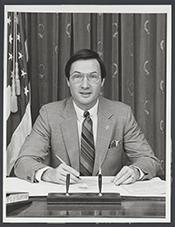
United States · United States Congress · 26 April 1984
Expresses the sense of the Congress that the President should express to the Soviet Union the U.S. disapproval of the Soviet Union's: (1) systematic nondelivery of U.S. mail addressed to persons in the Soviet Union; and (2) violation of specified treaties governing international mail. States that at the meeting of the Congress of the Universal Postal Union in Hamburg, Germany, U.S. representatives should; (1) bring such violations to the attention of the Union; (2) request that an investigation of such violations be conducted by the Union; and (3) consider possible sanctions against the Soviet Union for such violations.
United States · United States Congress · 24 April 1984
Designates the Brigantine National Wildlife Refuge and the Barnegat National Wildlife Refuge in New Jersey collectively as the Edwin B. Forsythe National Wildlife Refuge.
United States · United States Congress · 12 April 1984
Children's Defense Act of 1984 - Prohibits a youth-oriented organization from utilizing the services of any individual which includes direct contact with children until such organization has inquired through the appropriate State agency and received an indication that such individual has no prior conviction of a sexual offense involving a child. Prohibits Federal agencies from extending Federal financial assistance to any youth-oriented organization which does not comply with this Act. Allows the chief legal officer of each State to establish a plan for the functioning of a State funneling agency to permit youth- oriented organizations to comply with this Act. Permits such plan to be submitted to the Department of Justice for the approval of the Attorney General. Establishes guidelines for State funneling agencies to receive records and information from the Federal Bureau of Investigation. Sets forth security procedures for the records and information acquired and maintained by the State. Requires States to have in effect criminal and civil penalties and remedies for any security violation or unauthorized disclosure of records or information. Requires State and local governments to promptly report to the Department of Justice convictions for sexual offenses involving children.
United States · United States Congress · 12 April 1984
States that the Congress: (1) condemns Iraq for its use of chemical weapons; (2) condemns Iran for its violations of the human rights of its citizens in attacks against Iraq; (3) deplores the use of chemical weapons; (4) encourages the United Nations and other parties to continue investigations of suspected uses of chemical weapons; and (5) calls for continued and increased efforts at the Conference on Disarmament to negotiate a verifiable ban on such weapons.
United States · United States Congress · 9 April 1984
Authorizes the National Committee of American Airmen Rescued by General Mihailovich to establish a monument to General Draza Mihailovich in the District of Columbia, or its environs, in recognition of the role he played saving the lives of more than 500 U.S. airmen in Yugoslavia during World War II. Directs the Secretary of the Interior to select, with the approval of the National Commission of Fine Arts and the National Capital Planning Commission, a suitable site on public grounds for such memorial. Subjects the design and any plans for the memorial to the approval of the Secretary, the National Commission of Fine Arts, and the National Capital Planning Commission. Declares that no moneys belonging to the United States or the District of Columbia shall be expended for the establishment of such memorial. Directs the Secretary to permit groundbreaking for construction of the monument only after determining that sufficient funds are available for completion of the monument. Directs that the maintenance and care of the monument shall be the responsibility of the National Committee of American Airmen Rescued by General Mihailovich.
United States · United States Congress · 5 April 1984
Authorizes the President to: (1) enter into a trade agreement with Israel providing for the continuance of existing duty-free treatment of and the elimination of existing duties and other import restrictions on products of Israel; and (2) proclaim such continuances and modifications of tariff treatment of and import restrictions on such articles as necessary to carry out the trade agreement.
United States · United States Congress · 4 April 1984
Expresses the sense of the House of Representatives that no U.S. taxpayers' funds should be expended or transferred to aid Argentina or Third World nations with outstanding debts without congressional approval.
United States · United States Congress · 4 April 1984
Expresses the sense of the Congress that the Secretary of State should request the Organization of American States to consider the question of the involvement by Cuba in drug trafficking and the need for international inspections and factfinding hearings regarding such problem.
United States · United States Congress · 4 April 1984
Expresses the sense of the Congress that the President should take steps to place the question of the involvement by Cuba in drug trafficking on the United Nations' agenda and to request of U.N. agencies investigations and reports regarding such problem.
United States · United States Congress · 3 April 1984
Designates the Brigantine National Wildlife Refuge and the Barnegat National Wildlife Refuge in New Jersey collectively as the Edwin B. Forsythe National Wildlife Refuge.
United States · United States Congress · 29 March 1984
White House Conference on Small Business Authorization Act - Calls upon the President to conduct a National White House Conference on Small Business, not earlier than January 1, 1985, and not later than September 1, 1986, to: (1) increase public awareness of the contributions of small business; (2) identify small business problems; (3) examine the status of minority and women small business owners; (4) assist small business in carrying out its role as the nation's job creator; (5) develop specific recommendations for executive and legislative action; and (6) review the status of recommendations adopted at the Conference. Authorizes and directs Federal departments, agencies, and instrumentalities to provide support and assistance to the planning of such conference. Requires a final report of the Conference, within six months from the date such conference is convened, to be submitted to the President and the Congress. Requires the Small Business Administration to report annually to the Congress for the next three years following the submission of the final report of the Conference. Authorizes appropriations.
United States · United States Congress · 27 March 1984
Designates the Regional Veterans Administration Medical Center in Poplar Bluff, Missouri, as the General Black Jack Pershing Regional Veterans Administration Medical Center.
United States · United States Congress · 27 March 1984
Declares that the Commissioner of Social Security and the Secretary of Health and Human Services should immediately study and report to Congress on ways to correct the benefit disparity caused by the 1977 changes in the social security retirement benefit formula.
United States · United States Congress · 26 March 1984
Declares that it is the sense of the House of Representatives to urge the various House committees to apply an across-the-board budget-freeze approach to their formulation of the FY 1985 budget.
United States · United States Congress · 20 March 1984
Authorizes the Attorney General to make contracts retaining private counsel to furnish collection services in the case of any claim of indebtedness owed the United States. Permits the head of an executive or legislative agency to refer to a private counsel so retained any claims of indebtedness owed the United States arising out of such agency's activities. Declares that for the purposes of the Fair Debt Collection Practices Act, a private counsel performing collection services under this Act shall be considered a debt collector. Requires the Attorney General to transmit to Congress an annual report on the activities of the Department of Justice to recover such indebtedness. Requires the Attorney General to transmit to Congress a report on the actions taken under this Act within 60 days after the enactment of this Act.
United States · United States Congress · 20 March 1984
National Agricultural Soil Protection Act of 1984 - Directs the Secretary of Agriculture to enter into long-term contracts with producers to convert highly erodible land from crop use to soil conservation use (including haying, grazing, and wild living resources conservation). Provides producers with: (1) cash or in kind payments of between 50 and 80 percent of conservation conversion costs, limited to an annual maximum per-acre amount equal to the county's average per-acre land value; and (2) five to ten percent bonuses for conservation conversions in specially designated areas. Permits advance and installment payments. Directs the Secretary to: (1) provide technical assistance; and (2) ensure that the amount of converted acreage in any county shall not cause adverse economic effects in such county. Makes any producer who breaches such a contract ineligible for other price support benefits for three years. Redesignates the existing position of Under Secretary of Agriculture for International Affairs and Commodity Programs as the Assistant Secretary of Agriculture for International Affairs. Places the Foreign Agricultural Service and the Office of International Cooperation and Development under the direct supervision of such Assistant Secretary. Redesignates the existing position of Assistant Secretary of Agriculture for Natural Resources and Environment as the Under Secretary of Agriculture for Commodity Programs, Natural Resources, and Extension. Places the Agricultural Stabilization and Conservation Service, the Soil Conservation Service, the Forest Service, and the Extension Service under the direct supervision of such Under Secretary. Makes conforming amendments to the Agricultural Trade Act of 1978 and other Federal laws.
United States · United States Congress · 8 March 1984
Amends the Land and Water Conservation Fund Act of 1965 and the National Historic Preservation Act to require the Secretary of the Treasury to invest the portions of the land and water conservation fund and of the Historic Preservation Trust Fund not required to meet current withdrawals. Specifies the types of investments which may be made. Provides that no appropriation from either such fund for any fiscal year may exceed the maximum amount to be paid into such fund for such year plus interest accruing to the fund from the preceding year's investments. Extends the authorization of appropriations for both funds through FY 1991.
United States · United States Congress · 7 March 1984
Civil Service Amendments of 1984 - Title I: Pay for Performance; Senior Executive Service Management - Revises the merit pay system. Renames the system the performance management and recognition system. Allows the President to exclude any class of employees within any agency unit from such system under specified conditions. Excludes employees of the Office of the Architect of the Capitol, the Library of Congress, the Botanic Garden, and the Administrative Office of the Courts from such system. Directs the Office of Personnel Management (OPM) to prescribe regulations under which an employee may be excluded from such system. Declares that such system shall provide for comparability pay increases, periodic step increases, and performance awards based on an employee's performance as measured on a five-level scale consisting of one fully successful level, two levels below fully successful, and two levels above fully successful. Requires that any employee whose performance is rated at: (1) the second level below fully successful receive no comparability increase; (2) the first level below fully successful receive one half of the comparability increase; and (3) the fully successful level or above receive the full comparability increase. Requires employees whose performance cannot be rated to receive the full comparability increase. Denies periodic step increases to employees who perform below the fully successful level. Authorizes annual step increases to take effect on the first applicable pay period beginning on or after October 1 of each year. Provides for the award of a full step increase or a fraction thereof based on the employee's level of performance and the employee's basic pay rate within his or her pay grade. Limits any step increase to the amount that would raise the employee's basic pay rate to the maximum rate for his or her pay grade. Directs OPM to prescribe regulations governing step increases for employees whose performance cannot be evaluated under the standard performance evaluation procedures. Requires the payment of an additional performance award of an amount not to exceed 20 percent of an employee's basic pay to any employee whose performance is rated at the second level above fully successful. Authorizes the payment of such a performance award to an employee whose performance is rated at the first level above fully successful. Directs an agency to use a specified percentage of the agency's payroll for employees in the agency's performance management and recognition system for performance awards. Prohibits a reduction in the pay of an employee brought under such system as long as the employee continues to occupy the same position. Allows an employee under such system to be paid less than the minimum rate of basic pay for the grade of the employee's position as a result of a less than fully successful performance rating. Continues the cash award program (currently provided under the merit pay system) under such system. Directs OPM to report to the President and Congress annually on the effectiveness of such system. Terminates such system, with the exception of the cash award program, five years after the enactment of this Act. Requires agencies to develop separate performance appraisal procedures for employees covered by such system. Requires such performance appraisal procedures to: (1) require that supervisors consult with employees before establishing performance standards; and (2) use the results of performance appraisals as a basis of personnel actions. Directs OPM to prescribe regulations requiring that such procedures assure accurate evaluation of job performance, communication with employees regarding job requirements prior to each appraisal period, evaluation of employees based upon the standards, assistance to employees performing below the fully successful level, and a reduction in grade for or removal of employees who continually perform at the lowest level. Lists factors to be considered in performance appraisals, which may include organizational accomplishment. Authorizes the review of an employee's performance appraisal by an agency officer or employee. Requires the reconsideration of an employee's appraisal by a superior to the appraiser at the employee's request. Bars any appeal of a performance appraisal outside the agency. Prohibits OPM or any agency from prescribing any particular distribution of levels of performance ratings or any specific performance standard or element. Provides that a step increase received by an employee under the performance management and recognition system shall be considered to be equivalent to a step increase under the General Schedule if that employee transfers to a General Schedule position. Requires OPM's biennial report to Congress on the Senior Executive Service (SES) to specify the number of SES employees who were removed from the SES as a result of a reduction-in-force and placed in a General Schedule position, as authorized under this Act. Repeals the right of a former career civil servant to be reinstated to an SES position after being removed under a reduction-in-force. Entitles an employee who is removed from the SES under a reduction-in-force to be placed in a civil service position in a grade no lower than a GS-15. Eliminates certain pay protection provisions for employees removed from the SES due to less than fully successful performance. Provides that a career appointee may be removed from the SES due to a reduction-in-force unless such appointee is qualified for and assigned to a vacant SES position in the same agency. Eliminates an appointee's right to appeal to the Merit Systems Protection Board (MSPB) his or her removal or failure to receive an assignment to a vacant SES position. Authorizes the furlough of SES employees for insufficient work or funds or for other nondisciplinary reasons. Entitles a furloughed employee to appeal his or her status to the MSPB. Establishes the minimum amount for a performance award for an SES employee as five percent of such employee's basic pay. Limits the total amount an agency may pay in SES performance awards in a fiscal year. Repeals the aggregate pay limitation for SES employees who receive a bonus, award, or allowance. Allows an agency to suspend or remove an SES employee for failing to accept a directed reassignment or accompany a position in a transfer of function. Provides that such a removal based on an employee's refusal to accept a directed reassignment or to accompany a position transfer outside of the commuting area of the employee shall not jeopardize such employee's eligibility to receive a civil service annuity because of an involuntary separation. Allows an SES career appointee to be reassigned outside of his or her commuting area only if such appointee is provided with advance notice explaining the reasons for such reassignment. Title II: Effective Date; Transition Provisions - Sets forth the effective date of the performance management and recognition system. Provides that: (1) the basic pay rate of an employee under the merit pay system on the day before such date shall be such employee's pay rate on such date; and (2) any exclusion of an agency from merit pay system coverage shall cease to have effect on such date.
United States · United States Congress · 6 March 1984
Antifraudulent Adoption Practices Act of 1984 - Amends the Federal criminal code to make it a Federal offense for any person to knowingly and willfully make any false statement or conceal any material fact in connection with an adoption or the placement of a child in a home for permanent free care. Makes it unlawful for any person to solicit or receive money for arranging for an adoption or for a placement for permanent free care. Provides for the following exceptions: (1) licensed agencies; (2) fees received for professional legal or medical services; and (3) the person soliciting or receiving a fee is the natural parent of a child or the prospective adoptive parent. Provides for imprisonment for not more than five years and/or a fine of not more than $10,000. Makes it a Federal offense for any person to use force or duress to cause any other individual to travel in interstate or foreign commerce in connection with an adoption. Provides for imprisonment for not more than ten years and/or a fine of not more than $20,000. Amends the Child Abuse Prevention and Treatment and Adoption Reform Act of 1978 to require the Secretary of Health and Human Services to: (1) review model adoption legislation and procedures and propose necessary changes to insure against fraudulent practices; (2) coordinate with national, State, and volunteer organizations to improve State adoption legislation; and (3) assist States in the development of improved procedures for controlling illegal adoption practices. Grants the Federal district courts jurisdiction to hear any civil action involving fraudulent adoption practices regardless of the amount in controversy.
United States · United States Congress · 6 March 1984
States that the Congress: (1) protests the denial by the International Olympic Committee of accreditation to Radio Free Europe and Radio Liberty (RFE/RL) correspondents covering the winter Olympic games in Sarajevo, Yugoslavia, and urges such Committee to grant accreditation to RFE/RL correspondents to cover future Olympic games, including the 1984 Olympic games in Los Angeles; and (2) calls upon the President to encourage the accreditation by the International Olympic Committee of RFE/RL correspondents who are recognized and supported by the U.S. Olympic Committee to cover the Olympic games.
United States · United States Congress · 5 March 1984
Declares that it is the sense of the House of Representatives that the President should award the Presidential Medal of Freedom to David Phillip Vetter, of Spring, Texas, to be presented to his family in his memory as the oldest survivor of congenital severe combined immunodeficiency (SCID).
United States · United States Congress · 1 March 1984
Authorizes the President, on behalf of Congress, to present to Elie Wiesel a gold medal in recognition of his humanitarian efforts and outstanding contributions to world literature and human rights. Authorizes appropriations. Authorizes the Secretary of the Treasury to provide for the public sale of bronze duplicates of such medal.