Law· HJRESH.J.Res. 667 (101st)enacted
To designate November 16, 1990, as "National Federation of the Blind Day".
United States · United States Congress · 10 October 1990
Designates November 16, 1990, as National Federation of the Blind Day.
The world's political record
Person
United States · Official source
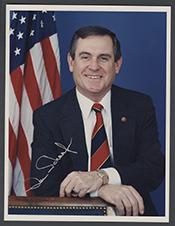
1,723 records where Rep. Schaefer, Dan [R-CO-6] is listed as a sponsor, author, or other actor. Search with topics and years
United States · United States Congress · 10 October 1990
Designates November 16, 1990, as National Federation of the Blind Day.
United States · United States Congress · 1 October 1990
Four Percent Solution Budget Act - Title I: The Four Percent Solution - Amends the Balanced Budget and Emergency Deficit Control Act of 1985 (Gramm-Rudman-Hollings Act) to impose a a four-percent cap on increases in outlays from the preceding year. Extends certain provisions and the terminating date of such Act through FY 1997 (currently, FY 1993). Excludes receipts and disbursements of the Resolution Trust Corporation from the budget deficit or any other totals of the budget. Amends the Congressional Budget Act to adjust the allowable maximum deficit amounts until there is a zero deficit in FY 1997. Requires the President to issue a midyear sequester on March 15 necessary to meet deficit and outlay targets. Requires the Congressional Budget Office and the Office of Management and Budget to make specified preliminary reports to the President before the issuance of such sequester. Title II: Preparation of the Budget - Amends Federal law to revise required budget contents with respect to estimated expenditures and proposed appropriations for the current fiscal year and the next fiscal year. Amends the Congressional Budget Act of 1974 to require the starting point for deliberations in the Committees on the Budget in the House of Representatives and in the Senate on the concurrent resolution on the budget for the next fiscal year to be the estimated level of outlays for the current year in each function and subfunction. Revises content requirements for the report accompanying such resolution. Requires the Director of the Congressional Budget Office to include in the report to the Budget Committees the estimated budget outlays in all functions and subfunctions for appropriated accounts for the current fiscal year and estimated budget outlays under current law for all entitlement programs for the next fiscal year. Title III: Pay-As-You-Go Budget - Prohibits the concurrent resolution on the budget from causing: (1) total budget outlays (excluding outlays of the Resolution Trust Corporation) to exceed the outlays target for that fiscal year; and (2) the recommended level of Federal revenues (excluding revenues of the Corporation) to be less than the recommended level of Federal revenues for the preceding fiscal year (excluding revenues of the Corporation). Prohibits a concurrent resolution on the budget from: (1) providing for an outlay excess in a functional category unless it provides for a decrease in budget outlays in another functional category; or (2) providing for a reduction in the recommended level of Federal revenues below that set forth in the most recently agreed to concurrent resolution on the budget for the preceding year, unless it provides for a reduction in budget outlays below the appropriate level established for the preceding year. Allows a waiver of such prohibitions by a three-fifths vote of each House of Congress. Makes it out of order in the Senate and in the House to consider a concurrent resolution under which the recommended level of revenues for a fiscal year exceeds the appropriate level of total budget outlays for that fiscal year unless the resolution specifies the purposes for which the excess revenues are to be allocated. Makes conforming amendments to Federal law with respect to the President's budget.
United States · United States Congress · 27 September 1990
Comprehensive Energy Self-Sufficiency Act of 1990 - Declares it the policy of the United States to encourage cost effective energy conservation and to facilitate research and development of domestic energy resources. Title I: Conservation and Energy Efficiency - Amends the Public Utility Regulatory Policies Act of 1978 (PURPA) to provide that the permissible State-regulated electric utility charges shall be such that a utility's return on energy investments is commensurate with returns earned on other utility investments of similar risk. Requires the Secretary of Energy to report to the President and the Congress regarding specified effects of least-cost energy planning upon electric utility rates. Requires the Tennessee Valley Authority to use least cost planning in its decision-making regarding increased electric power demand. Amends the National Enregy Conservation Policy Act (NECPA) to set a deadline by which each Federal agency must: (1) install energy conservation measures in Federal buildings with a specified payback period; (2) submit a list of projects to the Secretary which meets such payback criterion and which indicates total energy and cost savings involved; and (3) have substantially completed at least 25 percent of such projects or as many as would account for 25 percent of total energy savings. Directs the Secretary to develop guidelines for the selection of energy service contractors. Directs the Secretary to provide financial assistance to support a voluntary, national window rating program to develop a window energy ratings and labels. Directs the Federal Trade Commission to prescribe labeling rules for windows and window systems. Authorizes approriations. Amends NECPA to direct the Secretary to: (1) promulgate procedural guidelines enabling the States to assign energy efficiency ratings to residential buildings; and (2) establish a technical assistance program to State and local governments adopting energy efficiency rating systems or building codes. Amends the Internal Revenue Code to exclude from gross income: (1) the value of any subsidy provided by a public utility to a customer for the purchase or installation of any energy or water conservation measures; and (2) the value of any qualified transportation benefit provided by an employer. Restores the tax credit for residential energy conservation expenditures where heating oil is the primary source of heating. Title II: Renewable Energy Sources - Amends the Federal Power Act to prohibit the issuance of licenses for certain hydroelectric project works to anyone but the owner. Amends PURPA and the Federal Power Act to remove the size limitations placed upon hydroelectric generating facilities eligible for PURPA regulatory benefits. Amends the Internal Revnue Code to extend: (1) the time during which credit will be granted for producing fuel from nonconventional source; (2) excise tax rate reductions will apply to alcohol fuel mixtures; (3) credit will be applied for alcohol used as fuel. Title III: Electric Power - Competitive Wholesale Electric Generation Act of 1990 - Authorizes public utility holding companies that are exempt from the provisions of the Public Utility Holding Company Act of 1935 to acquire business interests in generators used exclusively for selling electric energy at wholesale (exempts wholesale generators). Declares that the ownership of exempt wholesale generators shall not result in the owner's being considered as primarily engaged in the sale or generation of electric power under the Federal Power Act. Preserves the ratemaking authority of the States. Amends the Federal Power Act to direct the Federal Energy Regulatory Commission (FERC), before approving rates agreed to between a public utility and a wholesale seller, to require the purchasing utility to certify that the rate conforms with least-costing planning schemes. Defines circumstances under which electric energy charges by a public utility exempt wholesale generator will be considered unjust and unreasonable. Authorizes appropriations for electronic switching research. Directs the Secretary of Energy to report to the Congress on legislative and regulatory reforms and incentives for more reliable electric transmission transfer capability within the reliability councils comprising the North American Electric Reliability Council. Title IV: Natural Gas - Directs FERC to: (1) issue regulations to expedite pipeline certifications; and (2) report to certain congressional committees on recommended reforms to facilitate increased deliverability of natural gas to consumers. Amends the Mineral Leasing Act to repeal the current 60-day waiting period requirement after notification of certain congressional committees before certain pipeline rights-of-way may be granted. Title V: Oil -Subtitle A: Use of MMT in Unleaded Gasoline - Directs the Administrator of the Environmental Protection Agency to approve the use of methylcyclopentadienyl manganese tricarbonyl (MMT) in unleaded gasoline. Subtitle B: Tax Incentives for Oil and Natural Gas Exploration and Production - Part I: National Energy Security Tax Credits - Amends the Internal Revenue Code (IRC) to establish a crude oil and natural gas exploration and development tax credit. Allows a 20 percent credit for qualified investments. Establishes a marginal production income tax credit for producers who maintain economically unproductive oil wells. Applies the credit to domestic crude that is: (1) from stripper well property; (2) heavy oil; (3) oil recovered through a tertiary recovery method; or (4) harsh environment oil (produced from Arctic areas in submerged lands). Fixes the credit at 20 percent of the qualified cost (determined in accordance with a formula set forth in this Act) of each barrel produced by the producer during the taxable year. Part II: Additional Exploration and Production Incentives - Amends the IRC to treat certain geological and geophysical costs and surface casing costs as intangible drilling and development costs that a taxpayer may elect to capitalize or to deduct for income tax purposes. Precludes a percentage depletion income tax deduction for proven oil and gas wells from application of the net income limitation percentage depletion. Increases from 65 percent to 100 percent the taxable income limitation on the percentage depletion deduction for oil and gas property. Affirms natural gas found in tight sands formations as a qualified fuel with respect to the credit, without exceptions. Defines "tar sands" for purposes of such credit. Part III: Amendments to the Alternative Minimum Tax - Repeals provisions that identify intangible drilling costs as a tax preference item for purposes of determining alternative minimum tax liability and corporate preference reductions. Part IV: Miscellaneous Tax and Administrative Amendments - Declares Revenue Ruling 77-176 (and other rulings that reach similar results) to be inapplicable with respect to the income tax treatment of mineral sharing arrangements. (The Revenue Ruling address situations in which a driller receives from a lessee an operating interest in oil and gas property as consideration for drilling a well on the leased tract.) Revises provisions governing the time when economic performance occurs for the purpose of income tax deductions or credits in connection with removal of offshore oil or gas production facilities. Specifies expressly the types of oil and gas exploration and development costs that are exempt from the required application of uniform cost capitalization rules. Subtitle C: Recovery Depletion Allowance; Research and Development Credit - Amends the Internal Revenue Code to set a depletion allowance of 27.5 percent in connection with domestic oil and natural gas recovered through enhanced recovery techniques. Reduces this percentage (but not below 15 percent) as the average annual removal price during the calendar year exceeds $30 (indexed for inflation). Terminates this provision with respect to production after 2009. Increases from 50 percent to 100 percent the net income limitation on percentage depletion in connection with incremental tertiary oil or natural gas. Permits a ten percent income tax credit for research to discover or improve tertiary recovery methods for domestic crude oil or natural gas. Subtitle D: Arctic National Wildlife Refuge - Directs the Secretary of the Interior to implement a competitive oil and gas leasing program for the Coastal Plain of the Arctic National Wildlife Refuge. States that this subtitle shall be considered the primary land management authorization for all exploration and production activities on the Coastal Plain. Provides that no land management review shall be required except as management specifically authorized by this subtitle. Mandates that all receipts from sales, rentals, bonuses, and royalties on leases under this subtitle be deposited into the Treasury. Directs the Secretary to promulgate regulations to ensure that oil and gas exploration and transportation activities are conducted to achieve the reasonable protection of animals and environmental resources (including subsistence uses of the Coastal Plain). States that the "Arctic National Wildlife Refuge, Alaska, Coastal Plain Resource Assessment," prepared by the Secretary, satisfies all legal requirements for such promulgation and that no further studies or assessments shall be required. Directs the Secretary to provide impact aid and other assistance to communities on the North Slope and elsewhere in Alaska in order to ensure the public services needed to accommodate oil and gas production and transportation activities on the Coastal Plain. Title VI: Coal - Directs the Secretary of Energy to establish research and demonstration goals for the timely development of: (1) coal production, transportation, and use technologies; and (2) cost-effective advanced coal-based technologies to be available for widespread commercial use after the year 2010, and which can control sulfur and nitrogen oxides at greater proficiency levels than are currently available; and (3) cost-effective energy production systems which use coal and achieve greater efficiency in the conversion of coal to useful energy. Requires the Secretary to submit an assessment to the Congress of the commercial development potential of technologies for non-fuel use of coal. Amends the Internal Revenue Code to restore investment credits for pollution devices required by the Clean Air Act Amendments of 1990. Title VII: Nuclear - Nuclear Standardization and Safety Reform Act of 1990 - Subtitle A: Standardization and Licensing - Amends the Atomic Energy Act of 1954 to direct the Nuclear Regulatory Commission to establish procedures for the preapproval of a limited number of standardized facility designs for production or utilization facilities for a ten-year period. Authorizes the Commission to design approval requests for any major subsystem that represents discrete elements of a production or utilization facility. Requires the Agency to specify by regulation the criteria and requirements for any subsystem approval. States that a design approval shall be considered to be a license. Sets forth guidelines for the issuance of a design approval, including ten-year renewal terms. Authorizes the Director to issue a site approval permit for a ten-year period even if an application for a construction permit or operating license has not been filed. Outlines the site approval procedure and the procedures for facility construction permits and operating licenses. Subtitle B: Conforming Amendments - Makes conforming Amendments to the Act. Subtitle C: Amendments of PUHCA - Amends the Public Utility Holding Company Act of 1935 to allow the Securities and Exchange Commission (SEC) to grant exempt status to certain public utility holding companies which would otherwise meet specified criteria but for their control of utility assets pursuant to a management agreement approved by the Nuclear Regulatory Commission (NRC). Permits the acquisition of public utility assets or securities without SEC approval if the acquiring public utility controls assets pursuant to a management agreement approved by the NRC. Subtitle D: Effective Date - Sets forth the effective date of this title. Title VIII: National Energy Strategy Implementation - Amends the Department of Energy Organization Act to direct the President to submit a proposed National Energy Policy Plan to the Congress by a specified deadlilne. Amends the Department of Energy Act to revise procedural guidelines for congressional consideration of an implementing bill for such Plan. Title IX: Impact of Federal Actions on Energy Security - Mandates that all Federal agencies shall: (1) develop measures to ensure that energy security concerns are given appropriate consideration in decisionmaking; and (2) include in their legislative proposals a detailed statement regarding the impact of such proposals upon energy production, transportation, or use, and alternatives to the proposed action. Title X: Outer Continental Shelf - Subtitle A: Revised Outer Continental Shelf Leasing Program - Requires the Secretary of the Interior to submit to the Congress a revised Outer Continental Shelf leasing program which includes plans for the expeditious development of oil and gas resources consistent with environmental safeguards. Subtitle B: Revenue Sharing - Outer Continental Shelf Revenue Sharing Act of 1990 - Establishes the Outer Continental Shelf Revenue Sharing Fund. Requires the Secretary of the Treasury to: (1) pay specified amounts into the Fund; and (2) provide each coastal State with an Outer Continental Shelf revenue sharing block grant. Requires a recipient coastal State to submit an assessment of the expenditure of funds provided by the block grants.
United States · United States Congress · 26 September 1990
Authorizes the President, in order to protect health and safety of human life, to decrease the sequester amounts specified in the order issued August 25, 1990, under the Balanced Budget and Emergency Deficit Control Act of 1985 (Gramm-Rudman-Hollings Act). Requires an increase in the sequester amount in other accounts, programs, projects, or activities to the extent amounts were decreased in such order.
United States · United States Congress · 17 September 1990
Plastic Recycling Assistance Act of 1990 - Directs the Administrator of the Environmental Protection Agency to require plastic containers manufactured or offered for sale in the United States to be coded to identify the principal plastic resin used in such containers. Establishes a symbol and numbers identifying specific types of resins, including degradable resins, for such codes. Prohibits States or political subdivisions from: (1) enforcing any law applicable to plastic coding unless requirements are the same as requirements under this Act; and (2) enforcing any ban on plastic containers coded in compliance with this Act. Prescribes civil and criminal penalties for violations of this Act. Requires the Administrator to study and report to the Congress on technology to facilitate the automated sorting of municipal solid waste from nonrecyclable wastes and to separate such wastes by type or category. Authorizes appropriations.
United States · United States Congress · 3 August 1990
Designates November 4 through 10, 1990, as National Key Club Week.
United States · United States Congress · 3 August 1990
Designates the week of September 23, 1990, as Religious Freedom Week.
United States · United States Congress · 3 August 1990
Declares that complete normalization of bilateral relations between the United States and the Socialist Republic of Vietnam must remain contingent upon: (1) the release of political and religious prisoners in Vietnam, the cessation of torture and psychological abuse within incarceration facilities, and the end of detentions without trial; (2) the abolition of political reeducation camps; (3) the establishment of an autonomous judiciary and bar association and codified rights for arrestees to appeal and to obtain independent legal representation; (4) the elimination of all prohibitions against organized opposition activity; (5) the repeal of the constitutional guarantee of permanent rule by the communist party; (6) a formal commitment by such party to permit free and open national elections; and (7) an acceptable resolution of all outstanding cases of U.S. military personnel unaccounted for in Southeast Asia.
United States · United States Congress · 30 July 1990
Expresses the sense of the Congress that Walker Percy of Covington, Louisiana, be remembered as one of the finest writers and contributors to the culture of the United States of the 20th century.
United States · United States Congress · 24 July 1990
Financial Crimes Prosecution and Recovery Act of 1990 as Reported By the Committee on the Judiciary of the House of Representatives - Title I: Enhanced Criminal Penalties - Amends Federal criminal law to establish criminal penalties (including imprisonment) for the concealment of assets from the Federal Deposit Insurance Corporation (FDIC) (acting as conservator or receiver) and the Resolution Trust Corporation (RTC) acting as conservator or receiver. Amends the Federal Deposit Insurance Act to prohibit certain felons convicted of dishonesty or breach of trust from controlling or participating in the affairs of a depository institution for a minimum ten-year period. Amends Federal criminal law to establish criminal penalties (including imprisonment) for obstructing any examination of a financial institution. Increases to 30 years (currently, 20 years) the maximum prison term for bank fraud and embezzlement. Establishes a ten-year statute of limitations for the prosecution of racketeering offenses involving financial institutions. Extends money laundering prohibitions to include funds from specified bank crimes. Directs the U.S. Sentencing Commission to promulgate guidelines for increased penalties for certain bank crime convictions in which the defendant derived more than $1,000,000 in gross receipts from the offense. Provides for restoration of forfeited property and for restitution to bank crime victims. Sets forth maximum criminal fines and minimum imprisonment terms for certain continuing financial crime enterprises (i.e., certain violations committed by at least four persons acting in concert). Title II: Protecting Assets from Wrongful Disposition - Authorizes the Attorney General to obtain a court order enjoining or restraining the alienation of disposition of property obtained as a result of a banking law violation. Amends the Federal Deposit Insurance Act to set forth attachment procedures. Amends Federal bankruptcy law to provide that the trustee shall be deemed to have assumed a debtor's commitment to a Federal depository institution regulatory agency to maintain the capital of an insured depository institution (thus precluding the trustee from rejecting such commitment as an executory contract which can be avoided as a discharge in bankruptcy). Exempts a Federal depository institution regulatory agency acting as conservator for an insured depository institution from the requirement of proving reasonable reliance upon a false writing supplied by a debtor who is an institution-affiliated party. Prohibits a discharge in bankruptcy for debts resulting from the debtor's failure to fulfill a commitment to a Federal financial institution regulatory agency to maintain the capital of an insured depository institution. Exempts a Federal depository institution regulatory agency acting as conservator for an insured depository institution from the requirement of a timely nondischargeability request (including notice and hearing) when seeking to recover a debt relating to malfeasance. Declares that for specified cases of deceitful conduct, any institution-affiliated party of an insured depository institution (or credit union) shall be deemed to have been acting in a fiduciary capacity with respect to any debt owed to a Federal banking regulatory agency (thus making such debt nondischargeable in bankruptcy). Makes it a prerequisite of a bankruptcy reorganization plan that the debtor will: (1) maintain any commitment to a Federal banking regulatory agency to maintain the capital of an insured depository institution; and (2) continue to be obligated for any debt to such agency for failure to fulfill such commitment. Makes certain debts owed by an institution-affiliated party to an insured depository institution under Federal receivership nondischargeable under a consumer debt bankruptcy plan. Amends the Federal Deposit Insurance Act to empower the FDIC (acting as conservator) to avoid fraudulent conveyances by a debtor institution-affiliated party. Prohibits an insured depository institution which does not meet minimum Federal capitalization requirements from making golden parachute payments, covered benefit payments, or certain payments in anticipation of insolvency to an institution-affiliated party without prior written Federal agency approval. Cites conditions under which insured depository institutions may make golden parachute payments and covered benefits payments with FDIC approval. Amends the Federal criminal code to revise civil and criminal forfeiture guidelines for: (1) property affecting a financial institution; and (2) fraudulent offenses involving the sale of assets held by Federal banking regulatory agencies. Amends the Federal Deposit Insurance Act to prohibit certain convicted felony debtors whose default to an insured financial institution in receivership will cause substantial loss from acquiring any asset of the institution (except with respect to repayment). Title III: Improved Procedures for Handling Banking-Related Cases - Amends Federal criminal law to authorize wiretaps for bank fraud and related offenses. Amends the Federal Deposit Insurance Act to set forth reciprocal assistance guidelines for foreign investigations by Federal banking agencies and investigations on behalf of foreign banking authorities. Amends the Financial Institutions Reform, Recovery, and Enforcement Act of 1989 (FIRREA) to extend to ten years (currently, five years) the statute of limitations for commencing a civil action for Federal bank law violations. Amends the Federal Deposit Insurance Act and the National Credit Union Act to grant the FDIC, the RTC, and the NCUA subpoena authority. Title IV: Structural Reforms to Improve the Federal Response to Crimes Affecting Financial Institutions - Establishes within the Office of the Deputy Attorney General in the Department of Justice a Financial Institutions Fraud Unit, headed by a Special Counsel who shall report directly to the Deputy Attorney General. Terminates such Office five years after enactment of this Act. Empowers the Special Counsel to investigate and prosecute criminal activity involving the financial services industry. Directs the Attorney General to establish: (1) financial institutions fraud task forces; and (2) a senior interagency group to assist in identifying the most significant financial institution fraud cases, to allocate investigative and prosecutorial resources, and to expedite interagency coordination and prosecution of financial institutions fraud. Amends Federal criminal law to authorize the Secret Service (under the direction of the Secretary of the Treasury) to detect and arrest persons who violate banking laws with respect to financial institutions and the Resolution Trust Corporation (RTC). Title V: Reporting Requirements - Directs the Attorney General to report quarterly to the Congress regarding financial institution crimes. Requires the Director of the Administrative Office of the United States Courts to present annual statistical tables to the Congress on the business imposed on the Federal courts by the savings and loan crisis. Title VI: National Commission on Financial Institution Reform, Recovery, and Enforcement - Establishes the National Commission on Financial Institution Reform, Recovery, and Enforcement to make investigations and recommendations regarding specified aspects of the savings and loan crisis. Requires the Commission to submit a final report to the President and the Congress within one year after enactment of this Act. Terminates the Commission 30 days after the submission of such final report. Authorizes appropriations. Title VII: Authorizations - Amends the FIRREA to authorize appropriations to the Attorney General and the Federal Court System for bank crime cases.
United States · United States Congress · 24 July 1990
Nonconventional Fuels Credit Extension and Modification Act of 1990 - Amends the Internal Revenue Code to extend the credit for producing fuel from a nonconventional source to wells or facilities in service before January 1, 1993 (currently, January 1, 1991) and sold before January 1, 2001. Redefines gas produced from a tight formation to include only gas: (1) which is committed or dedicated on April 20, 1977, to interstate commerce; or (2) which is produced from a well drilled after the date of enactment of this Act.
United States · United States Congress · 23 July 1990
Amends the Federal judicial code to increase the number of bankruptcy judgeships in the District of Colorado.
United States · United States Congress · 13 July 1990
FHA Protection and Homeownership Preservation Act of 1990 - Amends the National Housing Act to limit the maximum amount of a Federal Housing Administration (FHA) insured mortgage principal to a property's appraised value. Sets forth periodic premium payment schedules. Limits FHA rebates on unearned premiums. Directs the Secretary of Housing and Urban Development to: (1) insure that the Mutual Mortgage Insurance Fund attains specified capital ratios; (2) conduct annual Fund audits; and (3) adjust premiums as necessary. Authorizes periodic mortgage insurance safety premiums.
United States · United States Congress · 28 June 1990
Establishes a National Demonstration Program for Educational Performance Agreements for School Restructuring.
United States · United States Congress · 21 June 1990
Designates October 18, 1990, as National Hardwood Day.
United States · United States Congress · 21 June 1990
Expresses the sense of the House of Representatives that the memory of Walt Disney should be honored on the 35th anniversary of his contribution to the American dream (the opening of Disneyland).
United States · United States Congress · 14 June 1990
Financial Crimes Prosecution and Recovery Act of 1990 - Title I: National Commission on Financial Crimes - Establishes the National Commission on Financial Crimes to investigate fraud and abuse in the financial services industry and to recommend procedures for improving interagency cooperation and tactics for law enforcement officers in the investigation and prosecution of financial crimes. Sets forth provisions with respect to the membership, powers, pay, reporting requirements, and termination of the Commission. Title II: Improvements in Administration of the Department of Justice - Directs the Attorney General to establish a financial crimes strike force in each Federal judicial district which is in the top quartile of such districts with respect to the total number of criminal referrals filed with the Attorney General by the appropriate Federal banking agencies relating to residents of, or persons located in, such district. Provides for local control of each such strike force, through the U.S. Attorney for such district, except as otherwise provided by the Attorney General. Sets forth provisions regarding pay for attorneys on financial crimes strike forces. Directs the Attorney General to: (1) establish a merit system to recognize and reward outstanding efforts of individuals engaged in the investigation and prosecution of financial crimes; (2) prohibit any U.S. attorney or any other attorney employed by the Department of Justice from taking into account the dollar amount of any loss incurred in connection with any financial crime in making a determination with respect to the investigation or prosecution of such crime; and (3) prescribe by regulation that the investigation of any referral from an appropriate Federal banking agency related to a financial crime involving an insured depository institution in default or in danger of default, or of any troubled institution, be given priority in case management. Amends the Financial Institutions Reform, Recovery, and Enforcement Act of 1989 to make specified civil money penalties collected under such Act available to the Attorney General to carry out any provision of law. Amends the Federal criminal code to grant specified officials of the Federal Bureau of Investigation administrative subpoena authority regarding specified financial crimes. Sets forth provisions: (1) with respect to standards governing production of items subpoenaed; and (2) granting persons complying in good faith with a summons or order issued under this Act and producing the materials sought immunity from civil liability to the consumer for such production or nondisclosure of such production. Title III: Improvements in the Administration of the FDIC and the RTC - Amends the Federal Deposit Insurance Act (FDIA) to grant subpoena authority to the Federal Deposit Insurance Corporation (FDIC) and the Resolution Trust Corporation (RTC) as a conservator or receiver or for carrying out authority with respect to an insured depository institution. Amends the Internal Revenue Code to grant the FDIC and the RTC access to Internal Revenue Service returns and return information upon written requests by the respective Board of Directors and upon certification by the Board that it has a substantial need for such returns or return information. Amends the FDIA to authorize Federal banking agencies, in conducting any investigation, examination, or enforcement action under such Act, to: (1) request the assistance of any foreign banking authority; (2) maintain an office outside the United States for such purposes; (3) provide assistance to a foreign banking authority, upon request, if the requesting authority is conducting an investigation involving a violation of laws or regulations relating to banking matters that the requesting authority administers or enforces; and (4) conduct such an investigation as is necessary to collect information and evidence pertinent to such a request without regard to whether the facts stated in the request also constitute a violation of U.S. law. Authorizes the FDIC and the RTC, as conservator or receiver of any insured depository institution, to request the assistance of any foreign banking authority and provide assistance to any such authority in accordance with this Act. Requires the FDIC and the RTC to each maintain a permanent office to coordinate foreign investigations or investigations on behalf of foreign banking authorities. Authorizes the Board of Directors of the FDIC to act in its own name and through its own attorneys in any action or proceeding in which the FDIC is an interested party, whether in its corporate capacity or as conservator or receiver for any insured depository institution. Grants priority to the FDIC over certain claims or actions filed or begun against an affiliated party of the insured depository institution by depositors, creditors, or shareholders of the institution after enactment of this Act. Authorizes the FDIC, as conservator or receiver for any insured depository institution, to avoid any transfer of interest of an institution-affiliated party or any transfer of interest or obligation of person determined to be a debtor of the institution that was made within five years of appointment of the FDIC as conservator or receiver, if such party made such transfer or incurred such liability with intent to hinder, delay, or defraud the insured depository institution. Specifies circumstances under which the FDIC may recover the property transferred or the value of such property. Sets forth provisions regarding prejudgment attachments of assets where an institution-affiliated party may be required to provide restitution to the institution or where the party is a debtor of the institution, and where the assets will be dissipated or otherwise placed beyond the jurisdiction of the court or FDIC before any recovery may be completed unless a trustee is appointed. Establishes criminal penalties for knowingly concealing assets or property from the FDIC or the RTC as a conservator or receiver for any insured depository institution. Requires each Federal banking agency to require directors of depository institutions to complete an educational course on their duties as directors every three years. Authorizes a court or the Attorney General to direct disclosures of matters occurring before a grand jury during an investigation of a banking law violation to identified personnel of a financial institution regulatory agency upon a finding of substantial need, subject to specified conditions. Excludes the payment of restitution under specified Acts including the FDIA from discharge under bankruptcy provisions. Amends the Federal criminal code to subject to civil forfeiture property which constitutes or is derived from proceeds traceable to mail fraud, or fraud by wire, radio, or television, affecting a financial institution. Amends the FDIA, the Federal Credit Union Act, the Revised Statutes, the Federal Reserve Act, the Bank Holding Company Acts of 1956 and 1970, and the Home Owners' Loan Act to permit the appropriate Federal banking agency, the FDIC, or, in the case of the latter statute, the Director, to apply to specified courts to recover from a depository institution administrative costs arising out of actions taken to recover a civil penalty. Title IV: Taxpayer Recovery Act - Taxpayer Recovery Act of 1990 - Makes an exception to a discharge in bankruptcy for: (1) restitution that the debtor has been ordered to pay by a State or Federal court in any criminal proceeding arising from an act that caused a loss to any bank, savings association, or credit union (bank); or (2) damages provided in any judgment, order, or consent decree entered in any State or Federal court, or in any settlement agreement entered into by the debtor, arising from any act involving fraud or reckless disregard for the law committed with respect to any such institution. Requires that any individual acting as a director, officer, or institution-affiliated party of a bank be considered to be acting in a fiduciary capacity with respect to such institution for purposes of a provision making an exception to a discharge from bankruptcy involving fraud or defalcation while acting in such capacity. Specifies that reliance by a creditor will not be required to establish an exception to discharge if the creditor is a financial regulatory agency that is a successor to a bank. Sets forth time limits for the filing of a complaint objecting to the discharge of a debt owed to: (1) a bank that is closed, is in receivership or conservatorship, or is sold to another bank in a transaction assisted by a financial regulatory agency; or (2) such an agency. Specifies that an individual debtor who has committed an act involving fraud or reckless disregard for the law or is subsequently adjudicated to have committed such an act during the pendency of his bankruptcy proceeding with respect to any bank that is in receivership or conservatorship or that is sold to another bank assisted by a financial regulatory agency shall not be exempt from: (1) more than $7,500 in value of the debtor's aggregate interest in any real property that the debtor uses as a residence: and (2) the debtor's interest in any insurance policy or annuity.
United States · United States Congress · 14 June 1990
Korean War Veterans Memorial Thirty-Eighth Anniversary Commemorative Coin Act - Expresses the sense of the Congress that the United States should recognize the 38th anniversary of the Korean War by minting and issuing a silver dollar coin. Directs the Secretary of the Treasury to issue one-dollar silver coins to commemorate the 38th anniversary of the ending of the Korean War. Terminates such authority after December 31, 1991. Mandates that surcharges from the sale of such coins be used for the Korean War Veterans Memorial.
United States · United States Congress · 14 June 1990
Violent Crime and Drug Control Act of 1990 - Title I: Effective Rehabilitation - Amends the Public Health Service Act to require States to develop and submit to the Secretary of Health and Human Services annually for review and approval a Statewide Drug Treatment Plan. Requires States to maintain expenditures for drug abuse-related services at a level equal to not less than the average amount of such expenditures for the preceding two years, unless the Secretary determines that extraordinary conditions in the State (currently, limited to economic conditions) justify the waiver. Directs the Secretary to promulgate implementing regulations, including the procedures by which a full or partial waiver may be granted. Requires the Secretary of Education to: (1) develop a model curriculum regarding treatment for individuals who are addicted to drugs; and (2) disseminate such curriculum to medical schools. Authorizes appropriations. Bars the Secretary of Health and Human Services from making certain payments under the Alcohol and Drug Abuse and Mental Health Services Block Grant program unless the State: (1) makes specified progress toward setting up a referral system through which individuals seeking drug abuse treatment can be informed of appropriate facilities in the State for obtaining such treatment; and (2) agrees to establish procedures to ensure that newborn infants of drug or alcohol abusing mothers are tested and evaluated for exposure to illegal drugs, to waive civil and criminal liability against qualified health care professionals conducting such test and evaluation in compliance with State-established procedures, and, if the newborn has been exposed to illegal drugs, to ensure that the necessary health care services are immediately made available to the mother and infant. Extends to the Coast Guard coverage under the law providing for identification, treatment, and rehabilitation of members of the armed forces who are dependent on drugs or alcohol. Title II: User Accountability and Drug Paraphernalia Restrictions - Subtitle A: User Accountability - Amends the Anti-Drug Abuse Act of 1988 to remove discretion from the courts and thus make mandatory the denial of Federal benefits for a fixed term after a conviction for distribution or possession of a controlled substance. Requires the Office of Management and Budget (currently, the President) to report to the Congress by January 1, 1991 (currently, May 1, 1989) with regard to the withholding of Federal benefits, including a listing of each such benefit for which drug traffickers and possessors will be ineligible. Specifies that the "approved" drug treatment program which an individual convicted of a controlled substance possession offense must successfully complete must be a program chosen by the court. Restricts the allocation and distribution of funds under the Drug Control and System Improvement Grant program to States: (1) that do not have in effect, and which do not enforce, laws requiring the mandatory revocation of the driver's license for at least one year for specified drug offenses and a mandatory denial of requests by such individuals for the issuance or reinstatement of such license; and (2) in which the State legislature has not voted to exempt the State from the operation of such provisions. Allows such State laws, without risking loss of Federal funds under this Act, to provide that the license of a first, but not a subsequent, offender, be reinstated upon performance of three months community service by such offender who passes periodic drug tests during such service. Prohibits the Secretary of the department in which the Coast Guard is operating from issuing a license, certificate of registry, or merchant mariner's document unless the applicant makes available to the Secretary information contained in the National Driver Register regarding the applicant's driving record. Directs the Secretary to: (1) review the criminal record of such an applicant; and (2) establish a testing program for use of a dangerous drug in violation of law for such applicant for issuance or renewal of a license or certificate of registry. Limits the duration of certificates of registry to five years, subject to renewal for additional five-year periods (currently, unlimited). Makes mariners' documents valid for five years, subject to renewal for additional five-year periods. Requires the Secretary to review the criminal record of applicants for renewal of mariners' documents, licenses, and certificates of registry. Sets forth provisions with respect to termination of existing certificates of registry and merchant mariners' documents. Requires the Secretary to: (1) request a holder of a license, certificate of registry, or merchant mariner's document to make available to the Secretary all information contained in the National Driver Register regarding the motor vehicle driving record of such individual; (2) establish a program for testing the holder of such a license for use of alcohol and dangerous drugs in violation of law; (3) temporarily suspend (subject to a hearing within 15 days) and take possession of the license held by an individual who performs a safety sensitive function on a vessel and where there is probable cause to believe that the individual has performed such function in violation of law, has been convicted of an offense that would prevent the issuance or renewal of the license, or has been convicted within the five-year period of an offense under the National Driver Register Act of 1982 (NDRA). Defines "dangerous drug" to mean a narcotic, controlled substance, or marijuana. Includes among the bases for license suspension or revocation conviction of an offense: (1) that would prevent the issuance or renewal of a license; or (2) under the NDRA within the five-year period preceding the suspension or revocation. Authorizes the termination of a license revocation only after: (1) the Secretary decides that the issuance is compatible with good discipline and safety at sea; and (2) the former holder provides satisfactory proof that the bases for revocation are no longer valid. Sets forth procedures for the removal of a master or individual in charge of a vessel reasonably believed to be under the influence of alcohol or dangerous drugs. Amends the NDRA to: (1) authorize an individual who holds or who has applied for a license to request the chief driver licensing official of a State to transmit to the Secretary information regarding the motor vehicle driving record of the individual; and (2) require the Secretary to make the information available to the individual for review and written comment before denying, suspending, or revoking such license and to keep such information confidential, with exceptions. Bars the transmission of motor vehicle driving record information which was entered in the register more than five years before the date of the request, unless such information relates to revocations or suspensions that are still in effect on the date of the request. Applies penalties for the negligent operation of a vessel while "intoxicated" to negligent operation while "under the influence of alcohol, or a dangerous drug." Subtitle B: Drug Paraphernalia Restrictions - Amends the Anti-Drug Abuse Act of 1986 to provide that criminal forfeiture of drug paraphernalia will be accomplished in accordance with procedures applicable to other criminal forfeiture provisions of the Controlled Substances Act (CSA). Authorizes the Attorney General to bring a civil action and to seek injunctive relief and authorizes the court to assess a civil penalty of up to $100,000 for violations of the paraphernalia statute. Provides for civil forfeiture of drug paraphernalia, other property involved, and property traceable to property involved in a violation of criminal forfeiture provisions. Title III: Interdiction Improvements - Makes it unlawful for the pilot, operator, or person in charge of any aircraft which has crossed the U.S. border or is subject to U.S. jurisdiction operating outside the United States to refuse to obey the order of an authorized Federal law enforcement officer to land in cases involving enforcement of controlled substances or money laundering laws. Sets forth analogous provisions with respect to vessels. Establishes penalties for violation of such provisions. Specifies that any vessel or aircraft used in such a violation may be seized and forfeited. Amends the Federal Aviation Act of 1958 to require: (1) revocation of the registration certificate of an aircraft that refuses to land when ordered to do so by a law enforcement officer; and (2) the Administrator of the Federal Aviation Administration to establish procedures for the owner of the aircraft to show cause why the factual predicate did not exist to trigger the revocation of the registration or why it would be in the public interest to issue a new certificate of registration to be effective concurrent with the revocation which occurred by operation of law. Authorizes the Coast Guard to issue orders and make inquiries, searches, seizures, and arrests with respect to violations of U.S. laws occurring aboard any aircraft over the high seas and waters over which the United States has jurisdiction. Specifies the method by which orders to land an aircraft must be communicated. Establishes a civil penalty for failure to comply with a lawful boarding or order to land. Amends the Tariff Act of 1930 to: (1) authorize U.S. Customs officers to exercise their enforcement authority outside of the United States, including any location in which Customs officers are permitted to conduct inspections, examinations, or searches; and (2) provide civil penalties for failure of an aircraft to comply with customs officer orders to land or bring to and Tariff Act provisions regarding the boarding of vessels. Title IV: International Narcotics Control - Amends the Foreign Assistance Act of 1961 (FAA) to: (1) authorize the President to provide narcotics-related assistance to Bolivia, Colombia, and Peru; and (2) make funds available under such Act and the Arms Export Control Act for training and equipment for law enforcement agencies or other units in such countries organized for the specific purpose of narcotics enforcement. Waives during FY 1991 provisions of the FAA and similar provisions relating to limitations on assistance to countries in default on obligations owed to the United States with respect to narcotics-related assistance for a country which is a major illicit drug-producing country because of its coca production. Authorizes the President to provide assistance under the FAA to promote the production, processing, and marketing of products which can be produced economically in such countries in order to reduce dependence upon the production of crops from which narcotic and psychotropic drugs are derived. Revises certain narcotics-related provisions of the FAA to: (1) authorize the use of funds for international narcotics control for defensive arming of U.S.-title aircraft used in narcotics control eradication or interdiction efforts and for personnel and agents participating in such efforts; and (2) make an exception to the provision requiring the President to withhold 50 percent of the assistance authorized and appropriated for a major drug-producing or drug-transit country pending the March 1 certification of narcotics cooperation if he determines that application of such provision would be contrary to the national interest. Repeals provisions requiring that any aircraft made available to a foreign country be provided only on a lease or loan basis. Permits the assigning of more than six members of the armed forces to Military Assistance Groups in Bolivia and Peru. Continues for FY 1991 the waiver of the requirement under the FAA to withhold 50 percent of annual foreign aid to major drug-transit countries which meet specified requirements, such as cooperation with the United States in achieving anti-narcotics objectives. Amends the Federal criminal code to authorize the Secretary of State to order the surrender to a foreign country of a U.S. citizen whose extradition has been requested by such country even if the terms of the applicable treaty or convention do not obligate the United States to extradite its citizens. Amends the Export-Import Bank Act of 1945 to extend the Export-Import Bank's authority to finance sales of defense articles and services for anti-narcotics purposes to September 30, 1992 (currently, expires September 30, 1990). Expresses the sense of the Congress that: (1) practices of foreign governments that condone or permit illicit narcotics production and export are considered damaging to future trade relations with the United States; and (2) the Office of the U.S. Trade Representative should bring the matter of illicit narcotics production and export to the attention of appropriate countries, require foreign countries that tolerate such activities to address their elimination in a serious and effective manner, and consider rewarding foreign countries that make significant strides against drug trafficking with good trade relations with the United States. Title V: Firearms and Related Amendments - Amends the Federal criminal code to prohibit the transfer of firearms to non-residents of the State in which the transferor resides. Provides for the disposition of forfeited firearms. Classifies as serious drug offenses for purposes of the Armed Career Criminal Act of 1984 serious drug offenses committed by juveniles. Specifies that if a conviction was for a violent felony involving the threatened or actual use of a firearm or explosives, or was for a serious drug offense, such person shall be considered convicted for purposes of this Act irrespective of any pardon, setting aside, expunction, or restoration of civil rights. Permits the judicial officer to consider pretrial detention with respect to certain firearms and explosives offenses. Provides for enhanced penalties for: (1) the use of a semiautomatic firearm during a crime of violence or drug trafficking offense, with exceptions; and (2) possession of a firearm or explosive during the commission of such offenses. Makes enhanced penalties inapplicable in the presence of specified mitigating circumstances, unless the defendant engaged or participated in criminal conduct that gave rise to the occasion for the defendant's use of the firearm. Sets forth penalties for smuggling firearms in aid of drug trafficking and for theft of firearms and explosives. Bars the sale or possession of firearms and explosives to or by persons convicted of violent or serious misdemeanor drug or narcotic offenses. Provides for the mandatory revocation of the supervised release of an individual for possession of a firearm. Increases penalties for: (1) making knowingly false, material statements in connection with the acquisition of a firearm from a licensed dealer; and (2) a second offense of using an explosive to commit a Federal felony. Amends the Internal Revenue Code to: (1) change from six to five years the statute of limitations for certain firearms offenses; and (2) provide for the summary forfeiture of unregistered National Firearms Act weapons, with provision for reimbursement for innocent owners. Makes it unlawful for felons and others to possess explosives. Authorizes the summary destruction of explosives subject to forfeiture under specified circumstances. Sets forth requirements for reimbursement of the value of destroyed property. Title VI: Death Penalty - Amends the Federal criminal code to establish criteria for the imposition of the death penalty for Federal crimes. Requires the Government, for any offense punishable by death, to serve notice upon the defendant a reasonable time before trial or acceptance of a plea, that it intends to seek the death penalty and the aggravating factors upon which it will rely. Requires a separate sentencing hearing before a jury, or the court upon motion by the defendant, when the defendant is found guilty or pleads guilty to an offense punishable by death. Allows the defendant and the Government to present any information relevant to sentencing, without regard to the rules of evidence, but permits evidence to be excluded where its probative value is substantially outweighed by the danger of creating unfair prejudice, confusing the issues, or misleading the jury. Specifies mitigating factors which the defendant must establish by a preponderance of the information and aggravating factors which the Government must prove beyond a reasonable doubt. Sets forth special aggravating factors for: (1) espionage, treason, homicide, and the attempted murder of the President; and (2) drug offenses punishable by the death penalty (such factors include previous serious drug felony convictions, use of a firearm in committing or furthering certain continuing criminal enterprises, use of minors in trafficking, and lethal adulteration of controlled substances.) Directs the court, or the jury by unanimous vote, to impose the death penalty upon a finding of at least one aggravating and no mitigating factor, or one or more aggravating factors which outweigh any mitigating factors. States that no person who was under 18 years of age at the time of the offense may be sentenced to death. Requires the court to instruct the jury not to consider the race, color, national origin, creed, or sex of the defendant or victim in its consideration of the sentence. Establishes procedures for appeal from a death sentence. Requires the court of appeals, upon consideration of the record and the information and procedures of the sentencing hearing, to affirm the decision if: (1) the sentence was not imposed under the influence of passion, prejudice, or any other arbitrary factor; and (2) the information supports the finding of aggravating factors. Requires the court to provide a written explanation of its determination. Sets forth procedures for the implementation of the sentence of death. Limits the circumstances under which the offense of delivering defense information to aid foreign governments is punishable by death. Provides for the imposition of the death penalty for: (1) murder committed by prisoners in Federal prisons; (2) kidnappings which result in the death of any person; (3) hostage takings which result in the death of any person; (4) attempting to kill the President of the United States (if such attempt results in bodily injury or comes dangerously close to causing the President's death); (5) "murder for hire;" (6) murder in the aid of a racketeering activity; (7) international terrorism (where the killing is a first-degree murder); (8) engaging in a criminal enterprise activity which results in death; (9) specified violations of the CSA, the Controlled Substances Import and Export Act, and the Maritime Drug Law Enforcement Act; and (10) genocide. Increases the minimum sentence to life imprisonment for the crime of bank robbery which results in death. Provides for appointment of counsel in Federal cases where a defendant is charged with a crime with respect to which a sentence of death is sought and is or becomes financially unable to obtain adequate representation. Sets forth additional provisions with respect to: (1) representation before and after review of judgment; (2) standards for competence of counsel; and (3) claims of ineffectiveness of counsel. Authorizes, in the discretion of the court, appointment of counsel for a petitioner who is or becomes financially unable to afford counsel in Federal habeas corpus proceedings involving State prisoners in capital cases. Sets forth provisions regarding: (1) deadlines for collateral attacks on judgments imposing a sentence of death; and (2) stays of execution. Title VII: Criminal Justice System Reform - Subtitle A: Habeas Corpus Proceedings Relating to Death Penalty Cases - Amends the Federal judicial code to set forth special habeas corpus procedures in capital cases. Applies such procedures to Federal habeas corpus cases brought by prisoners in State custody who are subject to a capital sentence. Makes the applicability of such procedures contingent upon a State establishing a mechanism for the appointment, compensation, and payment of reasonable litigation expenses of competent counsel in State post-conviction proceedings brought by indigent prisoners whose capital convictions and sentences have been upheld on direct appeal to the court of last resort in the State or have otherwise become final for State law purposes. States that the rule of court on statutes establishing such mechanism must provide standards of competency for the appointment of such counsel. Directs that any such mechanism must offer counsel to all State prisoners under capital sentence and must provide for the entry of an order by a court of record: (1) appointing counsel to represent the prisoner upon a specified finding; (2) finding that the prisoner has rejected the offer of counsel and made the decision with an understanding of its legal consequences; or (3) denying the appointment of counsel upon a finding that the prisoner is not indigent. Provides for a mandatory stay of execution during the post-conviction review initiated pursuant to this Act. Details conditions which will cause such stay to expire. Prohibits a Federal court, if one of such conditions has occurred, from entering a stay of execution or granting relief in a capital case unless: (1) the basis for the stay and request for relief is a claim not previously presented in the State or Federal courts; (2) the failure to raise the claim was the result of State action in violation of the Constitution or laws of the United States, was the result of a recognition by the Supreme Court of a new Federal right that is retroactively applicable, or is due to the fact that the claim is based on facts that could not have been discovered through the exercise of reasonable diligence in time to present the claim for State or Federal post-conviction review; and (3) the facts underlying the claim would be sufficient, if proven, to undermine the court's confidence in the jury's determination of guilt on the offense for which the death penalty was imposed. Imposes time limits on filing for habeas corpus relief. Requires such time limits to be tolled under specified conditions. Requires the district court, upon the development of a complete evidentiary record, to rule on the merits of the claims properly before it. Makes the requirement for a certificate of probable cause inapplicable, with exceptions, where: (1) a second or successive petition is filed; and (2) certain requirements under a unitary review procedure (i.e., a State procedure that authorizes a person under sentence of death to raise, in the course of direct review of judgment, such claims as could be raised on collateral attack) are met. Subtitle B: General Habeas Corpus Reform - Amends the Federal judicial code to prohibit consideration of a habeas corpus claim by a State prisoner unless actual prejudice resulted from the denial of a Federal right and: (1) State action precluded assertion of the right; (2) the Federal right asserted was newly recognized; (3) the factual basis of the claim could not have been discovered through the exercise of reasonable diligence prior to the procedural default; or (4) a constitutional violation asserted in the claim probably resulted in a factually erroneous conviction or a sentence predicated on an erroneous factual determination. Establishes a one-year statute of limitations for habeas corpus actions brought by State prisoners. Vests authority to issue certificates for probable cause for appeal of habeas corpus orders exclusively in the courts of appeals. Permits denial on the merits of habeas corpus writs notwithstanding the failure to exhaust State remedies. Prohibits the granting of a habeas corpus writ with respect to any claim which has been fully and fairly adjudicated in State proceedings. Sets forth provisions regarding the appointment of counsel. Subtitle C: Exclusionary Rule - Amends the Federal criminal code to bar the exclusion of evidence obtained as a result of a search or seizure carried out under circumstances justifying an objectively reasonable belief that it was in conformity with the fourth amendment. Specifies that evidence shall not be excluded on the ground that it was obtained in violation of a statute, an administrative rule or regulation, or a rule of procedure unless exclusion is expressly authorized by statute or by a rule prescribed by the Supreme Court pursuant to statutory authority. Title VIII: Criminal Alien Justice Act - Amends the Immigration and Nationality Act to authorize Immigration and Naturalization Service (INS) agents and officers to carry firearms and make arrests. Revises the definition of "aggravated felony" for purposes of such Act. Includes among the classes of aliens ineligible to receive visas and excluded from U.S. entry an alien who: (1) is in illicit possession of a controlled substance; and (2) has been convicted of an aggravated felony. Subjects such aliens to summary exclusion. Subjects an alien convicted of an aggravated felony to an expedited summary deportation proceeding. Requires Federal and State courts to notify the INS upon sentencing an alien to an aggravated felony. Bars aliens who are aggravated felons and other criminal aliens from: (1) asylum; (2) a judicial recommendation against deportation; and (3) a deportation waiver based on length of U.S. domicile, family hardship, good moral character, and specified other grounds. Title IX: Justice System Integrity and Accountability - Subtitle A: Public Corruption - Amends the Federal criminal code to prescribe penalties to be imposed against anyone who defrauds the inhabitants of the United States, Indian country, or a State or political subdivision of: (1) the honest services of a government official or employee; or (2) a fair and impartially conducted election process through the use of fraudulent ballots or voter registration forms, paying or offering to pay any person for voting, the filing of fraudulent campaign reports, intimidating or coercing an individual to vote (or decline to vote) or register (or decline to register) to vote, or the unauthorized alteration or substitution of a ballot. Prescribes criminal penalties to be imposed upon any official who: (1) for financial gains uses interstate commerce to defraud the inhabitants of the United States, any State, political subdivision, or Indian tribal government, of the right to have government affairs conducted on the basis of complete, true, and accurate information; or (2) in order to carry out or conceal any scheme or artifice to defraud, discriminates, harasses, or takes adverse action against any employee or official of the United States or any State or political subdivision. Amends mail fraud provisions to prohibit use of any facility of interstate or foreign commerce in the execution of a scheme or artifice to defraud. Makes it a class B felony for a public official to corruptly demand or accept anything of value, personally or for another, in return for: (1) being influenced in the performance or nonperformance of any official act; or (2) being influenced to commit, collude in, or allow the commission of any offense against the United States or any State. Makes it a class B felony for a public official to corruptly give, offer, or promise anything of value, to an official or to another, with intent to: (1) influence any official act; (2) influence such official to commit, collude in, or allow the commission of any offense against the United States or a State; or (3) influence such official to do or omit any act in violation of such official's lawful duty. Grants Federal jurisdiction over an offense under this Act (with respect to narcotics-related corruption) which involves or is intended to further or conceal the illegal importation, manufacture, transportation, or distribution of any controlled substance or controlled substance analogue. Subtitle B: Drug Testing - Requires: (1) the Director of the Administrative Office of the U.S. Courts to establish a program of drug testing of criminal defendants on post-conviction release; and (2) the chief probation officer in each district to arrange for the drug testing of such defendants. Requires, as an explicit condition of probation, parole, or supervised release of a defendant involving a felony or a specified violent or drug offense, that the defendant refrain from any unlawful use of a controlled substance and submit to periodic drug tests. Sets limitations on the authority to require such tests and to take action against a defendant based on test results. Provides for revocation of supervised release by a defendant placed on parole, probation, or post-imprisonment release if such defendant unlawfully uses a controlled substance or refuses to cooperate in drug testing. Amends the Omnibus Crime Control and Safe Streets Act of 1968 to prohibit Federal assistance to any State that has not implemented a drug testing program for targeted classes of arrestees, prisoners, and persons on conditional or supervised release before or after conviction. Directs the Attorney General to promulgate regulations for such program, based in part on scientific and technical standards determined by the Secretary of Health and Human Services to ensure the reliability and accuracy of test results. Specifies that such regulations may include guidelines or specifications concerning: (1) the classes of persons to be targeted for testing; (2) the drugs to be tested for; (3) the frequency and duration of testing; and (4) the effect of test results in decisions concerning the sentence, conditions to be imposed on release before or after conviction, and the granting, continuation, or termination of such release. Subtitle C: Protection of Witnesses, Jurors, and Court Officers - Increases penalties for obstruction of justice offenses against court officers and jurors and for retaliatory killings of witnesses, victims, and informants. Title X: Amendments Related to Asset Forfeiture, Controlled Substances, and Money Laundering - Subtitle A: Asset Forfeiture - Sets forth provisions regarding the transfer of appropriations from the Department of Justice Assets Forfeiture Fund to the Special Forfeiture Fund. Authorizes such transfers on a quarterly basis (currently, at the end of each fiscal year). Amends the Federal judicial code to authorize the Attorney General to warrant clear title to a subsequent purchaser or transferee of forfeited property. Amends the Federal criminal code to provide for the forfeiture of the proceeds of a foreign drug offense, except to the extent of an interest of an owner by reason of any act or omission established by that owner to have been committed or omitted without the knowledge, consent, or willful blindness of the owner. Amends the Federal criminal code and the CSA to: (1) bar the use of bankruptcy proceedings to prevent a criminal forfeiture for violations of such Act; and (2) provide for nonabatement of criminal forfeiture when a defendant dies pending appeal. Amends the CSA to provide for the forfeiture of: (1) personal property used to facilitate a drug offense; and (2) proceeds traceable to conveyances used to facilitate drug violations. Authorizes the Attorney General or Secretary of the Treasury to transfer the forfeited personal property, or the proceeds of the sale of forfeited personal or real property, to a foreign country which participated in the seizure or forfeiture of the property, subject to specified conditions. Amends the CSA to authorize the destruction of dangerous, toxic, or hazardous materials subject to forfeiture. Amends the Federal judicial code to authorize the payment of awards for information or assistance leading to a civil or criminal forfeiture under any law enforced or administered by the Department of Justice. (Under current law, such authority is limited to forfeitures under specified Federal statutes.) Eliminates a restriction on the disposal of judicially forfeited property by the Department of the Treasury and the U.S. Postal Service. Provides that substitute assets will be forfeited by an intermediary who does not retain the laundered property if that person participates in three or more transactions involving $100,000 or more in a 12-month period. Amends the Anti-Smuggling Act of 1935 to: (1) provide for the seizure and forfeiture of vehicles with concealed compartments under specified conditions; and (2) make the existence of any compartment or equipment built or outfitted for smuggling to be prima facie evidence that a vehicle, vessel, or other conveyance is being, has been, or is attempted to be employed in smuggling or in defrauding the revenue of the United States. Authorizes the disclosure of grand jury information for use in connection with civil forfeiture proceedings. Authorizes the Director of the Office of National Drug Control Policy to transfer funds to agencies responsible for carrying out the National Drug Program. Subtitle B: Controlled Substances - Adds certain cocaine and drug conspiracy and attempt offenses committed by juveniles to the list of crimes for which prosecution as an adult is authorized if the Attorney General certifies that there is a substantial Federal interest in the case that justifies adult prosecution. Amends the CSA and Controlled Substances Import and Export Act to define "felony drug offense" as an offense relating to narcotics, marihuana, depressants, or stimulants. Revises recidivist penalty provisions of such Acts to incorporate such term. Provides for: (1) a sentence of mandatory life imprisonment without release and a fine for certain CSA convictions after two or more prior felony drug offense convictions; and (2) a mandatory fine of at least $1,000 for possession of a substance with a cocaine base under specified circumstances. Increases the minimum prison sentence for use of underage persons in illegal drug transactions. Amends the Omnibus Crime Control and Safe Streets Act of 1968 to provide for innovative intermediate sanctions programs in combination with drug testing, including boot camps, house arrest, electronic monitoring, intensive supervision, and community service. Amends the Tariff Act of 1930 to require the payment of at least a $500 penalty for failure to declare a controlled substance. Provides for enhanced penalties for drug trafficking in Federal prisons. Authorizes funding through January 1, 1992, for Treasury undercover operations under the Anti-Drug Abuse Act of 1988. Raises the cap for certain discretionary grants under the Omnibus Crime Control and Safe Streets Act of 1968 for drug and violent crime control programs . Sets forth provisions requiring the fingerprinting and photographing of, and keeping of records and information concerning, juveniles found guilty of specified felony or controlled substances offenses. Repeals provisions establishing procedures for special probation and record expungement for drug possessors. Subtitle C: Money Laundering - Makes changes in the definition of "financial transaction" for purposes of the money laundering statute. Amends the Anti-Drug Abuse Act of 1988 to continue the $10,000 cash transaction reporting requirement for another two years. Amends the Right to Financial Privacy Act of 1978 (RFPA) to authorize the transfer of certain financial records to another agency if the transferring agency has reason to believe that the records are relevant to a matter within the jurisdiction of, or appropriate for analysis by, the receiving agency for law enforcement purposes. Prohibits the disclosure of the existence or terms of a geographic targeting order. Makes the RFPA inapplicable to a financial institution providing information that it has reason to believe may be relevant to a Bank Secrecy Act violation. Exempts from liability a financial institution that: (1) ceases to do business with a customer because of suspicious transactions; and (2) discloses in good faith information and records relating to a customer violation of the Bank Secrecy Act. Authorizes the warrantless search of outgoing mail at U.S. borders by the U.S. Customs Service when a customs officer has reasonable cause to suspect that there are monetary instruments being transported in such a letter. Adds certain predicate offenses relating to financial institutions to the Federal money laundering statute. Amends the RFPA to add conforming predicate laundering references to the "insider" exemption under such Act. Subtitle D: Other Provisions - Authorizes the disclosure of cable television subscriber information to a Federal grand jury. Amends the Anti-Drug Abuse Act of 1988 to permit an arrest warrant to be issued for a foreign fugitive about to enter the United States. Authorizes State government personnel to assist in court-authorized electronic or wire interceptions. Authorizes providers of electronic communication services to disclose specified information, upon written request, to a governmental entity. Amends the Federal criminal code to provide that an element of an offense that the defendant knew that property was stolen or counterfeit may be established by proof that the defendant, as a result of an official representation as to the nature of the property, believed the property to be stolen or counterfeit. Amends Federal criminal code provisions with respect to the sexual abuse of minors to: (1) include 12- and 13-year-olds within the scope of provisions prohibiting engaging in sexual acts with children; (2) revise the definition of sexual act to include the intentional touching, not through the clothing, of the genitalia of individuals under age 16 with intent to abuse, humiliate, harass, degrade, or arouse or gratify the sexual desire of any person; and (3) provide enhanced penalties for subsequent offenses. Amends the Bankruptcy code to except from discharge under bankruptcy the payment of restitution under the Victim and Witness Protection Act of 1982. Title XI: Drug War Bonds - Directs the Secretary of the Treasury to issue: (1) Drug War Bonds for a three-year period with a 12-year maturity date; and (2) Drug War Stamps to evidence payments for or on account of such bonds. Specifies that the difference between the price paid and the amount received on redeeming a Drug War Savings Bond is interest under the Internal Revenue Code. Authorizes a taxpayer to designate a specified portion of any tax overpayment or make cash contributions to the War on Drugs Trust Fund (established by this Act). Authorizes the Attorney General to make expenditures from the Department of Justice Assets Forfeiture Fund into the War on Drugs Trust Fund. Amends the Internal Revenue Code to establish the War on Drugs Trust Fund. Transfers to such Fund: (1) proceeds from the sale of Drug War Bonds and stamps; and (2) certain cash contributions and portions of tax overpayments. Prescribes expenditures from the War on Drugs Trust Fund, including the construction of Federal prison facilities and education and rehabilitation programs. Directs the Attorney General to make recommendations to the Congress regarding the merits of privatizing Federal prisons. Title XII: Transportation Safety - Directs the Secretary of Transportation to establish testing programs for the use, in violation of law or Federal regulation, of controlled substances and of alcohol by individuals performing sensitive safety- or security-related functions for air carriers, motor carriers, rail carriers, pipeline facility operators, and recipients of assistance under the Urban Mass Transportation Act of 1964. Directs the Secretary to establish only those requirements applicable to foreign air and motor carriers that are consistent with U.S. international obligations, taking into consideration any applicable laws and regulations of foreign countries. Requires the Secretary to conduct a program to reduce illegal drug activities at truck stops. Provides that such program may include security and law enforcement activities at truck stops and educational programs for truck stop operators and operators of commercial motor vehicles. Sets forth provisions with respect to matching of Federal appropriations for such program. Amends the CSA to impose mandatory minimum criminal penalties for the unlawful distribution or possession of controlled substances within 1,000 feet of a truck stop or safety rest area. Prohibits the suspension of a sentence, granting of probation, or eligibility for parole until the individual has served the minimum required sentence under the Federal criminal code for any person who violates this Act after a prior conviction under this Act has become final. Requires the U.S. Sentencing Commission to promulgate specified sentencing guidelines for violations of this Act. Bars multiple enhancements.
United States · United States Congress · 13 June 1990
Sets forth standards for the establishment of congressional districts.
United States · United States Congress · 13 June 1990
Amends the Federal Election Campaign Act of 1971 to: (1) require unauthorized political advertising that advocates the election or defeat of a clearly identified candidate or solicits any contribution to contain a statement at the beginning and end that is easily readable or audible which identifies the person who paid for such advertising and specifies that the advertising is not authorized by any candidate; (2) allow House candidates to certify to the Federal Election Commission (FEC) their intention to limit to $100,000 their total expenditures from personal funds and the personal funds of their immediate family; (3) provide that the opponent of a candidate who spends more than such amount or who does not make such a certification shall no longer be subject to the limitations on contributions; and (4) direct the FEC to prescribe regulations for making such certifications.
United States · United States Congress · 13 June 1990
Amends the Federal Election Campaign Act of 1971 to: (1) exclude from the annual limitation on total individual contributions those contributions to national, State, and local committees of political parties that, in the aggregate, do not exceed $25,000 in a calendar year; (2) remove the limitations on contributions by the national or State committee of a political party or by a House or Senate campaign committee of a political party to candidates in general elections for Federal office; (3) allow national and State committees of a political party to match the total amount of independent expenditures made against their respective candidates in congressional elections; (4) establish guidelines for determining the Federal election portion of amounts paid by national and State committees of a political party for a mixed political activity (an activity, such as a voter registration program, for both influencing an election for Federal office and for other purposes); (5) subject such payments to the limitations and reporting requirements for expenditures; (6) require such payments to be made only from an account subject to the requirements of that Act; (7) repeal provisions excluding funds for constructing or purchasing office facilities from the definition of a "contribution"; (8) define "local committee" as an organization that is responsible for the daily operation of a political party at the local level; and (9) allow such local committees to make contributions and expenditures without limitation to any candidate who is affiliated with the party the committee represents and who is a candidate for Senator or Representative in the State involved. Amends the Internal Revenue Code to allow a tax credit for qualified political contributions to candidates for State or Federal office. Limits such credit to $250 for a taxable year.
United States · United States Congress · 13 June 1990
Amends the Federal Election Campaign Act of 1971 to prohibit labor organizations from using dues or agency fees for political purposes, unless the employee paying the dues or fees approves of such use. Permits employees to revoke their approval. Requires labor organizations using such dues or fees to notify annually the employees paying dues or agency fees of such prohibition and of their right to revoke their approval.
United States · United States Congress · 12 June 1990
Designates the post office building in Carpentersville, Illinois, as the Robert McClory Post Office.
United States · United States Congress · 12 June 1990
Designates July 1, 1990, as National Ducks and Wetlands Day.
United States · United States Congress · 11 June 1990
Designates October 20 through 28, 1990, as National Red Ribbon Week for a Drug-Free America.
United States · United States Congress · 7 June 1990
Designates the third Sunday in August 1990 as National Senior Citizens Day.
United States · United States Congress · 6 June 1990
Urges the President to instruct the Attorney General to appoint an independent counsel to investigate the involvement of Government officials in the savings and loan scandal.
United States · United States Congress · 5 June 1990
1992 Olympic Commemorative Coin Act - Directs the Secretary of the Treasury to issue 1992 Olympic Games commemorative five-dollar gold coins and one-dollar silver coins. Prescribes guidelines for the sale and pricing of such coins and directs the Secretary to ensure that their issuance will not result in any net cost to the United States. Mandates that surcharges be paid to the U.S. Olympic Committee.
United States · United States Congress · 24 May 1990
Economic Opportunity Act of 1990 - Amends part F (Job Opportunities and Basic Skills Training Program) of title IV of the Social Security Act to authorize States to assign participants in work supplementation programs to existing unfilled jobs and to use sums that would otherwise be used to provide such participants with food stamp benefits under the Food Stamp Act of 1977 to subsidize jobs for such participants. Establishes a required minimum employer contribution to the wages paid to program participants. Provides financial incentives for State participation in work supplementation programs.
United States · United States Congress · 24 May 1990
Designates the week of October 14 through 20, 1990, as National Radon Action Week.
United States · United States Congress · 24 May 1990
Designates and adopts the oak tree as the national arboreal emblem of the United States.
United States · United States Congress · 22 May 1990
Designates June 25, 1990, as Korean War Remembrance Day. Authorizes and requests the President to urge that the American flag be flown at half staff on such day in honor of the Americans who died as a result of their service in the Korean War.
United States · United States Congress · 22 May 1990
Designates June 3 through June 9, 1990, as Week for the National Observance of the 50th Anniversary of World War II.
United States · United States Congress · 15 May 1990
Emergency Food and Drug Enforcement Act of 1990 - Amends the Federal Food, Drug, and Cosmetic Act (FDCA) to direct the Secretary of Health and Human Services to debar an individual from submitting any application for approval of a new drug, or for a different or additional use of a previously approved drug, if the individual has been convicted of a Federal felony in connection with the development or approval of any drug. Prohibits the Secretary from taking any action on any application submitted by such an individual. Authorizes the Secretary to debar an individual and take no action on an application if the individual: (1) has been convicted of a Federal or State criminal offense in connection with the development or approval of a drug under such provisions, or involving bribery, fraud, or a similar crime, or obstruction of justice; (2) was named by a U.S. Attorney or a Federal grand jury as an unindicted coconspirator involving such an act; or (3) knowingly used the services of a debarred person. Provides for temporary denial of approval upon probable cause to believe that there has been an actual or attempted bribe or illegal gratuity, or that there has been a pattern of false statements, or a knowing and serious endangering of the public health or safety through multiple violations of the FDCA. Prohibits discrimination by an employer against any employee because the employee participated in the implementation of the debarment or temporary denial provisions of this Act. Requires drug approval applications to certify that the applicant did not and will not use the services of a debarred person in connection with the application. Sets forth civil monetary penalties for false statements, bribes, destruction, or alteration of evidence, obstruction, use of (or actions by) a debarred person, and other acts. Directs the Secretary to suspend for three years the distribution of drugs under any application of the person involved if the Secretary finds a pattern or practice of offenses or acts, for which this Act provides civil penalties, in connection with the development, approval, manufacturing, or distribution of two or more drugs. Prohibits such a finding if the person demonstrates that the offenses or acts did not influence the development, approval, manufacturing, or distribution. Allows the Secretary to waive the suspension if necessary to protect the public health. Directs the Secretary to withdraw approval if there are reasonable grounds to believe that the application was approved, expedited, or otherwise facilited, in whole or in part, through actual or attempted bribery, fraud, or false statement. Directs the Secretary of the Treasury: (1) to destroy any food, drugs, devices, or cosmetics being imported or offered for import if the article presents a threat to the public health; and (2) pending decision on the admission of an article, on request of the Secretary of Health and Human Services, refuse to authorize delivery of the article to the owner or consignee. Prohibits claims for payment for any samples collected, delivered, or examined. Requires manufacturers of low-acid foods for export to the United States, and importers of such foods, to register with the Secretary of Health and Human Services. Directs the Secretary to establish procedures for the registering of identifying marks used by food processing establishments producing such foods. Adds failure to register to the list of prohibited acts under the FDCA. Authorizes the Inspector General to investigate various matters involving the Food and Drug Administration, including allegations of employee misconduct; false or fraudulent materials or records; fraud, false claims, waste, or abuse; felony violations of the FDCA; and illegal sale under Federal law of a drug which is not a controlled substance. Includes agents of the Inspector General in the delineation of powers under the FDCA of enforcement personnel conducting examinations, investigations, or inspections. Removes the requirement that those examinations, investigations, or inspections relate to counterfeit drugs. Declares that provisions prohibiting the disclosure of trade secrets do not authorize the withholding of information from the Congress or its committees or subcommittees. Directs the Secretary to maintain for public inspection certain information concerning applications for drug approval, including the names of the persons conducting the chemistry and bioequivalence reviews.
United States · United States Congress · 9 May 1990
Authorizes the Secretary of the Interior to: (1) design, construct, operate, and maintain a water treatment plant for the Leadville Mine in Colorado; and (2) install concrete lining on the rehabilitated portion of the Leadville Mine Drainage Tunnel. Specifies that: (1) such treatment plant shall be designed and constructed to treat the quantity and quality of effluent historically discharged from such Tunnel and to meet requirements of the Federal Water Pollution Control Act; and (2) design, construction, operation, and maintenance costs of the works authorized by this Act shall be nonreimbursable. Requires the Secretary to: (1) submit the plans for design and operation of the works to the Administrator of the Environmental Protection Agency and the State of Colorado prior to initiation of construction in order to obtain their views; and (2) notify the Congress that the discharge will meet specified standards. Makes the Secretary responsible for the operation, maintenance, and replacement of the water treatment plant. Authorizes the Secretary to formulate and implement a program for the restoration of fish and wildlife resources of those portions of the Arkansas River basin affected by the effluent discharged from the Tunnel. Requires the Secretary to submit a copy of the proposed program to the Congress. Authorizes appropriations.
United States · United States Congress · 9 May 1990
Declares that the Congress acknowledges and appreciates the commitment, devotion, and sacrifices of present and former military families. Designates November 19, 1990, as National Military Families Recognition Day.
United States · United States Congress · 9 May 1990
Designates July 22 through 28, 1990, as National Invent America! Week.
United States · United States Congress · 2 May 1990
Directs the Secretary of the Army to transfer to the Secretary of Agriculture, acting through the Chief of the Forest Service, certain Federal lands in Pinon Canyon, Colorado, to be known as the Picket Wire Special Management Area. Requires the Secretary of Agriculture to administer the special management area to: (1) preserve and protect the paleontological, archeological, wildlife, vegetative, aquatic, and other natural resources of the area; (2) permit, within specified guidelines, access to those resources for scholarly research, public interpretation, and recreation; and (3) allow livestock grazing in the area only to the extent deemed necessary to benefit the natural resources of such area. Withdraws lands within such area from operation of the mining, mineral leasing, and other mineral entry laws of the United States. Prohibits any activities in the special management area impairing the preservation and protection of the paleontological, archeological, and natural resources of the area, including production of or exploration for oil, gas, or minerals of any kind or the storage or processing of nuclear waste, hazardous waste, or waste of any other kind. Requires the Secretary of Agriculture to develop a management plan for the special management area. Authorizes appropriations.
United States · United States Congress · 1 May 1990
Judicial Taxation Prohibition Act - Amends the Federal judicial code to deny to inferior Federal courts jurisdiction to issue any remedy, order, writ, or other judicial decree requiring the Federal Government or any State or local government to impose any new tax or to increase any existing tax or tax rate.
United States · United States Congress · 1 May 1990
Amends the Higher Education Act of 1965 to permit the deferral of payments on student loans during professional internships of any duration (by removing a two-year limitation).
United States · United States Congress · 1 May 1990
Constitutional Amendment - Declares that the Congress and the States shall have power to prohibit the act of physical desecration of the U.S. flag and to set criminal penalties for such act.
United States · United States Congress · 26 April 1990
Comprehensive American Wetlands Act of 1990 - Establishes a comprehensive system for the identification, valuation, preservation, and compensation to the owners of U.S. wetlands, and for providing tax incentives for transfers of wetlands to governments and other specified entities. Makes this Act inapplicable to any coastal wetlands in the United States or to any wetlands in the State of Alaska. Title I: Wetland Preservation - Directs the Soil Conservation Service (SCS) to conduct an inventory to locate, delineate, and determine the special wetland value of all U.S. wetlands subject to this Act. Directs the SCS, upon determining that certain lands may have special wetland value, to refer such determination to: (1) the U.S. Fish and Wildlife Service for determinations relating to wildlife habitat; (2) the Army Corps of Engineers for determinations relating to flood control (except lands eligible for certain small watershed projects, for which the SCS will make the determinations); (3) the Geological Survey for determinations relating to aquifer recharge; (4) the SCS for determinations relating to sedimentation discharge; and (5) the Environmental Protection Agency (EPA) for determinations relating to water quality. Directs the Cooperative Extension Service for each State to identify practices exempted from regulations under specified provisions of the Federal Water Pollution Control Act (FWPCA), taking into account existing practices and developing additional practices in consultation with the affected industry or community. Amends the FWPCA to include a similar exemption, with respect to certain areas of navigable waters, for normal crop rotation practices, activities generally acceptable within the agricultural community, or new technology activities proper in the industry or community, as established by the State Cooperative Extension Service. Requires that a list of exempted practices and activities be filed with the EPA Administrator, who shall publish the list as a proposed rule. Directs the EPA Administrator to identify the specific activities and practices for each State exempted by regulation. Requires mitigation as a condition for conversion of wetlands. Requires such mitigation to be, to the extent practicable, a restoration within the same environmental system of the special wetland values converted. Directs the Federal agency that determined the special value of the wetlands to determine the amount of mitigation, in consultation with the affected party. Limits such amount to not more than the following ratios of acreage restored to acreage converted: (1) one to one, for "nonconverted" wetlands; (2) two to one, plus preserving or enhancing in the same environmental system the special wetland values lost, for "special nonconverted" wetlands; and (3) five to one, plus such preservation or enhancement of those values, for "natural" wetlands. Exempts "prior converted" and certain small acreage wetlands from such mitigation requirements. Provides for consideration of construction of artificial wetlands as a mitigating factor. Establishes a wetlands conservation conveyance program. Authorizes the Secretary of the Interior to acquire lands from a willing seller by purchase or exchange, to provide for wetlands conservation. Authorizes the Secretary to transfer such lands to appropriate Federal agencies and contract with States for their management. Authorizes appropriations. Directs the Secretary of the Interior to evaluate wetlands within any lands acquired by the United States to determine if special wetland values are present and, if so, to administer such lands if practicable. Amends the Food Security Act of 1985 to authorize the Secretary of Agriculture to include in the agricultural conservation reserve program lands that are not highly erodible but that are wetlands. Limits to 10,000,000 acres the wetlands that may be enrolled in such program. Requires the Secretary, during the 1991 through 1995 crop years, to only enroll wetlands in such program. Amends the Agricultural Act of 1949 to revise conservation reserve credits for wheat, feed grains, cotton, and rice acreage. Allows any reduced, set-aside, or additional diverted cropland acreage to be devoted to water storage in compliance with an established conservation plan approved by the SCS. Doubles such credit for non-converted wetlands, and triples it for prior converted wetlands. Amends the Food Security Act of 1985 to revise the wetland conservation program with respect to determinations of ineligibility for specified Federal program loans, payments, and benefits for persons who produce agricultural commodities on converted wetland. Allows an exemption from the ineligibility penalty if: (1) an agricultural commodity was produced on converted wetlands as a natural result of a project found to be in the public interest, unless such lands were not used for agriculture before December 23, 1985; or (2) mitigation is carried out in accordance with this Act. Allows persons found to be ineligible appeal to the State Committee of the Agriculture and Soil Conservation Service. Authorizes the State Committee to modify the ineligibility determination after considering specified specified factors. Sets forth procedures for administrative appeals of decisions made under this Act and specified FWPCA provisions relating to wetlands. Directs the EPA Administrator to establish a National Appeals Division for hearing and determining appeals of decisions by employees of the EPA, the U.S. Fish and Wildlife Service, and the Army Corps of Engineers. Title II: Tax Treatment for Certain Transactions Relating to Wetlands - Amends the Internal Revenue Code to increase the charitable contribution base for contributions of wetlands. Grants a capital gains preference for certain sales and exchanges of wetlands by individuals. Allows a specified deduction of capital gains on certain sales and exchanges of wetlands to specified governmental units or any other organization approved by the Secretary of the Interior as a proper custodian of lands with wetland values. Sets forth a special rule for estates and trusts. Disallows such deduction in determining alternative minimum taxable income. Allows amortization of certain expenditures for restoring wetlands.
United States · United States Congress · 26 April 1990
Expresses the sense of the Congress that Israel should take immediate steps to reopen universities in the West Bank and Gaza Strip.
United States · United States Congress · 25 April 1990
Foreign Investment Analysis Act of 1990 - Amends the International Investment and Trade in Services Survey Act to direct the President to report to the Congress regarding the status of integrated business data acquired by the Bureau of Economic Analysis from the Bureau of the Census with respect to the range and scope of foreign business ownership interests in the United States. (Presently the two organizations may not share such data with one another.) Amends Federal census law to direct the Bureau of Economic Analysis and the Bureau of the Census to exchange and use data regarding foreign business ownership in the United States ("statistical establishment list information"). Sets forth confidentiality guidelines for such a data exchange and establishes criminal penalties for violations of such guidelines.
United States · United States Congress · 25 April 1990
Designates the month of October 1990 as Crime Prevention Month.
United States · United States Congress · 25 April 1990
Amends rule XXVII of the Rules of the House of Representatives to require the Clerk to cause to be printed in a separate section of the Congressional Record on the first legislative day of each week after a motion to discharge has been filed: (1) a copy of the motion; (2) the name of the Member filing it; and (3) a list of all Members who have signed such motion as of the last legislative day of the preceding week in which the House was in session.
United States · United States Congress · 24 April 1990
Authorizes and requests the President to designate May 26, 1990, to commemorate the bicentennial of "An Act for the government of the territory of the United States, south of the river Ohio" (from which Tennessee was formed).
United States · United States Congress · 19 April 1990
Expresses the sense of the Congress that: (1) the deficit target for FY 1991 set forth in the Balanced Budget and Emergency Deficit Control Act of 1985 (Gramm-Rudman-Hollings Act) should be met by limiting the growth in Federal spending; and (2) new revenues resulting from statutory changes in Federal tax laws should be deposited into the public debt reduction fund in the Treasury and used to reduce the public debt.
United States · United States Congress · 18 April 1990
Expresses the sense of the House of Representatives that the U.S. Postal Service should study and report to the Congress on the feasibility of establishing lower rates for second- and third-class mail matter which uses recycled paper and materials.