Resolution· SRESS.Res. 220 (119th)passed
A resolution designating the week of May 11 through May 17, 2025, as "National Police Week".
United States · United States Congress · 13 May 2025
The world's political record
Person
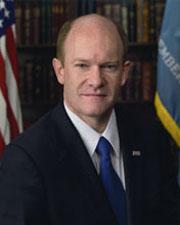
United States · Official source
4,516 records where Sen. Coons, Christopher A. [D-DE] is listed as a sponsor, author, or other actor. Search with topics and years
United States · United States Congress · 13 May 2025
United States · United States Congress · 12 May 2025
United States · United States Congress · 8 May 2025
This resolution recognizes the significance of Asian American, Native Hawaiian, and Pacific Islander Heritage Month as an important time to celebrate the significant contributions of Asian Americans, Native Hawaiians, and Pacific Islanders to the history of the United States.
United States · United States Congress · 8 May 2025
Chip Security Act This bill requires covered integrated circuit products (e.g., advanced computing chips) to incorporate certain security mechanisms. Specifically, the bill directs the Department of Commerce to require any covered integrated circuit product to have chip security mechanisms that implement location verification before the product is exported, reexported, or in-country transferred to or in a foreign country. Commerce must require any person that has received a license or other authorization under the Export Control Reform Act of 2018 to export, reexport, or in-country transfer a covered product to promptly report to Commerce's Bureau of Industry and Security if the person obtains credible information that the product has been diverted away from its intended location or has been subjected to tampering. Commerce must, in coordination with the Department of Defense (DOD), conduct an assessment and report to Congress on whether additional chip security mechanisms should be adopted. If Commerce determines additional security measures are necessary, then Commerce must require any covered product to include the secondary chip security mechanisms before the product is exported, reexported, or in-country transferred to or in a foreign country. The bill authorizes Commerce to take certain enforcement actions, such as verifying the ownership and location of a covered product that has been exported, reexported, or in-country transferred to or in a foreign country. Commerce must coordinate with DOD, within two years of the bill's enactment and annually thereafter for three years, to assess new chip security mechanisms and report to Congress.
United States · United States Congress · 8 May 2025
United States · United States Congress · 8 May 2025
United States · United States Congress · 7 May 2025
United States · United States Congress · 7 May 2025
Bankruptcy Administration Improvement Act of 2025 This bill makes several changes to the administration of bankruptcy cases, particularly by increasing certain fees, extending the sunset date of various fees, and extending the term of specified bankruptcy judgeships. The bill increases the fees paid to the trustee in Chapter 7 (liquidation) cases. The bill extends for an additional five years the fees paid quarterly to the U.S. trustee in Chapter 11 (reorganization) cases. The bill also increases the fee percentage for cases with large disbursements, subject to limitations. Finally, temporary bankruptcy judgeships in various districts are extended for an additional five years.
United States · United States Congress · 7 May 2025
United States · United States Congress · 7 May 2025
United States · United States Congress · 7 May 2025
United States · United States Congress · 7 May 2025
United States · United States Congress · 6 May 2025
United States · United States Congress · 6 May 2025
United States · United States Congress · 6 May 2025
United States · United States Congress · 5 May 2025
Improving Police Critical Aid for Responding to Emergencies Act or the Improving Police CARE Act This bill requires the Bureau of Justice Assistance (BJA) within the Department of Justice to develop and publish performance standards for trauma kits that are eligible to be purchased using funds under the Edward Byrne Memorial Justice Assistance Grant program. Additionally, the BJA must develop and publish best practices for the use, deployment, and maintenance of trauma kits by law enforcement agencies.
United States · United States Congress · 5 May 2025
United States · United States Congress · 5 May 2025
This resolution honors the contributions of small businesses in the United States and supports the designation of National Small Business Week.
United States · United States Congress · 5 May 2025
This resolution recognizes the centrality of a free press to free societies and democratic governance and expresses concerns about threats to the exercise of freedom of expression globally.
United States · United States Congress · 5 May 2025
United States · United States Congress · 1 May 2025
United States · United States Congress · 1 May 2025
United States · United States Congress · 1 May 2025
United States · United States Congress · 1 May 2025
United States · United States Congress · 1 May 2025
Patent Eligibility Restoration Act of 2025 This bill amends the law relating to patent subject matter eligibility to establish that only specified subject matter (e.g., a natural process wholly independent of human activity) is ineligible for patenting. (Currently, subject matter eligibility is determined by examining whether the claimed invention is directed to certain ineligible categories, and if so, whether there is an inventive concept. Subject matter eligibility is one of several requirements that an invention must satisfy in order to receive patent protection.) Under this bill, an invention shall be considered to involve patent-ineligible subject matter only if it falls within specified categories, such as (1) a mathematical formula that is not part of a useful process, machine, manufacture, or composition; (2) a mental process that is performed solely in the human mind; or (3) an unmodified human gene as the gene exists in the human body.
United States · United States Congress · 1 May 2025
Promoting and Respecting Economically Vital American Innovation Leadership Act or the PREVAIL Act This bill addresses various issues relating to the U.S. Patent and Trademark Office (USPTO), including by imposing additional requirements on administrative patent validity challenges (proceedings to review and potentially cancel issued patents) at the USPTO. The bill modifies provisions relating to inter partes reviews (IPRs) and other administrative patent validity proceedings, including by prohibiting an administrative patent judge who participated in deciding whether to institute an IPR (i.e., whether to allow the IPR to proceed based on the initial petition) from also participating in deciding the final outcome of the same IPR; prohibiting a person (individual or entity) from petitioning for an IPR against a patent unless the person meets certain standing requirements (currently, any person may petition for an IPR); prohibiting a person who has challenged a patent's validity in an IPR from raising the same challenges against the patent in other proceedings (e.g., district court) if the IPR has been instituted; and raising the burden that the petitioner in an IPR must meet to invalidate a previously issued patent claim. The bill also makes institutions of higher education (IHEs) and nonprofit entities that hold patents on behalf of IHEs eligible for reduced patent-related fees, including filing fees. (Currently, employees of IHEs are eligible for reduced fees but not the IHEs themselves.) The bill also makes fees collected by the USPTO available for the USPTO's use without further appropriations from Congress.
United States · United States Congress · 1 May 2025
Living Donor Protection Act of 2025 This bill prohibits life insurance, disability insurance, and long-term insurance carriers from denying or otherwise restricting coverage for living organ donors. Specifically, carriers may not deny, cancel, vary premiums, or otherwise impose conditions on policies based on an individual's status as a living organ donor. The bill also expressly specifies that recovery from organ-donation surgery constitutes a serious health condition that entitles eligible employees to job-protected medical leave. In addition, the Department of Health and Human Services must update educational materials on living organ donation to include information about the benefits and risks of living organ donation and the impact of donation on insurance access, particularly with respect to the bill's changes.
United States · United States Congress · 1 May 2025
Retired Law Enforcement Officers Continuing Service Act This bill authorizes the Department of Justice to award grants for state, local, tribal, and territorial law enforcement agencies to hire retired law enforcement personnel to perform civilian law enforcement tasks on behalf of the agency and to train civilian employees in the performance of such tasks. Under the bill, the term civilian law enforcement task includes assisting with certain investigations, reviewing camera footage, conducting crime scene analysis, and conducting forensic analysis.
United States · United States Congress · 1 May 2025
Securing and Enabling Commerce Using Remote and Electronic Notarization Act of 2025 or the SECURE Notarization Act of 2025 This bill allows a notary public commissioned under state law to remotely notarize electronic records and perform notarizations for remotely located individuals. The bill provides technical requirements for the notarizations, including the creation and retention of video and audio recordings and the use of communication technologies (i.e., video chat). Additionally, the bill requires U.S. courts and states to recognize notarizations—including remote notarizations of electronic records and notarizations of remotely-located individuals—that occur in or affect interstate commerce and are performed by a notary public commissioned under the laws of other states. The bill also allows a notary public to remotely notarize electronic records involving an individual located outside of the United States, subject to certain requirements.
United States · United States Congress · 1 May 2025
United States · United States Congress · 30 April 2025
United States · United States Congress · 30 April 2025
This bill increases the annual limit on the tax credit for qualified railroad track maintenance expenses (also referred to as the short line railroad tax credit) and expands eligibility for claiming the credit. Under current law, the tax credit is limited each tax year to $3,500 multiplied by the sum of the number of miles of railroad track owned or leased by the taxpayer (miles owned or leased) and the number of railroad track miles assigned to the taxpayer by a Class II or III railroad (miles assigned). This bill increases the annual limit to $6,100 multiplied by the sum of miles owned or leased and miles assigned. The $6,100 amount used in the calculation of the tax credit limit is adjusted for inflation for tax years beginning after 2025. The bill also expands eligibility for the tax credit to include gross expenses for maintaining railroad tracks owned or leased as of January 1, 2024. Under current law, the tax credit is limited to gross expenses for maintaining railroad tracks owned or leased as of January 1, 2015.
United States · United States Congress · 30 April 2025
United States · United States Congress · 30 April 2025
Assault Weapons Ban of 2025 This bill makes it a crime to knowingly import, sell, manufacture, transfer, or possess a semiautomatic assault weapon (SAW) or large capacity ammunition feeding device (LCAFD). The prohibition does not apply to a firearm that is (1) manually operated by bolt, pump, lever, or slide action, except for certain shotguns; (2) permanently inoperable; (3) an antique; (4) only capable of firing rimfire ammunition; or (5) a rifle or shotgun specifically identified by make and model. The bill also exempts from the prohibition the following, with respect to a SAW or LCAFD: importation, sale, manufacture, transfer, or possession related to certain law enforcement efforts, or authorized tests or experiments; importation, sale, transfer, or possession related to securing nuclear materials; and possession by a retired law enforcement officer. The bill permits continued possession, sale, or transfer of a grandfathered SAW, which must be securely stored. A licensed gun dealer must conduct a background check prior to the sale or transfer of a grandfathered SAW between private parties. The bill permits continued possession of, but prohibits sale or transfer of, a grandfathered LCAFD. Newly manufactured LCAFDs must display serial number identification. Newly manufactured SAWs and LCAFDs must display the date of manufacture. The bill also allows a state or local government to use Edward Byrne Memorial Justice Assistance Grant Program funds to compensate individuals who surrender a SAW or LCAFD under a buy-back program.
United States · United States Congress · 30 April 2025
United States · United States Congress · 29 April 2025
United States · United States Congress · 29 April 2025
Claiming Age Clarity Act This bill changes certain terms that are used by the Social Security Administration (SSA) to describe the ages at which a worker may claim Social Security retirement benefits. First, the SSA must use minimum monthly benefit age instead of early eligibility age . This refers to the earliest age (62 under current law) at which a worker may claim benefits. (Currently, the benefit amount of a worker who claims benefits early is reduced to account for the longer period during which the worker is expected to receive benefits.) Second, the SSA must use standard monthly benefit age instead of full retirement age and normal retirement age . These terms refer to the age at which a worker may claim benefits without a reduction in the benefit amount. (Currently, this age ranges from 65 to 67, depending on the worker's year of birth.) Finally, the SSA must use the term maximum monthly benefit age for any reference to age 70 as the maximum age at which a worker may receive delayed retirement credits. The SSA may not use the term delayed retirement credit. These terms refer to the mechanism that increases the benefit amount of a worker who delays claiming benefits after reaching the full retirement age. (Currently, a worker receives a credit for each month between the full retirement age and age 70 that the worker delays claiming benefits. Each credit increases the benefit amount that the worker will receive after claiming benefits by a specified percentage.)
United States · United States Congress · 29 April 2025
United States · United States Congress · 28 April 2025
Safe American Food Exports Act of 2025 or the SAFE Act of 2025 This bill provides statutory authority for the Department of Agriculture to preemptively negotiate regional export ban agreements for known animal disease threats that apply only to areas affected by animal disease outbreaks to enable the continuation of exports from areas not affected by an outbreak. The Animal and Plant Health Inspection Service, the Food Safety and Inspection Service, and the Foreign Agricultural Service, in consultation with the Office of the U.S. Trade Representative, may negotiate the regionalization, zoning, compartmentalization, and other agreements regarding outbreaks of known animal disease threats of trade significance with countries with export markets for livestock animals or animal products from the United States. The bill also specifies that such a negotiation should take into account accepted global research advances.
United States · United States Congress · 10 April 2025
United States · United States Congress · 10 April 2025
Service Dogs Assisting Veterans Act of 2025 or the SAVES Act of 2025 This bill requires the Department of Veterans Affairs (VA) to establish a five-year pilot program to award grants on a competitive basis to nonprofit entities to provide service dogs to veterans who have certain disabilities, conditions, or diagnoses (e.g., a visual impairment). Under the program, the VA may provide up to $2 million to a nonprofit entity in a fiscal year. The VA must provide a veterinary insurance policy to veterans who receive a service dog through a grant under the program.
United States · United States Congress · 10 April 2025
United States · United States Congress · 10 April 2025
United States · United States Congress · 10 April 2025
United States · United States Congress · 10 April 2025
United States · United States Congress · 10 April 2025
United States · United States Congress · 10 April 2025
United States · United States Congress · 10 April 2025
United States · United States Congress · 10 April 2025
United States · United States Congress · 10 April 2025