Bill· HRH.R. 3243 (119th)referred
Therapeutic Fraud Prevention Act of 2025
United States · United States Congress · 7 May 2025
The world's political record
Person
United States · Official source
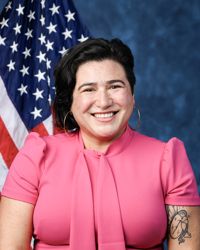
431 records where Rep. Randall, Emily [D-WA-6] is listed as a sponsor, author, or other actor. Search with topics and years
United States · United States Congress · 7 May 2025
United States · United States Congress · 5 May 2025
United States · United States Congress · 5 May 2025
United States · United States Congress · 5 May 2025
This resolution recognizes the historic struggle of the people of Mexico for independence and freedom, which Cinco de Mayo commemorates, and encourages the people of the United States to observe Cinco de Mayo.
United States · United States Congress · 1 May 2025
Ensuring Community Access to Pharmacist Services Act This bill provides for permanent coverage under Medicare of certain pharmacist services. Specifically, the bill provides for permanent coverage of testing and treatment services provided by pharmacists relating to (1) COVID-19, influenza, respiratory syncytial virus (RSV), and streptococcal pharyngitis (strep throat); and (2) other public health needs in relation to a declared public health emergency. (Similar authorities were temporarily granted during the COVID-19 public health emergency.) Such services must be provided in accordance with the applicable state laws governing pharmacists' scope of practice.
United States · United States Congress · 1 May 2025
United States · United States Congress · 30 April 2025
United States · United States Congress · 30 April 2025
Assault Weapons Ban of 2025 This bill makes it a crime to knowingly import, sell, manufacture, transfer, or possess a semiautomatic assault weapon (SAW) or large capacity ammunition feeding device (LCAFD). The prohibition does not apply to a firearm that is (1) manually operated by bolt, pump, lever, or slide action, except for certain shotguns; (2) permanently inoperable; (3) an antique; (4) only capable of firing rimfire ammunition; or (5) a rifle or shotgun specifically identified by make and model. The bill also exempts from the prohibition the following, with respect to a SAW or LCAFD: importation, sale, manufacture, transfer, or possession related to certain law enforcement efforts, or authorized tests or experiments; importation, sale, transfer, or possession related to securing nuclear materials; and possession by a retired law enforcement officer. The bill permits continued possession, sale, or transfer of a grandfathered SAW, which must be securely stored. A licensed gun dealer must conduct a background check prior to the sale or transfer of a grandfathered SAW between private parties. The bill permits continued possession of, but prohibits sale or transfer of, a grandfathered LCAFD. Newly manufactured LCAFDs must display serial number identification. Newly manufactured SAWs and LCAFDs must display the date of manufacture. The bill also allows a state or local government to use Edward Byrne Memorial Justice Assistance Grant Program funds to compensate individuals who surrender a SAW or LCAFD under a buy-back program.
United States · United States Congress · 29 April 2025
Equality Act This bill prohibits discrimination based on sex, sexual orientation, or gender identity with respect to businesses, employment, housing, federally funded programs, and other settings. Specifically, the bill expands Title II and Title VI of the Civil Rights Act of 1964 to prohibit public accommodations and federally funded programs, respectively, from discriminating based on sex, sexual orientation, or gender identity. It also includes stores, transit services, recreational facilities, and establishments that provide health care, accounting, or legal services as public accommodations under Title II. The bill also expands Title IV (desegregation of public schools) and Title VII (employment discrimination) to specifically include sexual orientation and gender identity. (The Supreme Court held in Bostock v. Clayton County that Title VII's prohibition of employment discrimination based on sex also prohibits employment discrimination based on sexual orientation or gender identity.) The bill similarly expands the Fair Housing Act (discrimination in public and private housing) to include sexual orientation and gender identity. It also prohibits discrimination based on sexual orientation or gender identity by creditors and with respect to jury selection. The bill defines sex for purposes of the aforementioned provisions to include sex stereotypes, pregnancy, childbirth, sexual orientation, gender identity, and sex characteristics.
United States · United States Congress · 29 April 2025
United States · United States Congress · 29 April 2025
Medicare for All Act This bill establishes a national health insurance program that is administered by the Department of Health and Human Services (HHS). Among other requirements, the program must (1) cover all U.S. residents; (2) provide for automatic enrollment of individuals upon birth or residency in the United States; and (3) cover items and services that are medically necessary or appropriate to maintain health or to diagnose, treat, or rehabilitate a health condition, including hospital services, prescription drugs, mental health and substance abuse treatment, dental and vision services, long-term care, gender affirming care, and reproductive care, including contraception and abortions. The bill prohibits cost-sharing (e.g., deductibles, coinsurance, and copayments) and other charges for covered services. Additionally, private health insurers and employers may only offer coverage that is supplemental to, and not duplicative of, benefits provided under the program. Health insurance exchanges and specified federal health programs terminate upon program implementation. However, the program does not affect coverage provided through the Department of Veterans Affairs or the Indian Health Service. The bill also establishes a series of implementing provisions relating to (1) health care provider participation; (2) HHS administration; and (3) payments and costs, including the requirement that HHS negotiate prices for prescription drugs. Individuals who are age 18 or younger, age 55 or older, or already enrolled in Medicare may enroll in the program starting one year after enactment of this bill; other individuals may buy into the program at this time. The program must be fully implemented two years after enactment.
United States · United States Congress · 28 April 2025
United States · United States Congress · 21 April 2025
United States · United States Congress · 17 April 2025
United States · United States Congress · 10 April 2025
United States · United States Congress · 10 April 2025
Northwest Straits Marine Conservation Initiative Reauthorization Act of 2025 This bill revises and reauthorizes for seven years the Northwest Straits Marine Conservation Initiative and its Northwest Straits Advisory Commission. The initiative and the commission work to protect and restore marine waters, habitats, and species of the Northwest Straits region (i.e., the waters of the Strait of Juan de Fuca and of Puget Sound from the Canadian border to the south end of Snohomish County in Washington state). Among other duties, the commission must provide resources and technical support for marine resources committees, develop scientifically sound restoration and protection recommendations, and serve as a public forum for informal policy discussions about the marine ecosystem of the Northwest Straits region.
United States · United States Congress · 10 April 2025
United States · United States Congress · 9 April 2025
Gas-Operated Semi-Automatic Firearms Exclusion Act or the GOSAFE Act This bill establishes a framework to regulate gas-operated semiautomatic firearms and large capacity ammunition feeding devices under federal firearms laws. First, the bill generally prohibits the import, sale, manufacture, transfer, receipt, or possession of a firearm that is or is modified to operate as a prohibited gas-operated semiautomatic firearm; a combination of parts that modify or can be assembled into a prohibited gas-operated semiautomatic firearm, or that produce an unlawful gas-operated semiautomatic cycling action; a device or combination of parts designed to materially increase the rate of fire of a semiautomatic firearm; or a firearm that is modified to materially increase the rate of fire. Second, the bill generally prohibits (1) the import, sale, manufacture, transfer, or receipt of a large capacity ammunition feeding device; or (2) the possession of a large capacity ammunition feeding device manufactured after the date of enactment. A violation is subject to criminal penalties—a fine, a prison term of up to 12 months, or both, for each violation. In addition, an individual who possesses a prohibited gas-operated semiautomatic firearm during a federal felony offense is subject to additional penalties—a fine, a mandatory minimum prison term of two years, or both. Finally, the bill allows a state or local government to use Edward Byrne Memorial Justice Assistance Grant Program funds to compensate individuals who surrender gas-operated semiautomatic firearms and large capacity ammunition feeding devices under a buy-back program.
United States · United States Congress · 9 April 2025
United States · United States Congress · 9 April 2025
United States · United States Congress · 9 April 2025
United States · United States Congress · 9 April 2025
United States · United States Congress · 8 April 2025
United States · United States Congress · 8 April 2025
United States · United States Congress · 8 April 2025
United States · United States Congress · 8 April 2025
United States · United States Congress · 8 April 2025
United States · United States Congress · 8 April 2025
United States · United States Congress · 7 April 2025
United States · United States Congress · 7 April 2025
United States · United States Congress · 3 April 2025
United States · United States Congress · 2 April 2025
United States · United States Congress · 1 April 2025
Workplace Violence Prevention for Health Care and Social Service Workers Act This bill requires the Department of Labor to address workplace violence in health care, social service, and similar sectors. Specifically, Labor must issue an occupational safety and health standard that requires certain employers to take actions to protect workers and other personnel from workplace violence. The standard applies to employers in the health care sector, in the social service sector, and in sectors that conduct activities similar to those in the health care and social service sectors. Among other elements, the standard must require each employer to (1) develop a workplace violence prevention plan, (2) promptly investigate incidents of workplace violence, and (3) provide relevant training and education to employees. The bill requires certain hospitals and skilled nursing facilities to comply with this standard as a condition of Medicare participation.
United States · United States Congress · 1 April 2025
Protect America's Workforce Act This bill nullifies the Executive Order titled Exclusions from Federal Labor-Management Relations Programs (issued on March 27, 2025), which excludes specified executive agencies and subdivisions from the Federal Service Labor-Management Relations Statute. The statute authorizes federal employees' participation in collective bargaining and enforces collective bargaining rights. The bill also specifies that a covered collective bargaining agreement in place as of March 26, 2025, shall have full force and effect through the stated term of the agreement.
United States · United States Congress · 1 April 2025
United States · United States Congress · 1 April 2025
Reentry Act of 2025 This bill allows for Medicaid payment of medical services furnished to an incarcerated individual during the 30-day period preceding the individual's release. The Medicaid and Children's Health Insurance Program (CHIP) Payment and Access Commission must report on specified information relating to the accessibility and quality of health care for incarcerated individuals, including the impact of the bill's changes.
United States · United States Congress · 1 April 2025
Sanctioning Russia Act of 2025 This bill imposes penalties on certain persons (individuals and entities) if the President determines that the Russian government or a person acting at Russia's direction is involved with (1) refusing to negotiate a peace agreement with Ukraine; (2) violating a negotiated peace agreement; (3) initiating another invasion of Ukraine; or (4) overthrowing, dismantling, or seeking to subvert the Ukrainian government. If the President makes such a determination, the bill requires certain actions including the President must impose visa- and property-blocking sanctions on specified persons such as the Russian president, certain Russian military commanders, and any foreign person that knowingly provides defense items to the Russian armed forces; the President must increase the rate of duty on all goods and services imported from Russia into the United States to at least 500% relative to the value of such goods and services; the President must increase the rate of duty on all goods and services imported into the United States from countries that knowingly engage in the exchange of Russian-origin uranium and petroleum products to at least 500% relative to the value of such goods and services; the Department of the Treasury must impose property-blocking sanctions on any financial institution organized under Russian law and owned wholly or partly by Russia, and any financial institution that engages in transactions with those entities; and the Department of Commerce must prohibit the export, reexport, or in-country transfer to or in Russia of any U.S.-produced energy or energy product.
United States · United States Congress · 31 March 2025
United States · United States Congress · 31 March 2025
Arts Education for All Act This bill expands arts education and programming for children in early education, K-12 students, and juveniles and adults in the criminal justice system. Specifically, the bill allows Child Care and Development Block Grant funding to be used for additional activities, including arts programming. Additionally, the bill addresses arts programming in elementary and secondary schools by directing each state educational agency to include information on arts programming in its state plan, including how it will integrate arts education instruction into the curriculum and increase the number of arts teachers in schools; requiring state report cards to include information on arts courses; requiring local educational agency (LEA) plans to describe how the LEA will encourage the use of arts education to improve student achievement; and allowing certain funds to be used for professional development for arts teachers. The bill directs the National Center for Education Research to carry out research on the use of arts and arts education in elementary and secondary schools, including in low-performing schools. Further, the National Center for Education Statistics must compile data on arts education. The National Assessment of Educational Progress must include a specified arts assessment. The bill requires a state's juvenile justice and delinquency plan to describe how the state will coordinate services and activities for juvenile justice and delinquency prevention with arts agencies and arts organizations. Additionally, grants for adult offender reentry demonstration projects may be used for facilitating arts education.
United States · United States Congress · 31 March 2025
United States · United States Congress · 31 March 2025
United States · United States Congress · 31 March 2025
Alleviating Barriers for Caregivers Act or the ABC Act This bill requires federal agencies to review and modify the administrative processes related to Medicare, Medicaid, the Children's Health Insurance Program (CHIP), and Social Security programs in order to streamline these processes for family caregivers. Specifically, the Centers for Medicare & Medicaid Services (CMS) and the Social Security Administration (SSA) must review processes related to eligibility determinations, applications, forms, and communications for these programs and identify ways to simplify and streamline these processes for family caregivers (e.g., reducing the need for family caregivers to submit the same information for multiple programs). The CMS and SSA must solicit input from family caregivers and state and regional organizations, implement any identified improvements, and report on these efforts to Congress. In addition, the CMS must issue a letter to state Medicaid and CHIP programs that encourages states to conduct a similar review and that provides potential improvements.
United States · United States Congress · 27 March 2025
United States · United States Congress · 27 March 2025
United States · United States Congress · 26 March 2025
Food Secure Strikers Act of 2025 This bill allows certain striking workers and their households to maintain their eligibility for the Supplemental Nutrition Assistance Program (SNAP). Specifically, the bill provides that a household that would otherwise be eligible to participate in SNAP is eligible for benefits if any member of the household is on strike because of a labor dispute. Current law generally prohibits a household from participating in SNAP if any member of the household is on strike unless the household was eligible for SNAP immediately prior to the strike. Also, under current law, households are not eligible for an increased SNAP allotment as a result of the decreased income of a striking member of the household. The bill expands SNAP eligibility for households with striking workers by repealing both of these restrictions. The bill also allows a government employee who is dismissed for striking and their household to maintain SNAP program eligibility. Specifically, current law prohibits certain individuals who voluntarily and without good cause quit a job from participating in SNAP. Further, a federal, state, or local government employee who participates in a strike against the government that results in their dismissal is considered to have voluntarily quit without good cause. The bill eliminates the provision that considers the dismissed government employee to have voluntarily quit without good cause, thereby allowing the employee and their household to maintain SNAP program eligibility if they are otherwise eligible for the program.
United States · United States Congress · 26 March 2025
Quinault Indian Nation Land Transfer Act This bill administratively transfers approximately 72 acres of specified lands in Washington from the U.S. Forest Service to the Department of the Interior. Interior must take this land into trust for the benefit of the Quinault Indian Nation. Land taken into trust shall be part of the tribe's reservation. The bill prohibits gaming on the land taken into trust. The bill requires Interior, for purposes of taking the land into trust, to meet the disclosure requirements for hazardous substances, pollutants, or contaminants, without otherwise being required to remediate or abate those hazardous substances, pollutants, or contaminants.
United States · United States Congress · 26 March 2025
Lower Elwha Klallam Tribe Project Lands Restoration Act This bill takes approximately 1,082.63 acres of specified lands in Washington into trust for the benefit of the Lower Elwha Klallam Tribe. Land taken into trust shall be part of the tribe's reservation. Further, the bill prohibits gaming on the land taken into trust.
United States · United States Congress · 26 March 2025
United States · United States Congress · 25 March 2025
United States · United States Congress · 25 March 2025
Protecting Students with Disabilities Act This bill prohibits the use of appropriated funds to eliminate the Department of Education's (ED's) oversight of the Individuals with Disabilities Education Act (IDEA). (The IDEA authorizes grant programs that support special education and early intervention services for children with disabilities. Currently, the IDEA is administered by the Office of Special Education Programs in the Office of Special Education and Rehabilitative Services in ED.) Specifically, the bill prohibits the use of appropriated funds to eliminate, consolidate, or otherwise restructure any office within ED that administers or enforces programs under the IDEA. Further, appropriated funds may not be used to (1) terminate, reassign, or alter the responsibilities of any personnel of any such office; or (2) contract with, or delegate to, any entity outside of ED to administer or enforce IDEA programs. (On March 20, 2025, President Donald Trump signed an executive order titled Improving Education Outcomes by Empowering Parents, States, and Communities , calling for the closure of ED and giving authority over education to the states. Further, the Trump Administration has announced plans to transfer ED's oversight of services for students with disabilities to the Department of Health and Human Services.)