Bill· HRH.R. 7817 (119th)referred
No Federal Tax Dollars for Illegal Aliens Health Insurance Act of 2026
United States · United States Congress · 5 March 2026
The world's political record
Person
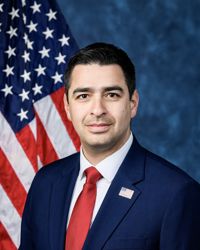
United States · Official source
280 records where Rep. Evans, Gabe [R-CO-8] is listed as a sponsor, author, or other actor. Search with topics and years
United States · United States Congress · 5 March 2026
United States · United States Congress · 3 March 2026
United States · United States Congress · 20 February 2026
Airspace Location and Enhanced Risk Transparency Act of 2026 or the ALERT Act This bill addresses aviation safety by increasing requirements for aircraft tracking and communication using Automatic Dependent Surveillance-Broadcast (ADS-B) technology and expanding oversight. As background, ADS-B for broadcasting (Out) and receiving (In) transmits information (e.g., location and weather) among aircraft and air traffic control (ATC). The bill requires the Department of Defense (DOD) and the Department of Transportation (DOT) to enter into an agreement regarding the use of collision prevention technologies on DOD aircraft. The agreement must require the use of ADS-B Out as the default practice for DOD helicopters operating in the national airspace, unless such use would affect operational security. For DOD helicopters that are carrying out special missions in the Washington, DC, metropolitan area and are exempt from ADS-B Out transmission requirements, DOD must coordinate with DOT to conduct a safety risk assessment and implement appropriate mitigations. By December 31, 2031, DOD aircraft (other than certain special mission aircraft) must be equipped with and operating integrated ADS-B In technology. With respect to civil aircraft, by December 31, 2031, the Federal Aviation Administration (FAA) must generally require aircraft that are currently required to be equipped with ADS-B Out to also be equipped with ADS-B In. Additionally, among other requirements, the FAA must establish time-on-position limits for supervisory ATC personnel; establish a process to timely notify parties involved in certain near-miss incidents; and evaluate and revise, as necessary, helicopter routes around Ronald Reagan Washington National Airport.
United States · United States Congress · 20 February 2026
United States · United States Congress · 13 February 2026
ELO Realignment and Strategic Engagement Reform Act of 2026 This bill requires the Department of Homeland Security (DHS) to develop a comprehensive plan to reorganize its Engagement, Liaison, and Outreach (ELO) Office and submit such plan to Congress. The bill also limits certain DHS actions until DHS submits the plan to Congress and certifies that it is being implemented. ELO is part of DHS's Office of Intelligence and Analysis (I&A). ELO manages strategic relationships with I&A’s international stakeholders and federal, state, local, tribal, territorial, and private sector partners, including by facilitating intelligence and information sharing. Under the bill, the plan must identify redundant or non-essential positions, programs, or functions within ELO; specify how reorganization of ELO will address such redundant or non-essential positions, programs, or functions; realign essential functions and personnel of ELO within the Partner Engagement directorate of I&A; and improve the management and coordination of strategic relationships with priority law enforcement agencies. Until DHS submits this plan to Congress and certifies that it is being implemented, DHS may not (1) expand the staffing, budget, or programmatic scope of ELO; or (2) establish new offices duplicating the mission of ELO or the Partner Engagement directorate without congressional authorization.
United States · United States Congress · 11 February 2026
United States · United States Congress · 11 February 2026
United States · United States Congress · 10 February 2026
United States · United States Congress · 9 February 2026
United States · United States Congress · 2 February 2026
Energy Threat Analysis Center Act of 2026 This bill reauthorizes through FY2031 and expands the pilot Energy Sector Operational Support for Cyber Resilience Program of the Department of Energy (DOE). The program aims to protect energy infrastructure through collaboration between the federal government and the energy sector and enhancing DOE’s emergency response capabilities. Specifically, the bill expands the program objectives to include enhancing collaboration between the government and the energy sector to address threats to energy systems, advancing the collective understanding of national security risks and vulnerabilities associated with the energy sector that may be exploited by adversaries, and helping the energy sector increase its understanding of tactics of adversaries that present risks to the energy sector. The bill allows DOE to establish an Energy Threat Analysis Center at one or more physical locations for program activities. The bill also eliminates technical assistance provided under the program to small electric utilities. Under the bill, the decision to provide assistance or information under the program to a governmental or private entity is at the sole discretion of the Secretary of Energy and is unreviewable. The bill authorizes the Secretary to (1) enter into and perform contracts, grants, and other transactions with public agencies, private organizations, and persons to carry out the program; and (2) establish and utilize preapproved national security contracting mechanisms, model partnership agreements, and expedited review procedures for purposes of entering into such transactions. In addition, the bill exempts the program from certain public disclosure and other transparency requirements.
United States · United States Congress · 30 January 2026
United States · United States Congress · 16 January 2026
United States · United States Congress · 13 January 2026
Hemp Planting Predictability Act This bill extends by two years the implementation of changes to the regulation of hemp products, which reimpose certain federal controls over some hemp products. Specifically, Congress enacted the FY2026 agriculture appropriations act (P.L. 119-37) on November 12, 2025. Effective November 12, 2026, the act modifies the statutory definition of hemp products that are considered to be lawful. This bill extends the effective date to November 12, 2028. As background, the 2018 farm bill excluded hemp from the Controlled Substances Act definition of marijuana and defined hemp . As a result, hemp and hemp-derived products at or below the 0.3% delta-9 tetrahydrocannabinol (THC, the psychoactive component of marijuana) concentration threshold were no longer regulated as Schedule I controlled substances and registration with the Drug Enforcement Administration was no longer required to cultivate or handle hemp and hemp-derived products. However, hemp remained subject to Department of Agriculture and Food and Drug Administration regulation. The 2025 changes to the definition of hemp, include changing the limit to a total THC concentration of not more than 0.3% on a dry weight basis rather than only delta-9 THC, explicitly including industrial hemp, excluding seeds from a cannabis plant that exceed a certain THC concentration, and excluding various types of hemp-derived cannabinoid products. Cannabinoids refer to unique chemical compounds that are found in hemp and marijuana (e.g., THC) and are known to exhibit a range of psychological and physiological effects.
United States · United States Congress · 13 January 2026
Developing Overseas Mineral Investments and New Allied Networks for Critical Energies Act or the DOMINANCE Act This bill establishes a Bureau of Energy Security and Diplomacy in the Department of State and authorizes several programs to address access to energy and critical minerals. The bureau must formulate and implement policies related to international energy, energy technology, critical minerals, and related supply chains. An assistant secretary is authorized to lead the bureau. The bill authorizes the State Department to establish multi-year energy security compacts with partner countries. The purpose of such compacts is to increase reliable access to energy, electricity, or critical minerals for both parties to the compact. The bill also authorizes the State Department to lead U.S. participation in a Minerals Security Partnership (MSP), whose purpose includes supporting investment in critical mineral mining, processing, and refining projects that enable critical mineral supply chains. The United States must prioritize MSP projects that advance the national and economic security interests of the United States and U.S. allies and partners. Fellowships are authorized to support (1) U.S. citizens attending foreign mining institutions in order to build the capacity of the U.S. mining workforce; and (2) foreign mining academics and professionals being placed at U.S. institutions to help advance research and development initiatives in the U.S. mining industry and expand U.S. mining education and workforce development programs.
United States · United States Congress · 13 January 2026
United States · United States Congress · 12 January 2026
Stop Insider Trading Act This bill generally prohibits Members of Congress and their spouses and dependent children from purchasing stocks and requires public notice before these individuals may sell stocks. Specifically, Members of Congress and the spouses and dependent children of Members of Congress may not purchase covered investments. Between 7 and 14 days before a Member or a covered spouse or dependent sells a covered investment, the relevant Member must file public notice of the intent to sell with the Clerk of the House of Representatives or the Secretary of the Senate, as appropriate. The Clerk or Secretary must publish this notice online. If the individual decides not to sell the covered investment, the notice must be withdrawn. Under the bill, a covered investment is a security issued by a publicly traded company or a comparable economic interest. Some investments are exempt, including interest in a widely held investment fund and certain investments held in a trust. Violations of these provisions are subject to a fee and, in the case of a purchase, a requirement to sell the covered investment. The fee must equal (1) the greater of $2,000 or 10% of the transaction value, and (2) any net gain realized from the transaction during a specified period. The fee may not be paid using campaign donations or Members’ official allowances. Certain transactions by covered spouses and dependents are exempt, including transactions made on behalf of another person or made as part of compensation from the individual’s employer.
United States · United States Congress · 12 January 2026
This bill extends by two years the implementation of changes to the regulation of hemp products, which reimpose certain federal controls over some hemp products. Specifically, Congress enacted the FY2026 agriculture appropriations act (P.L. 119-37) on November 12, 2025. Effective November 12, 2026, the act modifies the statutory definition of hemp products that are considered to be lawful. This bill extends the effective date to November 12, 2028. As background, the 2018 farm bill excluded hemp from the Controlled Substances Act definition of marijuana and defined hemp . As a result, hemp and hemp-derived products at or below the 0.3% delta-9 tetrahydrocannabinol (THC, the psychoactive component of marijuana) concentration threshold were no longer regulated as Schedule I controlled substances and registration with the Drug Enforcement Administration was no longer required to cultivate or handle hemp and hemp-derived products. However, hemp remained subject to Department of Agriculture and Food and Drug Administration regulation. The 2025 changes to the definition of hemp, include changing the limit to a total THC concentration of not more than 0.3% on a dry weight basis rather than only delta-9 THC, explicitly including industrial hemp, excluding seeds from a cannabis plant that exceed a certain THC concentration, and excluding various types of hemp-derived cannabinoid products. Cannabinoids refer to unique chemical compounds that are found in hemp and marijuana (e.g., THC) and are known to exhibit a range of psychological and physiological effects.
United States · United States Congress · 8 January 2026
United States · United States Congress · 7 January 2026
United States · United States Congress · 6 January 2026
United States · United States Congress · 18 December 2025
Protecting Students on Campus Act of 2025 This bill requires the Department of Education (ED) and institutions of higher education (IHEs) participating in federal student aid programs to distribute information on how to report alleged violations of civil rights under Title VI of the Civil Rights Act of 1964. (Title VI of the Civil Rights Act of 1964 prohibits discrimination based on race, color, or national origin in federally funded programs or activities.) Specifically, the bill requires ED's Office for Civil Rights (OCR) to conduct a public awareness campaign regarding the rights of individuals under Title VI. This campaign must be updated annually and distributed to IHEs. The bill requires an IHE to post a link on its website on how to file a Title VI complaint with OCR. Additionally, the IHE must annually post the materials from OCR's public awareness campaign. The information must be posted in high-traffic public places on campus (e.g., student centers) and high-traffic websites (e.g., the website for student services). OCR must give monthly congressional briefings on (1) the number of complaints filed with OCR, (2) how OCR plans to address those complaints and the investigations opened in response to those complaints, and (3) how long those complaints remain open. The bill also requires annual reporting by IHEs on discrimination complaints. Further, the bill directs ED's Office of Inspector General to audit and study discrimination complaints.
United States · United States Congress · 18 December 2025
United States · United States Congress · 16 December 2025
Essential Caregivers Act of 2025 This bill prohibits certain health care facilities from limiting the access of essential caregivers to residents of those facilities, including during designated emergency periods. Specifically, the bill generally prohibits Medicare skilled nursing facilities, Medicaid nursing facilities, Medicaid intermediate care facilities, and associated inpatient rehabilitation facilities from restricting the access of essential caregivers to residents of the facilities, including during emergency periods in which visitation rights are otherwise restricted. During emergency periods, facilities may restrict access for an initial period of up to seven days and for one additional maximum seven-day period (if the additional period is approved by the state health department). Facilities may restrict access for a total of 7 days (or 14 days with the approval of the state health department) during an emergency period. Essential caregivers must agree to comply with any safety protocols set by the facility, which may be no more stringent for caregivers compared to those for staff. Caregivers who fail to comply with these requirements may be denied access, subject to an appeals process.
United States · United States Congress · 11 December 2025
United States · United States Congress · 4 December 2025
United States · United States Congress · 3 December 2025
Fire Improvement and Reforming Exceptional Events Act or the FIRE Act This bill modifies the definition of exceptional events under the Clean Air Act and requires the Environmental Protection Agency (EPA) to revise its regulations regarding exceptional events or actions to mitigate wildfire risk. Generally, the EPA must exclude data from use in determinations of exceedances and violations of national ambient air quality standards (NAAQS) if a state demonstrates that an exceptional event caused a specific air pollution concentration. The bill provides that events caused by human activity that are intended to mirror the occurrence or reoccurrence of a natural event are exceptional events. Additionally, the bill no longer excludes from consideration as an exceptional event (1) meteorological events involving high temperatures or a lack of precipitation, or (2) stagnation of air masses that does not ordinarily occur. The bill requires the EPA to revise regulations regarding the reviewing and handling of air quality monitoring data influenced by actions to mitigate wildfire risk. The bill also requires the EPA to conduct regional modeling and analysis when multiple states submit petitions regarding the same exceptional event or action to mitigate wildfire risk.
United States · United States Congress · 3 December 2025
Home School Graduation Recognition Act This bill clarifies that students who complete their secondary education in a home school setting recognized under state law are high school graduates for purposes of eligibility for federal student aid.
United States · United States Congress · 2 December 2025
United States · United States Congress · 25 November 2025
United States · United States Congress · 21 November 2025
United States · United States Congress · 19 November 2025
United States · United States Congress · 12 November 2025
This bill repeals the authority for a Senator to bring a civil action against the federal government if an internet service provider or the Senate Sergeant at Arms (SAA) accessed or disclosed, or accesses or discloses, data from the Senator's office to provide to a federal agency without following prescribed notice requirements. The authority applies to a qualifying instance occurring on or after January 1, 2022. The authority for the civil action was enacted in H.R. 5371, the Continuing Appropriations, Agriculture, Legislative Branch, Military Construction and Veterans Affairs, and Extensions Act, 2026 , which was signed by the President on November 12, 2026. The relevant provision requires written notice from the internet service provider or the SAA to the Senate office upon receipt of any legal process seeking access or disclosure of covered data. A Senator affected by a federal violation of the provision may sue the federal government for the greater of $500,000 per violation or the actual damages, plus attorney's fees and related costs.
United States · United States Congress · 10 October 2025
Hiring Preference for Veterans and Americans With Disabilities Act This bill allows states and local jurisdictions to give a hiring preference (when hiring election workers to administer an election in the state or local jurisdiction) to veterans, individuals with a disability, and nonresident military spouses or dependents. Further, the bill prohibits states and local jurisdictions from refusing to hire a nonresident military spouse or dependent as an election worker solely on the grounds that the individual does not maintain a place of residence in the state or local jurisdiction.
United States · United States Congress · 3 October 2025
United States · United States Congress · 26 September 2025
United States · United States Congress · 26 September 2025
United States · United States Congress · 26 September 2025
United States · United States Congress · 23 September 2025
United States · United States Congress · 19 September 2025
United States · United States Congress · 17 September 2025
United States · United States Congress · 16 September 2025
United States · United States Congress · 16 September 2025
Pay Our Troops Act of 2026 This bill provides continuing appropriations for military pay for any period during which interim or full-year appropriations for FY2026 are not in effect (i.e., a government shutdown). Specifically, the bill provides FY2026 continuing appropriations for the pay and allowances of (1) members of the Armed Forces, including reserve components, who perform active service during the period; and (2) civilian personnel and contractors of the Department of Defense (and the Department of Homeland Security in the case of the Coast Guard) who are providing support to such members of the Armed Forces. If a government shutdown occurs, the bill provides the continuing appropriations until the earlier of (1) the enactment into law of specified appropriations legislation, or (2) January 1, 2027.
United States · United States Congress · 16 September 2025
This resolution (1) condemns the assassination of Charles "Charlie" James Kirk and all forms of political violence; and (2) honors the life, leadership, and legacy of Charlie Kirk.
United States · United States Congress · 15 September 2025
This resolution expresses support for the designation of National Clean Energy Week.
United States · United States Congress · 10 September 2025
United States · United States Congress · 10 September 2025
Reforming and Enhancing Sustainable Updates to Laboratory Testing Services Act of 2025 or the RESULTS Act This bill requires the use of particular data from the private sector to inform Medicare payment rates for certain widely available laboratory tests. Specifically, the Centers for Medicare & Medicaid Services (CMS) must contract with an entity that maintains a database of claims data for clinical diagnostic laboratory tests that (1) are not advanced diagnostic tests, and (2) were furnished by more than 100 providers and suppliers of such services over a specified six-month period (i.e., widely available tests). The database must meet specified requirements, such as having data that is representative of the entire country and from more than 50 private payors and claims administrators. The contracted entity must be a nonprofit entity that is not affiliated with any government agency, any insurance issuer or provider, or any other organization in the health care sector. Beginning January 1, 2028, the CMS must use the information obtained from the database to inform Medicare payment rates for these widely available laboratory tests. The bill additionally specifies processes for determining payment rates for laboratory tests that are not advanced diagnostic tests, are not widely available, and lack adequate claims data. The CMS must use certain existing processes to set appropriate rates. The bill also delays scheduled payment reductions for laboratory tests until 2028 and allows for judicial and administrative review of payment rates.
United States · United States Congress · 3 September 2025
United States · United States Congress · 2 September 2025
Protecting Information by Local Leaders for Agency Resilience Act or the PILLAR Act This bill extends the State and Local Cybersecurity Grant Program through FY2035, expands the scope of the program, and imposes certain limits on the use of grant funds. (The program provides grants to states and Indian tribes to address cybersecurity risks to government information systems.) The bill expands the scope of systems that may be secured using grant funds to include operational technology systems and specifies that systems using artificial intelligence are included. Such systems must be maintained, owned, or operated by or on behalf of state, local, or tribal governments. The bill also specifies that grant funds may not be used to purchase software, hardware, or related products or services that do not align with relevant guidance provided by the Cybersecurity and Infrastructure Security Agency (CISA). Further, the bill increases the federal share of costs available to entities that implement or enable multifactor authentication and identity and access management tools for critical infrastructure by a specified date. The bill requires annual reports by grant recipients to include a description of recipients’ progress in assuming the cost of continuing cybersecurity programs after grant funds are fully expended. The Government Accountability Office must periodically review the program. This effort must include a review of artificial intelligence adoption across a sample of grants. Finally, CISA must implement an outreach plan to inform local governments, including governments in rural areas or areas with small populations, about CISA’s no-cost cybersecurity offerings.
United States · United States Congress · 22 August 2025
United States · United States Congress · 15 August 2025