Bill· HRH.R. 5370 (119th)referred
To provide low-income individuals with opportunities to enter and follow a career pathway in the health professions, and for other purposes.
United States · United States Congress · 16 September 2025
The world's political record
Person
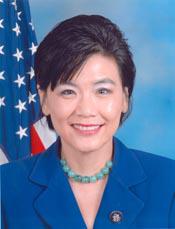
United States · Official source
5,659 records where Rep. Chu, Judy [D-CA-28] is listed as a sponsor, author, or other actor. Search with topics and years
United States · United States Congress · 16 September 2025
United States · United States Congress · 16 September 2025
United States · United States Congress · 15 September 2025
George Floyd Justice in Policing Act of 2025 This bill addresses a wide range of policies and issues regarding policing practices and law enforcement accountability. It increases accountability for law enforcement misconduct, restricts the use of certain policing practices, enhances transparency and data collection, and establishes best practices and training requirements. The bill enhances existing enforcement mechanisms to remedy violations by law enforcement. Among other things, it does the following: lowers the criminal intent standard—from willful to knowing or reckless—to convict a law enforcement officer for misconduct in a federal prosecution, limits qualified immunity as a defense to liability in a private civil action against a law enforcement officer, and grants administrative subpoena power to the Department of Justice (DOJ) in pattern-or-practice investigations. It establishes a framework to prevent and remedy racial profiling by law enforcement at the federal, state, and local levels. It also limits the unnecessary use of force and restricts the use of no-knock warrants, chokeholds, and carotid holds. The bill creates a national registry—the National Police Misconduct Registry—to compile data on complaints and records of police misconduct. It also establishes new reporting requirements, including on the use of force, officer misconduct, and routine policing practices (e.g., stops and searches). Finally, it directs DOJ to create uniform accreditation standards for law enforcement agencies and requires law enforcement officers to complete training on racial profiling, implicit bias, and the duty to intervene when another officer uses excessive force.
United States · United States Congress · 15 September 2025
United States · United States Congress · 15 September 2025
United States · United States Congress · 15 September 2025
United States · United States Congress · 11 September 2025
Indian Programs Advance Appropriations Act of 2025 This bill authorizes advance appropriations for several covered appropriations accounts of (1) the Bureau of Indian Affairs and the Bureau of Indian Education within the Department of the Interior, and (2) the Indian Health Service within the Department of Health and Human Services. The advance appropriations provide new budget authority that first becomes available for the first fiscal year after the budget year. The covered accounts within the Bureau of Indian Affairs are (1) Operation of Indian Programs, (2) Contract Support Costs, (3) the Indian Guaranteed Loan Program, (4) Construction, and (5) Payments for Tribal Leases. The covered accounts within the Bureau of Indian Education are (1) Operation of Indian Education Programs, and (2) Education Construction. The covered accounts within the Indian Health Service are (1) Indian Health Services, (2) Contract Support Costs, (3) Payments for Tribal Leases, and (4) Indian Health Facilities. The bill also requires the President's budget and the supporting documents submitted to Congress to include detailed estimates related to the advance appropriations.
United States · United States Congress · 11 September 2025
United States · United States Congress · 11 September 2025
United States · United States Congress · 11 September 2025
United States · United States Congress · 11 September 2025
United States · United States Congress · 10 September 2025
United States · United States Congress · 9 September 2025
United States · United States Congress · 9 September 2025
United States · United States Congress · 9 September 2025
United States · United States Congress · 8 September 2025
United States · United States Congress · 8 September 2025
United States · United States Congress · 8 September 2025
United States · United States Congress · 8 September 2025
United States · United States Congress · 4 September 2025
United States · United States Congress · 4 September 2025
United States · United States Congress · 3 September 2025
United States · United States Congress · 2 September 2025
United States · United States Congress · 2 September 2025
This resolution supports the designation of a National Military and Veterans Suicide Awareness Day.
United States · United States Congress · 29 August 2025
United States · United States Congress · 26 August 2025
United States · United States Congress · 15 August 2025
United States · United States Congress · 15 August 2025
United States · United States Congress · 15 August 2025
United States · United States Congress · 15 August 2025
United States · United States Congress · 12 August 2025
Keep Seniors Fed Act This bill amends the Supplemental Nutrition Assistance Program (SNAP) to exempt certain Social Security benefits (e.g., retirement and disability benefits) from household income for the purposes of determining program eligibility.
United States · United States Congress · 12 August 2025
United States · United States Congress · 12 August 2025
United States · United States Congress · 8 August 2025
United States · United States Congress · 5 August 2025
United States · United States Congress · 5 August 2025
United States · United States Congress · 5 August 2025
United States · United States Congress · 5 August 2025
United States · United States Congress · 1 August 2025
United States · United States Congress · 1 August 2025
Lowering Obstacles to Achievement Now Act or the LOAN Act This bill revises federal student aid programs, including the Federal Pell Grant program and the Public Service Loan Forgiveness (PSLF) program. It also repeals the education provisions that were enacted under P.L. 119-21 (commonly known as the One Big Beautiful Bill Act). Among other provisions, the bill revises the Federal Pell Grant program by (1) providing funding to increase the maximum award for each eligible student, and (2) allowing income-eligible graduate students to utilize their remaining Pell Grant eligibility toward their first graduate degree. Changes to the PSLF program include (1) reducing the number of monthly loan payments required for loan forgiveness, and (2) removing the requirement that a borrower must be employed in a public service job at the time of forgiveness. The bill makes Dreamer students (i.e., students who have been granted Deferred Action for Childhood Arrivals status and who entered the United States before the age of 18) who meet certain educational criteria eligible for federal financial aid. The bill also (1) establishes refinancing programs for federal and private student loans; (2) creates a new income-driven repayment plan; and (3) repeals origination fees for Direct Subsidized Loans, Direct Unsubsidized Loans, and Direct PLUS Loans. The bill repeals the education provisions that were enacted under P.L. 119-21. For example, the act addressed the amount of federal financial aid available to students by changing the mix and availability of student loans. (For more information, see CRS Report R48727 .)
United States · United States Congress · 1 August 2025
United States · United States Congress · 1 August 2025
United States · United States Congress · 1 August 2025
Protecting Health Care and Lowering Costs Act 2025 This bill makes permanent temporary provisions that generally expand eligibility for and increase the amount of the premium tax credit. This bill also repeals multiple Medicaid, Medicare, and health-related tax provisions enacted by the One Big Beautiful Bill Act (OBBBA). Currently, eligible taxpayers may claim the premium tax credit, which applies toward the cost of obtaining health insurance through health insurance exchanges. To qualify, a taxpayer’s household income must meet or exceed 100% of the federal poverty level (FPL) and, after 2025, may not exceed 400% of the FPL (maximum income limit). For 2021-2025, the maximum income limit is eliminated, which generally expands eligibility for the premium tax credit. Further, under current law, the amount of the premium tax credit is partially based on the taxpayer’s household income multiplied by the applicable percentage. The applicable percentage varies depending on which of six income ranges (adjusted for inflation after 2025) the taxpayer’s household income falls within. For 2021-2025, the applicable percentages are lowered and the adjustment of the applicable percentages for inflation is eliminated, which generally increases the amount of the premium tax credit. The bill permanently eliminates the 400% maximum income limit, lowers the applicable percentages, and eliminates the inflation adjustment for the applicable percentages. Finally, the bill repeals multiple Medicaid, Medicare, and health-related tax provisions enacted by the OBBBA, including certain Medicare and Medicare eligibility and verification requirements, the reduced window for retroactive Medicaid coverage, and premium tax credit verification requirements.
United States · United States Congress · 1 August 2025
Wildfire Emergency Preparedness Act of 2025 This bill establishes grants, training, and interagency coordination for responding to wildfires and fires in the wildland-urban interface (WUI) (i.e., where undeveloped land or vegetation meets human infrastructure). It also requires measures for protecting the health of firefighters and emergency responders. The bill establishes an Under Secretary of Agriculture for Fire Coordination to manage coordination of government preparation and response to wildfires and WUI fires. Such office may award grants to fire departments and emergency medical services organizations for training firefighting personnel or obtaining personal protective equipment for responding to such fires. Also, the Forest Service must establish a national plan with guidelines for training structural (i.e., urban) firefighters to respond to wildfires and WUI fires. The Forest Service may provide grants to certain nonprofit organizations to carry out training programs pursuant to the plan. Upon request from agencies, the Department of Defense (DOD) may allow its firefighters to conduct operations or assist in responding to wildfires and WUI fires. Agencies must reimburse DOD for such services. Additionally, the National Institute for Occupational Safety and Health must perform research and development and report to Congress on protecting the respiratory health of firefighters and identifying certain hazardous substances in areas affected by wildfires and WUI fires. Also, task forces within the National Urban Search and Rescue Response System of the Federal Emergency Management Agency (FEMA) must train each member in peer mental health support and include members who are mental health practitioners.
United States · United States Congress · 29 July 2025
Enhance Access To SNAP Act of 2025 or the EATS Act of 2025 This bill expands eligibility for the Supplemental Nutrition Assistance Program (SNAP) for certain students. Specifically, the bill removes the restriction on SNAP eligibility for students to allow otherwise eligible students who are attending institutions of higher education (IHEs) at least half time to participate in SNAP. Under current law, students 18-49 years old are restricted from participating in SNAP, with exceptions (e.g., caring for a child under the age of 6 or employed for at least 20 hours a week). The Consolidated Appropriations Act, 2021 temporarily exempted some students from certain SNAP eligibility requirements; these temporary student exemptions expired after the end of the COVID-19 public health emergency on May 11, 2023. Further, the bill provides that students enrolled at least half time in a recognized school, training program, or IHE constitute individual households (not residents of institutions ) and may be eligible for SNAP benefits. (Participation in SNAP is limited to households.)
United States · United States Congress · 29 July 2025
United States · United States Congress · 29 July 2025
United States · United States Congress · 29 July 2025
United States · United States Congress · 29 July 2025
United States · United States Congress · 25 July 2025