Bill· HRH.R. 5827 (118th)referred
Tenants’ Right to Organize Act
United States · United States Congress · 29 September 2023
The world's political record
Person
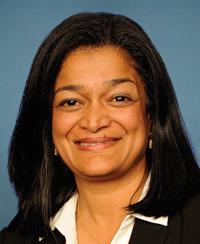
United States · Official source
3,379 records where Rep. Jayapal, Pramila [D-WA-7] is listed as a sponsor, author, or other actor. Search with topics and years
United States · United States Congress · 29 September 2023
United States · United States Congress · 28 September 2023
Indigenous Peoples' Day Act This bill designates Indigenous Peoples' Day as a legal public holiday in lieu of Columbus Day.
United States · United States Congress · 28 September 2023
United States · United States Congress · 28 September 2023
United States · United States Congress · 28 September 2023
Green New Deal for Public Schools Act of 2023 This bill provides environmental and educational resources to public elementary and secondary schools and Bureau of Indian Education (BIE) schools. Specifically, the bill requires the Department of Energy's Office of Energy Efficiency and Renewable Energy to provide climate capital facilities grants to eligible entities (e.g., public schools and BIE schools). Grant recipients must use these funds to construct new, or convert existing facilities into, healthy zero-carbon schools. Healthy zero-carbon school refers to a school with highly energy-efficient facilities that produce or procure sufficient carbon-free and pollution-free renewable energy to meet the school's needs. The bill directs the Department of Education (ED) to award resource block grants to qualified local educational agencies (LEAs) to hire and retain educators and staff in high-need schools. ED must award grants to eligible consortia of LEAs for educational equity planning and implementation. ED must establish the Climate Change Resiliency Program to increase the resiliency of public and BIE schools during climate change-related events, natural disasters, and public health crises. Further, ED must establish a related grant program for state educational agencies. Grant recipients must use these funds for certain activities (e.g., green infrastructure projects). The bill establishes the Office of Sustainable Schools within ED to (1) administer the resource block grant and educational equity grant programs, and (2) coordinate with specified agencies and the White House Office of Domestic Climate Policy on climate capital facilities grants and the Climate Change Resiliency Program.
United States · United States Congress · 27 September 2023
United States · United States Congress · 27 September 2023
United States · United States Congress · 22 September 2023
Tyler Clementi Higher Education Anti-Harassment Act of 2023 This bill addresses harassment at institutions of higher education (IHEs). Specifically, the bill requires each IHE to include in its annual security report a statement of policy regarding harassment on the basis of a student's actual or perceived race, color, national origin, sex (including sexual orientation, gender identity, pregnancy, childbirth, a medical condition related to pregnancy or childbirth, a sex stereotype, and sex characteristics, including intersex traits), disability, or religion. In addition, the Department of Education may award grants to IHEs to initiate, expand, or improve programs to (1) prevent the harassment of students; (2) provide counseling or redress services to students who have been harassed or accused of subjecting other students to harassment; or (3) educate and train students, faculty, or staff to prevent harassment or address harassment if it occurs.
United States · United States Congress · 21 September 2023
United States · United States Congress · 20 September 2023
Marijuana Opportunity Reinvestment and Expungement Act or the MORE Act This bill decriminalizes marijuana. Specifically, it removes marijuana from the list of scheduled substances under the Controlled Substances Act and eliminates criminal penalties for an individual who manufactures, distributes, or possesses marijuana. The bill also makes other changes, including the following: replaces statutory references to marijuana and marihuana with cannabis , requires the Bureau of Labor Statistics to regularly publish demographic data on cannabis business owners and employees, establishes a trust fund to support various programs and services for individuals and businesses in communities impacted by the war on drugs, imposes an excise tax on cannabis products produced in or imported into the United States and an occupational tax on cannabis production facilities and export warehouses, makes Small Business Administration loans and services available to entities that are cannabis-related legitimate businesses or service providers, prohibits the denial of federal public benefits to a person on the basis of certain cannabis-related conduct or convictions, prohibits the denial of benefits and protections under immigration laws on the basis of an event (e.g., conduct or conviction) relating to possession or use of cannabis that is no longer prohibited under the bill, establishes a process to expunge convictions and conduct sentencing review hearings related to federal cannabis offenses, and directs the Government Accountability Office to study the societal impact of cannabis legalization.
United States · United States Congress · 19 September 2023
United States · United States Congress · 19 September 2023
United States · United States Congress · 19 September 2023
United States · United States Congress · 19 September 2023
United States · United States Congress · 19 September 2023
United States · United States Congress · 19 September 2023
United States · United States Congress · 19 September 2023
John R. Lewis Voting Rights Advancement Act of 2023 This bill establishes new criteria for determining which states and political subdivisions must obtain preclearance before changes to voting practices may take effect. Preclearance is the process of receiving preapproval from the Department of Justice (DOJ) or the U.S. District Court for the District of Columbia before making legal changes that would affect voting rights. A state and all of its political subdivisions shall be subject to preclearance of voting practice changes for a 10-year period if, during the previous 25 years: 15 or more voting rights violations occurred in the state; 10 or more violations occurred, at least 1 of which was committed by the state itself; or 3 or more violations occurred and the state administers the elections. A political subdivision as a separate unit shall also be subject to preclearance for a 10-year period if three or more voting rights violations occurred there during the previous 25 years. States and political subdivisions that meet certain thresholds regarding minority groups must preclear covered practices before implementation, such as redistricting. States and political subdivisions must notify the public of changes to voting practices. The bill authorizes DOJ to require states or political subdivisions to provide certain documents or answers to questions for enforcing voting rights. The bill outlines factors courts must consider when hearing challenges to voting practices, such as the extent of any history of official voting discrimination in the state or political subdivision.
United States · United States Congress · 14 September 2023
Protection of Social Security Benefits Restoration Act This bill prohibits the application of, and repeals authority for, administrative offsets to Social Security, railroad retirement, and black lung benefits. (An administrative offset is the withholding of funds payable by or held by the United States to satisfy a debt.)
United States · United States Congress · 14 September 2023
Help Our Kelp Act This bill directs the National Oceanic and Atmospheric Administration (NOAA) to establish a grant program to fund projects to conserve, restore, or manage kelp forest ecosystems. (A kelp forest is a dense grouping of large brown algae which also serves as a habitat for marine life.) Eligible projects include those that address the greatest relative regional declines in kelp forest ecosystems, focus on kelp forest seeding and connectivity, or integrate Indigenous knowledge and cultural practices into the restoration and monitoring of kelp forest ecosystems. The bill specifies that members of the fishing industry, institutions of higher education, nonprofit organizations, Indian tribes, state agencies, and local governments are eligible to receive grants. The bill prohibits a grant from exceeding 85% of the total project cost. However, NOAA may waive this restriction in limited circumstances.
United States · United States Congress · 14 September 2023
No Tax Breaks for Union Busting (NTBUB) Act This bill denies employers a tax deduction for any expenditures incurred for attempting to influence their employees with respect to labor organizations or labor organization activities, such as elections, labor disputes, and collective actions. The bill requires employers to report on their attempts to influence their employees with respect to labor organizations and their activities.
United States · United States Congress · 14 September 2023
This resolution supports the designation of Public Radio Music Day. It also expresses deep appreciation for the role of public radio music stations in serving listeners, musicians, and hundreds of communities in the United States.
United States · United States Congress · 13 September 2023
Child Care Stabilization Act This bill provides additional funding through FY2028 for child care stabilization grants under which lead state agencies make subgrants to child care providers for personnel costs, facility costs, the purchase of personal protective equipment, and other costs related to providing child care services.
United States · United States Congress · 13 September 2023
No Tax Breaks for Union Busting (NTBUB) Act This bill denies employers a tax deduction for any expenditures incurred for attempting to influence their employees with respect to labor organizations or labor organization activities, such as elections, labor disputes, and collective actions. The bill requires employers to report on their attempts to influence their employees with respect to labor organizations and their activities.
United States · United States Congress · 12 September 2023
Humane Cosmetics Act of 2023 This bill generally prohibits animal testing in the evaluation of cosmetic products, and it prohibits the sale or transport of cosmetics developed using animal testing, subject to civil penalties. These prohibitions begin one year after enactment. The bill specifies exceptions to these prohibitions, including if such animal testing (1) is conducted outside the United States to comply with a foreign regulatory authority; (2) is pursuant to a specified finding that there are no nonanimal alternatives to test the safety of a potentially dangerous cosmetic product or ingredient; (3) is of a product or ingredient for a drug or device subject to regulation by the Food and Drug Administration (FDA); or (4) is required for a noncosmetic purpose pursuant to a state, federal, or foreign regulatory authority. Further, no animal-testing evidence may be used to establish the safety of a cosmetic product or ingredient that is regulated by the FDA after the effective date of this bill, subject to limited exceptions.
United States · United States Congress · 12 September 2023
United States · United States Congress · 8 September 2023
This resolution condemns racism, xenophobia, discrimination, scapegoating, and ethnic and religious bigotry. It acknowledges the climate of hate that Arab, Muslim, Middle Eastern, South Asian, and Sikh communities have experienced since September 11, 2001, and suggests specified relief to support those affected.
United States · United States Congress · 5 September 2023
Nationwide Right To Unionize Act This bill authorizes labor agreements to require membership in a labor organization (i.e., union) as a condition of employment regardless of state law (thus preempting any state laws that prohibit such agreements).
United States · United States Congress · 1 September 2023
Stop Waste And Misuse by the President Act of 2023 or the SWAMP Act of 2023 This bill requires the President, Vice President, President-elect, Vice President-elect, or an immediate family member of such an official, who, while traveling, stays in a hotel or other establishment providing daily-rate accommodation in which that person has an ownership or financial interest, to reimburse to the Treasury specified expenses. Specifically, Treasury must be reimbursed (1) any amount expended by the Secret Service for protection, and (2) any amount expended for other costs incurred by the government pertaining to that stay.
United States · United States Congress · 25 August 2023
Voters on the Move Registration Act of 2023 This bill requires the Consumer Financial Protection Bureau to develop, and specified agencies to distribute, a statement providing individuals with information on how to register to vote and their voting rights. This information must be provided to individuals upon their participation in certain rental assistance programs or application for certain residential mortgages.
United States · United States Congress · 25 August 2023
People Over Long Lines Act or the POLL Act This bill sets forth provisions related to voting and the administration of federal elections. Specifically, the bill requires states to ensure that voters wait no more than 30 minutes at any polling place to cast their vote in a federal election, establishes a private right of action for voters who experience longer waiting times, and directs the Election Assistance Commission to make payments to eligible states to prevent unreasonable waiting times. Next, the bill requires each state to provide for the minimum required number of voting systems, poll workers, and other election resources for each polling location on the day of any federal election and each day of early voting. The Department of Justice's Civil Rights Division must issue uniform standards regarding the minimum number and distribution of such systems, workers, and other resources. The bill also prohibits a chief state election administration official from taking an active part in political management or in a political campaign with respect to any federal election over which the official has supervisory authority, with certain exceptions.
United States · United States Congress · 25 August 2023
Youth Voting Rights Act This bill expands voting access for youth. Specifically, the bill establishes a private right of action to enforce the Twenty-Sixth Amendment, which prohibits denying or abridging the right to vote based on age. Further, the bill authorizes the Department of Justice to enforce the Twenty-Sixth Amendment against age-based restrictions for voting by mail. Additionally, the bill directs each state to designate as voter registration agencies all offices within public institutions of higher education (IHEs) that provide assistance to students, implement a preregistration process to allow minors who are 16 years or older to register to vote in federal elections that take place when or after the preregistered individual turns age 18, and ensure the availability of polling places on campuses of IHEs (with the availability of waivers). The bill prohibits durational residency requirements for voting in all federal elections. Currently, this prohibition applies only to voting for the offices of President and Vice President. States and local jurisdictions with voter identification requirements must treat IHE-issued student identification cards as voter identification. The Election Assistance Commission (EAC) must make grants to states to increase the involvement of individuals under age 18 in public election activities. The Government Accountability Office must report to Congress on trends related to voter registration, absentee voting, and provisional voting. The EAC must also collect and make publicly available certain data from states.
United States · United States Congress · 25 August 2023
United States · United States Congress · 25 August 2023
Sustaining Our Democracy Act This bill establishes and provides funds through FY2033 for the State Election Assistance and Innovation Trust Fund for purposes of promoting election activities. Specifically, the bill establishes the Democracy Advancement and Innovation Program, through which the Office of Democracy Advancement and Innovation (also established by this bill) shall make allocations to states for carrying out democracy promotion activities. These activities include improving the administration of federal elections, recruiting and training nonpartisan election officials and poll workers, and increasing voting access. The bill requires each state, in order to receive allocated funds, to (1) submit a plan for approval that describes how the state will distribute resources and carry out democracy promotion activities, and (2) establish uniform and nondiscriminatory state-based administrative complaint procedures. The bill prohibits states from using funds for certain activities, including any activity that diminishes the ability of any eligible voter to participate in the electoral process.
United States · United States Congress · 25 August 2023
Unhoused Voter Opportunity Through Elections Act or the Unhoused VOTE Act This bill expands voter registration and voting access for unhoused individuals. The bill specifies that no state or political subdivision may deny or abridge the right of any U.S. citizen to vote because the citizen resides at or in a nontraditional abode. Additionally, the bill requires jurisdictions that allow for ballot drop boxes to ensure that these drop boxes are available for in-person use and are accessible and clearly labeled. If a state requires individuals to show proof of residence in order to vote in a federal election, then the state must accept the individual’s written attestation of residence. A state may not prohibit an individual who is residing in a homeless shelter from using the shelter as the individual’s residence for purposes of voting in a federal election. The bill requires chief state election officials to conduct outreach to unhoused individuals. The bill directs the Election Assistance Commission to (1) develop best practices for election officials regarding voter registration and voting access for unhoused individuals, and (2) make grants to eligible states and local governments for programs and activities to support access to voting for unhoused individuals. The bill also revises the National Voter Registration Act of 1993, including by (1) treating emergency shelters as voter registration agencies, and (2) allowing an unhoused individual to use an unsheltered street location as the individual's place of residence for purposes of a voter registration application.
United States · United States Congress · 25 August 2023
Expanding the Voluntary Opportunities for Translations in Elections Act or the Expanding the VOTE Act This bill expands access to voting materials for individuals with limited proficiency in the English language. Section 203 of the Voting Rights Act of 1965 (VRA) requires covered states and political subdivisions to provide voting materials and other language assistance to persons who are American Indian, Asian American, Alaskan Natives, or of Spanish heritage and whose ability to speak or understand English limits electoral participation. A state or political subdivision that is subject to Section 203 is prohibited from providing English-only voting materials in an election. Among other requirements, this bill (1) requires the Department of Justice to issue a notice of prohibition, including the trigger threshold at which the prohibition applies, to certain states and political subdivisions; and (2) requires covered states and political subdivisions to provide written translations of all voting materials, with the consent of any applicable tribal government, to election workers. Additionally, the bill requires the Election Assistance Commission to make incentive grants for states and political subdivisions to provide translated voting materials. The bill also directs the Government Accountability Office to study and report on the impact of (1) reducing the threshold requirement under Section 203 of the VRA, and (2) expanding the definition of language minorities to include native speakers of additional languages.
United States · United States Congress · 22 August 2023
Southeast Asian Deportation Relief Act of 2023 This bill prohibits the detention or removal of certain nationals of Vietnam, Cambodia, or Laos. Specifically, this protection from detention or removal shall apply to nationals of these countries who (1) entered the United States on or before January 1, 2008, (2) have continuously resided in the United States since entry, and (3) are subject to a final order of removal. Such individuals shall also receive employment authorization. The bill also directs the Department of Justice to grant motions to reconsider or reopen the case of any non-U.S. national who was ordered removed, deported, or excluded from the United States between April 24, 1996, and this bill's enactment and who otherwise satisfies the requirements for protection from detention or removal under this bill. For these individuals, the bill also waives certain requirements that typically apply to motions to reconsider or reopen, such as deadlines for filing such a motion. Further, the Department of Homeland Security must provide individuals covered by the bill with notice of the bill's provisions. The notice must include instructions for filing a motion to reconsider and reopen removal proceedings.
United States · United States Congress · 8 August 2023
Restoring Unfairly Impaired Credit and Protecting Consumers Act This bill limits the adverse information allowed to be included on a consumer credit report, reduces the time period certain information remains on a report, and expands the availability of free credit reports. The bill prohibits medical debt from inclusion on a consumer credit report. In addition, it prohibits adverse credit information related to (1) unfair or fraudulent mortgage loans, (2) unfair or fraudulent private education loans, and (3) debt that is the result of financial abuse. Further, the bill reduces the time period certain adverse information is allowed to be included on a consumer credit report. This includes bankruptcy cases, tax liens that have been paid, accounts in collection, certain civil suits and judgements, criminal convictions, certain rehabilitated mortgage and private educational debt, and fully paid or settled debt. The bill expands free credit monitoring to include victims of fraud, data breaches, and identity theft; unemployed consumers; recipients of public welfare assistance; individuals 65 or older; and other classes as established by the Consumer Financial Protection Bureau (CFPB). Consumers must directly request free credit monitoring from the reporting agency and provide proof of identity. The CFPB must establish a fair and reasonable fee for credit reporting services for other consumers. The bill also establishes procedures for victims of financial abuse to provide documentation to consumer reporting agencies for removal of related adverse information. The CFPB must create a standardized affidavit for consumers to report identity theft, fraud, or the unauthorized disclosure of sensitive information.
United States · United States Congress · 8 August 2023
Protecting Sensitive Locations Act This bill prohibits immigration enforcement actions within 1,000 feet of a sensitive location except in exigent circumstances. Sensitive locations include health care facilities; schools and school bus stops; places that provide assistance for people such as children, pregnant women, and abuse victims; places that provide disaster or emergency services; places of worship; courthouses and lawyers’ offices; facilities used as polling places; certain labor union facilities; and public assistance offices. The prohibition shall apply to Department of Homeland Security officers and agents, as well as state employees pursuing immigration enforcement actions. If an enforcement action is carried out in violation of this prohibition, (1) no information resulting from the action may be entered into the record in a resulting removal proceeding, and (2) the affected individual may move to immediately terminate such a proceeding. U.S. Immigration and Customs Enforcement and U.S. Customs and Border Protection shall annually report to Congress about enforcement actions taken at sensitive locations in the preceding year.
United States · United States Congress · 4 August 2023
Working for Immigrant Safety and Empowerment Act of 2023 or the WISE Act of 2023 This bill expands eligibility for U nonimmigrant visas (victims of criminal activity) and addresses related issues. Generally, U visas are for victims of specified crimes (e.g., rape, trafficking, or domestic violence) who assist with the investigation or prosecution of the crime. The bill adds hate crimes, child abuse, and elder abuse as crimes that may qualify a victim for a U visa. Furthermore, the Department of Homeland Security (DHS) must provide work authorization to U visa applicants, whereas currently DHS may grant work authorization but is not required to do so. The bill also eliminates the annual numerical cap on U visas. The bill establishes a rebuttable presumption that certain individuals, including U visa applicants and T visa (victims of human trafficking) applicants, shall not be detained while the application is pending. Additionally, the bill provides immigration-related protections, such as by extending the admission period and providing work authorization, to the spouse or child of a nonimmigrant visa holder who subjected that spouse or child to battery or extreme cruelty. Further, the bill prohibits, with some exceptions for exigent circumstances, U.S. Immigration and Customs Enforcement or U.S. Customs and Border Protection from conducting immigration enforcement actions within 1,000 feet of a school, health care facility, place of worship, or other location specified in the bill.
United States · United States Congress · 4 August 2023
United States · United States Congress · 28 July 2023
United States · United States Congress · 28 July 2023
Unhoused Persons Bill of Rights This resolution urges the United States to protect the civil and human rights of unhoused individuals, to establish regulations and enforcement tools to protect unhoused individuals from violations of civil and human rights, and to establish blanket legal protections for third parties providing goods or services to unhoused individuals. The resolution also urges the United States to establish a process to award appropriate damages, attorney's fees, and costs to a prevailing plaintiff in an action alleging a violation of the human and civil rights of unhoused individuals. Relatedly, the resolution urges the United States to allow the court in such an action to consider housing status and apply leniency in compiling records, receipts, and documentation from those plaintiffs. The resolution also expresses the intention of the House of Representatives to address the unhoused crisis in the United States by providing funding and imposing requirements on the Department of Housing and Urban Development and the Department of Health and Human Services.
United States · United States Congress · 27 July 2023
United States · United States Congress · 27 July 2023
United States · United States Congress · 27 July 2023
Better Collaboration, Accountability, and Regulatory Enforcement for Animals Act of 2023 or the Better CARE for Animals Act of 2023 This bill modifies enforcement provisions under the Animal Welfare Act, including by allowing the Department of Justice (DOJ) to bring civil actions against violators of the act for appropriate relief, such as removing animals, revoking violators' licenses, or issuing civil penalties. DOJ must use the penalties to pay for the temporary care for animals pending the disposition of civil or criminal proceedings that allege violations of the act with respect to such animals.
United States · United States Congress · 27 July 2023
United States · United States Congress · 27 July 2023
United States · United States Congress · 27 July 2023
Preventing Health Emergencies And Temperature-related Illness and Deaths Act of 2023 or the Preventing HEAT Illness and Deaths Act of 2023 This bill establishes several programs to address the adverse health effects of extreme heat. For example, the bill establishes an interagency committee in the White House's Office of Science and Technology Policy to address the health risks of extreme heat through coordinated research, strategic partnerships, and workforce development. It also requires the National Oceanic and Atmospheric Administration (NOAA) to (1) establish a heat health information system to improve forecasts of extreme heat, and (2) contract with the National Academies of Sciences, Engineering, and Medicine to study policy, data, and research gaps relating to extreme heat. NOAA may also, in coordination with the interagency committee, award financial assistance to nonprofits, academic institutions, and state, local, and tribal governments to support the ability of communities to mitigate the health effects of extreme heat (e.g., building modifications and educational campaigns).
United States · United States Congress · 27 July 2023
United States · United States Congress · 27 July 2023