Bill· HJRESH.J.Res. 275 (101st)referred
Designating 1990 as the "International Year of Bible Reading".
United States · United States Congress · 18 May 1989
Designates 1990 as the International Year of Bible Reading.
The world's political record
Person
United States · Official source
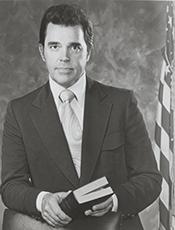
2,329 records where Rep. Applegate, Douglas [D-OH-18] is listed as a sponsor, author, or other actor. Search with topics and years
United States · United States Congress · 18 May 1989
Designates 1990 as the International Year of Bible Reading.
United States · United States Congress · 17 May 1989
Prohibits the President from relinquishing or transferring to any country any land, U.S. territory, exclusive economic zone, fishery conservation zone, or any U.S. claim to such areas unless provided for in a treaty between the United States and such country. Declares that a boundary between the United States and any other country may be established only by treaty.
United States · United States Congress · 16 May 1989
Expresses the sense of the Congress that Israel should take immediate steps to reopen schools in the West Bank.
United States · United States Congress · 16 May 1989
Recognizes the 50th anniversary of Little League Baseball.
United States · United States Congress · 11 May 1989
Designates October 16, 1989, and October 16, 1990, as World Food Day.
United States · United States Congress · 10 May 1989
Urges the President to initiate: (1) the abrogation of the Panama Canal Treaty and the Treaty Concerning the Permanent Neutrality and the Operation of the Panama Canal; and (2) negotiations with the Panamanian Government with regard to the Panama Canal's future status whenever that Government is freely elected.
United States · United States Congress · 9 May 1989
White House Conference on Small Business Act - Calls upon the President to conduct a National White House Conference on Small Business once every four years to: (1) increase public awareness of the contributions of small business; (2) identify small business problems; (3) examine the status of minority and women small business owners; (4) assist small business in carrying out its role as the Nation's job creator; (5) develop specific recommendations for executive and legislative action; and (6) review the status of recommendations adopted at the preceding Conferences. Directs Federal departments, agencies, and instrumentalities to provide support and assistance to the planning of such Conferences. Requires a final report of each Conference, within six months from the date a Conference is convened, to be submitted to the President and the Congress. Requires the Small Business Administration to report annually to the Congress following the submission of the final report of the Conference. Authorizes appropriations.
United States · United States Congress · 3 May 1989
Designates the Labor Day weekend beginning on September 2, 1989, as National Drive for Life Weekend. Calls on people to observe that weekend with a pledge to not drink and drive.
United States · United States Congress · 2 May 1989
Designates September 8, 1989, as National Pledge of Allegiance Day. Expresses the sense of the Congress that the Christopher Columbus Quincentenary Jubilee Commission should include the centennial observance of the Pledge of Allegiance in its commemorative activities.
United States · United States Congress · 2 May 1989
Designates February 18 through February 24, 1990, as National Visiting Nurse Associations Week.
United States · United States Congress · 27 April 1989
Amends the Toxic Substances Control Act to extend the deadlines to: (1) May 1, 1990, for the submission of asbestos management plans by local educational agencies; (2) December 31, 1989, for requests for deferral of such submissions; and (3) July 9, 1990, for the implementation of such plans, upon approval of a deferral request.
United States · United States Congress · 26 April 1989
Amends Internal Revenue Code provisions governing the income tax deduction for the health insurance costs of self-employed individuals to: (1) make the deduction permanent (under current law it will expire after tax year 1989); and (2) phase in an increase in the allowable deduction, reaching 100 percent for taxable years beginning in 1994 and thereafter.
United States · United States Congress · 25 April 1989
Abandoned Mine Reclamation Act of 1989 - Amends the Surface Mining Control and Reclamation Act of 1977 to mandate that certain reclamation fees and earned interest be used as funding sources for the Abandoned Mine Reclamation Fund. Permits the annual transfer of certain moneys in the Fund to the Secretary of Agriculture for the reclamation of rural lands. Directs the Secretary of the Interior (the Secretary) to credit to the Fund any income derived from investment of Fund money in certain public debt securities. Extends from August 3, 1992, to September 30, 2007, the termination date for authority to collect reclamation fee payments. Revises the guidelines for the allocation of funds among States and Indian tribes having an approved abandoned mine reclamation program. Directs the Secretary to: (1) maintain an annually updated inventory of lands and water eligible for reclamation or drainage abatement expenditures; and (2) provide technical and financial assistance to States and Indian tribes to enable them to update such inventory. Revises the guidelines under which the Secretary may fill voids and seal mine openings which constitute a public health and safety hazard. Requires the Secretary to ensure that funds used for emergency reclamation activities abate all adverse effects of coal mining practices existing at the affected project. Sets forth a modified reclamation fee schedule pertaining to coal mining operations certified by States and Indian tribes as having achieved the reclamation purposes of this Act. Declares that States and Indian tribes which make such certification shall continue to receive reclamation allocations as long as they maintain an approved abandoned mine reclamation program. Increases from 100,000 to 300,000 tons the annual tonnage production limits of small coal surface mining operators eligible for certain Federal technical assistance in determining the probable hydrologic consequences of operations and the results of test borings or core samplings required for permit applications.
United States · United States Congress · 25 April 1989
Amends the Internal Revenue Code to disallow an income tax deduction for business expenses incurred as removal or liability costs resulting from the discharge from a vessel onto navigable waters of oil being transported by or for the taxpayer. Applies this deduction denial retroactively with respect to amounts incurred in taxable years 1989 and thereafter.
United States · United States Congress · 25 April 1989
Designates May 29, 1989, as the National Day of Remembrance for the Victims of the U.S.S. Iowa.
United States · United States Congress · 18 April 1989
Coal Miners' Justice Act of 1989 - Directs the Secretary of Labor to review certain claims of coal miners and their survivors under the Black Lung Benefits Act.
United States · United States Congress · 18 April 1989
Save, America Act of 1989 - Amends the Internal Revenue Code to exclude from the gross income of an individual up to $5,000 ($10,000 for joint returns) of interest earned on a passbook savings account in a federally insured bank, savings and loan or similar institution, or credit union.
United States · United States Congress · 17 April 1989
Title I: National Development Investment - Public Works and Economic Development Act Amendments of 1989 - Amends the Public Works and Economic Development Act of 1965 to cite such Act as the National Development Investment Act and to revise the emphasis of such Act from primary Federal initiative to coordination of investments between the public and the private sectors. Authorizes the Secretary of Commerce to make development investment assistance grants to qualified applicants for: (1) constructing and improving public facilities; (2) revolving loan funds; and (3) employee stock ownership plans. Authorizes the Secretary to provide technical assistance for improving and enhancing economic development. Describes qualified applicants as States, distressed local governments, economic development districts, economic development organizations, and Indian tribes. Describes a distressed local government as one with a population under 50,000 that is located outside an economic development district. Requires an application for a grant under this Act to include: (1) a certification that the area concerned meets certain distress requirements; (2) a certification relative to performance of any responsibilities which the Secretary has agreed to accept; and (3) a development investment strategy prepared in accordance with this Act. Lists as distress requirements any one of which an area must meet in order to be eligible for a grant under this Act: (1) a per capita income of 80 percent or less of the national average; (2) an unemployment rate one percent above the national average for the most recent 24-month period for which statistics are available; or (3) a sudden economic dislocation resulting in job losses. Sets forth information to be contained in a grant applicant's development investment strategy. Authorizes the Secretary to make grants to establish a revolving loan fund for making or guaranteeing loans to small businesses for initial or working capital or for the purchase of facilities or equipment. Limits to $1,000,000 the amount of any such grant. Limits the amount of any grant under this Act to a maximum of 50 percent of the cost of completing the project as determined at the time of the grant application. Permits the Secretary to reduce or waive the non-Federal share of a project in the case of an Indian tribe. Limits expenditures in any one State to a maximum of 15 percent of the appropriations made pursuant to this Act, except for expenditures to Indian tribes. Prohibits the Secretary from obligating more than $4,000,000 in any fiscal year to any person, other than grants for employee ownership organizations. Requires the Secretary, each fiscal year, to obligate minimum amounts of funds for such grants. Authorizes the Secretary to make economic development planning grants to States, economic development districts, Indian tribes, distressed counties, and distressed units of local governments with populations over 50,000 (if located outside an economic development district). Earmarks such grants for coordination of investments for community facilities, economic development, manpower training, and transportation services. Authorizes the Secretary to evaluate Federal, State, and local development investment efforts. Authorizes the Secretary to conduct demonstration programs to test the feasibility of new ways to increase productivity in the steel industry and related industries, foster innovative technology, match labor force with labor markets, or encourage economic diversity and regional balance. Requires a report to the Congress no later than 90 days after completion of any demonstration program. Authorizes the Secretary to make grants to colleges, universities, and other nonprofit educational and research organizations for management and technical assistance. Declares that the Secretary of Commerce shall administer this Act with the assistance of a specified Assistant Secretary of Commerce. Authorizes the Secretary to consult with other persons and agencies. Prohibits the approval of any grant unless the Secretary is satisfied that the project concerned will be properly and efficiently administered, operated, and maintained. Permits the Secretary to discharge responsibilities relative to a project by accepting a certification of the grant applicant's performance of such responsibilities. Requires the Secretary to make comprehensive annual reports to the Congress detailing operations under this Act. Requires all laborers and mechanics employed by contractors or subcontractors on projects assisted under this Act to be paid the prevailing rate of wages. Requires the Secretary to maintain records of approved applications available for public inspection. Requires each recipient of a grant to maintain specified records. Allows the Secretary and the Comptroller General access to all records of such recipients. Prohibits the Secretary from: (1) discriminating in favor of or against any qualified applicant based on whether it is located in an urban or rural area; (2) creating separate allocations of funds for assistance to urban or rural areas unless allocations are based on objective findings or relative levels of distress in areas qualified for assistance; or (3) denying assistance to qualified applicants because the project is located in a State with low unemployment. Authorizes appropriations. Title II: Appalachian Regional Development - Appalachian Regional Development Act Amendments of 1989 - Amends the Appalachian Regional Development Act of 1965 to declare that investments under such Act shall also be made in severely distressed and underdeveloped counties lacking resources for basic services. Authorizes appropriations through FY 1992 for administrative expenses of the Appalachian Regional Commission. Authorizes the Commission to lease office space through FY 1992. Authorizes appropriations through FY 1992 for the Appalachian development highway system. Increases from 70 to 80 percent the subsequent Federal share of an Appalachian development highway segment when a participating State proceeds to construct a segment of such a highway without the aid of Federal funds. Applies such increase to projects approved after March 31, 1979. Removes the restriction on financial assistance for the cost of industrial facilities. Declares that after October 1, 1989, grants shall not exceed 50 percent of the costs of any approved project (except projects concerning Appalachian highways). Requires that energy enterprise development loan funds established with grants previously approved by the Commission be made available for authorized purposes. Authorizes appropriations through FY 1992. Extends the termination date of such Act from 1982 to October 1, 1992.
United States · United States Congress · 13 April 1989
Local Government Infrastructure Financing Improvement Act of 1989 - Amends the Public Works and Economic Development Act of 1965 to direct the Secretary of Commerce to provide local governments technical assistance with respect to financing construction, repair, and expansion of public works facilities, including provision of information necessary to familiarize local governments about the use and availability of tax-exempt public works facility bonds for such financing. Requires the Secretary to report biennially to specified congressional committees on local government public works financing practices. Amends the Internal Revenue Code to: (1) raise to $25,000,000 the threshold amount of tax-exempt bonds that a small governmental unit may issue and still remain within the exception from arbitrage rebate requirements; and (2) increase from ten percent to 25 percent the amount of tax-exempt government bond proceeds that may be used by a nongovernmental entity for private purposes without triggering treatment of the bond issue as a taxable private activity bond. Limits the latter provision to governmental issuers whose reasonably anticipated amount of tax-exempt obligations to be issued during the calendar year is $25,000,000 or less. Caps at $25,000,000 the amount of bonds to which the issuer may apply the 25 percent private use test in any year.
United States · United States Congress · 13 April 1989
Designates October 25, 1989, as National Arab-American Day.
United States · United States Congress · 13 April 1989
Expresses the sense of the House of Representatives that the President should: (1) call for an immediate cease-fire among the parties in Lebanon, the removal of all foreign military forces, and the disbanding of all paramilitary forces there; (2) urge all parties in Lebanon to respond to the international call for an immediate cease-fire and to undertake immediate discussions regarding internal reconciliation; (3) support international efforts to implement a cease-fire and start a process of internal reconciliation; and (4) support actions to encourage the election of a new president in Lebanon.
United States · United States Congress · 13 April 1989
Welcomes the commitment of General Andres Rodriguez to conduct discussions with Paraguayan political leaders aimed at amending the electoral laws of Paraguay and urges that the dialogue continue. Urges that specified changes be implemented, including universal voter registration, proportional representation in the legislature, removal of the requirement of Colorado political party membership for civil service and military employment, and measures to permit opposition candidates access to the media and freedom of assembly. Calls upon the provisional Government of Paraguay to: (1) permit journalists and foreigners to freely observe the May 1, 1989, elections; (2) verify the validity of current voter registration rolls and encourage open and free registration; (3) set a date for the long pending visit by the Inter-American Commission on Human Rights; (4) repeal laws which have been used for arresting and detaining people because of the peaceful expression of their political beliefs; and (5) permit independent, democratic labor unions to organize and operate freely.
United States · United States Congress · 6 April 1989
Amends Federal military personnel provisions to exempt retired members of the armed forces who are called to active, full-time duty with the American Battle Monuments Commission from certain number and grade limitations on officers in the armed forces.
United States · United States Congress · 5 April 1989
Cofiring Promotion Act of 1989 - Directs the Secretary of Energy to: (1) establish and implement a research and demonstration program for cofiring natural gas with coal in utility and large industrial boilers; and (2) enter into cooperative agreements with appropriate parties for demonstrating cofiring technology. Authorizes appropriations. Amends the Internal Revenue Code to: (1) include cofiring activities within the scope of the research and development income tax credit; (2) apply the accelerated cost recovery system to cofiring equipment; and (3) exclude depreciation associated with cofiring equipment from taxable income under the alternative minimum tax.
United States · United States Congress · 5 April 1989
Designates September 1989 as National Library Card Sign-Up Month.
United States · United States Congress · 5 April 1989
Declares that: (1) it is the sense of the House of Representatives that child survival and development programs are to be commended; (2) the House of Representatives reaffirms its goal of improvement of the survival rates, health, and development of people in all countries and urges the President to adopt this as a major priority; (3) the President is urged to propose to the Secretary General of the United Nations that he establish an independent advisory commission with regard to programs in primary health care, nutrition, basic education, and environment by members of the Grand Alliance for Children; and (4) the House of Representatives endorses the call for a World Summit on Children as an opportunity to attain specified goals, including the goals of Universal Childhood Immunization by 1990 and Health for All by the year 2000.
United States · United States Congress · 3 April 1989
Designates the week of October 22 through October 29, 1989, as Drug-Free America Week. Encourages every American to wear red during such week to symbolize a commitment to a drug-free lifestyle.
United States · United States Congress · 23 March 1989
Amends Federal veterans' benefits provisions to add $2,400 (currently $800) annually in such benefits to veterans of World War I who were not provided with the educational and home-loan benefits that were provided to veterans of later periods. Increases by $800 annually the rate of pension payable to a qualifying surviving spouse of a veteran of World War I.
United States · United States Congress · 23 March 1989
Declares it to be the policy of the United States that Federal records, books, and publications of enduring value be produced on acid-free permanent papers. Makes recommendations relating to such papers to Federal agencies and to American publishers. Recommends that the Secretary of State make known such national policy to foreign governments and appropriate international agencies. Directs the Librarian of Congress, the Archivist of the United States, the Director of the National Library of Medicine, and the Administrator of the National Agricultural Library to monitor progress in implementing such policy.
United States · United States Congress · 23 March 1989
Authorizes and requests the President to designate the third Sunday of August 1989 as National Senior Citizens Day.
United States · United States Congress · 23 March 1989
Designates the week beginning September 1, 1989, as World War II Remembrance Week in commemoration of the 50th anniversary of the outbreak of that War.
United States · United States Congress · 23 March 1989
Designates the week beginning October 29, 1989, as Gaucher's Disease Awareness Week.
United States · United States Congress · 23 March 1989
Designates September 1989 as National Alcohol and Drug Treatment Month.
United States · United States Congress · 22 March 1989
Designates the week of October 23 through October 29, 1989, as Eating Disorders Awareness Week.
United States · United States Congress · 21 March 1989
Anti-Terrorism Sanctions Act of 1989 - Requires the President to revoke the most-favored-nation trade status of certain foreign countries that repeatedly support international terrorism. Prohibits duty-free treatment for the products of such countries under the Trade Act of 1974 or the Caribbean Basin Economic Recovery Act. Prohibits the Secretary of Commerce from consulting with the governments of such countries regarding international travel and tourism. Allows the President to waive any sanction under this Act with respect to any foreign country if such waiver would be in the best interests of the United States. Requires the President to give 30 days' notice to the Congress concerning any waiver.
United States · United States Congress · 21 March 1989
Designates the month of November 1989 as National Diabetes Month.
United States · United States Congress · 20 March 1989
Designates October 1989 as National Down Syndrome Month.
United States · United States Congress · 15 March 1989
Veterans' Home Loan Mortgage Indemnity Act of 1989 - Establishes a Veterans' Mortgage Indemnity Fund. Provides that the Indemnity Fund shall be available to the Secretary of Veterans Affairs for all operations with respect to guaranteed or insured Department of Veterans Affairs housing loans for which fees are collected, other than loans for property which has been disposed of by veterans to purchasers who will assume liability for such loan. Provides that the following sums shall be credited to the Indemnity Fund: (1) all fees collected from such housing loans, other than loans for property which has been disposed of by the veteran to a purchaser who will assume liability for such loan; (2) .25 percent of the original amount of all loans for which a fee is collected for the first three fiscal years beginning with the fiscal year in which such fee is collected; (3) all collections of principal and interest and the proceeds from property held or disposed of with respect to such loans; and (4) all income from investments of the Indemnity Fund that are required to be made by the Secretary of the Treasury in obligations of the United States. Increases the fee for a Department housing loan to 1.25 percent of the total loan amount. Provides that the following fees shall be collected: (1) one percent of the total loan amount with respect to housing loans obtained which are in default; and (2) .75 percent of the total loan amount with respect to loans for purchase or construction for which a down payment of at least five percent of the total purchase price or construction costs has been made. Provides for the waiver of such fees for veterans who are receiving compensation and whose disability is rated at least 30 percent. Provides that the provision prohibiting fee collection with respect to all loans closed after September 30, 1989, shall apply after such date only to loans which are in default or loans for property which has been disposed of to another purchaser. Provides that any veteran who pays a fee for such loans, other than loans which are in default or loans for property which has been disposed of, or who is exempt from paying such fee, shall have no liability to the Secretary with respect to such loan for any loss resulting from a default of the veteran. Revises provisions regarding the Loan Guaranty Revolving Fund to: (1) provide that it shall be available to the Secretary for all housing operations except those carried out by the Indemnity Fund; (2) limit the deposit of housing loan fees in such Fund, other than fees for loans for property which has been disposed of, to fees collected before the effective date of this Act; and (3) limit the deposit of principal and interest and the proceeds from property held or disposed of with respect to housing loans to loans guaranteed before the effective date of this Act. Revises a provision authorizing the Secretary to sell notes evidencing loans which are in default to permit such sale only if the amount received at the time of the sale is at least 90 percent of the unpaid balance of such loan. Revises a provision regarding basic entitlement to housing loans to authorize the Secretary, in computing the amount of guaranty entitlement available to a veteran, to exclude the amount of entitlement used for any loan which has been repaid in full. Allows only the presence of fraud (currently, fraud, misrepresentation, material fault, or lack of good faith) as a bar to the waiver of recovery of payments, overpayments, or benefits made by the Department when the Secretary determines that recovery would be against equity and good conscience. Prohibits the Secretary, in waiving indebtedness following the default of a veteran on a housing loan, to base such waiver on the balancing of fault or on whether such veteran may be able to repay the indebtedness.
United States · United States Congress · 15 March 1989
Provides for the appointment of enlisted members of the armed forces to the American Battle Monuments Commission. (Currently, such appointments are limited to commissioned officers.)
United States · United States Congress · 15 March 1989
Terrorist Alien Removal Act of 1989 - Amends the Immigration and Nationality Act to make terrorist activity (as defined by this Act) grounds for deportation. Establishes removal procedures for alien terrorists, including a special removal hearing which shall be open to the public.
United States · United States Congress · 15 March 1989
Directs the Secretary of Transportation, upon request of the Ohio Turnpike Commission and the Ohio Department of Transportation, to: (1) enter into an agreement with such Commission and Department providing for the use of toll revenues from the operation of the Ohio Turnpike system for specified purposes, including construction, resurfacing, restoration, and costs of operation; and (2) void a specified agreement with the Commission and the State of Ohio with respect to such system.
United States · United States Congress · 14 March 1989
Amends the National Labor Relations Act to make it an unfair labor practice for an employer to hire, or threaten to hire, permanent replacement workers during the first ten weeks of any strike (or to enter into agreements for such purposes).
United States · United States Congress · 14 March 1989
Eliminates post-1968 service in the National Guard as a prerequisite to civil service retirement credit for former National Guard technicians. Amends the National Guard Technicians Act of 1968 to eliminate post-1968 service as a prerequisite for National Guard technicians for receipt of credit in the determination of length of Federal civil service for purposes of leave, Federal employees' death and disability compensation, group life and health insurance, severance pay, tenure, and status. Sets forth rules for applying provisions of this Act to affected individuals.
United States · United States Congress · 14 March 1989
Designates the week of October 8 through October 14, 1989, as National Job Skills Week.
United States · United States Congress · 14 March 1989
Designates the week of May 1 through May 7, 1989, as National Older Americans Abuse Prevention Week.
United States · United States Congress · 14 March 1989
Designates October 3, 1989, as National Teacher Appreciation Day.
United States · United States Congress · 14 March 1989
Designates the month of November in 1989 and 1990 as National Hospice Month.
United States · United States Congress · 9 March 1989
Requires at least 90 days of continuous active-duty service in order for veterans to become eligible for veterans' educational assistance under the Montgomery GI Bill. Revises the Montgomery GI Bill Selected Reserve Program to provide the monthly educational assistance allowance payable to an individual pursuing a full-time program of apprenticeship or other on-the-job training under such Program. Reduces proportionately the amount of such monthly allowance for each month in which an individual pursuing such a program fails to complete at least 120 hours of such training. Charges each individual's general entitlement to such educational assistance for each month that such individual is paid a monthly educational assistance allowance. Provides that the monthly allowance payable to an individual pursuing a cooperative program under such Program shall be 80 percent of the monthly allowance otherwise payable to such individual. Outlines the amount of educational assistance allowance payable to an individual pursuing a program of education exclusively by correspondence. Charges such individual's general entitlement a specified amount for each month the individual receives the correspondence education allowance. Prohibits an individual who serves in the Selected Reserve from receiving educational assistance credit under both the armed forces' educational assistance program and the veterans' educational assistance program. Requires such individual to elect the program to which such service shall be credited. Revises provisions concerning the secondary school education required before an individual becomes eligible for basic educational assistance. Includes as eligible for veterans' educational assistance under the Montgomery GI Bill those individuals who: (1) commenced their third academic year at one of the service academies or as a member of the Senior Reserve Officer Training Corps in a program of educational assistance before January 1, 1977; (2) served on active duty for a period of more than 180 days as a commissioned officer; (3) were discharged or released from such duty under conditions other than dishonorable; and (4) submit to the Secretary of Veterans Affairs before January 1, 1990, an irrevocable election to be eligible for such assistance. Directs the Secretary to refund to any person fulfilling such requirements his or her unused contributions to the Post-Vietnam Era Veterans Education Account. Increases the rates of subsistence allowances for veterans with service-connected disabilities. Revises provisions concerning the computation of the veterans' educational assistance allowance to state the specific amounts of such monthly allowance for full-time, three-quarter-time, and half-time pursuit of educational assistance under the program. Increases such allowance in certain instances. Revises the amount of monthly educational assistance to be paid to an eligible person pursuing an independent study program leading to a standard college degree, providing a different computation of the eligible amount if the individual is pursuing such degree entirely on an independent-study basis or if independent study is combined with resident training. Requires an individual's general entitlement to be charged for a combination of such independent study and resident training on the basis of the applicable monthly training time rate as determined by the Secretary. Outlines the amounts of general entitlement to be charged to the eligible spouse or surviving spouse of a veteran who pursues a program of education exclusively through correspondence and is paid a monthly educational assistance allowance. Increases the amount of the monthly educational assistance allowance available to eligible persons pursuing special restorative training. Provides the specific amount of monthly allowance available to eligible veterans or eligible persons pursuing a program of apprenticeship or other on-the-job training. Requires an individual to begin service in the Selected Reserve within one year of completing certain active duty in order to become entitled to basic educational assistance for service in the Selected Reserve. (Currently, there is no one-year requirement.) Entitles individuals who are discharged or released from active duty for a preexisting medical condition, service-connected disability, hardship, or for the convenience of the Government and who elect to participate in the veterans' educational assistance program by revoking an earlier decision not to participate in such program to the number of months of basic educational assistance equal to the number of months such individuals served on active duty after June 30, 1985.
United States · United States Congress · 9 March 1989
Veterans' Compensation Amendments of 1989 - Increases the rates of compensation, dependency and indemnity compensation, and the clothing allowance payable to veterans with service-connected disabilities and their survivors. Authorizes the Secretary of Veterans Affairs to adjust administratively the rates of disability compensation payable to persons who are not in receipt of compensation for service-connected disability or death.
United States · United States Congress · 9 March 1989
Amends Federal veterans' benefits provisions to remove a limitation on pension payments to veterans without spouses or children who are receiving Veterans Administration (effective March 1989, Department of Veterans Affairs) hospital care for a period of over three months.