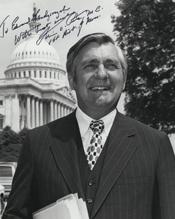
United States · United States Congress · 2 May 1977
Provides that recipients of veterans' pension and compensation will not have the amount of such pension or compensation reduced, or entitlement thereto discontinued, because of increases in monthly social security benefits. Applies these amendments to annual income determinations made for calendar years after 1972. (Amends 38 U.S.C. 415(g), adds 38 U.S.C. 503(d))
United States · United States Congress · 29 April 1977
Federal Aid Highway Act Amendments - Amends the Federal Aid Highway Act of 1976 to increase and extend the appropriations authorized under such Act for the Federal Aid primary system to $3,350,000,000 for each of the fiscal years 1978 through 1990. Increases the Federal Share for projects financed with primary funds on the Federal aid primary system from 70 percent of its cost to 80 percent, or to 95 percent under specified circumstances. (Amends 23 U.S.C. 109, 120)
United States · United States Congress · 29 April 1977
Wildlife on Federal Lands Trapping Act - Requires the Secretary of the Interior to issue such regulations, relating to trapping, as are necessary to carry out the purposes of this Act. Prohibits the Secretary from approving any type of trap unless such trap utilizes the most humane capture method available for the species concerned, and minimizes the probability of capturing species for which such trap was not intended. Directs the Secretary to undertake a research program to develop such types of traps. Establishes an advisory commission to make recommendations to the Secretary with respect to traps designed or intended for use. Prohibits the Secretary from permitting trapping on Federal lands where such trapping may reduce any species below specified levels. Sets forth a procedure for the application and issuance of trapping permits. Requires the attachment of a shipping certificate to any package containing the fur, hide, skin, horn, or feathers of any mammal or bird captured by any trap within any State or the District of Columbia if such package is transported in interstate or foreign commerce. Establishes criminal penalties for: (1) engaging in trapping without a permit issued pursuant to this Act; (2) violating any condition of such permit; (3) violating any regulation of the Secretary relating to trapping; (4) selling or transporting in interstate commerce an unapproved trap; or (5) falsifying the shipping certificate. Authorizes the Secretary to enter into cooperative agreements with States with respect to the imposition of trapping regulations consistent with those prescribed under this Act. Authorizes such appropriations as may be necessary to carry out the purposes of this Act.
United States · United States Congress · 25 April 1977
Amends the Postal Reorganization Act Amendments of 1976 to extend to June 15, 1977, the period during which the Postal Service is prohibited from: (1) increasing rates and fees to levels exceeding those in effect on the date of enactment of the Act; (2) offering levels and types of services which are less than those available on July 1, 1976; and (3) closing certain postal facilities which were in operation on July 1, 1976.
United States · United States Congress · 25 April 1977
Food Additive Safety Amendments - States that a food additive shall be deemed safe if the Secretary of Health, Education, and Welfare (1) makes a finding, based on recommendations of an advisory committee, that the public benefit from permitting the use of such additive would exceed the public risk which might result from such use; (2) gives notice in the Federal Register of such a finding and invites public comment thereon; and (3) issues a final order not earlier than 120 days of such publication in the Federal Register of such findings. Specifies factors the Secretary must take into consideration when evaluating a food additive. Deems saccharin a safe food additive unless the Secretary declares it unsafe under the provisions of this Act.
United States · United States Congress · 20 April 1977
Uniform Federal Welfare and Medicaid Assistance Act - Amends Title IV (Aid to Families with Dependent Children), Title XVIII (Medicare), and Title XIX (Medicaid) of the Social Security Act to provide that the Federal matching rate for purposes of reimbursement to States under the programs of aid to needy families with children and medical assistance shall be set at 75 percent.
United States · United States Congress · 19 April 1977
Directs the House Committee on International Relations to conduct hearings to determine the nature and extent of any United States involvement in the hostilities in Northern Ireland.
United States · United States Congress · 6 April 1977
Establishes, in the city of Lowell, Massachusetts, the Lowell National Cultural Park consisting of a preservation zone and an intensive use zone. Requires the Secretary of the Interior to establish the boundaries of such zones. Permits the Secretary to either enter into cooperative agreements with property owners to preserve and maintain property within the park or to acquire such property within the intensive use zone by purchase or condemnation if the parties have failed to reach an agreement through negotiation. Permits the Secretary to enter into agreements with Federal agencies or the Commonwealth of Massachusetts for firefighting, law enforcement or other specified assistance. Directs the Secretary to submit to Congress a park management plan and to establish standards applicable to the construction and use of properties within the intensive use zone. Requires any Federal agency conducting activities affecting the park to conform to such standards. Establishes the Lowell National Cultural Park Advisory Commission to advise the Secretary on the boundaries of the park and the development and use of properties and activities within the park.
United States · United States Congress · 4 April 1977
Constitutional Amendment - Provides that the people of the several States, and the District of Columbia, shall elect the President and Vice President. Requires each elector to cast a single vote for two persons who shall have consented to the joining of their names as candidates for the offices of President and Vice President. Requires the electors of President and Vice President in each State to have the qualifications requisite for electors of Members of Congress from that State, except that for electors of President and Vice President, the legislature of any State may prescribe less restrictive residence qualifications and for electors of President and Vice President, the Congress may establish uniform residence and age requirements. Provides that the pair of persons having the greatest number of votes for President and Vice President shall be elected, if such number be at least 40 percent of the whole number of votes cast for such offices. Provides that if no pair of persons has such number, a runoff election shall be held in which the choice of President and Vice President shall be made from the two pairs of persons who received the highest numbers of votes. Requires the days for such elections to be determined by Congress and to be uniform throughout the United States. Requires Congress to prescribe by law the time, place, and manner in which the results of such elections shall be ascertained and declared. Grants to each State the authority as to the time and place and manner of holding such elections and entitlement to inclusion or the ballot. Specifies that if, at the time fixed for declaring the results of such elections, the presidential candidate who would have been entitled to election as President has died, the Vice Presidential candidate entitled to election as Vice President shall be declared elected President. Allows Congress to provide for the case of the death, inability, or withdrawal of any candidate for President or Vice President before a President and Vice president have been elected, and for the case of the death of both the President and Vice President elect.
United States · United States Congress · 31 March 1977
Provides that recipients of veterans' pension and compensation will not have the amount of such pension or compensation reduced, or entitlement thereto discontinued, because of increases in monthly social security benefits. Applies these amendments to annual income determinations made for calendar years after 1972. (Amends 38 U.S.C. 415(g), adds 38 U.S.C. 503(d))
United States · United States Congress · 30 March 1977
Accelerated Depreciation Allowance Act - Amends the Internal Revenue Code to allow taxpayers to elect accelerated amortization (twice the allowable depreciation deduction) for manufacturing property placed in service in States having an unemployment rate which is greater than six percent between October 1, 1976 and October 1, 1981.
United States · United States Congress · 29 March 1977
Amends Title XVIII (Medicare) and Title XIX (Medicaid) of the Social Security Act to include as "medical and other health services" for which coverage will be provided under Medicare, and as "medical assistance" for which coverage will be provided under Medicaid, that medical or other remedial care furnished by licensed (registered) nurses within the scope of their practices as defined by State law.
United States · United States Congress · 28 March 1977
Surface Mining Control and Reclamation Act - Title I: Statement of Findings and Policy - Declares that most of the nation's coal reserve can only be mined by underground methods. Lists the purposes of this Act, including the establishment of a nationwide program to prevent adverse effects to society and the environment from surface coal mining. Title II: Office of Surface Mining Reclamation and Enforcement - Establishes in the Interior Department the Office of Surface Mining Reclamation and Enforcement with a Director appointed by the President. States that such Office shall administer the programs required by this Act and assist the States in development of State programs for surface coal mining and reclamation. States that the Office shall be considered an independent Federal regulatory body. Title III: State Mining and Mineral Resources Research Institute - Authorizes appropriations to the Secretary of the Interior of sums adequate to provide for each participating State $200,000 for fiscal year 1978, $300,000 for fiscal year 1979, and $400,000 for each fiscal year thereafter for five years, to assist the States in carrying on the work of a competent and qualified mining and mineral resources research institute or center at the school of mines of one public college or university of the State. Requires such monies to be matched dollar-for-dollar by the States. Authorizes appropriations of $15,000,000 for fiscal year 1978, such sum to be increased by $2,000,000 each fiscal year for six years thereafter, for specific projects in mining and mineral research in institutes. Directs the Secretary to establish a center for cataloging current and projected scientific research in mining and mineral resources. Requires the Secretary to appoint an Advisory Committee on Mining and Mineral Research for advice on all matters concerning mining and mineral resources research. Title IV: Abandoned Mine Reclamation - Creates the Abandoned Mine Reclamation Fund in the Treasury. Requires operators of coal mines to pay into the fund quarterly fees of $.35 per ton of coal produced by surface mining and $.15 per ton of coal produced by underground mining, or ten percent of the value of the coal in the mine, whichever is less. Authorizes use of money in the Fund for acquisition and reclamation of abandoned and unreclaimed mine lands and for acquisitions and fillings of voids and sealing of tunnels and entryways in abandoned mines. Authorizes the Secretary of Agriculture to enter into agreements with landowners of water rights under which such landowners shall furnish a conservation and development plan and shall effect such plan in return for financial assistance from the Secretary of Agriculture of up to 80 percent of the cost of such a reclamation effort. Encourages States to acquire abandoned and unreclaimed land, and to transfer it to the Secretary for reclamation, and authorizes matching grants for such purpose, up to 90 percent of the land price. Allows resale of reclaimed land by public bidding, and allows local public participation in determining the use of reclaimed land. Title V: Control of the Environmental Impacts of Surface Coal Mining - Directs the Secretary of the Interior to publish, within 180 days of the enactment of this Act, regulations which establish a permanent regulatory procedure and performance standards for surface coal mining and reclamation standards. Requires the Secretary to obtain the concurrence of the Administrator of the Environmental Protection Agency with respect to regulations concerned with air or water quality standards. Establishes a permit program to require mining operators to comply with environmental protection standards. Allows State control over surface mining permits if certain requirements are met. Authorizes the implementation of a Federal program if States fail to act. Permits State laws and regulations that are more stringent than those set forth pursuant to this Act. Requires permit applications to describe the method of mining and equipment proposed to be used, to describe by maps the land to be affected, and to contain a statement of results of test borings or core samplings of the affected land. Stipulates that permits must be accompanied by a mining and reclamation plan which shall include a description of present uses of the land, steps to be taken to prevent environmental damage and a description of the reclamation activities. Requires the posting of performance bonds and possession of liability insurance by applicants for permits. Requires the establishment of coal exploration regulations by appropriate State and Federal authorities. Requires that such regulations include provisions for reclamation of lands disturbed in exploration activities. Imposes the following general environmental performance standards on surface mining operations as a condition of the issuance of a permit under this Act: (1) restoration of the land affected to a prior use, consistent with public health and safety; (2) restoration to the original contour of the land and backfilling, grading, and compacting the excess overburden and other waste materials to attain the lowest grade; (3) removal and segregation of topsoil in a separate layer where it is able to support vegetation; (4) minimization of disturbances to the hydrologic balance at the mine site and surrounding areas by eliminating or reducing toxic drainage, siltation, and contamination problems; (5) conformity with standards for the design and location of coal mine waste piles; and (6) establishment of a diverse, effective, and permanent vegetation on regraded areas. Stipulates that the regulatory authority shall make test borings of core samplings for mining operators with an estimated annual production of less than 250,000 tons of coal. Establishes additional requirements for steep-slope surface mining operations. Defines the term "steep-slope" to include any slope above 20 degrees or lesser slopes as may be defined by the regulatory authority. Directs the Secretary to promulgate rules and regulations directed at the surface effects of underground mining. Directs and authorizes inspection of surface coal mining and reclamation to determine compliance with this Act and regulations. Provides requirements for recordkeeping and submittal and monitoring by mine operators. Imposes civil penalties for violation of this Act or regulations under it. Establishes procedures for citizen suits and judicial review of actions under this Act. Establishes conditions under which mine operators may request a release of all or part of the performance bond. Requires public notice and hearings upon applications for such releases. Requires States to establish, as a condition of assuming primary regulatory control, a planning process designed to identify lands unsuitable for surface coal mining. Requires designation of lands as unsuitable if it can be shown that reclamation pursuant to the requirements of the Act is not feasible. Authorizes designation of lands as unsuitable where operations mining will: (1) be incompatible with land use plans or programs; (2) affect fragile or historic lands of significant historic, scientific or esthetic value; (3) affect renewable land resources with an impact on long-range food and water supply; and (4) increase a significant hazard to life and property, including the possibility of flood and earthquake damage. Prohibits surface coal mining operations on certain Federal lands, or within 100 feet of a public road or within 300 feet of a building or dwelling, unless the consent of the affected public or private interest is obtained. Requires implementation of a Federal lands program applicable to all surface coal mining and reclamation activities pursuant to Federal laws or taking place on Federal lands. Requires that coal exploration operations which substantially disturb the natural land surface on such lands be subject to a permit program established by the Secretary of the Interior. Requires separate regulations for programs for special bituminous coal surface mines that meet specified criteria, and for anthracite coal surface mines which are regulated by environmental protection standards of the States. Title VI: Designation of Lands Unsuitable for Noncoal Mining - Allows the Secretary to designate Federal lands unsuitable for mining materials other than coal, if they are predominantly urban or suburban in character or if such mining operations would have an adverse impact on lands used primarily for residential and related purposes. Title VII: Administrative and Miscellaneous Provisions - Defines the terms used in this Act. Prohibits discrimination against employees for filing suit under this Act and for testifying in a proceeding under this Act. Authorizes the Secretary to make annual grants to the States to assist the States in developing, administering, and enforcing State programs under this Act. Authorizes the Secretary to provide technical assistance and training, and assistance in preparing and maintaining a continuing inventory of information on surface coal mining and reclamation projects. Requires the Secretary to submit an annual report to the President and the Congress. Directs the Secretary to contract with the National Academy of Sciences-National Academy of Engineering for a study of surface coal mining conditions in Alaska in order to determine which, if any, of the provisions of this Act should be modified with respect to such operations in Alaska. Directs the Chairman of the Council on Environmental Quality to contract with the National Academy of Sciences-National Academy of Engineering and other groups for a study of the technology for surface and open-pit mining and reclamation for minerals other than coal designed to assist in the development of regulation for such operations. Directs the Secretary to consult with Indian tribes in studying the regulation of surface mining on Indian lands. Requires all surface coal mining operations on Indian lands to comply with requirements at least as stringent as specified provisions in this Act within 30 months from the enactment of this Act. Authorizes the appropriation of the following sums to carry out this Act: (1) for various contract authority, $10,000,000 per fiscal year for fiscal years 1978, 1979, and 1980; (2) for the performance of test borings by the regulatory authority, an amount reserved for such purpose from the Abandoned Mine Reclamation Fund not to exceed $40,000 per fiscal year; (3) for administrative and other purposes, $10,000,000 for fiscal year 1978, $20,000,000 for fiscal years 1979 and 1980, and $30,000,000 for fiscal years thereafter; and (4) for research and demonstration projects of alternative coal mining technologies, $35,000,000 for fiscal year 1978, and for the next four years. Stipulates that no new budget authority for fiscal year 1977 is authorized by the provisions of this Act.
United States · United States Congress · 24 March 1977
Makes it a violation of the Federal Trade Commission Act for any retailer to increase the price of consumer commodities once he marks the price on any such consumer commodity, and permits the Federal Trade Commission to order any such retailer to refund any amounts of money obtained by increasing the price of such consumer commodity.
United States · United States Congress · 24 March 1977
Declares it the sense of Congress that the President should direct the Ambassador to the United Nations (1) to have the United States accepted as a member of the United Nations Council for Namibia, (2) to endorse United Nations Council for Namibia "Decree Number 1 - For the Protection of the Natural Resources of Namibia," and (3) to support any proposal in the Security Council declaring the administration of Namibia by South Africa a threat to the peace.
United States · United States Congress · 22 March 1977
Universal Voter Registration Act - Establishes the positions of Administrator and Assistant Administrator of Voter Registration within the Federal Election Commission. Specifies the duties of the Administrator, including (1) establishing and administering a voter registration program in accordance with this Act; (2) providing for the collection, analysis, and publication of voter registration information in coordination work the Secretary of Commerce; and (3) providing information and technical assistance to State and local officials concerning voter registration. Requires each State and local government to permit any individual who is eligible under applicable State and Federal law to register to vote in any Federal election to register on the date of a Federal election at the appropriate polling place. States that any individual so registering shall, if required by State or local authorities, establish his identity by (1) executing an affidavit containing certain information and (2) submitting either an affidavit executed by a person who is registered to vote at the polling place involved and is present at such polling place with the individual seeking registration or one of any forms of identification approved by the Commission. Directs the Commission to make grants for approved voter registration outreach programs to States which comply with the election day registration requirements of this Act. Conditions the amount of such grants on whether a State has a similar election day registration program in effect with respect to State and local elections. Stipulates that a registration outreach program may include projects relating to registration by mail, registration through the use of mobile units, or bilingual registration, and those projects otherwise designed to improve voter registration methods and procedures. List the purposes for which grant funds may be used. Sets forth criminal penalties for any person who knowingly and willfully (1) register, or attempts to register, to vote under this Act for the purpose of voting more than once in any Federal election; (2) conspires with any person for the purpose of enabling such person to make false registration to vote in a Federal election under this Act or for the purpose of enabling or encouraging any individual to make such false registration to vote in a Federal election; or (3) falsifies any information with respect to the name, residence, or age of such person, or any other information for the purpose of establishing eligibility to register to vote in a Federal election under this Act. Directs the Commission to institute actions to prevent any violation for this Act. Requires Federal courts to expedite consideration of actions involving a violation of, or a constitutional challenge to, any provision of this Act. Prohibits commercial use of any list compiled by a State or local government of individuals registered to vote in a Federal election.
United States · United States Congress · 22 March 1977
Amends the Occupational Safety and Health Act to exclude from coverage (1) employers with ten or fewer employees; and (2) employees not employed on a regular basis for 30 or more consecutive days. Requires that a warning rather than a citation be given for a first instance violation, other than a willful or serious violation, to an employer who has not employed more than 25 employees at any time during the 30 days prior to an inspection or investigation. Prohibits the imposition of a civil penalty against an employer for a nonserious violation if (1) such employer has not previously received a citation for the same violation; and (2) the inspection upon which such citation was based resulted in the issuance of citations for ten or or fewer violations of a nonserious nature.
United States · United States Congress · 22 March 1977
Amends Title XI (General Provisions and Professional Standards Review) of the Social Security Act to require the inclusion of professional registered nurses in Professional Standards Review Organizations of medical professionals in carrying out the functions of such review organizations pursuant to such Title. Requires the inclusion of two professional registered nurses on the Statewide Professional Standards Review Councils. Requires the inclusion of three professional registered nurses on the National Professional Standards Review Council. Includes professional registered nurses in that class of health care practitioners which may not be held civilly liable for action taken in compliance with or reliance upon norms of care and treatment applied by a Professional Standards Review Organization.
United States · United States Congress · 22 March 1977
Amends Title XVIII (Medicare) and Title XIX (Medicaid) of the Social Security Act to include as "medical and other health services" for which coverage will be provided under Medicare, and as "medical assistance" for which coverage will be provided under Medicaid, that medical or other remedial care furnished by licensed (registered) nurses within the scope of their practices as defined by State law.
United States · United States Congress · 21 March 1977
Authorizes the Administrator of General Services to dispose of approximately 30,000 long tons of grade A tin now held in the national and supplemental stockpiles. Stipulates that such disposal shall be made on the domestic market for consumption within the United States.
United States · United States Congress · 17 March 1977
Amends the Arms Export Control Act, with respect to approval for the transfer of defense articles, training, or services under that Act, to delay the effective date of such approval until the end of the first period of 30 days of continuous Congressional session after the President has certified the proposed transfer to Congress, unless Congress disapproves such transfer by concurrent resolution within that period. Permits such proposed transfer to become effective immediately if the President certifies to Congress that a state of emergency exists which requires such transfer in the national security interests of the United States.
United States · United States Congress · 17 March 1977
Amends the Internal Revenue Code to limit the application of the Tax Reform Act's elimination of the sick pay exclusion for persons who have not retired on total disability, to taxable years beginning after December 31, 1976.
United States · United States Congress · 16 March 1977
Campaign Financing Act -- Title I: Public Financing of Congressional General Election Campaigns - Entitles to payments under this Act Congressional candidates who agree to certain reporting and recordkeeping procedures and who certify that (1) he and his authorized committees will not incur campaign expenses in excess of certain limitations, (2) he has qualified to have his name placed on the election ballot in an election for Congressional office, and (3) he has received contributions in excess of a certain sum and no person has given more than $100 toward the amount so certified. Sets the amount of payments to an eligible candidate at the amount of contributions received up to a specified maximum. Stipulates that sums given by any one contributor totalling over $100 shall be disregarded for purposes of matching grants. Restricts use of funds forwarded under this Act to defraying campaign expenses either directly or through repayment of campaign loans. Specifies a limit on the amount of personal funds which a candidate may spend in connection with a Congressional campaign and remain eligible to matching grants. Amends the Federal Election Campaign Act of 1971 to specify spending limits for candidates receiving payments under this Act. Waives such limits for candidates whose opponents are not receiving matching payments and have spent sums in excess of the limit imposed for candidates receiving payments. Directs the Secretary of the Treasury to establish a separate Congressional General Election Payment Account in the Presidential Election Campaign Fund and to deposit certain sums in such account in accordance with specified guidelines. Requires repayment of excess payments and unexpended payments. Penalizes use of funds for other than campaign purposes. Authorizes the Federal Election Commission to institute repayment actions in district courts. Specifies the administrative authority of the Commission in carrying out this Act. Title II: Public Financing of Presidential General Election Campaigns - Raises the general election spending limit for Presidential candidates who are eligible to receive public funds under either the Presidential Election Campaign Fund Act or the Presidential Primary Matching Payment Account Act. Sets limits on the amount which a State party committee may spend in connection with the general election campaign of its Presidential candidate. Provides an alternative method for determining the amount of money to which candidates are entitled under the Presidential Election Campaign Fund Act based upon amount of contributions received after the final primary. Specifies conditions for candidates electing such method. Permits Presidential candidates eligible to receive payment under the Presidential Election Campaign Fund Act to receive additional small contributions from individual contributors up to a specified limit. Title III: Miscellaneous Provisions - Amends the Federal Election Campaign Act of 1971 to reduce the maximum amount which a multicandidate committee may contribute to any candidate or his committees. Specifies the effective date of the provisions of this Act and guidelines with respect to deposit in the Congressional General Election Campaign Fund during 1977.
United States · United States Congress · 16 March 1977
Amends the Public Health Service Act to authorize the Secretary of Health, Education, and Welfare to make grants to public and nonprofit private entities which are engaged in the development of new schools of veterinary medicine to assist in such development. Requires applying schools to demonstrate that there is a reasonable indication that non-Federal financial resources for development will be available and that Federal assistance will accelerate the date on which the school will be able to begin its teaching program.
United States · United States Congress · 16 March 1977
Amends the National Labor Relations Act to provide that the duty to bargain collectively includes bargaining with respect to retirement benefits for retired employees.
United States · United States Congress · 16 March 1977
Amends the Public Health Service Act to authorize the Secretary of Health, Education, and Welfare to make grants to public and nonprofit private entities which are engaged in the development of new schools of veterinary medicine to assist in such development. Requires applying schools to demonstrate that there is a reasonable indication that non-Federal financial resources for development will be available and that Federal assistance will accelerate the date on which the school will be able to begin its teaching program.
United States · United States Congress · 15 March 1977
Amends Title II (Old-Age, Survivors, and Disability Insurance) of the Social Security Act to provide a claimant who has been denied benefits thereunder with the opportunity to obtain informal reconsideration of his claim. Requires the maintenance of a written summary of reconsideration proceedings. Grants a claimant the right to a hearing on the denied claim if the Secretary of Health, Education, and Welfare affirms the denial upon review. Requires the hearing to be conducted pursuant to the requirements for an 'adjudication" under the Administrative Procedure Act under an administrative law judge (ALJ). Directs the Secretary to appoint ALJ's to conduct such hearings. Sets forth criteria under which the ALJ in charge of a hearing must remand a disputed claim to the appropriate regional commissioner of the Social Security Administration.
United States · United States Congress · 10 March 1977
Requires appointments to the position of postmaster at post offices serving a delivery area with a resident population of 5,000 or less to be made from a list of qualified applicants who have resided in the area for at least one year unless no such individual has applied for the position. (Amends 39 U.S.C. 1001)
United States · United States Congress · 10 March 1977
Tanker Safety Act - Amends the Ports and Waterways Safety Act of 1972 to direct the Secretary of Transportation to establish and maintain vessel traffic systems for the waters of the maritime safety zone. Defines "maritime safety zone" as extending 200 nautical miles from the shoreline of the United States. Exempts from this title foreign vessels which are in transit to places outside the United States. Directs the Secretary to : (1) establish procedures for the handling and emergency removal of oil or hazardous materials; (2) prescribe minimum safety equipment requirements for structures in or on the navigable waters of the United States or on the shores adjacent to such waters; (3) establish water or waterfront safety zones or other measures for controlled access and activity to protect vessels, structures, waters, or shore areas; and (4) establish procedures for inspection to assure compliance with minimum safety requirements. Requires the Secretary to take into account specified factors regarding navigation and vessel safety and protection of the marine environment in carrying out the duties required under this Act. Authorizes the Secretary to require the use of pilots on self-propelled vessels of the United States engaged in foreign commerce or on foreign vessels operating in the navigable waters of the United States. Requires the Secretary to develop, and seek adoption by the States of uniform, minimum standards relating to the regulation of pilotage at least equal to those required of federally licensed pilots. Authorizes the Secretary or the National Transportation Safety Board to investigate incidents which cause damage to any vessel or structure or which affect or may affect the navigation or vessel safety or environmental quality of ports, harbors, navigable waters, or the waters of the maritime safety zone. Grants subpoena powers in order to conduct such inquiry. Prohibits vessels which are determined to be unsafe or which may create a threat to the marine environment or which fail to comply with applicable regulations from entering or operating in the navigable waters or ports of the United States. Exempts the Panama Canal from the provisions of this Act. Directs the Secretary of the department in which the Coast Guard is operating to establish specified standards governing the design, repair, manning and maintenance of any vessel to increase navigation and vessel safety and marine environmental protection for vessels carrying oil or any hazardous material in bulk which are documented under the laws of the United States or which enter the navigable waters of the United States. Requires that all such vessels, after January 1, 1979, be equipped with specified navigational devices, a segregated ballast capacity and gas inerting system, and a double hull. Requires that such vessels hold a certificate of compliance issued by the Secretary in order to enter the navigable waters of the United States. Directs the Secretary to prescribe manning and training requirements for the crews of such vessels. Directs the Commandant of the Coast Guard to establish eligibility requirements for the issuance of a license to pilot any steam vessel. Specifies certain qualifications which must be met to receive such a license. Specifies conditions under which the Commandant may revoke such a license. Stipulates that the Federal Government shall exercise authority in the 200 mile maritime safety zone established under this Act by: (1) prohibiting the discharge of any oil or hazardous material within such zone; (2) by enforcing the provisions of any international agreement to which the United States is a party concerning navigation or vessel safety or protection of the marine environment; (3) prescribing vessel control traffic; and (4) inspecting vessels destined for any port or place within the United States. Authorizes the Secretary of Transportation to appoint persons as maritime safety officers. Grants such individuals arrest powers, and boarding and inspection powers, with or without a warrant. Directs the Secretary to establish a national program for inspection of any vessel subject to the Ports and Waterways Safety Act of 1972. Requires yearly inspection of all vessels and a special structure inspection for vessels over ten years old. Specifies the documents which must be kept on board any vessel subject to such Act. Sets forth civil and criminal penalties for violations of this Act. Requires the Secretary to report annually to the Congress regarding: (1) the administration of the Ports and Waterways Safety Act; (2) a summary of inspection and enforcement activities; and (3) recommendations to Congress for any necessary additional legislative authority.
United States · United States Congress · 10 March 1977
Directs the United States to pay reasonable litigation costs, including attorney fees, to prevailing defendants in civil actions in which the United States is a plaintiff.
United States · United States Congress · 10 March 1977
Authorizes the Secretary of the Interior to implement specified measures which will encourage the use of transportation modes other than personal motor vehicles for travel to and in national parks. Directs the Secretary to establish information programs to inform the public of park access opportunities. Requires that the Secretary develop projects for transportation services for access to parks with the cooperation of State and local transportation agencies, the Secretary of Transportation and the Secretary of Housing and Urban Development. Lists parks which shall be considered for such projects and sets forth criteria for determining which parks shall be selected. Directs the Secretary of the Interior to monitor such projects and to report to Congress his findings and recommendations for future projects within three years of the effective date of this Act.
United States · United States Congress · 10 March 1977
Department of Energy Organization Act - Title I: Declaration of Purposes - Declares it the purpose of this Act to establish a permanent Department or Energy in the executive branch to assist in the development of a coordinated national energy policy. Title II: Establishment of Department - Establishes a Department of Energy in the executive branch. Establishes an Energy Information Administration and an Economic Regulatory Administration within such Department. Title III: Transfers of Functions - Transfers to the Secretary of Energy all functions now vested in the Federal Energy Administration, the Energy Research and Development Administration, and the Federal Power Commission. Transfers energy-related functions from the Department of the Interior to the new Secretary. Transfers specified functions of the Securities and Exchange Commission, the Secretary of Housing and Urban Development, the Interstate Commerce Commission, the Secretary of the Navy, and the Secretary of Commerce to the new Secretary. Title IV: Board of Hearings and Appeals - Establishes a three-member Board of Hearings and Appeals within the Department to make agency determinations as required by law. Prohibits persons having interests in energy companies from serving as Board members. Title V: Administrative Procedures and Judicial Review - Stipulates that the provisions of the Administrative Procedure Act shall apply to rules and regulations issued by the Secretary or his delegate. Requires that opportunity for oral presentations of viewpoints be afforded where regulations are likely to have a substantial economic impact. Requires hearings on rules which substantially impact on a single geographic area to be held in such geographic area. Stipulates that United States district courts shall have exclusive jurisdiction of cases arising under this Act without regard to the amount in controversy, except where otherwise provided in authority transferred to the Secretary. Title VI: Administrative Provisions - Establishes a Leasing Liaison Committee to obtain information and make recommendations on Federal leasing activities conducted by the Secretary of the Interior which relate to energy resources. Requires officers and employees of the Department of Energy to disclose known financial interests in energy companies. Imposes criminal penalties for knowing violations of such disclosure requirements. Authorizes the Secretary to delegate authority to other officers, to create regional offices, and to establish advisory committees. Requires the Secretary to submit annual reports to the President for submission to the Congress. Title VII: Transitional Savings and Conforming Provisions - Stipulates that transfers of personnel as authorized by this Act shall not result in reduction in grade or unemployment for one year after enactment of this Act. Stipulates that orders, rules, and proceedings established or commenced under previous authority shall not be affected by the transfers under this Act. Amends the Federal Energy Administration Act, the Energy Reorganization Act, the Federal Power Act, the Motor Vehicle Information and Cost Savings Act, the Energy Conservation Standards for New Buildings Act, the Public Utility Holding Company Act of 1935, the Rural Electrification Act of 1936, and other provisions of law to conform with the changes made by this Act. Title VIII: Effective Date and Interim Appointments - Stipulates that the provisions of this Act shall take effect no later than 120 days after the Secretary first takes office. Establishes procedures for interim appointment of officers prior to the effective date of this Act.
United States · United States Congress · 9 March 1977
Amends the United Nations Participation Act of 1945 to permit enforcement of any executive order restricting the importation of Rhodesian chrome, pursuant to any United Nations Security Council resolution. Requires that steel mill products containing chromium not be imported while such executive order is in effect without the filing of a certificate of origin with the Secretary of the Treasury unless such shipment is released by the Secretary. Authorizes the Secretary to prescribe regulations to carry out this provision.
United States · United States Congress · 9 March 1977
Amends the Railroad Retirement Act and Title II (Old-Age, Survivors, and Disability Insurance) of the Social Security Act to exempt individuals suffering from multiple sclerosis from the requirement that an individual be entitled to disability benefits for at least 24 consecutive months in order to qualify for hospital insurance benefits under the Medicare program.
United States · United States Congress · 9 March 1977
Freight Claims Settlement Act - Amends the Interstate Commerce Act to require common carriers by railroad, specified transportation companies, motor carriers, and freight forwarders to acknowledge, in writing, receipt of a claim alleging loss or damage to property within 30 days after receipt of such a claim. Requires such carriers, within 120 days of receipt of such a claim to either: (1) pay such claim in full; (2) enter into an agreement with the claimant for settlement of such claim; (3) make a firm compromise offer in writing to the claimant; or (4) deny such claim in writing. Sets forth civil penalties on a per day basis for failure to meet such time limitations. Authorizes the Interstate Commerce Commission to prescribe such rules and regulations as may be necessary to carry out the provisions of this Act.
United States · United States Congress · 8 March 1977
Elementary and Secondary Career Education Act - Establishes a career education program for elementary and secondary schools to increase the emphasis such institutions place upon career awareness, exploration, decisionmaking, and planning. Authorizes appropriations for carrying out provisions of this Act for the next five fiscal years. Directs the Commissioner of Education to allot to each State an amount which bears the same ratio to the appropriated sums as such State's population, aged five to eighteen, bears to the total population, aged five to eighteen, of all the States. Stipulates that no State shall be allotted from such sums less than $100,000. Directs the Commissioner to allocate for each fiscal year an amount equal to three percent of the sums appropriated for that year to make grants to local educational agencies located in Puerto Rico, Guam, the Virgin Islands, American Samoa, and the Trust Territory of the Pacific Islands. Sets forth procedures for applying to the Commissioner for receiving such funds. Requires that an application contain specified assurances, including assurances that: (1) the State educational agency will be the agency responsible for planning the use and administering the expenditure of funds received under this Act; (2) the State educational agency or State Board of Education will adopt a statement of policy that career education is of prime importance in elementary and secondary schooling within the State; and (3) the State legislature and Governor have been notified of the State's application for such funds. Details the use of funds by the States which are permissible, including: (1) conducting inservice institutes for educational personnel; (2) training local career education coordinators; (3) collecting, evaluating, and disseminating career education materials; and (4) coordinating career education activities with other State and private agencies. Designates the Office of Career Education to be the administering agency within the Office of Education for the review of State plans, applications, and reports submitted pursuant to this Act. Provides that the Office of Career Education shall perform a national leadership role in furthering the purposes of career education. Directs the National Institute of Education to continue its complementary efforts in career education and calls for coordination between the Institute and the Office of Career Education in (1) identifying research and development priorities and (2) disseminating the products and findings of research and development undertaken by the Institute.
United States · United States Congress · 8 March 1977
Amends the Internal Revenue Code to allow a limited deduction for amounts paid by or on behalf of an individual for an individual retirement account, an individual retirement annuity, an individual retirement bond, an employee's trust, or an annuity contract.
United States · United States Congress · 7 March 1977
Amends the Internal Revenue Code to allow employers to take the credit for expenses of work incentive programs for wages paid new, full-time handicapped employees over the first cumulative 12 months of their employment.
United States · United States Congress · 3 March 1977
Immigration and Jobs Displacement Reform Act - Prohibits, under the Immigration and Nationality Act, the employment or referral for employment of aliens who have not been lawfully admitted to the United States for permanent residence, unless such employment is authorized by the Attorney General. Directs the Attorney General to serve a citation upon first-time violators of this Act. Establishes a civil penalty of not more than $1,000 for each alien if a violation occurs within two years after the service of a citation. Permits a civil penalty to be imposed only after an opportunity for hearing and after the Attorney General has determined that a violation did occur. Provides that one who is assessed a civil penalty and thereafter violates this Act shall be guilty of a misdemeanor and upon conviction punished by a fine not exceeding $5,000 or by one year imprisonment, or both, for each alien in respect to whom any violation of this Act occurs. Permits the Attorney General to adjust the status any illegal alien to that of an alien lawfully admitted for permanent residence if such alien has been continuously physically present in the United States since June 30, 1970, and who on June 30, 1977, is the spouse, parent, son, daughter, brother, or sister of an alien lawfully admitted to the United States for permanent residence or whose departure from the United States would result in unusual hardship. Adds border crossing cards, alien registration receipt cards, and other documents prescribed by regulation for entry into the United States to the list of documents the false making of which shall be punished by a fine or imprisonment or both. Requires the Secretary of Health, Education, and Welfare to disclose to the Attorney General the name and most recent address of any illegal alien who is receiving assistance under the Social Security Act. Allows the Attorney General to deport any alien who has become a public charge within five years after entry from causes not affirmatively shown to have arisen after entry. Directs the Attorney General and the Secretary of State in any quarter of a fiscal year in which the Quarterly Unemployment Rate exceeds five percent to reduce the maximum number of aliens who may, during the next quarter, acquire the status of an alien lawfully admitted for permanent residence. Sets forth the formula to be used to compute such reductions.
United States · United States Congress · 3 March 1977
Requires that any plan for reorganization of the Executive Branch submitted by the President to Congress specify the improvements in management, delivery of Federal services, and increases in efficiency in Government operations which are expected to result from such reorganization. Permits the President to amend any such plan at any time during the 30-day period during which such plan is in committee without affecting the time limits otherwise applicable to congressional consideration of such plan. Permits any such plan to deal with more than one logically consistent subject matter and permits submission of such plans under present law until four years after the enactment of this Act. (Amends 5 U.S.C. 903; 905)
United States · United States Congress · 3 March 1977
Authorizes the Secretary of the Interior to study the feasibility of establishing a national park, recreation area, or wilderness area at appropriate segments of the Ridgelands east of San Francisco Bay, California. Directs the Secretary to submit a report of findings and recommendations to the President and the Congress, within one year after the enactment of this Act.