Bill· HJRESH.J.Res. 557 (101st)referred
Designating the month of October 1990 as "Crime Prevention Month".
United States · United States Congress · 25 April 1990
Designates the month of October 1990 as Crime Prevention Month.
The world's political record
Person
United States · Official source
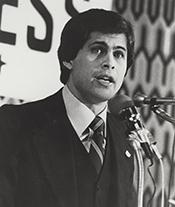
2,371 records where Rep. Eckart, Dennis E. [D-OH-11] is listed as a sponsor, author, or other actor. Search with topics and years
United States · United States Congress · 25 April 1990
Designates the month of October 1990 as Crime Prevention Month.
United States · United States Congress · 25 April 1990
Expresses the sense of the Congress that the administration should: (1) be commended for its quick action in addressing the humanitarian crisis in northern Ethiopia; and (2) impress upon Ethiopia's opposition groups that the U.S. attitude toward each such group will be greatly influenced by their cooperation in facilitating relief efforts and by steps they take in negotiating a lasting political settlement. Requests the President to urge: (1) the parties to the conflict in northern Ethiopia to agree to a ceasefire, to accept free passage of relief, and to permit the United Nations (U.N.) to assume a prominent role in coordinating international relief efforts; (2) Soviet President Gorbachev to press the Ethiopian Government to agree to such actions; and (3) nations supplying military assistance to the warring parties in Ethiopia to use their influence to facilitate a ceasefire and end external military flows. Urges the President: (1) until the Ethiopian Government takes such actions, to oppose favorable treatment of such Government by the International Bank for Reconstruction and Development (World Bank) and the International Monetary Fund (IMF), to continue to oppose upgrading of U.S. diplomatic relations with such Government, and to prohibit the importation of Ethiopian coffee; and (2) after the Ethiopian Government takes such actions and has made substantial progress in effecting macroeconomic reform and in negotiating a settlement of Ethiopia's internal wars, to begin the normalization of relations and to support an expanded World Bank and IMF role in Ethiopia.
United States · United States Congress · 24 April 1990
Mortgage Servicing Transfer Disclosure Act of 1990 - Amends the Real Estate Settlement Procedures Act of 1974 to prescribe mortgage servicing disclosure requirements for each person making a federally related mortgage loan to a consumer (including the identity of the person to whom the mortgage servicing contract is transferred). Sets forth guidelines for the treatment of consumer loan payments during the period in which the mortgage loan servicing contract is being transferred. Sets forth liability guidelines for violations of this Act. Authorizes consumer class action suits. Sets forth guidelines for annual notification to the consumer by the mortgage servicer of the consumer's escrow account status, including itemized expenses and anticipated charges.
United States · United States Congress · 24 April 1990
Authorizes and requests the President to designate May 26, 1990, to commemorate the bicentennial of "An Act for the government of the territory of the United States, south of the river Ohio" (from which Tennessee was formed).
United States · United States Congress · 24 April 1990
Designates January 6 through January 12, 1991, as National Law Enforcement Training Week.
United States · United States Congress · 19 April 1990
Amends the Internal Revenue Code to extend the tax exemption for qualified small issue industrial bonds (bonds issued to finance manufacturing facilities and farm property) through 1995.
United States · United States Congress · 18 April 1990
Foreign Investment Policy Improvements Act - Requires the Secretary of Commerce to issue a report on foreign direct investment in the United States. Requires the General Accounting Office to submit to a specified congressional committee a report analyzing and making recommendations with respect to the Secretary's report. Requires the Bureau of Economic Analysis to use certain business information relating to foreign-owned businesses in the United States (ten percent or more of whose voting securities are owned by foreign persons) when implementing the International Investment and Trade in Services Survey Act. Requires the Bureau, in a specified report, to include information on international investment in property in the United States by foreign persons, with separate tables listing businesses (50 percent or more, and 50 percent or less, of whose voting securities are owned or controlled by foreign persons). Amends such Act to authorize and provide for the collection and use of information on direct investments owned or controlled directly or indirectly by foreign governments. Increases, and makes mandatory, the civil penalties for failure to provide information under such Act.
United States · United States Congress · 18 April 1990
Directs the Administrator of the U.S. Fire Administration to review existing response information used by emergency response personnel at the State and local levels to evaluate its accuracy, consistency, and clarity. Specifies that such information should clearly communicate to such personnel the probable hazards in an emergency situation involving hazardous materials and the appropriate response to such hazards. Directs the Administrator to establish a working group to develop and disseminate hazardous materials identification, response, and incident data. Requires such working group to submit a report to the Administrator, along with recommendations to ensure that response information disseminated to emergency response personnel is appropriate for operational personnel at the local level. Requires the working group to meet at least once a year to review and recommend changes to the report.
United States · United States Congress · 4 April 1990
National Health Service Corps Revitalization Amendments of 1990 - Title I: Revisions in General Program for National Health Service Corps - Amends the Public Health Service Act provisions relating to the purpose of the National Health Service Corps to require that the Secretary of Health and Human Services use the Corps to provide primary health services in health manpower shortage areas. Removes a limitation on the dollar amount of pay increases which may be granted to a Corps member during the first 36 months of service. Removes provisions directing the Secretary, in assigning Corps members, to: (1) give priority to meeting Indian Health Service and other indian tribe or tribal organization needs; and (2) provide special consideration to homeless populations who do not have access to primary health care services. Applies certain definitions to provisions relating to Corps scholarship and loan programs as well as to provisions relating directly to the Corps. Requires that a complete descriptive list of health manpower shortage areas be published in the Federal Register by specified deadlines. Includes in the definition of "medical facility": (1) health programs or facilities operated by a tribe or tribal organization; and (2) facilities used in connection with provisions relating to health services for homeless individuals. Allows the Secretary to assign members of the Corps to an entity to provide health services in a health manpower shortage area only if there has been (currently, will be) appropriate and efficient use of Corps members assigned to that entity for the area. Removes certain provisions relating to priorities and considerations in assigning Corps personnel, replacing some such provisions with similarly worded provisions. Sets forth the exclusive factors the Secretary may consider in determining the areas with the greatest shortages. Requires annual publication in the Federal Register of a list of areas that are to be given priority in the assignment of Corps members and, for FY 1991, a list of entities authorized to receive assignments of Corps members. Replaces provisions relating to grants and contracts for programs respecting preparation for practice of individuals subject to a service obligation with provisions: (1) concerning consideration of characteristics of Corps members in making assignments; (2) requiring certain types of counseling of Corps members; (3) requiring assistance to Corps members in establishing local professional relationships; (4) directing the Secretary to provide assistance regarding temporary relief from Corps duties in order to pursue continuing education or other interests, including vacations; and (5) directing the Secretary to carry out activities to determine the characteristics of health professionals who are more likely to remain in shortage areas after completion of Corps service, and to determine the appropriate conditions for the assignment of certified nurse practitioners, certified nurse midwives, and physician assistants. Authorizes appropriations. Title II: Scholarship and Loan Repayment Programs of National Health Service Corps - Replaces measures providing for the establishment of the National Health Service Corps Scholarship Program with similar provisions directing the Secretary to establish such a Scholarship Program to assure, with respect to primary health services, an adequate supply of health professionals. (Current law makes no reference to primary health services.) Requires that an agreement to work as a provider of primary health services in a shortage area (currently, an agreement to work in a shortage area) be a part of the scholarship contract. Alters the priorities in providing contracts under the Scholarship Program to include an individual with characteristics that increase the probability that the individual will continue to serve in a shortage area after completion of obligated service. Changes the required contents of an annual report mandated by current law regarding the Scholarship Program. Replaces measures providing for the establishment of the National Health Service Corps Loan Repayment Program with similar provisions directing the Secretary to establish such a Loan Repayment Program to assure, with respect to the provision of primary health services, an adequate supply of health professionals. (Current law makes no reference to primary health services.) Requires that an agreement to work as a provider of primary health services in a shortage area (currently, an agreement to work in a shortage area) be a part of the loan repayment contract. Changes eligibility procedures for the Loan Repayment Program. Replaces provisions governing priorities in providing loan repayment contracts with provisions directing the Secretary to give priority to an individual who has characteristics that increase the probability that the individual will continue to serve in a shortage area after completion of obligated service. Increases the limit on the amount the Secretary may pay for each year of obligated service. Removes provisions allowing fulfillment of a service obligation in the Indian Health Service or in a program or facility operated by a tribe or a tribal organization. Requires (currently, allows) the Secretary to pay all (currently, part or all) of any increase in Federal income tax liability of an individual which arises as a result of the loan repayments. Changes the required contents of an annual report mandated by current law regarding the Loan Repayment Program. Requires that an annual report concerning the Scholarship Program and the Loan Repayment Program cover the next five years rather than the next three years. Authorizes appropriations, requiring set-asides in certain percentages for new applicants and for applicants in specified fields. Title III: State Offices of Rural Health - Authorizes the Secretary, through the Director of the Office of Rural Health Policy, to make grants to States for improving health care in rural areas through the operation of State offices of rural health. Requires recipient States to agree that such office will be provided with a minimum annual budget. Authorizes appropriations. Prohibits making grants under this program after the aggregate amounts appropriated reach a specified level. Title IV: General Provisions - Specifies the effective dates of provisions of this Act.
United States · United States Congress · 4 April 1990
Markets and Trading Reorganization and Reform Act - Title I: Establishment of Commission - Establishes the Markets and Trading Commission as an independent regulatory commission. Establishes within such body the Office of General Counsel. Title II: Transfers of Functions - Transfers to the Commission all functions of the Commodity Futures Trading Commission, the Securities and Exchange Commission, and the Board of Governors of the Federal Reserve System. Authorizes the Commission to: (1) direct contract markets to adjust margin levels required on contracts; and (2) prescribe limits on margin levels imposed by a contract market. Title III: Federal Financial Markets Coordinating Council - Establishes the Federal Financial Markets Coordinating Council comprised of specified banking regulatory agencies to: (1) coordinate the regulatory operations of such agencies; (2) periodically discuss regulatory issues; (3) establish an advisory committee composed of member representatives from the futures, commodities, options and securities exchanges, and the banking industry; and (4) submit biennial status reports to the Congress. Title IV: Administrative Provisions - Sets forth personnel and administrative provisions for the Commission. Requires the Commission to submit an annual status report to the President. Authorizes appropriations. Title V: Transitional Savings, and Conforming Provisions - Sets forth transition guidelines for the transfer and allocation of appropriations and personnel. Title VI: Effective Date - Sets forth the effective date of this Act.
United States · United States Congress · 4 April 1990
Declares that, until the certification required by this Act is made, no national of a European Community (EC) member country shall be eligible to certify compliance of products produced outside the United States with any standard or requirement of specified provisions of the Occupational Safety and Health Act of 1970, the Longshore and Harbor Workers' Compensation Act, or the Contract Work Hours and Safety Standards Act. Requires those restrictions to remain effective until the Secretary of Commerce certifies to appropriate congressional committees that the EC is setting product standards and requirements in an open and fair manner and has established equitable rules for testing and certifying products for compliance with standards and requirements of the EC by laboratories in non-EC member countries.
United States · United States Congress · 4 April 1990
Declares that, until the certification required by this Act is made, no national of a European Community (EC) member country shall be eligible to perform testing for compliance, or to certify compliance of products produced outside the United States with any standard or requirement of specified provisions of the Clean Air Act. Requires those restrictions to remain effective until the Secretary of Commerce certifies to appropriate congressional committees that the EC is setting product standards and requirements in an open and fair manner and has established equitable rules for testing and certifying products for compliance with standards and requirements of the EC by laboratories in non-EC member countries.
United States · United States Congress · 4 April 1990
Declares that, until the certification required by this Act is made, no national of a European Community (EC) member country shall be eligible to certify compliance of products produced outside the United States with any standard or requirement of specified provisions of the Public Health Service Act or the Federal Food, Drug, and Cosmetic Act. Requires those restrictions to remain effective until the Secretary of Commerce certifies to appropriate congressional committees that the EC is setting product standards and requirements in an open and fair manner and has established equitable rules for testing and certifying products for compliance with standards and requirements of the EC by laboratories in non-EC member countries.
United States · United States Congress · 4 April 1990
Declares that, until the certification required by this Act is made, no national of a European Community (EC) member country shall be eligible to perform testing for compliance, or to certify compliance of products produced outside the United States with any standard or requirement of specified provisions of the Communications Act of 1934. Requires those restrictions to remain effective until the Secretary of Commerce certifies to appropriate congressional committees that the EC is setting product standards and requirements in an open and fair manner and has established equitable rules for testing and certifying products for compliance with standards and requirements of the EC by laboratories in non-EC member countries.
United States · United States Congress · 4 April 1990
Declares that, until the certification required by this Act is made, no national of a European Community (EC) member country shall be eligible to certify compliance of products produced outside the United States with any standard or requirement of specified provisions of the Energy Policy and Conservation Act. Requires those restrictions to remain effective until the Secretary of Commerce certifies to appropriate congressional committees that the EC is setting product standards and requirements in an open and fair manner and has established equitable rules for testing and certifying products for compliance with standards and requirements of the EC by laboratories in non-EC member countries.
United States · United States Congress · 4 April 1990
Composting Research Act of 1990 - Directs the Secretary of Agriculture to: (1) establish a Compost Task Force; (2) conduct a composting agricultural wastes study; (3) conduct research on potential uses of compost; (4) evaluate existing compost programs; and (5) initiate a composting extension program.
United States · United States Congress · 4 April 1990
Authorizes appropriations to provide for a specified personnel level for the border patrol of the Immigration and Naturalization Service by October 1, 1992. Makes funds available from the Department of Justice Assets Forfeiture Fund to provide for such personnel level.
United States · United States Congress · 4 April 1990
Textile, Apparel, and Footwear Trade Act of 1990 - Limits the 1990 imports of textiles and textile products classified under a category to an amount equal to 101 percent of the total 1989 imports classified under such category. Limits the 1990 imports of nonrubber footwear classified under a nonrubber footwear category to an amount equal to: (1) the total 1989 imports of nonrubber footwear classified under such category; and (2) in the case of high priced nonrubber footwear, the total 1989 imports of high priced nonrubber footwear classified under such category. Provides for a one-percent annual growth in the amount of permitted imports of textiles and textile products after 1990. Exempts from the limitations imposed under this Act imports of textiles and textile products from U.S. possessions if such articles are exempt from duty under the Harmonized Tariff Schedule of the United States and are manufactured by U.S. citizens, nationals, or permanent residents of such a possession. Limits the imports of certain sweaters made in Guam to a specified amount during FY 1990 and to such amount increased by one percent per year in subsequent years. Declares such limitations shall not apply to Canada or Israel. Sets forth limitations on the amount of textile and textile products, classified under certain import categories, which may be imported from beneficiary countries under the Caribbean Basin Initiative. Authorizes the President to: (1) enter into trade agreements to grant new concessions as compensation to the extent required under U.S. trade agreements for the import limits imposed by this Act; and (2) proclaim such modification or continuance of any existing duty on textiles and textile products and on nonrubber footwear as necessary to carry out such agreements. Prohibits the President from reducing any rate of duty by more than ten percent. Requires the President, before entering into such trade agreements, to consider whether a country has violated trade concessions of benefit to the United States and the violation has not been adequately offset. Sets forth requirements governing staged rate reductions in the tariffs of articles affected by this Act. Prohibits the President, except as authorized by this Act, from entering into trade negotiations with any country with respect to duties on textiles, textile products, and nonrubber footwear. Prohibits the President, except as provided in this Act, from decreasing or proposing a decrease in any such duty by any means, including an implementing bill or a proclamation. Requires the President to report annually to the Congress on the administration of this Act. Requires the Secretary of Commerce, ten years after enactment of this Act, to study and report to the Congress on its operation. Requires the Secretary of the Treasury to establish a pilot program for the issuance and sale to U.S. companies at public auction of import licenses applicable to categories of textiles. Terminates such licensing program on December 31, 1991, and requires a report to the Congress on its administration.
United States · United States Congress · 4 April 1990
Designates May 13, 1990, as Infant Mortality Awareness Day.
United States · United States Congress · 4 April 1990
Commends the Runnin' Rebels of the University of Nevada at Las Vegas for winning the 1990 National Collegiate Athletic Association Men's Basketball Championship.
United States · United States Congress · 2 April 1990
Investment Advisors Disclosure and Enforcement Act of 1990 - Amends the Investment Advisers Act of 1940 to subject registered investment advisers (and persons controlling such advisers) to liability to persons injured by such advisers' violations of such Act. Prescribes prohibited practices regarding securities recommendations and sets forth disclosure requirements regarding conflicts of interests for investment advisers. Expands the definition of investment planners and related businesses. Authorizes the Securities and Exchange Commission to assess civil penalties and to seek court actions to enforce them.
United States · United States Congress · 29 March 1990
Denies Environmental Protection Agency (EPA) benefits for ten years to any person: (1) convicted of violating a Federal environmental law; or (2) found to have held a beneficial business interest in a business concern required to be listed on a disclosure statement under this Act and convicted of violating a Federal environmental law. Prohibits the EPA Administrator from denying benefits to any person who demonstrates that he has been rehabilitated. Requires the following persons to file disclosure statements with the Administrator: (1) Federal environmental permit applicants; (2) applicants for EPA loans, grants, or other benefits; or (3) persons submitting contract bids or competitive proposals to EPA. Provides for enforcement of this Act through EPA examination of disclosure statements and access to business sites and records. Grants persons declared to be ineligible for EPA benefits the opportunity for a hearing. Provides for public access to disclosure statements and business records, with the exception of confidential information.
United States · United States Congress · 29 March 1990
Requires the Attorney General to recruit 1,000 additional border patrol agents for the Immigration and Naturalization Service from eligible military personnel discharged involuntarily under honorable conditions after October 1, 1989.
United States · United States Congress · 29 March 1990
Designates July 19, 1990, as Flight Attendant Safety Professionals' Day.
United States · United States Congress · 29 March 1990
Designates September 13, 1990, as National DARE (Drug Abuse Resistance Education) Day.
United States · United States Congress · 29 March 1990
Expresses the sense of the Congress that foreign language instruction should begin at the elementary school level. Urges State and local educational agencies to initiate programs of foreign language instruction in elementary schools. Supports the statements of: (1) the National Governors' Association calling for such programs; and (2) the Follow-Up Committee to the Wingspread Consultation on Elementary School Foreign Languages, calling for establishment of a Blue Ribbon Commission to address the national agenda for foreign language instruction in elementary schools.
United States · United States Congress · 28 March 1990
National Child Search Assistance Act of 1990 - Requires each Federal, State, and local law enforcement agency to report each case of a missing child under age 18 to the National Crime Information Center (NCIC) of the Department of Justice. Directs the Attorney General to establish guidelines for the collection of such reports and to publish an annual summary. Requires States reporting under this Act to: (1) ensure that no State law enforcement agency establishes a policy which requires a waiting period before accepting a missing child report; (2) provide that all information is entered into the State law enforcement system and the NCIC computer networks and forwarded to the Missing Children Information Clearinghouse (Clearinghouse) or other designated agency within the State; (3) require the Clearinghouse or designated agency to notify all other law enforcement agencies in the State, verify and update the original entry made into the State law enforcement system and NCIC computer networks, and institute or assist with appropriate search and investigative procedures; and (4) maintain close liaison with the National Center for Missing and Exploited Children for the exchange of information and technical assistance in the missing children cases. Specifies that any State not complying with such reporting requirements shall be denied grants, cooperative agreements, or other assistance authorized by the Missing Children's Assistance Act.
United States · United States Congress · 28 March 1990
Tax Collection Enhancement Act of 1990 - Amends the Internal Revenue Code to provide for the collection of delinquent Federal income taxes by a State in the course of the State's collection of delinquent State income taxes. Allows a State to receive 50 percent of the amount of delinquent Federal income taxes it collects.
United States · United States Congress · 28 March 1990
Amends the Internal Revenue Code to make permanent the provisions permitting small issues of tax-exempt bonds to finance manufacturing facilities and farm property.
United States · United States Congress · 27 March 1990
Nontraditional Students Assistance Act of 1990 - Amends the Higher Education Act of 1965 to lower from 24 to 22 the age at which an individual is to be considered an independent student, for purposes of student financial assistance in general, as well as for Pell Grants. Makes less-than-half-time students who meet specified requirements eligible for student loans under the guaranteed student loan (GSL) program, as well as for Pell Grants. Makes such students also eligible for grace periods and deferrals with respect to repayment of GSL loans and of loans under the national student direct loan (NDSL) program.
United States · United States Congress · 27 March 1990
Foreign Trade Zones Improvement Act - Amends the Foreign Trade Zones Act to include the Secretary of Labor and the United States Trade Representative as members of the Board which grants corporations the authority to establish a foreign trade zone. Removes the Secretary of the Army from membership on the Board. Prohibits the Board from granting an application to establish a foreign trade zone unless the Board finds that the proposed zone will meet specified public economic interest criteria. Requires each application to address: (1) the ability of the applicant to maintain operations in the zone; and (2) the customs and tax benefits that will accrue to the applicant as a result of the zone's operation. Places upon the applicant the burden of proof that such zone will meet the public economic interest criteria. Sets forth specified procedures for the granting of applications for a foreign trade zone. Provides for Board review of such grants every seven years. Authorizes the Board to revoke grants that do not meet the requirements of this Act.
United States · United States Congress · 22 March 1990
Tourism Policy and Export Promotion Act of 1990 - Declares it to be the national goal to increase U.S. export earnings from U.S. tourism and transportation services with an eye toward: (1) the elimination of the travel and tourism export deficit of the United States and the U.S trade deficit; and (2) the achievement of a travel and tourism export surplus. Amends the Trade Act of 1974 to require the United States Trade Representative (USTR) to identify foreign trade barriers to U.S. travel and tourism. Requires the USTR to submit the National Trade Estimate to the President and the Senate Committees on Finance and Commerce, Science, and Transportation. Amends the International Trade Act of 1961 to require each annual tourism trade development plan to focus on those countries in which tourism trade development has the greatest potential for increasing travel and tourism export revenues. Declares that the Congress finds that increased efforts directed at the promotion of rural tourism will contribute to the economic development of rural America. Establishes the Rural Tourism Foundation. Authorizes appropriations.
United States · United States Congress · 22 March 1990
World War II 50th Anniversary Commemorative Coin Act - Expresses the sense of the Congress that the United States should recognize the 50th anniversary of World War II by minting and issuing commemorative coins. Directs the Secretary of the Treasury to issue and mint such coins in five dollar, one dollar, and half dollar denominations. Mandates that surcharges received from the sale of such coins be deposited in a coinage profit fund and allocated, upon separate congressional authorization, to the American Battle Monuments Commission to establish a World War II memorial. Directs the Secretary to report semiannually to the Congress regarding implementation of this Act.
United States · United States Congress · 22 March 1990
Designates July 2, 1990, as National Literacy Day.
United States · United States Congress · 22 March 1990
Designates the week beginning July 22, 1990, as Lyme Disease Awareness Week.
United States · United States Congress · 21 March 1990
Calls for the United States to: (1) continue to give the highest priority to accounting for Americans still missing or unaccounted for in Southeast Asia and to securing the return of Americans still held captive; (2) ensure cooperation with Vietnam and Laos to achieve credible answers for the families of such Americans, including primary-next-of-kin access to all records and information resulting from joint investigations, surveys, and excavations; (3) develop a means of accounting for Americans unaccounted for in Cambodia that is consistent with U.S. efforts to obtain a political settlement to the Cambodian situation; and (4) heighten responsible public awareness of Americans unaccounted for in Southeast Asia through the dissemination of factual data.
United States · United States Congress · 20 March 1990
Great Lakes Water Quality Improvement Act of 1990 - Amends the Clean Water Act to extend from five to seven years the period for conducting study and demonstration projects on the removal of toxic pollutants from the Great Lakes. Directs the Administrator of the Environmental Protection Agency to develop: (1) specific numerical water quality criteria for the Great Lakes; and (2) guidance for the use of such criteria by States and local governments in implementing pollution prevention procedures. Requires the Great Lakes States (Illinois, Indiana, Michigan, Minnesota, New York, Ohio, Pennsylvania, and Wisconsin) to adopt water quality standards which incorporate such criteria. Directs the Administrator to promulgate standards for Great Lakes States which fail to adopt such standards. Requires the Great Lakes States to develop and submit to the International Joint Commission remedial action plans for places designated as areas of concern pursuant to the Great Lakes Agreement between the United States and Canada. Directs the Great Lakes National Program Office to provide technical assistance to such States for plan development. Requires remedial actions to be included in such States' water quality plans. Directs the Administrator to develop and submit to the Commission a lakewide management plan for each of the Great Lakes. Provides for the revision of such plans and of remedial action plans, as necessary. Requires the Administrator to establish a program for making grants to Great Lakes States for the implementation of the Great Lakes Agreement and this Act. Directs the Administrator to develop consistent methods of reporting water quality data to the Commission. Authorizes and allocates appropriations.
United States · United States Congress · 20 March 1990
Directs the Secretary of Defense to establish the Commission on Base Realignment and Closure to: (1) determine if certain efficiencies can be realized through closure or realignment of domestic and overseas U.S. military installations; and (2) make recommendations for such closures and realignments. Directs the Secretary to initiate and complete all recommended closures and realignments by specified dates. Outlines conditions for such closures and realignments, including congressional reports and the lack of a joint resolution from the Congress disapproving the Commission's recommendations. Terminates the authority to carry out any closure or realignment under this Act on a specified date. Directs the Secretary to carry out any recommended base closure or realignment and to provide economic adjustment assistance, community planning assistance, and environmental restoration with respect to affected areas or communities. Directs the Administrator of General Services to delegate to the Secretary all appropriate authority to dispose of property for purposes of such closures or realignments, after consultation with the Governor of the State and the heads of local governments concerning other uses of the property to be disposed. Requires the Secretary to notify all other departments and other instrumentalities of the availability of such property made excess by such closures or realignments. Outlines the applicability of the National Environmental Policy Act of 1969 with respect to actions of the Commission and the Secretary concerning base closures and realignments under this Act. Directs the Secretary to report to the Congress on the schedule for, cost savings from, and environmental effects of, base closures and realignments. Establishes the Department of Defense Base Closure Account 1990 to receive deposits for, and proceeds from, base closures or realignments to be used for such closures and realignments. Requires certain reports with respect to the use of Account funds. Outlines the legislative process for the consideration of a joint resolution to disapprove the Commission's recommendations.
United States · United States Congress · 20 March 1990
Expresses the sense of the Congress that: (1) the United States should support the unified status of Jerusalem and continue to recognize that a unified Jerusalem is an integral part of the State of Israel; (2) efforts of the U.S. Government to achieve peace in the Middle East should take into account the close relationship between the United States and Israel, as well as Israel's legitimate security needs; and (3) efforts to advance the peace process must not call into question the status of Jerusalem.
United States · United States Congress · 19 March 1990
Innovative Boot Camp Prison Act of 1990 - Amends the Omnibus Crime Control and Safe Streets Act of 1968 to authorize grants to States to carry out projects that demonstrate innovative alternatives to the imprisonment of individuals convicted of nonviolent offenses. Includes boot camp prisons as such alternatives, in conjunction with drug treatment, literacy education, vocational education, and job training programs. Makes drug testing and treatment mandatory for drug offenders. Sets forth: (1) application procedures and requirements for grants; and (2) procedures for review of applications. Authorizes appropriations.
United States · United States Congress · 15 March 1990
Congratulates: (1) the people of Lithuania on their recent multiparty elections; (2) the new Government on its decision to restore Lithuanian independence; and (3) the new Supreme Council of the Republic of Lithuania. Urges the Soviet Government to enter into negotiations with the new Lithuanian Government on an equal basis and to refrain from acts of political and economic intimidation against Lithuania. Urges the President to: (1) strengthen and seek ways to demonstrate his commitment to an independent and democratic Lithuania; (2) take steps toward normalizing diplomatic relations with the Lithuanian Government; (3) seek effective political support among our allies as Lithuania attempts to negotiate credits in Western markets; and (4) seek ways to make appropriate technical assistance available to the Lithuanian people.
United States · United States Congress · 14 March 1990
Depository Institution Golden Parachute Prohibition Act of 1990 - Amends the Federal Deposit Insurance Act to authorize the Federal Deposit Insurance Corporation Board of Directors to prohibit any insured depository institution from making golden parachute payments as defined in the Internal Revenue Code (payments resulting from an agreement during the pendency of a tender offer to increase the compensation of senior management personnel).
United States · United States Congress · 14 March 1990
Designates the week of October 13 through October 20, 1990, as American Textile Industry Bicentennial Week.
United States · United States Congress · 14 March 1990
Designates the week beginning September 16, 1990, as National Give the Kids a Fighting Chance Week.
United States · United States Congress · 14 March 1990
Designates the week beginning June 10, 1990, as National Scleroderma Awareness Week.
United States · United States Congress · 14 March 1990
Requires the Clerk of the House of Representatives to provide a telecommunications device for the deaf in the office of each Member of the House of Representatives.
United States · United States Congress · 8 March 1990
Breast and Cervical Cancer Mortality Prevention Act of 1990 - Amends the Public Health Service Act to direct the Secretary of Health and Human Services, through the Director of the Centers for Disease Control, to make grants to States, with regard to breast and cervical cancer, for screening, referrals and follow-up services, public information and education programs, education and training for health professionals, quality monitoring of screening, and evaluations of such activities. Sets forth preferences in making the grants and requires equitable geographical distribution. Requires matching non-Federal funds in a specified ratio. Requires that States agree to: (1) provide all of certain services by a specified date; (2) switch to any improved screening procedures which become available; and (3) assure the quality of any screening procedures used. Directs the Secretary to establish guidelines for assuring the quality of mammography and cytological screening conducted under these provisions. Requires that low-income women be given priority in the provision of services. Requires that a charge for services, if any: (1) be made according to a public schedule; (2) be adjusted for income of the woman involved; and (3) not be imposed on women with incomes below the poverty line. Requires services to be provided throughout a State, including to members of any Indian tribe or tribal organization. Authorizes the Secretary to provide training and technical assistance. Directs the Secretary to provide for annual evaluations of programs carried out under this Act. Authorizes appropriations. Limits the number of grants made to seven in FY 1991.
United States · United States Congress · 8 March 1990
Regulated Precursor Chemicals Act of 1990 - Amends the Controlled Substances Act to revise and expand the list of precursor chemicals, including transferring to such list hydriodic acid from the list of essential chemicals. Revises the definition of "regulated transaction" to include transfers of any amount of an essential listed precursor chemical, with exceptions. Requires each regulated person to report to the Attorney General on any regulated transaction involving any quantity of a listed essential chemical. Makes it unlawful for any person to engage in a regulated transaction involving a listed precursor chemical or any other conduct that defines such person as a regulated person for purposes of such Act without a license required under such Act. Requires the Attorney General to establish a program requiring licenses for regulated persons and regulated transactions involving listed precursor chemicals where such requirement will contribute to carrying out the purposes of such Act and to criminal drug law enforcement. Provides for fines and imprisonment of not more than four years for violations of the licensing requirement. Requires the Attorney General to provide for the audit and control of listed precursor chemical inventories of persons possessing a license under this Act. Directs the Attorney General to cooperate with State authorities by providing information regarding regulated transactions in such chemicals that might be useful in the administration of State laws relating to precursor chemicals, controlled substances, and other illegal drugs.
United States · United States Congress · 7 March 1990
Antarctic Environmental Protection, Clean-Up, and Liability Act of 1990 - Amends the Antarctic Conservation Act of 1978 to require the Director of the National Science Foundation to: (1) prepare and annually update a waste management plan for wastes produced or disposed of in Antarctica by U.S. citizens; and (2) issue regulations requiring U.S. citizens engaged in activities in Antarctica to comply with specified waste disposal practices. Requires the Director to establish a long-term program for the removal of specified wastes produced or disposed of in Antarctica by U.S. citizens. Directs the Secretary of the department in which the Coast Guard is operating to issue regulations: (1) requiring all vessels engaged in U.S. activities in Antarctica, including tourist expeditions, to be equipped with compaction, storage, and incineration facilities (or stockpiling facilities for vessels not capable of being fitted with waste disposal facilities); and (2) prohibiting U.S. citizens from employing any vessel in Antarctica unless such vessel contains such facilities. Makes it unlawful for any individual in charge of a vessel or any U.S. citizen employing a vessel in Antarctica to: (1) intentionally discharge oil or dispose of plastic in the Antarctic marine environment; (2) dispose of dunnage, lining, or packing materials less than 25 nautical miles from the closest land or ice shelf; (3) dispose of food waste or other garbage less than 12 nautical miles from the closest land or ice shelf; or (4) discharge sewage within 12 nautical miles of the closest land or ice shelf. Prescribes civil penalties for disposal violations or for violations of waste disposal facility requirements. Makes vessels committing disposal violations or violations concerning compliance with specified international shipping conventions liable in rem for such penalties. Requires all vessels supporting U.S. activities in Antarctica to comply with specified international conventions relating to pollution prevention and ship safety. Directs the Secretary to issue regulations requiring all vessels supporting U.S. activities in Antarctica and all U.S. facilities in Antarctica where oil is stored to have contingency plans and the capability and equipment to respond, prevent, and clean up oil spills. Makes such parties liable for the removal of oil and for the restoration of any natural resources, specially-protected areas, or sites of special scientific interest. Prescribes civil penalties if such restoration is not feasible. Requires the President to direct the Secretary of State to initiate actions within the International Maritime Organization to secure designation of the waters south of 60 degrees south latitude as a special area under the International Convention for the Prevention of Pollution From Ships, 1973 and the Protocol of 1978 Relating Thereto. Directs the Under Secretary of Commerce for Oceans and Atmosphere to develop and implement an environmental monitoring program for Antarctica. Requires regulations promulgated pursuant to the Antarctic Conservation Act of 1978 to include requirements for specially-protected areas. Requires the Director to issue regulations designating as a pollutant any substance which is liable, if introduced into Antarctica, to: (1) create health hazards or harm living resources; or (2) damage amenities or interfere with other legitimate uses of Antarctica. Provides for the issuance of permits to regulate the discharge of such pollutants into the Antarctic environment by U.S. citizens. Applies the National Environmental Policy Act of 1969 to all Federal activities in Antarctica. Requires the Secretary of State, before submitting the Convention on the Regulation of Antarctic Mineral Resource Activities to the Senate for ratification, to prepare an environmental impact statement on the Convention and alternative regimes for protecting the Antarctic environment. Sets forth provisions concerning citizen suits. Authorizes appropriations.
United States · United States Congress · 7 March 1990
Nonindigenous Aquatic Nuisance Act of 1990 - Title I: United States Coast Guard Regulations - Directs the Secretary of the department in which the Coast Guard is operating, through the Commandant of the Coast Guard, to promulgate regulations to prevent and control the transportation into U.S. waters of viable biological materials in ship ballast waters. Mandates the use of a high sea ballast water exchange or alternative methods developed and recommended by the Secretary. Directs the Secretary to promulgate regulations to prevent the unintentional transfer or introduction of nonindigenous species by ships operating exclusively within U.S. territorial waters or contiguous coastal waters of North America. Exempts such ships from the high seas exchange requirement of this Act. Exempts from the high seas exchange requirement a ship that is subject to requirements regarding the treatment of ballast water for the removal of chemical contaminants. Authorizes the Secretary to assess civil monetary penalties for violation of the regulations. Makes civil penalties available, as provided by appropriation Acts, to endow research on the control of nonindigenous species. Title II: Zebra Mussel and Aquatic Nuisance Species Research, Control, and Educational Program - Directs the Secretary of the Interior, through the Director of the United States Fish and Wildlife Service, and the Secretary of Commerce, through the Administrator of the National Oceanic and Atmospheric Administration (National Cooperative Action Group - NCAG), to jointly coordinate national research, control, and educational efforts associated with the infestation of the zebra mussel and other aquatic nuisance species in U.S. waters. Authorizes the NCAG to establish and coordinate regional commissions as necessary and to facilitate information transfer among the commissions. Authorizes Federal agency heads, on request of the chairman of any commission, to detail personnel to the commission. Requires the NCAG to provide advice to the Secretary of State concerning aquatic nuisance species that infest water resources shared with other countries. Requires the NCAG to establish a regional commission for the Great Lakes region and to request that the Great Lakes Fishery Commission: (1) designate a representative to serve on it; (2) advise, coordinate, and provide secretarial services on matters related to Great Lakes fisheries, related environmental concerns, and interactions with the Government of Canada; and (3) provide technical services for any technical committee established by the NCAG. Requires that the NCAG request that the Great Lakes Commission (established under the Great Lakes Basin Compact): (1) designate a representative to serve on the regional commission; (2) advise, coordinate, and provide secretarial services on matters related to the economic impacts of the zebra mussel on the geographic area of the Great Lakes; and (3) provide technical services for any technical committee established by the NCAG. Requires that research activities under this Act be carried out only in drainage basins infested with an aquatic nuisance species, with research funds allocated, to the extent possible, to existing facilities within infested areas. Sets forth research priorities. Directs the Secretary of State to initiate negotiations with foreign governments concerning prevention, research, education, and control programs for shared water resources. Requires compliance with specified treaties relating to the Great Lakes. Directs the Secretary of the Interior to declare the zebra mussel an injurious species. Requires the appropriate lead agency to allocate funds authorized under this Act for competitive university research grants to be administered through the Sea Grant College program to study aquatic nuisance species. Authorizes the program to conduct education and assistance services related to the prevention and control of such species. Authorizes appropriations.