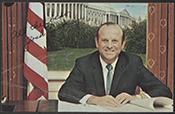
Bill· HRH.R. 14379 (95th)referred
United States · United States Congress · 14 October 1978
Amends the Congressional Budget Act of 1974 to require that a statement of the steps that have been or will be taken to reduce unobligated balances of budget authority under Federal programs and an estimate of the level of unobligated balances of budget authority that will exist at the end of the fiscal year be included in the report accompanying the first concurrent resolution on the budget each year, and in the annual reports submitted by other committees to the Budget Committees of the House of Representatives and the Senate, and in the President's annual budget.
Resolution· HCONRESH.Con.Res. 753 (95th)referred
United States · United States Congress · 13 October 1978
Expresses the sense of Congress that the Postal Service should issue a postage stamp commemorating the Jewish holiday of Chanukah.
Bill· HRH.R. 14340 (95th)referred
United States · United States Congress · 13 October 1978
Comprehensive Anti-Inflation Act - Title I: Coordination of Economic Policies - Amends the Employment Act of 1946 with the stated purpose of reducing the rate of inflation and keeping it within reasonable bounds. Directs the President, in each annual Economic Report, to establish economic and regulatory policies which set forth: (1) current trends in the levels of prices, wages, productivity, and production costs, including projections for inflation rates in the next calendar year; (2) annual numerical inflation goals; (3) fiscal policy targets; and (4) specific programs designed to achieve such inflation goals. Directs the Board of Governors of the Federal Reserve System to transmit annually to the Congress an independent statement of its intended monetary policies for the year. Title II: Establishment of Guidelines - Directs that a set of guidelines be established to govern price increases and wage settlements. Authorizes the President to promote voluntary compliance with such guidelines. Prohibits the use of mandatory wage or price controls by the President. Requires the Council of Economic Advisors to seek the advice and concurrence of the Council on Wage and Price Stability in establishing economic policies and guidelines. Title III: Policies and Programs to Reduce Inflation - Directs the President, in formulating and revising tax policy: (1) to reduce, or substitute for, taxes which significantly increase price levels; (2) to develop specific procedures to promote the promulgation of economically efficient and socially desirable regulations; (3) to deregulate industries over which the Federal Government has ratesetting authority; (4) to encourage the growth of productivity in both the private and public sectors; (5) to examine the use of tax incentives to hold cost increases to specified levels; (6) to strive to preserve production incentives and allow market forces to operate wherever possible; (7) to address the price implications of energy policies in the Economic Report; (8) to explore ways to increase competition in concentrated industries; and (9) to pursue negotiations for fair trade agreements with foreign nations. Title IV: Congressional Review - Directs the Joint Economic Committee to hold special hearings to review the President's proposed economic policies and to submit its findings and recommendations to the House of Representatives and the Senate.
Resolution· HRESH.Res. 1428 (95th)referred
United States · United States Congress · 12 October 1978
Fair Employment Relations Resolution - Title I: Fair Employment Relations Board - Establishes as an office of the House of Representatives the House Fair Employment Relations Board to: (1) establish and publish policies and guidelines for the implementation and enforcement of clause 9 of rule XLIII and clause 6(a)(3)(A) of the Rules of the House of Representatives; (2) supervise the actions of the Director and the operations of the House Fair Employment Relations Office; and (3) hear and determine complaints. Title II: House Fair Employment Relations Office - Establishes as an office of the House of Representatives the House Fair Employment Relations Office to develop procedures to implement the policies of the Board, gather information relating to House employment practices, and review procedures for the hearing and setting of complaints. Title III: Complaints of Violations of Equal Employment Opportunities - Provides for counseling and assistance through the Office to any individual who believes that he or she has been discriminated against in violation of rule XI of the Rules of the House of Representatives. Sets forth the procedures for filing informal complaints based on employment discrimination, and for the informal settlement of such claims. Sets forth the procedure for filing formal complaints, and for conducting hearings on such claims. Provides for an appeal to the Committee on Standards of Official Conduct from an adverse decision or order of the Board. Sets forth remedies available to individuals who have been discriminated against.
Bill· HJRESH.J.Res. 1149 (95th)referred
United States · United States Congress · 4 October 1978
Authorizes and requests the President to designate the seven-day period beginning on May 28, 1979, as "Vietnam Veterans Week."
Resolution· HRESH.Res. 1387 (95th)referred
United States · United States Congress · 28 September 1978
Expresses the sense of the House of Representatives that the United States Olympic Committee take the necessary measures to have the International Olympic Committee transfer the 1980 summer Olympics to a site outside the Soviet Union, and that the United States should consider withdrawal from such Olympics and establishing an alternate competition if such transfer does not occur.
Bill· HRH.R. 14147 (95th)referred
United States · United States Congress · 21 September 1978
Capital Availability for Higher Education Act - Amends the Higher Education Act of 1965 to: (1) raise from $2,500 to $3,500 the limit per academic year on federally insured loans to undergraduate students; (2) raise from $7,500 to $10,500 the total amount of such loans per undergraduate student; and (3) remove the $15,000 loan ceiling for graduate students. Authorizes eligible lenders to elect to have such loans collected by the Federal Government through the Secretary of the Treasury and the Commissioner of Education. Establishes guidelines and requirements for such program, including the deduction and withholding of wages by employers of student borrowers. Establishes the Guaranteed Student Loan Fund in the United States Treasury to repay funds withheld from the wages borrowers to lenders. Establishes an advisory panel to consider questions relating to such federally insured higher education loans.
Resolution· HRESH.Res. 1360 (95th)referred
United States · United States Congress · 20 September 1978
Expresses the sense of the House of Representatives that Reverend Sun Myung Moon return to the United States prior to October 31, 1978, appear before the Subcommittee on International Organizations investigating Korean-American relations, and fully respond to all questions of the subcommittee.
Resolution· HCONRESH.Con.Res. 716 (95th)referred
United States · United States Congress · 19 September 1978
Declares the sense of the Congress that the President and the Secretary of State should take all necessary steps to bring the Baltic States question before the United Nations and to urge the United Nations to request the Soviet Union to withdraw all non-native troops, agents, colonists, and controls from the Republics of Lithuania, Latvia, and Estonia, and to return all Baltic exiles from Siberia and from prisons and labor camps in the Soviet Union. Requires the Secretary of State to do his utmost to bring the matter of the Baltic States to the attention of all nations by means of special radio programs and publications. Declares that the United States should not agree to the recognition of the Soviet Union's annexation of Lithuania, Latvia, and Estonia. Directs the President to take steps to provide that all maps of Europe show the Republics of Lithuania, Latvia, and Estonia as independent states. Calls for a return of self-determination to the peoples of Lithuania, Latvia, and Estonia through free elections conducted under the auspices of the United Nations.
Bill· HRH.R. 14106 (95th)referred
United States · United States Congress · 18 September 1978
Authorizes the Administrator of General Services to make payments to local governments based on the amount of tax exempt public and foreign lands within the boundaries of such governmental units.
Bill· HRH.R. 14028 (95th)referred
United States · United States Congress · 8 September 1978
Provides for an official memorial flag to honor war veterans to be displayed in all national cemeteries on Memorial Day in lieu of small flags at individual gravesites. Describes such memorial flag.
Bill· HJRESH.J.Res. 1132 (95th)referred
United States · United States Congress · 8 September 1978
Authorizes and requests the President to designate the month of March, 1979, as "Youth Art Month."
Bill· HRH.R. 14005 (95th)referred
United States · United States Congress · 7 September 1978
Court Interpreters Act - Establishes, through the Director of the Administrative Office of the United States Courts, a program to: (1) compile and make available lists of qualified interpreters for non-English speakers and hearing impaired persons (whether or not also speech impaired) and; (2) provide the services of such interpreters free in criminal actions and civil actions initiated by the United States.
Bill· HRH.R. 13979 (95th)referred
United States · United States Congress · 6 September 1978
Amends the Internal Revenue Code to allow a tax credit for expenses related to the purchase and installation of a fire detector in the home of the taxpayer.
Bill· HRH.R. 13980 (95th)referred
United States · United States Congress · 6 September 1978
Authorizes the Secretary of Health, Education, and Welfare to provide, through demonstration projects, payments to individuals who are receiving, or are eligible to receive, benefits with respect to post-hospital extended care services under Title XVIII (Medicare) of the Social Security Act or intermediate care facility services or skilled nursing facility services under Title XIX (Medicaid) of such Act, who do not require 24-hour nursing care or supervision, and who desire to establish a noninstitutional living arrangement which will meet their medical and other needs. Requires payments received to be used to finance appropriate noninstitutional living arrangements which meet the medical and other needs of the individual. Provides that such payments shall not be includable in gross income under the Internal Revenue Code. Requires the Secretary to design demonstration projects for the purpose of determining: (1) the feasibility of transferring inpatients of skilled nursing and intermediate care facilities to noninstitutional living arrangements; (2) the types and percentage of such inpatients who could live effectively in a noninstitutional living arrangement; and (3) the types and percentages of such inpatients who would benefit economically and qualitatively from transferring to a noninstitutional living arrangement. Directs that funds for such payments be made from the Federal Hospital Insurance Fund established under the Social Security Act and from funds appropriated for Medicaid.
Bill· HRH.R. 13954 (95th)referred
United States · United States Congress · 17 August 1978
Veterans' Geriatrics and Gerontological Health Services Act - Establishes the Office of Assistant Chief Medical Director for Geriatrics, Gerontology, and Extended Care within the Office of the Chief Medical Director in the Veterans' Administration. Directs the Administration of Veterans' Affairs to designate 20 Veterans' Administration hospitals as geriatrics centers. Establishes a Geriatrics, Gerontology, and Extended Care Task Force within the Veterans' Administration.
Bill· HRH.R. 13957 (95th)referred
United States · United States Congress · 17 August 1978
Free and Fair Trade in Procurement Act - States the purposes of this Act to be to provide preference for domestic goods in government procurement with Federal funds, and to provide an additional preference for such procurement over foreign goods not freely and fairly traded. Defines "domestic article" for purposes of this Act to be any final good delivered to the government of which at least 75 percent of the total cost is attributable to United States sources. Includes within the definition of "Federal agency" for purposes of this Act AMTRAK and Conrail. Requires that domestic articles and materials be purchased for (1) procurements by Federal agencies or with Federal funds; (2) public buildings or public works involving Federal funds; and (3) State and local procurements at least 50 percent of which are federally funded. Allows for exceptions to such preference if the domestic product can not be obtained in sufficient quantity or quality, or if the cost of such product is excessive. Directs that no product may be procured with Federal funds from nonmembers or violators of an international government code to which the United States is a party. Allows for exceptions to such preference due to insufficient quantity, quality, or excessive cost. Extends the preference for domestic goods to subcontracts which form ten percent or more of the total delivered price of the procured product. Stipulates that the procurement preferences provided for in this Act shall not apply to the procurement of goods to be used outside the United States, or for purchases inconsistent with the public interest. States that the cost of a domestic product is to be considered excessive if the cost of the domestic product is (1) more than ten percent higher than a foreign equivalent product which is freely and fairly traded; or (2) not less than nor more than 40 percent higher than a foreign equivalent product which is not freely and fairly traded. Sets forth the guidelines for determining whether a foreign product is freely and fairly traded for purposes of this Act. Provides that a person in violation of certain unfair import practices under the Tariff Act of 1930 shall be barred from participating in any government procurements for three years. Requires a contractor supplying foreign products for government procurements to certify that he has written assurance from any foreign supplier that such foreign products are not being supplied at below their production cost, and that such foreign supplier is not in violation of United States antitrust laws. Provides that a contractor falsely certifying shall be barred from participating in any government procurements for three years. Repeals the "Buy American Act."
Bill· HRH.R. 13964 (95th)referred
United States · United States Congress · 17 August 1978
Provides for an official memorial flag to honor war veterans to be displayed in all national cemeteries on Memorial Day in lieu of small flags at individual gravesites. Describes such memorial flag.
Resolution· HRESH.Res. 1328 (95th)referred
United States · United States Congress · 17 August 1978
Urges the President to communicate with the Soviet Union concerning its obligation in accordance with the Helsinki accords to allow Isaac Zlotver to emigrate from the Soviet Union.
Bill· HRH.R. 13934 (95th)referred
United States · United States Congress · 17 August 1978
Good Samaritan Act - Declares: (1) that any physician, registered nurse, or aircraft employee who, in good faith and with a reasonable belief that immediate medical attention is necessary, renders emergency care to an injured or ill person aboard an aircraft within the special aircraft jurisdiction of the United States shall not be liable for any civil damages as a result of any act or omission by such individual in rendering such care, except for any act or omission amounting to gross negligence or willful or wanton misconduct; and (2) that any such individual shall not be liable for any such act or omission in rendering continued emergency care to the injured or ill person during transportation from the aircraft to a medical facility for further treatment or care.
Bill· HRH.R. 13890 (95th)referred
United States · United States Congress · 16 August 1978
Tuition Advance Fund Act - Amends the Higher Education Act of 1965 to authorize the Commissioner of Education to establish a system of undergraduate tuition advances to be repaid as an income tax imposed by the Internal Revenue Code of 1954. Establishes a trust fund in the United States Treasury for such tuition advance program.
Resolution· HRESH.Res. 1318 (95th)referred
United States · United States Congress · 16 August 1978
Recognizes the great contribution of Bernardo de Galvez to the independence of the United States.
Bill· HRH.R. 13893 (95th)referred
United States · United States Congress · 16 August 1978
Sales Representatives Protection Act - Requires a principal who, without good cause, terminates or fails to renew a contract between such principal and a sales representative, or reduces the rate of commission for orders solicited on behalf of such principal, to indemnify the representative according to this Act. Requires a principal who reduces the size of the geographic territory assigned to a representative for a specified account, which results in a specified reduction in commissions, to indemnify such representative. Sets forth formulae for the indemnification of such representatives. Requires a principal to furnish specified information to a sales representative concerning orders placed through the representative's account and a monthly accounting of commissions due such representative. Allows a plaintiff to bring an action to enforce any rights or liabilities created by this Act in a United States district court. Stipulates the procedure for such action.
Resolution· HRESH.Res. 1316 (95th)referred
United States · United States Congress · 16 August 1978
Directs the Secretary of Defense to rescind that portion of the Department of Defense directive which permits deserters from military service to receive in absentia discharges.
Showing the 24 most recent records of 1,672. Browse the full list