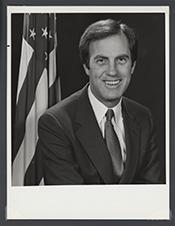
United States · United States Congress · 18 August 1982
Amends the Federal criminal code to impose mandatory minimum sentences for committing violent felonies against individuals aged 65 or older. Prohibits suspended, probationary, and concurrent sentences. Prohibits parole and any plea bargaining agreements that would result in the defendant's serving less than the minimum sentence.
United States · United States Congress · 18 August 1982
Disapproves the President's recommendation to extend the President's authority to waive the freedom of emigration requirements under the Trade Act of 1974 in order to extend the most-favored nation status of the People's Republic of China.
United States · United States Congress · 12 August 1982
Competitive Shipping and Shipbuilding Act of 1982 - Requires that, by 1983, five percent of all bulk cargoes imported into or exported from the United States by water be carried on U.S.-flag ships. Requires yearly one percent increases until the percentage carried on U.S.-flag ships reaches 20 percent. Directs the Secretary of Transportation to prepare annual estimates of current and projected costs of U.S.-flag bulk ship operation and shipbuilding. Requires anyone engaged in importing or exporting bulk commodities in U.S. foreign commerce whose business volume exceeds $1,000,000 annually to report to the Secretary of Commerce on the percentage of such person's exports and imports carried on U.S.-flag ships. Requires that such importer or exporter use U.S.-flag ships for the percentage of shipping required under this Act or be subject to specified penalties. Sets forth procedures for the investigation and prosecution of violations of this Act.
United States · United States Congress · 22 July 1982
Firearms Ownership Rights Act of 1982 - Title I: Findings and Purposes of this Act - Sets forth findings regarding the legislative history of the Gun Control Act of 1968 and Federal preemption of State and local firearms laws. Title II: Amendments to the Gun Control Act of 1968 - Amends the Gun Control Act of 1968 to declare that no provision shall be construed to preempt a State law on the same subject matter, unless there is a direct and positive conflict between the laws which cannot be reconciled. Declares that Congress does intend to preempt any local government law which prohibits or regulates the ownership or possession of firearms or ammunition, unless the local law is created by Federal or State law. Makes any local government which enacts a law conflicting with this Act ineligible to receive Federal funds for law enforcement.
United States · United States Congress · 15 July 1982
Residential Mortgage Investment Act of 1982 - Permits employee benefit plans, as defined under this Act, to engage in any qualified mortgage transaction involving any qualified residential mortgage loan, provided transactions between all parties are at arm's length. Permits such plans to participate in any mortgage pool, provided such pool conforms to specified requirements with regard to permitted investments. Authorizes the Secretary of the Treasury to prescribe regulations to carry out this Act. Provides that this Act shall supersede any and all contrary provisions of State law, the Employee Retirement Income Security Act of 1974, and the Internal Revenue Code. Prohibits the imposition of Federal excise tax on a plan or pool that engages in a transaction described under this Act.
United States · United States Congress · 15 July 1982
Expresses the support of the Congress for beginning strategic arms reductions talks. Urges the Soviet Union to join with the United States in concluding an equitable and verifiable agreement which freezes strategic nuclear forces at equal and substantially reduced levels. Reaffirms congressional support for the position that the United States should not enter into an arms agreement which provides for force levels inferior to those of the Soviet Union. Declares that the United States should propose practical measures to: (1) reduce the danger of accidental nuclear war; (2) prevent the use of nuclear weapons by third parties, including terrorists; and (3) halt the worldwide proliferation of nuclear weapons. Insists that any arms control agreement must be fully verifiable.
United States · United States Congress · 13 July 1982
Amends the Federal criminal code to abolish the defense of insanity. Provides that insanity at the time of an offense will not negate the mental state or condition required by law to convict a defendant, provided that the defendant was able to understand the nature and consequences of the offense. Places upon the defendant the burden to prove a lack of comprehension of the nature of his offense which is necessary to excuse him from trial. Requires a judge to commit to the appropriate medical institution any defendant so excused. Allows the court to commit a convicted defendant to an appropriate institution for medical assistance, until the defendant is declared sane by the medical authorities at the institution. Requires any remainder of a sentence to be served in prison.
United States · United States Congress · 13 July 1982
National Commission on Neurofibromatosis Act - Directs the Secretary of Health and Human Services to establish a National Commission on Neurofibromatosis within 60 days. Sets forth operating and related provisions. Authorizes the Commission to transmit interim reports. Requires: (1) a final report to the President and to each House of Congress within one year; and (2) the Secretary to file a final report and a budget analysis for neurofibromatosis research with the appropriate congressional committees within 15 days after the President submits his budget to Congress. Terminates the Commission three months after submission of the final report. Authorizes appropriations.
United States · United States Congress · 22 June 1982
Expresses the sense of Congress that legislation should be proposed and enacted to: (1) establish parity between the compensation of Government Printing Office (GPO) employees and the compensation of other Federal employees performing similar work; (2) fix the wages of GPO employees in accordance with the prevailing wage rate system applicable to executive branch employees; and (3) strengthen the Public Printer's ability to manage without infringing on the oversight responsibilities of the Joint Committee on Printing.
United States · United States Congress · 10 June 1982
Prohibition of Mandatory Retirement and Employment Rights Act of 1982 - Amends the Age Discrimination in Employment Act of 1967 to eliminate the upper age limitation of the class of persons to whom such Act applies.
United States · United States Congress · 7 June 1982
Amends titles II (Old Age, Survivors and Disability Insurance) and XVIII (Medicare) of the Social Security Act to prohibit the inclusion of the disbursements from the Federal Old-Age and Survivors Insurance Trust Fund, the Federal Disability Insurance Trust Fund, and the Federal Hospital Insurance Trust Fund and of the receipts from the old age, survivors and disability insurance taxes and the hospital insurance taxes on self-employment income, employees, and employers in the totals of the Federal budget. Exempts such disbursements and receipts from any general statutory limitation on Federal budget outlays.
United States · United States Congress · 25 May 1982
Constitutional Amendment - Declares that nothing in the Constitution shall be construed to prohibit prayer in public schools or institutions. States that no person shall be required by the United States or any State to participate in prayer.
United States · United States Congress · 13 May 1982
Expresses the sense of the House of Representatives that: (1) the House should not consider legislation which would reduce benefits under title II (Old Age, Survivors and Disability Insurance) of the Social Security Act to be paid in FY 1983; and (2) the House should actively consider legislation to remove the receipts and disbursements of the Federal Old-Age and Survivors Insurance Trust Fund and the Federal Disability Insurance Trust Fund from the totals of the Federal budget.
United States · United States Congress · 6 May 1982
Housing and Automobile Industries Recovery Act of 1982 - Title I: Exemption for the Purchase of Certain Bonds by Employee Pension Benefit Plans - Provides a temporary exemption from certain provisions of the Employee Retirement Income Security Act of 1974 and the Internal Revenue Code relating to prohibited transactions for the purchase of certain bonds sold to fund residential mortgages and domestic motor vehicle loans. Title II: Interest Reduction Payments - Provides for interest reduction payments by the Secretary of Housing and Urban Development to assist with the financing of the purchase of certain residences and domestic motor vehicles. Sets forth: (1) requirements and restrictions for eligible loans and mortgages; and (2) guidelines for the allocation of such payments. Authorizes appropriations for FY 1982 through 1988 to carry out this title. Prohibits the Secretary from making any commitments to make interest reduction payments under this title after August 31, 1983.
United States · United States Congress · 6 May 1982
Amends the Communications Act of 1934 to prohibit the Federal Communications Commission from considering interference to the skywave signal of any broadcasting station in determining whether harmful interference will result from a license applicant's proposed broadcasting frequency.
United States · United States Congress · 6 May 1982
Declares that the President should invite the Administrator of the Small Business Administration to participate in the Cabinet Council on Economic Affairs.
United States · United States Congress · 29 April 1982
Public Debt Reduction Act of 1982 - Amends the Internal Revenue Code to impose a manufacturers excise tax on the sale by the manufacturer, producer, or importer of any tangible personal property. Sets the rate of such tax at five percent of the selling price of the property. Exempts noncommercial sales and sales by farmers or fishermen from such tax. Terminates such tax after the earlier of: (1) January 1, 1993; or (2) the last day of the first calendar quarter after 1982 as of which no public debt obligation is held by any person other than the United States (or any agency or instrumentality thereof) or any Federal Reserve bank. Establishes in the Treasury a trust fund to be known as the "Public Debt Retirement Trust Fund" (Trust Fund). Appropriates to such Trust Fund amounts equivalent to the taxes imposed by this Act which are received in the Treasury. Requires the transfer of such amounts at least monthly. Provides that amounts in such Trust Fund may be used only for the payment at maturity, or the redemption or purchase before maturity, of any obligations included in the public debt. Requires that all obligations paid, redeemed, or purchased with amounts from such Trust Fund shall be cancelled and retired and shall not be reissued.
United States · United States Congress · 29 April 1982
Recognizes the Pause for the Pledge as part of National Flag Day and encourages that it be part of the day's ceremonies. Urges all Americans to participate in National Flag Day by reciting the Pledge of Allegiance on June 14. Provides that the Congress shall transmit a copy of this resolution to the Star-Spangled Banner Flag House in Baltimore, Maryland.
United States · United States Congress · 27 April 1982
Amends title IV (National Research Institutes) of the Public Health Service Act to establish in the Public Health Service a National Institute of Diabetes, Endocrinology, and Metabolic Diseases. Directs the Secretary of Health and Human Services to; (1) develop and expand diabetes research and training centers; and (2) evaluate such centers annually. Authorizes appropriations for FY 1983 through 1985. Directs the Secretary, with the Director of the Institute, to establish: (1) the Diabetes Data Group; (2) the Diabetes Information Clearinghouse; and (3) a diabetes data system. Authorizes appropriations for FY 1983 through 1985. Directs the Secretary to establish a diabetes and endocrine and metabolic disease coordinating committee to coordinate Federal activities with respect to such diseases. Requires the Committee to report annually to the Secretary. Directs the Secretary to establish a National Diabetes Advisory Board, whose duration shall expire on September 30, 1985. Authorizes appropriations for FY 1983 through 1985.
United States · United States Congress · 6 April 1982
Amends the Internal Revenue Code to allow a State, at its option, to enter into an agreement with the Secretary of the Treasury and the Secretary of Labor under which the State shall: (1) collect the tax imposed by the Federal Unemployment Tax Act; (2) retain a specified portion of such tax to be used for the administration of the State's unemployment compensation law and public employment offices; and (3) pay to the Treasury the remaining portion of such tax not retained. Allows a State to deposit any unexpended funds into its unemployment fund for use in payment of unemployment compensation. Requires the Secretary of the Treasury and the Secretary of Labor to enter into such an agreement unless: (1) the Secretary of Labor determines that a State does not have an unemployment compensation law which meets the requirements of Federal law; or (2) the Secretary of the Treasury determines that the State is not able to properly collect and pay over the required employment tax. Authorizes the Secretaries to declare a State to be in violation of such arragement if either should determine that the State is not meeting the requirements of this Act. Provides that a refusal to enter into an agreement and a declaration of violation shall be subject to administrative and judicial review. Provides tax penalties for any violation of such an agreement. Provides that any State entering into such an agreement shall not be eligible to receive payments under title III or title IX of the Social Security Act or under the Wagner-Peyser Act. Amends the Internal Revenue Code and titles III and IX of the Social Security Act to allow States, at their option, to maintain and manage their own unemployment funds.
United States · United States Congress · 1 April 1982
American Eagle Gold Coin Act of 1982 - Directs the Secretary of the Treasury to mint gold coins to be referred to as "American Eagles". Sets forth the specifications for four types of such gold coins. Declares that coins minted under this Act shall not be legal tender for public debts, public charges, taxes, duties or dues, but may be used for the payment of private debts. Sets forth the dates by which the Secretary shall begin delivery of such coins. Sets forth the formula by which the Secretary shall determine the daily price of such coins. Grants the Secretary the power to adjust the seigniorage charge on the sale of all such coins to finance the expenses of minting, delivering, and distributing them. Permits the exchange of gold bullion for such American Eagle coins. Permits the Secretary to prescribe necessary regulations. Declares that any gain or loss derived from the sale, exchange, or other disposition of any coin authorized by this Act shall not be recognized as a capital gain or loss under any Federal, State, or local income tax. Exempts the purchase or sale of any such coin from any Federal, State, or local sales, personal property, or excise tax.
United States · United States Congress · 1 April 1982
Establishes U.S. policy concerning commercial food exports. Declares that there should be no interruptions in exports unless there is a general embargo in circumstances that justify the united support of the free world.
United States · United States Congress · 1 April 1982
Expresses the sense of the House of Representatives that the United States should acclaim and support the demonstration of the people of El Salvador in favor of democracy.
United States · United States Congress · 31 March 1982
Enterprise Zone Tax Act of 1982 - Title I: Designation of Enterprise Zones - Amends the Internal Revenue Code to provide for the designation of enterprise zones by the Secretary of Housing and Urban Development for purposes of extending the tax incentives and regulatory flexibility measures provided by this Act. Specifies that State and local governments shall nominate areas for such designation. Limits the designation of enterprise zones to 25 nominated areas per year. Limits the period during which such designation shall remain in effect. Specifies that the Secretary may designate such zones only if: (1) the area is within the jurisdiction of the local government; (2) the boundary of the area is continuous; (3) the area has a population of at least 4,000 if any portion thereof is located within a standard metropolitan statistical area (with a population of at least 50,000) or 2,500 otherwise, or is within an Indian reservation; and (4) the area meets specified unemployment and poverty requirements. Requires nominating local governments, as a condition of the Secretary's designation, to agree in writing to follow a course of action which may include reducing tax rates, improving local services, simplifying or streamlining regulation of business, or receiving commitments of private entities to assist employees and residents of the area. Terminates the authority of the Secretary to designate enterprise zones on December 31, 1985. Describes areas to which preference shall be given in deciding to designate enterprise zones. Requires that any property tax reduction effected by a local government under the terms of this Act be disregarded for purposes of determining the eligibility of a State or local government for Federal assistance or benefits. States that designation of an enterprise zone shall not give displaced persons from such an area any rights or benefits under the Uniform Relocation Assistance and Real Property Acquisition Policies Act of 1970. Title II: Federal Income Tax Incentives - Subtitle A - Credits for Employers and Employees - Amends the Internal Revenue Code to allow employers a nonrefundable income tax credit for ten percent of the increase in payroll for all employees, taking into account a maximum of $15,000 in wages per employee. Allows such credit only for wages paid to employees who perform 90 percent of their services in work directly related to the conduct of the taxpayers' business located in the enterprise zone and who perform 50 percent of their services within such zone. Phases out such credit in the last three years of the enterprise zone designation. Allows a nonrefundable income tax credit for employers equal to 50 percent of the wages paid to certain disadvantaged workers for the first three years of the enterprise zone designation. Phases out such credit by ten percent a year beginning in the fourth year after such designation. Requires a recapture of such credit for the early termination of such employees. Disallows a deduction for the portion of wages or salaries subject to such credit. Requires employers to furnish to each employee a written statement showing the amount of wages paid to such employee. Provides an income tax credit for enterprise zone employees equal to five percent of the first $9,000 of wages received each year. Phases out such credit in the last four years of the enterprise zone designation. Subtitle B: Credits for Investment in Tangible Property in Enterprise Zones - Allows businesses an additional investment tax credit for certain tangible property located in enterprise zones. Limits such credit to five percent for zone personal property and ten percent for new zone construction property, including rental property. Requires that the property subject to such credit be predominantly used in the zone, be purchased after zone designation, and not be acquired from relatives or related corporations. Requires the recapture of such credit upon early disposition of the property. Subtitle C: Reduction in Capital Gain Tax Rates - Eliminates the capital gains tax on property of corporations acquired after the enterprise zone designation and used in a zone business. Qualifies certain low-income rental housing located in an enterprise zone for such treatment. Permits property to remain qualified for purposes of the revised capital gains treatment after a designation of an enterprise zone has terminated. Exempts gain from the sale or exchange of property used in a business in an enterprise zone from the computation of the minimum tax. Expresses the sense of Congress that if the minimum tax is modified, enterprise zone capital gain will be excluded in computing minimum taxable income. Subtitle D: Extension of Carryover Periods - Extends the net operating loss and investment tax credit carryover period to the longer of 15 years or the duration of the enterprise zone designation for businesses operating in such zones. Subtitle E: Rules Relating to Industrial Development Bonds - Provides that rules relating to small issue tax-exempt industrial development bonds now in effect shall apply to bonds used to finance land or other depreciable property located in an enterprise zone, even if such rules are subsequently changed. Subtitle F: Sense of the Congress With Respect to Tax Simplification - Expresses the sense of the Congress that the Internal Revenue Service should simplify the administration and enforcement of any provision of the Internal Revenue Code affected by this Act. Title III: Regulatory Flexibility - Revises the definition of "small entity" for purposes of the analysis of regulatory functions, to include qualified businesses (as defined in Title II of this Act), designating governments, and nonprofit enterprises operating within enterprise zones. Authorizes Federal agencies, upon request by designating governments, to waive or modify rules and regulations which pertain to the carrying out of projects or activities within an enterprise zone. Requires agencies to approve such request if the resulting benefits of job creation, community development, or economic revitalization outweigh the public interest in continuation of the rule unchanged. Disallows the waiver or modification of a rule that would directly violate a statutory requirement (including the Davis-Bacon Act and the Fair Labor Standards Act) or which would present a danger to the public health and safety. Provides that such waivers or modifications of a rule shall remain in effect as long as the zone designations. Amends the Department of Housing and Urban Development Act to direct the Secretary of Housing and Urban Development to promote the coordination of all enterprise zone programs and consolidate all periodic reports required under such programs into one summary report. Title IV: Establishment of Foreign Trade Zones in Enterprise Zones - Requires the Foreign-Trade Zone Board to consider on a priority basis and expedite the processing of applications for the establishment of foreign-trade zones within enterprise zones. Requires the Secretary of the Treasury to give priority to and expedite applications for the establishment of ports of entry necessary to establish such zones. States that to the maximum extent practicable foreign-trade zones should be established within enterprise zones.
United States · United States Congress · 31 March 1982
Amends rule X of the Rules of the House of Representatives to establish the Select Committee on Children, Youth, and Families to conduct a comprehensive study on their problems and to develop policies to coordinate governmental and private programs to address such problems. Provides that the committee shall not have legislative jurisdiction and shall terminate at the close of the Ninety-ninth Congress.
United States · United States Congress · 29 March 1982
Declares that the United States should propose to the Soviet Union: (1) a long-term, mutual, and verifiable nuclear forces freeze at equal and sharply reduced levels of forces; and (2) practical measures to reduce the danger of an accidental nuclear war and to prevent the use of nuclear weapons by third parties. States that the United States and the Soviet Union should channel their resources away from nuclear armaments and towards fighting poverty, hunger, and disease. Declares that the United States should continue to work for balanced arms reductions.
United States · United States Congress · 22 March 1982
Permits a reserve commissioned officer on active duty who is promoted to a higher reserve grade to continue to serve on active duty in such higher grade.
United States · United States Congress · 22 March 1982
Amends title II (Old Age, Survivors and Disability Insurance) of the Social Security Act to prohibit entitlement to title II benefits in the case of an individual who is not a U. S. citizen or national if such individual: (1) is not a permanent resident of the United States; or (2) is outside the United States. Prohibits the payment of title II benefits to any dependent or survivor of such an individual on the basis of such individual's wages and self-employment income. Makes such prohibition inapplicable if the benefit involved is payable to such an individual as the dependent or survivor of: (1) a U. S. citizen or national; (2) a permanent resident of the United States; or (3) a U. S. citizen or national residing outside the United States if the relationship required for such individual's entitlement already existed at the time such national or citizen reached age 50. Authorizes the payment of title II benefits to an individual who is not entitled to benefits pursuant to this Act until the total amount of such benefits equals the total amount of any taxes paid on the wages and self-employment income on which the benefits are based.
United States · United States Congress · 18 March 1982
National Defense Port System Act of 1982 - Title I: Establishment of National System of User Taxes for Deep-Draft Channels and Harbors - Directs the Secretary of the Treasury, not later than three months after recommendations have been made by the Deep-Draft Port Task Force established by this Act, to develop a nationally uniform system of user taxes to be imposed on the use of ports with deep-draft channels or harbors by any vessel which is in: (1) the business of transporting property or passengers for compensation or hire; or (2) transporting property or passengers in the business of the owner, lessee, or operator of the vessel. Requires such taxes to be imposed with respect to commodities, classes of commodities, and passengers. Prohibits any such tax from being levied on any item with respect to which such a tax has been previously paid. Allows the Secretary to increase or decrease such user tax under certain circumstances. Requires the master of any vessel with respect to which a tax is imposed to deliver to the Customs Service a manifest of the cargo and a declaration of the passengers upon arrival in a port having a deep-draft channel or harbor. Establishes the Deep-Draft Commercial Port Task Force to make specific recommendations to the Secretary of the Treasury concerning the classifications and amounts of tax which should be established for commodities. Directs the Secretary to impose a tax on the use of any deep-draft channel or harbor by any vessel transporting property which is to be unloaded at a privately owned port which is not open to public navigation and is not operated and maintained by the United States. Grants the consent of Congress, subject to certain conditions, to the imposition of certain State user fees at deep-draft channels or harbors. Requires the net produce of such fees to be transferred to, and for the use of, the United States Treasury. Prohibits the use of funds from the Port System Trust Fund or the general fund of the Treasury for any approved navigation improvement project, the operation or maintenance of any deep-draft channel or harbor, or any other civil works project of the Secretary of the Army in any State unless such State has port user fees in effect not later than two years after enactment of this Act. Directs the Secretary of the Treasury to collect and enforce such State port user fees. Establishes the Port System Trust Fund within the Treasury. Directs the Secretary to report annually to Congress on Trust Fund operations. Makes amounts in the Trust Fund available for: (1) navigation improvement projects; and (2) operation and maintenance of specified channels and harbors, including those in the Saint Lawrence Seaway, Great Lakes, or their connecting waters. Sets the Federal share of any approved navigation improvement project at 90 percent. Revises financing procedures of the Saint Lawrence Seaway Development Corporation. Terminates Corporation obligations outstanding on the effective date of this Act. Title II: Construction and Financing of Navigation Improvement Projects to Increase the Depth of Deep-Draft Channels and Harbors to More Than Forty-Five Feet - Directs the Secretary of the Army, acting through the Chief of Engineers, to expedite construction of approved navigation improvement projects if the appropriate State port authority enters into a specified agreement with the Secretary. Requires such port authority to reimburse the United States for 100 percent of construction, operation, and maintenance costs. Allows State port authorities to construct approved navigation improvement projects at their own expense and to finance such construction through the adoption of duties of tonnage. Grants the consent of Congress, subject to certain conditions, to the levying by the States of such duties of tonnage. Directs the Comptroller General to audit the operations of such State port authorities and to report to Congress thereon. Sets forth enforcement procedures concerning such duties of tonnage. Title III: Expedited Procedure for Approval of Navigation Improvement Projects and Related Landside Facilities Projects - Directs the Secretary to establish a project schedule for all agency decisions relating to navigation improvements and landside facilities projects. Authorizes the Secretary to modify the project schedule at any time. Describes procedures concerning judicial review of final agency decisions covered by a project schedule.