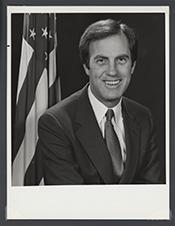
United States · United States Congress · 18 March 1982
Expresses the sense of the House of Representatives that neither House of Congress should recess or adjourn for a period of more than three days at a time until congressional action is completed on the first concurrent budget resolution for FY 1983.
United States · United States Congress · 17 March 1982
Directs the Secretary of the Treasury to study and report to specified congressional committees on the advisability of replacing the Federal individual income tax or such income tax and the Federal corporate income tax with a simplified income tax on gross income.
United States · United States Congress · 15 March 1982
Family Housing Production Act of 1982 - Requires the Secretary of Housing and Urban Development, through the Government National Mortgage Association, to enter into five-year contracts to provide periodic assistance payments on behalf of homeowners to mortgagees and other lenders. Directs the Secretary to give priority to assisting persons who have not owned a home within the last three years. Permits payments to be made only to a mortgagor who satisfies requirements for creditworthiness and has a family income not exceeding 140 percent of the area median income and who: (1) is the original owner of a manufactured home the loan for which is incurred under the National Housing Act; or (2) has a fixed-rate 30-year mortgage which is secured by a home built after enactment of this Act, has no prepayment penalty, and requires increased payments beginning with the second year which shall be applied to the principal obligation until it is paid off. Limits the amount of assistance payments to the difference between the amount of the monthly payment for principal, interest, and loan insurance under the first year of the loan and the amount the monthly payment for principal and interest would be if the interest rate on the loan were: (1) ten percent (12 percent for a manufactured home); or (2) four percentage points less than the rate specified in the loan, whichever rate is higher. Requires that the mortgagor pay at least 25 percent of his or her income toward the monthly loan payment. Declares that manufactured homes shall comprise not more than 20 percent of the units assisted under this Act. Directs the Secretary to allocate the amount available to carry out this Act on the basis of the population, decline in housing starts, and unemployment rate in each State relative to all States. Directs the Secretary to recapture the lesser of the amount of assistance provided under this Act or an amount equal to 50 percent of the net appreciation of the property whenever the mortgagor sells the property or rents it for a period exceeding one year. Authorizes the Secretary to insure mortgages assisted under this Act.
United States · United States Congress · 10 March 1982
Amends the Internal Revenue Code to allow an individual to withdraw amounts from an individual retirement account for the purchase of a principal residence. Requires that ten percent of the amount withdrawn shall be included in the gross income of the distributee over a period of ten years beginning with the taxable year in which the distributee: (1) disposes of such principal residence or ceases to use it as a principal residence; or (2) attains the age of 59 1/2. Allows such withdrawals only if: (1) the amount withdrawn is used within 90 days for the purchase of the principal residence; (2) the individual retirement account was established at least 36 months before such withdrawal; (3) the trustee of such account is a qualified home mortgage institution; and (4) the trustee is given at least 60 days notice before such withdrawal.
United States · United States Congress · 9 March 1982
Individual Housing Account Act - Amends the Internal Revenue Code to allow an income tax deduction from gross income for cash contributions to a tax-exempt savings account established for the benefit of the taxpayer (or the taxpayer and spouse if married) for the exclusive purpose of purchasing such taxpayer's first principal residence. Limits the maximum annual deduction to $5,000, with a maximum lifetime deduction of $20,000. Excludes distributions from such account from gross income as long as they are used exclusively for the purpose of purchasing the first principal residence of the taxpayer.
United States · United States Congress · 4 March 1982
Prohibits the Secretary of a military department or the Secretary of Energy from contracting out firefighting or security functions at military installations or installations where functions relating to military applications of nuclear energy are performed.
United States · United States Congress · 25 February 1982
Makes Federal crop insurance and Farmers Home Administration loans unavailable to producers of the 1982 crops of wheat, feed grains, rice, and cotton who do not participate in or comply with applicable acreage limitations and set-asides under the Agricultural Act of 1949 price support programs.
United States · United States Congress · 24 February 1982
Communications Act Amendments of 1982 - Amends the Communications Act of 1934 to state that participation by one or more Commissioners of the Federal Communications Commission (FCC) in any international conference shall not be considered an FCC meeting or a panel of Commissioners for any purpose. Deletes the provision relating to the allocation of broadcasting facilities by the FCC. Authorizes the FCC to choose to require a full hearing on license applications or to require evidence in any other form that will give all interested parties a chance to be heard. Requires the FCC to grant renewal of a radio or television broadcaster's license unless the licensee acted in such serious disregard for the Communications Act and the FCC's policies that denial of the license is justified. Denies the FCC the authority to consider the application of any person other than the licensee for the television or radio broadcast facilities for which license renewal is sought. Makes such denial inapplicable for any renewal application filed before January 26, 1982. Repeals the antitrust provisions of the Communications Act. Prohibits the FCC from requiring radio or television broadcast station licensees to: (1) provide certain programs; (2) adhere to a particular programming format; (3) ascertain the interests of their service areas; (4) restrict their commercials; and (5) maintain or make publicly available program logs of the station. Requires an efficiently operating radio on U.S. passenger and cargo ships above a certain size and on all U.S. and foreign ships leaving for a sea voyage. Requires such radio to meet either treaty requirements or FCC regulations. Repeals specified provisions dealing with ship radios and radio operators. Prohibits all U.S. ships carrying more than six passengers for hire from being navigated in the open sea or any U.S. tidewater unless equipped with efficient radio equipment. (Current law exempts certain ships.) Increases from $2,000 to $100,000 the limit on the amount of forfeiture penalty applicable to specified violations of the Communications Act or of the criminal code.
United States · United States Congress · 24 February 1982
Increases the monthly rate of dependency and indemnity compensation payable to the surviving spouse of a veteran who died from a service-connected or compensable disability by the amount such spouse would have received under the Social Security Act were she caring for a child under 16 (when such child is actually between 16 and 18 years of age). Directs the Administrator to make monthly payments equivalent to the child's insurance benefit under the Social Security Act before the Omnibus Budget Reconciliation Act of 1981 to children of such deceased veterans between the ages of 18 and 22 attending institutions of higher learning.
United States · United States Congress · 22 February 1982
Declares that the House of Representatives considers Arland D. Williams, Junior, to be a national hero for his heroic sacrifice after the airplane crash in the Potomac River on January 13, 1982.
United States · United States Congress · 10 February 1982
Limits amounts provided in House Committee expense resolutions for the second session of the Ninety-seventh Congress to the total amounts expended under such resolutions for the first session.
United States · United States Congress · 9 February 1982
Ancient Indian Land Claims Settlement Act of 1982 - Ratifies the transfers of land or natural resources within the States of New York or South Carolina, which were made on behalf of an Indian Tribe before January 1, 1912. Extinguishes, by virtue of ratification, related claims against such transfers. Exempts specified land in New York from ratification. Directs the Secretary of the Interior to publish a notice in the Federal Register soliciting information from such Indian tribes about outstanding claims. Directs the Secretary, within 180 days of such submission, to determine: (1) the credibility of such claims; and (2) the amount of fair compensation due credible claims. Prohibits judicial review of such determination. Requires such Indian tribes to accept or reject the Secretary's determination within 60 days. States that such determination shall be binding if it is accepted. Authorizes the Secretary to assist such Indian tribes receiving compensation to purchase other lands or natural resources. Authorizes such Indian tribes to file a cause of action in the Court of Claims, against the United States, for compensation arising out of land transfer claims which have not been settled or determined by the Secretary. Gives the Court of Claims exclusive jurisdiction over such cases. Sets out: (1) criteria for determining entitlement to a recovery against the United States; and (2) procedures for determining and paying the amount of such recovery. Limits recovery due certain claims arising after July 22, 1790. Assigns docket priority to claims brought under this Act before the Court of Claims. Authorizes appropriations. Requires any contest of the constitutionality or validity of this Act to be brought in certain Federal district courts within a specified time.
United States · United States Congress · 3 February 1982
Authorizes the Speaker of the House of Representatives and the President pro tempore of the Senate to present, on behalf of Congress, a gold medal to Admiral Hyman George Rickover in recognition of his distinguished service and for his contributions to the development of safe nuclear energy and to the defense of the United States. Directs the Secretary of the Treasury to provide for a gold medal with suitable emblems, devices, and inscriptions. Authorizes appropriations to carry out such provision. Authorizes the Secretary to make available bronze duplicates of such medal for sale under regulations he prescribes and in accordance with provisions of this Act.
United States · United States Congress · 3 February 1982
Requires the Office of Personnel Management to provide a 30-day period each year during which Federal employees may transfer enrollments between health benefit plans.
United States · United States Congress · 3 February 1982
Amends the Federal criminal code to establish procedures for the imposition of the death penalty for Presidential assassination. Requires a separate sentencing hearing before a jury, or the court upon motion by the defendant, when the defendant is found guilty or pleads guilty to an offense punishable by death. Provides that no presentence report shall be prepared in such cases. Allows the defendant and the Government to present any information relevant to sentencing, without regard to the rules of evidence, but permits information to be excluded where its probative value is substantially outweighed by the danger of unfair prejudice, confusion of the issues, or misleading the jury. Specifies mitigating factors which the defendant must establish by a preponderance of the information and aggravating factors which the Government must prove beyond a reasonable doubt. Conditions imposition of the death penalty on a unanimous finding by the jury (or finding by the court) that: (1) some aggravating factor exists; and (2) the aggravating factors sufficiently outweigh any mitigating factor found to exist. Directs the court to impose the death penalty upon a finding that such sentence is justified. Establishes procedures for appeal from the death sentence.
United States · United States Congress · 2 February 1982
Expresses the sense of the Congress that the President should demand compliance by the Soviet Union with existing treaties on chemical warfare as a prerequisite for starting the Geneva arms talks.
United States · United States Congress · 2 February 1982
Expresses the sense of Congress that the President should deny Federal employment and benefits, including employment with Federal grantees and borrowers, to persons who are required to but do not register under the Military Selective Service Act.
United States · United States Congress · 26 January 1982
Designates January 30, 1982, as A National Day of Solidarity With the Polish People. Expresses the sense of the Congress with respect to the state of martial law in Poland.
United States · United States Congress · 25 January 1982
Amends the Federal criminal code to require the United States Parole Commission to make available to a State and local law enforcement agency upon request information regarding parolees under the jurisdiction of the Commission, who have been convicted of Federal crimes involving violence to persons or damage to property, and who reside in such agency's jurisdiction.
United States · United States Congress · 15 December 1981
Orphan Drug Act - Amends the Federal Food, Drug, and Cosmetic Act to direct the Secretary of Health and Human Services to promulgate regulations to exempt from such Act drugs intended solely for drug treatment investigations. Defines "drug treatment investigation" as an investigation of a drug which involves human participants with a rare disease or condition. Establishes in the Department of Health and Human Services an interagency committee known as the Committee on Orphan Drug Development. Makes it the function of such committee to promote the development of drugs for rare diseases or conditions (orphan drugs). Requires the Director of the National Institutes of Health (NIH) to submit to the Committee an annual report on the rare disease and condition research activities of NIH. Requires the Committee to report by June 1 of each year to the appropriate congressional committees on its activities and the results of its evaluations, including the report submitted by NIH. Amends the Internal Revenue Code to allow a tax credit for qualified experimental expenses incurred while researching orphan drugs.
United States · United States Congress · 11 December 1981
Amends title XVIII (Medicare) of the Social Security Act to permit an individual to elect hospice care, in lieu of certain other benefits, during two periods of 180 days each during the individual's lifetime. Provides for full reimbursement of reasonable costs to a hospice program, subject to a ceiling. Directs the Comptroller General to conduct a study of the hospice reimbursement method. Defines hospice care as including items and services furnished to the terminally ill in their homes, on an outpatient basis, and on a short term inpatient basis.
United States · United States Congress · 11 December 1981
Amends the Omnibus Budget Reconciliation Act of 1981 to extend by five months (until September 30, 1982) the period within which an individual must have become a full-time student at a postsecondary educational institution in order to receive, after July 1982, child's insurance benefits on the basis of student status under title II (Old Age, Survivors and Disability Insurance) of the Social Security Act. Extends by one year (through August 1986) the period during which such benefits may be paid to an individual so qualified.
United States · United States Congress · 11 December 1981
Expands the membership of the Advisory Commission on Intergovernmental Relations to include three elected school board officials from different States.
United States · United States Congress · 10 December 1981
Amends title II (Old Age, Survivors and Disability Insurance) of the Social Security Act to prohibit entitlement to title II benefits in the case of an individual who is not a U. S. citizen or national if such individual: (1) is not a permanent resident of the United States; or (2) is outside the United States. Prohibits the payment of title II benefits to any dependent or survivor of such an individual on the basis of such individual's wages and self-employment income. Makes such prohibition inapplicable if the benefit involved is payable to such an individual as the dependent or survivor of: (1) a U. S. citizen or national; (2) a permanent resident of the United States; or (3) a U. S. citizen or national residing outside the United States if the relationship required for such individual's entitlement already existed at the time such national or citizen reached age 50. Authorizes the payment of title II benefits to an individual who is not entitled to benefits pursuant to this Act until the total amount of such benefits equals the total amount of any taxes paid on the wages and self-employment income on which the benefits are based.
United States · United States Congress · 9 December 1981
Amends the Lanham Trademark Act to prohibit any State from requiring the alteration of or an additional trademark other than the trademark exhibited by the registrant in the certificate of registration issued by the United States Patent and Trademark Office.
United States · United States Congress · 9 December 1981
Amends the Federal National Mortgage Association Charter Act to authorize the Secretary of Housing and Urban Development to direct the Government National Mortgage Association, during fiscal year 1982, to provide financial assistance to mortgagors by reducing the mortgage payments for certain new homes to amounts the payments would equal if the interest rates on such mortgages were 12 percent. Directs the Association to provide such assistance by: (1) purchasing and servicing mortgages; or (2) making payments to mortgagees on the principal of or interest on mortgage loans. Requires the Association to recapture the lesser of the amount of assistance provided to a mortgagor or 50 percent of the net appreciation of the assisted property whenever the property is sold or refinanced or whenever the property is no longer the mortgagor's principal place of residence. Directs the Secretary to provide that: (1) assistance is allocated among the regions of the country on the basis of each region's inventory of unsold, newly constructed homes; (2) the amount of assistance provided to any mortgagor shall not exceed $6,000; and (3) priority for assistance is given to first-time buyers who could not otherwise afford to buy and who are purchasing modest homes constructed by small homebuilders.
United States · United States Congress · 8 December 1981
Amends the Internal Revenue Code to revise requirements for the tax exclusion of interest on small issues of industrial development bonds. Limits the small issue exemption to obligations used to finance the following types of business: (1) manufacturing; (2) processing; and (3) warehousing and distribution facilities. Requires bond issuing authorities to conduct public hearings prior to the approval and issuance of any small issue industrial development bond. Requires the Governor of a State to report to the Secretary of the Treasury annually beginning in 1984 on bonds issued during the preceding year.
United States · United States Congress · 23 November 1981
Requires nationals of Communist countries to register with the Attorney General before engaging in certain activities involving Members of Congress and congressional employees. Requires the Attorney General to deport persons violating this Act. States that such deportations shall not be subject to judicial review or other related provisions under the Immigration and Nationality Act.
United States · United States Congress · 20 November 1981
Requests the President to designate February 22, 1982, as a day of national celebration in honor of the two hundred and fiftieth anniversary of the birth of George Washington.
United States · United States Congress · 19 November 1981
Two-Way Street Act - Imposes an import parity fee, in addition to other fees already imposed, on automobiles imported into the United States from Japan. Establishes a Parity Fee Commission to determine the size of the parity fee. Permits persons who build cars in the United States to import one car from Japan without paying the parity fee for each car built by such a person in the United States. Sets forth the powers and duties of the Commission. Authorizes appropriations.
United States · United States Congress · 10 November 1981
Taxpayer Protection Act - Amends the Internal Revenue Code to subject the Internal Revenue Service (IRS), in the collection of taxes, to provisions of the Fair Debt Collection Practices Act regarding communication and harassment in connection with debt collection. Prohibits the publication of any deficiency which has not been adjudged to be payable by a competent court. Permits individual taxpayers to bring a civil action in a U.S. district court for damages resulting from collection practices prohibited by this Act. Requires a Federal court order before property of a taxpayer may be levied upon for the collection of tax. Specifies that a showing of fraud or malfeasance or a misrepresentation, for purposes of modifying or reconsidering a closing agreement between an individual taxpayer and the Secretary of the Treasury, shall be taken into account only if such a showing or misrepresentation is determined by a competent court. Prohibits the Secretary from consenting to extend for more than one year the period for assessment of the income tax liability of any individual taxpayer. Requires the Secretary to prepare, for distribution to taxpayers, brief but comprehensive statements which set forth in nontechnical terms: (1) the rights and obligations of taxpayers during an audit; (2) the procedures which the IRS may use in enforcing revenue laws; and (3) the procedures by which a taxpayer may appeal adverse decisions, prosecute refund claims, and file taxpayer complaints. Requires a copy of such statement to accompany any tax forms sent to taxpayers. Prescribes criminal penalties for: (1) any investigation by employees of the United States in connection with Federal tax laws which inquires into the beliefs, associations, or activities of any individual or organization; or (2) the maintenance of any records containing information derived from such an investigation. Creates a civil cause of action for any taxpayer aggrieved by a prohibited investigation or by the deprivation of any civil rights. Permits the award of a judgment of costs, including reasonable attorney's fees, to a prevailing taxpayer in any proceeding before the Tax Court. Makes binding on the Secretary : (1) a tax return prepared for the taxpayer by an officer or employee of the IRS acting in his official capacity to provide such assistance; and (2) written information or advice given to the taxpayer by such an officer or employee acting in his official capacity. Places the burden of proof, in administrative and judicial proceedings involving the IRS and a taxpayer, upon the IRS. Directs that all property of taxpayers, for purposes of the estate and gift tax, be valued at historical cost (original cost to the taxpayer or the basis of the property if it was not purchased). Prohibits the use in IRS personnel evaluations of amounts collected pursuant to audits or investigations. Precludes the Secretary from exercising any enforcement authority over churches or certain other organizations. Prohibits the audit of any group of taxpayers unless the Secretary has first met certain notice requirements or permitted members of the group to file an amended return. Sets forth conditions which must be met by the IRS before any action is taken to interfere with the property rights of a taxpayer. Requires the IRS, before securing the records of, or personal data concerning, any taxpayer, to: (1) notify the taxpayer in writing of the demand, the material sought, and the need for the material; (2) have commenced an action in a competent court against the taxpayer; and (3) have justified its need before the court consistent with the discovery rules of the Federal Rules of Civil Procedure. States that the IRS shall have no authority, in enforcing the tax obligations of any person, which is in conflict with the rights and privileges granted under the Constitution.
United States · United States Congress · 5 November 1981
Expresses the sense of the Congress that no limitation should be placed on the Federal income tax deduction for interest paid on a residential mortgage.
United States · United States Congress · 29 October 1981
National Defense Port System Act of 1981 - Title I: Establishment of National System of User Fees for Deep-Draft Channels and Harbors - Directs the President to appoint a task force which shall make specific recommendations to the Secretary of the Treasury concerning the imposition of user fees on ports having deep-draft channels or harbors. Sets forth factors to be considered by the task force. Directs the Secretary to establish a nationally uniform system of user fees. Allows the Secretary to increase or decrease such user fees under certain circumstances. Requires such fees to be collected by the Customs Service. Establishes the Port System Trust Fund within the Treasury. Directs the Secretary to report annually to Congress on Trust Fund operations. Makes amounts in the Trust Fund available for: (1) navigation improvement projects; and (2) operation and maintenance of specified channels and harbors, including those in the Saint Lawrence Seaway, Great Lakes, or their connecting waters. Revises financing procedures of the Saint Lawrence Seaway Development Corporation. Terminates Corporation obligations outstanding on the effective date of this Act. Title II: Construction and Financing of Navigation Improvement Projects to Increase the Depth of Deep-Draft Channels and Harbors to More Than Forty-Five Feet - Directs the Secretary of the Army, acting through the Chief of Engineers, to expedite construction of approved navigation improvement projects if the appropriate State port authority enters into a specified agreement with the Secretary. Requires such port authority to reimburse the United States for 100 percent of construction, operation, and maintenance costs. Allows State port authorities to construct approved navigation improvement projects at their own expense and to finance such construction through the adoption of duties of tonnage. Grants the consent of Congress, subject to certain conditions, to the levying by the States of such duties of tonnage. Directs the Comptroller General to audit the operations of such State port authorities and to report to Congress thereon. Sets forth enforcement procedures concerning such duties of tonnage. Title III: Expedited Procedure for Approval of Navigation Improvement Projects and Related Landside Facilities Projects - Directs the Secretary to establish a project schedule for all agency decisions relating to navigation improvements and landside facilities projects. Authorizes the Secretary to modify the project schedule at any time. Describes procedures concerning judicial review of final agency decisions covered by a project schedule.
United States · United States Congress · 29 October 1981
Constitutional Amendment - Requires Congress, prior to each fiscal year, to adopt a statement of receipts and outlays for that year in which total outlays are no greater than total receipts. Permits Congress in such statement to provide for a specific excess of outlays over receipts by a three-fifths vote directed solely to that subject. Prohibits total receipts for any fiscal year set forth in such statement from increasing by a rate greater than the rate of increase in national income in the last calendar year ending before such fiscal year, unless Congress passes a bill directed solely to approving specific additional receipts and such bill has become law. Permits Congress to waive the provisions of this Act with respect to any fiscal year in which a declaration of war is in effect. Prohibits the Congress from requiring that the States engage in additional activities without compensation equal to the additional costs. Declares that total receipts shall include all receipts of the United States, except those derived from borrowing and total outlays shall include all outlays of the United States except those for repayment of debt principal.
United States · United States Congress · 28 October 1981
Taxpayer's Court Costs and Fees Act of 1981 - Amends the Internal Revenue Code to permit reasonable court costs, including attorneys' fees, to be awarded to the prevailing party (other than the United States or a creditor of the prevailing party) in a civil action brought by the United States in any court of the United States for the determination, collection, or refund of any tax, interest, or penalty imposed under the Internal Revenue Code. Prohibits such an award where the court finds that the position of the United States was substantially justified or that special circumstances make an award unjust. Includes within the definition of "attorney's fees" amounts paid to an individual who is not an attorney but who is authorized to practice before the Tax Court. Defines "prevailing party" as a party who substantially prevails with respect to the amount in controversy or the most significant issue or set of issues.