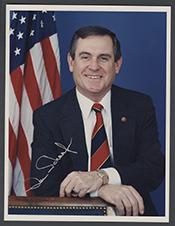
United States · United States Congress · 9 November 1995
Prohibits the obligation or expenditure of funds appropriated or otherwise made available to the Department of Defense for the ground deployment of U.S. forces in Bosnia and Herzegovina as part of any peacekeeping operation or implementation force, unless funds for such deployment have been specifically appropriated by a law enacted after the date of enactment of this Act.
United States · United States Congress · 8 November 1995
Amends the Energy Policy and Conservation Act and the Energy Conservation and Production Act to authorize appropriations for FY 1996 through 1999 for specified energy conservation programs and the weatherization program.
United States · United States Congress · 2 November 1995
Travel and Tourism Partnership Act of 1995 - Establishes the National Tourism Board to develop a national travel and tourism strategy for increasing U.S. travel and tourism. Establishes the National Tourism Organization as a non-Federal non-profit organization to implement the national travel and tourism strategy. Directs the Secretary of State and the Director of the United States Information Agency (USIA) to: (1) place priority on implementing recommendations by the National Tourism Board; and (2) cooperate with the National Tourism Organization. Authorizes the President to transfer up to 25 staff members of the United States Travel and Tourism Administration to the Foreign Service or the Commercial Service for two years to assist the Organization in its start-up activities. Amends the Export Enhancement Act of 1988 to require the Trade Promotion Coordinating Committee's (TPCC) Federal trade promotion plan to reflect, among other things, recommendations by the National Tourism Board. Makes the President of the National Tourism Organization a member of the TPCC.
United States · United States Congress · 30 October 1995
State Water Sovereignty Protection Act - Directs the United States, whenever it seeks to appropriate water or acquire a water right within a State, to be subject to all procedural and substantive laws of that State relating to its water rights and uses. Gives consent to join the United States in any State proceeding relating to the allocation or use of a water right. Subjects management and control of water within a State to the laws of such State. Delegates to the respective States the authority to regulate water. Allows the United States to exercise management and control of water within a State only in compliance with that State's laws. Subjects the United States to the imposition of costs and fees in a proceeding to the same extent as a private party.
United States · United States Congress · 30 October 1995
Expresses the sense of the House of Representatives that: (1) in the negotiation of any peace agreement between the parties to the conflict in the Republic of Bosnia and Herzegovina, there should not be a presumption, and it should not be considered to be a prerequisite to the successful conclusion of such a negotiation, that enforcement of such agreement will involve deployment of U.S. armed forces on the ground in the territory of the Republic; and (2) no U.S. armed forces should be deployed on the ground in such territory to enforce a peace agreement until the Congress has approved the deployment.
United States · United States Congress · 26 October 1995
Amends the Internal Revenue Code to allow an individual to designate a specified portion (but not less than $1) of any income tax overpayment and any cash contributions to be used for the benefit of units of the National Park System. Establishes a National Parks Trust Fund into which appropriated or credited amounts are received. Authorizes the Secretary of the Treasury to pay, not less often than quarterly, specified expenditures from the Trust Fund to the Director of the National Park Service. Requires that expenditures from such Fund be used only for operations, maintenance, and construction within the units of the National Park System. Prohibits the use of such expenditures for the purposes of land acquisition.
United States · United States Congress · 26 October 1995
Prohibits the obligation or expenditure of funds appropriated or otherwise made available to the Department of Defense for the ground deployment of U.S. forces in Bosnia and Herzegovina as part of any peacekeeping operation or implementation force, unless the deployment is specifically authorized by a law enacted after the date of enactment of this Act.
United States · United States Congress · 25 October 1995
Amends the Fair Labor Standards Act of 1938 to exempt from minimum wage and overtime compensation provisions employees of nonprofit institutions who: (1) are employed to serve as houseparents for abused, neglected, delinquent, homeless, or emotionally impaired children residing at facilities of such institutions; (2) reside with such children at such facilities for at least 72 hours a week; (3) receive free board and lodging from such enterprises; and (4) are compensated at an annual rate of at least $8,000.
United States · United States Congress · 19 October 1995
Animal Drug Availability Act of 1995 - Amends Federal Food, Drug, and Cosmetic Act provisions relating to new animal drugs to redefine "substantial evidence" to mean evidence from one or more scientifically sound studies including, as appropriate, in vitro studies, studies in laboratory animals, bioequivalence studies, and any studies voluntarily undertaken by or for the applicant that provide some assurance that the drug will have the intended effect. Excludes a claim for the use of a drug in a minor species or a minor use of a drug from disapproval, if there is an application filed for the drug which is approved prior to the submission of the claim. Allows consideration, when a new animal drug contains more than one active ingredient or its labeling suggests use of the drug in combination with another animal drug, only of whether any of the active ingredients or any of the drugs in the combination, at the longest withdrawal time of any of the active ingredients or drugs in the combination, exceeds its established tolerance or interferes with the methods of analysis for another of the active ingredients or drugs in the combination. Requires the Secretary to issue proposed regulations implementing the provisions of this section which: (1) further define "substantial evidence;" (2) take into account the proposals contained in the citizen petition submitted by the American Veterinary Association and the Animal Health Institute; and (3) provide for the opportunity for a conference to make a decision establishing a submission or an investigational requirement. (Sec. 4) Requires the Secretary to approve or disapprove the application within 90 (currently 180) days of receipt of the application. (Sec. 5) Requires: (1) the Secretary to refer disputed issues received in writing from an applicant to an advisory committee or to a special Government employee; and (2) the committee or employee to submit a report containing recommendations regarding the matter. (Sec. 6) Requires the Secretary to refuse approval of an application if information submitted with respect to the drug indicates that any use suggested in labeling proposed for that drug will result in a unsafe amount of residue. (Sec. 7) Permits the export of an unsafe (as defined in the Act) new animal drug, if it is not in conflict with the laws of the country to which it is exported. (Currently, such export is prohibited.)
United States · United States Congress · 25 September 1995
Congressional Award Act Amendments of 1995 - Amends the Congressional Award Act to extend through 1997 the requirement that the Comptroller General determine that the Director of the Congressional Award Program has ensured that appropriate procedures for fiscal control and fund accounting are established for the financial operations of the Program and that such operations are administered by personnel with expertise in accounting and financial management. Extends the Congressional Award Board until October 1, 1998.
United States · United States Congress · 14 September 1995
Conveys all right, title, and interest of the United States to specified property in San Bernardino County, California, to the Department of Health Services of such State for use as a low-level radioactive waste disposal facility, upon the tendering of $500,100 on behalf of California and the release of the United States from any liability for claims relating to such property. Terminates the authority to make such conveyance on October 1, 2010. Conveys concurrently to the Department necessary easements for utilities and ingress and egress to such property and the right to improve them.
United States · United States Congress · 13 September 1995
Amends titles II (Old Age, Survivors and Disability Insurance) and XVI (Supplemental Security Income) (SSI) of the Social Security Act to provide for payments to State and local prisons for monthly reports on the identities of inmates ineligible for benefits, especially those erroneously paid such a benefit. Denies SSI benefits for ten years to a person found to have fraudulently obtained such benefits while in prison.
United States · United States Congress · 12 September 1995
Federal Thrift Savings Plan Enhancement Act of 1995 - Amends Federal civil service law with respect to the Civil Service and Federal Employees' Retirement Systems and the Thrift Savings Plan (TSP) Program. Provides for: (1) an additional Small Capitalization Stock Index Investment Fund and International Stock Index Investment Fund in the TSP; and (2) repeal of the limitations on individual TSP contributions, including those from judges and other specified personnel of the Federal judicial branch.
United States · United States Congress · 8 September 1995
TABLE OF CONTENTS: Title I: Veterans' Housing Programs Title II: Veterans' Employment and Training Title III: Employment and Reemployment Rights of Members of the Uniformed Services Veterans Housing, Employment Programs, and Employment Rights Benefits Act of 1995 - Title I: Veterans' Housing Programs - Extends permanently the authority of the Secretary of Veterans Affairs to: (1) negotiate interest rates charged to veterans on housing loans which are guaranteed or insured by the Department of Veterans Affairs; (2) carry out a demonstration project for guaranteeing veterans' housing loans in a manner similar to that in which adjustable rate mortgages are insured under the National Housing Act; (3) guarantee loans made to veterans for the purchase or construction of homes; (4) allow lenders of guaranteed loans to review home appraisals; and (5) enter into specified agreements with States, their political subdivisions, and nonprofit organizations for the provision of housing assistance for homeless veterans. Authorizes the Secretary to approve the issuance of, and guarantee timely payment of principal and interest on, certificates or other securities evidencing an interest in a pool of mortgage loans representing Department of Veterans Affairs-guaranteed housing loans, as long as such securities are issued on or before December 31, 2000 (currently, December 31, 1995). (Sec. 102) Requires specified veterans' housing loan information to be included in a current annual Department budget report required to be submitted to the Congress. Repeals superseded reporting requirements under the Veterans Home Loan Program Amendments of 1992. (Sec. 103) Amends the Stewart B. McKinney Homeless Assistance Act to: (1) extend through FY 1998 the authorization of appropriations for homeless veterans' reintegration projects; (2) revise the amount of appropriations authorized for FY 1997 and 1998; and (3) extend through FY 1998 the general authorization of appropriations and the authority under such Act. Title II: Veterans' Employment and Training - Directs the Secretary of Labor to assign regional administrators for the Veterans' Employment and Training Service (Service) in at least five geographic regions of the United States. (Currently, such representatives are required for each region for which the Secretary operates a regional office.) (Sec. 202) Authorizes the hiring of other support personnel for Directors and Assistant Directors for the Service. Revises eligibility requirements for persons appointed as Directors and Assistant Directors in any State for at least two years. (Sec. 204) Authorizes the Secretary of Labor to conduct a pilot program under which the primary responsibilities of local veterans' employment representatives will be case management and the provision and facilitation of direct employment and training services to veterans. Limits the pilot program to no more than five States. Requires reports to the Congress and the Senate and House Veterans' Affairs Committees. Terminates pilot program authority on October 1, 1998. Title III: Employment and Reemployment Rights of Members of the Uniformed Services - Requests the prompt reemployment of persons upon completion of any military service. (Currently, such request is limited to those who completed such service under honorable conditions.) Revises generally: (1) provisions prohibiting discrimination or acts of reprisal against persons who exercise certain employment or reemployment rights provided under current law, whether or not such person has performed military service; and (2) provisions guaranteeing reemployment rights to persons who serve in the armed forces. (Sec. 306) Prohibits an employer from requiring a person engaged in military service to use vacation, annual, or similar leave during such period of service. (Sec. 309) Allows a person to submit a complaint against the Office of Personnel Management for the enforcement of any employment or reemployment right. (Sec. 313) Empowers the Secretary, in conducting investigations concerning employment and reemployment rights of former military personnel, to interview persons with information relevant to such investigation. (Sec. 314) Provides transition rules and effective dates.
United States · United States Congress · 7 September 1995
TABLE OF CONTENTS: Title I: Private Property Rights and Voluntary Incentives for Private Property Owners Title II: Improving Ability to Comply with the Endangered Species Act of 1973 Title III: Improving Scientific Integrity of Listing Decisions and Procedures Title IV: Recognizing Other Federal Action, Laws, and Missions Title V: Better Management and Conservation of Listed Species Title VI: Habitat Protections Title VII: State Authority to Protect Endangered and Threatened Species Title VIII: Funding of Conservation Measures Title IX: Miscellaneous Provisions Endangered Species Conservation and Management Act of 1995 - Amends the Endangered Species Act of 1973 (the Act) to revise: (1) the findings and purposes of the Act to include consideration of economic impacts and property owners' rights while encouraging practices that protect species; and (2) the policy of the Act to prohibit the Federal Government from using or limiting the use of privately owned property when such action diminishes the value of such property without payment of fair market value to the owner of private property. Title I: Private Property Rights and Voluntary Incentives for Private Property Owners - Amends the Act to prohibit the Government from taking an agency action affecting privately or non-federally owned property under the Act which results in diminishment of value of any portion of that property by 20 percent or more unless compensation is offered in accordance with this title. Requires the Federal agency that takes an action that exceeds that amount to compensate the private property owner for the otherwise lawful use or limitation on such use in the amount of the diminution in value of the portion of that property resulting from such use or limitation. Specifies that, if the diminution in value of a portion of that property is greater than 50 percent, at the option of the owner, the agency shall buy that portion and pay fair market value based on the value of the property before the use or limitation was imposed. Directs that compensation paid reflect the duration of the use or limitation necessary to achieve the purposes of the Act. Sets forth provisions regarding: (1) procedures for written requests for compensation by the owner; (2) agency negotiations with that owner to reach agreement; (3) choice of remedies; (4) arbitration; (5) civil actions (an owner who prevails in a civil action against the agency shall be entitled to the amount of compensation awarded plus reasonable attorney's fees and other litigation costs); (6) source of payments; (7) availability of appropriations (any U.S. obligation to make such a payment shall be subject to the availability of appropriations); and (8) duty of notice to owners of agency actions limiting the use of private property and of procedures for obtaining compensation. (Sec. 102) Requires the Secretary of the Interior (Secretary), in carrying out the program authorized by the Act, to cooperate to the maximum extent practicable with the States and other non-Federal persons, including consultation before acquiring any land or water, or interest therein, for the purpose of conserving any endangered or threatened species. Authorizes the Secretary to enter into a cooperative management agreement with any State or local government or non-Federal person for the management of a species listed as endangered or threatened, to be listed, or which is a candidate for listing, or for the management or acquisition of an area which provides habitat for a species, subject to specified limitations. Sets forth provisions regarding: (1) environmental assessments; (2) the effect of listing a species; and (3) violations of such agreements. (Sec. 103) Authorizes the Secretary to provide grants to certain non-Federal persons for the purpose of conserving, preserving, or improving habitat for any species that is determined to be an endangered or threatened species upon determining that: (1) the property for which the grant is provided contains habitat that significantly contributes to the protection of the population of the species and has been managed for species protection for a sufficient period of time to significantly contribute to the protection of the species population; and (2) the management of the habitat advances the interest of species protection. (Sec. 104) Directs the Secretary to initiate a program to provide technical advice and assistance to non-Federal persons who wish to participate in achieving the conservation objective for a species for which a conservation goal has been adopted. (Sec. 105) Specifies that nothing in the Act shall be construed to supersede, abrogate, or otherwise impair any right or authority of a State to allocate or administer quantities of water. Title II: Improving Ability to Comply With the Endangered Species Act of 1973 - Amends the Act to provide that an activity of a non-Federal person is not a taking of a species if the activity: (1) is consistent with the provisions of a final conservation plan or conservation objective; (2) complies with the terms and conditions of an incidental take permit or a cooperative management agreement; (3) addresses a critical, imminent threat to public health or safety or a catastrophic natural event, or is mandated by any Federal, State, or local government agency for public health or safety purposes; or (4) is incidental to, and not the purpose of, carrying out an otherwise lawful activity that occurs in an area of the territorial sea or exclusive economic zone that is not designated as critical habitat and the affected species is not a species of fish. Makes enforcement provisions and provisions regarding rewards and incidental expenses paid by the Secretary or the Secretary of the Treasury applicable specifically to endangered or threatened species of fish and wildlife (current law doesn't specify endangered or threatened species). Specifies that no interpretation, policy, guideline, finding, or other informal determination may be relied upon by the Secretary in the implementation and enforcement of the Act unless such determination has been the subject of a proposed rule, subject to specified requirements. Places the burden on the Secretary to show that a specimen belongs to a species which is determined to be an endangered or threatened species. Authorizes civil suits by persons who have suffered or are threatened with economic or other injury resulting from actions by Federal officials with respect to enforcement of the Act under specified circumstances. (Sec. 202) Defines, for purposes of the Act: (1) "take" to mean to harm, pursue, hunt, shoot, wound, kill, trap, capture, collect, or attempt to engage in that conduct; and (2) "harm" to mean to take a direct action against any member of an endangered species of fish or wildlife that actually injures or kills a member of the species. (Sec. 203) Authorizes non-Federal persons to initiate consultation with the Secretary on any prospective activity: (1) to determine if the activity is consistent with a conservation plan or objective; or (2) if the person determines that the activity is inconsistent, to determine whether the activity is likely to jeopardize the continued existence of an endangered or threatened species or to destroy or adversely modify the designated critical habitat of the species in a manner that is likely to jeopardize the continued existence of the species. (Sec. 204) Sets forth or revises provisions regarding: (1) incidental take permit requirements; (2) general, research, and educational permits; (3) maintenance of aquatic habitats for listed species; (4) compliance with international requirements and treaties; and (5) incentives for protection of marine species. Title III: Improving Scientific Integrity of Listing Decisions and Procedures - Revises provisions of the Act regarding determinations that a species is endangered or threatened to direct the Secretary to make such determinations based on specified factors, including: (1) the present or threatened loss of its habitat; and (2) the inadequacy of existing Federal, State, and local government regulatory mechanisms. Requires the Secretary to make such determinations solely on the basis of the best scientific and commercial data available after conducting a review of the status of the species and after soliciting and fully considering the best scientific and commercial data available concerning the status of a species from any affected State or any interested non-Federal person, taking into account other specified factors. Sets forth or revises provisions regarding: (1) consideration of State recommendations; (2) listing of foreign species; (3) soliciting scientific information; (4) emergency listings; (5) use of the best scientific and commercial data; (6) identifying data used for decisions; (7) judicial review; (8) peer review; (9) making data public; (10) improving the petition and designation processes; (11) greater State involvement; (12) monitoring the status of species; and (13) petitions to delist species. Title IV: Recognizing Other Federal Action, Laws, and Missions - Amends the Act to direct: (1) the Secretary to review other programs administered by the Secretary and utilize such programs in furtherance of the purposes of the Act; and (2) each Federal agency to ensure that any action authorized, funded, or carried out by such agency is not likely to jeopardize the continued existence of any endangered or threatened species or destroy or adversely modify any habitat that is designated by the Secretary as critical habitat of the species in a manner that is likely to jeopardize the continued existence of the species. Sets forth provisions regarding: (1) involvement of applicants for Federal approvals; (2) conferring on candidate species; (3) limitations on modifications to land management; (4) resolving conflicts between Federal agencies; (5) procedures for consultation; and (6) activities prior to completion of consultation. (Sec. 402) Sets forth provisions regarding exemptions from consultation and conferencing requirements. Specifies that an agency action shall not constitute a taking of a species prohibited by the Act or any regulation thereunder if the action is consistent with those provided for in a final conservation plan or a conservation objective under this Act, or a cooperative management agreement or an incidental take permit. (Sec. 403) Eliminates the Endangered Species Committee and related provisions. Title V: Better Management and Conservation of Listed Species - Amends the Act to direct the Secretary to publish a conservation objective and a conservation plan for each species determined to be an endangered or threatened species. Requires the Secretary: (1) within 30 days after the listing determination, to appoint an assessment and planning team (which shall report to the Secretary within 180 days the assessment of specified biological, economic, and intergovernmental factors with respect to the listed species); and (2) within 210 days, to review the report to establish a conservation objective for the species and publish in the Federal Register the conservation objective, along with a statement of findings on which the objective was established. (Sec. 502) Directs the Secretary, in the development and implementation of a conservation plan, to accord specified priorities, including to: (1) the development of an integrated plan for two or more endangered or threatened species that are likely to benefit from an integrated conservation plan; and (2) nonregulatory, incentive-based conservation measures and commercial activities that provide a net benefit to the conservation of the species. Sets forth provisions regarding: (1) publication of a draft plans; (2) contents of such plan; (3) plan preparation procedures; (4) publication of a final plan; (5) participation by other persons; (6) plan revision or amendment; and (7) lack of further procedures or requirements for actions consistent with the conservation plan. (Sec. 503) Delineates procedures regarding: (1) management prior to publication of a conservation plan; (2) emergency rulemaking protections; (3) suspension of conservation plans or objectives; (4) non-delegation of duties; and (5) review of conservation plans. (Sec. 504) Authorizes the Secretary to: (1) designate critical habitat of a species determined to be an endangered or threatened species that meets specified requirements utilizing the National Biodiversity Reserve (see Title VI) as a first priority; and (2) revise a critical habitat designation on determining that such habitat does not meet such requirements. Sets forth provisions regarding: (1) deadlines for designation; (2) basis for designation (directs the Secretary to exclude any area from critical habitat which does not meet the definition as set forth in this Act, which is not necessary to achieve the conservation objective for the affected species, for which the Secretary determines that the benefits of exclusion outweigh the benefits of designation (with exceptions), and in the case of property owned by a non-Federal person, where the owner has not given written consent to the designation or has not been compensated); (3) procedure for designation; and (4) judicial review of the critical habitat designation. Sets forth provisions regarding: (1) the standard for judicial review of decisions regarding conservation objectives or plans; (2) conservation plans for foreign species; and (3) the definition of critical habitat. (Sec. 505) Authorizes the Secretary to: (1) utilize captive propagation as a means of protecting or conserving an endangered or threatened species; and (2) provide annual grants to non-Federal persons to fund captive propagation programs if the Secretary determines that such a program contributes to enhancement of the population of such a species. (Sec. 506) Revises provisions regarding experimental populations to require the Secretary, before authorizing the release of a population of endangered or threatened species outside the current range of such species, to identify the precise boundaries of the geographic area for the release and determine whether the release is in the public interest. Provides that: (1) any member of an experimental population found outside the geographic area in which the population is released shall not be treated as a threatened species if the member poses a threat to the welfare of the public; and (2) critical habitat shall not be designated under the Act for any experimental population determined to be not essential to the continued existence of a species. Sets forth requirements for releases of such populations, including that the Secretary require that: (1) to the maximum extent practicable, the release occurs only in a unit of the National Park System or the National Wildlife Refuge System; (2) the regulations authorizing the release identify precisely the geographic area for the release; and (3) a release on non-Federal land occurs only with the written consent of the owner of the land. (Sec. 507) Revises provisions regarding regulations to protect threatened species to direct the Secretary to issue, concurrently with the regulation that provides for the listing of the species, such regulations as the Secretary deems necessary and advisable to provide for the conservation of such species. Specifies that prohibitions applied to the threatened species shall address the specific circumstances of such species and may not be as restrictive as such prohibition for endangered species. Requires conservation guidelines to include a system for developing and implementing, on a priority basis, conservation objectives and conservation plans. Directs the Secretary to provide to the public notice of, and opportunity to submit written comments on, any guideline proposed to be established. Title VI: Habitat Protections - Establishes a National Biological Diversity Reserve, composed of units of Federal and State lands designated and managed in accordance with this title. Directs the Secretary and the Secretary of Agriculture to designate to the Reserve by regulation those units of the national conservation systems which are within the jurisdiction of the Secretary concerned and which the Secretary determines would contribute to the protection, maintenance, and enhancement of biological diversity. Directs the Secretary to: (1) designate to the Reserve a unit of State-owned lands if such unit is nominated for designation by the Governor of the State and is managed under State law in accordance with this title; (2) designate to the Reserve privately owned land that is nominated for designation by the owner of the land, and remove such land from the Reserve if the owner requests removal; (3) remove from the Reserve a unit designated which the Secretary finds is not managed under State law in accordance with this title; and (4) remove from the Reserve any State-owned lands at the request of the Governor of that State. Requires: (1) each unit of the Reserve to have as an objective for the management thereof the preservation, maintenance, and enhancement of biological diversity; and (2) within one year of the designation of a unit to the Reserve, the manager of such unit to complete, and the Secretary concerned to make available to the public by notice in the Federal Register, an inventory of the species composing the biological diversity within such unit. (Sec. 602) Directs the Secretary, and the Secretary of Agriculture with respect to the National Forest System, to establish and implement a program to conserve fish, wildlife, and plants, including those which are determined to be endangered or threatened species. Provides that, to carry out such program, the appropriate Secretary: (1) shall utilize the land acquisition and other authority under the Fish and Wildlife Act of 1956, the Fish and Wildlife Coordination Act, and the Migratory Bird Conservation Act, as appropriate; and (2) is authorized to acquire lands, waters, or interests therein (lands). (Sec. 603) Directs the Secretary and the Secretary of Agriculture to encourage exchanges of lands within the jurisdiction of each Secretary (other than units of the National Park System and the National Wilderness Preservation System) for lands that are not in Federal ownership and that are affected by this Act. Sets forth provisions regarding the timing of exchanges, environmental assessment, expeditious exchange decisions, applicable law, and valuation of lands acquired. Title VII: State Authority to Protect Endangered and Threatened Species - Authorizes the Secretary to delegate to a State which establishes and maintains an adequate program for the conservation of endangered and threatened species the authority contained in this Act with respect to species of fish, wildlife, and plants that are residents in the State. Requires the Secretary, within 120 days after receiving a certified copy of a proposed State program, to determine whether such program will be adequate to provide protections to endangered and threatened species in such State, based on specified guidelines. Sets forth provisions regarding: (1) Federal financial assistance to a State which has received such delegation; (2) contents of a delegation agreement; (3) State compliance with this Act; (4) review of State programs; and (5) conflicts between Federal and State laws. (Sec. 702) Directs the Secretary, in any instance in which a State has a program for management of a native species which is the subject of a request for an export permit under the Convention on International Trade in Endangered Species of Wild Fauna and Flora, to act in accordance with the recommendation of the State unless the Secretary makes a finding and publishes a notice in the Federal Register that scientific evidence justifies a conclusion contrary to the advice of the State. Authorizes the State which is subject to such a finding, or any person in that State directly affected because of inability to obtain a permit, to appeal the finding to an administrative law judge or a court. Places the burden on the Secretary to show that the evidence supports a finding contrary to the recommendation of the State. Title VIII: Funding of Conservation Measures - Authorizes appropriations to the Departments of the Interior, Commerce, and Agriculture through FY 2001 to carry out the Act, including for cooperative management agreements, Convention implementation, non-Federal conservation planning, and habitat conservation grants. (Sec. 802) Directs the Secretary, for any non-Federal person or Federal power marketing administration, to pay half of any direct costs that result from the compliance by the person or administration mandated by a conservation plan or measure that provides protection to a listed species under a plan developed under the Pacific Northwest Electric Power Planning and Conservation Act, including a plan that provides protection to a larger population unit of the same listed species. Sets forth provisions regarding consultation requirements, incidental take permits, cooperative management agreements, method of cost-sharing, existing cost-sharing agreements, and adjustments to the cost-sharing percentage. (Sec. 803) Establishes in the Treasury an Endangered Species and Threatened Species Conservation Trust Fund. Title IX: Miscellaneous Provisions - Defines or redefines the terms: (1) "non-Federal person"; and (2) "commercial activity." (Sec. 902) Directs the Secretary to: (1) identify those species which are listed under the Act as a result of being determined to be a population segment; and (2) review and determine whether or not it is in the national interest to continue to list each such segment. Requires those segments which the Secretary recommends for continued listing to be submitted to the Congress for approval, and that any segment not determined to be in the national interest to be delisted. (Sec. 903) Requires the Secretary to publish a list of all species that were determined to be endangered or threatened species for which no final recovery plans were issued, divided equally into three tiers of priority for preparation of conservation objectives and plans (with any species listed as an endangered or threatened species in more than one State being placed in the first tier of priority). Directs the Secretary to publish a conservation objective, draft conservation plan, and final conservation plan for each species within each tier of priority according to a specified timetable. Sets forth provisions regarding: (1) priority for revision of existing plans (for listed species with recovery plans); (2) a schedule for revision of plans; (3) species for which no conservation plan is required; (4) a prohibition on additional requirements; and (5) existing biological opinions.
United States · United States Congress · 6 September 1995
Expresses the sense of the Congress that the President and the Congress should adopt a Peace Through Strength Strategy for the post-Cold War era, based on the following general principles and goals: (1) the United States must accept and maintain global leadership through a clear and consistent articulation of vital U.S. national interests and goals; (2) the United States must maintain highly trained, well-equipped, combat-ready military forces and the national will to prevail in any conflict; (3) U.S. interests are promoted through participation in global and regional political, military, and economic organizations, treaties, and alliances, but the United States must retain its sovereignty and reserve the right to act unilaterally; (4) national wealth and economic strength are the foundation of all forms of power; (5) the economic vitality of the United States rests not only on free market competitiveness but also on responsible financial management; (6) the United States must expand effective human and technical intelligence capabilities to anticipate, detect, and respond to emerging threats; (7) the United States will act to lessen, prevent, and eliminate security threats, including those posed by the proliferation of weapons of mass destruction and of high technology conventional arms, terrorism, drug trafficking, and disruption of access to vital resources; (8) national security policy must be explained to the public in the clear context of national interests and a realistic strategy for protecting those interests; (9) the United States must maintain a strong technological and industrial base with a skilled workforce to support superior U.S. global economic competitiveness and military preparedness; and (10) the United States must systematically and sharply reduce its dependence on imported oil.
United States · United States Congress · 4 August 1995
TABLE OF CONTENTS: Title I: Deterrence of Illegal Immigration Through Improved Border Enforcement, Pilot Programs, and Interior Enforcement Subtitle A: Improved Enforcement at Border Subtitle B: Pilot Programs Subtitle C: Interior Enforcement Title II: Enhanced Enforcement and Penalties Against Alien Smuggling; Document Fraud Subtitle A: Enhanced Enforcement and Penalties Against Alien Smuggling Subtitle B: Deterrence of Document Fraud Subtitle C: Asset Forfeiture for Passport and Visa Offenses Title III: Inspection, Apprehension, Detention, Adjudication, and Removal of Inadmissible and Deportable Aliens Subtitle A: Revision of Procedures for Removal of Aliens Subtitle B: Removal of Alien Terrorists Subtitle C: Deterring Transportation of Unlawful Aliens to the United States Subtitle D: Additional Provisions Title IV: Enforcement of Restrictions Against Employment Title V: Reform of Legal Immigration System Subtitle A: Worldwide Numerical Limits Subtitle B: Changes in Preference System Subtitle C: Refugees, Asylees, Parole, and Humanitarian Admissions Subtitle D: General Effective Date; Transition Provisions Title VI: Restrictions on Benefits for Aliens Subtitle A: Eligibility of Illegal Aliens for Public Benefits Subtitle B: Expansion of Disqualification from Immigration Benefits on the Basis of Public Charge Subtitle C: Attribution of Income and Affidavits of Support Title VII: Facilitation of Legal Entry Title VIII: Miscellaneous Provisions Immigration in the National Interest Act of 1995 - Title I: Deterrence of Illegal Immigration Through Improved Border Enforcement, Pilot Programs, and Interior Enforcement - Subtitle A: Improved Border Enforcement - Increases: (1) the Border Patrol; and (2) Immigration and Naturalization Service (INS) border enforcement and related personnel. (Sec. 102) Provides for barrier and road improvements at U.S. border areas of high illegal entry, including San Diego, California. Authorizes appropriations for San Diego area improvements. (Sec. 103) Provides for improved border equipment and technology. (Sec. 104) Provides for biometric identifiers to be included in border crossing identification cards. (Sec. 105) Establishes civil penalties for illegal U.S. entry. (Sec. 106) Authorizes appropriations for detention and prosecution of aliens who have unlawfully entered the United States at least twice. (Sec. 107) Provides for inservice Border Patrol training. Authorizes appropriations. Subtitle B: Pilot Programs - Establishes pilot programs for: (1) deterrence of multiple unauthorized U.S. entries, which may include interior or third party repatriation; (2) use of closed military bases as INS detention centers; and (3) collection of alien departure records. Subtitle C: Interior Enforcement - Provides for increased INS interior investigative and enforcement personnel. Title II: Enhanced Enforcement and Penalties Against Alien Smuggling; Document Fraud - Subtitle A: Enhanced Enforcement and Penalties Against Alien Smuggling - Amends Federal criminal law to: (1) authorize wiretaps in alien smuggling investigations; and (2) include alien smuggling within racketeering offenses. (Sec. 203) Amends the Immigration and Nationality Act (Act) to revise and increase criminal penalties for alien smuggling. (Sec. 204) Increases the number of Assistant United States Attorneys and provides for their assignment to criminal matters involving illegal aliens. (Sec. 205) Authorizes and provides for INS undercover investigations. Subtitle B: Deterrence of Document Fraud - Amends Federal criminal law and the Act to increase and establish criminal and civil penalties for specified immigration related document fraud offenses, including false citizenship claims. Subtitle C: Asset Forfeiture for Passport and Visa Offenses - Amends Federal criminal law to provide for asset forfeiture for passport and visa offenses. Title III: Inspection, Apprehension, Detention, Adjudication, and Removal of Inadmissible and Deportable Aliens - Subtitle A: Revision of Procedures for Removal of Aliens - Amends the Act to revise alien removal and penalty provisions. (Sec. 309) Sets forth transition provisions with respect to: (1) the Attorney General's option to apply current or revised procedures; (2) judicial review; (3) suspension of deportation; and (4) certain family unity aliens. Subtitle B: Removal of Alien Terrorists - Part 1: Removal Procedures for Alien Terrorists - Amends the Act to establish a special removal procedure for alien terrorists, including establishment of a special removal court and a panel of special attorneys with access to classified information. (Sec. 322) Authorizes additional appropriations for INS detention and removal of alien terrorists. Part 2: Inadmissibility and Denial of Relief for Alien Terrorists - Amends the Act to make membership in a terrorist organization grounds for U.S. exclusion. (Sec. 332) Denies alien terrorists status adjustment and deportation relief. Subtitle C: Deterring Transportation of Unlawful Aliens to the United States - Amends the Act with regard to vessel and aircraft transportation of illegal aliens into the United States. Subtitle D: Additional Provisions - Authorizes Federal retirees to be used in the Institutional Hearing Program. (Sec. 358) Authorizes additional appropriations to the Attorney General for removing inadmissible or deportable aliens. (Sec. 359) Establishes in the Treasury an Immigration Enforcement Account. (Sec. 360) Declares that Congress advises the President to negotiate prisoner transfer treaties, which may include compensation provisions. (Sec. 361) Amends the Violent Crime Control and Law Enforcement Act of 1994 to direct INS to operate a criminal alien identification system. (Sec 363) Authorizes special registration of aliens on criminal probation or parole. Title IV: Enforcement of Restrictions Against Employment - Increases full-time employee positions in: (1) the Investigations Division of INS; and (2) the Wage and Hour Division of the Employment Standards Administration of the Department of Labor. (Sec. 403) Amends the Act to revise the employer sanctions program. Provides for an employment eligibility confirmation mechanism. Title V: Reform of Legal Immigration System - Amends the Act to restructure current legal immigration categories and levels into the following: (1) family-sponsored immigrants; (2) employment-based immigrants; and (3) humanitarian immigrants. Subtitle A: Worldwide Numerical Limits - Amends the Act to establish fiscal year worldwide limits for such immigrant categories. (Sec. 504) Requires periodic congressional review and reauthorization of worldwide immigration levels. Subtitle B: Changes in Preference System - Amends the Act to limit immediate relatives to spouses and children of U.S. citizens. (Sec. 512) Limits preference allocation for family-sponsored immigrants to: (1) spouses and children of lawful permanent resident aliens; and (2) qualifying parents of U.S. citizens. Requires parents to have adequate health coverage. (Sec. 513) Revises preference allocations for employment-based immigrants. Establishes: (1) a pilot program for smaller alien job creation investors; and (2) conditional permanent resident status for certain foreign language teachers. (Sec. 515) Revises special immigrant status provisions, including: (1) inclusion of certain NATO civilian employees; and (2) extension of status for religious workers. (Sec. 517) Makes specified family and employment-based amendments. Subtitle C: Refugees, Asylees, Parole, and Humanitarian Admissions - Amends the Act to limit annual refugee admissions to 75,000 in FY 1997 or 50,000 in succeeding years unless the Congress provides for additional entries. (Sec. 523) Authorizes the temporary employment of certain retirees to help reduce asylum application backlogs. (Sec. 524) Limits parole entry to a case-by-case basis for humanitarian or significant public benefit reasons. (Sec. 525) Provides for the admission of humanitarian immigrants. (Sec. 526) Revises asylum provisions. Subtitle D: General Effective Date; Transition Provisions - Sets forth transition provisions for specified classification status petitions. Title VI: Restrictions on Benefits for Aliens - Subtitle A: Eligibility of Illegal Aliens for Public Benefits - Part 1: Public Benefits Generally - Makes illegal aliens ineligible for unemployment benefits and Federal and State assistance, contracts, and licenses, with exceptions for emergency medical services, public health immunizations, and short-term emergency disaster relief. Requires proof of identify for Federal contracts, grants, loans, licenses, and specified public assistance programs. Authorizes States to establish similar requirements. (Sec. 605) Requires the Secretary of Housing and Urban Development to report on the disqualification of illegal aliens from housing assistance programs. Part 2: Earned Income Credit - Amends the Internal Revenue Code to deny the earned income tax credit to individuals not authorized to work in the United States. Subtitle B: Expansion of Disqualification from Immigration Benefits on the Basis of Public Charge - Amends the Act to revise public charge grounds for inadmissibility and deportability. Subtitle C: Attribution of Income and Affidavits of Support - Attributes a sponsor's income and resources to a family-sponsored immigrant for purposes of eligibility for Federal means-tested public benefits programs. (Sec. 632) Amends the Act to set forth sponsor affidavit of support requirements. Title VII: Facilitation of Legal Entry - Provides for: (1) increased numbers of land border inspectors; and (2) border infrastructure improvements. (Sec. 703) Amends the Act to provide for: (1) preinspection at specified foreign airports; and (2) training of airline personnel in fraudulent document detection. Establishes a carrier consultant program. Title VIII: Miscellaneous Provisions - Amends the Act, as amended by the Immigration and Nationality Technical Corrections Act of 1994 to revise the definition of "aggravated felony." Amends the Act with regard to: (1) definitions of "child" and "parent"; (2) visa processing procedure; (3) waiver authority concerning notice of visa application denial; (4) Canadian landed immigrants; (5) H-1B nonimmigrants; (6) visa extensions; (7) status adjustment; (8) access to certain confidential INS files; (9) nonimmigrant status for spouses and children of members of the armed forces; (10) fraudulent birth certificates; (11) visa "shopping"; and (12) specified miscellaneous and technical provisions.
United States · United States Congress · 4 August 1995
Continues existing average fuel economy standards for passenger and non-passenger automobiles until such standards are specifically amended or changed by law.
United States · United States Congress · 3 August 1995
Family Business Protection Act of 1995 - Amends the Internal Revenue Code to exclude from the gross estate, for estate tax purposes, specified portions of the adjusted value of the qualified family-owned business interests of the decedent.
United States · United States Congress · 2 August 1995
Constitutional Amendment - Requires a three-fifths majority of the whole number of each House of the Congress to pass any bill to levy a new tax or increase the rate or base of any tax. Allows the Congress to waive the requirement when a declaration of war is in effect and when the United States is engaged in military conflict that causes an imminent and serious threat to national security and is so declared by a joint resolution, adopted by a majority of the whole number of each House, that becomes law. Makes a bill passed under waiver effective for no longer than two years. Requires all votes under this amendment to be by roll call.
United States · United States Congress · 27 July 1995
Equal Opportunity Act of 1995 - Prohibits discrimination or preferences in Federal employment and contracting on the basis of race, color, national origin, or sex, or entering into a consent decree requiring, authorizing, or permitting any such discrimination or preference. Prohibits construing this Act to prohibit or limit: (1) employment recruiting or encouraging contract bidding or requiring or encouraging Federal contractors to so recruit or encourage, if the recruiting or encouraging does not involve a numerical objective or otherwise granting a preference; (2) any act designed to benefit historically Black colleges or universities; (3) any action under a Federal law or treaty relating to the Indian tribes; or (4) classifications based on sex if sex is a bona fide occupational qualification reasonably necessary to the normal operation of the Government, contractor, or subcontractor, the classification is designed to protect privacy, a U.S. national security interest is involved, or the classification is applied regarding an armed forces member on active duty in a theatre of combat operations. Allows as remedies only injunctive or equitable relief (including back pay), attorney's fees, and costs.
United States · United States Congress · 13 July 1995
George Washington Commemorative Coin Act of 1995 - Requires the Secretary of Treasury to mint and issue five-dollar gold coins emblematic of George Washington. Mandates that the design for the coins be: (1) selected by the Secretary after consultation with the Mount Vernon Ladies' Association and the Commission of Fine Arts; and (2) reviewed by the Citizens Commemorative Coin Advisory Committee. Provides for the distribution of coin sale surcharges to the Mount Vernon Ladies' Association.
United States · United States Congress · 12 July 1995
TABLE OF CONTENTS: Title I: Rechargeable Battery Recycling Act Title II: Mercury-Containing Battery Management Act Mercury-Containing and Rechargeable Battery Management Act - Directs the Administrator of the Environmental Protection Agency to establish a program to provide information on the proper handling and disposal of used regulated batteries and rechargeable consumer products with nonremovable batteries. Defines a "regulated battery" as a rechargeable battery that contains a cadmium or lead electrode or contains other electrode chemistries and is the subject of a specified determination by the Administrator. Establishes civil penalties for violations of this Act. Sets forth recordkeeping requirements and establishes access authorities for the Administrator. Authorizes appropriations. Title I: Rechargeable Battery Recycling Act - Rechargeable Battery Recycling Act - Prohibits any person from selling for use in the United States a regulated battery or a rechargeable consumer product ready for retail sale and manufactured on or after 12 months after this Act's enactment date unless the battery is easily removable from the product or is sold separately. Sets forth labeling requirements, including that the label contain a statement that the battery must be recycled or disposed of properly. Authorizes the Administrator, upon determining that other rechargeable batteries having electrode chemistries different from regulated batteries are toxic and may cause substantial harm if discarded for land disposal or incineration, to promulgate requirements for: (1) labeling such batteries and related products; and (2) easy removability of regulated batteries from rechargeable consumer products designed to contain such batteries. Provides for exemptions from this Act's requirements under certain conditions. Title II: Mercury-Containing Battery Management Act - Mercury-Containing Battery Management Act - Prohibits the sale or offering for sale or promotional purposes of: (1) alkaline-manganese batteries manufactured on or after January 1, 1996, with a mercury content that was intentionally introduced (limits the content in alkaline-manganese button cells to 25 milligrams of mercury per button cell); (2) zinc carbon batteries manufactured on or after January 1, 1996, that contain mercury that was intentionally introduced; (3) button cell mercuric-oxide batteries for use in the United States on or after January 1, 1996; and (4) any mercuric-oxide battery on or after January 1, 1996, unless the manufacturer identifies a collection site that has all required Federal, State, and local government approvals, to which persons may send such batteries for recycling or disposal and informs its purchasers of such site and of a telephone number to get information about sending such batteries for recycling or disposal. Authorizes the Administrator, upon the petition of a person that proposes a new use for a battery technology or the use of a battery described in this title in a new product, to exempt such new use or product from this title if there exist safeguards to ensure that the battery or product will not be disposed of in an incinerator, composting facility, or landfill (other than a facility regulated under subtitle C of the Solid Waste Disposal Act).
United States · United States Congress · 11 July 1995
Encourages and authorizes the States to study and to adopt interstate insurance regulatory compacts to address regulatory issues, such as the regulation of non-U.S. insurers, insurer solvency, rehabilitation and liquidation, guaranty fund protection, and insurance agent licensing.
United States · United States Congress · 30 June 1995
Independent Contractor Tax Simplification Act of 1995 - Amends the Internal Revenue Code to provide that, for purposes of determining the employment status of individuals as employees, a service provider shall not be treated as an employee, a service recipient shall not be treated as an employer, and a payor shall not be treated as an employer if: (1) a service provider has a significant investment in assets and training, incurs significant unreimbursed expenses, agrees to perform the service for a specified amount of time or to complete a specific result and is responsible for damages for early termination without cause, receives payment primarily on a commission basis, or has purchased resale products; (2) the service provider has a principal place of business, does not primarily provide service in the service recipient's place of business, or pays a fair market rent for use of the recipient's place of business or does not have to perform service only for the service recipient and, in the current year or in the proceeding or subsequent years, has performed or has offered to perform a significant amount of service for other persons; and (3) the services by an individual are performed according to a written contract between the service recipient or payor which provides that the individual will not be treated as an employee.
United States · United States Congress · 22 June 1995
TABLE OF CONTENTS: Title I: Deterrence of Illegal Immigration Through Improved Border Enforcement and Pilot Programs Subtitle A: Improved Enforcement at Border Subtitle B: Pilot Programs Title II: Enhanced Enforcement and Penalties Against Alien Smuggling; Document Fraud Subtitle A: Enhanced Enforcement and Penalties Against Alien Smuggling Subtitle B: Deterrence of Document Fraud Subtitle C: Asset Forfeiture for Passport and Visa Offenses Title III: Inspection, Apprehension, Detention, Adjudication, and Removal of Inadmissible and Deportable Aliens Subtitle A: Revision of Procedures for Removal of Aliens Subtitle B: Removal of Alien Terrorists Subtitle C: Deterring Transportation of Unlawful Aliens to the United States Subtitle D: Additional Provisions Title IV: Enforcement of Restrictions Against Employment Title V: Reform of Legal Immigration System Subtitle A: Worldwide Numerical Limits Subtitle B: Changes in Family-Sponsored and Employment- Based Preference System Subtitle C: Refugees, Asylees, Parole, and Humanitarian Admissions Subtitle D: Effective Dates; Transition Provisions Title VI: Restrictions on Benefits for Illegal Aliens Subtitle A: Eligibility of Illegal Aliens for Public Benefits Subtitle B: Expansion of Disqualification from Immigration Benefits on the Basis of Public Charge Subtitle C: Attribution of Income and Affadavits of Support Title VII: Facilitation of Legal Entry Title VIII: Miscellaneous Immigration in the National Interest Act of 1995 - Title I: Deterrence of Illegal Immigration Through Improved Border Enforcement and Pilot Programs - Subtitle A: Improved Enforcement at Border - Increases: (1) the Border Patrol; and (2) Immigration and Naturalization Service (INS) border enforcement and related personnel. (Sec. 102) Provides for improved border crossing cards, equipment, and crossing barriers, including authorization of appropriations for fencing and road improvements in the border area near San Diego, California. (Sec. 105) Amends the Immigration and Nationality Act (Act) to establish civil penalties for illegal U.S. entry. Subtitle B: Pilot Programs - Establishes pilot programs for: (1) interior repatriation of inadmissible or deportable aliens; (2) use of closed military bases to detain inadmissible or deportable aliens; and (3) collection of alien departure records. Title II: Enhanced Enforcement and Penalties Against Alien Smuggling; Document Fraud - Subtitle A: Enhanced Enforcement and Penalties Against Alien Smuggling - Amends Federal criminal law to: (1) authorize wiretaps in alien smuggling investigations; and (2) include alien smuggling offenses under the purview of the Racketeer Influenced and Corrupt Organizations (RICO) provisions. (Sec. 203) Amends the Act to: (1) expand INS forfeiture authority for smuggling or harboring illegal aliens; and (2) increase criminal penalties for alien smuggling. (Sec. 205) Increases the number of Assistant United States Attorneys and provides for their assignment to criminal matters involving illegal aliens. Subtitle B: Deterrence of Document Fraud - Amends Federal criminal law and the Act to increase and establish criminal and civil penalties for specified immigration related document fraud offenses. Subtitle C: Asset Forfeiture for Passport and Visa Offenses - Amends Federal criminal law to provide for asset forfeiture for passport and visa offenses. Title III: Inspection, Apprehension, Detention, Adjudication, and Removal of Inadmissible and Deportable Aliens - Subtitle A: Revision of Procedures for Removal of Aliens - Amends the Act to revise alien removal provisions. Subtitle B: Removal of Alien Terrorists - Part 1: Removal Procedures for Alien Terrorists - Amends the Act to establish a special removal procedure for terrorists, including the designation by the Chief Justice of the United States of a special removal court. Part 2: Exclusion and Denial of Asylum for Alien Terrorists - Amends the Act to make membership in a terrorist organization a ground for U.S. exclusion. (Sec. 332) Denies asylum, status adjustment, and deportation relief to alien terrorists. Subtitle C: Deterring Transportation of Unlawful Aliens to the United States - Amends the Act with regard to vessel and aircraft transportation of illegal aliens into the United States. Subtitle D: Additional Provisions - Amends the Act to impose civil penalties upon an alien subject to an order of removal who fails to depart. (Sec. 358) Authorizes additional appropriations for removal of illegal aliens. (Sec. 359) Establishes in the Treasury an Immigration Enforcement Account. Title IV: Enforcement of Restrictions Against Employment - Increases full-time employee positions in: (1) the Investigations Division of INS; and (2) the Wage and Hour Division of the Employment Standards Administration of the Department of Labor. (Sec. 403) Amends the Act to revise the employer sanctions program. Title V: Reform of Legal Immigration System - Subtitle A: Worldwide Numerical Limits - Amends the Act to revise legal immigration categories and numerical limitations. (Sec. 504) Requires periodic congressional review and reauthorization of worldwide immigration levels. Subtitle B: Changes in Preference System - Amends the Act to revise the immigration preference system. Subtitle C: Refugees, Asylees, Parole, and Humanitarian Admissions - Amends the Act to revise annual refugee admissions and asylee adjustment provisions. (Sec. 523) Authorizes the temporary employment of certain retirees to help reduce asylum application backlogs. (Sec. 524) Limits parole entry to a case-by-case basis for humanitarian or significant public benefit reasons. Subtitle D: General Effective Date; Transition Provisions - Sets forth transition provisions for specified classification status petitions. Title VI: Restrictions on Benefits for Illegal Aliens - Subtitle A: Eligibility of Illegal Aliens for Public Benefits - Part 1: Public Benefits Generally - Makes illegal aliens ineligible (with specified exceptions) for public assistance, contracts, and licenses. (Sec. 602) Makes unauthorized aliens ineligible for unemployment benefits. Part 2: Earned Income Credit - Amends the Internal Revenue Code to deny the earned income tax credit to individuals not authorized to work in the United States. Subtitle B: Expansion of Disqualification from Immigration Benefits on the Basis of Public Charge - Amends the Act to revise public charge grounds for inadmissibility and deportability. Subtitle C: Attribution of Income and Affidavits of Support - Attributes a sponsor's income and resources to a family-sponsored immigrant for purposes of eligibility for Federal means-tested public benefits programs. (Sec. 632) Amends the Act to set forth sponsor affidavit of support requirements. Title VII: Facilitation of Legal Entry - Provides for: (1) increased numbers of land border inspectors; and (2) border infrastructure improvements. (Sec. 703) Amends the Act to provide for: (1) preinspection at specified foreign airports; and (2) training of airline personnel in fraudulent document detection. Establishes a carrier consultant program. Title VIII: Miscellaneous Provisions - Amends the Act, as amended by the Immigration and Nationality Technical Corrections Act of 1994 to revise the definition of "aggravated felony." Amends the Act with regard to: (1) definitions of "child" and "parent"; (2) visa processing procedure; (3) waiver authority concerning notice of visa application denial; (4) Canadian landed immigrants; (5) H-1B nonimmigrants; (6) visa extensions; (7) status adjustment; (8) access to certain confidential INS files; (9) nonimmigrant status for spouses and children of members of the armed forces; (10) fraudulent birth certificates; and (11) specified miscellaneous and technical provisions.
United States · United States Congress · 16 June 1995
TABLE OF CONTENTS: Title I: Abolition of Department of Education Title II: Education Program Subtitle A: Elementary and Secondary Education Subtitle B: Conforming Amendments to the Individuals with Disabilities Education Act Subtitle C: Higher Education Programs Subtitle D: Miscellaneous Provisions Title III: General Provisions Title IV: Statements of Policy Back to Basics Education Reform Act - Eliminates the Department of Education and redefines the Federal role in education. Title I: Abolition of Department of Education - Abolishes the Department of Education. (Sec. 102) Establishes (and sunsets) an Office of Economic Opportunities in the Department of Health and Human Services. Provides that the Office shall be: (1) headed by a Director for Economic Opportunities, who shall be appointed by the President and confirmed with the advice and consent of the Senate; and (2) administered under the supervision and direction of the Assistant Secretary for the Administration for Families and Children. Transfers Department of Education functions to the Office. Abolishes the Office and all of its functions upon the expiration of the authorization for the programs under its jurisdiction. (Sec. 103) Directs the Secretary of Health and Human Services to appoint as principal officers of the Office: (1) an Assistant Director of Childhood Schooling; and (2) an Assistant Director of Advanced Schooling. (Sec. 104) Allows the Secretary of Education to serve as Director of the Office until an individual is appointed to such position or until the end of a 120-day period, whichever is earlier. (Sec. 105) Authorizes the Secretary of Health and Human Services, as is necessary or appropriate, to: (1) allocate or reallocate any function of the Office among its officers; and (2) consolidate, alter, or discontinue in the Office any organizational entities that were entities of the Department of Education. Prohibits transfer of any function or personnel of the Office to any agency outside of the Office. (Sec. 106) Directs the President to submit to the Congress a plan for winding up the affairs of the Department of Education in accordance with this Act. (Sec. 107) Directs the Comptroller General to submit to the Congress a report with recommendations for the most efficient means of achieving, in accordance with this Act: (1) the complete abolition of the Department of Education; and (2) the termination, transfer, or other continuation of functions of the Department of Education. (Sec. 110) Limits Federal expenditures in each fiscal year for the administration of a function transferred by this Act to not more than 70 percent of the total amount expended for the administration of that function during fiscal year 1995. Title II: Education Programs - Subtitle A: Elementary and Secondary Education - Chapter 1: Elementary and Secondary Education Block Grant - Authorizes the Director of the Office to provide an elementary and secondary education block grant to the Governor of each State that complies with specified requirements. (Sec. 202) Authorizes such block grant program, and sets forth provisions for State eligibility, general State requirements, amount of State allotment, local fiscal accountability, and participation of children enrolled in private schools. (Sec. 209) Authorizes appropriations. Chapter 2: Other Elementary and Secondary Education Programs - Repeals: (1) titles I, II, III, IV, V, VI, VII, X, XI, XII, XIII, XIV, and parts B and C of title IX of the Elementary and Secondary Education Act of 1965 (ESEA); (2) the Goals 2000: Educate America Act; (3) the School-to-Work Opportunities Act; (4) specified provisions of the General Education Provisions Act; and (5) the National Education Statistics Act of 1994. Amends ESEA provisions relating to impact aid. Requires that impact aid programs provided under title VIII of ESEA be administered by the Department of Defense through the Assistant Secretary for Force Management Policy. Provides that Indian education programs under part A of title IX of ESEA shall be administered by the Department of the Interior through the Assistant Secretary for Indian Affairs. Subtitle B: Conforming Amendments to the Individuals with Disabilities Education Act - Amends the Individuals with Disabilities Education Act (IDEA) to transfer authority from the Department and Secretary of Education to the Department and Secretary of Health and Human Services. (Sec. 212) Amends IDEA definitions of excess costs and of native language. (Sec. 213) Transfers of IDEA administering authority to the Office. (Sec. 214) Revises IDEA provisions relating to outreach services for certain institutions of higher education. Subtitle C: Higher Education Programs - Chapter 1: Elimination and Reduction of Programs - Repeals the Higher Education Act of 1965, with exceptions for its short title and provisions relating to Pell Grants, the Federal Family Education Loan Program, Perkins Loans, needs analysis, certain general provisions, definitions, and the program integrity triad. (Sec. 221) Provides that such repeal of HEA provisions shall not affect Federal authority to collect loans. Discontinues Federal contributions for FY 1997 or any succeeding year to student loan funds established under Perkins Loans provisions of HEA. Limits Federal funds for Howard University under specified Federal law and the Howard University Endowment Act to: (1) specified maximum amounts and uses in fiscal years through FY 2000; and (2) nothing for FY 2001 and thereafter. (Sec. 222) Amends the Congressional Budget Act to revise the Federal Credit Reform Act with respect to defining the cost of a direct loan. (Sec. 223) Amends HEA to provide for the sale of Federal Direct Student Loan (FDSL) loan portfolios. (Sec. 224) Makes a statement of policy that the Federal student loan programs should be reviewed to evaluate whether reforms need to be made based on the principles of risk sharing, market-based orientation, privatization, and deregulation. (Sec. 225) Eliminates in-school interest subsidies under HEA guaranteed loan programs. Chapter 2: Higher Education Block Grant - Authorizes block grants to States to assist institutions of higher education to improve access to higher education and the quality of educational programs. (Sec. 232) Sets forth such block grant program provisions for distribution of funds, State assurances, use of funds, and public disclosure. (Sec. 236) Authorizes appropriations. Subtitle D: Miscellaneous Provisions - Provides that nothing in this Act shall be construed to affect continued funding for Gallaudet University, the American Printing House for the Blind, or the National Institute for the Deaf at FY 1995 levels through FY 2000. (Sec. 242) Directs the Secretary of Health and Human Services to: (1) consult with the Congress before issuing regulations regarding the grants under chapter 1 of subtitle A and chapter 2 of subtitle C of this title; and (2) issue only regulations necessary for the timely distribution of such funds to the States. (Sec. 243) Directs the Secretary of Health and Human Services to provide for a consolidated application for grants under chapter 1 of subtitle A and chapter 2 of subtitle C of this title. Requires that consolidated applications also be permitted at the local level. (Sec. 244) Limits the amount that is authorized to be appropriated for programs under chapter 2 of subtitle A, subtitle B, and chapter 1 of subtitle C to not more than the amount appropriated for such programs for FY 1995. Requires that such programs be authorized through FY 2000. (Sec. 245) Provides that nothing in this title shall be construed to affect the applicability of civil rights laws relating to any program established, transferred, or consolidated under this Act. Sets forth education-related civil rights enforcement and reporting duties of the Secretary of Health and Human Services, the Director of the Office of Civil Rights of the Department of Health and Human Services, and the Assistant Attorney General in charge of the Civil Rights Division of the Department of Justice. Title III: General Provisions - Sets forth requirements relating to certain references, exercise of authorities, savings provisions, transfer of assets, delegation and assignment, authority of the Office of Management and Budget with respect to functions transferred, and proposed changes in law. Title IV: Statements of Policy - Sets forth statements of policy regarding: (1) Federal education funding (review and evaluation as to the feasibility of further enhancing the ability of States and local communities to fund education by reducing the Federal tax burden and commensurately eliminating Federal Government involvement in providing grants for education programs); (2) job training programs (review and transfer all those under jurisdiction of the Department of Education to the Department of Labor and consolidate them into one or more block grants); and (3) Indian education (review programs transferred to the Department of the Interior to ensure that they benefit Native American children who live on reservations).
United States · United States Congress · 16 June 1995
Amends rule XIII of the Rules of the House of Representatives to abolish the Consent Calendar and establish the Corrections Calendar. Sets forth procedures for consideration of bills on such Calendar on the second and fourth Tuesdays of each month. Requires a three-fifths vote to pass any bill called from such Calendar. Prohibits the sustaining of any point of order against or the rejection of such bill from causing it to be removed from the Union or House Calendar to which it was originally referred.
United States · United States Congress · 7 June 1995
Black Revolutionary War Patriots Commemorative Coin Act - Directs the Secretary of the Treasury to mint and issue one-dollar silver coins emblematic of the Black Revolutionary War Patriots Memorial in Washington, D.C. Directs that coin sale surcharges be paid to the Black Revolutionary War Patriots Foundation for raising an endowment to support construction of the Memorial.
United States · United States Congress · 7 June 1995
Franked Mail Savings Act - Amends the Legislative Branch Appropriations Act, 1991 to establish an Official Mass Mailing Allowance for Members of the House of Representatives. Requires the Official Mass Mailing Allowance to be: (1) available only for postage for any mass mailing sent by a Member as franked mail; (2) the sole source of funding for any such postage; and (3) available in a session of Congress in an amount that does not exceed the total amount allocated to the Official Mail Allowance of a Member in such session. Treats the Official Mass Mailing Allowance and mass mailings separately from the Official Mail Allowance. Continues the applicability of current provisions of law relating to mass mailings sent by a Member or Member-elect. Prohibits a mass mailing from being sent if it would be postmarked during any session that begins in an even-numbered calendar year, except mail matter sent after election day, mailed by a chairperson of a congressional committee, or which relates to an emergency or disaster declared by the President. Sets forth requirements for the submission of samples of mass mailings to the House Commission on Congressional Mailing Standards. Revises the formula for determining the Official Mail Allowance (thereby reducing the maximum allocation allowed). Prohibits the transfer of any amount (except for amounts from the Official Mass Mailing Allowance) to or from the Official Mail Allowance of a Member. (Currently, transfers up to a specified amount are allowed from the Official Expenses and Clerk Hire Allowances.)
United States · United States Congress · 6 June 1995
Utah Public Lands Management Act of 1995 - Designates specified lands in Utah as components of the National Wilderness Preservation System. Provides for continuation of existing grazing on such lands. Provides that nothing in this Act shall be construed to affect Utah's jurisdiction of fish and wildlife management, including water development and predator control. States that the Congress does not intend these wilderness designations to lead to creation of buffer zones. Provides that the Oil Shale Reserve Number Two, within Desolation Canyon Wilderness, shall not be reserved for oil shale purposes after the date of enactment of this Act. Prescribes footages for use of roads and rights-of-way as wilderness boundaries and prohibits closure of roads except in specified circumstances. Provides for reasonable access to wilderness-enclosed facilities and lands. (Sec. 4) States that nothing in this Act or any other shall be construed to constitute Federal reservation of water or water rights for any purpose arising from designation of the areas as wilderness. Requires the Secretary of the Interior to: (1) allow for the discovery and protection of cultural or paleontological resources; and (2) assure nonexclusive access to Native American sites for traditional cultural and religious purposes, including wood gathering and plant collecting. (Sec. 7) States that nothing in this Act shall be construed to restrict low-level overflights over the designated areas or to require the removal of existing communication or tracking systems. (Sec. 8) States that the Congress does not intend these wilderness designations to lead to reclassification of any airshed to a more stringent Prevention of Significant Deterioration (PSD) air quality classification. (Sec. 9) Sets forth specified disclaimers regarding interpretation of this Act. (Sec. 10) Requires those areas in Utah administered by the Secretary of the Interior which are not designated as wilderness to be managed for multiple use. (Sec. 11) Provides for the exchange for other Federal lands of school and institutional trust lands granted to Utah which are within or adjacent to wilderness areas.
United States · United States Congress · 25 May 1995
TABLE OF CONTENTS: Title I: Management of Grazing on Federal Land Subtitle A: General Provisions Subtitle B: Qualifications and Grazing Preferences Subtitle C: Grazing Management Subtitle D: Authorization of Grazing Use Subtitle E: Civil Violations and Failures of Compliance Subtitle F: Unauthorized Grazing Use Subtitle G: Procedure Subtitle H: Advisory Committees Subtitle I: Reports Title II: Grassland Livestock Grazing Act - Title I: Management of Grazing on Federal Land - Subtitle A: General Provisions - Sets forth findings, objectives, and definitions. States that land use plans shall manage livestock grazing under the principle of multiple use and sustained yield. Subtitle B: Qualifications and Grazing Preferences - Sets forth: (1) mandatory qualifications for grazing use on Federal land; (2) grazing preferences (base property and specifying grazing preference); and (3) allocations resulting from changes in Federal land acreage. Subtitle C: Grazing Management - Requires the creation of allotment management plans and sets forth required plan contents. (Sec. 122) Authorizes Secretary of the Interior-lessees range improvement cooperative agreements. (Sec. 123) States that no water rights shall be acquired or transferred in connection with livestock grazing management unless authorized by State law. Subtitle D: Authorization of Grazing Use - Requires grazing applications to be filed at local Bureau of Land Management offices. Specifies permit and lease terms and conditions. (Sec. 135) Sets forth livestock ownership and identification provisions. (Sec. 137) Establishes a grazing fee based upon the gross value of livestock production. Subtitle E: Civil Violations and Failures of Compliance - Sets forth civil sanctions for specified acts of noncompliance. Subtitle F: Unauthorized Grazing Use - Specifies damages for unauthorized grazing use, including livestock impoundment and sale. Subtitle G: Procedure - Sets forth specified grazing permit or lease procedures. Subtitle H: Advisory Committees - Directs the Secretary to establish: (1) grazing use advisory committees; and (2) resource advisory councils and grazing advisory councils for each grazing district. Subtitle I: Reports - Directs the Secretary to report annually to the Congress regarding grazing revenues, costs, and rangeland management. Title II: Grassland - Amends the Forest and Rangeland Renewable Resources Planning Act of 1974 to remove National Grasslands and land utilization projects from National Forest System management. Amends the Bankhead-Jones Farm Tenant Act to provide for a program of land conservation and utilization to accomplish livestock grazing purposes.
United States · United States Congress · 17 May 1995
Waste Isolation Pilot Plant Land Withdrawal Amendment Act - Amends the Waste Isolation Pilot Plant Land Withdrawal Act (WIPP Act) to remove certain provisions relating to: (1) a test phase; (2) requirements for the commencement of disposal operations; and (3) disposal regulations. Requires periodic compliance review (currently, periodic compliance recertification) by the Administrator of the Environmental Protection Agency. Declares that the Secretary of Energy should determine whether engineered or natural barriers, or both, will be required. (Current law requires that the Secretary use both engineered and natural barriers and waste form modifications.) Exempts transuranic mixed waste designated for disposal at the Waste Isolation Pilot Plant (WIPP) project from the land disposal restrictions in specified Federal regulations. Removes certain provisions: (1) relating to determination of noncompliance during the disposal and decommissioning phases; and (2) declaring that the authorities provided to the Administrator and the State (under provisions relating to compliance with environmental laws and regulations) are in addition to the enforcement authorities available to the State under State law and to the Administrator, the State, and any other person under the Solid Waste Disposal Act and the Clean Air Act. Replaces provisions relating to retrievability with provisions declaring that it is the intent of the Congress that a decision will be made by the Secretary regarding the disposal of transuranic waste no later than a specified date. Removes provisions: (1) mandating a plan for the decommissioning of WIPP; and (2) setting a deadline for a plan for the management and use of the Withdrawal (the WIPP withdrawal site) following WIPP decommissioning or termination of the land withdrawal. Authorizes appropriations to the State of New Mexico (currently, to the Secretary for payments to the State of New Mexico) for 15 fiscal years beginning on the date of enactment of the WIPP Act (currently, beginning in the first fiscal year in which the transport of transuranic waste to WIPP is initiated). Declares that an appropriation to the State shall be in addition to any appropriation for WIPP. Allows WIPP to receive transuranic waste from the Secretary that did not result from a defense activity.
United States · United States Congress · 12 May 1995
TABLE OF CONTENTS: Title I: Cancellation and Suspension Title II: Minor Use Crop Protection Act of 1995 Title III: Data Collection Activities to Assure the Health of Infants and Children and Other Measures Title IV: Amendments to the Federal Food, Drug, and Cosmetic Act Food Quality Protection Act of 1995 - Title I: Cancellation and Suspension - Amends provisions of the Federal Insecticide, Fungicide, and Rodenticide Act (FIFRA) relating to cancellations, changes in classifications, or other terms of registration with respect to the authority of the Administrator of the Environmental Protection Agency. Requires that a rulemaking under such provisions be based on a validated test or other significant evidence raising prudent concerns of unreasonable adverse effects to man or to the environment. Denies registration applications that are not in compliance with this Act. Title II: Minor Use Crop Protection Act of 1995 - Minor Use Crop Protection Act of 1995 - Amends FIFRA to define "minor use" as the use of a pesticide on an animal or commercial agricultural crop or site or for public health protection where: (1) the total U.S. acreage for the crop is less than 300,000 acres; or (2) the Administrator determines that the use does not provide sufficient economic incentive to support the initial or continuing registration of a pesticide for such use and there are insufficient alternatives available for the use, the alternatives pose greater environmental or health risks, or the pesticide plays or will play a significant part in managing pest resistance or in an integrated pest management program. Extends the period of exclusive data use for data submitted to support original registration applications for pesticides for an additional year for each three minor uses registered after this Act's enactment and before the expiration of the period of exclusive use, up to a total of three additional years for all minor uses registered by the Administrator if the Administrator determines that: (1) there are insufficient alternatives available for the use or the alternatives pose greater environmental or health risks; or (2) the pesticide plays or will play a significant part in managing pest resistance or in an integrated pest management program. Requires the Administrator, upon the request of a registrant, to extend the deadline for the production of residue chemistry data required solely to support a minor use subject to specified conditions. Applies the same extension conditions to data for reregistrations. Authorizes the Administrator to modify or revoke such extensions if the use may cause unreasonable adverse environmental effects. Permits the Administrator, in handling the registration of a pesticide for a minor use, to waive applicable data requirements if the absence of data will not prevent the Administrator from determining the risk presented by the pesticide and that the risk would not have an adverse environmental effect. Provides for expedited review (within one year of submission) of applications to support minor use pesticide registrations. Sets forth conditions for extensions of registrations for unsupported minor uses. Provides a procedure for meeting data requirements where a registrant has voluntarily cancelled a registration and another application is pending for registration of a pesticide that is for a minor use and is identical or substantially similar to, or for an identical or substantially similar use as, the cancelled pesticide. Directs the Administrator to establish a minor use program. Directs the Secretary of Agriculture to establish a Department of Agriculture minor use program and a separate matching fund program. Requires the matching fund program to be utilized to ensure the continued availability of minor use crop protection chemicals. Authorizes appropriations. Title III: Data Collection Activities to Assure the Health of Infants and Children and Other Measures - Directs the Secretary of Agriculture, in consultation with the Administrator and the Secretary of Health and Human Services, to coordinate the development and implementation of survey procedures to ensure collection of adequate data on food consumption patterns of infants and children. Requires residue surveillance activities of the Department of Agriculture to provide for the improved surveillance of pesticide residues, including increased sampling of foods most likely consumed by infants and children. Directs the Secretary of Agriculture to: (1) collect pesticide use data of statewide or regional significance for all the major crops and crops of dietary significance; and (2) in cooperation with the Administrator, implement research, demonstration, and education programs to support adoption of integrated pest management. Requires Federal agencies to use and promote integrated pest management techniques. Title IV: Amendments to the Federal Food, Drug, and Cosmetic Act - Amends the Federal Food, Drug, and Cosmetic Act (FDCA) to redefine "pesticide chemical," subject to exception, as any substance that is a pesticide, or any active ingredient thereof, within the meaning of FIFRA. Defines "pesticide chemical residue," subject to exception, as a residue in or on a raw agricultural commodity or processed food of a pesticide chemical or any other added substance present as a result of a pesticide chemical's metabolism or other degradation. Deems a processed food not to be adulterated, within the meaning of FDCA, if there are present pesticide chemical residues at tolerance levels not considered unsafe. (Current law treats only raw agricultural commodities in this manner.) Sets forth requirements relating to tolerances and exemptions from tolerances for pesticide chemical residues in food, including residues of degradation products, which allow the presence in processed food at the tolerance applicable to the raw agricultural commodity from which the processed food is made. Prohibits establishment of a tolerance that is more stringent than a level the Administrator determines is adequate to protect the public health (i.e., if the dietary risk posed by such level of residues is negligible). Allows a greater than negligible dietary risk if: (1) use protects from greater adverse health effects to humans or the environment; (2) use avoids greater risks from another pesticide; or (3) the unavailability of the pesticide would reduce the availability of an adequate, wholesome, and economical domestic supply of the food. Prohibits issuance of a final rule that revokes, modifies, or suspends a tolerance or exemption until the Administrator has taken any necessary action under FIFRA with respect to the registration of the pesticide involved. Requires the Administrator, where a pesticide is labeled for use on a particular food, to: (1) revoke any tolerance or exemption that allows the presence of a particular chemical or its residue in or on such food if the Administrator cancels the registration of each pesticide that contains the chemical or modifies it to prohibit the pesticide's use in connection with such food; and (2) suspend any such tolerance or exemption upon the suspension of the use of each pesticide that contains the chemical. Provides for: (1) tolerances for unavoidable residues in the case of a residue of a canceled or suspended pesticide chemical that will unavoidably persist in the environment and be present in or on a food; and (2) residues resulting from an application which was lawful at the time of application but with respect to which the tolerance or exemption has since been revoked, suspended, or modified. Prohibits, subject to exception, a State from enforcing any limit on a qualifying pesticide chemical residue (as defined in this Act) in or on any food which is not identical to Federal requirements. Prohibits a State, absent an unreasonable dietary risk, from enforcing a limit on the level of residues in any food if the sale of such food containing such residue level was lawful at the time of application of the pesticide. Authorizes appropriations for increased monitoring of pesticide residues in imported and domestic food.
United States · United States Congress · 12 May 1995
Provides an income tax exclusion, in the same manner as is provided for workers' compensation benefits, of amounts paid to a police officer or fire fighter employed by a State or political subdivision (or the survivors of such an individual), and determined to be disabled due to occupational injury or sickness, under a State plan that pays disability benefits regardless of the disability's relation to employment.
United States · United States Congress · 11 May 1995
National Senior Citizens Pet Ownership Protection Act - Amends the Housing and Urban-Rural Recovery Act of 1983 to prohibit owners and managers of federally assisted rental housing from preventing elderly and disabled tenants from owning or having household pets.
United States · United States Congress · 9 May 1995
TABLE OF CONTENTS: Title I: Findings and Purposes; Definitions Title II: Disposition of Locatable Mineral Deposits Title III: Surface Management of Mineral Activities Title IV: Royalty Title V: Abandoned Locatable Minerals Mine Reclamation Program Title VI: Administrative Provisions Mining Law Reform Act of 1995 - Title I: Findings and Purpose; Definitions - Declares that it is the purpose of this Act to: (1) promote mineral exploration and development; (2) ensure land reclamation; and (3) avoid claims of takings of property rights that could require compensation under the Fifth Amendment to the Constitution. Title II: Disposition of Locatable Mineral Deposits - Mandates: (1) an annual $100 maintenance fee, payable in advance, for each unpatented mining claim or site until a patent has been issued therefor; and (2) an initial maintenance fee of $100 for the assessment year which includes the date of location of such mining claim or site. (Sec. 201) Sets forth claim maintenance and assessment work requirements. Confers the right of exclusive possession upon the owner of any unpatented mining claim or site in compliance with this Act. Requires the owner of each unpatented mining claim or site to pay a location fee of $25 per claim at the time the notice or certificate of location is filed. Credits the annual claim maintenance fee payments for unpatented mining claim or site against the requisite royalties. Prescribes procedural guidelines for fee adjustments and disposition. Exempts from application of this section any oil shale claims subject to claim maintenance fees under the Energy Policy Act of 1992. Repeals the fee requirements of the Omnibus Budget Reconciliation Act of 1993. Amends the Federal Land Policy and Management Act of 1976 (FLPMA) to: (1) repeal the filing requirements for mining claim recordation; and (2) declare that failure to file a timely notice or certificate of location shall constitute forfeiture of the mining claim and render the claim null and void. (Sec. 202) Permits waiver of the maintenance fee upon written certification that the owner and all related persons own not more than 25 unpatented mining claims or sites. (Sec. 203) Prohibits the Secretary of the Interior from denying residential occupancy, or requiring removal of equipment or facilities, if a notice of intent or plan of operations shows such occupancy to be reasonably required. Sets forth procedural guidelines for reversion to the Secretary of a patented estate that is used for unauthorized purposes. Amends the Department of the Interior and Related Agencies Appropriations Act, 1995 to repeal its proscription against the obligation of appropriated funds to process patents for mining or mill site claims. Title III: Surface Management of Mineral Activities - Declares that compliance with this title constitutes compliance with specified provisions of the FLPMA and any National Forest System surface management resource standard contained in specified Acts and any other law applicable to Federal lands subject to this title within the National Forest System. States that this Act is applicable only to mineral activities on those Federal lands where the surface estate is managed by the Bureau of Land Management or the U.S. Forest Service. Cites the Federal environmental protection statutes applicable to mining operations under this Act. (Sec. 302) Prescribes procedural guidelines for: (1) authorization of mineral activities and plans of operations requirements (including a reclamation plan that complies with State requirements, and evidence of financial assurance); (2) cooperative agreements for joint administration between the Secretary and the requesting State; and (3) enforcement and administrative and judicial review. Title IV: Royalty - Imposes a royalty of three percent of the net proceeds upon the production and sale of locatable minerals from any unpatented mining claim (and from certain patented claims). Waives the royalty for: (1) any mine with an annual gross yield of less than $500,000; and (2) minerals processed at a facility by the same person which extracted the minerals if a certain urban development action grant has been made. Prescribes royalty payment guidelines. Title V: Abandoned Locatable Minerals Mine Reclamation Program - Requires any State which wishes to receive certain royalty proceeds to establish an interest-bearing abandoned locatable mineral mine reclamation fund. (Sec. 501) Establishes the Abandoned Locatable Minerals Mine Reclamation Fund to consist of certain allocated royalty receipts in a State where a State Fund has not been established. (Sec. 503) Identifies: (1) Federal lands and water eligible for reclamation under this Act; and (2) reclamation uses and objectives for moneys in a State Fund. (Sec. 505) Requires each State with a State Fund to furnish an annual accounting report to the Congress. Title VI: Administrative Provisions - Declares that this Act supersedes the general mining laws only to the extent that they conflict with the requirements of this Act. Sets forth the effect of this Act upon other Federal and State laws.
United States · United States Congress · 9 May 1995
Expresses the sense of the Congress that economically targeted investments violate specified provisions of the Employee Retirement Income Security Act of 1974 (ERISA) relating to a fiduciary's responsibility to serve the interests of employee benefit plan participants and beneficiaries exclusively. Requires that the application of such ERISA provisions to employee benefit plan asset investments be determined without regard to a specified Department of Labor (DOL) interpretive bulletin or any other similar directive regarding economically targeted investments. Prohibits DOL officers or employees from traveling, lecturing, or otherwise expending DOL resources to promote, directly or indirectly, economically targeted investments. Amends ERISA to prohibit Federal agencies or instrumentalities from establishing or maintaining any clearinghouse or other database relating to economically targeted investments for employee benefit plans. Directs Federal agencies and instrumentalities to immediately terminate contracts or other arrangements which violate this Act.
United States · United States Congress · 3 May 1995
TABLE OF CONTENTS: Title I: Development of Competitive Telecommunications Markets Title II: Cable Communications Competitiveness Title III: Broadcast Communications Competitiveness Title IV: Effect on Other Laws Title V: Definitions Communications Act of 1995 - Title I: Development of Competitive Telecommunications Markets - Amends the Communications Act of 1934 (the Act) to provide that the duty of a common carrier includes the duty to interconnect with the facilities and equipment of other providers of telecommunications and information services. Includes within the duty of a local exchange carrier specified duties with respect to: (1) interconnection; (2) unbundling of network elements; (3) resale; (4) number portability; (5) dialing parity; (6) access to rights of way; (7) network functionality and accessibility; and (8) good faith negotiation. Requires a local exchange carrier to provide, to any other carrier or person offering (or seeking to offer) a telecommunications or information service: (1) access to and interconnection with the facilities of the carrier's network at any technically feasible and economically reasonable point within the carrier's network on just and reasonable terms and conditions, upon request; and (2) reasonable and nondiscriminatory access on an unbundled basis to databases, signaling systems, poles, ducts, conduits, and rights-of-way owned or controlled by a local carrier that is at least equal to that afforded by the carrier to itself or to any other person and that is sufficient to ensure the full interoperability of the equipment and facilities of the carrier and of the person seeking such access. Sets forth provisions regarding: (1) preemption of State and local regulation of interstate or intrastate telecommunications services; (2) statements of terms and conditions for access and interconnection; (3) Bell operating company (BOC) entry into "interlata services" (telecommunications between a point located in a local access and transport area and a point located outside such area); (4) the convening of a Federal State Joint Board to recommend actions for the preservation of universal service; (5) pricing flexibility and abolition of rate-of-return regulation; (6) network functionality and accessibility; (7) illegal changes in subscriber carrier selections; (8) required periodic FCC studies regarding universal service, advanced telecommunications services for elementary and secondary school students, and accessibility by individuals with disabilities; and (9) exemptions for U.S. territories. (Sec. 103) Prohibits a BOC, directly or through an affiliate, from manufacturing or providing telecommunications equipment or manufacturing customer premises equipment until the FCC has approved verifications that such BOC and each BOC with which it is affiliated are in compliance with access and interconnection requirements. Sets forth provisions regarding: (1) information requirements; and (2) FCC administration and enforcement authority. Prohibits a BOC or any affiliate from engaging in the provision of electronic publishing that is disseminated by means of such BOC's or any of its affiliates' basic telephone service, but allows a separated affiliate or electronic publishing joint venture to engage in such activity if it is operated independently from the BOC and it meets specified requirements (e.g., maintains separate books, has no officers, director, or employees in common, does not permit the BOC to perform specified functions on behalf of a separated affiliate, and has performed annually a compliance review). Authorizes a person claiming that any act or practice of a BOC, affiliate, or separated affiliate violates this section to file a complaint with the FCC or bring suit for damages, or to apply to the FCC for a cease and desist order. Requires any separated affiliate to file with the FCC annual reports in a form substantially equivalent to the Form 10-K required by Securities Exchange Commission regulations. Prohibits any BOC or affiliate from engaging in the provision of alarm monitoring services before July 1, 2000, except for existing legal activities. Requires a common carrier engaged in the provision of alarm monitoring or telemessaging services to provide nonaffiliated entities, upon reasonable request, with the network services it provides to its own alarm monitoring or telemessaging operations, on nondiscriminatory terms and conditions. Prohibits such a carrier from subsidizing such services with revenues from telephone exchange service. Directs the FCC to establish procedures for the expedited receipt and review of complaints concerning violations that result in material financial harm to a provider of such services. (Sec. 103(sic)) Directs the FCC to forbear from applying certain provisions or regulations to a common carrier or service, or class of carriers or services, in any or some geographic markets if the FCC determines that: (1) enforcement of such provision or regulation is not necessary to ensure that the charges, practices, classifications, or regulations by, for, or in connection with that carrier or service are just and reasonable and not discriminatory; (2) such enforcement is not necessary for the protection of consumers; and (3) forbearance from applying such provision or regulation is consistent with the public interest. (Sec. 104) Sets forth provisions regarding the privacy of customer proprietary network information. (Sec. 105) Requires a utility to provide a cable television (TV) system or other provider of telecommunications services with nondiscriminatory access to any pole, duct, conduit, or right-of-way owned or controlled by the utility. Directs the FCC to prescribe regulations for ensuring that utilities charge just and reasonable and nondiscriminatory rates for pole attachments provided to all providers of telecommunications services, which shall: (1) apportion the cost of the entire pole, duct, conduit, or right-of-way according to the percentage of usable space required for each entity; and (2) allow for reasonable terms and conditions relating to health, safety, and the provision of reliable utility service. (Sec. 106) Sets forth provisions regarding: (1) preemption of franchising authority regulation of telecommunications services; and (2) mobile service access to long distance carriers. Title II: Cable Communications Competitiveness - Authorizes a common carrier subject to the Act: (1) either through its own facilities or through an affiliate, to provide video programming directly to subscribers in its telephone service area; and (2) to provide channels of communications or pole, line, or conduit space, or other rental arrangements, to any entity which is directly or indirectly owned, operated, or controlled by, or under common control with, such carrier, if such facilities or arrangements are to be used for or in connection with the provision of video programming directly to subscribers in its telephone service area. Exempts from specified requirements under the Act an affiliate that: (1) is owned, operated, or controlled by, or under common control with, a carrier; and (2) provides video programming to subscribers in the telephone service area of such carrier, but does not utilize the local exchange facilities or services of any affiliated carrier in distributing such programming. Prohibits a carrier from providing video programming directly to subscribers in its telephone service area unless such programming is provided through a video programming affiliate that is separate from such carrier. Requires a carrier that provides video programming directly to subscribers in its telephone service area to establish a video platform, with exceptions. Sets forth provisions regarding: (1) authority of a State commission to prohibit cross-subsidization; (2) prohibition against buyouts, with exceptions; (3) rural area exemptions; (4) competition from cable systems, including the development of a National Information Infrastructure; and (5) competitive availability of navigation devices. Directs the FCC to complete an inquiry to ascertain the level at which video programming is closed captioned and to report to the Congress. Title III: Broadcast Communications Competitiveness - Requires the FCC, if it determines that it will issue additional licenses for advanced TV services, to: (1) limit the initial eligibility for such licenses to persons that, as of the date of such issuance, are licensed to operate a TV broadcast station, hold a permit to construct such a station, or both; and (2) adopt regulations that allow such licensees or permittees to offer such ancillary or supplementary services on designated frequencies as may be consistent with the public interest, convenience, and necessity. (Sec. 302) Revises provisions regarding license terms and renewal for the operation of a TV broadcast station. Increases to seven years (currently, five) the period for each license granted. Directs the FCC to continue a license in effect pending any hearing and final decision on an application and the disposition of a petition for rehearing. (Sec. 303) Requires the FCC to grant an application for a broadcast station license renewal if it finds that, during the preceding term of the station's license: (1) the station has served the public interest, convenience, and necessity; (2) there have been no serious violations by the licensee of this Act or FCC rules and regulations; and (3) there have been no other violations by the licensee of this Act or FCC rules and regulations which, taken together, would constitute a pattern of abuse. (Sec. 304) Grants the FCC exclusive jurisdiction over the regulation of the direct broadcast satellite service. (Sec. 305) Specifies that a ship documented under U.S. law operating in accordance with the Global Maritime Distress and Safety System provisions of the Safety of Life at Sea Convention shall not be required to be equipped with a radio station operated by one or more radio officers or operators. (Sec. 306) Directs the FCC to promulgate regulations to prohibit restrictions that inhibit a viewer's ability to receive video programming services through signal receiving devices designed for off-the-air reception of TV broadcast signals. (Sec. 307) Includes programming of a licensee in the direct broadcast satellite service within the scope of provisions penalizing the manufacture, import, sale, or distribution of equipment that is primarily of assistance in the unauthorized decryption of satellite cable programming. Title IV: Effect on other Laws - States that this Act shall supersede the Modification of Final Judgment (i.e., the order entered August 24, 1982, in the antitrust action styled United States v. Western Electric, including any judgment or order with respect to such action entered on or after that date), with exceptions. (Sec. 402) Preempts local taxation with respect to direct broadcast satellite service. Title V: Definitions - Defines various terms used in this Act.
United States · United States Congress · 3 May 1995
Amends the Communications Act of 1934 (the Act) to prohibit the Federal Communications Commission (FCC) from prescribing or enforcing any regulation: (1) prohibiting or limiting, either nationally or within any particular area, a person or entity from holding any form of ownership or other interest in two or more broadcasting stations or in such a station and any other medium of mass communication; or (2) prohibiting a person or entity from owning, operating, or controlling two or more networks of broadcasting stations or such a network and any other medium of mass communications. Requires the FCC to prohibit a person or entity from obtaining any license if such license would result in such person or entity directly or indirectly owning, operating, controlling, or having a cognizable interest in: (1) television stations which have an aggregate national audience reach exceeding 35 percent for any determination made before one year after enactment of this Act or 50 percent for any determination made thereafter; or (2) two or more television stations within the same market, except where at least one of the stations is a UHF station or where the Commission determines that ownership, operation, or control of two VHF television stations within the same market would not harm the preservation of a diversity of voices in the market. Requires the FCC to study and report to the Congress, within two years after the enactment of this Act, on the development of competition in the television marketplace and the need for any revisions to, or elimination of, audience reach limitations under this Act.
United States · United States Congress · 7 April 1995
Prostate Cancer Diagnosis and Treatment Act of 1995 - Amends title XVIII (Medicare) of the Social Security Act to provide for coverage of services for the early detection of prostate cancer and certain drug treatments for such cancer. Requires the Secretary of Health and Human Services to establish fee schedules for such services. Amends Federal law to cover such detection and treatment services for veterans as a preventive health service. Amends the Public Health Service Act to authorize appropriations for certain public health programs related to prostate cancer research and education. Directs the Administrator of the Agency for Health Care Policy and Research to: (1) conduct and support prostate cancer health services and screening and treatment procedures; and (2) provide for the development, periodic review, and updating of clinically relevant guidelines, standards of quality, performance measures, and medical review criteria.
United States · United States Congress · 6 April 1995
Amends the Indian Child Welfare Act of 1978 to require that determinations of status as: (1) an Indian child be prospective from date of birth; and (2) a member of an Indian tribe be prospective from tribal membership. States that for the purposes of any child custody proceeding involving an Indian child, retroactive effect of tribal membership shall not be permitted.
United States · United States Congress · 4 April 1995
Clinical Laboratory Improvement Act Amendments of 1995 - Exempts a physician clinical office laboratory from Public Health Service Act certification requirements, except when such laboratory performs a Pap Smear (Papanicolaous Smear) analysis.
United States · United States Congress · 29 March 1995
Expresses the sense of the Congress that the President should promptly indicate that the United States will welcome a private visit by Taiwanese President Lee Teng-hui to his alma mater, Cornell University, and will welcome a transit stop by President Lee in Anchorage, Alaska, to attend the USA-ROC Economic Council Conference.
United States · United States Congress · 24 March 1995
Insurance State's and Consumer's Rights Clarification and Fair Competition Act of 1995 - Prohibits a person from selling, underwriting, or soliciting the purchase of insurance in a State unless the person qualifies under and complies with all insurance regulatory requirements in the State and the person is not prohibited from engaging in such activities under Federal or State laws. Declares that these provisions cover any insurance sold, solicited, underwritten, or reinsured by an entity that operates in interstate commerce or is part of an entity any part of which operates in interstate commerce.
United States · United States Congress · 23 March 1995
Amends Federal transportation law to require the Secretary of Transportation to issue regulations requiring the use of child safety restraint systems on commercial aircraft. Expresses the sense of the Congress that the U.S. representative to the International Civil Aviation Organization should seek an international standard to require that airline passengers be restrained on takeoff and landing and when directed by the captain of such aircraft.
United States · United States Congress · 22 March 1995
FDA Export Reform and Enhancement Act of 1995 - Amends the Federal Food, Drug, and Cosmetic Act (FDCA) to modify the circumstances in which a drug, device, or biological product (including a partially processed biological product) may be exported.
United States · United States Congress · 9 March 1995
Truth in Lending Act Amendments of 1995 - Amends the Truth in Lending Act pertaining to consumer credit cost disclosure to exclude from the determination of finance charges: (1) charges imposed by third parties not affiliated with the creditor (including settlement agents, attorneys, and escrow and title companies) if the creditor does not expressly require the imposition of such charges and does not retain them; (2) taxes levied on security instruments or evidences of indebtedness if payment is a precondition for recording such an instrument; (3) fees, for preparation of loan-related documents and attending or conducting settlement in extensions of credit secured by interest in real property; and (4) fees related to pest infestation on premises, structural inspections, and flood hazards. (Sec. 3) Excludes from a consumer's statutory right of rescission certain refinancings or consolidations of debt secured by a first lien. (Sec. 4) Increases the allowable tolerances for accuracy pertaining to the annual percentage rate disclosure requirements on consumer credit transactions. Provides that the disclosure for per diem interest shall be deemed to be accurate if it is based on information actually known to the creditor at the time that the disclosure documents are being prepared for the consummation of the transaction. (Sec. 5) Sets forth liability limitations for: (1) a creditor's treatment, for disclosure purposes, of specified taxes, fees, and charges other than finance charges; and (2) a creditor's finance charge disclosures within specified tolerance limits. (Sec. 7) Provides that the statute of limitations on a consumer's right of rescission is absolute and acts as a bar to any subsequent assertion of such rescission in State or Federal court. (Sec. 8) Narrows the civil liability guidelines for consumer credit disclosures to: (1) declare a creditor liable for actual damages sustained by a person to the extent such person demonstrates reliance on the inaccurate disclosure which prevented the person from accepting better credit terms actually available from another creditor; (2) revise the general rules for liability of a creditor's voluntary assignee for a violation apparent on the face of the disclosure statement; and (3) declare that a servicer of a consumer obligation shall not be treated as an assignee unless the servicer is the owner of the obligation.