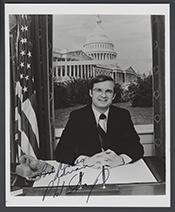
United States · United States Congress · 2 February 1983
Fair Practices in Automotive Products Act - Sets forth for all motor vehicle manufacturers which produce over 100,000 motor vehicles for ultimate retail sale in the United States "minimum domestic content ratios" (the domestic value, including labor and parts, of the manufacturer's production costs of all automotive products sold in the United States). Requires all vehicle manufacturers producing more than 100,000 motor vehicles for sale in the United States to provide information to the Secretary of Transportation for the purpose of administering this requirement. Establishes penalties for a vehicle manufacturer who fails to meet the minimum domestic content ratio. Directs the Secretary of Transportation and the Federal Trade Commission to investigate and prepare a written report regarding policies and practices of vehicle manufacturers used to persuade U.S. motor vehicle dealers to favor foreign made parts rather than domestically produced parts.
United States · United States Congress · 2 February 1983
Directs the President to resume negotiations with the Soviet Union on a treaty prohibiting: (1) the testing, deployment, production, or use of any weapons system designed to damage or interfere with a spacecraft; and (2) the stationing in outer space of any weapon designed to inflict injury or damage on the Earth, in the atmosphere, or on objects placed in space. Requires such a treaty to provide for verifying compliance with its terms. Directs the President to request the United Nations to bring about multilateral negotiations banning all weapons based in space.
United States · United States Congress · 25 January 1983
American Defense Education Act - Authorizes a national program to provide incentives to local educational agencies to improve: (1) instruction in mathematics, science, communication skills, foreign languages, and technology; and (2) guidance and counseling. Title I: Elementary and Secondary Education Programs - Requires local education agencies which desire to participate in such national program to develop and carry out a program of improvement of instruction and student achievement. Sets forth requirements for such programs. Entitles participating local educational agencies to receive basic payments for each fiscal year equal to two percent of an established payment rate multiplied by the average daily attendance. Entitles agencies which show substantial evidence of meeting program goals to an incentive payment equal to an additional two percent of the established payment rate multiplied by the average daily attendance. Sets forth a formula for establishing such payment rate. Sets forth requirements for applications for payments. Directs the Secretary of Education ("the Secretary") to approve applications which meet such requirements. Sets forth provisions for participation in such program by children enrolled in private schools. Title II: Teacher Training and Postsecondary Programs - Authorizes the Secretary to establish a program of grants to institutions of higher education for coordination between such institutions and local education agencies in improving science and mathematics education, through precollege teacher training, development, and recruitment programs. Sets forth requirements for grant proposals and priorities in grant selection. Authorizes appropriations for FY 1985 through 1987 for such grants. Title III: Research to Improve Instruction - Directs the Secretary to administer, through the National Institute of Education (NIE), in consultation with appropriate Federal agencies, a program to support research and development into effective education in mathematics, the sciences, foreign languages, and technology. Authorizes appropriations to the Department of Education to be made available to NIE to carry out such educational research program for FY 1985 through 1987. Title IV: General Provisions - Directs the Secretary to administer the program and to pay each local educational agency with an approved application the amount to which it is entitled for each fiscal year. Provides for a joint survey and report to Congress by the Secretaries of Defense and Education, for each year from 1983 through 1987, on the academic achievement levels of U.S. 18-year-olds and the personnel training and educational needs of the armed forces.
United States · United States Congress · 25 January 1983
Prohibits the expenditure of funds for the production of lethal binary chemical munitions after the enactment of this Act. Defines lethal binary chemical munitions to mean: (1) toxic chemicals intended to injure or kill humans; and (2) devices intended to disseminate such chemicals. Expresses the sense of Congress that the President should begin negotiations with the Soviet Union for a mutual, verifiable limitation on chemical weapons.
United States · United States Congress · 25 January 1983
Authorizes the President to present on behalf of Congress a gold medal to Danny Thomas in recognition of his humanitarian efforts and outstanding work as an American. Directs the Secretary of the Treasury to strike a gold medal with suitable emblems, devices, and inscriptions to be determined by said Secretary. Provides, effective October 1, 1983, funds not to exceed $22,000 to carry out the purposes of the Act. Provides that the Secretary may cause bronze duplicates of the medal to be coined and sold under regulations prescribed by the Secretary at a price sufficient to cover the costs of producing the gold medal. Directs that the appropriation used to carry out the provisions of the Act shall be reimbursed out of the proceeds from such coin sales. Provides that the medals are to be national medals.
United States · United States Congress · 6 January 1983
Construction Work in Progress Policy Act of 1983 - Amends the Federal Power Act to authorize the Federal Energy Regulatory Commission to approve, upon application by a public utility, the inclusion of the costs of construction work in progress (defined as construction of a facility used to generate electric energy) in the rate base of such public utility with respect to: (1) any pollution control facility; and (2) the conversion of oil or natural gas-fired facilities to the use of other fuels. Requires the Commission to hold an evidentiary hearing upon application by a public utility for approval of such a rate increase. Sets forth the items required in any such application. Requires the Commission to approve the rate increase applied for or to order a lesser rate increase if, after the hearing, the Commission finds that: (1) the utility will be in severe financial difficulty unless construction work in progress costs are included in the rate base; (2) the facility being constructed is reasonably necessary to meet energy demands; (3) any mismanagement involved will not affect the utility's future financial situation; (4) the long-term benefits justify short-run rate increases in the case of customers purchasing electric energy for resale; (5) such wholesale customers have been offered an ownership interest in the facility under construction; (6) the rate increase will not unreasonably impair the ability of wholesale customers to sell electric energy to their retail customers at the least cost; and (7) the applicant utility will discontinue the capitalization of allowance for funds used during construction for those construction work in progress costs included in the rate base. Provides that no rate increase approved or ordered under this Act may: (1) be charged for electric energy sold before the date of such approval or order; (2) exceed the amount needed to alleviate the utility's financial difficulties; (3) have an anticompetitive effect; (4) be applied to any customer who holds an ownership interest in the facility being constructed (with limited exceptions); or (5) be unduly discriminatory or preferential or exceed a just and reasonable amount.
United States · United States Congress · 3 January 1983
Constitutional Amendment - Declares that equality of rights under the law shall not be denied or abridged by the United States or any State on account of sex.
United States · United States Congress · 3 January 1983
States that the Strategic Arms Reduction Talks (START) between the United States and the Soviet Union should: (1) pursue a complete halt to the nuclear arms race; (2) decide when and how to achieve a mutual verifiable freeze on the testing, production, and further deployment of nuclear warheads, missiles, and other delivery systems; (3) give special attention to destabilizing weapons; (4) pursue reductions through numerical ceilings and other means; (5) preserve present limitations on nuclear weapons; and (6) incorporate ongoing negotiations in Geneva on land-based intermediate-range nuclear missiles into the START negotiations. Requires that every effort be made to reach common positions with the NATO allies.
United States · United States Congress · 3 January 1983
States that the United States and the Soviet Union should: (1) pursue a complete halt to the nuclear arms race; (2) decide when and how to achieve a mutual and verifiable freeze on the testing, production, and further deployment of nuclear warheads, missiles, and other delivery systems; (3) give special attention to destabilizing weapons; and (4) proceeding from this freeze, pursue major, mutual, and verifiable reductions in nuclear warheads, missiles, and other delivery systems.
United States · United States Congress · 3 January 1983
Declares that the Commissioner of Social Security and the Secretary of Health and Human Services should develop and present to Congress a plan to correct the benefit disparity caused by the 1977 changes in the social security retirement benefit formula.
United States · United States Congress · 14 December 1982
Declares that a specified decision of the Federal Communications Commission shall not, prior to January 1, 1984, prohibit regulated communications common carriers from providing, installing, or maintaining telephones and other customer-premises equipment.
United States · United States Congress · 29 November 1982
Establishes the Commission on the Bicentennial of the United States Constitution. Requires the Commission to: (1) plan and develop appropriate activities to commemorate the bicentennial of the Constitution; (2) encourage private organizations, and State and local governments to organize and participate in bicentennial activities; (3) coordinate activities throughout all the States; and (4) serve as a clearinghouse for the collection and dissemination of bicentennial information. Directs the Commission to seek assistance from private and governmental agencies and organizations. Requires the Commission to submit a report of its recommendations to the President, Congress and the Judicial Conference within two years of enactment of this Act and annually until its termination. Terminates the Commission on December 31, 1989. Authorizes appropriations for FY 1983 and such sums as necessary through FY 1989.
United States · United States Congress · 22 September 1982
Directs the President to take every possible action to encourage increasing the processed product share of farm exports including, but not limited to: (1) urging U.S. negotiators to try to include a quantity of value-added processed farm products in grain agreements with the Soviet Union or other nonmarket economy countries; (2) seeking elimination of unfair trade practices by foreign competitors by pursuing international trade negotiations; (3) using the authority of Public Law 480 to encourage inclusion of more processed products under both concessional sales and food aid programs; and (4) using authorities of the Commodity Credit Corporation and the Export-Import Bank to ensure that credit arrangements for farm exports and farm product exports are on terms equal to those offered by other countries.
United States · United States Congress · 16 September 1982
Directs the Committee on Governmental Operations of the House and the Committee on Governmental Affairs of the Senate to study: (1) the budgetary systems of States required to maintain balanced budgets; and (2) the impact of off-budget activities on the Federal budget process. Requires that such Committees recommend changes to the Federal budget system necessary for a balanced budget framework. Title I: Amendments to Budget and Accounting Act, 1921 - Amends the Budget and Accounting Act, 1921, to require that any budget submitted to Congress by the President shall set forth a level of estimated expenditures which do not exceed receipts. Provides that the President, for reasons of national security or economic necessity may submit two budgets, only one of which is balanced. Title II: Amendments to Congressional Budget Act of 1974 - Amends the Congressional Budget Act of 1974 to provide for the annual adoption of one concurrent resolution on the budget. Requires the submission of balanced budgets by the Committees on the Budget of each House. Allows the Committees to submit two budgets, only one of which is balanced, if the Committees find it infeasible to submit a complying budget. Repeals provisions which require a second concurrent resolution on the budget. Revises certain reconciliation procedures. Provides that the budget resolution shall be binding unless waived by a three-fifths vote in either House of Congress. Requires the chairman of the House and Senate Budget Committees and a presidential appointee to meet and agree upon common economic and technical estimating assumptions to be used for preparation of the President's budget proposal. Requires, beginning with FY 1984, that the appropriate level of total budget outlays set forth in any concurrent resolution on the budget, as reported, for a fiscal year not exceed specified percentages of the Trend Gross National Product for such fiscal year. Sets forth the definition of the Trend Gross National Product for the purposes of this Act. Title III: Technical and Conforming Amendments - Amends the Congressional Budget and Impoundment Control Act of 1974, the Congressional Budget Act of 1974, and the Rules of the House of Representatives to make technical and conforming changes. Title IV: Effective Date - Sets forth the effective dates for this Act.
United States · United States Congress · 18 August 1982
Establishes the Commission on Capital Markets to evaluate the regulation of financial intermediaries by the Federal and State governments and the functioning of such intermediaries in the accumulation and allocation of capital within the U.S. economy. Requires the Commission, not later than one year after its initial meeting, to submit to Congress a report on the results of its evaluation. Terminates the Commission 90 days after the submission of its final report to Congress. Authorizes appropriations as necessary to carry out this Act.
United States · United States Congress · 12 August 1982
Amends the Federal Election Campaign Act of 1971 to reduce the multicandidate political committee contribution limit respecting Federal elections. Limits multicandidate political committee contributions to congressional candidates in general, special, or runoff elections.
United States · United States Congress · 10 August 1982
Expresses the sense of the House of Representatives that regulations recently proposed by the Secretary of Education under the Education of the Handicapped Act should not be permitted to take effect.
United States · United States Congress · 15 July 1982
Residential Mortgage Investment Act of 1982 - Permits employee benefit plans, as defined under this Act, to engage in any qualified mortgage transaction involving any qualified residential mortgage loan, provided transactions between all parties are at arm's length. Permits such plans to participate in any mortgage pool, provided such pool conforms to specified requirements with regard to permitted investments. Authorizes the Secretary of the Treasury to prescribe regulations to carry out this Act. Provides that this Act shall supersede any and all contrary provisions of State law, the Employee Retirement Income Security Act of 1974, and the Internal Revenue Code. Prohibits the imposition of Federal excise tax on a plan or pool that engages in a transaction described under this Act.
United States · United States Congress · 14 July 1982
Constitutional Amendment - Declares that equality of rights under the law shall not be denied or abridged by the United States or any State on account of sex.
United States · United States Congress · 1 July 1982
Designates certain lands in the Hoosier National Forest in Indiana as the Charles C. Deam Wilderness. Requires that the right of public access to the Terril Cemetery and the right of adequate access to privately owned lands within the areas designated as wilderness by this Act be protected. Prohibits the condemnation of private property pursuant to this Act without the owner's consent. States that the second roadless area review and evaluation (RARE II) final environmental statement (dated January 1979) shall not be subject to judicial review with respect to national forest system lands in Indiana. Provides that: (1) the RARE II Study of national forest system lands in Indiana shall be considered an adequate consideration of the suitability of such lands for inclusion in the National Wilderness Preservation System; and (2) the Department of Agriculture shall not be required to review the wilderness option before the revision of the initial land management plans, required for such lands by the Forest and Rangeland Renewable Resources Planning Act of 1974. Requires that areas in Indiana reviewed in the RARE II final environmental statement and not designated as wilderness by this Act be managed for multiple uses other than wilderness. Prohibits the Department of Agriculture from conducting any further statewide roadless area review and evaluation of national forest system lands in Indiana to determine their suitability as wilderness without express congressional authorization.
United States · United States Congress · 24 June 1982
Amends the Energy Policy and Conservation Act to extend until August 1, 1982: (1) the authority for oil companies to carry out voluntary agreements for implementing the allocation and information provisions of the international energy program; and (2) the antitrust exemption for oil companies participating in such program.
United States · United States Congress · 23 June 1982
States that the United States and the Soviet Union should begin the strategic arms reduction talks (START), which should have the following objectives: (1) pursuing a complete halt to the nuclear arms race; (2) deciding when and how to achieve and pursue a mutual and verifiable freeze on the testing, production, and further deployment of nuclear warheads, missiles, and other delivery systems; (3) giving special attention to destabilizing weapons; (4) preserving present limitations and controls on current nuclear weapons and delivery systems; and (5) incorporating ongoing negotiations in Geneva on land-based intermediate-range nuclear missiles into the START negotiations. Declares that the United States shall try to reach a common position with the North Atlantic Treaty Organization allies on any agreement that would be inconsistent with existing U.S. commitments to those allies. Declares that the United States shall promptly approve the SALT II agreement if adequate verification capabilities are maintained.
United States · United States Congress · 27 May 1982
Fair Trade in Steel Act of 1982 - Declares that it is congressional policy to allow access to the U.S. market for foreign-produced steel on an equitable basis in order to safeguard the national security, insure orderly trade, and alleviate U.S. balance-of-payments problems. Title I: Steel Tripartite Advisory Council - Directs the President to establish within the Executive Office of the President a Steel Tripartite Advisory Council. Requires the Council to advise the President and Congress on problems within the basic steel industry and to provide advice and recommendations on related domestic and international issues. Requires other Federal agencies to provide the Council with economic information upon request. Directs the Council to report to the President on the condition of the steel industry. Title II: Quantitative Restrictions on Imports of Certain Steel Products - Limits to 5,000,000 tons the amount of articles in all steel product categories that may be imported between July 1, 1982, and January 1, 1983. Imposes a further limitation on such imports if unemployment in the domestic steel industry reaches between ten percent and 15 percent for three consecutive months. Prohibits any steel imports if unemployment in the domestic industry for three consecutive months is over 15 percent. Limits the amount of steel imports in each calendar year after 1982 to 10,000,000 tons. Imposes further limitations on imports depending upon the level of unemployment in the domestic industry. Imposes additional limitations on imports during any year after 1982 of articles in any one steel product category. Imposes a per country limitation on imports during such years of articles: (1) in all steel product categories; and (2) within any one steel product category. Directs the Secretary of Commerce to apportion shares of the U.S. market to foreign countries on the basis of information provided by the Secretary of the Treasury. Declares that it is the goal of this title to ensure that the imports of articles in all steel product categories be equalized on a monthly basis throughout each calendar year. Directs the Secretary of Commerce to impose additional limitations on the imports from a country whose exports to the United States exceed a specified limit. Authorizes the President to reduce such restrictions imposed under this title if the President makes a specified determination and the Congress, after notification by the President, does not adopt a concurrent resolution disapproving such reduction. Title III: Quantitative Restrictions on Iron Ore Imports - Limits the amount of iron ore that may be imported: (1) between July 1, 1982, and December 31, 1982, to 7,000,000 tons; (2) during 1983 to 14,000,000 tons; and (3) during 1984 to 14,000,000 tons, unless the Secretary finds that there has been an increase in employment in the domestic iron ore industry. Provides for a ten percent increase in imports in 1984 for each ten percent increase in employment. Authorizes the Secretary to waive the restrictions on imports of iron ore in order to insure continued operation of domestic steelmaking plants. Requires that such waiver be made on a plant-by-plant basis and only if the Secretary makes a specified determination.
United States · United States Congress · 21 May 1982
Amends the Agricultural Act of 1970 to prohibit the President from restricting the export of an agricultural commodity sought to be exported under an export sales contract: (1) requiring delivery of a commodity aboard an export vehicle within 180 days; (2) entered into before the President announces an export restriction on the commodity; and (3) reported pursuant to a specified section of the Agricultural Act of 1970. Permits the President to restrict exports of such a commodity during a declared war or national emergency.
United States · United States Congress · 21 May 1982
Professional Sports Stabilization Act of 1982 - Declares that it shall not be unlawful under any antitrust law for a professional sports league and its member clubs to enforce rules: (1) requiring approval by the league membership for the relocation of a member club; or (2) providing for the division of league or member club revenues that promote comparable economic opportunities for member clubs. Prohibits State and local governments from imposing limitations on the collective conduct of sports leagues or member teams authorized by this Act. Specifies the applicability of this Act to actions commenced under the antitrust laws before its enactment.
United States · United States Congress · 11 May 1982
National Energy Emergency Preparedness Act of 1982 - Amends the Energy Policy and Conservation Act to extend the authority with respect to international voluntary agreements under the international energy program until June 30, 1985. Directs the President to undertake and continue petroleum product acquisition, transportation, and injection activities at a rate which assures that the quantity of petroleum products in the Strategic Petroleum Reserve will be increased at an average annual rate of at least 200,000 barrels per day. Directs the President to assure that quantities in the Reserve are increased at an average annual rate of at least 300,000 barrels per day during periods in which the President considers it fiscally prudent to do so. Provides that the preceding requirements shall cease to apply when there are at least 500,000,000 barrels in the Reserve; except that until at least 750,000,000 barrels are stored, the President shall seek to continue petroleum product acquisition, transportation, and injection activities at the 200,000 barrel per day rate. Provides the Secretary of Energy with authority to store petroleum products in interim storage facilities. Prohibits: (1) limiting the use of the Strategic Petroleum Reserve Petroleum Account so that it cannot be used to meet expenses relating to interim facilities for the storage of petroleum products for the Strategic Petroleum Reserve; and (2) requiring any amendment to the Strategic Petroleum Reserve Plan prior to the storage of petroleum products in interim storage facilities. Prohibits obligating more than ten percent of the total amounts in the Account obligated annually for interim storage facilities. Prohibits any action relating to the storage of petroleum products in existing facilities for interim storage being deemed "a major Federal action significantly affecting the quality of the human environment" as defined in the National Environmental Policy Act of 1969. Directs the President to collect information on the pricing, supply, and distribution of petroleum products by product category at the wholesale and retail levels, on a State by State basis. Directs the President to submit a report to Congress containing: (1) a memorandum of law describing the authorities available to the President under existing law to respond to a severe energy supply interruption; and (2) a description of the options available to the President to implement such authorities. Directs the Secretary of Energy to analyze the impact on the domestic economy and on consumers of reliance on market allocation and pricing during any substantial reduction in the amount of petroleum products available and to submit such analysis to Congress. Directs the President to submit a report to Congress containing: (1) a description of the foreseeable situations which could result in a severe energy supply interruption; and (2) the strategy of distribution which could be used to respond to such situation.
United States · United States Congress · 3 May 1982
Expresses the sense of the House of Representatives that: (1) a continued Federal commitment to the railroad retirement system is essential to assure the integrity of railroad retirees' benefits; and (2) the preservation of the present structure of the railroad retirement system, including the Railroad Retirement Board, is necessary to fullfill the responsibility of the Government.
United States · United States Congress · 28 April 1982
Amends the Energy Policy and Conservation Act to eliminate provisions which: (1) permit petitions to the Secretary of Energy for prescription of rules which supersede State energy efficiency standards; and (2) provide for supersedure of State energy efficiency standards prescribed after January 1, 1978.
United States · United States Congress · 22 April 1982
Surplus Agricultural Commodities Disposal Act of 1982 - Amends the Agricultural Act of 1949 to direct the Commodity Credit Corporation to contract for the processing of surplus commodities into liquid fuels and agricultural commodity byproducts. Requires the Secretary to report to Congress within 120 days and annually thereafter.
United States · United States Congress · 1 April 1982
Expresses the sense of the Congress that: (1) an effective Federal environmental program is necessary to protect U.S. citizens' health and well-being; (2) the Environmental Protection Agency should be appropriated increased funds to protect our environment and meet expanded responsibilities mandated by law; and (3) the President should submit a new budget for the Environmental Protection Agency for FY 1983 reflecting these principles.
United States · United States Congress · 29 March 1982
Authorizes the President to designate April 4, 1982, as the National Day of Reflection. Notes that such date coincides with the 80th birthday of Rabbi Menachem Mendel Schneerson, head of the Lubavitch movement.
United States · United States Congress · 24 March 1982
States that the Federal Government should restore balance to the Department of Energy's FY 1983 budget by maintaining funding for energy conservation, renewable energy, and weatherization programs and by distributing information on conservation and renewable energy.
United States · United States Congress · 22 March 1982
Amends title II (Old Age, Survivors and Disability Insurance) of the Social Security Act to prohibit entitlement to title II benefits in the case of an individual who is not a U. S. citizen or national if such individual: (1) is not a permanent resident of the United States; or (2) is outside the United States. Prohibits the payment of title II benefits to any dependent or survivor of such an individual on the basis of such individual's wages and self-employment income. Makes such prohibition inapplicable if the benefit involved is payable to such an individual as the dependent or survivor of: (1) a U. S. citizen or national; (2) a permanent resident of the United States; or (3) a U. S. citizen or national residing outside the United States if the relationship required for such individual's entitlement already existed at the time such national or citizen reached age 50. Authorizes the payment of title II benefits to an individual who is not entitled to benefits pursuant to this Act until the total amount of such benefits equals the total amount of any taxes paid on the wages and self-employment income on which the benefits are based.
United States · United States Congress · 17 March 1982
States that the United States and the Soviet Union should begin the strategic arms reduction talks (START) with the following objectives: (1) preserving present controls on current nuclear weapons and nuclear delivery systems while pursuing substantial, equitable, and verifiable reductions; (2) seeking methods of avoiding the testing and deployment of destabilizing nuclear weapons; and (3) incorporating the ongoing negotiations on land-based intermediate-range nuclear missiles into the START negotiations.