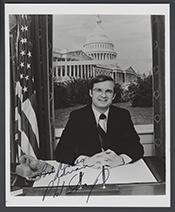
United States · United States Congress · 13 September 1983
Amends the Energy Policy and Conservation Act to direct the Secretary of Energy to engage in drawdown and distribution of the Strategic Petroleum Reserve in order to test the Distribution Plan and its implementation. Requires such drawdown and distribution to occur at least once before September 30, 1985, and periodically thereafter.
United States · United States Congress · 13 September 1983
Designates the week beginning February 12, 1984, as a time to recognize the contributions of volunteers who become Big Brothers and Big Sisters to single parent youths.
United States · United States Congress · 4 August 1983
Provides that for purposes of determining the minimum allocation for any State for highway projects, the amount of taxes paid into the Highway Trust Fund with respect to gasohol and certain methanol and ethanol fuels shall be determined as if such fuels were taxed as gasoline.
United States · United States Congress · 20 July 1983
Authorizes the President to present, on behalf of Congress, a gold medal to Margaret Truman Daniel, daughter of Harry S. Truman, in recognition of the lifetime of outstanding public service he gave to the United States. Commemorates his one hundredth birthday which will be celebrated on May 8, 1984. Authorizes appropriations.
United States · United States Congress · 19 July 1983
Designates the Veterans Administration Outpatient Clinic to be located in Crown Point, Indiana, as the Adam Benjamin Veterans Administration Outpatient Clinic.
United States · United States Congress · 14 July 1983
Amends the Agricultural Act of 1949 to require the Secretary of Agriculture to announce 1984 feed grain acreage limitations or set-asides by September 16, 1983.
United States · United States Congress · 30 June 1983
Patent Term Restoration Act of 1983 - Amends the patent laws to extend the terms of patents which encompass specified products or a method for using a product, any of which are subject to certain nonpatent regulatory review periods. Sets forth the terms and conditions of such extension, including a seven year limitation. Directs the Commissioner of Patents to issue to the owner of record of a patent a certificate of extension stating the fact and length of the extension and identifying the product and the use and the claim to which such extension is applicable. Makes such certificate a part of the original patent. Limits the application of such patent term extension to patents for products subject to regulation under the Federal Food, Drug, and Cosmetic Act, the Public Health Service Act, the Federal Insecticide, Fungicide, and Rodenticide Act, the Toxic Substances Control Act, and the Act of March 4, 1913 (relating to virus, serum, toxin, and analogous products).
United States · United States Congress · 27 June 1983
Expresses the sense of the Congress that further expansion of cargo preference requirements, either for commercial or other trade, should not be imposed.
United States · United States Congress · 22 June 1983
Establishes the Commission on Capital Markets to evaluate the regulation of financial intermediaries by the Federal and State governments and the functioning of such intermediaries in the accumulation and allocation of capital within the United States economy. Sets forth the information to be included in such evaluation. Requires the Commission, within nine months after the initial meeting, to submit to Congress a report on the results of its evaluation. Terminates the Commission ninety days after the submission of its final report. Authorizes appropriations.
United States · United States Congress · 7 June 1983
Amends the Energy Policy and Conservation Act to eliminate provisions which: (1) permit petitions to the Secretary of Energy for prescription of rules which supersede State energy efficiency standards; and (2) provide for supersedure of State energy efficiency standards prescribed after January 1, 1978.
United States · United States Congress · 7 June 1983
National Summit Conference on Education Act of 1983 - Authorizes appropriations to the Department of Education for conducting a National Summit Conference on Education. Sets forth provisions for appointment of participants to the Conference. Directs the Conference to develop recommendations in response to the findings of the National Commission on Excellence in Education and relating to specified areas of educational policy. Directs the Conference to transmit its recommendations to the President, the Congress, and State Governors by January 15, 1984.
United States · United States Congress · 24 May 1983
United States Caribbean Possessions Act - Title I: Eastern Caribbean Regional Development Fund - Lists countries which the President shall consider in designating beneficiary countries for purposes of this title. Prohibits the President from designating a country a beneficiary country: (1) if such country is a communist country; (2) if the country has taken certain expropriating actions against property owned by U.S. citizens; (3) if the country fails to act in good faith with respect to arbitral awards involving U.S. citizens or companies; (4) if the country affords preferential treatment to a developed country other than the United States which adversely affects U.S. commerce unless the President receives certain assurances; (5) if a government-owned entity in such country engages in the broadcast of copyrighted material belonging to U.S. copyright owners without their express consent; and (6) unless such country is party to a treaty regarding the extradition of U.S. citizens. Lists factors the President shall take into account in determining whether to designate a country a beneficiary country. Prohibits the President from terminating the designation of a country as a beneficiary country unless, at least 60 days before the termination, the President has notified the Congress and the beneficiary country of such determination. Directs the President to withdraw or suspend the designation of a country as a beneficiary country if, because of changed circumstances, the country would be barred from designation as a beneficiary country. Establishes in the Treasury the Eastern Caribbean Regional Development Fund. Appropriates to the Fund the amount of money collected from: (1) the import duties on articles entered from beneficiary countries; and (2) the taxes on rum imported into the United States from beneficiary countries. Authorizes the Administrator of the Fund to allocate and distribute the moneys in the Fund to island beneficiary countries. Sets forth the method of allocation. Title II: Tax and Tariff Provisions - Amends the Internal Revenue Code to require that if the amount of taxes collected on rum imported into the United States from beneficiary countries exceeds the amount needed in the Eastern Caribbean Regional Development Fund the excess shall be covered into the treasuries of Puerto Rico and the Virgin Islands. Prohibits granting duty-free treatment to bulk rum manufactured outside the United States, its territories, or possessions.
United States · United States Congress · 19 May 1983
Renewable Energy Incentive Act of 1983 - Title I: Certain Renewable Energy Source Incentives - Amends the Internal Revenue Code to extend for five years from 1985 to 1990 the investment tax credit for: (1) solar, wind, or geothermal property; (2) ocean thermal property; (3) hydroelectric generating property; and (4) biomass property. Allows an investment tax credit for cogeneration energy property until 1990. Increases the energy percentage for solar, wind, or geothermal energy and ocean thermal property from 15 percent to 25 percent. Increases the energy percentage for hydroelectric generating property from 11 percent to 15 percent. Allows an energy percentage of ten percent for cogeneration property. Extends the residential energy income tax credit from 1985 to 1990. Allows the regular investment tax credit for energy property which is considered to be a structural component of a building and is used as air or water heating equipment for such building. Allows an investment tax credit until 1995 for affirmative commitments made for projects concerning: (1) solar, wind, or geothermal property; (2) ocean thermal property; (3) biomass property; and (4) cogeneration property. Extends for seven years from 1988 to 1995 the investment tax credit for affirmative commitments made for certain hydroelectric generating property. Increases from two to five the number of possible sites for ocean thermal property. Allows an investment tax credit for ocean thermal property which produces energy used in a possession of the United States. (Present law requires that such energy be used in the continental United States.) Title II: Biomass Incentive - Treates as biomass property methane-containing gas produced by anaerobic digestion from nonfossil waste materials. Title III: Effective Date - Sets forth the effective date of this Act.
United States · United States Congress · 18 May 1983
Rural Electrification and Telephone Revolving Fund Self-Sufficiency Act of 1983 - Amends the Rural Electrification Act of 1936 (REA) to eliminate the requirement for a State certificate of convenience and necessity before the Administrator may make loans to provide rural telephone service. Revises the liabilities and uses of the Rural Electrification and Telephone Revolving Fund established under the REA to provide that notes of the Administrator to the Secretary of the Treasury to obtain funds for loans shall be equity capital of the Fund. States that assets of the Fund shall be available only for: (1) payment of interest and principal on loans to the Administrator from the Secretary of the Treasury; and (2) for certificates of beneficial ownership issued to such Secretary or in the private market. Requires the Administrator to maintain two separate accounts within the fund: (1) the Electrification Account; and (2) the Telephone Account. Lists the items that shall be accounted for in each Account respectively, and restricts the purposes for which the assets of each Account shall be available. Authorizes the Administrator to repurchase specified certificates of beneficial ownership under certain conditions affecting their interest rates. Establishes guidelines for interest-bearing insured loans made by the Administrator to electric and telephone borrowers. Requires the Secretary of Agriculture to request in each annual supplemental budget estimate the amount needed to replenish the Fund for anticipated and actual costs resulting from loans made at less than a specified rate during the preceding fiscal year. Directs the Administrator to guarantee loans to specified borrowers or to accommodate or subordinate liens or mortgages held in the Fund, according to prescribed rules and regulations. Directs the Administration to promulgate such rules and regulations within 90 days after the effective date of this Act. Prescribes guidelines under which certain lenders are authorized to adjust interest rates on loans guaranteed by the Administrator. Requires rural electrification borrowers to obtain concurrent supplemental financing according to prescribed guidelines in any fiscal year in which the minimum loan level for insured rural electrification loans is less than $1,000,000,000. Repeals the loan-making authority of the Governor of the Rural Telephone Bank which require approval by the Secretary of Agriculture of facilities or lines to be acquired with such loans. Eliminates loan restrictions placed upon potential borrowers whose net worth exceed their assets by twenty percent.
United States · United States Congress · 16 May 1983
Health Care for the Unemployed Act - Amends the Social Security Act to add a new title, Title XXI - Health Care for the Unemployed: Part A - Grants to States - Authorizes to be appropriated for FY 1984 - 1986 a sum sufficient to enable each State to furnish medical assistance to unemployed individuals and their immediate family. Requires a State, in order to receive funding, to have an approved State plan for medical assistance for the unemployed. Requires a State plan to: (1) meet specified administrative requirements of the State's Medicaid plan; (2) make medical assistance available to eligible individuals voluntarily enrolled during the individual's coverage period; (3) require the State unemployment compensation agency to inform unemployment compensation recipients of the plan and of group health plans, and to notify the State Medicaid agency of eligible unemployment compensation recipients; (4) provide the following services: (a) inpatient hospital services for up to nine days annually; (b) outpatient hospital, emergency, rural health clinic, and physician services for up to ten visits annually; (c) laboratory and x-ray services, subject to such limits as the Secretary of Health and Human Services shall establish; and (d) family planning and nurse mid-wife services; (5) provide for the imposition of premiums, enrollment fees, and similar charges; (6) provide that the plan will be secondary in payment to any other insurance or benefit plan providing medical assistance; and (7) provide that a State make reasonable efforts to determine the Medicaid eligibility of individuals enrolled in the plan who are not receiving unemployment compensation. Requires the Secretary to approve any plan meeting the above requirements, but precludes approval of any plan which: (1) excludes any U.S. citizen or any individual residing in the State; or (2) if approved, would result in a reduction of Medicaid services. Requires the Secretary to disapprove a plan if it reduces or eliminates Medicaid eligibility under its AFDC plan (Aid to Families with Dependent Children, part A of title IV of the Act) with respect to the unemployed parent program or the coverage of certain children. Provides that an individual is eligible for such medical assistance for a week if the individual: (1) is receiving unemployment compensation and three weeks have elapsed since the first week the individual received unemployment compensation; or (2) is not receiving unemployment compensation for the week, was receiving unemployment compensation for a week during the 104 week period ending with the week before the first week in which the plan is in effect and has not received unemployment compensation for any week in which the plan is in effect, and meets certain requirements relating to work availability. Makes an individual's family eligible if the individual is eligible. Requires a State plan to establish standards concerning whether or not an individual is employed. Requires an individual to be considered employed for a week if the individual's earnings equal or exceed an amount equal to 30 times the minimum hourly wage. Makes an individual ineligible for a week if: (1) the individual is covered under a group health plan for which a contribution is being made by someone other than the individual; (2) the individual is covered under his or her spouse's group health plan; (3) the individual is eligible for Medicaid; (4) the individual is employed for four consecutive weeks; or (5) the individual was disqualified because of fraud for unemployment compensation or convicted of a Medicaid offense in the previous year. Requires a State to impose: (1) a premium of between two and five percent of an individual's unemployment compensation; and (2) the same deduction, cost-sharing, and similar charges as imposed under Medicaid. Authorizes a State plan to provide an enrollee the option of receiving medical assistance with another health benefit plan. Authorizes a State to provide an eligible individual with the option of having the State make a cash payment for the premium of another plan. Sets forth the methods for determining payments to States. Makes provisions of title XIX relating to the operation of State plans applicable to title XXI. Sets forth definitions used in this part. Directs the Secretary, provided certain conditions are met, to grant a waiver to a State plan with respect to some or all of the Medicaid administrative requirements in the case of a State plan that enters into an arrangement with one or more private health benefits plans which provide health insurance or health benefits to all eligible individuals and which provide required benefits at a cost no greater than the premiums and other charges of the State plan. Makes specified provisions of title XIX and part A (General Provisions) of title XI of the Act relating to rural health clinics, fraud and abuse, Indian health service facilities, cost sharing, judicial and administrative review, capital expenditures, and administration applicable to this part. Part B: Open Enrollment, Continuation, and Conversion Rights of Individuals - Requires the group health plans of employers required to pay minimum wage and States and political subdivisions with 25 or more employees to meet the requirements of this part. Requires a group health plan to have an open enrollment period for each married employee eligible to enroll whose spouse loses coverage under a group health plan due to involuntary termination of the spouse's health plan. Requires a group health plan to provide continuation of coverage under the plan for at least 90 days following an individual's involuntary separation or layoff. Requires a State to provide an employee covered under an insured group health plan subject to State insurance law the option of securing health benefits coverage without evidence of insurability where the individual's loss of coverage under the group health plan results from the individual's involuntary layoff or separation from employment. Authorizes an individual or State adversely affected by the failure of an employer to comply with the requirements of this part to seek injunctive relief in a Federal district court. Part C: Assistance to Hospitals Serving the Unemployed - Directs the Secretary to make grants to hospitals to assist the hospitals in providing services to individuals unable to pay. Requires a hospital, in order to receive a grant, to: (1) be located in an area of high unemployment or serve primarily medically underserved populations; (2) serve a significantly disproportionate number of patients having low income; (3) provide services to individuals without regard to their inability to pay; and (4) offer assurances that it will use the grants in addition to, rather than in lieu of, existing Federal, State, and local funds. Directs the Secretary to report to Congress concerning the grants. Authorizes appropriations for such grants for FY 1983-1986. Establishes the effective date for part A of title XXI as July 1, 1983, with repeal as of October 1, 1986. Provides for the participation of Puerto Rico, the Virgin Islands, Guam, the Northern Mariana Islands, and American Samoa in the plan established by this title.
United States · United States Congress · 12 May 1983
Expresses the sense of the House of Representatives that the President should seek a consensus at the Williamsburg Summit, aimed at: (1) reducing disparities in certain financial rates and economic policies among summit countries; and (2) arranging a meeting of summit country finance ministers with the Secretary of the Treasury, to achieve an alignment between the interest rates and major currencies. Urges the President to arrange, in conjunction with the Williamsburg Summit, bilateral discussions with the Prime Minister of Japan to bring about further realignment of the yen and dollar exchange rates.
United States · United States Congress · 26 April 1983
Amends title II (Old Age, Survivors and Disability Insurance) of the Social Security Act and the Internal Revenue Code to provide for mandatory coverage of ministers and members of religious orders under the Old Age, Survivors and Disability Insurance program unless: (1) the Secretary of Health and Human Services determines that such service is not performed in the employ of another person and so certifies to the Secretary of the Treasury; (2) such a minister or member has elected to be subject to the old age, survivors and disability insurance tax and the hospital insurance tax on self-employment income; or (3) such a minister or member has filed an application for tax-exempt status with a statement that he or she is conscientiously or religiously opposed to the acceptance of any public insurance.
United States · United States Congress · 21 April 1983
Amends the Internal Revenue Code to provide that the standard mileage rate used in computing the charitable deduction for expenses incurred in the operation of a motor vehicle shall be the same as the standard mileage rate established by the Secretary of the Treasury for the business-related deduction.
United States · United States Congress · 19 April 1983
Dedicates the Golden Gate National Recreation Area in California to Phillip Burton. Directs the Secretary of the Interior to inform the public of the contributions of Phillip Burton through the use of signs, maps, and interpretive programs and to establish an appropriate memorial to him within the recreation area. Authorizes appropriations.
United States · United States Congress · 23 March 1983
Amends the Low-Income Home Energy Assistance Act of 1981 to increase the authorization of appropriations for low-income home energy assistance for FY 1984. Decreases the maximum amount of grant money allotted for a fiscal year to States for low-income home energy assistance which a State may request to be held available for the next fiscal year. Requires the Secretary of Health and Human Services to collect home energy and home energy assistance data on a State-by-State basis. Requires the Secretary to submit the annual report on such data required under such Act no later than September 30 of each calendar year.
United States · United States Congress · 23 March 1983
Expresses the sense of Congress that the family planning program under title X of the Public Health Service Act should be administered in the Health Resources and Services Administration of the Department of Health and Human Services.
United States · United States Congress · 16 March 1983
Amends the Internal Revenue Code to repeal the highway use tax on heavy trucks. Increases the excise tax on diesel fuel from nine cents per gallon to 12 cents per gallon in 1983 and from 12 cents per gallon to 14 cents per gallon in 1984. Requires the Secretary of the Treasury to prescribe regulations exempting from such increases diesel fuel used in automobiles and light trucks.
United States · United States Congress · 16 March 1983
States that the Government should restore balance to the Department of Energy's FY 1984 budget by maintaining funding for energy conservation, solar and renewable energy, and weatherization programs and by distributing information on conservation and renewable and solar energy.
United States · United States Congress · 16 March 1983
Expresses the sense of Congress that the President should enter into negotiations with the Soviet Union to establish an agreement that would require the Soviet Union to purchase a minimum amount of grain annually for a five year period.
United States · United States Congress · 9 March 1983
United States Olympic Checkoff Act of 1983 - Amends the Internal Revenue Code to allow taxpayers to designate on their income tax returns a contribution of one dollar of their income tax refunds or any cash amount voluntarily forwarded with their returns to support the U.S. Olympic Trust Fund. Establishes in the Treasury a U.S. Olympic Trust Fund (trust fund). Appropriates to such trust fund an amount equal to the amount designated on tax returns. Directs the Secretary of the Treasury to pay amounts so transferred to the U.S. Olympic Committee. Allows specified administrative expenses to be paid from such trust fund.
United States · United States Congress · 8 March 1983
Vietnam Veterans Agent Orange Relief Act - Establishes a presumption of service-connected disability for veterans exposed to herbicides during service in Southeast Asia during the Vietnam era who suffer from specified diseases which may be caused by exposure to such herbicides, developed to a ten percent degree of disability. Permits the Administrator of Veterans Affairs to determine what other diseases may be due to exposure to herbicides, chemicals, or environmental hazards. Directs the Administrator to promulgate regulations within one year of enactment incorporating such determinations and setting forth the standards used to reach them.
United States · United States Congress · 3 March 1983
World War I Veterans Service Pension Act - Directs the Administrator of Veterans Affairs to pay (in addition to any pension already paid) a monthly pension of $150 to each veteran of World War I who meets specified service requirements and to certain surviving spouses.
United States · United States Congress · 2 March 1983
Title I: Consumer Credit - Consumer Debtor Bankruptcy Amendments Act of 1983 - Amends the Bankruptcy Code to permit a bankruptcy court to dismiss a case or suspend all proceedings if it determines that a debtor whose debts are primarily consumer debts does not need the provisions of the chapter under which relief has been sought and the granting of relief under such chapter would be a substantial abuse of its provisions. Requires the Clerk of each Federal judicial district to compile statistics regarding debtors where debts are primarily consumer debts. Requires the bankruptcy judge to convene, and permits such judge to preside at, any meeting of creditors and to perform such additional judicial duties as may be required. Declares that the value of the creditor's interest in the estate's interest in consumer goods property shall be determined in light of the purpose of the valuation and of the proposed disposition or use of such property, and in conjunction with any hearing on such disposition or use or on a plan effecting such creditor's interest. Declares that the value of consumer goods which the debtor seeks to redeem in liquidation shall be presumed to be the established resale market price, if such market exists. Permits the court to utilize other methods of valuation if no such market exists or if the court determines that resale value is inappropriate in light of the property's proposed use or disposition. Requires the debtor in bankruptcy cases to file a statement of estimated income and expenses for the year following filing of his petition. Requires the debtor, if the schedule of assets and liabilities include consumer debts secured by property of the estate, to file and serve upon each creditor holding such security and upon the trustee, a statement expressing the debtor's intention with respect to retention or surrender of the collateral. Requires the debtor, at or before the meeting of creditors provided for by such title, to perform his intention with regard to such secured creditors. Requires that the notice of meeting of the creditors be accompanied by a copy of the statement of estimated income and expenses and that the debtor supply the clerk of the court, upon the filing of the petition, with enough copies of such statement to accommodate the listed creditors. Requires individuals filing for bankruptcy in joint or consolidated cases to elect either the Federal or State exemptions. Places an aggregate limit of $3,000 on the value of the exemption with regard to household goods and personal effects. Prohibits the debtor from utilizing the unused dollar value of the homestead exemption to exempt additional property not explicitly provided for by such Act. Repeals the provisions of such Act which currently authorize the debtor to avoid nonpurchase money security interest in property. Presumes nondischargeable any debt incurred on or within 40 days before the date of the filing of a petition under such title. Allows for rebuttal of such presumption. Allows creditors to enforce liens which have not been avoided in bankruptcy. Permits reaffirmation of consumer debts subject to the debtor's right to rescind any such agreement within 60 days or until a discharge is received, whichever occurs later. Declares that at the meeting of creditors the court shall inform the debtor of the nature and effect of a discharge and of any reaffirmation of debt. Prohibits the custodian from being an assignee under a general assignment for the benefit of the debtor's creditors that was appointed or took possession more than 120 days before the date of the filing of the petition. Permits the trustee or the court, however, to require such an assignee to file an accounting. Limits the trustee's power to avoid liens or recover payments made within 90 days of the filing of the petition in bankruptcy (within one year in the case of an insider) unless the creditor had reasonable cause to believe the debtor was insolvent. Permits the court, upon notice and hearing, to require a creditor to accept payments in redemption of the value of a claim secured by a nonpossessory, nonpurchase money security interest in tangible personal property, over a reasonable period not to exceed five years, if such tangible personal property consists of specified household goods and tools of the debtor's trade. Permits the court, upon notice and hearing, to avoid any lien in whole or in part, if the court finds;: (1) that the debtor has no reasonable ability to pay the redemption value of such property out of anticipated future income; and (2) the enforcement of such lien would impose undue hardship on the debtor. Allows a creditor, upon 10 days notice to the debtor and codebtor, to collect any portion of a debt from the codebtor which is not being paid by the debtor through the adjustment of debts of such debtor with a regular income. Requires payments under an adjustment of debts payment plan to commence within thirty days after the filing of the plan. Provides for the return of such funds after deducting the costs of administration if no plan is confirmed. Provides for the separate classification of codebtor claims and non-dischargeable claims and authorizes payment of them under an adjustment of debts payment plan. Allows a debtor to choose such a repayment plan of up to five years. Bases such repayment upon the debtor's ability to repay out of future income after taking into account the basic living necessities for the debtor and dependents. Provides for an early discharge of debts where a reasonable portion of unsecured claims are paid. Permits a hardship discharge of otherwise non-dischargeable debts to the extent the debtor attempted to pay such debts under an adjustment of debts payment plan, but was prevented from so doing by unforeseen circumstances. Title II: Agricultural Produce - Agricultural Produce Bailment Bankruptcy Amendments Act of 1983 - Requires bankruptcy courts to give priority to allowed unsecured claims of farmers arising from the sale or conversion of farm produce to or by a debtor who operates a farm produce storage facility. Specifies that such sale or conversion must have occurred within 180 days before the filing of the petition or before the cessation of the debtor's business, whichever occurs first. Limits the payment of any such claim to $2,000 per individual. Permits a bankruptcy court to expedite the procedures for determining interests in and the disposition of grain and proceeds held by debtors who own or operate grain storage facilities. Requires the court to expedite such procedures if requested by a trustee or a claimant. Sets forth factors for the court to consider before deciding whether to shorten the time periods for procedures. Lists the procedures which may be expedited. Specifies administration details. Title III: Miscellaneous - Declares that if any provision of this Act or the application thereof to any person or circumstances is held invalid the provisions of every other part and their application shall not be affected thereby. Makes the provisions of this Act effective 90 days after enactment. Declares that the amendments made by this Act shall not apply to cases pending before the date of enactment.
United States · United States Congress · 23 February 1983
Increases from 26 to 30 the number of members of the Advisory Commission on Intergovernmental Relations, by adding: (1) one elected officer of a local government of an area with a population of less than 10,000 and one elected school board member, to be appointed by the President; and (2) one judge of a U.S. court of appeals or district court and one chief justice or judge of a State court of last resort, to be appointed by the Chief Justice of the United States.
United States · United States Congress · 23 February 1983
Solar Energy National Security and Employment (SENSE) Act of 1983 - Title I: Use of Solar and Other Renewable Forms of Energy Developed By Private Sector - Renewable Energy Small Business Development Act of 1983 - Amends the Internal Revenue Code to increase the energy percentage for energy property which is used in determining the qualified investment tax credit. Treats biomass recycling equipment as biomass property and includes biomass property as "energy property" for purposes of the energy percentage. Eliminates the requirement that the primary energy sources for a facility producing alcohol for fuel purposes not be oil or natural gas or a product of either one in order for such alcohol to be treated as "qualified fuel" for purposes of the energy percentage. Amends the Export-Import Bank Act of 1945 to require that a minimum of 12 percent of the loan authority of the Export-Import Bank in any fiscal year be made available only to businesses with $25,000,000 or less in previous-year sales and include an amount of loan authority for renewable energy transactions that is appropriate to the demand for such loans. Amends the Public Utility Regulatory Policies Act of 1978 to require that the rates for purchases by an electric utility of electric energy from any qualifying cogeneration facility or qualifying small power production facility be established at the incremental cost of alternative electric energy of such utility, unless the State regulatory authority or a nonregulated electric utility determines that a different rate would encourage cogeneration and small power production, would not discriminate against cogenerators and small power producers, and would be in the consumers' and the public's interest. (Currently, such rates must be just and reasonable to the consumers and in the public interest and must not discriminate against cogenerators and small power producers.) Requires a cogeneration facility or small power production facility to pay reasonable interconnection costs incurred by an electric utility which is required to offer to interconnect with such facility. Requires the U.S. Trade Representative to issue policy guidance to departments and agencies with respect to international trade issues involving renewable energy. Amends the Small Business Innovation Development Act of 1982 to require that a reasonable portion of the funds appropriated for nonnuclear programs of the Department of Energy be set aside for renewable energy and energy conservation businesses. Title II: Renewable Energy National Security - Renewable Energy National Security Act of 1983 - Requires the Secretary of a military department, when procuring energy systems, to procure systems that include energy-conserving equipment. Includes biofuels as a renewable form of energy for purposes of energy systems procurement by a military department. Requires the Secretary of Defense to provide for the use of biofuels in meeting Department of Defense energy needs to the extent feasible and consistent with overall defense needs. Requires the Secretary of Defense to encourage the use of energy-conserving devices and equipment in military construction projects, including family housing projects, where practical and economically feasible. Amends the Agricultural Act of 1949 to include spoilt and contaminated grains among the accumulated stocks of agricultural commodities which the Commodity Credit Corporation may process into liquid fuels. Authorizes the Corporation to provide for the storage of liquid fuels so processed for use by the agricultural sector during periods of fuel shortages. Requires the Corporation to provide for the processing of spoilt and contaminated commodities into liquid fuels before the processing of stocks of usable feedstock. Amends the Energy Policy and Conservation Act to require the Secretary of Energy to maintain a data base on the location of all stockpiles of renewable energy supplies and biofuels and of all renewable energy production facilities in the United States. Requires that such data be made available to Government departments and agencies upon request. Requires the Secretary of Defense to assess and report to the Armed Services Committees of the House of Representatives and the Senate on the feasibility of using mobile energy systems that use renewable energy as emergency backup energy systems at military installations. Title III: Federal Training and Economic Development Programs to Create Jobs in Energy Conservation Industries - Part A: Short Title; Findings - Renewable Energy Employment Act - Sets forth the short title of this title and congressional findings. Part B: Job Training in Renewable Energy - Requires the Secretary of Labor to review all Federal job training or placement programs and to implement policies, procedures, and programs to develop a labor force skilled in energy conservation, weatherization of homes, and the use of renewable energy technologies. Part C: Housing and Community Development Programs - Amends the Energy Conservation in Existing Buildings Act of 1976 to require the Secretary of Energy to maintain information on: (1) the areas to be served under the weatherization assistance program; (2) methods for providing priority assistance to elderly and severely handicapped low-income persons; (3) outreach activities with respect to such program; (4) labor plans; (5) policies to ensure that owners and renters are treated equitably; and (6) plans to ensure participation by Native Americans under such program. Requires the Secretary and the Director of the Community Services Administration to include in the annual report to the President and Congress on the weatherization program an evaluation of the effect of such program on energy conservation and employment. Authorizes appropriations for the weatherization program for FY 1984 and succeeding fiscal years. Amends the Housing and Community Development Act of 1974 to include the potential for local energy development, including energy conservation and renewable energy use, among the factors which must be taken into account by the standards issued by the Secretary of Housing and Urban Development for determining the eligibility of cities and urban counties for urban development action grants. Includes among the activities of Community Development Programs which are eligible for assistance under such Act those amounts spent for energy needs. Amends the Housing Act of 1949 to authorize the Secretary of Housing and Urban Development to make loans for energy conservation and renewable energy development or retrofit for housing in rural areas. Requires Federal agencies administering financial assistance programs for economic development or job creation to consider the development of energy conservation and renewable energy as significant criteria for the provision of such assistance. Part D: Promotion of Sustainable Agriculture - Amends the Consolidated Farm and Rural Development Act to include as non-fossil energy systems windmills, anaerobic digesters, alcohol distilleries, microhydroelectric generators, gasifiers, and solar heating systems. Requires the Secretary of Agriculture, in making loans to farmers and ranchers, to promote sustainable agriculture (a set of agricultural production practices which are designed to produce long term, sustainable yields of agricultural products, involve the use of renewable resources, and avoid the use of chemical products). Amends the Rural Development Act of 1972 to require that small farm extension programs assist small farm families in carrying out sustainable agriculture. Provides that sustainable agriculture extension programs shall consist of extension programs to provide farmers with assistance and current information with respect to sustainable agriculture. Permits all other persons in a State, in addition to universities and colleges in such State, to participate in agricultural research and extension programs. (Under current law, only universities and colleges in a State may participate in such programs.) Requires the Secretary of Agriculture, in carrying out the National Agricultural Research, Extension, and Teaching Policy Act of 1977, to ensure that adequate national support of extension, teaching, and agricultural research is provided to establish integrated multidisciplinary organic farming research projects. Requires the Secretary of Agriculture to report annually to Congress on sustainable agriculture in the United States. Title IV: Renewable Energy Consumer Incentives - Renewable Energy Consumer Incentives Act of 1983 - Amends the Solar Energy and Energy Conservation Act of 1980 to extend the life of the Solar Energy and Energy Conservation Bank until September 30, 1990. (Under current law, the Bank will not exist after September 30, 1987.) Requires that a portion of the payments by the Bank to financial institutions to provide financial assistance for the installation of solar energy systems in residential, commercial, and agricultural buildings be allocated for active solar energy. Provides that there shall be no Federal preference with respect to financial assistance between single-family and multifamily residences. Permits all financial institutions to apply directly to the Bank for financial assistance. Authorizes appropriations for FY 1985 through 1990 for the financial assistance program under the Solar Energy and Energy Conservation Act of 1980 for the purchase and installation of residential and commercial energy conserving improvements and solar energy systems. Amends the Internal Revenue Code to include passive solar energy property which uses convective, conductive, or radiant energy transfer and which has significant impact on home energy savings as a "renewable energy source property" which is eligible for the residential energy credit. Makes the residential energy credit inapplicable to energy conservation and renewable energy source expenditures made after December 31, 1990. (Under current law, such credit is inapplicable to expenditures made after December 31, 1985.) Amends the Low- Income Home Energy Assistance Act of 1981 to permit a State to transfer up to ten percent of its allotment under the low-income home energy assistance program for States to block grants for support of energy related information systems. Requires the Secretary of Energy to develop a formalized information exchange on the Federal, State, and local levels with respect to conservation and renewable energy. Authorizes appropriations to provide financial assistance to States and local governments to coordinate such program. Amends the Solar Energy Research, Development, and Demonstration Act of 1974 to require the Secretary of Energy to maintain a renewable energy and energy conservation information program. (This program replaces the solar energy information program required to be established under current law.) Requires the Secretary to establish a National Appropriate Technology Service to provide individualized technical assistance to anyone interested in renewable energy and energy efficient technologies. Amends the Motor Vehicle Information and Cost Savings Act to require the Secretary of Transportation to consider the use or integration of renewable fuels and any approaches which maximize conservation and renewable energy applications in determining maximum feasible average fuel economy. Amends the Energy Policy and Conservation Act to require the Federal Trade Commission to prescribe labeling requirements for consumer goods particularly in cases where there is a direct consumer benefit to save energy or utilize renewable energy. Amends the Small Business Act to authorize the Small Business Administration to provide reduced-rate loans to small businesses for acquisition of system performance ratings from testing laboratories for energy conservation and renewable energy systems and technologies. Amends the Public Utility Regulatory Policies Act of 1978 to require State regulatory authorities to adopt and publish standard contracts with respect to: (1) the sale of electric energy by utilities to small power production facilities of not more than 100 kilowatts capacity; and (2) the purchase of electric energy produced by such facilities by utilities. Requires the Secretary of Energy to include renewable energy as a discrete energy sector in all publications of "The Monthly Energy Review." Requires Federal agencies with renewable energy programs to submit annual reports on such programs to Congress. Sets forth reporting requirements which apply to specified Federal agencies.
United States · United States Congress · 10 February 1983
Residential Mortgage Investment Act of 1983 - Amends the Employee Retirement Income Security Act of 1974 and the Internal Revenue Code to exempt from specified prohibited transaction provisions: (1) any qualified mortgage transaction engaged in by an employee benefit plan provided only that such transaction received the prior approval of an independent fiduciary; and (2) purchase, retention, or sale by an employee benefit plan of interests in Federal or State government-guaranteed residential mortgage loans.
United States · United States Congress · 7 February 1983
Amends the Internal Revenue Code to permit farmers who participate in a Federal payment-in-kind program to elect to treat commodities they receive as income in the year of receipt or the year of sale. Permits farmers to elect a deferral of the income resulting from the cancellation of Commodity Credit Corporation loans. Provides that farmers participating in a payment-in-kind program do not forfeit eligibility for the special use valuation provisions for farm property.
United States · United States Congress · 3 February 1983
United States Academy of Peace and Conflict Resolution Act - Establishes the United States Academy of Peace and Conflict Resolutions as an independent nonprofit corporation. Permits the Academy to use "United States" or "U.S." or any other reference to the United States Government or Nation in its title, corporate seal, emblem, or other mark of recognition in any fiscal year only if there is an authorization of appropriations for the Academy for such fiscal year provided by law. Sets forth the powers and the duties of the Academy, including establishment of an Endowment of the United States Academy of Peace and Conflict Resolution. Authorizes the Academy to: (1) conduct research on the causes of war and the elements of peace; (2) provide peace education and research programs; (3) conduct training in conflict resolution; (4) disseminate information on peace learning; (5) establish a Center for International Peace; and (6) establish a United States Medal of Peace and other medals or honors. Authorizes the Academy to refuse research requests of Federal agencies for reason of cost or of inappropriateness to the Agency's purpose or independence. Prohibits the Academy from undertaking to influence the passage or defeat of any Federal, State, local, or United Nations legislation, but permits Academy personnel to testify or make other appropriate communication when formally requested to do so by a legislative body, committee, or member thereof. Provides for appointment of members of the Academy's Board of Directors. Sets forth grounds for removal of Board members. Permits Board meetings to be closed only in exceptional circumstances. Sets forth provisions for Academy officers, employees, procedures, and records. Provides that, with certain exceptions, the Academy shall not be considered a department, agency, or instrumentality of the Government. Prohibits the use of any political test or political qualification with respect to personnel actions of the Academy or financial assistance by the Academy. Authorizes appropriations in a specified amount for an Academy principal office capitalization fund. Authorizes appropriations in specified amounts for FY 1984 and 1985 for Academy programs and administration. Requires that Academy expenses in connection with the United States Medal of Peace or the accompanying cash award be paid out of the private funds of the Endowment. Restricts contract-making authority under this Act to the extent and amounts provided in appropriation Acts. Directs the Chairman of the Board of Directors of the Academy to report to the Congress and the President, beginning two years after the enactment of this Act and at two-year intervals thereafter. Directs the President to transmit to the Congress the recommendations of the appropriate Federal agencies with respect to such report and to any legislation concerning the Academy. Requires the appropriate congressional committees to hold hearings to review such report and recommendations.
United States · United States Congress · 2 February 1983
Housing Finance Opportunity Act of 1983 - Amends the Internal Revenue Code of 1954 to permit the continued issuance of tax-exempt (interest excluded from gross income) mortgage revenue bonds after December 31, 1983.