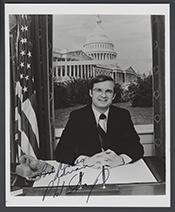
United States · United States Congress · 18 February 1981
World War I Veterans Service Pension Act of 1981 - Requires the Administrator of Veterans' Affairs to pay (in addition to any pension already paid) a monthly pension of $150: (1) to each veteran of World War I who meets specified service requirements; (2) to the surviving spouse of each such veteran; or (3) when there is no surviving spouse, to the child or children of each such veteran.
United States · United States Congress · 5 February 1981
Administrative Rulemaking Reform Act - Directs a Federal agency preparing to hold a rulemaking session to make a reasonable effort to inform those likely to be affected by the proposed rulemaking. Requires the notice of rulemaking to include: (1) the projected effective date of the rules; (2) the purpose of the rulemaking; (3) the text of the proposed rules; and (4) the studies on which the agency intends to rely in the rulemaking proceedings. Requires public notice and public opportunity for comment on all rulemaking proceedings unless the agency finds that proposed rules are emergency rules or are of routine or insignificant impact. Requires Federal agencies to give interested persons at least 45 days to participate in the rulemaking. Provides for agency hearings to receive oral comments, and procedures to resolve significant controversies over factual issues. Requires each agency to maintain a public file of all relevant material and required statements for each rulemaking. Prohibits adoption of a proposed rule that has been revised substantially unless interested persons are provided an opportunity to comment on such revisions. Sets forth an expedited rulemaking procedure for rules to replace emergency rules. Directs each agency to submit a copy of each promulgated rule to each House of Congress. Declares that no rule, excluding an emergency rule, shall become effective if: (1) both Houses of Congress adopt a concurrent resolution disapproving it within 90 days of continuous session of Congress; or (2) one House adopts such a resolution within 60 such days and the other House does not disapprove such resolution within 30 days thereafter. Authorizes either House to adopt a resolution directing an agency to reconsider and repromulgate a newly promulgated rule or an existing rule within a specified period. Provides that if such agency fails to act such rule shall lapse. Directs the Administrative Conference of the United States to study and report on the effects on rulemaking of the Congressional review provisions of this Act. Authorizes appropriations for such study. Directs a court reviewing an agency rule to set aside any rule found to be unwarranted by material in the rulemaking file.
United States · United States Congress · 5 February 1981
Directs the Secretary of Health and Human Services, acting through the National Institute of Arthritis, Metabolism, and Digestive Diseases, to: (1) conduct a clinical investigation of the safety and efficacy of dimethyl sulfoxide as a drug to be used by persons with arthritis; and (2) report to Congress within one year of enactment of this Act.
United States · United States Congress · 4 February 1981
Family Enterprise Estate and Gift Tax Equity Act - Amends the Internal Revenue Code to increase the unified credit against the estate and gift taxes from $47,000 to $155,800 by specified annual increments through 1985. Increases from $175,000 to $500,000, by specified annual increments through 1985, the minimum gross estate requirement for filing of a return. Repeals the existing limitations on the marital deduction for gift and estate taxes. Increases from $3,000 to $6,000 the annual gift tax exclusion. Qualifies estates of decedents who were disabled or retired for the special valuation of certain farms based on use if such decedents materially participated in the operation of the farm for five out of eight years preceding the year in which they became disabled or eligible for disability benefits, under title II (Old Age, Survivors and Disability Insurance) of the Social Security Act. Permits the spouse of a decedent to use such valuation if the spouse has managed the farm or business for ten years preceding the decedent's death or takes over active management upon the decedent's death. Qualifies the owner of a woodland for the special use valuation if the owner or a member of the owner's family actively managed the property for ten years prior to the owner's death. Reduces from 15 to ten years the length of time a qualified property must be held and put to a qualified use following the decedent's death before it can be disposed of without incurring a recapture of estate tax benefits. Permits active management rather than material participation as a test for qualification of the estate for spouses, children under 21, students, and disabled individuals who receive property from a decedent who qualified for special use valuation. Repeals the $500,000 limitation on the reduction of the value of qualified real property permitted by the special use valuation. Allows the like kind exchange of property without loss of special use valuation eligibility. Allows valuation based on net crop share rentals as an alternative method of valuing farms. Repeals the requirement that an heir elect special treatment for involuntary conversions of qualified real property, thus making such treatment automatic upon such conversion. States that gifts made within three years of a decedent's death shall be valued as of the time of transfer rather than as of the date of death. Authorizes an individual to elect to pay a gift tax rather than use the unified tax credit. Modifies the alternate extension of time for payment of the estate tax where the estate consists largely of an interest in a closely held business to: (1) allow an installment payment election if the value of the interest in the closely held business is either 35 percent of the value of the gross estate or 50 percent of the taxable estate; (2) increase to 50 percent the value of an interest disposed of which will accelerate the payment of tax; and (3) permit payment, but with a penalty, of an installment within six months after the due date. Allows a disclaimer of an interest in property for estate tax purposes in specified circumstances where such disclaimer does not result in the passing of the interest concerned under the applicable State law.
United States · United States Congress · 22 January 1981
Capital Cost Recovery Act of 1981 - Amends the Internal Revenue Code to revise the method for determining useful lives of business assets for purposes of computing allowable depreciation deductions. Replaces the asset depreciation range (ADR) method with a schedule of capital cost recovery periods for three classes of business property. Establishes capital cost recovery periods for the following classes of business property: (1) buildings and their structural components, ten years; (2) tangible property, five years; and (3) automobiles, taxis, and light-duty trucks (up to $100,000), three years. Permits calculation of the investment tax credit for such property without regard to the useful life of the property. Requires the recapture of depreciation amounts and investment tax credit amounts applicable to assets which are sold or otherwise disposed of prior to the expiration of the capital cost recovery period. Permits a taxpayer to deduct less than the full allowance for capital cost recovery in any taxable year. Permits a carryover to succeeding taxable years of any unused depreciation amounts. Disqualifies capital cost recovery property from the allowance for first year depreciation. Treats amounts claimed as the capital cost recovery of noncorporate lessors as an item of tax preference for purposes of the minimum tax. Adopts as an accounting practice the "half year convention" under which investments eligible for capital cost recovery treatment or the investment tax credit which are made at any time during the taxable year are deemed to be made in the middle of such year.
United States · United States Congress · 16 January 1981
Limits the amount of official funds available to a Member of Congress for the purchase of postage stamps to $100 for each calendar year. Requires deposit of any amount of such funds not used in the calendar year in the Treasury as miscellaneous receipts.
United States · United States Congress · 16 January 1981
Amends the Federal Election Campaign Act of 1971 to prohibit any Member of Congress from using funds received as contributions to pay personal expenses.
United States · United States Congress · 6 January 1981
Amends the Internal Revenue Code to provide that the standard mileage rate used in computing the charitable deduction for expenses incurred in the operation of a motor vehicle shall be the same as the standard mileage rate for the business related deduction.
United States · United States Congress · 6 January 1981
Amends the Legislative Reorganization Act of 1946 to require both Houses of Congress to adopt a resolution approving any adjustment in annual rates of pay for Members of Congress before such adjustment may take effect. Requires the adoption of such resolution by both Houses within 60 calendar days of continuous session of the Congress after the date on which the adjustment under the General Schedule takes effect.
United States · United States Congress · 5 January 1981
Amends the Internal Revenue Code to permit taxpayers who do not itemize income tax deductions to claim a deduction from gross income for charitable contributions.
United States · United States Congress · 5 January 1981
Sunset Review Act of 1981 - Requires the House Committee on Rules and the Senate Committee on Rules and Administration to jointly develop and maintain an inventory of all Federal programs and tax expenditures. Requires such inventory to classify all such programs and expenditures according to the jurisdiction of the various legislative committees of the two Houses. Requires the General Accounting Office (GAO), before the beginning of the 98th Congress, after consultation with the appropriate legislative committees and the Congressional Budget Office, to submit a draft inventory to the House Committee on Rules and the Senate Committee on Rules and Administration. Requires such Committees to notify each legislative committee of the programs and tax expenditures which are classified within its jurisdiction. Allows any legislative committee to propose revisions of such inventory within 30 days after notification. Requires that such inventory be published in a single document. Requires that an update be made of such inventory at the beginning of every Congress. Specifies information to be contained in such an inventory. Directs the GAO to publish a supplement to such inventory which includes certain budget information. Requires each legislative committee of the House of Representatives and the Senate, by a specified date, to report a resolution setting forth an agenda for the sunset review of selected Federal programs within its jurisdiction, or, in the case of the House Committee on Ways and Means and the Senate Committee on Finance, of selected tax expenditures. Directs the committees of each House to develop their sunset review agenda in consultation with any other committee which has concurrent jurisdiction over any programs or tax expenditures involved. Requires, where practicable, that related programs and expenditures be reviewed during the same Congress. Requires the report accompanying any agenda reported in the 104th Congress and every fifth Congress thereafter to summarize the programs and expenditures reviewed and not reviewed during the five previous Congresses. Prohibits either the House or the Senate from considering a primary expense resolution for any legislative committee in any Congress until that committee has developed and submitted its sunset review agenda. Requires the House Committee on Rules and the Senate Committee on Rules and Administration to incorporate such agendas into a consolidated sunset review agenda and to report such consolidated agenda to its House in the form of a concurrent resolution, within seven legislative days after all committee sunset review agendas have been submitted. Requires the consolidated sunset review agenda to be adopted in the House and in the Senate no later than March 30 in the first session of each Congress. Sets forth the procedures for the consideration and adoption of such agenda. Requires each committee of the House or the Senate, not later than May 15 in the second session of each Congress, to report a bill or bills modifying, continuing, or terminating each program or tax expenditure which it has been directed to review under the consolidated sunset review agenda adopted during the first session. Requires such bill to be accompanied by a report. Requires each department, agency, and instrumentality in the executive branch of the Government which is responsible for the administration of a Federal program or tax expenditure selected for sunset review to provide the appropriate Congressional committees with its views, information, and assistance. Directs the Comptroller General to supply specified information on audits. Exempts foreign intelligence or counterintelligence programs designated by the President as requiring protection from unauthorized disclosure. Directs the Permanent Select Committee on Intelligence of the House and the Select Committee on Intelligence of the Senate to review such programs pursuant to the spirit of this Act. Amends rule X of the Rules of the House of Representatives to include the consolidated sunset review agendas and the Congressional inventory of Federal programs as part of the House Committee on Rules' functions.
United States · United States Congress · 5 January 1981
Amends the Omnibus Crime Control Act of 1970 to revise and increase the mandatory penalties for using or carrying a firearm during commission of a Federal felony. Defines such offense as using a firearm to commit a felony over which the district courts have exclusive jurisdiction or carrying a firearm during such a felony involving violence. Deletes the requirement that the firearm be carried "illegally." Increases the additional penalty imposed for such offense from one to ten years' imprisonment to five to ten years' imprisonment for a first offender and from two to 25 years to ten years to life imprisonment for a second or subsequent offender. Extends to first offenders the directions, currently applicable only to second offenders, that the court not suspend any sentence or grant probation and that the additional sentence not run concurrently with any term of imprisonment imposed for the offense itself. Makes a first offender ineligible for parole for five years and a second or subsequent offender ineligible for ten years. Expresses the sense of Congress that the executive prosecute vigorously such offenses.
United States · United States Congress · 5 January 1981
Sunset Act of 1981 - Title I: Reauthorization of Government Programs - Sets forth a ten-year schedule for reauthorization of all Federal programs according to budget function and subfunction as set forth in the Budget of the United States Government for fiscal year 1979. Sets forth the procedure in the House of Representatives and the Senate for the consideration of any bill, resolution, or amendment which authorizes new budget authority. States that it is not in order for either House to consider any legislation which authorizes the enactment of new budget authority for a program for a period of more than ten years, for an indefinite period, or for any fiscal year beginning after the next reauthorization date applicable to such program. Provides that before the Congress can appropriate funds for any program, after its first reauthorization date, there must be a specific authorization in law to support the appropriation. Requires the committees of the Senate and House of Representatives to schedule and conduct a sunset review of programs to be reauthorized. Requires that the report accompanying such reauthorizations contain specified information and be completed during the Congress in which the program is scheduled for reauthorization. Exempts from the requirements of this Act specified programs such as interest on Federal debts, health care services, general retirement and disability payments, as well as litigation activities which have as their objectives the protection and implementation of civil rights guaranteed by the Constitution, and specified retirement pay and benefits. Allows the reauthorization schedule set forth in this Act to be changed by concurrent resolution of the two House of Congress and sets forth the procedure for such change. Requires all legislation and other matters related to changes in the dates for programs under this Act to be referred to the committee with legislative jurisdiction over any program affected by the proposal and, sequentially, to the Committee on Rules in the House Representatives and to the Committee on Rules and Administration in the Senate. Requires such committees to report any concurrent resolution or bill referred to it by a committee of legislative jurisdiction within 30 days, with a statement on each of its recommendations. Makes provisions for any proposed change which has been reported by a committee before June 1, 1982. Title II: Program Inventory - Directs the Comptroller General and the Director of the Congressional Budget Office, in cooperation with the Director of the Congressional Research Service, to prepare an inventory of Federal programs. Declares that the purpose of such program inventory is to advise and assist Congress in carrying out reauthorization and reexamination requirements and to link such reauthorization and review process with the budget process. Requires the Comptroller General to submit such program inventory to each House of Congress no later than January 1, 1982. Sets forth the contents of the inventory program, including the type of authorization provided for such programs' new budget authority and the manner in which related program areas may be grouped for evaluation and review. Permits the Congressional committees, the Congressional Budget Office, and the Congressional Research Service to review the program inventory and to suggest revisions. Requires that the program inventory be revised at the end of each session of Congress, and that such revisions be reported to each House. Requires that periodic reports tabulate the progress of Congressional action on bills and resolutions authorizing budget authority for programs in the inventory. Requires the Comptroller General and the Director of the Congressional Budget Office to submit periodic reports to the Congress on the adequacy of the functional and subfunctional categories for grouping programs of like missions or objectives. Title III: Program Reexamination - Requires each committee of the Senate and the House of Representatives to reexamine selected programs or groups of programs over which it has jurisdiction. Sets forth procedures for such review, and criteria for selection of program areas for evaluation. Directs each committee to consult with the appropriate committees of either the House of Representatives or the Senate in order to achieve coordination of program reevaluation. Directs each Committee to inform itself of the related activities of or available assistance from the General Accounting Office, the Congressional Budget Office, the Congressional Research Service, the Office of Technology Assessment, and other appropriate instrumentalities in the executive and judicial branches. Requires each committee to deliver a report on the reexamination to the Secretary of the Senate or the Clerk of the House at the date specified in the funding resolution first reported by such committee in 1983 and thereafter for the first session of each Congress. Allows two or more committees which have legislative jurisdiction over the same programs or portions of the same programs to examine such programs jointly and submit a joint report. Stipulates that such report: (1) contain the findings, recommendations, and justifications of the program; and (2) include specified information including, but not limited to, an assessment of the cost-effectiveness of the program and an identification of any trends, developments, and emerging conditions which are likely to affect the nature and extent of the problems or needs which the program is intended to address. Requires each executive department or agency which is responsible for a program selected for reexamination to submit a report to the Office of Management and Budget and to the appropriate committees of the Congress on its findings, recommendations, and justifications of specified aspects of the program. Title IV: Tax Expenditures - Requires the Director of the Congressional Budget Office, after consultation with the Joint Committee on Taxation of the Congress, to prepare an inventory of tax expenditure provisions and to submit a report on such inventory to the Committee on Ways and Means of the House and the Senate Finance Committee. Defines the term "tax expenditure provision" as any provision of Federal law which allows a special exclusion, exemption, or deduction in determining liability for any tax or which provides a special credit against any tax, a preferential rate of tax, or a deferral of tax liability. Specifies the contents of the report, which include an estimate of the revenue loss from each tax provision. Requires the Director to: (1) submit a revised inventory to each House of Congress by December 1, 1982; (2) revise the inventory after the close of each session of Congress and report such revisions to Congress; and (3) periodically report on Congressional action on bills and resolutions which create or affect tax provisions. Directs the House Committee on Ways and Means and the Senate Committee on Finance to prepare a reauthorization schedule for all tax provisions similar to the schedule set out for Federal programs in title I of this Act. Requires Congress to take final action on the reauthorization schedule for tax provisions before the end of the 97th Congress. Provides that each tax expenditure provision shall expire unless it is reauthorized by a law enacted during the Congress in which it is scheduled for review. Sets forth procedures and restrictions for the consideration of bills reauthorizing tax provisions, which are similar to the restrictions and procedures governing bills authorizing new budget authority for Federal programs as described in title I. Requires that the report accompanying a reauthorization bill include specified information. Permits Congress to prescribe technical rules necessary to mitigate adverse effects which might result for taxpayers who rely on a certain tax provision. Title V: Miscellaneous - Amends the Budget and Accounting Act of 1921 to permit the committees of Congress to obtain from the agencies of the Government estimates or requests for appropriations, or requests for increases in an item of any such estimate or request, and recommendations as to how the revenue needs of the Government should be met. Sets forth administrative procedures and requirements. Directs the President, with the cooperation of the head of each appropriate agency, to submit to the Congress a "Regulatory Duplication and Conflicts Report" for all programs scheduled for reauthorization in the next Congress. Requires that each such report identify duplicative or conflicting rules and regulations promulgated by executive departments, independent agencies, and State and local governments and contain recommendations which address such conflicts or duplications. Directs the chairmen of the House and Senate committees having jurisdiction over a program scheduled for reauthorization during a Congress, to introduce a bill constituting a reauthorization within 15 days of the beginning of the second session of that Congress. Declares that it shall be in order to discharge a committee from consideration of such a bill if the committee fails to report the bill by a specified date. Makes it the duty of the Committees on Governmental Affairs and on Rules and Administration of the Senate and the Committees on Government Operations and Rules of the House of Representatives to review the operation of the procedures established by this Act and to submit a report every five years beginning December 31, 1988. Authorizes appropriations through fiscal year 1992.
United States · United States Congress · 5 January 1981
Authorizes the President, subject to specified conditions, to negotiate agreements with foreign governments limiting imports of automobiles, trucks, and their parts. Restricts such authorization and such agreements to a specified period of time. Requires consultation with the private sector. Prohibits treating actions taken pursuant to such agreements as violations of U.S. laws.
United States · United States Congress · 5 January 1981
Declares the sense of Congress that the Constitution does not preclude discretionary use of periods of silence for private prayer, meditation, contemplation, or introspection in the public schools.
United States · United States Congress · 18 September 1980
Pacific Northwest Electric Power Planning and Conservation Act - Establishes the Pacific Northwest Electric Power and Conservation Planning Council composed of representatives from the States of Washington, Oregon, Idaho, and Montana. Directs the Council to establish a voluntary scientific and statistical advisory committee to assist in the development, collection, and evaluation of specified information relevant to the Council's development and amendment of a regional conservation and electric power plan. Authorizes the Council to establish such other voluntary advisory committees as necessary or appropriate to assist it. Directs the Council to prepare a regional conservation and electric power plan, giving priority in decreasing order of importance, to conservation, renewable resources, energy resources derived from utilizing waste heat or having high fuel conversion efficiency, and other resources. Sets forth the components of such plan, including: (1) an energy conservation program; (2) recommendations for research and development; (3) a methodology for determining environmental and social costs and benefits of conservation measures taken under this Act; (4) a 20-year demand forecast of power resources required to meet the Administrator of the Bonneville Power Administration's obligations and the portion of such obligations which can be met by resources in each of the above priority categories; (5) an analysis of reserve and reliability requirements and cost-effective methods of providing reserves; and (6) a methodology for determining surcharges, if surcharges are recommended by the Council. Directs the Council to study energy conservation measures and analyze the result of the implementation of such measures. Directs the Council and the Administrator of the Bonneville Power Administration to inform the Pacific Northwest public of major regional power issues to insure widespread public involvement in the formulation of regional power policies. Directs the Council to: (1) solicit recommendations from the region's State and Federal fish and wildlife agencies and appropriate Indian tribes for measures to protect, mitigate, and enhance fish and wildlife resources affected by the development and operation of any hydroelectric project of the Columbia River and its tributaries and for fish and wildlife research and development; and (2) develop a program based on the recommendations consisting of measures to protect, mitigate and enhance fish and wildlife affected by any hydroelectric project while assuring the Pacific Northwest a reliable and efficient power supply. Directs the Administrator to utilize the Bonnevile Power Administration fund and the authorities available under this Act and other applicable laws to finance such fish and wildlife protection and enhancement activities. Directs the Council to submit an annual report to specified congressional committees on the actions taken and to be taken by the Council regarding such fish and wildlife protection and enhancement activities. Directs the Council, by a specified date, to complete a thorough analysis of the costs and the equity of the conservation measures and conservation resources implemented pursuant to this Act to consumers in the Pacific Northwest region. Directs the Administrator to offer to sell electric power to each requesting public body and cooperative entitled to preference under the Bonneville Project Act of 1937 and to each requesting investor-owned utility to meet that entity's firm power load which exceeds its resource capability for meeting the previous year's firm loan requirements. Authorizes the Administrator to sell electric power to Federal agencies in the region. Directs the Administrator, subject to certain stipulations, to purchase electric power from a Pacific Northwest utility if offered at the "average system cost" of resources then available to that utility, and to offer, in exchange, to sell an equivalent amount of electric power to such utility for resale to that utility's residential users within the region. Directs the Administrator to determine the "average system cost" on the basis of a methodology developed by the Council and subject to the review and approval by the Federal Energy Regulatory Commission. Authorizes the Administrator to sell electric power to existing direct service industrial customers which presently have contracts for the purchase of electric power from the Administrator, so long as such sale provides a portion of the reserves for firm power loads within the region. Prohibits the Administrator from selling electric power, including reserves, directly to new direct service industrial customers or to existing direct service industrial customers in excess of the amount permitted above unless the Administrator determines that such proposed sale is consistent with the plan, is approved by the Council, and meets certain additional requirements. Authorizes the Administrator to sell, or otherwise dispose of, electric power, including acquired power, that is surplus to obligations incurred in accordance with this Act and other applicable statutes. Sets forth provisions regarding negotiations for, and offers to enter into, initial long term contracts for the sale and/or exchange of electric power. Directs the Administrator to acquire electric power resources through conservation, to implement all conservation measures, and to acquire such renewable resources, which are installed, by a residential or small commercial consumer to reduce load, as the Administrator determines are consistent with the criteria for developing the regional conservation and electric power plan, and in the case of major resources, as provided in this Act. Provides that such measures and resources may include: (1) loans and grants to consumers for insulation, weatherization, increased system efficiency, and waste energy recovery; (2) technical and financial assistance to, and other cooperation with, the Administrator's customers and governmental authorities to encourage conservation; (3) aiding such customers and authorities in implementing model conservation standards adopted pursuant to this Act; and (4) conducting demonstration projects to determine the cost-effectiveness of conservation measures and direct application of renewable energy resources. Directs the Administrator, when proposing to acquire any major resource, when implementing a conservation measure which will conserve electric power in an amount equal to that of a major resource, when paying or reimbursing investigation and preconstruction expenses of the sponsors of a major resource, or when granting billing credit involving a major resource to: (1) conduct public hearings; (2) give notice of the proposed action to the Council, the Governor of each affected State, and the Administrator's customers; and (3) publish such notice in the Federal Register. Directs the Administrator to submit a written decision on such action to the Council and to the public for the Council's approval. Prohibits the Administrator from implementing any such proposed action without submitting to the appropriate congressional committees the administrative record of the decision. Establishes procedures to be followed when the Administrator wishes to acquire a resource, which does not meet the criteria of this Act, for experimental, developmental, or demonstration purposes, but which has a potential for providing cost-effective service to the region. Establishes procedures to be followed for entering into agreements for resources the Administrator determines to be consistent with the plan. Authorizes the Administrator to grant billing credits and provide services to a customer, subject to certain limitations, for such customer's independent conservation activities, and for resources acquired by the customer which reduce the obligation of the Administrator to acquire resources under this Act. Directs the Administrator to investigate opportunities for adding to the region's resources or reducing the region's power costs through the accelerated or cooperative development of resources located outside the States of Idaho, Montana, Oregon, and Washington, if such resources are renewable resources and are planned or considered for development by nonregional agencies which would own, sponsor, or otherwise develop them. Directs the Administrator to establish rates for: (1) the sale and disposition of electric power and the transmission of non-Federal power; and (2) electric power sold to meet the general requirements of public body, cooperative, and Federal agency customers within the Pacific Northwest, and electric utility customers. Sets forth guidelines to be followed in establishing such rates. Authorizes the Administrator to make annual impact aid payments from the Fund to local governments within the region with respect to major transmission facilities which: (1) are within the jurisdictions of such governments; (2) have a substantial impact on such governments; and (3) are completed after the effective date of this Act. Directs the Administrator to determine the amounts of such payments by a regionwide, uniform formula established by rule under the rate-setting procedures set forth in this Act. Amends the Federal Columbia River Transmission System Act to authorize the Administrator: (1) to make expenditures from the Bonneville Power Administration fund for making such payments as are required under this Act; (2) to issue and sell bonds on behalf of the Bonneville Power Administration in order to implement authority under this Act to provide financial assistance for conservation measures, renewable resources, and fish and wildlife; and (3) purchase electric power on a short term basis to meet obligations which may arise because of actions taken under this Act to protect, mitigate and enhance fish and wildlife. Increases the aggregate principal amount of any bonds outstanding at one time after October 1, 1981, by $1,250,000,000, and provides that such amount shall be reserved for the purposes of providing funds for conservation and renewable resources loans and grants in a special revolving account created in the Bonneville Power Administration fund. Authorizes the Secretary of the Treasury to increase the interest rate on such bonds issued by the Administrator if, beginning in fiscal year 1982, the Administrator fails to repay by the end of any fiscal year all the amounts projected to be repaid to the Treasury under the repayment criteria of the Secretary of Energy because of reasons other than a decrease in power sale revenues due to fluctuating streamflows or reasons beyond the Administrator's control. Amends the Act limiting the transfer of electric energy generated at Federal hydroelectric plants in the Pacific Northwest for use outside the Pacific Northwest to redefine the term "Pacific Northwest." Authorizes the Administrator to enter into contracts in accordance with the Bonneville Project Act of 1937. Directs the Administrator to discharge office functions in accordance with the Bonneville Project Act of 1937, the Department of Energy Organization Act, and this Act. Sets forth various administrative and savings provisions. Establishes within the Bonneville Power Administration an executive for conservation and renewable resources who shall be responsible for conservation and direct application renewable resource programs.
United States · United States Congress · 20 August 1980
Declares that the people of Poland should be allowed to settle their own affairs, including the formation of independent trade unions and the right to strike, without foreign interference.
United States · United States Congress · 19 August 1980
Authorizes the President to negotiate and enter into agreements with foreign governments limiting exports of automobiles and trucks into the United States. Terminates such authority two years after enactment of this Act. Stipulates that this Act shall not affect import impact investigations and actions in response to such investigations.
United States · United States Congress · 25 June 1980
Expresses the sense of Congress that the present level of the trade deficit with Japan is intolerable and threatens the future of trade between our nations. Urges Japan to cooperate in correcting such deficit.
United States · United States Congress · 19 June 1980
Expresses the sense of Congress regarding the domestic automotive and truck industry. Declares it to be a goal of the United States to achieve technological superiority in the world automobile and truck industry. Advocates changes in economic, fiscal, and import policies in order to create adequate capital and produce a more favorable climate for the domestic automobile and truck industry.
United States · United States Congress · 9 June 1980
Extends the congratulations of the Congress to the Order of the Sons of Italy in America for their 75th anniversary. Proclaims Sunday, June 22, 1980, as "National Italian-American Day."
United States · United States Congress · 15 May 1980
Prohibits the importation of any article from a foreign country whenever export controls are in effect with respect to such country for reasons of national security or foreign policy under the Export Administration Act of 1979.
United States · United States Congress · 6 May 1980
Disapproves the proposed rule under the Natural Gas Policy Act of 1978 relating to incremental pricing of natural gas, a copy of which was transmitted to Congress on May 6, 1980.
United States · United States Congress · 28 March 1980
National Ridesharing Act of 1980 - Transfers specified provisions of the Federal-Aid Highway Act of 1978 relating to carpool and vanpool projects to Federal highway law, as codified. Includes specified recipients of financial assistance under the Urban Mass Transportation Act of 1964 among those to whom the Secretary of Transportation may make grants and loans for carpool and vanpool projects. Prohibits the use of such grants for the construction of highway lanes as preferential carpool or vanpool highway lanes, or for the construction of parking facilities. Directs the Secretary to establish within the Department of Transportation a National Office of Ridesharing to coordinate all carpooling and vanpooling activities within the Department. Requires the Office, in connection with carpooling and vanpooling, to: (1) set national goals for reduction of pollution and traffic and conservation of motor fuel; (2) compile statistics; (3) perform economic analyses; (4) provide promotion, technical assistance, and public information; (5) evaluate national impacts of, and identify obstacles to, such programs; and (6) report and recommend legislation to Congress. Directs the Secretary to report annually on such programs to the President and the Congress. Prohibits the Secretary from approving, after January 1, 1982, the granting of such carpooling or vanpooling financial assistance to be used in any urban area of more than 50,000 population unless the Secretary finds that such assistance is based on a continuing comprehensive transportation planning process carried on cooperatively by States and local communities. Amends the Federal-Aid Highway Act of 1978 to increase the amount of the authorization of appropriations from the Highway Trust Fund for specified assistance for carpool and vanpool projects for fiscal year 1981 and to extend the authorization of such appropriations through fiscal year 1982. Increases the amounts authorized to be appropriated from the Highway Trust Fund for specified grants and loans for such projects for fiscal year 1979, 1980, and 1981, and extends such authorization of appropriations through fiscal year 1982. Provides that, to the extent authorized by Acts governing the use of funds available in the windfall profit tax account, such funds shall be available, as provided in appropriation Acts, for such financial assistance for such projects. Limits the amounts of such funds available for specified purposes in fiscal year 1982.
United States · United States Congress · 26 March 1980
Infant Formula Act of 1980 - Amends the Federal Food, Drug, and Cosmetic Act to set forth requirements for infant formulas. States that formulas which do not conform to such requirements shall be deemed to be adulterated. Permits the Secretary of Health and Human Services (formerly, the Secretary of Health, Education, and Welfare) to revise such requirements and establish quality control procedures. Requires each manufacturer of an infant formula to notify the Secretary whether the formula as processed meets such requirements and of any changes in such formula or its processing. Requires a processor who has information that any infant formula leaving his or her control may be adulterated or misbranded to promptly notify the Secretary. Sets forth reporting and recordkeeping requirements respecting the distribution of such formula as may be necessary to effect and monitor recalls. Directs the Secretary to prescribe the scope and extent of such recalls. Exempts infant formulas represented and labelled for use by infants having unusual medical or dietary problems from the specified nutrient requirements of such Act. Permits the Secretary to establish terms and conditions for the exemption of other infant formulas from such requirements. Grants an inspector enforcing the provisions of this Act access to specified records of the manufacturer at all times. Makes the failure to submit required reports or to provide required notice prohibited acts under the Federal Food, Drug, and Cosmetic Act.
United States · United States Congress · 17 March 1980
Amends the Food Stamp Act of 1977 to reduce the value of the allotment received by a household containing members who have available to them meals provided under the national school lunch program.
United States · United States Congress · 4 March 1980
National Educational Opportunities Act of 1980 - States the purpose of this Act to be to: (1) establish a national policy on equal educational opportunities based on the implementation of quality education with equal educational opportunities for all students regardless of race, color, or national origin; (2) provide an experimental mechanism for States and their local educational systems to implement such national policy; (3) support experimental efforts to reduce achievement disparities between racial and socio-economic groups in the schools; and (4) facilitate, where possible, a reduction in the concentration of children from low-income and minority groups in certain schools primarily by means other than busing. Requires a State wishing to receive funds under this Act to submit a desegregation plan and an implementation plan. Sets forth the guidelines and requirements for such implementation plan, including: (1) the creation of a State advisory council and local advisory committees: (2) an intradistrict and interdistrict transfer plan; (3) an intradistrict and interdistrict cooperation plan; and (4) a compensatory education program. Requires such implementation to: (1) be submitted to the Secretary of Education by January 31, 1982; (2) be developed in consultation with local educational agencies and the State advisory council; and (3) define goals consistent with the purpose of this Act and provide for attaining such goals by a date approved by the Secretary, but in no event later than October 1, 1987. Requires the Secretary to provide notice to applicants 30 days before a final selection is made. Authorizes appropriations for fiscal years 1981-1985.
United States · United States Congress · 26 February 1980
Amends the Powerplant and Industrial Fuel Use Act of 1978 to limit the sum of all severance taxes or fees, for any fiscal year, levied upon or collected from any taxpayer by a State or any political subdivision thereof on coal destined for shipment in interstate commerce for use in any powerplant or major fuel- burning installation or on any improvements or other rights, property, or assets produced, owned, or used in connection with the production of such coal. States that such tax shall not exceed a total of 12 1/2 percent of the value of such coal produced during a fiscal year.
United States · United States Congress · 25 February 1980
Swine Health Protection Act - Prohibits the feeding, or the permission to feed, of garbage to swine unless such garbage has been treated to kill disease organisms, in accordance with regulations issued by the Secretary of Agriculture, at a facility holding a valid permit issued by the Secretary (or the chief agricultural or animal health official of a State with an agreement with the Secretary). Exempts waste from ordinary household operations which is fed directly to swine on the same premises as the household from coverage as "garbage" under this Act. Requires persons operating a garbage-treatment facility who know such garbage is to be fed to swine to hold a valid permit issued under this Act. Provides for the issuance, suspension, and revocation of such permits. Requires that such facilities, to be issued such permits: (1) meet requirements prescribed by the Secretary to prevent the introduction or dissemination of any infectious or communicable disease of animals or poultry; and (2) be so constructed that swine are unable to enter the premises or have access to untreated garbage or material coming in contact with such garbage. Sets forth civil and criminal penalties for violations of this Act. Provides for general enforcement of this Act by the Attorney General, upon the request of the Secretary, in U.S. district courts. Provides for cooperative agreements with State agencies for coordination of enforcement, administration, and regulation under this Act and under State law. Specifies that nothing in this Act shall be construed to repeal or supercede any State law prohibiting the feeding of garbage to swine. Authorizes appropriations necessary to carry out this Act.
United States · United States Congress · 30 January 1980
Amends the Federal Election Campaign Act of 1971 to prohibit any Member of Congress from using funds received as contributions to pay personal expenses.
United States · United States Congress · 30 January 1980
Expresses appreciation to Canada for: (1) its historic close relations and cooperation with the United States in conducting foreign policy; (2) its support for U.S. efforts to obtain the safe release of the hostages in Iran; and (3) its efforts to protect and arrange the safe departure of certain U.S. citizens from Iran.
United States · United States Congress · 12 December 1979
Authorizes the President to impose higher or additional duties on the products of any country which is not cooperating with the United States in its diplomatic or economic initiatives to terminate the unlawful actions of other foreign governments regarding U.S. citizens assigned to a U.S. diplomatic mission.