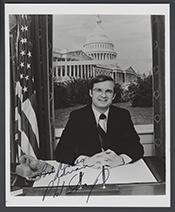
United States · United States Congress · 13 November 1979
Expresses the sense of Congress that the President should terminate all military training of Iranian personnel pursuant to sales under the Arms Export Control Act.
United States · United States Congress · 9 November 1979
Sunset Review Act of 1979 - Requires the House Committee on Rules and the Senate Committee on Rules and Administration to jointly develop and maintain an inventory of all Federal programs and tax expenditures. Requires such inventory to classify all such programs and expenditures according to the jurisdiction of the various legislative committees of the two Houses. Requires the General Accounting Office, before the beginning of the 97th Congress, after consultation with the appropriate legislative committees, to submit a draft inventory to the House Committee on Rules and the Senate Committee on Rules and Administration. Requires such Committees to notify each legislative committee of the programs and tax expenditures which are classified within its jurisdiction. Allows any legislative committee to propose revisions of such inventory within 30 days after notification. Requires, after a determination that all programs and tax expenditures are accurately classified, that such inventory be published in a single document. Requires that an update be made of such inventory at the beginning of every Congress. Directs the General Accounting Office to maintain and publish a supplement to the inventory. Requires each legislative committee of the House of Representatives and the Senate, on or before March 1 in the first session of each Congress beginning with the 98th Congress, to develop, adopt, and submit to the House Committee on Rules and the Senate Committees on Rules and Administration an agenda for the sunset review of selected Federal programs within its jurisdiction or in the case of the House Committee on Ways and Means and the Senate Committee on Finance, of selected tax expenditures. Requires the committees of each House to develop their sunset review agenda in consultation with any other committee which has concurrent jurisdiction over any programs or tax expenditures involved. Prohibits either the House or the Senate from considering a primary expense resolution for any legislative committee in any Congress until that committee has developed and submitted its sunset review agenda. Requires the House Committee on Rules and the Senate Committee on Rules and Administration to incorporate such agendas into a consolidated sunset review agenda and to report such consolidated agenda to its House in the form of a concurrent resolution, within seven legislative days after all committee sunset review agendas have been submitted. Requires the consolidated sunset review agenda to be adopted in the House and in the Senate no later than March 30 in the first session of each Congress. Sets forth the procedures for adoption. Requires each committee of the House or the Senate, not later than May 15 in the second session of each Congress, to report a bill or bills modifying, continuing, or terminating each program or tax expenditure which it has been directed to review under the consolidated sunset review agenda adopted during the first session. Requires such bill to be accompanied by a report setting forth the committee's findings, recommendations, and justifications. Requires each department, agency, and instrumentality in the executive branch of the Government which is responsible for the administration of a Federal program or tax expenditure selected for sunset review to give assistance to the appropriate Congressional committees. Specifies that nothing in this Act shall affect the authority of any legislative committee to review programs or tax expenditures within its jurisdiction and to report legislation modifying, continuing, or terminating such programs or expenditures at such times and in such manner as it deems appropriate. Amends rule X of the Rules of the House of Representatives to include the consolidated sunset review agendas and the congressional inventory of Federal programs as part of the House Committee on Rules' functions.
United States · United States Congress · 26 October 1979
National Energy Conservation Incentives Act - Title I: Amendments to Utility Program - Amends the residential energy conservation title of the National Energy Conservation Policy Act to extend the definition of "residential building" to include: (1) any building used for residential occupancy which contains at least one dwelling unit; and (2) specified commercial buildings. Requires that each utility program under such title contain procedures authorizing utilities to reinspect buildings equipped with conservation measures to determine the extent to which such measures have been installed. Amends the requirements for approval of proposed residential energy conservation plans to require that contractors or suppliers of residential energy conservation measures seeking to be included on the list of approved contractors and suppliers provide one year warranties on materials and installation of such measures and express a willingness to defer receipt of payment for such measures sold or installed until the reinspection described above is completed. Requires that such list indicate such willingness on the part of such contractors and suppliers to allow such deferred payments. Requires that the list of lending institutions offering financial assistance for the purchase and installation of such conservation measures indicate the availability at each such institution of assistance provided under the Energy Conservation Bank Act. Amends the requirements under such title concerning accounting and payment of costs of operating a utility program under such Act. Authorizes public utilities to make loans or capital investment payments to residential building owner customers for the purchase and installation of residential energy conservation measures under specified conditions. Amends the accounting and payment of costs provisions of such title to provide for the financing of such loans and capital investment payments. Stipulates that neither the Attorney General, the Federal Trade Commission, nor any other agency shall be barred from challenging anticompetitive acts or practices related to activities conducted under this Act, nor shall any person be deemed to have immunities or defenses to actions under the antitrust laws as a result of the provisions of this Act. Establishes effective dates for the issuance of regulations implementing the provisions of this Act by the Secretary of Energy, Governors or State regulatory agencies, and nonregulated utilities. Directs the Secretary of Energy to provide assistance to States for the training of residential building inspectors undertaking inspections required by this Act and for the development of approved energy conservation methods and inspections. Authorizes appropriations for fiscal year 1980 through 1982 to carry out this title. Title II: Financial Assistance Provided by the Energy Conservation Bank - Energy Conservation Bank Act - Establishes the Energy Conservation Bank in the Department of Housing and Urban Development to provide financial assistance with respect to loans made to owners of existing commercial and residential buildings for the purchase and installation of energy conserving improvements in such buildings. Authorizes the Bank to provide such assistance in the form of payments to financial institutions and public utilities providing financing pursuant to the National Energy Conservation Policy Act. Sets forth criteria for providing such assistance and terms, conditions, and maximum amounts thereof. Establishes as part of the Bank an Advisory Committee to provide advice to the Board of Directors of the Bank on matters concerning energy conservation assistance. Directs the Bank to promote the program established by this Act and to coordinate its efforts with the Department of Energy. Directs the Board to issue an annual report to the Congress and the President discussing the operations of the Bank identifying problems encountered in the energy conservation industry, the Federal Government, and financial institutions concerning energy conservation, and making recommendations for improvement in the Bank's operations. Authorizes the Secretary of Housing and Urban Development to permit the Bank to use personnel of such Department for the purpose of carrying out this Act. Establishes penalties for fraud and misrepresentation with respect to loans assisted under this Act. Authorizes the use of funds from the Energy Security Trust Fund to provide assistance under this title. Sets forth limitations on the amount of such funds available for each of the fiscal years 1980 through 1983. Title III: Secondary Financing - Requires that the Board direct the Bank to make commitments to purchase, to purchase and to service, sell, and otherwise deal in loans and advances of credit made under this Act and the National Energy Conservation Policy Act to residential building owners for the purchase of energy conserving improvements. Authorizes the Bank to issue obligations to enable the Bank to carry out its functions. Exempts transactions authorized under this Act from State or local usury or loan insurance laws. Repeals specified provisions of the National Housing Act which authorize the Government National Mortgage Association to purchase energy conserving improvement loans. Amends the Federal Home Loan Mortgage Corporation Act to authorize such Corporation to purchase, make commitments to purchase, and to hold, deal with, sell, and otherwise dispose of mortgages or interest therein held by any public utility acting under a utility program pursuant to the National Energy Conservation Policy Act, the original proceeds of which are applied for in order to finance energy conserving improvements. Amends the Federal National Mortgage Association Charter Act to authorize such association to exercise powers similar to those granted to the Federal Home Loan Mortgage Corporation as described above. Title IV: Weatherization Program - Amends the Energy Conservation in Existing Buildings Act of 1976 to limit the amount of any grant made under such Act to be used for administrative purposes. Amends such Act to increase the amount of payment which may be made to pay volunteers and trainees and public employment workers under the Comprehensive Employment and Training Act of 1973 available to work on weatherization projects in the event there are insufficient participants under such program. Requires the coordination of activities related to rehabilitation, weatherization, and code enforcement conducted by local governments including activities undertaken pursuant to the Housing and Community Development Act and related to energy assistance programs for low- income families, including programs under the Economic Opportunity Act of 1964. Amends such Act to repeal the provisions granting priority in the allocation of weatherization assistance funds to community action agencies serving an area eligible for emergency energy conservation assistance under the Economic Opportunity Act of 1964. Directs the Secretary to establish standards and procedures for weatherization programs under such Act in a manner designed to accomplish uniform results among all the States in any particular similar climatic area. Directs the President to appoint an energy conservation coordinator to assure that the Secretaries of Energy, Housing and Urban Development, Agriculture, Health, Education and Welfare, Defense, the Administrator of the General Services Administration, and other heads of agencies responsible for developing energy conservation standards reach a consensus on establishing criteria for issuing such standards. Directs the President to make annual reports to the Congress on the activities relating to coordination of Federal energy conservation programs. Makes technical amendments to the Energy Conservation in Existing Buildings Act of 1976.
United States · United States Congress · 18 October 1979
Rural Cooperative Business Income Act of 1979 - Amends the Internal Revenue Code to provide that income received by a mutual or cooperative telephone or electric company for services to customers or rural telephone or electric companies, and income received from the rental or sale of communications or power facilities, shall not be subject to the tax on unrelated business income.
United States · United States Congress · 16 October 1979
Small Business Innovation Act of 1979 - Title I: Amendments to the Small Business Act - Amends the Small Business Act to empower the Small Business Administration to provide management assistance in addition to technical assistance to small business concerns to obtain government contracts for research and development. Directs the SBA to consult and cooperate with other Government agencies in furthering the purposes of the Small Business Act. Directs each Federal agency to target an increase of its research and development budget to be obligated for prime contract awards to small business concerns by at least two percent more than the percent of such awards made in the preceding fiscal year. Requires the increase to begin in fiscal year 1980 and continue until such concerns are receiving at least 20 percent of such awards. Directs each agency to fully utilize procurement methods authorized under this Act in order to achieve the target levels. Requires each Federal agency having a research and development budget of $100,000,000 or more to initiate and conduct a small business innovation research competitive solicitation program. Directs that funding for such program shall be made available from each agency's budget and that each agency, utilizing applicable procurement methods, award to small business concerns at least 50 percent of its annual target for prime contracts. Directs each agency to conduct its program in accordance with such rules and regulations as are established by the SBA, including: (1) identifying specific and definable categories of projects; (2) establishing a simplified, standardized acquisition process; and (3) developing solicitation release schedules for notifying small business of contract opportunities. Requires the SBA to develop and maintain a master solicitation release schedule, source file, and informational program to facilitate small business participation in federally funded research and development. Directs the National Science Foundation and the Office of Federal Procurement Policy to provide advice and assistance to the SBA in the promulgation of such regulations. Requires the Administrator of the Office of Federal Procurement Policy, in cooperation with the SBA, to insure that such regulations provide the maximum practicable opportunity for small business concerns to perform federally funded research and development contracts. Provides that such regulations shall include: (1) the elimination of cost-sharing requirements and the allowance of negotiated fees on all contracts; (2) the opportunity for fair and equitable competition for contract awards; (3) a fair and prompt review of unsolicited proposals and the opportunity to receive sole source awards; (4) the consideration of independent research and development and bid and proposal costs as expenses under the contract in the fiscal year in which they occur; (5) the requirement for the Departments of Defense and Energy and the National Aeronautics and Space Administration to conduct periodic breakout reviews of all proposed large-scale systems contracts; (6) the opportunity for women-owned and minority business firms to be considered for research and development contracts; (7) the evaluation of procurement personnel performance in the award of contracts to small and minority business concerns; and (8) the responsibility to identify, study, and eliminate discrimination practices in procurement systems. Requires all Federal agencies to promulgate regulations which, insofar as practicable, impose the least amount of regulatory burden on small businesses. Directs the Securities and Exchange Commission to conduct an annual review of its rules and regulations which have the effect of restricting small business concerns from access to securities markets and to report to the appropriate congressional committees relative to the results of such review. Title II: Amendments to the Internal Revenue Code of 1954 - Amends the Internal Revenue Code to provide procedures for sales and exchanges of interests in qualified small business concerns. Allows a taxpayer who sells an equity interest in any such business and purchases replacement property within 18 months, to elect that the gain from such sale be recognized to the extent that the amount realized exceeds the costs of the replacement property. Requires that such election be filed with the Secretary of the Treasury in such manner as the Secretary may prescribe. Requires, for purposes of this Act, that an exchange of equity interest shall be treated as a sale of such interest and the acquisition of replacement property on such exchange shall be treated as a purchase of such property. Requires that the determination of whether an equity interest in a small business concern be made at the time such interest is acquired by the taxpayer. Provides limitations on stock sales with respect to any equity interest in a qualified small business concern. Requires a reduction on the basis of replacement property in the case of nonrecognition of gain on the sale of equity interest in qualified small business concerns. Provides a statute of limitations for the assessment of any deficiency attributable to gain from the sale of equity interest in such business concerns. Provides technical and conforming amendments to the Internal Revenue Code applicable to provisions of this Act. Permits employees of qualified small concerns to exercise stock options within ten years after the date such option was granted. Provides for a reduction of capital gains tax for such business concerns held by a taxpayer for at least 5 years. Grants a capital loss carryover to a taxpayer to the extent such loss is attributable to an investment in such business concern for the ten succeeding years after the loss year. Allows a tax deduction for contributions to research and experimental expenditure reserves equal to the amount of such cash contribution during the taxable year, subject to specified limitations. Provides that such reserves shall be considered tax-exempt organizations under provisions of the Internal Revenue Code. Requires that amounts distributed to any person from such reserve shall be included in the gross income of such person, unless such amount relates to a research and experimental expenditure expense. Amends the definition of small business corporations under the Code to specify that such corporation does not have more than 100 shareholders and does not have as a shareholder a person who is not an individual or corporation. Removes limitations on amounts allowable for tax losses with respect to stock issued by qualified small business concerns. Sets forth effective dates for amendments made under this Act. Allows a qualified small business concern to treat research and experimental expenditures for the acquisition or improvement of property as expenses not chargeable to its capital account. Allows such concerns to treat such expenditures for any property subject to a depreciation or depletion allowance as deferred expenses, and in the case of a building such deferred expense shall be allowed ratably over a period of 120 months. Title III: Patents and Inventions - States that it is the objective of this Act to amend existing patent procedures in order to promote the marketing of inventions developed under federally supported research and development projects by nonprofit organizations and small business firms. Permits any such organization or firm to elect, within a reasonable amount of time, to retain title to such inventions. Permits Federal agencies which have supported such projects to retain title to inventions through their funding agreements in specified circumstances, including when necessary to conduct foreign intelligence or counterintelligence activities. Requires review of agency determinations that such circumstances exist by the Comptroller General and the Chief Counsel for Advocacy of the Small Business Administration. Directs the Comptroller General to report to Congress on the implementation of this Act by Federal agencies. Enumerates provisions which must be included in funding agreements between Federal agency and a small business firm or nonprofit organization including provisions: (1) to insure the rights of the Federal Government under this Act; (2) to provide that the agency shall have a nonexclusive, nontransferable, irrevocable and paid-up license to use the invention; (3) to prohibit a nonprofit organization from assigning rights to the invention without the approval of the Federal agency; (4) to prohibit such an organization, other than small business firms, from granting exclusive rights from the earlier of five years from the first commercial use of the invention or eight years from the date of invention; and (5) to require such organizations to use their royalties and earnings to support scientific research or education. Provides that the first commercial use with respect to a product of the invention shall not end the exclusive period to different subsequent products covered by the invention. Requires the head of a Federal agency to approve provisions of a funding agreement which require the licensing to third parties of inventions owned by the contractor. Sets forth terms and conditions under which such approval may be granted. Authorizes a Federal agency to transfer or assign its rights, acquired from an agency employee as coinventor, to an inventor electing to acquire title to an invention. Empowers any Federal agency to require inventors or their assigns to grant licenses in order to: (1) achieve practical application of the invention in its field of uses; (2) alleviate health or safety needs; (3) meet requirements for public use specified by Federal regulations; or (4) achieve participation by United States industry in the manufacturing of an invention. Entitles the government to 15 percent of all net income in excess of $70,000 gross income received by a contractor after a patent application is filed on a subject invention. Provides that if a contractor receives a gross income of $1,000,000, the government shall be entitled to a share of the excess of $1,000,000 that shall be negotiated but not to exceed five percent of such excess. Limits the government share of any such excesses to its contributions under the funding agreement. Authorizes and directs the Director of the Office of Federal Procurement Policy to revise the government entitlements in light of changes to the Consumer Price Index or other indices at least every three years. Declares such government entitlements applicable to subject inventions upon which United States patents are granted and in effect. Restricts the assignment and licensing of rights by patent holders to foreign owned or controlled firms unless such persons agree that any products embodying the subject invention or produced through the use of the subject invention will be manufactured substantially in the United States where commercially feasible. Authorizes Federal agencies to withhold information on inventions from public disclosure. Specifies the authority of Federal agencies with respect to obtaining patents, granting licenses, and transferring custody of patents. Authorizes the Administrator of General Services to promulgate regulations specifying the terms upon which any federally-owned invention may be licensed. Sets forth the procedure whereby Federal agencies may grant exclusive or partially exclusive licenses in any invention covered by a federally-owned domestic patent or patent application. Prohibits licensing which lessens competition. Directs that business firms be given preference in exclusive or partially exclusive licensing. Enumerates provisions which must be contained in any grant of a license by a Federal agency. Declares that this Act shall take precedence over any other Act in the disposition of inventions. Directs the Commissioner of Patents and Trademarks to establish regulations governing: (1) the citation to the Patent and Trademark Office of prior art patents or publications which are pertinent to a later patent; and (2) the reexamination of a patent to determine whether such a prior patent or publication has any bearing on the patentability of any claim of such patent. Authorizes any individual to: (1) cite to the Office any such prior patent; and (2) request such a reexamination. Requires the Commissioner within 90 days of such a request to make a determination as to whether the cited prior patent raises a new question of the patentability of any claim of the later patent. Authorizes the Commissioner on his or her own initiative to make such a determination at any time. States that a determination that no new question is raised shall be final. Directs the Commissioner, upon determining that there is a new question of patentability, to order and conduct a reexamination. Requires that the patent owner be provided at least two months to file a statement on such question and that the person making the reexamination request be provided two months to respond to such statement. Declares that the patent owner shall be provided an opportunity in any reexamination to amend any claim of the patent in order to distinguish the claim from the prior patent cited, or in response to a decision adverse to the patentability of the claim. Authorizes the owner to appeal any adverse decision. Directs the Commissioner, upon the conclusion of any reexamination or appeal proceeding, to issue and publish a certificate cancelling any unpatentable claim, confirming any valid claim, and incorporating any amended claim in the patent. Declares that no prior patent or publication may be relied upon as evidence of nonpatentability in a civil action involving the validity or infringement of a patent unless: (1) the prior patent or publication was cited by or to the Office regarding application or reexamination proceedings for the patent; or (2) the court concludes that consideration of the prior patent or publication in such proceedings is unnecessary for adjudication. Sets forth circumstances under which a court may stay the proceedings of a civil action involving the infringement or validity of a patent to enable either party to such action to secure a determination on a request for reexamination of the patent by the Patent and Trademark Office. Provides the moving party in such action the right to dismiss the complaint commencing such action.
United States · United States Congress · 16 October 1979
Amends title II (Old Age, Survivors and Disability Insurance) of the Social Security Act to prohibit the payment of benefits to any individual for any month in which such individual is confined in a penal institution. Stipulates that benefits withheld from such individuals shall be treated as having been paid to such individuals for purposes of determining the benefits to which other persons are entitled on the basis of the same wages and self-employment income.
United States · United States Congress · 9 October 1979
Limits the amount of official funds available to a Member of Congress for the purchase of postage stamps to $100 for each calendar year. Requires any amount of such funds not used in the calendar year to be deposited in the Treasury as miscellaneous receipts.
United States · United States Congress · 28 September 1979
Exempts nonprofit veterans' organizations and nonprofit fraternal organizations from the requirement that certain musical performance royalties be paid to copyright holders.
United States · United States Congress · 26 September 1979
Amends the Internal Revenue Code to provide that the standard mileage rate used in computing the charitable deduction for expenses incurred in the operation of a motor vehicle shall be the same as the standard mileage rate established by the Secretary of the Treasury for the business related deduction.
United States · United States Congress · 18 September 1979
Congressional Pay Raise Deferral Act - Amends the Federal Salary Act of 1967 and the Legislative Reorganization Act of 1946 to provide that any adjustment in the rate of pay for Members of Congress proposed during any Congress shall not take effect earlier than the beginning of the next Congress. States that any such pay adjustment proposed in an even-numbered year of any Congress after the congressional elections and before the beginning of the following Congress, shall be considered as occurring during the first session of the following Congress for the purposes of this Act.
United States · United States Congress · 2 August 1979
Amends the Motor Vehicle Information and Cost Savings Act to stipulate that an automobile manufacturer's failure to comply with any average fuel economy standard shall not be deemed "unlawful conduct" under such Act unless the Secretary of Transportation has determined that: (1) any credits which the manufacturer may have received for exceeding such standards in any model year do not fully offset any penalty for failure to achieve such standards; and (2) the time for which such credits could be earned to offset such a penalty has expired. Allows such a credit to be used to offset any penalty which may have been assessed against the manufacturer in the three consecutive years prior to the model year in which the manufacturer exceeds such a standard.
United States · United States Congress · 27 July 1979
Title I: Purposes and Definitions - Declares that the purpose of this Act is to provide for a coordinated, simplified, and prompt process for Federal approval of nonnuclear energy facilities which are determined to be in the national interest. Title II: Priority Projects - Authorizes the President to establish an Energy Mobilization Board to be composed of members appointed by the President. Sets forth the general duties and powers of such Board. Stipulates that any action by the Board in designating a priority energy project shall not be considered as a "major Federal action" for purposes of the National Environmental Policy Act of 1969 (NEPA). Directs the Council on Environmental Quality to determine whether any Federal action relating to the Priority Energy Project, after it has been so designated and prior to establishing the Project Schedule, will be a "major Federal action" for purposes of compliance with NEPA. Directs the Board to designate Priority Energy Projects, based on specified criteria, and to publish a Project Decision Schedule containing deadlines for all Federal actions relating to such projects. Directs the President to make any decisions or perform any actions in the event that an agency or department fails to meet its deadline. Stipulates that nothing in this Act shall prohibit any agency from making a negative determination with regard to such projects if it is within the agency's authority to do so, and provides that in the event a negative decision is rendered, the Priority Energy Project designation shall be terminated. Limits to 24 the number of Priority Energy Projects to be designated in any one year. Provides for coordination of the actions of Federal, State, and local governments. Directs the Board to recommend to any State Governor and to the Congress actions to alleviate or prevent any delays in a priority project created or threatened by any State or local government. Authorizes waivers of Federal, State, or local law upon the Board's determination that any Federal, State, or local time requirement for agency action is unreasonable and would impede the making of any agency decision. Specifies the procedure for obtaining such waivers. Title III: Judicial Review and Miscellaneous Provisions - Limits judicial review to cases of absolute necessity involving alleged denial of rights under the United States Constitution or violations of statutory jurisdiction, authority, limitations, or rights. Sets time limits for filing claims arising out of actions taken pursuant to this Act, and bars any claims filed thereafter. Stipulates that such claims shall be brought in the district court of the district in which the Priority Energy Project would be located, and grants exclusive original jurisdiction to such court in such matters. Directs such court to give precedence to such matters over all other matters on the court's docket, to the greatest extent practicable. Authorizes the Supreme Court, exclusively, to review interlocutory judgments or orders of the district court pursuant to this title, and directs the Supreme Court to give precedence to such matters. Terminates the Board's authority to designate priority projects seven years after the date of enactment of this Act. Authorizes the appropriation of $2,000,000 for fiscal year 1980 to carry out this Act.
United States · United States Congress · 26 July 1979
Campaign Contribution Reform Act of 1979 - Amends the Federal Election Campaign Act of 1971 to prohibit any multicandidate political committee (other than a multicandidate committee of a political party) from making contributions to a candidate for the office of Representative in, or Delegate or Resident Commissioner to, the Congress and his or her authorized committees which in any calendar year exceeds: (1) $5,000 with respect to any general or special election and a primary election relating to such election; or (2) $7,500 (but not more than $5,000 for one election) with respect to a general or special election and both a primary and runoff election relating to such election. Prohibits a candidate for the office of Representative in, or Delegate or Resident Commissioner to, the Congress or any authorized political committee from accepting contributions from political committees, other than committees of a political party, aggregating more than $50,000 in any calendar year, except in the case of a candidate who is a candidate in a general election and a special election, such candidate may accept such contributions aggregating: (1) $50,000 with respect to such general and any primary election relating to such general election; and (2) $50,000 with respect to such special election and any primary election relating to such special election. Specifies that any contribution made in a year, other than the calendar year in which the election is held, is considered to be made in the calendar year in which such election is held, and any contribution made after the date of such election shall be considered a contribution with respect to such election only if such contribution is used to pay obligations incurred with respect to such election. Specifies that any extension of credit for goods or services relating to advertising on broadcasting stations, in newspapers or magazines, by direct mail or other similar types of general public political advertising shall be considered a contribution, if such extension of credit is: (1) in an amount of more than $1,000; and (2) for a period of more than 30 days.
United States · United States Congress · 28 June 1979
Smaller Enterprise Regulatory Improvement Act - Amends the Small Business Act to require each Federal agency to publish semiannually an agenda of those rules which may be proposed during the upcoming six-month period affecting a substantial number of small business concerns and small organizations. Defines "small organizations" to include unincorporated businesses, sheltered workshops, nonprofit enterprises which are not dominant in their fields and such other groups and enterprises as each Federal agency shall establish by rule. Requires each published agenda to be transmitted to the Office of Advocacy of the Small Business Administration for comments. Directs each Federal agency to endeavor to provide notice of each agenda to affected small enterprises by means other than publication in the Federal Register. Directs each Federal agency to publish a written analysis prior to the issuance of any rule affecting a substantial number of small business concerns and organizations which considers: (1) the effect of such rule on small enterprises and competition; (2) whether an exemption could be provided such small enterprises; (3) whether lesser compliance standards could be adopted for small enterprises; and (4) the expected nature of reporting and recordkeeping requirements necessitated by such rule. Requires each Federal agency to issue a rule containing an exemption or differing compliance standards for such small business concerns and organizations if it is lawful, desirable, and feasible to do so. States that such small enterprises shall be given an opportunity to participate in agency rulemaking. Requires each agency to review its existing rules and prepare an analysis for purposes of eliminating those rules which are most burdensome to small businesses and organizations. Permits any agency to perform the analyses required by this Act in conjunction with any other analysis required by law. Declares that such other analysis shall not in itself satisfy the requirements of this Act.
United States · United States Congress · 27 June 1979
Capital Cost Recovery Act of 1979 - Amends the Internal Revenue Code to revise the method for determining useful lives of business assets for purposes of computing allowable depreciation deductions. Replaces the asset depreciation range (ADR) method with a schedule of capital cost recovery periods for three classes of business property. Establishes capital cost recovery periods for the following classes of business property: (1) buildings and their structural components, ten years; (2) tangible property, five years; and (3) automobiles, taxis, and light-duty trucks (up to $100,000), three years. Allows a ten percent investment tax credit for buildings and tangible property, and a six percent credit for automobiles, taxis, and light duty trucks. Requires the recapture of depreciation amounts and investment tax credit amounts applicable to assets which are sold or otherwise disposed of prior to the expiration of the capital cost recovery period. Permits taxpayer to deduct less than the full allowance for capital cost recovery in any taxable year. Permits a carryover to succeeding taxable years of any unused depreciation amounts. Disqualifies capital cost recovery property from the allowance for first year depreciation. Treats amounts claimed as the capital cost recovery of noncorporate lessors as an item of tax preference for purposes of the minimum tax. Adopts as an accounting practice the "half year convention" under which investments eligible for capital cost recovery treatment or the investment tax credit which are made at any time during the taxable year are deemed to be made in the middle of such year.
United States · United States Congress · 13 June 1979
Amends the Saccharin Study and Labeling Act to extend until June 30, 1981, the period during which the Secretary of Health, Education, and Welfare may not take specified actions to restrict the continued use of saccharin or of any food, drug, or cosmetic containing saccharin.
United States · United States Congress · 5 June 1979
Congratulates the men and women of the Apollo program upon the tenth anniversary of the first manned landing on the Moon and requests the President to designate the period of July 16 through July 24, 1979, as "United States Space Observance" in honor of such event.
United States · United States Congress · 30 May 1979
Expresses the sense of Congress that the President, at the Tokyo Summit, should request those nations dependent on Middle East stability to cooperate with the United States in financing the Israeli-Egyptian Peace Treaty.
United States · United States Congress · 1 May 1979
Relieves a named university and a named association of liability to the United States for a specified amount representing reimbursements for costs actually incurred but in excess of contractual provision. Directs the Secretary of the Treasury to refund a specified amount already paid by such association.
United States · United States Congress · 24 April 1979
State and Local Government Cost Estimate Act of 1979 - Amends the Congressional Budget Act to require the Congressional Budget Office, for every bill or resolution reported in the House or Senate, to prepare and submit (along with its regular estimate of the Federal cost involved) an estimate of the costs which would be incurred by State and local governments in carrying out or complying with such bill or resolution.
United States · United States Congress · 23 April 1979
Alaska National Interest Lands Conservation Act of 1979 - Title I: Findings, Policy, and Definitions - Declares it the purpose of this Act to preserve for the benefit of present and future generations certain lands in the State of Alaska in order to: (1) preserve unrivaled scenic, geologic, and wildlife values; (2) perpetuate significant and diverse ecosystems; (3) protect and preserve cultural values of Native and non-Native people; (4) provide recreation; (5) maintain wilderness resource values; (6) preserve rivers; (7) maintain opportunities for research; and (8) utilize natural resources, consistent with sound ecological principles. Provides that: (1) intangible values should be considered on an equal basis with tangible values; (2) the management policies should cause the least adverse impact possible to people who depend on subsistence uses of resources; and (3) the interests of the State of Alaska and the Native Corporations shall be continually considered in carrying out provisions of this Act to maintain a viable economy and provide employment for citizens of Alaska. Title II: National Park System - Designates as units of the National Park System: (1) Bering Land Bridge National Monument; (2) Cape Krusenstern National Monument; (3) Gates of the Arctic National Monument; (4) Kenal Fjords National Monument; (5) Kobuk Valley National Monument; (6) Lake Clark National Monument; (7) Yukon-Charley National Monument; and (8) Katmai National Monument. Expands and redesignates: (1) Aniakchak National Monument by the addition of 160,000 acres of public lands to be redesignated as Aniakchak National Park and National Preserve; (2) Mount McKinley National Park by the addition of Denali National Monument to be redesignated as Denali National Park and National Preserve; (3) Glacier Bay National Monument by the addition of 40,000 acres of public lands to be redesignated as Glacier Bay National Park; (4) Noatak National Monument by the addition of 660,000 acres of public lands to be redesignated as Noatak National Preserve; and (5) Wrangell-Saint Elias National Monument by the addition of 1,230,000 acres of public lands to be redesignated as Wrangell-Saint Elias National Park and Preserve. Establishes as units of the National Park System: (1) Aniakchak National Preserve; and (2) Lake Clark National Preserve. Directs the Secretary of the Interior to administer lands, waters, and interests of all National Park System units in accordance with applicable laws and this Act. Incorporates the redesignated national monuments specified in this Act as part of the appropriate national park. Makes available for the appropriate national park any funds which were available for the corresponding monument. Subjects the portion of the Alaska Railroad right-of-way within Denali National Park to laws and regulations applicable to fish and wildlife protection. Permits the continuation of reindeer grazing within Bering Land Bridge National Park. Prohibits the Secretary, generally, from acting to restrict unreasonably the exercise of valid commercial fishing rights or privileges obtained pursuant to State or Federal law, within respect to the Malaspina Glacier area of Wrangell-Saint Elias National Park and the Dry Bay area of Glacier Bay National Park. Requires the Secretary to recognize and convey valid Native selections or nominations of land within boundaries of the Wrangell-Saint Elias National Park and Preserve in accordance with the Alaska Native Claims Settlement Act. Prohibits the charging of fees for admission to any unit of the National Park System located in Alaska. Title III: National Wildlife Refuge System - Redesignates Becharof National Monument as Becharof National Wildlife Refuge and Yukon Flats National Monument as Yukon Flats National Wildlife Refuge. Designates as units of the National Wildlife Refuge System: (1) Alaska Maritime National Wildlife Refuge; (2) Alaska Peninsula National Wildlife Refuge; (3) Innoko National Wildlife Refuge; (4) Kanuti National Wildlife Refuge; (5) Koyukuk National Wildlife Refuge; (6) Nowitna National Wildlife Refuge; (7) Selawik National Wildlife Refuge; (8) Teshekpuk National Wildlife Refuge; (9) Tetlin National Wildlife Refuge; and (10) Utukok National Wildlife Refuge. Expands the following units of the National Wildlife Refuge System: (1) Arctic National Wildlife Range; (2) Cape Newenham National Wildlife Refuge; (3) Clarence Rhode National Wildlife Range and Hazen Bay National Wildlife Refuge; (4) Kenai National Moose Range; and (5) Kodiak National Wildlife Refuge. Declares that all Executive orders and other administrative actions which were in effect before the date of enactment of this Act will remain in force, except to the extent that they are inconsistent with this Act or the Alaska Native Claims Settlement Act. Makes available for the purposes of any conservation units established under this Act all funds that were previously available. Directs the Secretary of the Interior to administer each wildlife refuge subject to valid existing rights and in accordance with applicable law and this Act. Prohibits the Secretary from permitting uses or granting easements in the above-designated refuges which are not compatible with the purposes of the refuge. Withdraws, subject to valid existing rights, all public lands in each refuge from all forms of appropriation under the mining laws and from operation of the mineral leasing laws. Authorizes the Secretary to permit oil and gas development under a leasing program. Directs that the area of the Iliamna watershed be managed for the primary purposes of watershed protection and fish production. Prohibits the Secretary from conveying any lands in such area to the State of Alaska, unless the State devises a plan for the protection of management of the watershed and fishery resources of such area. Provides that nothing in this title shall limit the Secretary's responsibility with respect to the exploration of oil reserves under the Naval Petroleum Reserves Production Act of 1976. Prohibits the Secretary from acting to restrict unreasonably the exercise of valid commercial fishing rights or privileges obtained pursuant to State or Federal law with respect to designed or redesignated units of the National Wildlife Refuge System. Directs the Secretary to undertake to enter into cooperative management agreements with Native Corporations, the State, or persons owning land within the refuge. States that land subject to the agreement shall be managed by the owner in a manner compatible with the major purposes of the refuge, and in a manner which will not diminish opportunities for subsistence uses in the refuge. Sets forth terms and conditions for such agreements. States that the Congress finds that barren-ground caribou are a migratory species deserving special protection and that the Western Arctic and Porcupine herds of such caribou are of national and international significance. Directs the Secretary to conduct a study of the barren-ground caribou herds north of the Yukon and Tanna Rivers, and, acting through the Secretary of State, to initiate negotiations with the Government of Canada in order to enter into a treaty to protect the Porcupine caribou herd and its habitat. Title IV: National Forest System - Expands as units of the National Forest System the Tongass National Forest and the Chugach National Forest. Directs that such lands as are added to the Tongass and Chugach National Forests shall be administered by the Secretary of Agriculture in accordance with the provisions of this Act and the laws applicable to the National Forest System. Directs the Secretary of Agriculture to modify any existing national forest timber sale contracts applying to lands designated by this Act as wilderness by substituting other national forest lands of corresponding quality, quantity, and access, to the extent practicable. Authorizes the Secretary of Agriculture to acquire timber rights to those lands selected for the village of Angoon under the Alaska Native Claims Settlement Act by purchase or exchange for timber rights elsewhere within the Tongass National Forest. Allows, at the election of the shareholders of Kootznoowoo, Inc., the conveyance of timber rights to lands selected by the corporation to the Secretary of Agriculture, and within one year after such a conveyance the conveyance to Kootznoowoo, Inc. of timber rights which are of equal value to those conveyed to the Secretary. Directs the Secretary of Agriculture to designate alternative lands, of equal or greater timber value, for the benefit of Shee Atika, Inc., in satisfaction of the rights of the Natives of Sitka as provided by the Alaska Native Claims Settlement Act. Specifies that such lands shall be located in southeast Alaska other than Admiralty Island. Sets forth procedures for conveyance of surface and subsurface rights, and the release of such rights. Directs the Secretary to convey specified lands to: (1) Goldbelt, Inc., representing the Natives of Juneau with respect to their land entitlements under the Alaska Natives Claims Settlement Act; and (2) S.E. Alaska, Inc. Exempts such conveyances from the requirements of the National Environmental Policy Act of 1969. Directs the Secretary of the Interior to reimburse Shee Atika, Inc., Goldbelt, Inc., and Kootznoowoo, Inc. for reasonable and necessary land selection costs. Specifies that permits issued by the Forest Service, before the enactment of this Act, for a dwelling or campsite in the Admiralty Island National Monument, Misty Fjords National Monument, or any wilderness area, shall expire not later than ten years after the enactment of this Act. Provides a limited exception to such permit expiration for Thayer Lake Lodge. Directs the Secretary of Agriculture to permit the taking of fish and wildlife in national forest wilderness areas designated by this Act. Designates Admiralty Island National Monument and Misty Fjords National Monument as conservation system units. Directs the Secretary of Agriculture to issue regulations with respect to mining activities on national forest lands in Alaska in order to protect water quality in such areas. Amends the Alaska Native Claims Settlement Act to prohibit any land conveyed to a Native Corporation pursuant to this Act, which is within a contingency area designated in a U.S. timber sale contract, from being subject to such contract or to entry or timbering by the contractor. Prohibits a timber contractor from entering or cutting timber from land in a contingency area that has been withdrawn or selected by a Native Corporation until such Corporation has received all conveyances. Directs the Secretary of Agriculture to improve timber production from high quality timber growing sites in the Tongass National Forest through a program of precommercial thinning. Directs the Secretary of Agriculture to establish an insured or guaranteed loan program for purchasers of national forest materials in Alaska to assist such purchasers in the acquisition of equipment to use wood products which might not otherwise be utilized. Directs the Secretary of Agriculture to carry out a study and report to Congress to identify opportunities to increase timber yields on national forest lands in Alaska, and to reduce inefficient timber uses or waste of national forest produced fiber. Title V: National Wild and Scenic Rivers System - Amends the Wild and Scenic Rivers Act by adding to the Wild and Scenic Rivers System the following rivers (or segments thereof) which are outside the boundaries of other conservation system units: Birch Creek, Colville, Copper, Delta, Etivluk-Nigu, Fortymile, Gulkana, Alagnak, Killik, Nowitna, Selawik, Unalakleet, and Yukon (Ramparts section). Adds to the system the following rivers (or segments thereof) which form the boundary of, or are within, any national preserves in Alaska: Aniakchak and Charley (including their major tributaries), Chilikadrotna, Chitina, Mulchatna, Noatak, Stony, and Telaquana. Adds to the system portions of the following rivers which form the boundary of, or are within, any national wildlife refuge in Alaska: Nowitna, Colville, Porcupine, Beaver Creek, Sheenjek, Andreafsky, Selawik, Ivishak, Kanektok, Kisaralik, Squirrel, and Utukok. Requires that detailed boundaries and development plans be established for specified rivers within one to three years of the date of enactment of this Act. Designates the following rivers to be studied for possible inclusion in the system: Ikpikpuk, Koyuk, Kuskokwim, Melozitna, Mulchatna, Nelchina-Tazlina, Nuyakuk, Situk, and Susitna. Sets forth requirement for the completion of such studies. Authorizes the Secretary to seek cooperative agreement with the owners of non-Federal lands adjoining rivers which are newly designated units of the Wild and Scenic Rivers System. Permits the Secretary to establish a river protection zone extending two miles from the banks of such rivers. Withdraws the minerals in Federal lands within the boundaries of such rivers and within each such river protection zone from all forms of appropriation under the United States mining laws. Authorizes the Secretary to permit the use of snowmobiles for customary purposes by local residents and by authorized subsistence users, if such use was occurring on or before January 1, 1979. Authorizes the Secretary to grant permits to oil and gas pipelines to cross areas designated as wild, scenic, or recreational river areas in Alaska, if the Secretary determines that no feasible alternative route exists. Title VI: National Wilderness Preservation System - Designates as units of the National Wilderness Preservation System certain lands in: (1) Aniakchak National Park and Preserve; (2) Bering Land Bridge National Preserve; (3) Denali National Park and Preserve; (4) Gates of the Arctic National Park; (5) Glacier Bay National Park; (6) Katmai National Park; (7) Kenai Fjords National Park; (8) Kobuk Valley National Park; (9) Lake Clark National Park and Preserve; (10) Noatak National Preserve; (11) Wrangell-Saint Elias National Park and National Preserve; and (12) Yukon-Charley National Preserve. Designates as wilderness areas within the National Wilderness Reservation System certain lands in: (1) Alaska Maritime National Wildlife Refuge; (2) Arctic National Wildlife Range; (3) Becharof National Wildlife Refuge; (4) Innoko National Wildlife Refuge; (5) Izembek National Wildlife Range; (6) Kanuti National Wildlife Refuge; (7) Kenai National Wildlife Range; (8) Koyukuk National Wildlife Refuge; (9) Nowitna National Wildlife Refuge; (10) Nunivak National Wildlife Refuge; (11) Sulawik National Wildlife Refuge; (12) Tetlin National Wildlife Refuge; (13) Togiak National Wildlife Range; (14) Yukon Delta National Wildlife Refuge; and (15) Afognak Island. Designates as wilderness areas within the National Forest System certain lands in Chugach National Forest and Tongass National Forest. Directs the Secretary of Agriculture to study the feasibility of designating Prince William Sound, Chugach National Forest as a wilderness area and to report his findings to the President and the Congress within three years. Authorizes the Secretary of Agriculture to permit fishery research, management, enhancement, and rehabilitation activities within national forest wilderness areas in Alaska. Directs the Secretary of Agriculture to implement a cooperative planning process for the enhancement of fisheries resources in the Chugach and Tongass National Forests. Provides for the maintenance of existing public use cabins located in national forest wilderness areas and the construction of a limited number of new cabins for the protection of the public health and safety. Directs the Secretary to review nondesignated wilderness areas and to report to the President and the Congress on the feasibility of designating such areas as wilderness areas. Title VII: Subsistence - Declares that the first priority consumptive use of public land resources under this Act shall be the taking of fish and other renewable resources for nonwasteful subsistence uses by local rural residents. Stipulates that restrictions on the taking of populations of fish and wildlife on such lands for subsistence uses in order to protect the continued viability of such populations, or to continue such uses, shall be based on: (1) customary and direct dependence upon the populations as the mainstay of livelihood; (2) local residency; and (3) the availability of alternative resources. Authorizes the States to regulate the taking of fish and wildlife on public lands for subsistence uses in a manner consistent with the policies and requirements of this Act. Directs the Secretary, if the State fails to exercise its authority to regulate subsistence uses, to establish: (1) at least seven Alaska subsistence resource regions which, taken together, include all public lands; (2) such local advisory committees within each region, as necessary, based upon a finding that the existing State fish and game advisory committees do not adequately assist in the preparation of the reports required of the regional councils; and (3) a regional advisory council in each subsistence region, to be composed of residents of the affected region. Sets forth the duties of such regional councils in regard to subsistence uses of fish and wildlife within the regions, including the preparation of annual reports to the Secretary. Requires that such reports contain identifications, evaluations and recommended strategies for the management of fish and wildlife populations within the regions, as well as recommendations concerning policies, standards, guidelines, and regulations to implement such strategies. Directs the Secretary to follow the advice of such councils unless he determines in writing that such advice is not supported by substantial evidence, violates recognized principles of fish and wildlife conservation, or would be detrimental to the satisfaction of subsistence needs. Directs the Secretary to monitor State regulation of the subsistence preference granted under this title and to advise the States and Congress of his findings and recommendations. Directs the local and regional advisory councils established by this title to notify the Secretary if any such council determines that the State has not adequately provided for a system of subsistence preference in the region or locality which such council represents. Directs the Secretary to review the determinations of any council and advise the State of his findings. Directs the Secretary to close public areas to all consumptive uses except subsistence uses by local residents if he determines that the States has failed to comply with directives from the Secretary regarding improvements in the subsistence preference program and that such failure endangers the fish or wildlife population in an area or the ability of rural residents to satisfy their subsistence needs. Sets forth procedures for hearing and appeal by the State. Gives the Secretary emergency authority to close any public land to subsistence uses if necessary for public safety, administration, or to insure the natural stability and continued productivity of one or more fish or wildlife populations. Authorizes the Secretary to enter into cooperative agreements or to otherwise cooperate with other Federal agencies, the State of Alaska, Native Corporations, and other appropriate persons and organizations, (including, through coordination with the Secretary of State, other nations) in order to protect subsistence resources and uses. Prohibits Federal agencies from withdrawal, reservation, lease, permit, or other use, occupancy or disposition of lands within their jurisdiction if the effect would be to significantly restrict the subsistence uses unless the head of the agency: (1) gives notice to the appropriate State agency, local committees and regional councils; (2) gives notice of, and holds, a hearing in the vicinity of the area involved; and (3) makes specific determinations regarding the purpose and the effect of the restriction. Directs the Secretary to insure the access to subsistence resources on public lands to persons engaged in subsistence uses. Directs the Secretary, acting through the United States Fish and Wildlife Service and National Park Service to undertake research on fish and wildlife resources and subsistence activities on the public lands. Title VIII: Administrative and Miscellaneous Provisions - Authorizes the Secretary to acquire by purchase, donation, or exchange any lands within the boundaries of any conservation system unit. Stipulates that land owned by the State, a political subdivision, or a Native Corporation may only be acquired with their consent. Sets forth administrative provisions relating to such acquisitions. Allows the Secretary to permit on conservation system units the use of snow machines, motorboats, airplanes, and nonmotorized transportation methods, subject to reasonable regulation. Authorizes the Secretary to acquire up to 7,500 acres of archaeological or paleontological sites outside of the Cape Krusenstern National Park, Bering Land Bridge National Park, Kobuk Valley National Park, and the Yukon-Charley Rivers National Park. Requires the Secretary, prior to acquiring any such property in excess of 100 acres, to submit notice of the proposed acquisition to the appropriate committees of the Congress, and publish notice of such proposed acquisition in the Federal Register. Directs the Secretary to provide advice, assistance, and technical expertise to an applying Native Corporation or Native Group for the purpose of preserving cultural resources, without regard to whether title to such resources is in the United States. Authorizes the Secretary to investigate and plan for an information and education center for visitors to Alaska, on no more than 1,000 acres of land adjacent to the Alaska Highway. Authorizes the Secretary to investigate and plan for such centers in Anchorage and Fairbanks, and authorizes the Secretary of Agriculture to investigate and plan for centers in Juneau, Ketchikan, or Sitka. Authorizes the Secretary to establish administrative sites and visitor facilities within the conservation units, if compatible, or outside the units. Directs the Secretary to locate such sites and facilities on Native lands where practicable and desirable. Sets forth the authorities of the Secretary in regard to establishing such sites and facilities. Directs the Secretary, under reasonable terms, to permit a person who on or before January 1, 1979, was adequately providing any type of visitor service to a conservation system unit, to continue providing the services if they are consistent with the purposes of the unit. Requires that the Secretary, in selecting persons to provide visitor services, give preference to Native Corporations most directly affected by the conservation system unit, and local residents. Directs the Secretary to establish a local-hire program, under which the Secretary will consider for selection qualified local residents to positions in any of the conservation system units, without regard to civil service regulations which require minimum periods of formal training or experience, other preference provisions, or numerical limitations on personnel. Requires the Secretary to submit annual reports and recommendations to Congress on such program. Requires the Secretary to prepare detailed management plans for national park and wildlife refuge units and submit them to Congress within five years of the date of enactment of this Act. Sets forth requirements for such plans, factors which must be considered, public hearings requirements, and requirements for reports to the appropriate committees of Congress. Closes all areas of the National Park System in Alaska to the taking of fish and wildlife, except for authorized subsistence use, fishing, and sport hunting as the Secretary may permit within national preserves. Stipulates that other conservation units will be subject to applicable Federal and State law with respect to the taking of fish and wildlife. Authorizes the issuance of permits to certain sport hunting guide services and nonsubsistence trappers to continue the taking of wildlife in connection with their business for a period not to exceed ten years from the enactment of this Act, if the Secretary determines that a termination of such privilege would result in serious economic hardship for such individuals. Requires that the boundary maps described in this Act shall be on file and available for public inspection in the office of the Secretary of the Interior and Secretary of Agriculture. Specifies that in the event of discrepancies between the acreages stated in this Act and those depicted on such maps, the maps shall be controlling. Prohibits the boundaries of areas added to the national systems to extend beyond the mean high tide line to include lands owned by the State unless the State concurs. Directs that a map and legal description of each change in land management status effected by this Act be published in the Federal Register and filed with the Speaker of the House of Representatives and the President of the Senate, and that each such description shall have the same force as if included in this Act. Directs that the Secretary shall make each such map and description available for public inspection. Authorizes the Secretary of the Interior and the Secretary of Agriculture to make minor adjustments in the boundaries or areas added to or established by this Act, as appropriate, following reasonable notice in writing to Congress. Permits reasonable access to and operation and maintenance of existing air and navigation aids and facilities for weather, climate, and fisheries research and monitoring in accordance with applicable law. Authorizes reasonable access to and operation and maintenance of, existing facilities for national defense purposes, notwithstanding any other provision of this Act. Permits the establishment of new facilities for national defense purposes within any conservation unit after consultation with the Secretary of the Interior and the Secretary of Agriculture by the head of the applicable Federal department, in accordance with terms and conditions as may be mutually agreed in order to minimize the adverse effects within such unit. Amends the Act to authorize the Secretary of the Interior to establish the Klondike Gold Rush National Historical Park to provide that lands owned by the State or any political subdivision may be acquired by exchange or donation and that the State may include minerals in any such transaction. Withdraws all public lands within a specified area near the Denali National Park from all forms of entry or appropriation under the mining laws and from operation of mineral leasing laws of the United States, for the purpose of establishing Denali Scenic Highway. Directs the Secretary to study the desirability of establishing a Denali Scenic Highway and within three years after the date of enactment to report to the President, who shall advise the President of the Senate and the Speaker of the House of Representatives of any legislation to create such a scenic highway (if so recommended). Withdraws all public lands within the conservation system units in Alaska, subject to valid existing rights, from the mining and mineral leasing laws of the United States. Directs any holder of a valid existing mineral claim or lease to exercise their rights in accordance with regulations promulgated by the Secretary to assure such activities are compatible with the conservation unit. Denies valid lease status to certain noncompetitive oil and gas leases. Allows any holder of a mining claim who feels he has suffered loss to bring an action against the United States in the U.S. District Court for Alaska. Directs the Secretary to assess the oil, gas, and other mineral potential on all public lands in the State of Alaska in order to expand the data base with respect to mineral potential of such lands. Authorizes the appropriation of such sums as may be necessary to carry out the provisions of this Act for fiscal years beginning after fiscal year 1979. Title IX: Implementation of Alaska Native Claims Settlement Act and Alaska Statehood Act - Amends the Alaska Native Claims Settlement Act to cancel all stock issued previous to December 18, 1991, and to issue shares of appropriate class stock to each shareholder. Makes further provisions for permissible restrictions on stockholders; amendments to the articles of incorporation; and stock alienation, annual audits, and transfer of stock ownership. Allows the Secretary, upon the request of a Village Corporation, to waive the requirement that a Corporation select land in whole sections (and that natural features are to be used as boundaries) where such waiver is justified and appears to be beneficial. Provides for the selection of land by Regional Corporations where the public lands consist only of a mineral estate. Makes provisions for the conveyance of real property by a Village Corporation to a shareholder of such Corporation to provide homesites and for the reconveyance of less than 1,280 acres by a Village Corporation to a Municipal Corporation or the State in trust. Places restrictions on the conveyance to Regional Corporations of lands which are located in a wildlife refuge. Permits a Regional Corporation which is precluded from receiving title to protected lands to file a claim to certain other lands designated by the Secretary for such purpose. Provides that the 20 year moratorium on the payment of State and local real property taxes on land conveyed pursuant to the Alaska Native Claims Settlement Act shall begin with the vesting of title in such lands. Provides that the moratorium shall not apply to land which is leased or developed for purposes other than exploration. States that fire protection of Native land provided by the Department of the Interior shall cover wildland. Provides for the selection of additional lands by a Village Corporation which has not fulfilled its entitlement under the Alaska Native Claims Settlement Act. Withdraws from further entry all lands located in patented townsites or which are the subject of an application for patent. Provides for the conveyance of unoccupied townsite lands. Requires the Secretary to act on any pending townsite entry and to issue patent, if appropriate, to the townsite trustee. Approves Alaska Native allotment applications which were pending before the Department of the Interior on December 18, 1971, and which describe land that was unreserved on December 13, 1968, except when provided otherwise by the applicable provisions of this Act. Makes exceptions to such approval for: (1) allotment applications describing land within the boundaries of a National Park system unit established before or by this Act and the described land not withdrawn; (2) allotment applications describing land patented or deeded to the State of Alaska, or land selected by, or tentatively approved or confirmed to the State of Alaska and not withdrawn; (3) allotment applications where a Native Corporation files a protest stating the applicant is not entitled and the land is withdrawn for selection by the Corporation; (4) allotment applications where the State of Alaska files a protest stating the land in the allotment application is necessary for access to public lands; (5) allotment applications where a person or entity files a protest and the land is a situs of an improvement by that person or entity; and (6) an allotment application that was pending before the Department of the Interior on December 18, 1971, which was knowingly and voluntarily relinquished by the applicant. Sets forth procedures for the Secretary to adjust descriptions of lands in allotment applications to eliminate conflicts. Allows the allotment applicant to amend the land description in the allotment if such description describes land that the applicant did not intend to claim. Directs the Secretary to notify the State and all interested parties of such intended correction and gives parties an opportunity to file a protest. Deems vacant, unappropriated and unreserved land described in an allotment application pending before the Department of the Interior on December 18, 1971, which was at such time withdrawn, reserved, or classified for powersite or power-project purposes unless the described land is included as part of a project under the Federal Power Act or is presently utilized for purposes of transmitting or generating electrical power. Reserves such land to be allotted subject to a right of reentry for a specified 20-year period. Directs the Secretary to identify and adjudicate any record entry or application for title made under an Act other than the Alaska Native Claims Settlement Act, the Alaska Statehood Act, or the Act of May 17, 1906, prior to issuing a certificate for an allotment subject to this Act. Directs the Secretary to determine whether such entry or application represents a valid existing right. Disallows the affecting of existing rights acquired by actual use of the described lands prior to its withdrawal or classification. Requires that payments under such Act shall be deposited into the Alaska Native Fund on the first day of the fiscal year for which the monies are appropriated, and shall be distributed at the end of the first quarter of the fiscal year. Directs the Secretary to pay by grant to certified Native Group Corporations an amount not more than $100,000 or less than $50,000 for planning, development, or other authorized purposes. Provides for a two year statute of limitation for the filing of any appeal from a decision of the Secretary under this title or under the Alaska Native Claims Settlement Act. Conveys to a Village Corporation found eligible by the Secretary of Interior, the surface estate to public land in its "core" township or townships (towns or townships in which the Native Villages are located). Stipulates that where two or more corporations have claim to the same township, the conveyance is delayed until an arbitration decision or other binding agreement between or among the Corporations is filed with and published by the Secretary. Conveys to a Village Corporation found eligible by the Secretary, the surface estate to certain lands in the "core" township. Conveys the surface and subsurface estate in the former Indian Reserve to certain village Corporations. Excludes the Village Corporation for the Native Village of Klukwan from such conveyances. Conveys the subsurface estate in "core" townships conveyed to Village Corporations, to Regional Corporations to the extent they would otherwise have obtained such subsurface estate pursuant to the Alaska Native Claims Settlement Act. Sets forth requirements with respect to the granting of easements on such lands. Provides for the relinquishment of all claims by the United States to submerged lands under a nonnavigable meanderable stream or a lake having a surface area of 160 acres or more which is adjacent to land which is conveyed to a Native Corporation pursuant to the Alaska Native Claims Settlement Act of this Act. Provides that such submerged lands shall not be charged toward the acreage entitlement of any Native Corporation. Retains in Federal ownership submerged lands within the boundaries of any conservation system unit. Lists specified lands of: (1) Nana/Cook Inlet Regional Corporation, the Ahtna Regional Corporation, and the Bering Straits Regional Corporation to be withdrawn for selection, and (2) the Doyon Regional Corporation to be exchanged for lands relinquished. Requires the Hodzana River area to be managed as a study area by the Fish and Wildlife Service in cooperation with Doyon, Limited. Lists lands, previously selected by Doyon, Limited which such corporation may identify in partial satisfaction of its entitlement under such Act. Provides for the settlement of certain claims and litigation to implement such Act under the unique circumstances of the Native Village of Eklutna. Directs the Secretary to convey the surface and subsurface estates of specified lands on Afognak Island to Koniag, Incorporated. Directs the Secretary to negotiate with specified Native Corporations for boundaries and prices of certain areas of the Pribilof Islands group to be included in the Alaska Maritime National Wildlife Refuge. Authorizes the Secretary to accept from Arctic Slope Regional Corporation a relinquishment of all right, title, and interest of such Corporation in specified Alaskan lands. Directs the Secretary to make specified conveyances of land pursuant to the Cook Inlet Village Settlement. Grants final approval to all tentative approvals of the State of Alaska land selections pursuant to the Alaska Statehood Act. Vests title in all such lands in the State as of the date of tentative approval. Directs the Secretary to convey public lands selected by the Chugach Regional Corporation from certain lands within the Chugach National Forest. Directs the Secretary to study the land ownership and use patterns in the Chugach region in cooperation with the Secretary of Agriculture, the Alaska Advisory Coordinating Council, Chugach Natives, Inc., and the State of Alaska (if the State chooses to participate). Title X: Transportation and Utility Systems - Declares that applications for rights-of-way in conservation system units in Alaska shall be made only as provided by this title. Provides that transportation and utility systems subject to this title are: (1) water transportation systems; (2) pipelines and other systems for the transportation of their liquids and gases, including oil, natural gas, synthetic liquid and gaseous fuels, and any refined produce produced from such sources; (3) pipeline, slurry and emulsion systems, and conveyor belts for transportation of solid materials; (4) systems for the transmission and distribution of electric energy; (5) systems for the transmission of radio, television, telephone, telegraph, and other electronic signals, and other means of communication; (6) improved rights-of-way for snow machines, air cushion vehicles, and other all-terrain vehicles; and (7) roads, highways, railroads, tunnels, tramways, airports, and other systems of transportation. Directs the Secretaries of the Interior and Agriculture, in consultation with other appropriate Federal agencies, to prepare and publish a consolidated application form to be used for applying for a right-of-way for a transportation or utility system subject to this title. Requires any Federal agency which receives an application for a right-of-way to notify the applicant within 60 days of the receipt of the application that such application is either complete or that more information is required. Sets forth filing requirements for environmental impact statements required to be filed with an application for a right-of-way. Requires the heads of Federal agencies to coordinate their procedures for processing applications for rights-of-way for transportation or utility systems which require the approval of more than one agency. Sets forth procedures for the consideration, processing, and approval of applications for rights-of-way. Requires the Secretary to submit his recommendation for the approval or disapproval of an application to Congress. Provides that such application shall be deemed approved only upon enactment of a joint resolution by the Senate and the House of Representatives. Title XI: Federal-State Coordination - Establishes the Alaska Advisory Coordinating Council, cochaired by the Secretary of the Interior and the Governor of Alaska and composed of the Alaska field directors of the Federal land managing and planning agencies; the Commissioners of the Alaska Departments of Natural Resources, Fish and Game, and Environmental Conservation; and representatives from a Village Corporation and a Regional Corporation. Requires that all Council meetings be open to the public, with at least 15 days prior notice in the Federal Register and in newspapers of general circulation in Alaska. Directs the Council to conduct studies and advise the Secretary, other Federal agencies, the State, and Native Corporations regarding land and resource uses in Alaska, including natural resource management, economic development, and other land administration programs. Authorizes the Council to recommend cooperative planning and management zones where the management of lands or resources of one member materially affects another. Authorizes Federal members of the Council to enter into cooperative agreements with Federal agencies, with State and local agencies, and with Native Corporations for mutual consultation, review, and coordination of resource management plans within such zones. Authorizes the Secretary to provide technical and other assistance to landowners whose lands or resources are subject to a cooperative agreement, for fire control, trespass control, law enforcement, resource use, and planning. States that such assistance may be provided without reimbursement if the Secretary determines that doing so would further the purposes of the cooperative agreement and would be in the public interest. Provides that the Council will terminate in ten years, unless extended by Congress. Directs the Council to establish a citizens' advisory committee of land-use advisors. Establishes the Alaska Land Bank Program to facilitate the coordinated management and protection of Federal, State, Native, and other private lands. Authorizes certain private landowners to enter into agreements with the Secretary for ten years, with five year renewal periods, concerning the management of the affected lands. Sets forth required terms of such agreements, as well as benefits to private landowners. Provides, as to Native Corporations and other persons or groups that have received or will receive lands or interests therein pursuant to the Alaska Native Claims Settlement Act on this title, immunity from adverse possession, Federal and State taxation, and judgment in any action at law or equity to recover sums owned or penalties incurred by any Native Corporation, or any officer, director, or stockholder of any such Corporation. Title XII: Oil and Gas Exploration, Development, and Production - States as the purpose of this title the furtherance of exploration, development, and production, through private enterprise with appropriate environmental safeguards, of oil and gas resources on certain public lands in Alaska. Provides that this title shall apply to: (1) the National Petroleum Reserve - Alaska; (2) nonwilderness portions of all units of the wildlife refuge system in Alaska; and (3) all public lands in Alaska which are not within any conservation system unit and which are managed by the Secretary of the Interior through the Bureau of Land Management. Provides that exploration, development, and production of oil and gas on lands to which this title applies shall be conducted pursuant to the Mineral Leasing Act of 1920 except to the extent otherwise provided by this title. Authorizes the Secretary to issue permits for the exploration for oil and gas resources which is conducted pursuant to a plan approved by the Secretary. Requires the holder of any permit issued by the Secretary to disclose to the Secretary any information obtained as a result of any exploration activities. Requires the Secretary to maintain the confidentiality of such information until the permittee acquires a lease for the lands on which the permit data was acquired or at such time as the data ceases to hold proprietary value, but in no case longer than ten years. Directs the Secretary to study such information and to consult with the Secretary of Energy regarding the national interest involved in exploring for and developing oil and gas from lands subject to this title. Directs the Secretary to encourage the State to undertake studies on lands associated with lands subject to this title. Provides that leases shall be issued only by competitive bidding with respect to the following lands: (1) the National Petroleum Reserve - Alaska; (2) nonwilderness portions of all units of the wildlife refuge system in Alaska; and (3) all public lands in Alaska which are not within any conservation system unit and which are managed by the Secretary through the Bureau of Land Management and are determined by the Secretary to be within an area favorable for the occurrence of oil or gas. Requires the development and production of oil or gas on leased lands to be carried out in accordance with a development and production plan approved by the Secretary. Directs the Secretary to suspend or cancel such leases if he determines that operations under such lease pose environmental threats to the land. Requires the Secretary to issue a permit for oil and gas exploration on public lands within six months of a request if the applicant is not required to file an environmental impact statement, or three months after the filing of such a statement if such a statement is required. Requires the Secretary to include in reports required under the Mining and Minerals Policy Act of 1970 information with respect to oil and gas development activities under this title. Requires the Secretary to establish a program for the consideration and issuance of exploration permits to applicants for public lands within the National Petroleum Reserve - Alaska, including public lands within the Teshekpuk and Utukok National Wildlife Refuges within 240 days after the date of the enactment of this Act. Requires the Secretary to publish a schedule of proposed lease sales covering such land and to hold the first lease sale on such lands within 18 months after the date of enactment of this Act. Provides that exploration for, and development and production of, oil and gas on nonwilderness areas within the National Wildlife Refuge System shall be carried out according to the provisions of this title, except for lands that have been withdrawn from such use under this Act. Directs the Secretary to establish a program for issuance of exploration permits and for lease sales of lands subject to the Bureau of Land Management.
United States · United States Congress · 10 April 1979
Amends title II (Old Age, Survivors and Disability Insurance) of the Social Security Act to provide that disability insurance benefits for an individual having a terminal illness shall begin with the first month during all of which such individual has such illness. Defines the term "terminal illness" to mean, a medically determinable physical impairment which is expected to result in death within the next 12 months.
United States · United States Congress · 10 April 1979
Soft Drink Interbrand Competition Act - Declares that exclusive territorial arrangements made as a part of a licensing agreement for the manufacture, distribution, or sale of a trademarked soft drink product are lawful under the antitrust laws provided such product is in substantial and effective competition with other products of the same general class. Prohibits recovery in private actions under the Clayton Act based on territorial provisions in a trademark licensing agreement prior to a final determination that such provisions are unlawful.
United States · United States Congress · 10 April 1979
Declares the sense of Congress that the Constitution of the United States does not preclude periods of silence (for private prayer, meditation, contemplation, or introspection) in the public schools to be used at the discretion of individual students.
United States · United States Congress · 9 April 1979
National Agricultural Bargaining Act - Repeals the Agricultural Fair Practices Act of 1967 and establishes an agricultural bargaining policy substantially identical but expanded. Enumerates the unfair practices a handler of agricultural products is forbidden to commit under existing law, and adds a list of unfair practices an association of producers may not commit, including: (1) refusal to bargain in good faith with a handler over prices, terms of sale, and compensation for products produced under contract; (2) coercing or intimidating a handler to breach or terminate marketing contracts and association membership agreements; (3) circulating false reports about an association's or handler's finances, management, or activities; and (4) conspiracy to commit an unfair practice. Requires the Secretary of Agriculture to accredit an association for bargaining if it meets specified requirements. Defines good faith bargaining for the purposes of this Act and specifies the conditions and procedure for the accreditation of producer associations. Requires each accredited association to submit an annual report to the Secretary. Directs the Secretary to notify any association of the ways in which he believes it has ceased to maintain accreditation standards, and to allow it a reasonable time to answer or correct the deficiencies noted. Provides a procedure for revocation of accreditation. Provides for the assignment of association dues and fees. Authorizes the Secretary to: (1) provide mediation services when bargaining between a handler and an association reaches an impasse; and (2) establish a procedure for compulsory and binding arbitration whenever such an impasse will result in a serious interruption in the flow of products to consumers, or will cause substantial economic hardship to the producers or handlers involved in the bargaining. Provides an administrative procedure for processing charges of unfair practices, but authorizes the Secretary to institute inquiries on his own motion, and to commence a civil action for injunctive and other relief. Specifies the Secretary's investigative powers. Establishes civil and criminal penalties for the violation of this Act.
United States · United States Congress · 26 March 1979
National Educational Opportunities Act of 1979 - States the purpose of this Act to be to: (1) establish a national policy on equal educational opportunities based on the implementation of quality education with equal educational opportunities for all students regardless of race, color, or national origin; (2) provide an experimental mechanism for States and their local educational systems to implement such national policy; (3) support experimental efforts to reduce achievement disparities between racial and socio-economic groups in the schools; and (4) facilitate, where possible, a reduction in the concentration of children from low-income and minority groups in certain schools primarily by means other than busing. Requires a State wishing to receive funds under this Act to submit a desegregation plan and an implementation plan. Sets forth the guidelines and requirements for such implementation plan, including: (1) the creation of a State advisory council and local advisory committees; (2) an intradistrict and interdistrict transfer plan; (3) an intradistrict and interdistrict cooperation plan; and (4) a compensatory education program. Requires such implementation to be submitted to the Secretary of Health, Education, and Welfare by January 31, 1980. Requires the Secretary to provide notice to applicants 30 days before a final selection is made. Authorizes appropriations for fiscal years 1980-1984.
United States · United States Congress · 20 March 1979
Amends the Internal Revenue Code to subject nonresident aliens and foreign corporations to a tax on the gain from the sale or exchange of farm or rural lands situated in the United States. Requires foreign corporations which hold United States farm lands comprising 20 percent of their assets to make reports on such holdings as the Secretary of the Treasury may require.
United States · United States Congress · 20 March 1979
Authorizes the Joint Committee on the Library to procure a bust or statue of Martin Luther King, Junior, to be placed in a suitable location in the Capitol. Authorizes appropriations not to exceed $25,000 for such purpose
United States · United States Congress · 1 February 1979
Amends the Internal Revenue Code to permit taxpayers who do not itemize income tax deductions to claim a deduction from gross income for charitable contributions.
United States · United States Congress · 1 February 1979
Administrative Rulemaking Reform Act - Requires a Federal agency preparing to hold a rulemaking session to make a reasonable effort to inform those likely to be affected by the proposed rulemaking. Requires that if the affected group is large, representatives of such group must be notified. Requires, in addition to present requirements, that the notice of rulemaking include the projected effective date of the rules, the purpose of the rulemaking, the text of the proposed rules, and the technical or other studies on which the agency intends to rely in the rulemaking proceedings. Applies the requirements of this Act to all rulemaking sessions except: (1) those specifically authorized to be kept secret in the interest of national security, and (2) those relating to agency management. Requires public notice and public opportunity for comment on all rulemaking proceedings under this Act unless the agency finds that the rules to be proposed are emergency rules or are of routine or insignificant impact in which case the rule must be published with reasons for its adoption. Requires Federal agencies to give interested persons at least 45 days to participate in the rulemaking. Requires the agency to maintain a file of each proceeding to be made available to the courts, Congress, and to the public in connection with review of the rule. Limits the period for public comment to a maximum of 90 days. Requires a copy of all proposed rules to be sent to Congress. States that such rule, other than an emergency rule, shall not become effective if it is disapproved within 90 days by both Houses of Congress, or it is disapproved within 60 days by one House and no action is taken on the disapproval resolution by the other House. Provides that either House of Congress may, by resolution, require any agency to reconsider and resubmit any rule to which this Act applies. Requires that such proposed rule be repromulgated anew in accordance with all the provisions of this Act unless it is reconsidered and resubmitted to Congress within 180 days after the adoption of the resolution requiring such reconsideration. Requires the Administrative Conference of the United States to study Congressional review of agency rulemaking under this Act and report the effect of such review on such rulemaking before July 1, 1984. Authorizes to be appropriated $200,000 to finance such study. Makes this Act effective 90 days after enactment. Terminates the Congressional review required by this Act at the adjournment of the Ninety-eight Congress.
United States · United States Congress · 31 January 1979
Amends rule XXXII of the Rules of the House of Representatives to allow admission to the House floor to clerks of committees when business from their committees is under consideration, and to not more than one person from a Member's staff when that Member has a bill or an amendment under consideration.
United States · United States Congress · 25 January 1979
Title I: Improvements in Adjustment Assistance for Workers - Amends the Trade Act of 1974 to require the Secretary of Labor to reconsider any denial of adjustment assistance for workers separated from employment up to 18 months before a petition for such assistance was granted. Authorizes workers separated from employment between October 31, 1974, and November 1, 1977, who previously did not file a petition for certification of eligibility for adjustment assistance, to file such a petition for consideration by the Secretary. Authorizes the filing of such petitions by the Secretary on behalf of any group of workers, as well as by a group of workers or their representative. Requires the Secretary to certify a group of workers as eligible to apply for adjustment assistance if: (1) sales or production at their place of employment decrease or threaten to decrease due to increased imports; or (2) (a) at least 25 percent of the total sales or production of their firm consists of providing articles or services to an import-impacted firm, and (b) a significant number of workers have been or may be separated due to a decrease or threatened decrease of sales or production of articles or services for such an import-impacted firm. Directs the Secretary of Labor to provide information to the Secretary of Commerce regarding petitions for adjustment assistance filed by workers when the workers' firm has also filed for such assistance. Stipulates that no adjustment assistance shall be provided a worker until sales or production at the worker's firm have decreased absolutely. Provides for trade readjustment allowances to be made to workers who: (1) had been employed at least 26 weeks in the year prior to separation or 40 weeks in the two years prior to separation; and (2) were part of a group certified as eligible for such assistance. Extends the time during which certain workers can continue to receive readjustment allowances. Directs the Secretary to establish experimental training programs for workers displaced by import competition. Requires the Secretary to report with recommendations to Congress by March 1, 1982, concerning the effectiveness of such training programs. Authorizes appropriations for such programs through fiscal year 1981. Increases the job search allowances and relocation allowances provided adversely affected workers. Revises the conditions for such allowances. Title II: Improvements in Adjustment Assistance to Firms - Amends the Trade Act of 1974 to authorize the Secretary of Commerce to certify firms, whose sales or production decrease or threaten to decrease due to increased imports, as eligible for adjustment assistance. Authorizes the Secretary to certify as eligible for such assistance those firms where at least 25 percent of their sales go to an import-impacted firm and significant numbers of workers have been or may be separated due to a decrease or threatened decrease of sales or production of articles or services for such an import-impacted firm. Requires the Secretary of Commerce to share information provided by firms petitioning for certification with the Secretary of Labor. Prohibits any assistance to firms until sales or production have decreased absolutely. Requires the Secretary of Commerce to provide technical assistance to firms preparing proposals for adjustment assistance. Increases the proportion of the cost the Secretary will bear for technical assistance furnished to firms through private individuals, firms, or institutions. Authorizes the Secretary to contract to pay to, or on behalf of, a borrower an amount to reduce the interest such borrower must pay on financial assistance loans guaranteed pursuant to this Act. Revises the conditions for financial assistance to adversely affected firms. Title III: General Provisions - Establishes a Commerce-Labor Adjustment Action Committee to coordinate the economic adjustment responsibilities of the Departments of Commerce and Labor and other Federal agencies. Authorizes the Secretary of Labor to make grants to unions and employee organizations concerning the design of an effective program of trade adjustment assistance for workers. Authorizes the Secretary of Commerce to: (1) make grants for industry-wide programs designed to improve economic efficiency; and (2) study those industries threatened by import competition.
United States · United States Congress · 25 January 1979
Amends the Internal Revenue Code to allow certain individuals to compute the amount of the income tax deduction for retirement savings on the basis of the earned income of their spouses.
United States · United States Congress · 18 January 1979
Authorizes and requests the President to designate the week beginning on the Sunday preceding the fourth Thursday in November of each year as "National Family Week."