Bill· HRH.R. 5245 (95th)referred
A bill to deauthorize the Lafayette Dam and Reservoir, Wabash River, Ind.
United States · United States Congress · 21 March 1977
Deauthorizes the Lafayette Dam and Reservoir, Wabash River, Indiana.
The world's political record
Person
United States · Official source
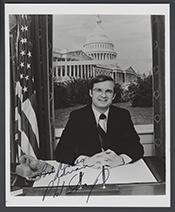
1,180 records where Rep. Sharp, Philip R. [D-IN-2] is listed as a sponsor, author, or other actor. Search with topics and years
United States · United States Congress · 21 March 1977
Deauthorizes the Lafayette Dam and Reservoir, Wabash River, Indiana.
United States · United States Congress · 21 March 1977
States that this Congress should expeditiously determine the future telecommunications policy of this Nation. Requests the Federal Communications Commission to defer implementation of any further new telecommunications policies until Congress has completed its study on the matter and determined what such future policy should be.
United States · United States Congress · 16 March 1977
Campaign Financing Act -- Title I: Public Financing of Congressional General Election Campaigns - Entitles to payments under this Act Congressional candidates who agree to certain reporting and recordkeeping procedures and who certify that (1) he and his authorized committees will not incur campaign expenses in excess of certain limitations, (2) he has qualified to have his name placed on the election ballot in an election for Congressional office, and (3) he has received contributions in excess of a certain sum and no person has given more than $100 toward the amount so certified. Sets the amount of payments to an eligible candidate at the amount of contributions received up to a specified maximum. Stipulates that sums given by any one contributor totalling over $100 shall be disregarded for purposes of matching grants. Restricts use of funds forwarded under this Act to defraying campaign expenses either directly or through repayment of campaign loans. Specifies a limit on the amount of personal funds which a candidate may spend in connection with a Congressional campaign and remain eligible to matching grants. Amends the Federal Election Campaign Act of 1971 to specify spending limits for candidates receiving payments under this Act. Waives such limits for candidates whose opponents are not receiving matching payments and have spent sums in excess of the limit imposed for candidates receiving payments. Directs the Secretary of the Treasury to establish a separate Congressional General Election Payment Account in the Presidential Election Campaign Fund and to deposit certain sums in such account in accordance with specified guidelines. Requires repayment of excess payments and unexpended payments. Penalizes use of funds for other than campaign purposes. Authorizes the Federal Election Commission to institute repayment actions in district courts. Specifies the administrative authority of the Commission in carrying out this Act. Title II: Public Financing of Presidential General Election Campaigns - Raises the general election spending limit for Presidential candidates who are eligible to receive public funds under either the Presidential Election Campaign Fund Act or the Presidential Primary Matching Payment Account Act. Sets limits on the amount which a State party committee may spend in connection with the general election campaign of its Presidential candidate. Provides an alternative method for determining the amount of money to which candidates are entitled under the Presidential Election Campaign Fund Act based upon amount of contributions received after the final primary. Specifies conditions for candidates electing such method. Permits Presidential candidates eligible to receive payment under the Presidential Election Campaign Fund Act to receive additional small contributions from individual contributors up to a specified limit. Title III: Miscellaneous Provisions - Amends the Federal Election Campaign Act of 1971 to reduce the maximum amount which a multicandidate committee may contribute to any candidate or his committees. Specifies the effective date of the provisions of this Act and guidelines with respect to deposit in the Congressional General Election Campaign Fund during 1977.
United States · United States Congress · 15 March 1977
Requests that the concerns of the United States be conveyed to the Soviet government regarding adherence to the Helsinki Declaration with respect to freedom to emigrate.
United States · United States Congress · 14 March 1977
Redesignates the Boundary Waters Canoe Area in Superior National Forest, Minnesota, as the Boundary Waters Wilderness Area. Specifies restrictions relating to timber harvesting, mining, and use of recreational vehicles within such area. Increases to one and one-quarter percent of the fair appraised value the amount payable to the State of Minnesota with respect to lands within the Superior National Forest.
United States · United States Congress · 8 March 1977
Provides that recipients of veterans' pension and compensation will not have the amount of such pension or compensation reduced, or entitlement thereto discontinued, because of increases in monthly social security benefits. Directs the Administrator of Veterans' Affairs to (1) restore the entitlement of any person who lost their entitlement by reason of certain past increases in monthly social security benefits; and (2) pay in a lump sum to any such person any such compensation or pension that would have been payable to him but to such loss of entitlement.
United States · United States Congress · 8 March 1977
Entitles all veterans of the Mexican border period and of World War I, and their widows and children, to pensions on the same basis as veterans of the Spanish-American War and their widows and children, regardless of whether a veteran was disabled or receiving disability compensation, and regardless of income level.
United States · United States Congress · 8 March 1977
Child Exploitation Prevention Act - Amends the Child Abuse Prevention and Treatment Act to prohibit the sexual exploitation of children by making it unlawful for any individual to (1) cause or permit a child to be photographed or filmed engaged in a sexual act prohibited under this Act; (2) photograph or film a prohibited sexual act; (3) knowingly transport any film or photograph depicting a prohibited sexual act; or (4) receive for sale or sell any such film or photograph, if such individual knows or should know such film or photograph has or may be transported in such a manner as to affect interstate or foreign commerce. Imposes a fine of up to $50,000 and/or imprisonment for up to 20 years for a violation of the sexual exploitation of children provisions of this Act. Imposes a fine of up to $25,000 and/or imprisonment for up to 15 years for a violation of the transportation of photographs and films of children engaged in sexual acts provisions of this Act.
United States · United States Congress · 3 March 1977
Amends the Trade Act of 1974 to permit to be included within a group of workers certified by the Secretary of Labor as eligible for adjustment assistance thereunder individuals whose last total or partial separation from employment occurred up to two years prior to the date of the petition on which such certification was granted.
United States · United States Congress · 2 March 1977
Administrative Rule Making Reform Act - Requires a Federal agency preparing to hold a rule making session to make a reasonable effort to inform those likely to be affected by the proposed rule making. Requires that if the affected group is large, representatives of such group must be notified. Requires, in addition to present requirements, that the notice of rule making include the projected effective date of the rules, the purpose of the rule making, the text of the proposed rules, and the technical or other studies on which the agency intends to rely in the rule making proceedings. Applies the requirements of this Act to all rule making sessions except (1) those specifically authorized to be kept secret in the interest of national security, (2) those relating to agency management, and (3) those promulgating rules which are not enforceable by imprisonment, fine, civil penalty, or denial of future Federal benefits. Requires public notice and public opportunity for comment of all rule making proceedings under this Act unless the agency finds that the rules to be proposed are emergency rules or are of routine or insignificant impact in which case the rule must be published with reasons for its adoption. Requires Federal agencies to give interested persons at least 45 days to participate in the rule making. Requires the agency to maintain a file of each proceeding to be made available to the courts, Congress, and to the public in connection with review of the rule. Limits the period for public comment to a maximum of 90 days. Requires a copy of all proposed rules to be sent to Congress. States that such rule, other than an emergency rule, shall not become effective if it is disapproved within 90 days by both Houses of Congress, or it is disapproved within 60 days by one House and no action is taken on the disapproval resolution by the other House. Provides that either House of Congress may, by resolution, require any agency to reconsider and resubmit any rule to which this Act applies. Requires that such proposed rule be repromulgated anew in accordance with all the provisions of this Act unless it is reconsidered and resubmitted to Congress within 180 days after the adoption of the resolution requiring such reconsideration. Sets forth procedures for adoption of resolutions to approve, disapprove, or compel reconsideration for both Houses. Requires the Administrative Conference of the United States to study congressional review of agency rule making under this Act and report the effect of such review on such rule making before July 1, 1982. Authorizes to be appropriated $200,000 to finance such study. Makes this Act effective on the first day of the first session of the 95th Congress. Terminates the congressional review required by this Act at the adjournment of the 97th Congress.
United States · United States Congress · 2 March 1977
Sequoria National Park Enlargement Act - Enlarges boundaries of Sequoia National Park, California, by including Mineral King Valley. Directs the Secretary of the Interior to develop a management plan for the area acquired pursuant to this Act. States that such plan shall consider the need for additional recreational areas.
United States · United States Congress · 2 March 1977
Regulatory Reform Act - Requires the President to submit to Congress a plan recommending reforms with respect to the regulation of: (1) energy, the environment, housing, and occupational health and safety by specified Federal agencies by April 30, 1979; (2) transportation and communications by specified Federal agencies by April 30, 1981; (3) banking and finance, international trade, and Government procurement by specified Federal agencies by April 30, 1983; and (4) food, consumer health and safety, economic trade practices, and labor- management concerns by specified Federal agencies by April 30, 1985. States that each such plan shall include recommendations for reform of such specified agencies and shall report on the cumulative impact of all Government regulatory activity reviewed, up to that date, on specific industry groupings. States that if the President fails to submit such plans by the specified dates, the Senate and House Committees on Government Operations shall draft their own plans to be submitted to Congress for action. Requires the Comptroller General and the Congressional Budget Office to, contemporaneously with the development of the President's plan, submit a report assessing the purpose, effects, efficiency, and cost effectiveness of each agency included in the plans submitted by the President. States that if no comprehensive regulatory reform legislation is enacted by August 1 of the year following the year in which a comprehensive plan has been submitted by the President, then all agencies affected thereby shall have no authority to issue any new rules not essential for preserving the public health and safety; if such reform is not enacted by October 1 of such year, such agency shall have no authority to enforce any rule not essential for preserving the public health and safety; if no such reform is enacted by December 31 of such year, such agency shall be terminated on such date. States that all rules of such terminated agency essential for preserving the public health and safety shall remain effective and shall be enforced by the Department of Justice. Requires the President to submit subsequent plans in the manner and in the order and frequency set forth by this Act every ten years.
United States · United States Congress · 28 February 1977
Requires that any plan for reorganization of the Executive Branch submitted by the President to Congress specify the improvements in management, delivery of Federal services, and increases in efficiency in Government operations which are expected to result from such reorganization. Permits the President to amend any such plan at any time during the 30-day period during which such plan is in committee without affecting the time limits otherwise applicable to congressional consideration of such plan. Permits any such plan to deal with more than one logically consistent subject matter and permits submission of such plans under present law until four years after the enactment of this Act. (Amends 5 U.S.C. 903; 905)
United States · United States Congress · 23 February 1977
Requires Federal agencies to publicly report to Congress all expenditures made for or on the behalf of a Member of Congress or a congressional employee with respect to the travel of such person and requires the committee of Congress which approved such travel to reimburse such agency for such expenditures.
United States · United States Congress · 23 February 1977
Requires the Congressional Record for the House of Representatives to contain an accurate and verbatim account of remarks actually delivered on the floor of the House together with supporting data. Limits revisions of verbatim remarks in the Record to the correction of grammatical and typographical errors which do not change the meaning, content, or substance of those remarks. Entitles Members to insert in the Records remarks not actually delivered on the floor. Stipulates that such insertions always be clearly distinguishable from verbatim remarks.
United States · United States Congress · 23 February 1977
Amends rule XI of the Rules of the House of Representatives to prohibit the use of Committee funds for travel unless the official nature of the travel is established by a resolution approved in a public session by majority vote of the committee involved. Requires the resolution to set forth: (1)the proposed itinerary in detail; (2)the purpose of each destination; (3)the names of all persons who propose to take the trip at private or committee expense; (4)reimbursement provisions; (5)the anticipated benefit to the taxpayers; and (6)the estimated total expense. Requires a complete travel report to be filed with the respective committee within ten working days of the completion of travel.
United States · United States Congress · 17 February 1977
Amends the Legislative Reorganization Act of 1946 to establish the annual rates of pay for Members of Congress, Delegates to the House of Representatives, the Resident Commissioner from Puerto Rico, the President pro tempore of the Senate, the Speaker of the House of Representatives, and the majority and minority leaders of both Houses at the rates in effect for such positions on September 30, 1976, until otherwise fixed by law. Amends the Federal Salary Act to remove the requirement that the Commission on Executive, Legislative, and Judicial Salaries conduct periodic reviews of the salaries of specified executive and legislative positions. Declares that the annual rate of salary of the Vice President shall, until otherwise provided by law, be the rate in effect for such office on September 30, 1976. Specifies that basic pay rates for certain executive, legislative, and judicial positions may not be increased until the President determines that there are in effect codes of conduct applicable to every individual in such position.
United States · United States Congress · 9 February 1977
Congressional Salary Act -- Amends the Federal Salary Act of 1967 to make any recommendations of the President relating to the salaries of Members of Congress, Delegates to the House of Representatives, and the Resident Commissioner from Puerto Rico purely advisory. Amends the Legislative Reorganization Act of 1946 to require that the annual rate of pay for Members of Congress, Delegates to the House of Representatives, the Resident Commissioner from Puerto Rico, and the Senate and House leadership be the rate payable for such positions on the date of enactment of this Act unless otherwise established by law. Prohibits any law increasing such rates of pay from taking effect before the first day of the Congress following the Congress during which such law is enacted.
United States · United States Congress · 8 February 1977
Limousine Limitation Act - Prohibits Government use of any limousine, use of any Government motor vehicle to transport any official between his place of employment and his dwelling place, and Government employment of any chauffeur. Excepts from this Act limousines for the President, Ambassadors, and specified other persons whose personal safety depends upon the use of such limousines.
United States · United States Congress · 7 February 1977
Amends the Internal Revenue Code to limit the application of the Tax Reform Act's elimination of the sick pay exclusion for persons who have not retired on total disability, to taxable years beginning after December 31, 1976.
United States · United States Congress · 2 February 1977
Designates the anniversary of Martin Luther King Junior's birth, January 15, as a legal public holiday.
United States · United States Congress · 31 January 1977
Declares the support of the House of Representatives for the President's intentions (1) to proceed with a comprehensive nuclear test ban treaty, (2) to seek ratification of the SALT II agreement, and (3) to seek an agreement with the Soviet Union for major reductions in atomic weapons.
United States · United States Congress · 26 January 1977
Amends the Trade Act of 1974 to permit to be included within a group of workers certified by the Secretary of Labor as eligible for adjustment assistance thereunder individuals whose last total or partial separation from employment occurred up to two years prior to the date of the petition on which such certification was granted.
United States · United States Congress · 26 January 1977
Emergency Natural Gas Act - Authorizes the President to declare natural gas emergencies where severe natural gas shortages threaten the supply of natural gas for high-priority uses in areas of the United States. Authorizes the President to order transfers of supplies of interstate natural gas from one pipeline to another or order the construction and operation of additional facilities, to alleviate natural gas shortages. Stipulates that no such delivery or transportation may continue after April 30, 1977. Stipulates that such transfers as ordered by the President shall not subject the pipeline to regulation under the Natural Gas Act or other provisions of State or Federal law. Establishes procedures for enforcement of orders issued under this Act. Establishes criteria for compensation of pipelines for compliance with such orders. Exempts activities pursuant to this Act from the antitrust law. Authorizes the President to require contracts for purchases of emergency supplies of natural gas before August 1, 1977. Stipulates that such transactions shall be exempt from Federal Power Commission regulation under the Natural Gas Act. Imposes civil and criminal penalties for violations of orders issued under this Act.
United States · United States Congress · 26 January 1977
Federal Agency Control and Review Act - Requires the Office of Management and Budget to study the efficiency and effectiveness of each Federal agency every ten years and to recommend to the President and Congress reorganization or abolition of each such agency as may be necessary to improve such efficiency and effectiveness. Abolishes each such agency upon the due date of such report unless during the ten-year period since the last report Congress has passed legislation continuing such agency.
United States · United States Congress · 24 January 1977
Financial Disclosure Act - Requires the President, Vice President, Members of Congress and candidates for those offices, justices and judges of the United States, Presidential nominees, officers and employees of the United States compensated at a rate equal to or in excess of the rate prescribed for the grade of GS-15, and members of the uniformed services compensated at a rate equal to or in excess of the monthly rate prescribed for grade O-6 to file in each calendar year, with the Comptroller General and other specified executive or administrative officers, a financial statement for the preceding calendar year if such individual has occupied or been a candidate for the office or position for more than 90 days in such calendar year. Specifies the content of such financial statements. Makes mandatory the inclusion in such report of all items held not only by the individual, but by the spouse, and dependents of such person, and those acting on the individual's behalf. Permits the President to exempt any individual in the Central Intelligence Agency, the Defense Intelligence Agency, and the National Security Agency, or other person engaged exclusively in intelligence activities from the requirement to file a report with the Comptroller General if such disclosure would reveal the identity of an undercover Federal agent. Makes failure to file and falsifying reports punishable by a fine and/or imprisonment. Requires the head of each agency, the Clerk of the House of Representatives, the Secretary of the Senate, and the Director of the Administrative Office of the United States Courts to submit annually to the Comptroller General a complete list of individuals required to file such a report. Requires the Comptroller General to refer to the Attorney General the names of all individuals who the Comptroller General have reasonable cause to believe has failed to file or falsified such report, and that if such an individual is a Member of Congress, that the name be referred to the appropriate Congressional committees. Requires the Comptroller General to make such reports available to the public for all purposes not excluded under this Act. Makes the House of Representatives, the Senate, the Director of the Administrative Office of the United States Courts, the Chairman of the Civil Service Commission and the head of each agency responsible for the review of such reports in accordance with any law or regulation regarding conflicts of interest or confidential financial information. Directs the Comptroller General to conduct audits of each specified group at varying intervals, and gives the Comptroller General subpena power for the purpose of conducting such audits. Requires the Civil Service Commission and the Department of Justice to recommend to Congress such legislation as may be necessary in the area of financial conflicts of interest among Federal employees and officers.
United States · United States Congress · 19 January 1977
Government Economy and Spending Reform Act - Title I: Authorization of New Budget Authority - Terminates all budget authority for Federal programs on specified dates according to the functional or subfunctional category of each program as set forth in the fiscal year 1977 budget. Requires the Comptroller General to report to Congress by April 1, 1977, on specified programs with respect to the laws under which such program is carried on, the amount of new budget authority received by such program during the four fiscal years ending before April 1, 1977, and to identify programs for which no outlays have been made during the last two fiscal years ending before April 1, 1977. Prohibits providing new budget authority after the applicable review date set forth in this Act unless the provision of such budget authority is specifically authorized by law or the standing rules of either House of Congress. Title II: Zero-Base Program Review - Sets forth a timetable for Congressional zero-base review of new budget authority. Defines "zero-base review" as an evaluation of a given program to determine the merits of its continuation at a level less than, equal to, or more than its existing level. Requires each congressional committee conducting a zero-based program review to adopt tentative and final review plans, receive reports from the Comptroller General and Federal agencies on the program being reviewed, and report to their respective House the results of such zero-base review of the program. Sets forth minimum objectives of inquiry for such reviews. Requires that any committee reporting pursuant to this Act recommend the extent to which any program reviewed should be continued or eliminated. Title III: Continuing Review - Amends the Legislative Reorganization Act of 1970 to require, whenever the Comptroller General issues a report which discloses any substantial deficiency in the achievement of the objectives of any Federal program, the agency conducting such program to report to specified congressional committees 60 days after such report and every six months thereafter to delineate the actions taken with respect to such deficiency. Requires that such agency continue to issue such reports until such time as the Comptroller General determines that no purpose is served by their submission. Amends the Budget and Accounting Act of 1921, to require the inclusion in the Budget of a statement of the specific objectives of each Government program, and a comparison, in each subsequent Budget, of the achievement of such objectives for the last completed fiscal year with the planned objectives of such year. Title IV: Miscellaneous - Requires the Director of Management and Budget to study the feasibility of zero-base budgeting for Federal agencies. Requires the Director of the Congressional Budget Office to study the feasibility of personnel ceilings on employees of the United States and their relationships to alternative methods of carrying out the activities of such employees. Requires that such reports be submitted to Congress. Requires Federal agency heads to report requests for new budget authority to Congress. Requires specified committees to study the effectiveness of the zero-base review procedures required by this Act.
United States · United States Congress · 17 January 1977
Congressional Pay Raise Deferral Act - Amends the Federal Salary Act of 1967 and the Legislative Reorganization Act of 1946 to provide that any adjustment in the rate of pay for Members of Congress proposed during any Congress shall not take effect earlier than the beginning of the next Congress. States that any such pay adjustment proposed in an even-numbered year of any Congress after the congressional elections and before the beginning of the following Congress, shall be considered as occurring during the first session of the following Congress for the purposes of this Act.
United States · United States Congress · 17 January 1977
Directs the Joint Committee on the Library to procure a bronze bust or statue of Martin Luther King, Jr. and to place it in a suitable location in the Capitol.
United States · United States Congress · 4 January 1977
Creates a Select House Committee on Population to conduct an investigation and study of: (1) the major adverse effects of current population growth throughout the world; (2) approaches which have been shown to be effective in coping with excessive population growth; and (3) means to encourage countries with excessive population growth rates to adopt methods proven to be successful in reducing population growth rates.
United States · United States Congress · 17 September 1976
Emergency Federal Power Act Amendments - Amends the Federal Power Act to require that the operation of proposed rate schedules become effective only upon a determination by the Federal Power Commission that such schedules are lawful. Authorizes the use of special interim proceedings whereby the Commission may order parts of proposed rate schedules into effect pending results of a final determination. Prohibits public utilities from proposing additional rate increases where such proposed increases were part of a rate schedule pending before the Commission for 18 months or less. Directs the Commission to require public utilities to report anticipated shortages of electric energy. Authorizes the Commission to order such utilities to take actions necessary to alleviate the effects of such shortages.
United States · United States Congress · 14 September 1976
Designates a specified building in Gary, Indiana, as the Ray J. Madden Post Office Building.
United States · United States Congress · 13 September 1976
Emergency Federal Power Act Amendments - Amends the Federal Power Act to require that the operation of proposed rate schedules become effective only upon a determination by the Federal Power Commission that such schedules are lawful. Authorizes the use of special interim proceedings whereby the Commission may order parts of proposed rate schedules into effect pending results of a final determination. Prohibits public utilities from proposing additional rate increases where such proposed increases were part of a rate schedule pending before the Commission for 18 months or less. Directs the Commission to require public utilities to report anticipated shortages of electric energy. Authorizes the Commission to order such utilities to take actions necessary to alleviate the effects of such shortages.
United States · United States Congress · 2 September 1976
Amends the Trade Act of 1974 to permit to be included within a group of workers certified by the Secretary of Labor as eligible for adjustment assistance thereunder individuals whose last total or partial separation from employment occurred more than one year prior to the date of the petition on which such certification was granted.
United States · United States Congress · 2 September 1976
Amends Rule XI of the Rules of the House of Representatives to provide that committee funds shall not be used for travel unless its official nature is established by resolution approved by majority vote of the committee involved. Requires that the official travel resolution set forth specific items including the purpose of each destination, the names of all persons who propose to take the trip, the anticipated benefit to the taxpayers, and the estimated total expense.
United States · United States Congress · 26 August 1976
Authorizes the President to issue a proclamation designating the week beginning October 3, 1976, and ending October 9, 1976, as "National Volunteer Firemen Week."
United States · United States Congress · 10 August 1976
Indemnity for Participants in the Swine Flu Innoculation Program Act - Amends the Public Health Service Act to make the United States liable for claims for personal injury or death resulting from the administration of vaccine under the national swine flu innoculation program where such claims are based upon the act or omission of a program participant (except in cases of negligence). Establishes procedures for bringing such actions. Makes the remedy accorded by this Act the exclusive legal remedy. Requires the Attorney General to defend any civil action or proceeding against any employee of the Government or program participant brought under this Act. Requires the Attorney General to certify that the claim arises under this Act prior to designating such action an action against the United States.
United States · United States Congress · 30 July 1976
Provides for the relief of Habiba Saidzada.
United States · United States Congress · 27 July 1976
Deauthorizies the Lafayette Dam and Reservoir in Indiana.
United States · United States Congress · 1 July 1976
Authorizes and requests the President to designate the 2nd day of July, 1976, as "Bicentennial Day of Prayer of Thanksgiving and Guidance."
United States · United States Congress · 29 June 1976
Directs the President to remove mandatory allocation controls from the class of petroleum products known as middle distillates. Stipulates that standby allocation authority shall remain in force with respect to such products. Defines the term "middle distillates" to include number 2 heating oil, number 2-D diesel, fuel, number 1 heating oil, number 1-D diesel fuel, and kerosone, as further defined in regulations issued pursuant to the Emergency Petroleum Allocation Act of 1973.
United States · United States Congress · 4 May 1976
Amends the State and Local Fiscal Assistance Act of 1972 to take into account transfers of funds from publicly owned public utilities in addition to revenues raised by State and local taxes when calculating the general tax factor for the purpose of computing State and local revenue sharing entilements.
United States · United States Congress · 30 April 1976
Terminates the authorization of the navigation study and survey of the Wabash River, Indiana.
United States · United States Congress · 29 April 1976
Amends the Federal Energy Administration Act of 1974 to authorize appropriations through fiscal year 1977 to the Federal Energy Administration to carry out the functions of the (1) Executive Director and Administration; (2) Office of Energy Policy and Analysis; (3) Office of Regulatory Programs; (4) Office of Conservation and the Environment; (5) Office of Energy Resource Development; and (6) Office of International Energy Affairs. Stipulates that funds appropriated for the Executive Director and Administration shall not be used to carry out the functions of the Office of Nuclear Affairs. Limits the amount of such funds which may be used for the Office of Communications and Public Affairs. Directs the Administrator of the Federal Energy Administration to provide information to Congress and the public with respect to the Project Independent Evaluation System computer model. Extends the duration of authorizations under such Act through fiscal year 1979.
United States · United States Congress · 13 April 1976
Establishes in the House of Representatives the Select Committee on Nuclear Proliferation and Nuclear Export Policy. Directs the Committee to conduct a full and complete study of: (1) the threat of nuclear proliferation; (2) the present policies of the United States concerning nuclear proliferation; (3) the decisionmaking process within the executive branch on nuclear export policies; and (4) any related areas which the committee deems necessary to investigate and study to discharge its responsibilities. Directs the committee to report to the House as soon as practicable the results of its investigation and study, together with such recommendations as it deems advisable.
United States · United States Congress · 2 April 1976
Terminates the duty of the Secretary of Commerce to take agricultural censuses every five years and censuses of irrigation and drainage every ten years. Directs the Secretary to continue the statistical classification of farms which was in effect on January 1, 1975, until June 30, 1976. Directs the Secretary of Agriculture to collect information on agriculture, irrigation, and drainage on a sample basis, which is comparable to the information previously collected every five years in the agriculutral census. Allows the Secretary, when sampling methods would be inappropriate, to use other statistical methods to collect information relating to the classification of farms. (Amends 13 U.S.C. 142)
United States · United States Congress · 4 March 1976
Authorizes the President to designate the second full calendar week in March of 1976 as "National Employ the Older Worker Week."
United States · United States Congress · 23 February 1976
Government Economy and Spending Reform Act - Title I: Authorizations of New Budget Authority - Terminates on specified dates budget authority for all Government programs except health care services, general retirement and disability insurance, and Federal employee retirement and disability programs which are funded by trust funds. Declares out of order in either the Senate or the House of Representatives any legislation which authorizes new budget authority not in compliance with this Act. Requires the Committees on Appropriations and the Committees on the Budget of both Houses of Congress to identify each program's functional and subfunctional category (as so characterized in the Budget of the United States, Fiscal Year 1977, transmitted to Congress by the President on January 21, 1976), the committees having legislative jurisdiction over such program, and whether such program operates under permanent authorizations and budget authority. Makes the budget termination provisions of this Act effective on the first day of the Ninety-fifth Congress. Title II: Early Elimination of Inactive and Duplicate Programs - Requires the Comptroller General of the United States to identify for Congress any programs which have duplicate objectives or for which no outlays have been made for the last two fiscal years. Directs the standing committees of both Houses to consider such programs and report recommendations on such programs before March 15, 1978, if possible. Title III: Quadrennial Program Review and Evaluation - Sets forth a timetable for reviewing the budget of a Government program. Requires review by standing committees of the Congress every four years of each program's cost, effectiveness, and the extent to which such program duplicates or is similar to any other program. States that such review shall include a comprehensive evaluation of the merits of such program to determine if it warrants continuation. Requires justification of any recommendation to fund any program which has objectives similar to or the same as another program's objectives. Directs the Comptroller General and the Congressional Budget Office to provide Congress with information and analysis of programs being reviewed under this Act. Requires the President to similarly review the merits of continuing programs contained in the annual Budget and to report the finding of such review prior to transmitting the Budget to Congress. Title IV: Continuing Review and Evaluation - Directs the Comptroller General to report to Congress the result of any audit which shows a substantial deficiency in achievement of the objectives of any Government program. Requires subsequent audits, a report of which must be submitted to Congress, to determine if such deficiency has been eliminated. Title V: Miscellaneous - States that those provisions of this Act which direct the operation of either House are enacted as an exercise of the rulemaking power of such House and recognizes the right of either House to change such rules.
United States · United States Congress · 4 February 1976
Redefines the crime of deprivation of employment or other benefit because of political activity to include within the scope of political activity, an individual's making or failing to make a contribution of a thing of value (including services) for the benefit of any candidate or any political party. Defines "candidate," "election," and "employee" for purposes of this Act. Makes it a Federal crime to deprive or threaten to deprive an individual of any employment or other benefit, provided in whole or in part by any Act of Congress appropriating funds for relief purposes, on account of race, color, sex, religion, or national origin. Subjects an individual guilty of either offense under this Act to a fine of not more than $10,000, imprisonment for one year, or both. (Amends 18 U.S.C. 601; Adds 18 U.S.C. 246)
United States · United States Congress · 27 January 1976
Expresses the sense of the House of Representatives that the people of Angola should be allowed to determine their own political future without foreign interference. Expresses support for efforts by the Organization of African Unity to achieve a settlement of the conflict in Angola. Calls upon all countries to terminate military assistance to any group in Angola. States that the President should do his utmost to seek an agreement among the various parties involved in hostilities or in the support of such hostilities in Angola to terminate such hostilities. Directs the President to refrain from providing assistance of any kind, for military activities in Angola, until specifically approved by Congress.