Bill· HJRESH.J.Res. 427 (101st)referred
Designating the month of May 1990 as "National Trauma Awareness Month".
United States · United States Congress · 25 October 1989
Designates May 1990 as National Trauma Awareness Month.
The world's political record
Person
United States · Official source
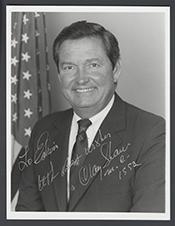
3,161 records where Rep. Shaw, E. Clay, Jr. [R-FL-22] is listed as a sponsor, author, or other actor. Search with topics and years
United States · United States Congress · 25 October 1989
Designates May 1990 as National Trauma Awareness Month.
United States · United States Congress · 24 October 1989
Designates February 4 through February 10, 1990, as National Burn Awareness Week.
United States · United States Congress · 19 October 1989
Amends the Federal Aviation Act of 1958 to prohibit the Administrator of the Federal Aviation Administration from refusing to issue or renew an airman's certificate, or terminate the employment of an airman, solely by reason of the airman's age if such person is under the age of 65.
United States · United States Congress · 11 October 1989
Tuna Management Act of 1989 - Amends the Magnuson Fishery Conservation and Management Act to declare that the United States claims and will exercise exclusive fishery management authority over all pelagic species throughout the migratory range of each such species beyond the U.S. Exclusive Economic Zone, except when within any foreign nation's territorial sea or exclusive economic zone as recognized by the United States. Repeals provisions of such Act providing for the exclusion of highly migratory species of fish from the sovereign rights and exclusive fishery management authority asserted by the United States under existing provisions. Amends the Atlantic Tunas Convention Act of 1975 to change the composition of the advisory committee established by that Act.
United States · United States Congress · 5 October 1989
Declares that: (1) Antarctica is a global ecological commons and should be managed under a new agreement among the Antarctic Treaty Consultative Parties or a protocol to the Convention on the Regulation of Antarctic Mineral Resource Activities which should for an indefinite period establish Antarctica as a region closed to commercial minerals development and related activities; (2) under such new agreement, information about minerals or other resources in Antarctica should be obtained under strictly controlled arrangements and should be openly shared in the international scientific community; (3) the Convention is not adequate to protect the environment of Antarctica and could stimulate commercial exploitation; (4) pending the negotiations and entry into force of a new agreement or protocol ensuring the full protection of Antarctica as a global ecological commons, the President should not present the Convention to the Senate for advice and consent to ratification; (5) the United States should support the interim measures presently in force among nations signatory to the Convention; and (6) the negotiation of such a new agreement or protocol should be a major item on the agenda of the pending XV Antarctic Treaty Consultative meeting opening on October 9, 1989.
United States · United States Congress · 4 October 1989
Requires the U.S. Government to exhaust all reasonable possibilities to obtain proof of the death of a missing person in order to establish a reasonable presumption that a member of the armed forces in a missing status is dead. Requires the head of the Federal agency concerned to provide certain procedural rights to the primary next of kin of a missing person when an action is to be undertaken by such agency to review the status of such missing person, including the right to review all information obtained by such agency with regard to the missing person's status. Directs the Secretary of Defense to study and report to the Senate and House Armed Services Committees on current provisions of the Missing Persons Act.
United States · United States Congress · 4 October 1989
Designates December 3 through December 9, 1989, as National Cities Fight Back Against Drugs Week.
United States · United States Congress · 2 October 1989
Billboard Control Act of 1989 - Revises Federal provisions with respect to restrictions on outdoor advertising adjacent to interstate and Federal-aid primary highways. Specifies that a State shall be treated as failing to provide effective control of the erection and maintenance of outdoor advertising signs, displays, and devices (signs): (1) unless the State submits to the Secretary of Transportation by December 1st of each year an inventory of conforming and non-conforming signs in such State; and (2) if the State allows vegetation located on any land on which the State owns a right-of-way for a highway to be cut to improve the visibility of such signs. Requires the Secretary to submit to the Congress a detailed annual report on the extent to which each State has complied with the requirements of this Act, including a compilation of inventories and a description of the Secretary's efforts to assure that necessary directional information about facilities providing goods and services of interest to the traveling public is available to motorists. Makes exceptions to restrictions under this Act for signs which are lawfully in existence on September 1, 1989, and those located in industrial or commercial areas.
United States · United States Congress · 28 September 1989
Amends the Internal Revenue Code to increase the credit percentage of the earned income tax credit. Allows a supplemental tax credit for individuals with children under the age of five. Authorizes advance tax credit payments by employers based on the number of qualifying children. Requires such employers to collect a certificate or statement of eligibility from the employee. Amends the Social Security Act to eliminate changes in the treatment of earned income credit in determining certain aid to families with dependent children benefits. Provides for phasing out the dependent care credit and the exclusion for dependent care assistance for taxpayers whose incomes exceed $70,000.
United States · United States Congress · 28 September 1989
Special Needs Adoption Assistance Act of 1989 - Amends the Internal Revenue Code to authorize a deduction for the expenses of adopting a child with special needs. Limits deductible adoption expenses to $3,000. Prohibits a deduction of any such expense for which a deduction or credit is allowable under other Internal Revenue Code provisions. Provides that any reimbursement of such expenses shall be includible in the taxpayer's gross income. Allows such a deduction whether or not a taxpayer itemizes deductions. Directs the Office of Personnel Management (OPM) to establish a demonstration program requiring executive agencies to reimburse employees for the expenses of adopting a child with special needs. Authorizes agencies to require employees applying for reimbursement of such expenses to obtain State or private adoption agency certification that the adoptive child is a child with special needs. Limits such adoption expenses to $2,000 per child and $5,000 in any calendar year. Prohibits such reimbursement in any adoption: (1) in which one of the adopting parents is a biological parent; (2) of a child 18 years of age or older; (3) of a child who, immediately prior to the adoption, was not a citizen or legal resident of the United States; (4) in which the employee separated from the service before the adoption is final; or (5) for which the employee made payment or received reimbursement under other governmental adoption programs. Requires such reimbursement to be made from the fund available for payment of such employee's pay. Directs OPM to: (1) prescribe regulations and provide assistance to administer the reimbursement of special needs adoption expenses; and (2) report to the President and the Congress on the operation of such demonstration program. Repeals this Act on December 31, 1993, and prohibits further reimbursement of such expenses unless this Act is extended by the Congress.
United States · United States Congress · 28 September 1989
Amends the Rail Passenger Service Act to repeal an exemption from specified communicable disease control requirements of the Public Health Service Act for waste disposal from railroads operating in intercity rail passenger service.
United States · United States Congress · 28 September 1989
Designates March 3, 1990, as United States Naval Reserve Day in recognition of the Reserve's 75th anniversary.
United States · United States Congress · 26 September 1989
Crime Awareness and Campus Security Act of 1989 - Amends the Higher Education Act of 1965 (the Act) to require, under specified student aid program participation agreements, each institution of higher education to certify that it: (1) has established a campus security policy; and (2) will submit an annual uniform crime report to the Federal Bureau of Investigation, as prescribed by the Attorney General. Requires each eligible institution of higher education participating in any program under student assistance (title IV) provisions of the Act, to prepare, publish, and distribute to all current students and employees, and to any applicant for enrollment or employment, upon request, an annual report containing specified types of information with respect to its campus security policies and campus crime statistics. Requires each such institution to make interim reports on specified types of crimes reported to campus security or local law enforcement authorities, and to distribute such reports to students and employees in a timely manner. Directs the Secretary of Education periodically to survey campus security policies, procedures, and practices and disseminate information on those that have been effective in reducing campus crime.
United States · United States Congress · 26 September 1989
Amends the Omnibus Crime Control and Safe Streets Act of 1968 to prohibit Federal assistance to any State that has not implemented a drug testing program for targeted classes of arrestees, prisoners, and persons on conditional or supervised release before or after conviction. Directs the Attorney General to promulgate regulations for such programs based in part on scientific and technical standards determined by the Secretary of Health and Human Services to ensure the reliability and accuracy of test results. Specifies that such regulations may include guidelines or specifications concerning: (1) the classes of persons to be targeted for testing; (2) the drugs to be tested for; (3) the frequency and duration of testing; and (4) the effect of test results in decisions concerning the sentence, conditions to be imposed on release before or after conviction, and the granting, continuation, or termination of such release. Amends the Public Health Service Act to require a State, in order to receive the drug abuse portion of its allotment under such Act for a fiscal year, to develop, implement, and submit an approved Statewide Drug Treatment Plan. Requires such Plan to include a single, designated State agency for formulating and implementing the Plan and a description of: (1) the mechanisms used to assess the needs and make funding allocations for drug treatment throughout the State; (2) a statewide plan to expand treatment capacity; (3) performance-based criteria to be used to allocate funds; (4) drug-free patient and workplace programs (which must include drug testing) to be utilized in drug treatment facilities and programs; (5) actions to be taken to improve the referral of drug users to appropriate treatment facilities; (6) the program of in-service training to be implemented for employees of treatment facilities receiving Federal funds; (7) the plan to be implemented to coordinate drug treatment facilities with other social, health, correctional, and vocational services; and (8) the plan to be implemented to expand and improve efforts to contact and treat expectant women who use drugs and provide appropriate followup care to their affected newborns. Requires such Plan to be submitted to the Secretary annually for review and approval. Authorizes the Secretary to review, approve, disapprove, and propose changes to State plans. Requires each State to submit such reports as the Secretary may require and to comply with such additional provisions as the Secretary may find necessary to verify the accuracy of such reports. Authorizes the Secretary to waive any or all requirements of this Act with respect to the Plan upon the written request of a State, provided that the State implements an alternative treatment plan that fulfills the objectives of this Act. Amends the Higher Education Act of 1965 to make ineligible for Federal funds or assistance any institution of higher education which fails to certify to the Secretary that it has adopted and implemented a program to prevent illicit drug use and alcohol abuse by students and employees that includes the annual distribution to each student and employee of: (1) standards of conduct that clearly prohibit the unlawful possession, use, or distribution of illicit drugs and alcohol by students and employees on its property or as part of its activities; (2) a description of applicable sanctions under local, State, or Federal law for unlawful possession or distribution of such drugs; (3) health risks associated with such use; (4) any drug or alcohol counseling, treatment, or rehabilitation programs available to employees or students; and (5) a clear statement that the institution will impose sanctions, and a description of such sanctions, up to and including expulsion or termination of employment and referral for prosecution. Requires such program to provide for a biennial review by the institution to determine the program's effectiveness, to implement changes as needed, and to ensure that sanctions are consistently enforced. Requires: (1) each institution that provides such certification to make a copy and the results of such biennial review available, upon request, to the Secretary and to the public; and (2) the Secretary to publish regulations to implement and enforce this Act, including regulations providing for periodic review of programs and sanctions, up to and including the termination of financial assistance, for institutions of higher education that fail to implement their programs or to consistently enforce their sanctions. Allows sanctions to include the completion of an appropriate rehabilitation program. Amends the Drug-Free Schools and Communities Act of 1986 to make ineligible for Federal funds or assistance any local educational agency which fails to certify to the State educational agency that has adopted and implemented an analogous program to prevent the use of illicit drugs and alcohol by students or employees. Authorizes appropriations for FY 1990 through 1993 for the Special Forfeiture Fund. Waives provisions of the Foreign Assistance Act of 1961 and the Foreign Operations, Export Financing, and Related Appropriations Act, 1989 to make certain appropriated funds available for narcotics-related activities in Colombia, Bolivia, and Peru.
United States · United States Congress · 25 September 1989
Amends the Immigration and Nationality Act to expand the arrest authority of Immigration and Naturalization Service officers and employees.
United States · United States Congress · 18 September 1989
Designates the period of September 16 through October 9, 1989, as Coastweeks '89, recognizing the importance of coastal zones. Designates September 16, 1989, as National Estuaries Day and September 23, 1989, as National Beach Cleanup Day.
United States · United States Congress · 14 September 1989
Amends the Job Training Partnership Act to require accreditation or certification of providers of training and education under such Act.
United States · United States Congress · 14 September 1989
Congressional and Judicial Equal Employment Opportunity Act of 1989 - Amends the Civil Rights Act of 1964 to require that personnel actions affecting employees or applicants in the legislative and judicial branches of the Government be free from any discrimination based on race, color, national origin, religion, sex, handicap, or age. Allows Members of Congress to take into consideration an individual's domicile and political affiliation. Establishes within the judicial branch an Employment Review Board. Provides that members of the Board be appointed from the retired judges of the Supreme Court and Courts of Appeals. Authorizes an aggrieved individual to file a written complaint with the Board. Establishes procedures for the Board to investigate, settle, hear, and determine the claims alleged. Provides that if a violation is found an order for relief may compel the defendant to: (1) employ or reinstate such individual on such terms and conditions as may be appropriate, except that the Board may not compel any committee or Member of Congress to employ or reinstate, or modify the terms and conditions of employment of, any individual; (2) pay compensatory damages; and (3) pay fees and allowances of witnesses and reasonable attorneys' fees. Authorizes the U.S. Court of Appeals for the District of Columbia Circuit to review, enjoin, set aside, suspend, modify, or enforce orders of the Board. Requires members of the Board to submit written reports to the Committee on Standards of Official Conduct of the House of Representatives and the Senate Select Committee on Ethics describing complaints during the reporting period.
United States · United States Congress · 13 September 1989
Farm Animal and Research Facilities Protection Act of 1989 - Amends the Food Security Act of 1985 to make it unlawful to disrupt or damage a farm animal facility, its animals, or property. Sets forth penalties for violations of this Act. Allows the Secretary of Agriculture to investigate such offenses. Grants U.S. district courts jurisdiction in such cases. Provides for a private right of action.
United States · United States Congress · 12 September 1989
Amends Federal transportation law to authorize a person to assert that it would be an unreasonable practice for a motor common carrier or a nonhousehold goods freight forwarder to seek to collect tariff rates or charges in addition to those originally billed and collected, or to impose rules, classifications, or practices permitting such a collection. Declares that the Interstate Commerce Commission shall determine whether or not such a collection or imposition is an unreasonable practice violating Federal law. Shortens the statute of limitations for the filing of claims: (1) by a motor common carrier for recovery of transportation or service charges; and (2) by a person to recover overcharges by a motor carrier. Decreases the limitation period for both kinds of claims from 36 months to: (1) 24 months for claim accruals during the year following enactment of this Act; and (2) 18 months for claim accruals on or after one year following enactment. Permits motor carriers and shippers to resolve by mutual consent, subject to Commission review, any overcharge and undercharge claims resulting from billing errors or incorrect tariff provisions arising from the inadvertent failure to properly and timely file and maintain agreed upon rates, rules, or classifications, or under circumstances where application of the filed tariff would be an unreasonable practice.
United States · United States Congress · 12 September 1989
Amends the Higher Education Act of 1965 to provide reduced rates of interest under the Guaranteed Student Loan (Stafford Loan) program to individuals who enter the teaching profession.
United States · United States Congress · 12 September 1989
Designates October 27, 1989, as National Hostage Awareness Day in recognition of the 42d birthday of Terry Anderson and his fifth year in captivity. States that efforts should be made to have such date declared International Hostage Day by the United Nations. States that all Federal and international agencies should increase efforts to secure the release of the remaining hostages in Lebanon. Calls for prayer on such date for the release of all U.S. and foreign hostages in Lebanon.
United States · United States Congress · 11 September 1989
Commends and expresses support for President Barco and the Government and people of Colombia for standing up to the drug traffickers. Urges the administration to continue to make available whatever equipment, training, intelligence, and financial assistance that Colombia needs to overcome the activities of the drug traffickers.
United States · United States Congress · 4 August 1989
Amends the Internal Revenue Code to subject to arbitrage rebate requirements certain tax-exempt bonds (hedge bonds) when certain percentages of the net proceeds are not spent by the end of each of five years (or longer if approved by the Secretary of the Treasury) from the date of issuance.
United States · United States Congress · 4 August 1989
Catastrophic Coverage Repeal Act of 1989 - Repeals Medicare (title XVIII of the Social Security Act) catastrophic health care coverage provided under the Medicare Catastrophic Coverage Act of 1988. Makes transitional and conforming amendments.
United States · United States Congress · 4 August 1989
Amends the Internal Revenue Code to provide an exception from the arbitrage rebate requirement for tax-exempt bonds if certain percentages of the net proceeds are expected to be spent by the end of each of three years from the date of issuance.
United States · United States Congress · 4 August 1989
Designates November 12 through November 18, 1989, as National Glaucoma Awareness Week.
United States · United States Congress · 4 August 1989
Calls on all countries that produce high explosives to: (1) cooperate in global efforts to develop suitable chemical taggants for preblast detection of high explosives; (2) refrain from selling high explosives to known supporters of terrorism; (3) develop controls to ensure that high explosives purchased by customers are not transferred to terrorist groups; and (4) formally agree to require that any high explosive produced in that country include a preblast detection taggant, as soon as one suitable for that form of explosive is developed.
United States · United States Congress · 3 August 1989
Declares that the Congress acknowledges and appreciates the commitment, devotion, and sacrifices of present and former military families. Designates November 20, 1989, as National Military Families Recognition Day.
United States · United States Congress · 31 July 1989
Benjamin Franklin National Memorial Commemorative Coin Act - Requires the Secretary of the Treasury to issue a specified number of five-dollar gold coins, one-dollar silver coins, and half-dollar clad coins in commemoration of the bicentennial of the death of Benjamin Franklin. Provides that such coins shall be considered legal tender. Requires the Secretary to begin issuing such coins on October 1, 1989. Directs the Secretary to obtain silver for the minting of such coins from stocks of silver held by the Secretary or from any other federally owned stocks of silver and to obtain gold pursuant to authority under existing law. Provides that the design of such coins shall be selected by the Secretary after consultation with the Chairman of the Benjamin Franklin National Memorial at the Franklin Institute and the Chairman of the Commission of Fine Arts. Specifies the sales price of such coins as the face value plus costs. Requires that all sales of such coins include a surcharge of $35 per coin for five-dollar coins, $7 per coin for one-dollar coins, and $2 for half-dollar coins. Requires that all surcharges received by the Secretary from the sale of such coins shall be paid to the Benjamin Franklin National Memorial (The Franklin Institute): (1) to restore and renovate the Memorial; (2) to construct or renovate certain adjoining areas of the Franklin Institute; (3) to establish an endowment to ensure the continued upkeep and maintenance of the Memorial; (4) for exhibits in the Memorial or certain adjoining areas of the Institute; and (5) for funds for construction of certain facilities and for the acquisition and preservation of artifacts relating to Franklin. Authorizes the Comptroller General to audit such payments. Prohibits the minting of such coins under this Act after December 31, 1990. Requires the Secretary to ensure that the minting and issuance of such coins shall not result in any net costs to the Government.
United States · United States Congress · 28 July 1989
Expresses the sense of the House of Representatives that: (1) the Exxon Company should dedicate whatever resources are necessary and pay all expenses required to compensate affected parties expeditiously, mitigate impacts, and complete cleanup of Prince William Sound and other Alaska lands and waters damaged by the Exxon Valdez oilspill; (2) the scope and thoroughness of the cleanup should not be determined by Exxon, but by the U.S. Coast Guard; (3) if the cleanup has not been completed to the Coast Guard's satisfaction by September 15, 1989, Exxon should renew the cleanup in the spring, until the Coast Guard has determined that the cleanup is complete; and (4) Exxon should maintain a contingency force in affected Alaskan communities from September 15, 1989, until full-scale cleanup efforts renew in the spring.
United States · United States Congress · 27 July 1989
Commends the citizens of the Sioux City, Iowa, tri-State area for their heroism and volunteerism in providing assistance to the passengers and crew of crashed United Airlines Flight 232.
United States · United States Congress · 27 July 1989
Expresses the sense of the Congress that: (1) human rights violations in Cuba should be condemned; and (2) the President should award the Presidential Medal of Freedom to Armando Valladares.
United States · United States Congress · 24 July 1989
Designates the week of October 22 through October 29, 1989, as National Red Ribbon Week. Recognizes and commends the hard work and dedication of certain individuals and organizations and urges activities that support community and alcohol education during such week. Encourages Americans to wear or display red ribbons during such Week to present and symbolize their commitment to a healthy, drug-free lifestyle, and to develop an attitude of intolerance to the use of drugs.
United States · United States Congress · 21 July 1989
Drug War Bond Act of 1989 - Directs the Secretary of the Treasury to issue: (1) Drug War Bonds for a three-year period with a 12-year maturity date; and (2) Drug War Stamps to evidence payments for or on account of such bonds. Amends the Internal Revenue Code to exclude the interest earned on such War Bonds from an individual's gross income. Authorizes a taxpayer to designate a specified portion of any tax overpayment or make cash contributions to the War on Drugs Trust Fund (established by this Act). Authorizes the Attorney General to make expenditures from the Department of Justice Assets Forfeiture Fund into the War on Drugs Trust Fund. Amends the Internal Revenue Code to establish the War on Drugs Trust Fund. Transfers to such Fund: (1) proceeds from the sale of Drug War Bonds and stamps; and (2) certain cash contributions and portions of tax overpayments. Prescribes expenditures from the War on Drugs Trust Fund, including the construction of Federal prison facilities and education and rehabilitation programs. Precludes the receipts and disbursements from the War on Drugs Trust Fund from being included in either the congressional budget totals or in the budget totals as submitted by the President. Exempts the receipts and expenditures from the War on Drugs Trust Fund from: (1) statutory expenditure and lending limitations; and (2) certain orders issued under the Balanced Budget and Emergency Deficit Control Act of 1985 (Gramm-Rudman-Hollings Act). Requires the Secretary to report to the Congress on programs established by this Act. Directs the Attorney General to make recommendations to the Congress regarding the merits of privatizing Federal prisons.
United States · United States Congress · 20 July 1989
Prohibits the Secretary of the Interior from engaging in any leasing activity with respect to specified submerged lands of the Outer Continental Shelf off the State of Florida. Directs the Secretary to promulgate guidelines for the United States to follow when buying back any existing oil or gas lease on such lands.
United States · United States Congress · 19 July 1989
Dolphin Protection Consumer Information Act of 1989 - Provides for the labeling of all tuna products as "DOLPHIN SAFE" if the products are, in their entirety: (1) not caught with specified nets or technologies; and (2) regardless of the country of origin, sold or consumed in the United States. Requires tuna products sold or consumed in the United States and not so labeled to bear the statement: "The tuna in this product has been captured with technologies that are known to kill dolphins." Deems a can, box, or package containing any tuna product mislabeled if it is not labeled as required by these provisions, or if its label contains any false or misleading information pertaining to dolphins, whales, or other cetaceans. Directs the Secretary of Health and Human Services, through the Food and Drug Administration, to conduct inspections to determine if tuna products are being labeled in accordance with provisions of this Act. Authorizes any person to commence a civil action against the Secretary where there is alleged a failure of the Secretary to perform the inspection. Provides for injunction proceedings, jurisdiction, burden of proof, trial by jury, and awarding of costs. Authorizes any U.S. citizen to seek an injunction or restraining order. Provides for criminal penalties.
United States · United States Congress · 18 July 1989
Claude Pepper Act for Amputees - Amends the Rehabilitation Act of 1973 to authorize the Director of the National Institute on Disability and Rehabilitation to conduct a research program to finance development of advanced technology prosthetic and orthotic devices by Federal, State, and local government agencies and qualified private organizations. Requires such program to include research on: (1) the development of lower and upper limb devices; (2) useful applications of modern materials; and (3) new methods of utilizing body power. Directs the Secretary of Education to prescribe regulations for such program within 90 days. Authorizes appropriations for FY 1990 and 1991 for such research program. Requires that at least ten percent of such funds be used to make grants to providers of prosthetic and orthotic services who are approved under agreement with the Department of Veterans Affairs.
United States · United States Congress · 13 July 1989
Designates April 9, 1990, as National Former Prisoner of War Recognition Day.
United States · United States Congress · 11 July 1989
Authorizes the Secretary of the department in which the Coast Guard is operating to issue for a named vessel a certificate of documentation for employment in the coastwise trade of the United States.
United States · United States Congress · 11 July 1989
Amends the judicial code to provide for the appointment of one additional district judge for the Southern District of Florida.
United States · United States Congress · 29 June 1989
Authorizes any Army, Navy, Marine Corps, Air Force, or Coast Guard band to produce recordings for commercial sale. Allows proceeds to be credited to the appropriations of the Departments of the Army, Navy, Air Force, and the Coast Guard for the expenses of such bands. Directs the Secretaries of the Army, Navy, Air Force, and Transportation to prescribe regulations governing the accounting of such proceeds.
United States · United States Congress · 29 June 1989
Florida Seminole Indian Act of 1989 - Provides for the allocation of funds awarded to the Seminole Indians in certain dockets of the Indian Claims Commission, according to specified percentages, to the Seminole Tribe of Florida, the Miccosukee Tribe of Indians of Florida, the independent Seminoles of Florida, and the Seminole Nation of Oklahoma. Declares the funds allocated to each Indian tribe under this Act to be held in trust by the United States for the benefit of such tribe. Sets forth guidelines for the investment of such funds. Directs the Secretary of the Interior to compile a roll of independent Seminoles of Florida. Requires that the funds allocated to such Indians, including all accrued interest and investment income, be distributed on a per capita basis to those enrolled.
United States · United States Congress · 29 June 1989
Constitutional Amendment - Declares that the Congress and the States shall have power to prohibit the physical desecration of the U.S. flag.
United States · United States Congress · 28 June 1989
Designates November 1989 as An End to Hunger Education Month.
United States · United States Congress · 27 June 1989
Authorizes the Secretary of the department in which the Coast Guard is operating to issue for a named vessel a certificate of documentation for employment in the coastwise trade of the United States.
United States · United States Congress · 27 June 1989
Prohibits the importation of meat, wine, cheese, or any other edible agricultural commodity from Romania.
United States · United States Congress · 27 June 1989
Expresses the sense of the House of Representatives that individuals throughout the United States should observe Independence Day, July 4, 1989, as Take Pride in the Flag Day to celebrate the 213th anniversary of the signing of the Declaration of Independence and the 201st anniversary of the ratification of the U.S. Constitution.
United States · United States Congress · 27 June 1989
Expresses the sense of the House of Representatives with respect to its concern over the Supreme Court's decision in Texas v. Johnson and its commitment to preserving the honor and integrity of the flag. Condemns all actions intended to desecrate the flag. Urges the American people to continue to display proudly the U.S. flag.
United States · United States Congress · 14 June 1989
Southeast Interstate Low-Level Radioactive Waste Compact Amendments Consent Act of 1989 - Grants congressional approval to amendments made by the party States to the Southeast Interstate Low-Level Radioactive Waste Management Compact which provide for: (1) withdrawal from the Compact; and (2) the maximum length of time a party State is required to operate a regional facility.