Bill· HJRESH.J.Res. 533 (99th)open
A joint resolution designating April 28, 1986, as "National Nursing Home Residents Day".
United States · United States Congress · 24 February 1986
Designates April 28, 1986, as National Nursing Home Residents Day.
The world's political record
Person
United States · Official source
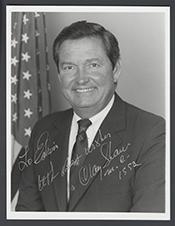
3,161 records where Rep. Shaw, E. Clay, Jr. [R-FL-22] is listed as a sponsor, author, or other actor. Search with topics and years
United States · United States Congress · 24 February 1986
Designates April 28, 1986, as National Nursing Home Residents Day.
United States · United States Congress · 20 February 1986
Designates the month of October 1986 as Lupus Awareness Month.
United States · United States Congress · 19 February 1986
Designates the week of May 25 through May 31, 1986, as Critical Care Week.
United States · United States Congress · 19 February 1986
Expresses the House of Representatives' support for the democratic aspirations of the Haitian people and calls upon the Government of Haiti to establish an electoral process culminating in free elections not later than six months after enactment of this Act.
United States · United States Congress · 6 February 1986
Drug Abuse Education Act of 1986 - Requires the Secretary of Education to establish a program of grants to States for drug abuse education in elementary and secondary schools. Lists the State and local educational agency uses of such funds. Restricts the amount States may use for administrative costs. Provides for: (1) the allotment of such grant funds to States; (2) State application for such grant funds; (3) allocations to local educational agencies; and (4) local application to State educational agencies. Provides for the equitable participation of children enrolled in private nonprofit elementary and secondary schools in such program. Requires the Secretary to: (1) collect and disseminate program-related information to State and local educational agencies; (2) provide technical assistance; and (3) identify research and development priorities. Authorizes appropriations for such activities. Provides that the use of such grant funds is to supplement and not supplant other Federal funds. Authorizes appropriations for FY 1987 through 1991.
United States · United States Congress · 6 February 1986
General Aviation Tort Reform Act of 1986 - Amends the Federal Rules of Civil Procedure to provide uniform rules for negligence and products liability claims arising from general aviation accidents. Allows any person claiming damages from such an accident to bring a products liability action against the general aviation manufacturer if: (1) the product was defective when it left the control of the manufacturer; (2) the defective condition was the proximate cause of the harm; (3) the condition would not have been corrected by actions described in directives issued by the Federal Aviation Administration (FAA) or the manufacturer; and (4) the aircraft was being used for a purpose and in a manner for which it was manufactured. Provides an alternative method to establish manufacturer liability where the manufacturer failed to provide reasonable warnings (unless such warnings would not have affected the conduct of the product user). Provides a third method to establish manufacturer liability where: (1) the manufacturer made an express warranty with respect to the product; (2) the warranty related to that aspect of the product which caused the harm; (3) the product failed to conform to the warranty; and (4) such failure was the proximate cause of the harm. States that all actions for damages arising from a general aviation accident shall be governed by the principles of comparative responsibility. Provides that defendants in such actions are severally but not jointly liable for damages (except that manufacturers of airframes and systems or components of aircraft may be jointly and severally liable under certain circumstances). Provides a 12-year limitation on liability of manufacturers. States that express warranties running for a longer period of time and the duty to provide additional warnings shall not be affected by such limitations. Allows awards of punitive damages. Prescribes a statute of limitations for such actions. Preempts State laws to the extent that this Act establishes applicable rules or procedures. Grants Federal district courts (concurrently with State courts) original jurisdiction (without regard to the amount in controversy) in all civil actions for damages arising out of a general aviation accident. Allows the removal of State actions to an appropriate Federal district court by any defendant. Prescribes venue restrictions. Expresses the intent of the Congress that orders to pay reasonable expenses, including attorney's fees, be enforced.
United States · United States Congress · 6 February 1986
Bankruptcy Judgeship Act of 1986 - Amends the judicial code to increase the number of bankruptcy judges: (1) from two to three for the Eastern and Western Districts of Arkansas; (2) from seven to nine for the Northern District of California; (3) from four to six for the Eastern District of California; (4) from 12 to 19 for the Central District of California; (5) from three to four for the Southern District of California; (6) from two to four for the Middle District of Florida; (7) from four to six for the Northern District of Georgia; (8) from one to two for the Southern District of Georgia; (9) from one to two for Idaho; (10) from eight to ten for the Northern District of Illinois; (11) from two to three for the Central District of Illinois; (12) from two to three for the Northern District of Indiana; (13) from one to two for the Northern District of Iowa; (14) from one to two for the Southern District of Iowa; (15) from two to three for the Western District of Kentucky; (16) from two to three for Maryland; (17) from two to three for the Western District of Michigan; (18) from one to two for Nebraska; (19) from two to three for Nevada; (20) from five to seven for New Jersey; (21) from one to two for the Northern District of Oklahoma; (22) from two to three for the Western District of Oklahoma; (23) from four to five for Oregon; (24) from one to two for South Carolina; (25) from two to three for the Eastern District of Tennessee; (26) from two to three for the Western District of Tennessee; (27) from four to five for the Northern District of Texas; (28) from three to six for the Southern District of Texas; (29) from two to three for the Western District of Texas; (30) from two to three for Utah; (31) from three to four for the Eastern District of Virginia; (32) from one to two for the Eastern District of Washington; (33) from four to five for the Western District of Washington; and (34) from three to four for the Eastern District of Wisconsin. Makes members of the bar of the Commonwealth of Puerto Rico eligible for appointment to bankruptcy judgeships.
United States · United States Congress · 6 February 1986
Amends the Export Administration Act of 1979 to prohibit exporting any item on the U.S. Munitions List to any country which the Secretary of State determines engages in or provides support or sanctuary for international terrorism. Prohibits exporting to such a country: (1) goods, technology, or other information that could make a significant contribution to the military potential of that country or that could enhance the ability of such country to support international terrorism; and (2) any aircraft. Prohibits rescinding a determination that a country supports international terrorism, unless the Secretary of State, at least 60 days before the rescission would take effect, certifies to the Congress that: (1) the country has not provided support for international terrorism for the preceding 12 months; and (2) the country has made explicit assurances that it will not support international terrorism in the future. Directs the President to try to secure international cooperation in prohibiting such exports to such countries. Directs the Secretary of State, within 90 days of enactment of this Act, to compile a list of countries providing support to international terrorism and a list of the goods, technology, and other information which shall not be exported to such countries.
United States · United States Congress · 6 February 1986
Amends the Export-Import Bank Act of 1945 to prohibit the Export-Import Bank from guaranteeing, insuring, or extending credit in connection with any export of goods or services to Angola until the President certifies to the Congress that no Cuban military personnel or military personnel from any other controlled country remain in Angola.
United States · United States Congress · 6 February 1986
Designates the week of March 9 through March 15, 1986, as National Employ the Older Worker Week.
United States · United States Congress · 6 February 1986
Declares that each standing committee of the House of Representatives may, within two days of adoption of this resolution, submit to the House Budget Committee alternatives to the President's sequestration order under the Balanced Budget and Emergency Deficit Control Act of 1985 (Gramm-Rudman-Hollings Act), insofar as such order affects laws within the jurisdiction of the committee. Requires the Budget Committee, within four days of adoption of this resolution, to report a resolution containing instructions to committees sufficient to achieve the total level of deficit reduction contained in the President's sequestration order for FY 1986. Provides that such instructions shall require that each committee (and each subcommittee of the Committee on Appropriations) achieve the same level of deficit reduction with respect to programs under its jurisdiction as would have been saved under the President's order. Requires committees to submit recommendations to the Budget Committee by February 21, 1986, sufficient to meet deficit reductions. Requires the Budget Committee to promptly report a reconciliation bill carrying out such recommendations. Authorizes the Budget Committee to include legislative language within the jurisdiction of any noncomplying committee. Requires such reconciliation bill to include a provision which states that if it is enacted on or before March 1, 1986, then the sequestration order for FY 1986 is null and void. Establishes procedures for floor consideration of such reconciliation bill, including limitation on debates and amendments.
United States · United States Congress · 6 February 1986
Let's Be Frank About The Frank Resolution - Amends rule XLVI of the Rules of the House of Representatives to require the quarterly publication in the Congressional Record of the volume and postage costs of franked mass mailing by each Representative during such quarter.
United States · United States Congress · 4 February 1986
Amends the Internal Revenue Code to extend the Hazardous Substance Response Trust Fund (Superfund) excise taxes on crude oil and petroleum products for the 180-day period beginning on February 3, 1986. Permits repayable advances to be made to such fund during the 180-day period beginning on February 3, 1986.
United States · United States Congress · 4 February 1986
Designates the week of September 7 through September 13, 1986, as National Independent Retail Grocer Week.
United States · United States Congress · 4 February 1986
Designates August 12, 1986, as National Neighborhood Crime Watch Day.
United States · United States Congress · 30 January 1986
Big Cypress National Preserve Addition Act - Establishes the Big Cypress National Preserve Addition out of specified lands in Florida. Requires the Secretary of the Interior to administer such Addition as part of the National Park System. Requires the Secretary of the Interior to review the Addition for suitability for designation as a wilderness area. Sets forth land acquisition procedures. Requires the Secretary to report to the Congress within one year on the existing Preserve and the Addition concerning their management and public use. Authorizes appropriations.
United States · United States Congress · 30 January 1986
Consumer Rail Equity Act - Reaffirms the intent of the Congress that the Railroad Revitalization and Regulatory Reform Act of 1976 and the Staggers Rail Act of 1980 be implemented in a manner which provides both greater competitive alternatives and adequate railroad revenues. Establishes a rebuttable presumption of rail market dominance if a person challenging a transportation rate shows that the railroad charging such rate does not face effective transportation competition. Shifts the burden of proof regarding transportation rate reasonableness from the shipper to the rail carrier establishing the challenged rate. Declares that it is Federal policy to encourage and promote competitive transportation rates for domestically produced coal and other commodities in order to increase their competitive position in domestic and export markets. Directs the Commission to establish a rail cost adjustment factor which includes changes in railroad productivity, volume, and output mix. Provides that certain rail carrier rates shall be reduced to the extent of any subsequent decreases in rail cost adjustment factors. Includes within the standards used to determine railroad revenue adequacy: (1) identification of revenues, expenses, and investment base reasonably related to rail transportation service; (2) straight-line depreciation of assets reasonably related to rail transportation service, minus deferred tax reserves resulting from accelerated depreciation; and (3) actual cost of debt capital and reasonable estimates of the current cost of equity capital. Requires the Commission, when making revenue adequacy determinations, to consider specified indicators of a rail carrier's financial status. Requires the Commission to determine, on an annual basis, which rail carriers are earning adequate or inadequate revenues and to determine for each rail carrier the revenues required to achieve or maintain revenue adequacy. Allows (current law requires) the Commission to exempt persons from application of this Act when: (1) such application is not necessary to implement Federal transportation policy; and (2) the Commission finds there is no market dominance involved in the affected transaction. Requires any rail carrier providing service under certain line rates to participate in competitive joint rail rates through practicable interchange connections (or publish a competitive proportional rate) if requested to do so by a rail carrier (or shipper or receiver) who has an actual or practicable interchange connection. Directs the Commission, upon petition of any interested party, to require certain terminal facilities owned by a rail carrier in interstate or foreign commerce to be used by another rail carrier if the Commission finds: (1) it is in the public interest to do so; and (2) that the owner of such terminal facility will not suffer substantial impairment of its own business interests. Directs the Commission to require, upon petition by an interested party, that rail carriers enter into reciprocal switching agreements if such an agreement is in the public interest or necessary to provide alternative competitive rail service. Directs the Commission to establish reciprocal switching compensation at a level not to exceed the current percentage of the actual variable costs for such service (unless the carrier demonstrates that a higher level is reasonable and necessary). Revises railroad line abandonment procedures to provide that a rail carrier must wait one year before resubmitting a previously denied abandonment application, unless a substantial change in circumstances can be shown. Requires the Commission to hold hearings in communities affected by a proposed railroad line abandonment if requested to do so by community protestants. Requires the Commission to base its abandonment determination upon financial data regarding the facility proposed to be abandoned rather than upon financial data regarding industry-wide averages. Subjects to Commission review any State decision regarding intrastate rates, rules, and practices if a party to such State proceedings petitions for Commission review. Requires the Commission to take action on such petition within 120 days of its receipt. Authorizes the Commission to vacate a State decision found inconsistent with this Act.
United States · United States Congress · 30 January 1986
Expresses the sense of the House of Representatives that the President should award the Presidential Medal of Freedom posthumously to Michael J. Smith, Francis R. Scobee, Ronald E. McNair, Ellison S. Onizuka, Sharon Christa McAuliffe, Gregory B. Jarvis, and Judith A. Resnik, all of whom died in the explosion of the space shuttle Challenger.
United States · United States Congress · 29 January 1986
Social Security Trust Funds Safeguard Act of 1986 - Amends titles II (Old Age, Survivors and Disability Insurance) and XVIII (Medicare) of the Social Security Act to require that all amounts appropriated to, or deposited in, a trust fund established under one of those programs be immediately and exclusively available for the purposes for which trust fund amounts are specifically made available under such program. Requires the President, in addition to appointing one member of the the public to the Board of Trustees of the social security trust funds (currently two members of the public are chosen), to appoint a Managing Trustee to the board, by and with the advice and consent of the Senate, for a term of four years. Provides that the Managing Trustee may be removed only for cause, but is prohibited from engaging in any other business, vocation, or employment. Requires the Department of Health and Human Services to provide the Managing Trustee with appropriate assistance. Directs the Managing Trustee to invest that portion of the social security trust funds which is not required to meet current withdrawals in accordance with an annual investment plan submitted by the Board. Requires the Board to conduct a continuing study and actuarial analysis of the status of investments made by the Managing Trustee and, by August 1 of each year, formulate and submit to the President and each House of the Congress an investment plan to govern the investments of the social security trust funds during the fiscal year. Requires the annual investment plan to set forth standards governing the investment and disinvestment of the trust funds which ensure, so far as is possible, that the OASDI and Medicare programs fulfill their intended purposes in a fiscally and actuarially sound nonpartisan manner, free from the influence of irrelevant budgetary or fiscal considerations. Directs that such plan be accompanied by any recommendations of the Board regarding investment of the social security trust funds. Directs that the investment plan and recommendations be incorporated in a special message to each House. Sets a minimum and maximum on amounts of the social security trust funds to be invested in obligations which are not obligations of the United States but which are guaranteed as to both principal and interest by the United States. Sets forth effective date and transitional provisions.
United States · United States Congress · 28 January 1986
Prohibits any benefits payable from the Civil Service Retirement and Disability Fund, including cost-of-living increases, during calendar year 1987 from being subject to reduction or suspension by statute or presidential order.
United States · United States Congress · 28 January 1986
Amends the Balanced Budget and Emergency Deficit Control Act of 1985 (Gramm-Rudman-Hollings Act) to exempt cost-of-living increases in Federal retirement and disability programs from reduction under the President's sequestration order for FY 1986. Provides for reducing the outlays of each agency to offset the increased costs.
United States · United States Congress · 28 January 1986
Designates the week beginning on April 20, 1986, as National Reading is Fun Week.
United States · United States Congress · 28 January 1986
Amends rule XV of the Rules of the House of Representatives to prohibit the House from passing or adopting any bill or joint resolution making or authorizing appropriations of at least $1,000,000,000, or increasing or decreasing revenues by at least $1,000,000,000, except by a rollcall vote.
United States · United States Congress · 23 January 1986
Amends the Internal Revenue Code to extend the termination date of the residential energy tax credit for solar property from December 31, 1985, to July 31, 1986. Sets forth definitions and special rules for solar property during such extension period. Extends the energy investment tax credit for solar energy property from December 31, 1985, to July 31, 1986. Sets forth special rules for solar property eligible for such credit during such extension period.
United States · United States Congress · 23 January 1986
Live Birth Abortion Revision Act - Amends the Internal Revenue Code to deny a taxpayer's personal exemption deduction for a child who is born alive after an induced abortion or an attempt to perform an abortion and dies as a result of such procedure. Denies the deduction for abortion expenses unless the abortion was performed to save the life of the mother. Denies the personal exemption deduction for the spouse or a dependent of the taxpayer if the taxpayer intentionally causes the death of such spouse or dependent. Requires a court determination of an intentional cause of death.
United States · United States Congress · 21 January 1986
Amends rule I of the Rules of the House of Representatives to revise the procedures for demanding rollcall votes on the passage of bills and resolutions. Directs the Speaker of the House, if such a demand has been made while a measure is under consideration, to inquire, when putting the question on final passage, whether any Member insists on a request for a recorded vote.
United States · United States Congress · 18 December 1985
Amends the National Endowment for Democracy Act to prohibit the National Endowment for Democracy from making grants to any organization if a member of the Board of Directors of the Endowment: (1) is affiliated with that organization; or (2) has been affiliated with that organization within the preceding two years.
United States · United States Congress · 18 December 1985
Amends rule XV of the Rules of the House of Representatives to prohibit the House from passing or adopting any bill or joint resolution making appropriations or providing revenue except by a rollcall vote.
United States · United States Congress · 17 December 1985
Designates the week beginning on June 1, 1986, as National Neighborhood Housing Services Week.
United States · United States Congress · 12 December 1985
Designates the week of February 9 through February 15, 1986, as National Burn Awareness Week.
United States · United States Congress · 12 December 1985
Designates the first Friday of May of each year, commencing with May 2, 1986, as National Teachers Appreciation Day.
United States · United States Congress · 10 December 1985
Calls upon the President to direct the Agency for International Development to work in a global effort to provide universal access to childhood immunization by 1990 by: (1) assisting in the delivery, distribution, and use of vaccines; and (2) performing and supporting research and development activities that will be targeted at developing new vaccines and at modifying existing vaccines to make them more appropriate for use in developing countries. Declares that the President should appeal to the public to provide the necessary resources to achieve universal access to childhood immunization by 1990. Amends the Foreign Assistance Act of 1961 to increase the authorization of appropriations for FY 1987 for the Child Survival Fund.
United States · United States Congress · 10 December 1985
Requires that the economic assumptions pertaining to inflation that are used for major weapon system programs of the Department of Defense included in the annual budget transmitted by the President to the Congress be the same as those used for all other programs, projects, and activities included in such budget.
United States · United States Congress · 5 December 1985
Expresses the sense of the Congress that Canada should carry out its pledge to discontinue the imposition of Federal excise tax on imported U.S. tourism literature.
United States · United States Congress · 20 November 1985
Telecommunications Equipment and Information Services Act of 1985 - Authorizes the Bell operating companies to provide information services (excluding electronic publishing) and to manufacture telecommunications equipment, subject to such regulations as the Federal Communications Commission may prescribe. Conditions such authority on the Commission's determination that no Bell operating company could impede competition in the information services or telecommunications equipment manufacturing businesses. Requires the Commission to include in its annual report to the Congress an assessment, providing for public comment, of the impact of this Act on employment in such businesses.
United States · United States Congress · 20 November 1985
Designates May 25, 1986, as Hands Across America Day. Authorizes and requests the President to commend: (1) United Support of Artists for Africa for their Hands Across America project; and (2) the American people for their commitment to helping people help themselves.
United States · United States Congress · 13 November 1985
Increases the liability of any person who violates Federal law on false claims to three times (currently, two times) the amount of damages the Government sustains as a result of such violation.
United States · United States Congress · 13 November 1985
Criminals' Accountability Act of 1985 - Amends Federal bankruptcy provisions to make nondischargeable any debt arising from a judgment or consent decree requiring a debtor to make restitution as a result of the commission of a crime.
United States · United States Congress · 12 November 1985
Prohibits the Secretary of the Treasury, in efforts to meet the public debt limit, from reducing the assets or earnings of, or delaying payments to, the Federal Old-Age and Survivors Insurance Trust Fund, Federal Disability Insurance Trust Fund, Federal Hospital Insurance Trust Fund, Federal Supplementary Medical Insurance Trust Fund, Railroad Retirement Account, Civil Service Retirement and Disability Fund, and Department of Defense Military Retirement Fund below levels otherwise maintained by law or by established standard procedures.
United States · United States Congress · 12 November 1985
Designates September 19, 1986, as National P.O.W./M.I.A. Recognition Day.
United States · United States Congress · 12 November 1985
Authorizes and requests the President to designate April 20 through April 26, 1986, as National Organ and Tissue Donor Awareness Week.
United States · United States Congress · 8 November 1985
Expresses the sense of the House of Representatives that interstate natural gas pipelines should transport natural gas for any person, including residential and commercial users, and should do so on a nondiscriminatory basis.
United States · United States Congress · 7 November 1985
Directs the Bureau of Justice Assistance to make grants to local governments for the development and implementation of innovative antiterrorism plans for deep draft ports and international airports.
United States · United States Congress · 6 November 1985
Anti-State-Supported Terrorism Act of 1985 - Authorizes the President, if a nation supports an act of terrorism against U.S. citizens, to: (1) suspend U.S. aid to that nation; (2) suspend trade between the United States and that nation; (3) deny trade benefits to that nation; and (4) impose other sanctions if they are imposed multilaterally.
United States · United States Congress · 6 November 1985
Designates the week of January 26 to February 1, 1986, as Truck and Bus Safety Week.
United States · United States Congress · 5 November 1985
Declares that: (1) the people around the world desire a world free from the threat of war; (2) it is the hope of all citizens that the President and General Secretary Gorbachev will reach an arms control agreement which significantly cuts nuclear stockpiles and halts the arms race between the United States and the Soviet Union; and (3) in order to express this hope, all citizens are invited to light candles from dusk to dawn on November 19 and 20, 1985, while the President and Gorbachev meet in summit.
United States · United States Congress · 31 October 1985
United States Trustees Act of 1985 - Title I: Amendments to Title 28 of the United States Code - Requires the Attorney General to direct United States trustees appointed to bankruptcy cases in discharging their duties. Authorizes the Attorney General to investigate the official acts, records, and accounts of such trustees. Directs the Attorney General to appoint one U.S. trustee for each of 24 bankruptcy regions constituted of specified Federal judicial districts. Reduces a U.S. trustee's term of office from seven to four years. Subjects a U.S. trustee to removal by the Attorney General without cause. Eliminates the 90-day limitation on service by an acting U.S. trustee. Permits the Attorney General to authorize a U.S. trustee designated to serve in more than one region to remain at his or her original official station. Limits the maximum annual compensation for a person appointed as standing trustee in individual debt bankruptcy cases to step 1 of grade GS-16, generally, and up to step 6 of grade GS-16 if such person has significantly decreased actual expenses resulting in a decrease of his or her percentage fee. Authorizes the use of interest earned from the deposit of payments under plans in the cases for which such person serves to pay such person's actual, necessary expenses, without limitation, if the Attorney General approves. Increases the maximum annual salary of a U.S. trustee to the rate of basic compensation for level IV of the Executive Schedule. Repeals the rulemaking authority of the Director of the Administrative Office of the United States Courts. Increases the filing fees required to commence bankruptcy cases to $100 for individual debt and liquidation cases and $500 for reorganization cases. Requires a debtor to pay $400 to convert an individual debt or liquidation case to a reorganization case. Prescribes the portions of such fees to be transmitted to the Treasury by the clerk of the court. Prescribes monthly charges to be paid as administrative expenses to U.S. trustees in reorganization cases. Directs the U.S. trustees to transmit charges received to the Treasury. Allows the Attorney General to increase such fees and charges based on the amount necessary for repayment to the Treasury of amounts appropriated for the U.S. trustee system. Title II: Amendments to Title 11 of the United States Code - Authorizes the bankruptcy court in an involuntary liquidation case to order the U.S. trustee to appoint an interim trustee. (Currently, the court makes such an appointment.) Authorizes the appropriate U.S. trustee to raise, appear, and be heard on any issue in any bankruptcy case or proceeding. Provides that the U.S. trustee for the judicial district in which a case is pending is eligible to serve as trustee in such case. Provides that the U.S. trustee qualifies whenever he or she serves in a bankruptcy case. Requires the appropriate U.S. trustee (currently, the court) to determine the amount of, and sufficiency of the surety on, a bond required to be filed by an individual in order to qualify as a trustee in a bankruptcy case. Prohibits the court from removing a U.S. trustee. Permits a U.S. trustee to remove: (1) a trustee in an individual debt or reorganization case by filing with the court a notice of the appointment of a successor trustee; and (2) a trustee or an examiner in a liquidation case after notice and a hearing, unless the court orders otherwise. Prohibits compensation for service or reimbursement of expenses of U.S. trustees or standing trustees in individual debt bankruptcy cases. Requires any compensation paid to a U.S. trustee serving as trustee in a bankruptcy case to be paid to the Treasury. Prohibits a trustee in a liquidation or reorganization case from employing a professional person who represents or is employed by a creditor, if the U.S. trustee objects. Requires the U.S. trustee to convene and preside at a meeting of creditors after an order for relief has been filed in a bankruptcy case. Permits the U.S. trustee to examine the debtor at such meeting. Authorizes the U.S. trustee (currently, the court) to order a meeting of any equity security holder. Permits a U.S. trustee to aggregate money of estates for which he or she serves as trustee for deposit or investment in order to increase earnings. Provides for the appointment of original, interim, and successor trustees for liquidation cases by U.S. trustees. (Currently, the court has such authority.) Requires a trustee in a liquidation case to file reports on the operation of a debtors' business and the administration of the debtor's estate with the appropriate U.S. trustee. Permits a creditors' committee to consult with, and make recommendations to, the U.S. trustee concerning the performance of the trustee's duties. Authorizes a court to dismiss: (1) a voluntary liquidation case if the debtor fails to file information on his or her financial affairs within 15 days after filing the petition commencing the case; and (2) a liquidation case if the debtor fails to file his or her intentions for property securing consumer debts within the prescribed period. Grants a U.S. trustee the same rights and responsibilities as a trustee in the discharge of a liquidation case. Provides for the appointment of committees of creditors and equity security holders in reorganization cases by the appropriate U.S. trustee. (Currently, the court has such authority.) Authorizes the U.S. trustee to request the appointment of a trustee or examiner and the termination of the trustee's appointment to such a case. Directs the U.S. trustee (currently, the court) to appoint any successor trustee or examiner. Permits a court to dismiss a reorganization case or to convert such a case to a liquidation case at the request of a U.S. trustee. Includes as cause for dismissal the (1) nonpayment of court fees; (2) failure of a debtor in a voluntary case to file information on his or her financial affairs within 15 days after filing the petition commencing the case; and (3) failure of a debtor to file his or her intention for property securing consumer debts within the prescribed period. Provides for the appointment of a standing trustee or the designation of a trustee in an individual debt bankruptcy case by the appropriate U.S. trustee. (Currently, the court has such authority.) Permits the U.S. trustee to serve as such trustee. Permits a court to dismiss an individual debt case or to convert such a case to a liquidation or reorganization case at the request of a U.S. trustee. Includes as a cause for dismissal the failure of a debtor to file: (1) information on his or her financial affairs within 15 days after the filing of the petition commencing the case; or (2) his or her intentions for property securing consumer debts within the prescribed period. Title III: Transition and Repealer - Repeals provisions that would repeal specified provisions providing for the appointment, compensation, staff, and termination of U.S. trustees as of September 30, 1986. Sets forth technical amendments providing for transition to the United States trustee system established by this Act. Title IV: Authorization for Appropriations for Bankruptcy Administration - Authorizes appropriations to carry out this Act. Requires the use of bankruptcy filing fees to reimburse the Treasury for such appropriations. Title V: The Rules of Bankruptcy Procedure - Provides that Part X of the Rules of Bankruptcy Procedure shall apply in any district in which a U.S. trustee is serving until such part is superseded by Rules of Bankruptcy Procedure as prescribed by the Supreme Court.
United States · United States Congress · 31 October 1985
Anti-Terrorism Trade Preference Act of 1985 - Directs the Secretary of State to identify and publish the name of each country that repeatedly supports acts of international terrorism. Requires the Secretary to provide the Congress with a list of such countries annually. Imposes the following sanctions on countries identified as supporting international terrorism: (1) termination, withdrawal, or suspension of any treaty that relates to most-favored-nation treatment of such country; (2) denial of most-favored-nation treatment and imposition of column 2 tariff rates on imports from such countries; (3) non-application of the Generalized System of Preferences on imports from such countries; and (4) non-application of the provisions of the Caribbean Basin Economic Recovery Act with respect to the products of such countries. Authorizes the President to waive such sanctions if it would be in the best interests of the United States. Directs the President to notify the Congress 30 days before any such waiver takes effect.
United States · United States Congress · 31 October 1985
Designates October 31, 1986, as National Child Identification and Safety Information Day.
United States · United States Congress · 31 October 1985
Expresses the sense of the Congress that: (1) the Postmaster General should issue a stamp, before October 1, 1986, commemorating the 100th Congress; and (2) the U.S. Postal Service should conduct a public competition for the design of the stamp.