Bill· HJRESH.J.Res. 62 (98th)open
A joint resolution designating the month of March 1983 as National Eye Donor Month.
United States · United States Congress · 6 January 1983
Designates the month of March 1983 as National Eye Donor Month.
The world's political record
Person
United States · Official source
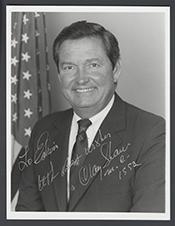
3,161 records where Rep. Shaw, E. Clay, Jr. [R-FL-22] is listed as a sponsor, author, or other actor. Search with topics and years
United States · United States Congress · 6 January 1983
Designates the month of March 1983 as National Eye Donor Month.
United States · United States Congress · 3 January 1983
Florida Wilderness Act of 1983 - Designates the following lands in Florida as components of the National Wilderness Preservation System: (1) the Bradwell Bay Wilderness Addition in the Apalachicola National Forest; (2) the Mud Swamp/New River Wilderness in the Apalachicola National Forest; (3) the Big Gum Swamp Wilderness in the Osceola National Forest; (4) the Alexander Springs Wilderness in the Ocala National Forest; (5) the Juniper Prairie Wilderness in the Ocala National Forest; (6) the Little Lake George Wilderness in the Ocala National Forest; and (7) the Billies Bay Wilderness in the Ocala National Forest. Prohibits the Department of the Interior from issuing phosphate leases in the Osceola National Forest until the President recommends to Congress that such leases be permitted in a specified area of the forest, based upon a national need for phosphate. Requires the President to submit the basis for such recommendation, a statement of conditions governing the activity, and the required environmental impact statements. Makes a Presidential recommendation effective within 90 days after its submission to Congress unless Congress passes a concurrent resolution disapproving it. Requires the Secretary of the Interior, within 60 days after enactment of this Act, to determine if specified phosphate preference right lease applicants have discovered valuable deposits of phosphate. Requires the Secretary, within one year of the enactment of this Act, to determine the fair market value of phosphate leases which would be issued to such lease applicants absent the leasing ban under this Act. Directs the Secretary to acquire by exchange, monetary credit, lease issuance suspension, or purchase any valuable phosphate lease rights from such lease applicants within three years after enactment of this Act. Provides that the designation of the Big Gum Swamp Wilderness will not alter phosphate lease rights applicable to lands within the wilderness. Allows waivers of the time deadlines under this Act. Authorizes appropriations.
United States · United States Congress · 3 January 1983
Amends the Foreign Assistance Act of 1961 to prohibit assistance to any country which is a known source of illicit drugs, unless the President has certified to Congress during the fiscal year that the governing authorities of that country are fully cooperating with the United States in its efforts to reduce the flow of illicit drugs from that country. Amends the Arms Export Control Act to prohibit issuing letters of offer and export licenses and to prohibit extending credits or guarantees to any country which is a known source of illicit drugs, unless the President has certified to Congress during the fiscal year that the governing authorities of that country are fully cooperating with the United States in its efforts to reduce the flow of illicit drugs from that country.
United States · United States Congress · 3 January 1983
Sunset Act of 1983 - Title I: Reauthorization of Government Programs - Sets forth a ten-year schedule for reauthorization of all Federal programs according to budget function and subfunction as set forth in the Budget of the United States Government for fiscal year 1983. Sets forth the procedure in the House of Representatives and the Senate for the consideration of any bill, resolution, or amendment which authorizes new budget authority. States that it is not in order for either House to consider any legislation which authorizes the enactment of new budget authority for a program for a period of more than ten years, for an indefinite period, or for any fiscal year beginning after the next reauthorization date applicable to such program. Provides that before the Congress can appropriate funds for any program, after its first reauthorization date, there must be a specific authorization in law to support the appropriation. Requires the committees of the Senate and House of Representatives to schedule and conduct a sunset review of programs to be reauthorized. Requires that the report accompanying such reauthorizations contain specified information and be completed during the Congress in which the program is scheduled for reauthorization. Exempts from the requirements of this Act specified programs such as interest on Federal debts, health care services, general retirement and disability payments, as well as litigation activities which have as their objectives the protection and implementation of civil rights guaranteed by the Constitution, and specified retirement pay and benefits. Allows the reauthorization schedule set forth in this Act to be changed by concurrent resolution of the two Houses of Congress and sets forth the procedure for such change. Requires all legislation and other matters related to changes in the dates for programs under this Act to be referred to the committee with legislative jurisdiction over any program affected by the proposal and, sequentially, to the Committee on Rules in the House of Representatives and to the Committee on Rules and Administration in the Senate. Requires such committees to report any concurrent resolution or bill referred to it by a committee of legislative jurisdiction within 30 days, with a statement on each of its recommendations. Makes provisions for any proposed change which has been reported by a committee before June 1, 1984. Title II: Program Inventory - Directs the Comptroller General and the Director of the Congressional Budget Office, in cooperation with the Director of the Congressional Research Service, to prepare an inventory of Federal programs. Declares that the purpose of such program inventory is to advise and assist Congress in carrying out reauthorization and reexamination requirements and to link such reauthorization and review process with the budget process. Requires the Comptroller General to submit such program inventory to each House of Congress no later than January 1, 1984. Sets forth the contents of the inventory program, including the type of authorization provided for such programs' new budget authority and the manner in which related program areas may be grouped for evaluation and review. Permits the congressional committees, the Congressional Budget Office, and the Congressional Research Service to review the program inventory and to suggest revisions. Requires that the program inventory be revised at the end of each session of Congress, and that such revisions be reported to each House. Requires that periodic reports tabulate the progress of congressional action on bills and resolutions authorizing budget authority for programs in the inventory. Requires the Comptroller General and the Director of the Congressional Budget Office to submit periodic reports to the Congress on the adequacy of the functional and subfunctional categories for grouping programs of like missions or objectives. Title III: Program Reexamination - Requires each committee of the Senate and the House of Representatives to reexamine selected programs or groups of programs over which it has jurisdiction. Sets forth procedures for such review, and criteria for selection of program areas for evaluation. Directs each committee to consult with the appropriate committees of either the House of Representatives or the Senate in order to achieve coordination of program reevaluation. Directs each Committee to inform itself of the related activities of or available assistance from the General Accounting Office, the Congressional Budget Office, the Congressional Research Service, the Office of Technology Assessment, and other appropriate instrumentalities in the executive and judicial branches. Requires each committee to deliver a report on the reexamination to the Secretary of the Senate or the Clerk of the House at the date specified in the funding resolution first reported by such committee in 1985 and thereafter for the first session of each Congress. Allows two or more committees which have legislative jurisdiction over the same programs or portions of the same programs to examine such programs jointly and submit a joint report. Stipulates that such report: (1) contain the findings, recommendations, and justifications of the program; and (2) include specified information including, but not limited to, an assessment of the cost-effectiveness of the program and an identification of any trends, developments, and emerging conditions which are likely to affect the nature and extent of the problems or needs which the program is intended to address. Requires each executive department or agency which is responsible for a program selected for reexamination to submit a report to the Office of Management and Budget and to the appropriate committees of the Congress on its findings, recommendations, and justifications of specified aspects of the program. Title IV: Tax Expenditures - Requires the Director of the Congressional Budget Office, after consultation with the Joint Committee on Taxation of the Congress, to prepare an inventory of tax expenditure provisions and to submit a report on such inventory to the Committee on Ways and Means of the House and the Senate Finance Committee. Defines the term "tax expenditure provision" as any provision of Federal law which allows a special exclusion, exemption, or deduction in determining liability for any tax or which provides a special credit against any tax, a preferential rate of tax, or a deferral of tax liability. Specifies the contents of the report, which include an estimate of the revenue loss from each tax provision. Requires the Director to: (1) submit a revised inventory to each House of Congress by December 1, 1984; (2) revise the inventory after the close of each session of Congress and report such revisions to Congress; and (3) periodically report on Congressional action on bills and resolutions which create or affect tax provisions. Directs the House Committee on Ways and Means and the Senate Committee on Finance to prepare a reauthorization schedule for all tax provisions similar to the schedule set out for Federal programs in title I of this Act. Requires Congress to take final action on the reauthorization schedule for tax provisions before the end of the 98th Congress. Provides that each tax expenditure provision shall expire unless it is reauthorized by a law enacted during the Congress in which it is scheduled for review. Sets forth procedures and restrictions for the consideration of bills reauthorizing tax provisions, which are similar to the restrictions and procedures governing bills authorizing new budget authority for Federal programs as described in title I. Requires that the report accompanying a reauthorization bill include specified information. Permits Congress to prescribe technical rules necessary to mitigate adverse effects which might result for taxpayers who rely on a certain tax provision. Title V: Miscellaneous - Amends the Budget and Accounting Act of 1921 to permit the committees of Congress to obtain from the agencies of the Government estimates or requests for appropriations, or requests for increases in an item of any such estimate or request, and recommendations as to how the revenue needs of the Government should be met. Sets forth administrative procedures and requirements. Directs the President, with the cooperation of the head of each appropriate agency, to submit to the Congress a "Regulatory Duplication and Conflicts Report" for all programs scheduled for reauthorization in the next Congress. Requires that each such report identify duplicative or conflicting rules and regulations promulgated by executive departments, independent agencies, and State and local governments and contain recommendations which address such conflicts or duplications. Directs the chairmen of the House and Senate committees having jurisdiction over a program scheduled for reauthorization during a Congress, to introduce a bill constituting a reauthorization within 15 days of the beginning of the second session of that Congress. Declares that it shall be in order to discharge a committee from consideration of such a bill if the committee fails to report the bill by a specified date. Makes it the duty of the Committees on Governmental Affairs and on Rules and Administration of the Senate and the Committees on Government Operations and Rules of the House of Representatives to review the operation of the procedures established by this Act and to submit a report every five years beginning December 31, 1990. Authorizes appropriations through fiscal year 1994.
United States · United States Congress · 3 January 1983
Amends the Federal census provisions to require Federal agencies to use the most recent population data (rather than the most recent decennial census data) in determining the amount of benefits due State and local governments under Federal programs.
United States · United States Congress · 3 January 1983
Designates November 14, 1982, as National Retired Teachers Day.
United States · United States Congress · 3 December 1982
Federal Anti-Tampering Act - Amends the Federal Criminal Code to make it a Federal offense to maliciously cause bodily injury or death to any person by tampering with any article, product, or commodity which is produced or distributed for human use or consumption. Provides for a prison term of up to 20 years and a fine of up to $20,000 if personal injury results, or a prison term of up to life if death results.
United States · United States Congress · 1 December 1982
Amends rule VIII of the Rules of the House of Representatives to require a recorded vote on final passage of legislation that adjusts the pay of Members, affects limitations on outside earned income, or provides tax credits or deductions for Members as a separate or distinct class. Excludes adjustments made under the Legislative Reorganization Act of 1946 from such requirement. Makes it out of order in the House to consider any bill, resolution, or conference report subject to such amended rule unless: (1) it comprises only the items affecting the pay or benefits of Members; and (2) it takes effect at the beginning of the subsequent Congress. Requires the Committee on Rules, when reporting a resolution waiving any point of order relative to specified clauses of rule VIII, to clearly identify the subject matter of the point of order being waived and the clause of such rule.
United States · United States Congress · 30 September 1982
Immigration Emergency Act - Authorizes the President to declare an immigration emergency if in his judgment: (1) a substantial number of undocumented aliens from a designated country (countries) or geographic area (areas) are ready to leave for the United States, or have already done so; and (2) the normal procedures and resources of the Immigration and Naturalization Service would be inadequate to handle the influx of these aliens. Requires the President to explain such action to the Speaker of the House and the President pro tempore of the Senate within 48 hours. Terminates such emergency period after 120 days unless ended sooner or extended by the President. Authorizes the President during an immigration emergency to: (1) prevent U.S. vessels, vehicles, or aircraft from traveling to designated countries or areas; (2) prevent inadmissible aliens from arriving by requiring their return or their vessel, vehicle, or aircraft's return to a suitable country or area; (3) exempt executive instrumentalities from additional specified environmental requirements for up to one year; and (4) designate one or more Federal agencies including the military to carry out these emergency powers (once they are invoked by the President). Requires an alien to be detained pending a final determination of admissibility. Permits the Attorney General to transfer such detained aliens at any time. Limits judicial review of the Attorney General's detention and transfer authority to habeas corpus questions of whether a particular person is within the category of aliens subject to detention. Grants search and seizure and disaster authority to agencies enforcing this Act. Prohibits U.S. conveyances to travel to, or within specified distances of, designated countries or areas during an immigration emergency without prior executive approval. Provides penalties for violations, including fines, forfeiture, and imprisonment. Provides that violations of the Immigration and Nationality Act committed during an immigration emergency may be investigated by the Federal Bureau of Investigation, the Immigration and Naturalization Service, the Coast Guard, or any component of the Department of the Treasury. Amends the Immigration and Nationality Act to increase the fine for unlawfully bringing aliens into the United States. Permits the seizure of a vessel or aircraft so involved. Authorizes up to $35,000,000 for purposes of this title.
United States · United States Congress · 28 September 1982
Comprehensive Victim and Witness Protection and Assistance Act of 1982 - Amends rule 32 of the Federal Rules of Criminal Procedure to require that presentence reports contain: (1) information concerning any harm or loss suffered by the victim; (2) information that may aid the court in sentencing; (3) a statement of the circumstances of the commission of the offense; and (4) any prior criminal record of the defendant. Amends the Federal criminal code to establish as offenses "tampering with a witness or an informant" and "retaliating against a witness or an informant." Authorizes the Attorney General to initiate civil proceedings to restrain any harassment of a victim or witness. Authorizes a sentencing court to order the defendant to make restitution. Requires the court to state for the record the reasons for not ordering restitution. Prescribes a procedure for the issuance of restitution orders. Directs the Attorney General to develop Federal guidelines for the fair treatment of crime victims and witnesses. Requires the Attorney General to consider certain objectives in preparing the guidelines, including: (1) ensuring that victims receive prompt social and medical services; (2) giving victims and witnesses notice of important criminal justice proceedings and scheduling changes; (3) arranging for the prosecution to obtain the nonbinding views of victims of serious crimes during such stages as plea bargaining and pretrial release; (4) encouraging employers to continue to pay victims and witnesses for work absences to assist investigations and prosecutions; (5) training law enforcement personnel in victim assistance; and (6) informing victims or witnesses on legal steps for protection from intimidation. Directs the Attorney General to recommend to Congress any laws that are necessary to ensure that no Federal felon derives any profit from the sale of his or her story until any victim of the offense receives restitution. Amends the Bail Reform Act of 1966 to require as a condition of pretrial release that the defendant not commit certain offenses.
United States · United States Congress · 16 September 1982
Designates December 12 through December 18, 1982, as National Drunk and Drugged Driving Awareness Week.
United States · United States Congress · 15 September 1982
Criminal Justice Reform Act of 1982 - Title I: Offenders with Mental Disease or Defect - Insanity Defense Reform Act of 1982 - Amends the Federal criminal code to make it a defense to a Federal prosecution that at the time of the offense the defendant, as a result of mental disease or defect, lacked the state of mind required as an element of the offense charged. Requires the court to hold a hearing to determine the present mental condition of the defendant. Directs the court to commit such person to the custody of the Attorney General upon a finding by a preponderance of the evidence that the person is presently suffering from a mental disease or defect, rendering him mentally incompetent. Directs the Attorney General to hospitalize such person in a suitable facility. Provides that when the defendant has recovered and is able to understand the nature and consequences of the proceedings against him, the court will order his release and set a date for trial. Authorizes a special verdict of "not guilty only by reason of insanity" for any criminal defendant who raises the issue of insanity by notice as provided by Rule 12 of the Federal Rules of Criminal Procedure. Provides for the hospitalization of persons found not guilty only by reason of insanity, convicted persons, imprisoned persons, and persons due for release who are found to suffer from mental disease or defect. Allows for discharge when such person is found to have recovered. Requires reimprisonment of any such person for whom a term of prison sentence has not yet expired. Title II Application of the Exclusionary Rule - Exclusionary Rule Application Act of 1982 - Allows evidence obtained as a result of a search or seizure to be admissible if the search or seizure was undertaken in a reasonable good faith belief that it was in conformity with the fourth amendment to the Constitution. Title III: Federal Intervention in State Criminal Proceedings - Federal Intervention Reform Act of 1982 - Conditions consideration of a habeas corpus claim by a State prisoner on a showing of actual prejudice resulting from the Federal right violated and that : (1) state action precluded assertion of the right; (2) the Federal right did not previously exist; or (3) the factual basis of the claim could not have been discovered by reasonable diligence. Establishes a one-year statute of limitations for habeas corpus actions brought by State prisoners. Vests authority to issue certificates for probable cause for appeal of habeas corpus orders exclusively in the courts of appeals. Permits denial on the merits of habeas corpus writs notwithstanding the failure to exhaust State remedies. Prohibits the granting of a habeas corpus writ with respect to any claim which has been fully and fairly adjudicated in State proceedings.
United States · United States Congress · 9 September 1982
Commends the supporters of the Florida Sheriffs Boys Ranch on the occasion of its 25th anniversary.
United States · United States Congress · 19 August 1982
Expresses the sense of the Congress that the Secretary of Health and Human Services should withdraw certain proposed rules that would reduce public notice and comment opportunities in rulemaking procedures.
United States · United States Congress · 11 August 1982
Missing Children Act - Authorizes the Attorney General to collect and exchange information which would assist in the identification of unidentified deceased individuals and the location of missing persons, including missing children.
United States · United States Congress · 15 July 1982
Residential Mortgage Investment Act of 1982 - Permits employee benefit plans, as defined under this Act, to engage in any qualified mortgage transaction involving any qualified residential mortgage loan, provided transactions between all parties are at arm's length. Permits such plans to participate in any mortgage pool, provided such pool conforms to specified requirements with regard to permitted investments. Authorizes the Secretary of the Treasury to prescribe regulations to carry out this Act. Provides that this Act shall supersede any and all contrary provisions of State law, the Employee Retirement Income Security Act of 1974, and the Internal Revenue Code. Prohibits the imposition of Federal excise tax on a plan or pool that engages in a transaction described under this Act.
United States · United States Congress · 15 July 1982
Requests the President to designate the first week in October of 1982, 1983, and 1984 as National Port Week.
United States · United States Congress · 15 July 1982
Expresses the support of the Congress for beginning strategic arms reductions talks. Urges the Soviet Union to join with the United States in concluding an equitable and verifiable agreement which freezes strategic nuclear forces at equal and substantially reduced levels. Reaffirms congressional support for the position that the United States should not enter into an arms agreement which provides for force levels inferior to those of the Soviet Union. Declares that the United States should propose practical measures to: (1) reduce the danger of accidental nuclear war; (2) prevent the use of nuclear weapons by third parties, including terrorists; and (3) halt the worldwide proliferation of nuclear weapons. Insists that any arms control agreement must be fully verifiable.
United States · United States Congress · 24 June 1982
Amends the Federal criminal code to authorize a verdict of "guilty but mentally ill" even if such illness would not constitute legal insanity. Permits the court to impose on a defendant found guilty but mentally ill any sentence which the court can impose on a defendant convicted of such offense. Allows treatment of the defendant for mental illness during the term of sentence.
United States · United States Congress · 24 June 1982
Designates the week beginning on October 24, 1982, as National Parkinson's Disease Week.
United States · United States Congress · 22 June 1982
Requests the President to designate the week of April 17 through April 23, 1983, as National Coin Week.
United States · United States Congress · 22 June 1982
Expresses the sense of Congress that legislation should be proposed and enacted to: (1) establish parity between the compensation of Government Printing Office (GPO) employees and the compensation of other Federal employees performing similar work; (2) fix the wages of GPO employees in accordance with the prevailing wage rate system applicable to executive branch employees; and (3) strengthen the Public Printer's ability to manage without infringing on the oversight responsibilities of the Joint Committee on Printing.
United States · United States Congress · 16 June 1982
Expresses the sense of the House of Representatives that the President should: (1) urge the Soviet Union to allow Lev Shapiro and his family to emigrate to Israel; and (2) inform the Soviet Union that the United States, in evaluating its relations with other countries, will consider the extent to which those countries honor their commitments to human rights under international law.
United States · United States Congress · 10 June 1982
Prohibition of Mandatory Retirement and Employment Rights Act of 1982 - Amends the Age Discrimination in Employment Act of 1967 to eliminate the upper age limitation of the class of persons to whom such Act applies.
United States · United States Congress · 9 June 1982
Limits the outside earned income of Senators to $18,000 per calendar year.
United States · United States Congress · 7 June 1982
Designates the Federal building in Lima, Ohio, as the Tennyson Guyer Federal Building.
United States · United States Congress · 7 June 1982
Amends titles II (Old Age, Survivors and Disability Insurance) and XVIII (Medicare) of the Social Security Act to prohibit the inclusion of the disbursements from the Federal Old-Age and Survivors Insurance Trust Fund, the Federal Disability Insurance Trust Fund, and the Federal Hospital Insurance Trust Fund and of the receipts from the old age, survivors and disability insurance taxes and the hospital insurance taxes on self-employment income, employees, and employers in the totals of the Federal budget. Exempts such disbursements and receipts from any general statutory limitation on Federal budget outlays.
United States · United States Congress · 27 May 1982
Safe Harbor Leasing Reform Act of 1982 - Amends the Internal Revenue Code to limit the accelerated depreciation deductions and investment tax credit amounts accruing to safe harbor lessors from sale and leaseback arrangements of depreciable property. Allows such lessors a limited income tax credit for the reduction in tax benefits. Exempts safe harbor lessors from at risk requirements for deducting investment losses. Limits the availability of sale and leaseback arrangements in the case of certain lessees with foreign source income. Limits the income tax deduction for interest on investment indebtedness for safe harbor lease property.
United States · United States Congress · 26 May 1982
Violent Crime and Drug Enforcement Improvements Act of 1982 - Title I: Bail Reform - Bail Reform Act of 1982 - Repeals the Bail Reform Act of 1966 and sets forth new bail procedures. Retains execution of a money bond as a condition for pretrial release. Authorizes a judicial officer to consider the safety of any person or the community when making a pretrial release determination. Establishes as a mandatory release condition that the person not commit a Federal, State, or local crime during release. Expands the discretionary release conditions to include that the defendant: (1) maintain employment or an educational program; (2) avoid contact with an alleged victim or potential witness; (3) report to a law enforcement or pretrial service agency; (4) comply with a curfew; (5) refrain from possessing a firearm or using alcohol or narcotic drugs; (6) undergo medical treatment; (7) agree to forfeit designated property, including money, upon failure to appear; and (8) return to custody at specified hours. Prohibits a judicial officer from imposing financial conditions that result in the pretrial detention of a person. Authorizes a judicial officer to order the detention for up to ten days of a person who is presently on pretrial release for a felony under Federal, State, or local law or on probation or parole or release pending sentencing or appeal for any offense, upon a determination that such person may flee or pose a danger to any person or the community. Requires that a detention hearing be held in any case involving: (1) a crime of violence; (2) any offense punishable by life imprisonment or death; (3) a narcotics offense punishable by at least ten years imprisonment; (4) a serious risk of flight or obstruction of justice; or (5) any felony committed after the person has been convicted of two or more offenses for which a hearing is mandated. Authorizes a judicial officer, after such a hearing, to order the pretrial detention of a person upon finding that no condition will reasonably assure such person's appearance and the safety of any other person and the community. Creates certain rebuttable presumptions with regard to absence of such conditions. Enumerates additional factors to be considered by the judicial officer in making a release determination, including the defendant's past conduct, history of drug or alcohol abuse, criminal history, and the nature and seriousness of the danger to the community or any person. Requires the detention of a person who has appealed his conviction unless the judicial officer finds by clear and convincing evidence that: (1) such person is not likely to flee or pose a danger to another person or property; and (2) the appeal raises a substantial question of law or fact. Requires the detention of a person awaiting sentencing unless the officer finds by clear and convincing evidence that the person is not likely to flee or pose a danger to any other person or the community. Authorizes a U.S. attorney to appeal a release order. Makes a person guilty of an offense for failing to appear after having been released. Provides increased penalties for persons charged with more serious offenses. Makes it an affirmative defense to such crime that uncontrollable circumstances prevented the person from appearing. Establishes mandatory additional penalties for commission of an offense while on pretrial release. Subjects a person who has been conditionally released and who violates a condition of release to revocation of release and prosecution for contempt of court. Authorizes a surety to arrest a person charged with an offense who is released upon execution of an appearance bond with such surety. Requires such person to be delivered promptly to a judicial officer for a revocation determination. Grants new authority to law enforcement officers to arrest a person who violates pretrial release conditions. Title II: Witness-Victim Protection - Witness-Victim Protection Act of 1982 - Amends rule 32 of the Federal Rules of Criminal Procedure to require that presentence reports contain information assessing the impact upon and cost to any person who was the victim of the offense. Amends the Federal criminal code to establish as offenses "tampering with a witness, victim, or an informant" and "retaliating against a witness or an informant." Amends the Bail Reform Act of 1966 to require as a condition of pretrial release that the defendant not commit these offenses. Grants general authority to the Attorney General to relocate or protect Government witnesses. Authorizes the Attorney General to initiate civil proceedings to restrain tampering with a witness or victim. Grants exclusive jurisdiction to the Federal courts over civil claims against the United States for damages caused by dangerous offenders who are released or who escape from the lawful custody of a U.S. employee as a result of such employee's gross negligence. Directs the Attorney General to develop Federal guidelines for the fair treatment of crime victims to ensure that all victims of crime are justly compensated. Title III: Controlled Substances Penalties - Controlled Substances Penalties Amendments Act of 1982 - Increases the fine levels for drug trafficking. Increases the penalties for trafficking in large amounts of controlled substances. Title IV: Protection of Federal Officials - Amends the Federal criminal code to make it a Federal crime to kill, assault, or kidnap a cabinet officer, the second ranking official in each executive department, the Director or Deputy Director of Central Intelligence, a U.S. Supreme Court justice or nominee, or a senior presidential or vice presidential adviser. Includes as a Federal crime any attempt or conspiracy to commit such offenses. Title V: Sentencing Reform - Sentencing Reform Act of 1982 - Sets forth a new sentencing structure applicable to a defendant who is found guilty of an offense under any Federal statute. Permits an individual to be sentenced to a term of imprisonment or probation and a fine, and to receive additional sanctions, including: (1) forfeiture for certain racketeering crimes and drug-related offenses; (2) an order of notice to victims of crimes in cases involving fraud or deceptive practices; or (3) an order of restitution in cases involving bodily injury or property damage. Permits an organization to receive these penalties, with the exception of imprisonment. Creates the United States Sentencing Commission. Specifies factors to be considered by a sentencing court, including the guidelines and policy statements issued by the United States Sentencing Commission. Requires the court to impose a sentence within the range set forth by the Commission unless aggravating or mitigating circumstances exist that were not adequately considered by the Commission in formulating the guidelines. Requires the court to state in open court at the time of sentencing the reason for imposing a sentence at a point within the prescribed range, or the specific reason for imposing a sentence outside of such range. Authorizes the imposition of a term of probation, unless specifically prohibited, for all but the most serious class of felonies. Requires as a mandatory condition of probation that a defendant not commit another crime. Enumerates 20 discretionary conditions. Sets forth a fine schedule for the categories of offenses, generally at higher levels than current law. Includes higher maximums for organizational defendants. Directs the court to consider the defendant's financial status in determining the amount of a fine and the method of payment. Sets maximum terms of imprisonment for five classes of felonies (A to F), three classes of misdemeanors (A to C), and an infraction (five day maximum). Allows the court, in imposing a sentence of imprisonment for a felony or misdemeanor, to include a term of supervised release after imprisonment. Eliminates the special sentencing provisions under current law for dangerous special offenders, youth offenders, young adult offenders, and drug addicts, but provides for these categories of offenders under the proposed sentencing guidelines. Excludes capital punishment as an authorized penalty, but leaves unaffected the current death penalty and procedures for aircraft hijacking. Eliminates the parole system. Permits a defendant to petition for a sentence reduction upon a showing of extraordinary and compelling reasons. Limits this motion for defendants who are sentenced to six or more years of imprisonment. Allows the defendant or the government to file a notice of appeal in the district court for review of a final sentence. Title VI: Criminal Forfeiture - Comprehensive Criminal Forfeiture Act of 1982 - Amends the Racketeer Influenced and Corrupt Organizations Act (RICO) to specify that property subject to forfeiture for racketeering activity includes: (1) all proceeds obtained directly or indirectly from racketeering activity; (2) real and tangible and intangible personal property; and (3) positions, offices, appointments, and benefits obtained through illegal activity. Makes property forfeitable to the United States upon the commission of the act giving rise to forfeiture. Permits the forfeiture of property which has been transferred to a third party, but includes a provision protecting innocent bona fide purchasers. Authorizes a court to order the forfeiture of substitute assets of the defendant where the original property cannot be located or traced. Authorizes a court to take appropriate action preserving the availability of property during the pre-indictment period effective for up to 90 days. Specifies the circumstances under which a temporary restraining order may be issued without notice to the affected party. Authorizes the Attorney General to grant petitions for remission or mitigation of forfeiture. Directs the Attorney General to establish regulations governing the restitution and disposition of forfeited property. Amends the Comprehensive Drug Abuse Prevention and Control Act of 1970 to establish general criminal forfeiture provisions for felony violations under titles II and III. Includes provisions similar to the RICO amendments of this Act, relating to property subject to forfeiture, third party transfers, asset substitution, pre-indictment orders, and remission. Authorizes a court to issue a warrant authorizing the seizure of property subject to forfeiture in the same manner provided for a search warrant, if other injunctive relief would not assure the availability of the property. Provides that a criminal forfeiture proceeding shall stay any civil forfeiture proceeding with respect to the same property. Authorizes the Drug Enforcement Administration to set aside 25 percent of the amounts realized from forfeitures under the Comprehensive Drug Abuse Prevention and Control Act of 1970 for payment for information or assistance leading to forfeiture. Terminates this program on September 30, 1984. Title VII: Offenders With Mental Disease or Defect - Authorizes a special verdict of "not guilty only by reason of insanity" for any criminal defendant who raises the issue of insanity by notice as currently provided. Establishes a new civil commitment procedure for persons found not guilty only by reason of insanity. Title VIII: Surplus Federal Property Amendments - Amends the Federal Property and Administrative Services Act of 1949 to authorize the Administrator of the General Services Administration to transfer to any State or local government surplus property determined by the Attorney General to be required for correctional facility use. Requires the Administrator to report annually to Congress on the acquisition cost of all donated personal property and real property disposed of during the preceding fiscal year. Title IX: - Miscellaneous Criminal Justice Improvements - Makes it a Federal offense to use interstate commerce facilities in the commission of murder-for-hire. Increases penalties for violent crimes committed in aid of racketeering activities. Expands explosives offenses to cover arson. Permits administrative forfeiture procedures for property valued at less than $100,000. Extends kidnapping jurisdiction to protect certain Federal officials if the crime is committed while the victim is engaged in his or her official duties. Extends Federal jurisdiction over the robbery of a pharmacy. Increases the penalties for distributing controlled substances in, on, or within 1,000 feet of an elementary or secondary school. Revises the provisions relating to offenses against families of Federal officials, currency and foreign transactions, truck theft, felony-murder, the federal juvenile justice system, and emergency electronic surveillance. Urges the President to promote a declaration by the United Nations of an International Year Against Drug Abuse.
United States · United States Congress · 21 May 1982
Professional Sports Stabilization Act of 1982 - Declares that it shall not be unlawful under any antitrust law for a professional sports league and its member clubs to enforce rules: (1) requiring approval by the league membership for the relocation of a member club; or (2) providing for the division of league or member club revenues that promote comparable economic opportunities for member clubs. Prohibits State and local governments from imposing limitations on the collective conduct of sports leagues or member teams authorized by this Act. Specifies the applicability of this Act to actions commenced under the antitrust laws before its enactment.
United States · United States Congress · 19 May 1982
Amends the Internal Revenue Code to permit subchapter S corporations in the automobile leasing business to allocate their at-risk loans, for purposes of the investment tax credit, among shareholders in the same manner as other ownership interests are allocated. Limits such allocation authority to subchapter S corporations which for the current taxable year and each of the two preceding taxable years: (1) had at least 150 full-time employees working directly with the care rental business; and (2) had at least $50,000,000 in gross receipts from the car rental business.
United States · United States Congress · 5 May 1982
Urges the President to promote a declaration by the United Nations of an International Year Against Drug Abuse.
United States · United States Congress · 29 April 1982
Expresses the sense of the Congress that if Israel is illegally denied its right to participate in the United Nations General Assembly or in any specialized agency of the United Nations the United States should: (1) suspend its participation in the General Assembly or specialized agency; and (2) withhold its assessed contribution to the United Nations or specialized agency until the illegal action is reversed.
United States · United States Congress · 28 April 1982
Amends the Energy Policy and Conservation Act to eliminate provisions which: (1) permit petitions to the Secretary of Energy for prescription of rules which supersede State energy efficiency standards; and (2) provide for supersedure of State energy efficiency standards prescribed after January 1, 1978.
United States · United States Congress · 22 April 1982
Expresses the sense of Congress that the Secretary of Commerce should establish standards and procedures, including an opportunity for public comment, before any weather station or weather service office of the National Weather Service is closed or its personnel reduced.
United States · United States Congress · 20 April 1982
Requests the President to designate May 13, 1982, as American Indian Day.
United States · United States Congress · 6 April 1982
Amends the Internal Revenue Code to allow a State, at its option, to enter into an agreement with the Secretary of the Treasury and the Secretary of Labor under which the State shall: (1) collect the tax imposed by the Federal Unemployment Tax Act; (2) retain a specified portion of such tax to be used for the administration of the State's unemployment compensation law and public employment offices; and (3) pay to the Treasury the remaining portion of such tax not retained. Allows a State to deposit any unexpended funds into its unemployment fund for use in payment of unemployment compensation. Requires the Secretary of the Treasury and the Secretary of Labor to enter into such an agreement unless: (1) the Secretary of Labor determines that a State does not have an unemployment compensation law which meets the requirements of Federal law; or (2) the Secretary of the Treasury determines that the State is not able to properly collect and pay over the required employment tax. Authorizes the Secretaries to declare a State to be in violation of such arragement if either should determine that the State is not meeting the requirements of this Act. Provides that a refusal to enter into an agreement and a declaration of violation shall be subject to administrative and judicial review. Provides tax penalties for any violation of such an agreement. Provides that any State entering into such an agreement shall not be eligible to receive payments under title III or title IX of the Social Security Act or under the Wagner-Peyser Act. Amends the Internal Revenue Code and titles III and IX of the Social Security Act to allow States, at their option, to maintain and manage their own unemployment funds.
United States · United States Congress · 1 April 1982
Designates September 19 through September 25, 1982, as National Cystic Fibrosis Week.
United States · United States Congress · 29 March 1982
Declares that the United States should propose to the Soviet Union: (1) a long-term, mutual, and verifiable nuclear forces freeze at equal and sharply reduced levels of forces; and (2) practical measures to reduce the danger of an accidental nuclear war and to prevent the use of nuclear weapons by third parties. States that the United States and the Soviet Union should channel their resources away from nuclear armaments and towards fighting poverty, hunger, and disease. Declares that the United States should continue to work for balanced arms reductions.
United States · United States Congress · 18 March 1982
Requests the President to designate August 14, 1982, as National Navajo Code Talkers Day.
United States · United States Congress · 18 March 1982
Expresses the sense of the House of Representatives that neither House of Congress should recess or adjourn for a period of more than three days at a time until congressional action is completed on the first concurrent budget resolution for FY 1983.
United States · United States Congress · 15 March 1982
Declares that if Israel or any other democratic state is denied its rights and privileges in the United Nations General Assembly the United States will suspend its participation in the General Assembly and will withhold its contribution to the United Nations until the action is reversed.
United States · United States Congress · 11 March 1982
Directs the President to designate April 12, 1982, as American Salute to Cabanataun Prisoner of War Memorial Day.
United States · United States Congress · 10 March 1982
Declares that if any democratic state is denied its rights and privileges in the United Nations General Assembly the United States will: (1) suspend its participation in the General Assembly; and (2) withhold its assessed contributions to the United Nations until the action is rectified.
United States · United States Congress · 9 March 1982
Designates April 9 of each year as National P.O.W./M.I.A. Recognition Day.
United States · United States Congress · 3 March 1982
Requests the President to designate the month of February 1983 as "American History Month."
United States · United States Congress · 2 March 1982
Expresses the sense of the Congress that funding for community service employment programs for senior citizens under title V of the Older Americans Act of 1965 for FY 1983 and subsequent fiscal years should be provided at levels sufficient to maintain or increase the number of employment positions provided under such programs.
United States · United States Congress · 1 March 1982
Immigration Court and Procedure Reform Act of 1982 - Amends the Immigration and Nationality Act to establish a United States Immigration Court. States that such Court shall consist of a 50 judge trial division and a seven judge appellate division. Sets forth jurisdictional provisions. Permits Supreme Court review of immigration appellate division decisions based on a writ of certiorari or on appeal from a holding declaring an Act of Congress unconstitutional. Sets forth appellate review procedures. Makes the asylum eligibility provisions consistent with parallel refugee provisions. Modifies asylum procedures to: (1) establish an "asylum officer" to conduct hearings in a nonadversarial setting; (2) permit aliens to have an attorney present in an advisory capacity; (3) make an asylum determination final; (4) put the burden of proof on the alien; (5) require asylum applications to be made within 14 days; (6) prohibit proceedings from being reopened unless there is a clear showing of changed circumstances in the applicant's country; and (7) permit the Attorney General to terminate an alien's asylum status if he or she is no longer a refugee as a result of changed circumstances in the home country. Gives exclusive judicial review responsibility in an asylum claim to the appellate division of the Immigration Court. Denies review under the Administrative Procedure Act. Makes conforming amendments to: (1) exclusion and deportation hearing and appeals provisions; and (2) certificate of identity provisions.
United States · United States Congress · 25 February 1982
Provides for reimbursement of Broward County, Florida, for medical costs incurred by the County in connection with the 1981 drowning of 33 Haitians.
United States · United States Congress · 3 February 1982
Amends the Federal criminal code to establish procedures for the imposition of the death penalty for Presidential assassination. Requires a separate sentencing hearing before a jury, or the court upon motion by the defendant, when the defendant is found guilty or pleads guilty to an offense punishable by death. Provides that no presentence report shall be prepared in such cases. Allows the defendant and the Government to present any information relevant to sentencing, without regard to the rules of evidence, but permits information to be excluded where its probative value is substantially outweighed by the danger of unfair prejudice, confusion of the issues, or misleading the jury. Specifies mitigating factors which the defendant must establish by a preponderance of the information and aggravating factors which the Government must prove beyond a reasonable doubt. Conditions imposition of the death penalty on a unanimous finding by the jury (or finding by the court) that: (1) some aggravating factor exists; and (2) the aggravating factors sufficiently outweigh any mitigating factor found to exist. Directs the court to impose the death penalty upon a finding that such sentence is justified. Establishes procedures for appeal from the death sentence.