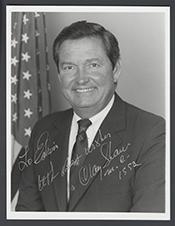
United States · United States Congress · 25 January 1982
Amends the Internal Revenue Code to repeal the provision allowing an income tax deduction without substantiation for living expenses of Members of Congress.
United States · United States Congress · 25 January 1982
Amends the Federal census provisions to require Federal agencies to use the most recent population data (rather than the most recent decennial census data) in determining the amount of benefits due State and local governments under Federal programs.
United States · United States Congress · 11 December 1981
Amends title XVIII (Medicare) of the Social Security Act to permit an individual to elect hospice care, in lieu of certain other benefits, during two periods of 180 days each during the individual's lifetime. Provides for full reimbursement of reasonable costs to a hospice program, subject to a ceiling. Directs the Comptroller General to conduct a study of the hospice reimbursement method. Defines hospice care as including items and services furnished to the terminally ill in their homes, on an outpatient basis, and on a short term inpatient basis.
United States · United States Congress · 23 November 1981
Requires a two-thirds vote in each House of Congress to pass a joint resolution to continue appropriations for Federal departments, agencies, and other entities pending the passage of appropriation Acts for such entities. Exempts the Congress from such requirement when the President declares a state of emergency in the operation of the Federal Government.
United States · United States Congress · 20 November 1981
Requests the President to designate February 22, 1982, as a day of national celebration in honor of the two hundred and fiftieth anniversary of the birth of George Washington.
United States · United States Congress · 12 November 1981
Expresses the sense of the Congress that policies of Jewish emigration discrimination and anti-Semitism are morally reprehensible. Urges the President to tell the Soviet Union that the United States opposes these policies and wants emigration restrictions on Soviet Jews removed.
United States · United States Congress · 5 November 1981
Expresses the sense of the Congress that no limitation should be placed on the Federal income tax deduction for interest paid on a residential mortgage.
United States · United States Congress · 29 October 1981
Prohibits recovery of damages for the injury or death of a foreign seaman if the incident occurred while such seaman was engaged in certain activities.
United States · United States Congress · 29 October 1981
Constitutional Amendment - Requires Congress, prior to each fiscal year, to adopt a statement of receipts and outlays for that year in which total outlays are no greater than total receipts. Permits Congress in such statement to provide for a specific excess of outlays over receipts by a three-fifths vote directed solely to that subject. Prohibits total receipts for any fiscal year set forth in such statement from increasing by a rate greater than the rate of increase in national income in the last calendar year ending before such fiscal year, unless Congress passes a bill directed solely to approving specific additional receipts and such bill has become law. Permits Congress to waive the provisions of this Act with respect to any fiscal year in which a declaration of war is in effect. Prohibits the Congress from requiring that the States engage in additional activities without compensation equal to the additional costs. Declares that total receipts shall include all receipts of the United States, except those derived from borrowing and total outlays shall include all outlays of the United States except those for repayment of debt principal.
United States · United States Congress · 26 October 1981
Authorizes the President to present, on behalf of the Congress, a specially struck gold medal to Queen Beatrix of the Netherlands in recognition of the bicentennial anniversary of diplomatic and trade relations between the Netherlands and the United States. Authorizes the Secretary of the Treasury to coin and sell bronze duplicates of such medal. Authorizes appropriations.
United States · United States Congress · 22 October 1981
Amends the Foreign Assistance Act of 1961 to repeal the prohibition against using funds authorized for international narcotics control to pay for herbicides to eradicate marihuana. Makes narcotics control funds appropriated before enactment of this Act available to pay for such herbicides. Removes specified limitations on the uses of narcotics control funds which were obligated for Colombia and which were appropriated for fiscal year 1980.
United States · United States Congress · 20 October 1981
Bankruptcy Improvements Act of 1981 - Amends title 11 of the United States Code (Bankruptcy) to establish an eligibility test for liquidation bankruptcy relief based on the individual petitioner's ability to pay a reasonable portion of his debts out of future income. Permits the court to dismiss a bankruptcy case under chapter 7 (liquidation) upon the motion of any party in interest filed not later than 30 days after the meeting of creditors, and after notice and a hearing, if the debtor is ineligible for relief under such title. Requires the bankruptcy judge to preside at any meeting of creditors and to perform such additional judicial duties any may be required. Declares that the value of the creditor's interest in the estate's interest in such property shall be determined in light of the purpose of the valuation and of the proposed disposition or use of such property, and in conjunction with any hearing on such disposition or use or on a plan affecting such creditor's interest. Declares that the value of consumer goods which the debtor seeks to redeem in liquidation shall be presumed to be the established resale market price, if such market exists. Requires the debtor in bankruptcy cases to file a statement of income and expenses. Requires the debtor, if the debtor's schedule of assets and liabilities includes consumer debts which are secured by property of the estate, to file and serve upon each creditor holding such security and the trustee, a statement expressing the debtor's intention with respect to retention or surrender of the collateral. Requires the debtor, at or before the meeting of creditors provided for by such title, to perform his intention with regard to such secured creditors. Repeals the provisions concerning exempt property and makes the States responsible for establishing exemptions to bankruptcy proceedings. Makes any debt which was incurred on or within 90 days before the date of the filing of a petition under such title nondischargeable. Allows creditors to enforce liens which have not been voided in bankruptcy. Permits reaffirmation of consumer debts subject to the debtor's right to rescind any such agreement within 60 days or until a discharge is received, whichever occurs later, by giving a written notice of rescission to the creditor. Declares that at the meeting of creditors the court shall inform the debtor of the nature and effect of a discharge. Eliminates the trustee's power to avoid liens or recover payments made within 90 days of filing petition in bankruptcy (within one year in the case of an insider) unless the creditor had reasonable cause to believe the debtor was insolvent. Permits the court, upon notice and hearing, to require a creditor to accept payments in redemption of the value of a claim secured by a nonpossessory, nonpurchase money security interest in tangible personal property, over a reasonable period not to exceed five years, if such tangible personal property consists of specified objects. Allows a creditor, upon 10 days notice to the debtor and codebtor, to collect any portion of a debt from the codebtor which is not being paid by the debtor through the adjustment of debts of such debtor with a regular income. Requires payments under an adjustment of debts payment plan to commence at the time of the filing of the plan. Provides for the return of such funds after deducting the costs of administration if no plan is confirmed. Provides for the separate classification of co-debtor claims and non-dischargeable claims and authorizes payment of them under an adjustment of debts payment plan. Allows a debtor to choose such a repayment plan of up to five years. Bases such repayment upon the debtor's ability to repay out of future income after taking into account the basic living necessities for the debtor and dependents. Provides for an early discharge of debts where at least 70 percent of all allowed unsecured claims are paid. Permits a hardship discharge of otherwise non-dischargeable debts to the extent the debtor attempted to pay such debts under an adjustment of debts payment plan.
United States · United States Congress · 20 October 1981
Establishes the Global Peace Award. Provides that the first Global Peace Award shall be awarded in memory of the late President Mohamed Anwar El-Sadat of Egypt.
United States · United States Congress · 7 October 1981
Prompt Payment Act of 1981 - Requires Federal agencies to pay interest on overdue payments to businesses for property or services. Requires the Office of Management and Budget (OMB) to prescribe required payment dates. Specifies the procedures for computing such interest. Requires an agency to pay any interest charges out of funds made available for administration of its programs. Authorizes Federal grant recipients to provide for the payment of interest on overdue payments on their procurement contracts. Directs each agency to report to OMB annually on interest payments made during the fiscal year. Requires OMB to report to specified congressional committees on agency compliance with this Act. Requires the Director of OMB to delegate responsibility for OMB functions under this Act to the Office of Federal Procurement Policy.
United States · United States Congress · 7 October 1981
Expresses the sense of the House of Representatives that the provisions of the Internal Revenue Code which provide incentives for energy conservation and development of renewable energy sources should not be repealed or amended to reduce such incentives.
United States · United States Congress · 6 October 1981
Amends the Bail Reform Act of 1966 to authorize a judicial officer when making a pretrial release determination to consider whether a person charged with possession or transfer of a controlled substance will pose a danger to any other person or the community. Requires the judicial officer to hold a hearing for such persons to determine whether surety resources have been obtained by noncriminal means.
United States · United States Congress · 2 October 1981
Amends titiles II (Old Age, Survivors and Disability Insurance) and XVI (Supplemental Security Income) of the Social Security Act to require Federal agencies to give to the Secretary of Health and Human Services, upon request, the names and social security account numbers of disability or SSI benefit recipients who are inmates of penal institutions.
United States · United States Congress · 23 September 1981
Expresses the sense of the House of Representatives that the President and Secretary of State should: (1) urge foreign governments to take measures to stop the production and exportation of illicit narcotics; (2) solicit recommendations for U.S. assistance; and (3) consider the desirability of imposing sanctions on nations in which illicit narcotics trade continues.
United States · United States Congress · 15 September 1981
Title I: Amendments to Omnibus Crime Control and Safe Streets Act of 1968 - Justice Assistance Act of 1981 - Amends title I of the Omnibus Crime Control and Safe Streets Act of 1968 (Justice System Improvement) to eliminate the Law Enforcement Assistance Administration and the Office of Justice Assistance, Research and Statistics. Retains the Bureau of Justice Statistics and the National Institute of Justice. Establishes a new Office of Justice Assistance. Revises the formula grant program to make the following changes. Eliminates the authority for local governments to receive formula grants. Decreases from 23 to 15 the purposes for which formula grants may be made. Requires States to provide a 50 percent match to receive Federal funding, or 25 percent match for innovative programs addressing critical problems of crime. Requires grant recipients to assume program costs after a four-year period. Revises the application requirements for a State to receive formula grant assistance. Requires States to include assurances that not more than ten percent of assistance will be spent on innovative programs addressing critical crime problems or five percent of assistance on administrative costs. Requires submission of the formula grant application for approval to the State legislature which shall act on the application as it would for State budget requests. Retains the current requirement that 80 percent of total funding be allocated for formula grants. Requires a State to distribute formula grants among local governments in the same proportion that such governments expend State funds for law enforcement purposes. Eliminates the national priority grant program. Retains the discretionary grant program. Revises the general purposes for which such grants may be made. Requires that private nonprofit organizations be the primary recipients of such grants for providing educational, training, and technical assistance and undertaking national projects. Revises the training and manpower development program to eliminate the training programs for prosecuting attorneys and State and local criminal justice personnel by the Law Enforcement Assistance Administration. Retains the Federal Bureau of Investigation training of State and local criminal justice personnel and the criminal justice education program. Permits "construction" under such Act to include renovation, repairs, or remodeling. Decreases from $750,000,000 to $170,000,000 the amount authorized to be appropriated for each of FY 1980 through 1983. Authorizes additional appropriations as are necessary to provide emergency law enforcement assistance to States. Eliminates the current authorization of appropriations for the Office of Community Anti-Crime Programs and the requirement that at least 19.15 percent of total appropriations be maintained for juvenile delinquency programs. Title II: Emergency Federal Law Enforcement Assistance - Authorizes a State or local government to apply for emergency Federal law enforcement assistance in the event that a crime problem of serious and epidemic proportions exits. Requires the Attorney General, in approving or disapproving such application, to consider: (1) the nature and extent of the crime problem; (2) the emergency or extraordinary circumstances; (3) the availability of State and local resources; (4) the cost of increased Federal presence; and (5) the need to avoid unnecessary Federal involvement in local concerns. Authorizes appropriations for such purpose.
United States · United States Congress · 10 September 1981
United States Olympic Development Fund Checkoff Act of 1981 - Permits taxpayers to designate on their income tax returns an election to contribute one dollar of their income tax refunds or one dollar forwarded with returns to support the fund established by this Act. Establishes in the Treasury of the United States a United States Olympic Development Fund. Appropriates to the Fund an amount equivalent to the amount designated on tax returns to be available to the Fund. Directs the Secretary of the Treasury to pay amounts so transferred to the U.S. Olympic Committee for use in a program of expansion and improvement of amateur athletics. Sets forth reporting requirements with respect to the expenditure of such funds by the Committee.
United States · United States Congress · 9 September 1981
Social Security Alien and Foreign Resident Limitations Act of 1981 - Amends title II (Old Age, Survivors and Disability Insurance) of the Social Security Act to prohibit entitlement to title II benefits in the case of an individual who is not a U.S. citizen or national and whose entitlement is based upon the wages and self-employment income of a resident of a foreign country who is entitled to old-age or disability benefits if such individual does not bear a spousal, filial, parental, divorced, or surviving relationship to such resident as of the date such resident reaches age 57. Prohibits entitlement to title II benefits in the case of an individual who is not a U.S. citizen or national on the basis of such individual's own wages and self-employment income. Entitles a non-U.S. citizen or national to a single lump-sum benefit on the basis of such individual's wages and self-employment income if such individual is lawfully admitted to the United States for permanent residence or employment purposes or such individual's status is changed to permit such individual to work in the United States. Prohibits entitlement to title II benefits in the case of a non-U.S. citizen or national whose entitlement is based upon the wages and self-employment income of a non-U.S. citizen or national who is not a permanent resident of the United States or who has not been admitted to the United States for employment purposes. Prohibits entitlement to title II benefits in the case of a U.S. citizen or national whose entitlement is based upon the wages and self-employment income of a non-U.S. citizen or national.
United States · United States Congress · 31 July 1981
Bail Reform Act of 1981 - Repeals the Bail Reform Act of 1966 and sets forth new bail procedures. Authorizes a judicial officer to consider the safety of any person or the community when making a pretrial release determination. Establishes as a mandatory release condition that the person not commit a Federal, State, or local crime during release. Authorizes pretrial release upon execution of an unsecured appearance bond. Expands the discretionary release conditions to require that the defendant: (1) maintain employment or an educational program; (2) avoid contact with an alleged victim or potential witness; (3) report to a law enforcement or pretrial service agency; (4) comply with a curfew; (5) refrain from possessing a firearm or using alcohol or narcotic drugs; (6) undergo medical treatment; (7) forfeit designated property upon failure to appear; and (8) return to custody at specified hours. Authorizes a judicial officer to order the detention for up to ten days of a person who is presently on pretrial release for a felony under Federal, State, or local law or on probation or parole or release pending sentencing or appeal for any offense, if no conditions will assure his appearance and the safety of the community and any other person. Authorizes a judicial officer to order the pretrial detention of a person upon finding that: (1) no condition will reasonably assure such person's appearance and the safety of any other person and the community; and (2) there is a substantial probability that the person committed the offense. Requires that a detention hearing be held in any case involving: (1) a crime of violence; (2) any offense punishable by life imprisonment or death; or (3) a narcotics offense punishable by at least ten years imprisonment. Permits the Government or the court to move for a detention hearing in any other case involving: (1) a serious risk of flight or obstruction of justice; or (2) any offense committed after the person has been convicted of two or more offenses for which a hearing is mandated. Enumerates additional factors to be considered by the judicial officer in making a release determination, including the defendant's past conduct, history of drug or alcohol abuse, criminal history, and the nature and seriousness of the danger to the community or any person. Requires the detention of a person who has appealed his conviction unless the judicial officer finds by clear and convincing evidence that: (1) such person is not likely to flee or pose a danger to another person or property; and (2) the appeal raises a substantial question of law or fact. Requires the detention of a person awaiting sentencing unless the officer finds by clear and convincing evidence that the person is not likely to flee or pose a danger to any other person or the community. Authorizes a U.S. attorney to appeal a release order. Establishes mandatory additional penalties for commission of an offense while on pretrial release. Subjects a person who has been conditionally released and violates a condition of release to revocation of release and prosecution for contempt of court. Grants new authority to law enforcement officers to arrest a person who violates certain pretrial release conditions.
United States · United States Congress · 30 July 1981
Disapproves the final rule promulgated by the Secretary of Commerce dealing with the Federal consistency provisions of the Coastal Zone Management Act of 1972.
United States · United States Congress · 28 July 1981
Expresses the sense of the House of Representatives that the President should: (1) express to the Soviet Union the U.S. opposition to the Soviet's imprisonment of Benedict Scott (Vytautas Skuodis); and (2) take every appropriate action to secure his release from prison and the emigration of him and his family.
United States · United States Congress · 28 July 1981
Expresses the sense of the Congress that U.S. foreign policy should reflect a national strategy of peace through strength with specified principles and goals.
United States · United States Congress · 22 July 1981
Coal Pipeline Act of 1981 - Amends the Interstate Commerce Act to authorize a person to apply to the Interstate Commerce Commission (ICC) for a certificate of public convenience to construct, operate, or maintain a coal pipeline or to extend an existing coal pipeline. Directs the Commission to approve the application if the public convenience will be enhanced. Permits any person holding such a certificate to acquire rights-of-way on private lands by exercise of the power of eminent domain. Limits the scope of such exercise regarding rights to water or to certain historic or significant lands. Requires coal pipeline certificate holders to fulfill relevant common carrier transportation and service obligations. Requires the line pipe of all pipelines to be located underground, to the maximum extent practicable, consistent with environmental protection, safety, and good engineering and technological practices. Authorizes the Secretary of the Interior to grant or renew to a certificate holder rights-of-way on Federal lands for the construction, operation, maintenance, or extension of coal pipelines. Requires the Secretgary to first consult with the heads of other agencies which may administer such Federal lands. Requires a right-of-way to be granted or renewed in accordance with specified provisions of the Federal Land Policy and Management Act of 1976. Authorizes the Secretary to prescribe additional terms and conditions. Exempts existing coal pipeline rights-of-way and law suits commenced prior to enactment of this Act from certain provisions of this Act. Prohibits the United States or its agents from using or claiming water within any State for a coal pipeline unless pursuant to State substantive and procedural law. Directs the Secretary of Transportation to issue regulations establishing uniform Federal standards applicable to certain aspects of coal pipeline facilities. Exempts existing coal pipelines from certain such standards. Authorizes the Attorney General, at the request of the Secretary of Transportation, to institute a civil action to enforce any such regulation. Authorizes the Attorney General, at the request of the Secretary of the Interior, to institute a civil action to enforce any provision of this Act. Sets forth civil and criminal penalties for any person failing to comply with any provision or regulation of this Act.
United States · United States Congress · 16 July 1981
Amends title II (Old Age, Survivors and Disability Insurance) of the Social Security Act to impose criminal penalties for the alteration, purchase or sale, or counterfeiting of a social security card or for possession of a social security card or counterfeit social security card with intent to sell or alter.
United States · United States Congress · 9 July 1981
Prohibits the use of appropriated funds for the purchase of United States Capitol Historical Society calendars for Members of the House of Representatives beginning with calendar year 1982.
United States · United States Congress · 8 July 1981
Maritime Act of 1981 - Transfers all of the functions, powers, duties, assets, and liabilities of the Maritime Administration of the Department of Commerce to the Department of Transportation. Establishes the office of the Maritime Administrator to head the Maritime Administration. Transfers personnel employed in connection with the functions transferred by this Act. Directs the Director of the Office of Management and Budget to make such incidental dispositions of personnel, assets, liabilities, records, and appropriations as may be necessary to carry out the provisions of this Act. Makes conforming amendments to specified Acts.
United States · United States Congress · 22 June 1981
Expresses the sense of the Congress that: (1) Canada and the United States should create the North American Air Quality Commission (NAAQC); (2) the NAAQC should be the primary means for coordinating U.S. and Canadian enforcement efforts to reduce acid precipitation pollution; (3) the NAAQC should recommend to Canada and the United States policies and legislation to reduce acid precipitation pollution; and (4) the NAAQC should report twice annually to the Canadian Parliament and the U. S. Congress on both countries' progress toward reduction of such pollution.
United States · United States Congress · 18 June 1981
Postal Service Amendments of 1981 - Authorizes the United States Postal Service to issue written demands requiring access to books, records, documents, or other objects believed to relate to any postal offense or civil matter under investigation by the Postal Service. Provides for the enforcement of such a demand by the appropriate district court. Authorizes the Postal Service to issue an order requiring any person to cease and desist from conducting a lottery or scheme for obtaining money or property by false representations through the mail. Declares that the resumption of such an activity through the use of any instrumentality of interstate commerce shall be considered to be a failure to comply with such order. Permits the Postal Service, in investigating whether a person is conducting such an activity, to tender the price of any article or service that such person has offered for sale. Declares that failure by such person to provide such article or service, or failure to comply with a written demand of the Postal Service for access to materials, shall constitute probable cause to believe such person is engaged in such activities, warranting the detention of such person's incoming mail. Establishes a civil penalty to be assessed by the Postal Service, after an opportunity for an agency hearing, against any person who: (1) attempts to evade an order directing the postmaster to return mail addressed to such person; (2) fails to comply with a cease and desist; or (3) assists another person in evading such an order.
United States · United States Congress · 11 June 1981
Family Enterprise Estate and Gift Tax Equity and Reduction Act - Amends the Internal Revenue Code to reduce the estate and gift tax rates. Increases the unified credit against the estate and gift taxes from $47,000 to $103,500 by specified annual increments through 1985. Increases from $175,000 to $600,000, by specified annual increments through 1985, the minimum gross estate requirement for filing of a return. Repeals the existing limitations on the marital deduction for gift and estate taxes. Permits an election by an executor to take into account a life estate which passes to a surviving spouse for purposes of determining the marital deduction. Includes amounts equal to the value of such interests in the estate of the surviving spouse for purposes of imposition of the estate tax. Increases from $3,000 to $10,000 the annual gift tax exclusion. Revises the definition of "qualified real property," for purposes of the special use valuation, to include: (1) real property which is put to a qualified use by a member of the decedent's family; (2) certain future interests; and (3) timber. Qualifies estates of decedents who were disabled or retired for the special use valuation if such decedents materially participated in the operation of the farm or business for five out of eight years preceding the year in which they became disabled or eligible for disability benefits, under title II (Old Age, Survivors and Disability Insurance) of the Social Security Act. Permits the spouse of a decedent to use such valuation if the spouse has managed the farm or business for ten years preceding the decedent's death or takes over active management upon the decedent's death. Qualifies the owner of a woodland for the special use valuation if the owner or a member of the owner's family actively managed the property for ten years prior to the owner's death. Includes as property qualified for the valuation certain future and partial interests. Reduces from 15 to ten years the length of time a qualified property must be held and put to a qualified use following the decedent's death before it can be disposed of without incurring a recapture of estate tax benefits. Permits active management rather than material participation as a test for qualification of the estate for spouses, children under 21, students, and disabled individuals who receive property from a decedent who qualified for special use valuation. Modifies the formula for recapture upon partial disposition of qualified property to include in the calculation of the additional tax imposed the adjusted tax difference attributable to the property disposed of or ceased to be used for a qualified use. Repeals the $500,000 limitation on the aggregate decrease in the value of property to which the special use valuation is applied. Allows the like kind exchange of property without loss of special use valuation eligibility. Permits, for purposes of calculating the five-year period required for qualification of real property, the aggregation of periods with respect to exchange property with those with respect to property included in the gross estate. Repeals the requirement that an heir elect special treatment for involuntary conversions of qualified real property, thus making such treatment automatic upon such conversion. Applies the special use valuation provisions to: (1) property which passes to a trust all of the beneficiaries of which are members of the decedent's family without regard to whether any beneficiary has a present interest in the trust; and (2) property held by a trust in which the decedent has an interest which is includible in the decedent's estate and which passes to a qualified heir as though the decedent had a direct interest in the property. Alters the method of valuing farms and woodlands and provides an alternate discount method of valuation. Expands the definition of "member of the family," for purposes of determining special use valuation eligibility, to include members of a spouse's family. Permits a parent or fiduciary of a person under a legal disability to sign an agreement to the application of recapture provisions on behalf of such person. Specifies that the estate tax deduction for certain indebtedness of an estate shall not be reduced if the value of the property is determined by applying the special use valuation. States that gifts made within three years of a decedent's death shall be valued as of the time of transfer rather than as of the date of death. Allows an individual to elect to pay a gift tax rather than use the unified tax credit. Modifies the alternate extension of time for payment of the estate tax where the estate consists largely of an interest in a closely held business to: (1) allow an installment payment election if the value of the interest in the closely held business is either 25 percent of the value of the gross estate or 35 percent of the taxable estate; (2) alter the definition of "interest in a closely held business"; (3) increase to 50 percent the value of an interest disposed of which will accelerate the payment of tax; and (4) permit payment, but with a penalty, of an installment within six months after the due date. Revises rules for determining whether property qualifies as an interest in a closely held business with respect to property included in the gross estate which is transferred prior to death and ownership of assets leased to or used by a family-owned business. Revises rules regarding the qualification of corporate distributions of property in redemption of stock which is included in a decedent's gross estate. Removes the limitation on substantially disproportionate redemptions of stock of a corporation which is a closely held business. Revises the formula for determining whether such redemptions are substantially disproportionate and the rule for determining whether a shareholder's interest in a corporation is terminated. Applies the four percent rate of interest on estate tax payments extended under the alternate extension of time provisions to the entire amount of the tax to be paid. Permits an election to value at 50 percent of its value an interest in a closely held business the net equity of which is less than $50,000,000. Imposes an additional estate tax if such interest is disposed of within ten years after the decedent's death. Allows a disclaimer of an interest in property for estate tax purposes in specified circumstances where such disclaimer does not result in the passing of the interest concerned under the applicable State law.
United States · United States Congress · 11 June 1981
Amends the Comprehensive Drug Abuse Prevention and Control Act of 1970 to require a judicial officer, in setting conditions for pretrial release for any person charged with certain narcotics offenses, to consider which conditions will reasonably assure the safety of the community, the personal safety of persons in the community, and the prevention of similar offenses by such person. Requires a judicial officer to deny release to any person charged with a narcotics offense who: (1) has previously been convicted of a felony narcotics offense under Federal, State, or foreign law; (2) is on parole, probation, or other conditional release for a felony offense under Federal or State law; (3) is an illegal alien; (4) was arrested in possession of a false passport; or (5) has been convicted of being a fugitive from justice. Requires the Government to provide clear and convincing evidence that the person charged falls within any such category and to establish that there is substantial probability that the person committed the offense . Permits the judicial officer to grant release to a person who has not been previously convicted of a felony narcotics offense upon a finding of special mitigating factors. Requires that the case of a person who is denied release be placed on an expedited calendar.
United States · United States Congress · 4 June 1981
Urban Jobs and Enterprise Zone Act of 1981 - Title I: Designation of Enterprise Zones - Amends the Internal Revenue Code to provide for the designation of enterprise zones, for a period ending December 31, 2001, and subject to the approval of the Secretary of Housing and Urban Development, by local governments or by State governments on behalf of local governments for purposes of extending the tax incentives and regulatory flexibility measures provided by titles II and III of this Act. Specifies that the Secretary may approve the designation of such zones only if: (1) the area is within the jurisdiction of the designating local government; (2) the boundary of the area is continuous and includes accessible vacant or underutilized properties; (3) the area has a population of at least 4,000 if any portion thereof is located within a standard metropolitan statistical area with a population of at least 50,000 or 2,500 otherwise or is an Indian reservation; and (4) the area meets specified unemployment and poverty requirements. Requires designating local governments, as a condition of the Secretary's approval, to agree in writing to follow a course of action which may include reducing tax rates, improving local services, simplifying or streamlining regulation of business, or receiving commitments of private entities to assist employees and residents of the area. Terminates the authority of the Secretary to designate enterprise zones on December 31, 1996. Sets forth minimum and maximum numbers of such designations. Describes areas to which preference shall be given in deciding to designate enterprise zones. Amends the Department of Housing and Urban Development Act to set forth the duties of the Secretary under this Act. Requires any property tax reduction effected by a local government under an agreed to program to be disregarded for purposes of determining the eligibility of a State or local government for Federal assistance or benefits. Expresses the sense of the Congress that: (1) local governments should attempt to facilitate to the greatest extent possible the employment of poor and unemployed residents of their enterprise zones and should consider the effects of a designation upon area employment practices and patterns; and (2) whenever possible, foreign-trade zones should be established within enterprise zones and that in the case of any application for designation of a foreign-trade zone within an enterprise zone: (A) the Foreign-Trade Zone Board should expedite the application process; (B) the Board, in evaluating such application, should consider future development to be expected as a result of the incentives provided by this Act; and (C) the Board should provide technical assistance to the applicants. Title II: Taxation - Subtitle A: Refundable Credits for Employers and Employees - Amends the Internal Revenue Code to allow employers a refundable income tax credit for five percent of the wages paid to unemployed or economically disadvantaged individuals who are certified as eligible under the Comprehensive Employment and Training Act and who perform at least 50 percent of their services within an enterprise zone. Disallows a deduction for the portion of the wages or salaries equal to the amount of such credit. Allows individuals who are employees of qualified businesses and at least 50 percent of whose services during the taxable year are performed in an enterprise zone a refundable tax credit for five percent of the earned income attributable to services performed in an enterprise zone during a 36-month period. Limits such credit to $1,500 for any taxable year. Defines "qualified business" as a person: (1) at least 50 percent of whose gross receipts are attributable to the active conduct of a trade or business within an enterprise zone; and (2) at least 40 percent of whose employees are individuals whose employment qualifies for the employers' credit allowed under this subtitle and who are hired after the later of the date on which the conduct of a business in an enterprise zone is begun or the area is designated as such a zone. Subtitle B: Reduction in Capital Gain Tax Rates - Reduces the alternative tax on capital gains and increases the capital gains deduction. Qualifies certain low-income rental housing located in an enterprise zone for such treatment. Permits property to remain qualified for purposes of the revised capital gains treatment after a designation of an enterprise zone has terminated. Exempts gain from the sale or exchange of property used in a business in an enterprise zone from the computation of the minimum tax. Removes as an item of tax preference accelerated depreciation on real property used in such a business. Subtitle C: Reduction in Gross Income of Trades or Businesses Operating in Zone - Excludes from taxable income a specified percentage of the sum of any amount received by a qualified business from the active conduct of a trade or business within an enterprise zone and any interest on financing provided by a taxpayer to a qualified business in connection with the conduct of such business. Subtitle D: Other Incentives - Permits any qualified business to elect to use the cash receipts and disbursements method of accounting without regard to any inventory requirements if its gross receipts do not exceed $2,000,000 in any prior taxable year. Allows a 20-year carryover of net operating losses for qualified businesses. Qualifies for the investment tax credit low-income rental housing with respect to which the capital gains tax reduction is granted under subtitle B of this title. Subtitle E: Sense of the Congress with Respect to Tax Simplification - Expresses the sense of the Congress that the Internal Revenue Service should simplify the administration and enforcement of any provision of the Internal Revenue Code affected by this title. Title III: Regulatory Flexibility - Revises the definition of "small entity," for purposes of the analysis of regulatory functions, to include qualified businesses (as defined in title II of this Act), designating governments, and nonprofit enterprises operating within enterprise zones.
United States · United States Congress · 3 June 1981
Missing Children Act - Directs the Attorney General to collect and preserve information which would assist in: (1) the identification of any deceased individual who has not been identified within 30 days of his or her death; and (2) the location of any missing child who is under the age of 17, does not have a history of running away, and has been missing for at least 48 hours.
United States · United States Congress · 2 June 1981
Amends the Internal Revenue Code and title II (Old Age, Survivors and Disability Insurance) of the Social Security Act to provide coverage under the Old Age, Survivors and Disability Insurance program for Members of Congress and congressional employees.
United States · United States Congress · 2 June 1981
Expresses the sense of the House of Representatives that the week commencing on June 7, 1981, should be designated as "National Italian-American Heritage Week."
United States · United States Congress · 28 May 1981
Prohibits the Federal Trade Commission from investigating or taking any action concerning any State regulated profession until Congress enacts legislation which expressly provides that the Commission has authority over professions and that the Commission's authority preempts State authority. Vacates any such action taken during the period beginning on May 28, 1981, and ending on the date of enactment of this Act.