Amendment· HAMDTHAMDT 841 (97th)open
An amendment to require the USDA Secretary to obtain recommendations to fill vacancies on the FmHA county committee from the board of county commissioners in the state.
United States · United States Congress
The world's political record
Person
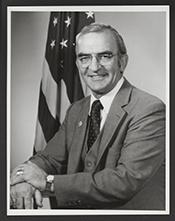
United States · Official source
No stored named vote for this person. House roll-calls come from Congress.gov; Senate member lists come from senate.gov LIS XML.
United States · United States Congress
United States · United States Congress
United States · United States Congress
United States · United States Congress
United States · United States Congress
United States · United States Congress
United States · United States Congress
United States · United States Congress
United States · United States Congress
United States · United States Congress
United States · United States Congress
United States · United States Congress
United States · United States Congress · 27 October 1990
Budget Process Reform Act - Title I: Statement of Congressional Purpose - Declares that the purpose of this Act is to facilitate rational, informed, and timely decisions by the Congress. Expresses the sense of the Congress that the Federal budget process should focus the attention of policymakers and the public on the aggregate impact of Federal spending on the economy, and on the tradeoffs that must be made among priorities in order to control overall levels of spending. Declares that the budget process should contain safeguards against delay and inaction, so that temporary shut-downs of the Government may be avoided. Title II: Binding Budget Law - Requires the Congress to enact a binding budget law, in the form of a joint resolution, by April 15 of the calendar year before that in which the fiscal period commences. Requires the budget law to fit on a single page, which sets forth specific budget ceilings in major functional categories. Makes it out of order in the House of Representatives or the Senate to consider any spending bill affecting spending in a major functional category unless and until a joint resolution on the budget is enacted. Amends the Congressional Budget Act of 1974 to prohibit baseline budgeting. Requires the budget to include comparisons of current fiscal year and proposed subsequent fiscal year spending. Title III: Enforcement Mechanisms - Subtitle A: Super majority Required to Break Budget Law - Requires a two-thirds majority vote in the House and the Senate to consider any spending bill prior to the enactment of the budget law. Requires the Congressional Budget Office to provide to the Congress an estimate of the costs in each major functional category of any spending bill as soon as practicable after its introduction. Limits such estimates to those bills likely to result in costs of more than $10,000,000. Requires a two-thirds affirmative vote in the House and the Senate to consider over-budget spending bills. Requires a two-thirds affirmative vote in the House and the Senate to waive any provision of this Act. Subtitle B: Limited Enhanced Rescission Authority - Amends the Impoundment Control Act of 1974 to limit the President's rescission authority to spending that is above the limits of the budget law. Subtitle C: "Blank Check" Appropriations Prohibited - Declares the intent of the Congress to end open-ended, "blank check" appropriations which typically authorize spending "such sums as may be necessary." Requires fixed-dollar appropriations for every account except social security and interest on the debt. Prohibits open-ended appropriations. Requires Executive agencies to adjust benefit levels to ensure that appropriations for entitlement programs are not exceeded. Subtitle D: "Pay As You Go" Requirement for New Spending - Prohibits the Congress from considering any legislation which exceeds the budget ceiling unless it offsets such increased spending with an equal amount of reductions. Requires a two-thirds affirmative vote in the House and the Senate to waive such prohibition. Title IV: Sustaining Mechanism - Makes appropriations to provide for an automatic continuing resolution if for any account an appropriation for a fiscal period does not become law before the beginning of such period. Restricts legislation providing funding to the Committees on Appropriations. Title V: Protection of Social Security - Provides that no reduction in benefits under title II (Old Age, Survivors and Disability Insurance) of the Social Security Act shall be made as a consequence of this Act. Title VI: Timetable - Revises the timetable for the congressional budget process. Title VII: Conforming Amendments - Makes various technical and conforming amendments, including changing references to a concurrent resolution on the budget to references to a joint resolution on the budget. Title VIII: Definitions and Rules of Interpretation - Sets forth definitions for specified terms. Title IX: Effective Date - Declares the effective date of this Act to be January 1, 1991, applicable to fiscal years beginning after September 30, 1991.
United States · United States Congress · 18 October 1990
Airport System Planning Act of 1990 - Amends the Airport and Airway Improvement Act of 1982 to prohibit project grant applications from proposing airport development or airport planning except in connection with public-use airports included in an Airport Capital Improvement Plan prepared pursuant to this Act. Prohibits the approval of such an application unless the Secretary of Transportation is satisfied, among other things, that the project is reasonably consistent with airport and aviation system plans (existing at the time of the projects approval) of the State and the regional transportation planning authorities of the area in which the airport is located. Requires the Secretary of Transportation to establish performance measures for evaluating both individual airport improvement projects and the needs of the Nation's system of airports in conducting planning activities. Requires the Secretary, every four years, to conduct a national forum of Federal, State, and local officials and private sector representatives to identify and evaluate long-range problems associated with public-use airports. Directs the Secretary to transmit to the Congress and the President a strategic plan for airports. Requires the Secretary to transmit annually to the Congress and the President an Airport Capital Improvement Plan that includes: (1) a list of airport improvement projects which may receive Federal funding in the next five years; and (2) an evaluation and specific proposals to eliminate or reduce constraints on the development of such projects. Requires, upon a State's request, Federal cooperation and participation in the airport system planning of that State. Requires the Secretary to: (1) establish guidelines for forecasting aviation activity at public-use airports within each State; and (2) develop a model State statute for airport vicinity land use planning. Directs the Secretary to conduct research and establish a methodology for determining the relationship between airport system capacity enhancement alternatives and the overall performance of the national economy, including the impact of such alternatives on private sector production of goods and services and on U.S. international competitiveness.
United States · United States Congress · 17 October 1990
Expresses the sense of the Congress that the President should declare November 2, 1990, a national day of prayer for: (1) members of American military forces and American citizens stationed or held hostage in the Middle East, and for their families; and (2) American and Iraqi authorities to bring about a just resolution of the Persian Gulf crisis.
United States · United States Congress · 10 October 1990
Designates November 16, 1990, as National Federation of the Blind Day.
United States · United States Congress · 4 October 1990
Amends the Federal Water Pollution Control Act to extend through FY 1992 the authorization of appropriations for: (1) specified research, investigations, training, and information; (2) grants to States for pollution control programs; (3) the Great Lakes program; (4) nonpoint source pollution control in rural areas; (5) interagency agreements to maintain water quality; (6) the clean lakes program; and (7) nonpoint source pollution management programs. Extends the general authorization for such Act through FY 1992. Increases the amount authorized to be appropriated for the State water pollution control revolving fund program for FY 1992.
United States · United States Congress · 24 September 1990
Designates March 25, 1991, as National Medal of Honor Day.
United States · United States Congress · 11 September 1990
Requires the Secretary of Agriculture, if marketing quotas are not in effect, to announce a minimum 15 percent acreage reduction production for the 1991 wheat crop. Requires the Secretary to implement a paid land diversion program for 1991 wheat producers who make certain acreage reductions and conservation plantings. Provides for a portion of such payments to be paid in advance.
United States · United States Congress · 3 August 1990
Designates November 4 through 10, 1990, as National Key Club Week.
United States · United States Congress · 3 August 1990
Designates September 1991 as National Rice Month.
United States · United States Congress · 3 August 1990
Designates September 15 to October 15, 1990, as Community Center Month.
United States · United States Congress · 3 August 1990
Expresses the sense of the Congress that: (1) 1991 should be considered as Rebuild America Year; (2) a national effort to rebuild the infrastructure of the United States should be undertaken to provide assistance to States and localities in meeting core infrastructure needs; (3) the multibillion dollar balances in the Highway and Airport and Airway Trust Funds should be spent to rebuild the infrastructure of the United States; (4) the President should work with the Congress to establish a comprehensive national infrastructure policy and to revitalize and supplement existing programs to achieve this goal; (5) the Federal Government along with State and local governments and the private sector should share their expertise and support in formulating and developing a national effort to rebuild the infrastructure of the United States; and (6) the President and the Congress should dedicate appropriate funding to implement a national effort to rebuild the infrastructure of the United States.
United States · United States Congress · 3 August 1990
Designates the week of September 23, 1990, as Religious Freedom Week.
Showing the 24 most recent records of 2,125. Browse the full list