Bill· HRH.R. 5271 (119th)referred
Pakistan Freedom and Accountability Act
United States · United States Congress · 10 September 2025
The world's political record
Person
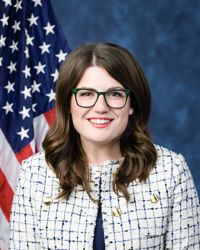
United States · Official source
362 records where Rep. Elfreth, Sarah [D-MD-3] is listed as a sponsor, author, or other actor. Search with topics and years
United States · United States Congress · 10 September 2025
United States · United States Congress · 10 September 2025
United States · United States Congress · 9 September 2025
United States · United States Congress · 9 September 2025
United States · United States Congress · 8 September 2025
United States · United States Congress · 4 September 2025
United States · United States Congress · 3 September 2025
United States · United States Congress · 19 August 2025
United States · United States Congress · 15 August 2025
United States · United States Congress · 12 August 2025
United States · United States Congress · 5 August 2025
Expanding the Voluntary Opportunities for Translations in Elections Act or the Expanding the VOTE Act This bill expands access to voting materials for individuals with limited proficiency in the English language. Section 203 of the Voting Rights Act of 1965 (VRA) requires covered states and political subdivisions to provide voting materials and other language assistance to persons who are American Indian, Asian American, Alaskan Natives, or of Spanish heritage and whose ability to speak or understand English limits electoral participation. A state or political subdivision that is subject to Section 203 is prohibited from providing English-only voting materials in an election. Among other requirements, this bill (1) requires the Department of Justice to issue a notice of prohibition, including the trigger threshold at which the prohibition applies, to certain states and political subdivisions; and (2) requires covered states and political subdivisions to provide written translations of all voting materials, with the consent of any applicable tribal government, to election workers. Additionally, the bill requires the Election Assistance Commission to make incentive grants for states and political subdivisions to provide translated voting materials. The bill also directs the Government Accountability Office to study and report on the impact of (1) reducing the threshold requirement under Section 203 of the VRA, and (2) expanding the definition of language minorities to include native speakers of additional languages.
United States · United States Congress · 5 August 2025
Youth Voting Rights Act This bill expands voting access for youth. Specifically, the bill establishes a private right of action to enforce the Twenty-Sixth Amendment, which prohibits denying or abridging the right to vote based on age. Further, the bill authorizes the Department of Justice to enforce the Twenty-Sixth Amendment against age-based restrictions for voting by mail. Additionally, the bill directs each state to designate as voter registration agencies all offices within public institutions of higher education (IHEs) that provide assistance to students, implement a preregistration process to allow minors who are 16 years or older to register to vote in federal elections that take place when or after the preregistered individual turns age 18, and ensure the availability of polling places on campuses of IHEs (with the availability of waivers). The bill prohibits durational residency requirements for voting in all federal elections. Currently, this prohibition applies only to voting for the offices of President and Vice President. States and local jurisdictions with voter identification requirements must treat IHE-issued student identification cards as voter identification. The Election Assistance Commission (EAC) must make grants to states to increase the involvement of individuals under age 18 in public election activities. The Government Accountability Office must report to Congress on trends related to voter registration, absentee voting, and provisional voting. The EAC must also collect and make publicly available certain data from states.
United States · United States Congress · 5 August 2025
Election Mail Act This bill addresses the delivery and processing of election mail for federal elections, including by establishing certain standards for mail-in ballots. Specifically, the bill requires the U.S. Postal Service (USPS) to ensure (to the maximum extent practicable) same-day processing of mail-in ballots, postmark each ballot, carry election mail (e.g., voter registration applications and mail-in ballots) as first-class mail that is free of postage, appoint an election mail coordinator at each area office and district office, and consult annually with Indian tribes regarding barriers to voting for eligible voters living on Indian lands. The bill prohibits the USPS, within 120 days of a federal election, from making any operational change that would restrict the prompt and reliable delivery of election mail. Each state and jurisdiction must provide with each mail-in ballot a return envelope with an intelligent mail barcode. This requirement does not apply to a state or jurisdiction that uses an alternative system that enables voters to track the ballot through the mail. The bill requires election officials to count mail-in ballots that are postmarked by election day and arrive within seven days after the election.
United States · United States Congress · 5 August 2025
United States · United States Congress · 5 August 2025
Time Off to Vote Act This bill requires an employer, upon the request of an employee, to provide the employee with a minimum of two consecutive hours of paid leave while polls or sites that facilitate voting-related activity are open on the day of a federal election. This allotted time may be used to vote, return a mail-in ballot, or perform other voting-related activities. The employer may determine the two-hour period, excluding any lunch break or other break. Taking such leave shall not result in the employee losing accrued employment benefits. The bill makes it unlawful for an employer to interfere with the right to take such leave or for an employer to discriminate against an employee for taking such leave. Further, the bill makes it unlawful for any employer to retaliate against an employee for (1) opposing any practice made unlawful by this bill; (2) filing a charge, or instituting or causing to be instituted any proceeding, under or related to this bill; or (3) testifying or preparing to testify in an inquiry or proceeding relating to such leave. The bill specifies penalties for employers who violate these provisions.
United States · United States Congress · 5 August 2025
United States · United States Congress · 5 August 2025
Unhoused Voter Opportunity Through Elections Act or the Unhoused VOTE Act This bill expands voter registration and voting access for unhoused individuals. The bill specifies that no state or political subdivision may deny or abridge the right of any U.S. citizen to vote because the citizen resides at or in a nontraditional abode. Additionally, the bill requires jurisdictions that allow for ballot drop boxes to ensure that these drop boxes are available for in-person use and are accessible and clearly labeled. If a state requires individuals to show proof of residence in order to vote in a federal election, then the state must accept the individual’s written attestation of residence. A state may not prohibit an individual who is residing in a homeless shelter from using the shelter as the individual’s residence for purposes of voting in a federal election. The bill requires chief state election officials to conduct outreach to unhoused individuals. The bill directs the Election Assistance Commission to (1) develop best practices for election officials regarding voter registration and voting access for unhoused individuals, and (2) make grants to eligible states and local governments for programs and activities to support access to voting for unhoused individuals. The bill also revises the National Voter Registration Act of 1993, including by (1) treating emergency shelters as voter registration agencies, and (2) allowing an unhoused individual to use an unsheltered street location as the individual's place of residence for purposes of a voter registration application.
United States · United States Congress · 5 August 2025
Sustaining Our Democracy Act This bill establishes and provides funds through FY2035 for the State Election Assistance and Innovation Trust Fund for purposes of promoting election activities. Specifically, the bill establishes the Democracy Advancement and Innovation Program, through which the Office of Democracy Advancement and Innovation (also established by this bill) shall make allocations to states for carrying out democracy promotion activities. These activities include improving the administration of federal elections, recruiting and training nonpartisan election officials and poll workers, and increasing voting access. The bill requires each state, in order to receive allocated funds, to (1) submit a plan for approval that describes how the state will distribute resources and carry out democracy promotion activities, and (2) establish uniform and nondiscriminatory state-based administrative complaint procedures. The bill prohibits states from using funds for certain activities, including any activity that diminishes the ability of any eligible voter to participate in the electoral process.
United States · United States Congress · 5 August 2025
United States · United States Congress · 1 August 2025
United States · United States Congress · 1 August 2025
United States · United States Congress · 29 July 2025
United States · United States Congress · 25 July 2025
United States · United States Congress · 23 July 2025
United States · United States Congress · 23 July 2025
United States · United States Congress · 22 July 2025
United States · United States Congress · 22 July 2025
United States · United States Congress · 21 July 2025
United States · United States Congress · 17 July 2025
United States · United States Congress · 17 July 2025
United States · United States Congress · 17 July 2025
This bill reauthorizes and revises programs of the Centers for Disease Control and Prevention (CDC) that support services and education addressing breast and cervical cancer. The bill reauthorizes through FY2030 and makes changes to the CDC’s National Breast and Cervical Cancer Early Detection Program. This program provides grants to states for breast and cervical cancer screening, diagnostic, and treatment services for individuals who have low incomes, are uninsured, or otherwise lack access to such services. The bill increases flexibility in how states may spend grant funds under the program. The Government Accountability Office must report to Congress on the work of the National Breast and Cervical Cancer Early Detection Program, including the number of individuals served and barriers to accessing screenings. Also, the bill reauthorizes through FY2031 CDC programs relating to young women’s awareness of breast health and breast cancer. These programs include campaigns to educate young women and health care professionals, research on preventing breast cancer in younger women, and grants for resources and services to young women diagnosed with breast cancer and precancerous conditions.
United States · United States Congress · 17 July 2025
United States · United States Congress · 17 July 2025
United States · United States Congress · 16 July 2025
United States · United States Congress · 16 July 2025
United States · United States Congress · 16 July 2025
United States · United States Congress · 15 July 2025
United States · United States Congress · 14 July 2025
United States · United States Congress · 10 July 2025
This resolution expresses support for the designation of Journeyman Lineworkers Recognition Day. (A journeyman lineworker is a person who builds and maintains electrical power systems.)
United States · United States Congress · 7 July 2025
Mitigation Action and Watermen Support Act of 2026 or the MAWS Act of 2026 This bill requires the National Oceanic and Atmospheric Administration (NOAA) to establish a pilot program to facilitate the purchase of blue catfish caught within the Chesapeake Bay Watershed. (Blue catfish are considered an invasive species in the Chesapeake Bay.) Under the program, NOAA must enter into cooperative agreements with manufacturers or processors of pet food, animal feed, or aquaculture feed for the purchase of blue catfish from watermen and seafood processors. NOAA must determine the minimum price per pound after considering market factors; feedback from watermen, seafood processors, and participants in the program; and differentiation of price points for fillet and byproduct. The bill also requires NOAA to enter into a memorandum of understanding with nonfederal partners to develop abundance estimates of blue catfish in the Chesapeake Bay Watershed. NOAA must make the first abundance estimate publicly available before beginning the pilot program.
United States · United States Congress · 30 June 2025
Digital Coast Reauthorization Act of 2025 This bill reauthorizes through FY2030 the Digital Coast program managed by the National Oceanic and Atmospheric Administration (NOAA) and makes other changes to the program. Through the program, NOAA administers a digital platform with data, tools, training, and other information to support coastal management needs. The bill requires NOAA to ensure that data and resulting integrated products developed under the program are fully and freely available on the program website and via other sources. Further, NOAA must support existing efforts to acquire and integrate data related to underground infrastructure and subsurface utilities.
United States · United States Congress · 30 June 2025
United States · United States Congress · 26 June 2025
United States · United States Congress · 26 June 2025
Bridge Corrosion Prevention and Repair Act of 2025 This bill establishes certain requirements to address corrosion control in bridge and railroad-bridge projects that receive federal assistance. Specifically, certified contractors must employ a substantial number of individuals who are certified by a qualified training program in corrosion control, mitigation, and prevention in order to work on certain aspects of bridge project activities. A certified contractor must also provide training for any non-certified coating applicators employed by the contractor to work on certain aspects of a project. The bill further requires bridge projects to implement a corrosion management system that utilizes industry-recognized standards and corrosion mitigation and prevention methods for construction, repair, and maintenance projects. In addition, the bill expands the scope of the Railroad Rehabilitation and Improvement Financing Program to include corrosion control work on rail bridges. (This program provides direct loans and loan guarantees for the development of railroad infrastructure.) The bill also requires the Department of Transportation to study and report on best practices for inspecting and addressing corrosion on weathering steel bridges. This report must be made available to state and local governments, metropolitan planning organizations, and regional organizations.
United States · United States Congress · 26 June 2025
Strengthening Protections for Domestic Violence and Stalking Survivors Act of 2025 This bill extends federal restrictions on the receipt, possession, shipment, and transportation of firearms and ammunition to new types of stalking and domestic violence offenders. Specifically, the bill extends federal firearms-related restrictions to individuals who are convicted of a misdemeanor crime of stalking. The term misdemeanor crime of stalking means a federal, state, tribal, or local offense involving harassment, intimidation, or surveillance that (1) causes emotional distress; or (2) places a person in reasonable fear of harm to themselves, an immediate family member, a current or former cohabitant, an intimate partner, or a pet. Additionally, the bill extends federal firearms-related restrictions to individuals who are subject to a domestic violence protection order that restrains them from harassing, stalking, or threatening a current or former dating partner (regardless of when the relationship occurred) or an individual similarly situated to a spouse. Currently, the restrictions only apply if the domestic violence protection order restrains the individual from harassing, stalking, or threatening a co-parent, a current or former spouse, or a current or former cohabitant. Finally, the bill extends federal firearms-related restrictions to individuals who commit a misdemeanor crime of domestic violence against the child of a current or recent former dating partner. Currently, the restrictions only apply if the offense is committed against a current or recent former dating partner.
United States · United States Congress · 26 June 2025
United States · United States Congress · 26 June 2025
United States · United States Congress · 25 June 2025
United States · United States Congress · 24 June 2025
Women's Health Protection Act of 2025 This bill prohibits governmental restrictions on the provision of, and access to, abortion services. Before fetal viability, governments may not restrict providers from using particular abortion procedures or drugs, offering abortion services via telemedicine, or immediately providing abortion services if delaying risks the patient's health. Furthermore, governments may not require providers to perform unnecessary medical procedures, provide medically inaccurate information, or comply with credentialing or other conditions that do not apply to providers who offer medically comparable services to abortions. Additionally, governments may not require patients to make medically unnecessary in-person visits before receiving abortion services or disclose their reasons for obtaining services. After fetal viability, governments may not restrict providers from performing abortions when necessary to protect a patient's life and health. The same provisions that apply to abortions before viability also apply to necessary abortions after viability. Additionally, states may authorize post-viability abortions in circumstances beyond those that the bill considers necessary. Further, the bill recognizes an individual's right to interstate travel, including for abortion services. The bill also prohibits governments from implementing measures that are similar to those restricted by the bill or that otherwise target and impede access to abortion services, unless the measure significantly advances the safety of abortion services or health of patients and cannot be achieved through less restrictive means. The Department of Justice, individuals, or providers may sue states or government officials to enforce this bill, regardless of certain immunity that would otherwise apply.
United States · United States Congress · 23 June 2025
This concurrent resolution directs the President to remove U.S. Armed Forces from hostilities against Iran unless explicitly authorized by a declaration of war or a congressional authorization for use of military force against Iran. Elements of the U.S. Armed Forces needed to defend the United States, an ally, or a partner from imminent attack are not covered by this requirement provided the President complies with a specified provision of the War Powers Resolution. (The provision generally requires the President to remove U.S. Armed Forces from hostilities no more than 60 days after the President notifies or is required to notify Congress of such involvement, unless Congress authorizes such use. For more information on the War Powers Resolution, see CRS In Focus 13134 .)