Amendment· HAMDTHAMDT 591 (98th)passed
An amendment to the Miller (CA) amendment (HA586) to limit to 5 percent the total amount of state funds that can be used for state administrative purposes.
United States · United States Congress
The world's political record
Person
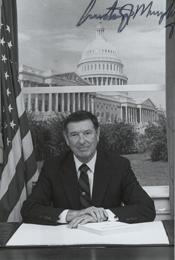
United States · Official source
4,495 records where Rep. Murphy, Austin J. [D-PA-20] is listed as a sponsor, author, or other actor. Search with topics and years
United States · United States Congress
United States · United States Congress
United States · United States Congress
United States · United States Congress
United States · United States Congress
United States · United States Congress
United States · United States Congress
United States · United States Congress
United States · United States Congress
United States · United States Congress
United States · United States Congress
United States · United States Congress
United States · United States Congress
United States · United States Congress
United States · United States Congress
United States · United States Congress
United States · United States Congress
United States · United States Congress · 29 November 1994
Expresses appreciation to specified current and former staff members for their dedication to the Congress and to the residents of the 20th and 22nd congressional districts of Pennsylvania.
United States · United States Congress · 30 September 1994
Designates the week of November 6 through 12, 1994, as National Health Information Management Week.
United States · United States Congress · 28 September 1994
Designates October 19, 1994, as National Mammography Day.
United States · United States Congress · 27 September 1994
Designates the week beginning October 16, 1994, as National Penny Charity Week.
United States · United States Congress · 22 September 1994
Designates November 1, 1994, as National Family Literacy Day.
United States · United States Congress · 20 September 1994
Designates October 29, 1994, as National Firefighters Day.
United States · United States Congress · 19 September 1994
George Washington Boyhood Home Commemorative Coin Act of 1994 - Directs the Secretary of the Treasury to issue one-dollar silver coins emblematic of a profile of George Washington and a depiction of his xboyhood home. Declares that all surcharges received from coin sales shall be paid to the George Washington Boyhood Home Foundation.
United States · United States Congress · 13 September 1994
Missing Service Personnel Act of 1994 - Requires the military commander of the unit, facility, or area to which the following persons are assigned to conduct an investigation as to their whereabouts after receiving factual information that their status is uncertain: (1) military personnel who disappear during a period of war, national emergency, or hostilities; and (2) any civilian Federal employee (including an employee of a Federal contractor) who serves with or accompanies an armed force in the field during such a period. Requires such persons to be placed in a missing status and requires notification of such status to either the officer having general court-martial authority over the person (for military personnel) or the Secretary of the military department employing such person (for civilian and contractor employees). Requires such officials to be kept informed (specifies deadlines) as to all information and inquiries concerning efforts to locate such missing personnel. Requires such officials to appoint a board to conduct an inquiry into the whereabouts and status of such persons. Provides for: (1) board composition, activities, and access to information; (2) inquiry proceedings (requiring the appointment of counsel, with specified duties, to represent the missing person); (3) a board recommendation as to the official status of a person following such an inquiry; (4) board reports to the officials involved as to board conclusions (prohibiting public availability of such reports for a one-year period); (5) report review by the official; (6) a report from such official to interested persons; and (7) an additional investigation and inquiry by an additional board upon receipt of new information within one year after the date of the first official notice of a person's disappearance. Allows interested persons (family members, dependents, next of kin) to participate at the proceedings of the board during such additional inquiry. Provides for the availability of appropriate information to board personnel conducting investigations and inquiries. Provides similar procedures for the second board with respect to meetings (open to the public, with exceptions), recommendations, reports, review by the Secretary of the military department concerned, and reports to interested persons. Requires a board to be reconvened when information becomes available that would directly lead to a determination of a person's status. Requires the Secretary concerned to appoint a board to conduct an inquiry as to the status of a missing person: (1) on or about three years after the first official notice of the disappearance of such person; and (2) not later than every three years thereafter until a total of 12 years after the first official notice. Provides for: (1) the release to a board by the Secretary concerned of all personnel file information concerning missing persons; (2) the treatment of classified information; (3) penalties for the wrongful withholding of information; (4) limited circumstances under which a board may recommend that a missing person be declared officially dead; (5) the submission by the board of appropriate information if such recommendation occurs; and (6) judicial review for interested persons of a board decision to declare a person officially dead. Provides for the appointment of a board to review the status of a person previously declared dead, with board procedures similar to those described above. Requires a person previously declared dead or in a missing status who is subsequently found alive to be paid for the full time of their absence.
United States · United States Congress · 21 August 1994
TABLE OF CONTENTS: Title I: Grants for Correctional Facilities Title II: State and Local Law Enforcement Grants Title III: Protection Against Sexually Violent Predators Title IV: Eliminating Excessive and Redundant Appeals Title V: Reform of 'Exclusionary Rule' Title VI: Truth-In-Sentencing Title VII: Prison Work Required; Luxuries Abolished Title VIII: Improving Border Controls Title IX: Enhanced Gun Penalties Title X: Violent Crime Reduction Trust Fund Title XI: Mandatory Life Imprisonment for Persons Convicted of Certain Felonies Back-To-Basics Crime Control Act of 1994 - Title I: Grants for Correctional Facilities - Directs the Attorney General to make grants to States to construct, expand, and improve prisons and jails. Authorizes specified sums to each State without conditions imposed by the Federal Government, except requirements to comply with this title and to use such funds exclusively for the construction of prisons and jails. Authorizes appropriations. Sets forth formulas for the distribution of funds in FY 1995 and in FY 1996 through 1999 based on violent crimes reported by the States to the Federal Bureau of Investigation (FBI). (Sec. 102) Specifies that 25 percent of total funds appropriated under this title shall be allocated to each eligible State according to a formula which takes into account the percentage change in the time to be served by persons convicted of violent crimes. Directs that States which have achieved a truth in sentencing standard of violent criminals serving 85 percent of prison time assessed receive the incentive funds, subject to specified requirements. Title II: State and Local Law Enforcement Grants - Requires the Attorney General to make grants to States to increase the number of law enforcement officers in service. Authorizes specified funds, without conditions imposed by the Federal Government (except that the funds be used exclusively to increase the number of law enforcement officers in service). Requires States to allocate 80 percent of their grants to local government for use by local law enforcement, as nearly as possible in proportion to the populations served by such local law enforcement agencies (LEAs). Title III: Protection Against Sexually Violent Predators - Directs the Attorney General to: (1) establish guidelines for State programs to require a sexually violent predator to register a current address with a designated State LEA upon being released from prison or being placed on parole or supervised release; and (2) approve each State program that complies with the guidelines. Makes States that do not implement and maintain such programs ineligible to receive ten percent of the funds that would otherwise be allocated to the State in drug control and system improvement grants under the Omnibus Crime Control and Safe Streets Act of 1968. Requires: (1) the determination that a person is, or is no longer, a sexually violent predator to be made by the sentencing court after receiving a report by a board of experts on sexual offenses; and (2) each State to establish a board composed of experts in the field of the behavior and treatment of sexual offenders. Sets forth provisions regarding: (1) notification regarding the duty of an offender to register and to provide any new address to a designated State LEA and of a State prison official to obtain specified information; (2) the transfer of information to the State LEA and to the FBI; (3) quarterly verification of the released offender's address; (4) penalties for failing to register and keep the registration current; (5) termination of the obligation to register; (6) community notification concerning a predator required to register; and (7) immunity for good faith conduct by LEAs, their employees, and State officials. Title IV: Eliminating Excessive and Redundant Appeals - Amends the Federal judicial code to establish a one-year statute of limitations for habeas corpus actions brought by State prisoners. Vests authority to issue certificates for probable cause for appeal of habeas corpus orders exclusively in the courts of appeals. Permits denial on the merits of habeas corpus writs notwithstanding the failure to exhaust State remedies. Establishes a two-year statute of limitations for Federal prisoners filing for collateral relief. (Sec. 406) Sets forth special habeas corpus procedures in capital cases brought by prisoners in State custody who are subject to a capital sentence. Makes such procedures contingent upon: (1) a State establishing by rule of its court of last resort or by statute a mechanism for the appointment, compensation, and payment of reasonable litigation expenses of competent counsel in State post convictions and sentences have been upheld on direct appeal to such court or have otherwise become final; and (2) such rule or statute providing standards of competency for the appointment of counsel. Provides for a mandatory stay of execution during the post-conviction review initiated pursuant to this title. Details conditions which will cause such stay to expire. Prohibits a Federal court from entering a stay of execution or granting relief in a capital case unless specified conditions are met. Sets forth lime limits for determining petitions. Authorizes the State or Government to enforce such time limits by applying to the court of appeals or the Supreme Court for a writ of mandamus. Title V: Reform of 'Exclusionary Rule' - Amends the Federal criminal code to prohibit the exclusion of evidence obtained as a result of a search or seizure, in a proceeding in a court of the United States, on the grounds that the search or seizure was in violation of the Fourth Amendment of the Constitution if it was carried out in circumstances justifying an objectively reasonable belief that it was in conformity with such amendment. Makes the fact that evidence was obtained pursuant to and within the scope of a warrant prima facie evidence of the existence of such circumstances. Prohibits the exclusion of evidence, in a proceeding in a U.S. court, on the ground that it was obtained in violation of a statute, administrative rule or regulation, or rule of procedure unless exclusion is expressly authorized by statute or by a rule prescribed by the Supreme Court pursuant to statutory authority. Title VI: Truth in Sentencing - Amends the Federal criminal code to permit the Bureau of Prisons to add, in its discretion, additional time to a prisoner's sentence of up to 15 percent of the prisoner's term for unsatisfactory behavior. Prohibits a sentence from being reduced for satisfactory behavior to a term less than the original sentence nominally imposed. Title VII: Prison Work Required; Luxuries Abolished - Directs the Attorney General to implement and enforce regulations which: (1) mandate prison work for all able-bodied inmates in Federal penal and correctional institutions; and (2) prohibit the Government provision in inmates' cells of television, radio, telephone, stereo, or similar amenities. (Sec. 702) Amends the Higher Education Act of 1965 to prohibit awards of Pell grants to prisoners in Federal or State penal institutions. Title VIII: Improving Border Controls - Authorizes appropriations. Authorizes and directs the Attorney General to use such funds to permit the commander of the Border Patrol to increase by at least 6,000 the number of border patrol agent positions above the number of such positions as July 1, 1994. (Sec. 802) Amends the Immigration and Nationality Act to provide for expedited deportation and exclusion of criminal aliens. Prohibits reentry of an alien into the United States during the minimum period of confinement to which the alien was sentenced. Authorizes the Attorney General to prescribe special regulations for the registration and fingerprinting of aliens on criminal probation or parole. Expands the definitions of "aggravated felony." (Sec. 805) Sets forth deportation procedures for certain criminal aliens who are not permanent residents. Grants a U.S. district court jurisdiction to enter a judicial order of deportation at the time of sentencing against an alien whose criminal conviction causes such alien to be deportable under provisions relating to conviction of an aggravated felony if requested prior to sentencing by the U.S. Attorney. (Sec. 807) Restricts defenses to deportation for certain criminal aliens. Enhances penalties for failing to depart or reentering after a final order of deportation. (Sec. 810) Authorizes appropriations for a criminal alien information system. Title IX: Enhanced Gun Penalties - Amends the Federal criminal code to enhance penalties imposed upon persons convicted of using or carrying a firearm during and in relation to the commission of a felony. (Sec. 902) Sets a mandatory minimum sentence for unlawful possession of a firearm by a convicted felon, fugitive from justice, addict or unlawful user of a controlled substance, or transferor or receiver of a stolen firearm. (Sec. 903) Increases the general penalty for violation of Federal firearms laws. Title X: Violent Crime Reduction Trust Fund - Establishes a Violent Crime Reduction Trust Fund as a separate account in the Treasury into which shall be transferred savings realized from implementation of provisions of the Federal Workforce Restructuring Act of 1994. Sets forth provisions regarding: (1) transfers into, and appropriations from, the Fund; (2) annual reporting requirements on the status of the Fund; and (3) allocation of sums in the Fund. Extends authorizations of appropriations for fiscal years for which the full amount authorized is not appropriated. Title XI: Mandatory Life Imprisonment for Persons Convicted of Certain Felonies - Amends the Federal criminal code to provide for mandatory life imprisonment for persons convicted in Federal court of a serious violent felony if: (1) the person has been convicted (and the conviction has become final) on separate prior occasions in a Federal or State court of two or more serious violent felonies, or one or more serious violent felonies and one or more serious drug offenses; and (2) each serious violent felony or serious drug offense used as a basis for sentencing under this title, other than the first, was committed after the defendant's conviction of the preceding serious violent felony or serious drug offense. Sets forth provisions regarding: (1) persons subject to the criminal jurisdiction of an Indian tribal government; and (2) resentencing upon the overturning of a prior conviction. (Sec. 1102) Prohibits the court from reducing the sentence of a defendant unless specified conditions are met, including that defendant is at least age 70, has served at least 30 years in prison for the offense or offenses for which the defendant is currently imprisoned, and a determination has been made by the Director of the Bureau of Prisons that the defendant is not a danger to the safety of any other person or the community.
United States · United States Congress · 21 August 1994
Expresses the sense of the House of Representatives that a commemorative stamp should be issued in honor of Dr. Benjamin Elijah Mays, educator, civil and human rights nonviolent leader, and public theologian.
United States · United States Congress · 21 August 1994
Expresses the sense of the House of Representatives that the President should award Benjamin Elijah Mays the Presidential Medal of Freedom posthumously in honor of his distinguished career as an educator, civil and human rights nonviolent leader, and public theologian and his many contributions to the improvement of American society and the world.
United States · United States Congress · 17 August 1994
Requires the administrative agency to which the Secretary of Labor has delegated the authority to adjudicate Federal workers' compensation claims to select physicians on an impartial basis when seeking a second medical opinion in such a claim.
United States · United States Congress · 17 August 1994
Requires the administrative agency to which the Secretary of Labor has delegated authority to adjudicate workers' compensation claims of Federal employees under civil service law to select only board-certified physicians to provide second opinions.
United States · United States Congress · 17 August 1994
Amends Federal civil service law to revise the appeals process under provisions for workers' compensation for Federal employees.
United States · United States Congress · 11 August 1994
Designates the months of March 1995 and March 1996 as Irish-American Heritage Month.
United States · United States Congress · 10 August 1994
Northern Marianas Delegate Act - Requires the Commonwealth of the Northern Mariana Islands to be represented in the Congress by the Resident Representative authorized by the Covenant to Establish a Commonwealth of the Northern Mariana Islands in Political Union with the United States of America. Provides that the Resident Representative shall be a nonvoting Delegate to the House of Representatives. Sets forth requirements for the election of the Delegate. Requires a candidate for the office of Delegate to: (1) be at least 25 years of age on the date of the election; (2) have been a U.S. citizen for at least seven years prior to the date of the election; (3) be an inhabitant of the Northern Mariana Islands; and (4) not be a candidate for any other office. Grants the Delegate the same compensation, allowances, and benefits as a Member of the House and entitles the Delegate to privileges and immunities granted to nonvoting House of Delegates.
United States · United States Congress · 2 August 1994
Designates the week beginning September 12, 1994, as National Hispanic Business Week.
United States · United States Congress · 25 July 1994
Amends Federal civil service law with respect to procedures for handling claims of Federal employees for compensation for work injuries.
United States · United States Congress · 19 July 1994
Designates September 17, 1994, as Constitution Day.
United States · United States Congress · 14 July 1994
Designates the second Sunday in October 1994 as National Children's Day.
United States · United States Congress · 12 July 1994
Designates the second week of August 1994 as National U.S. Seafood Week.
United States · United States Congress · 30 June 1994
First-Time Homebuyers Assistance Act - Amends the Internal Revenue Code to set forth the conditions under which builders will be allowed to compute on the installment sales method income from the sale of newly constructed one-family residential real property.
United States · United States Congress · 16 June 1994
United States-China Act of 1994 - Declares that if nondiscriminatory treatment (most-favored-nation treatment) is not granted to China by reason of the enactment of a congressional disapproval resolution, such treatment shall continue to apply to goods that are produced by a person that is not a state-owned Chinese enterprise, but not apply to any goods that are produced by a state-owned Chinese enterprise. Provides that if nondiscriminatory treatment is granted to China for a 12-month period on July 3, 1994, such treatment shall not apply to: (1) any good that is produced by the People's Liberation Army or a Chinese defense industrial trading company; or (2) any nonqualified good that is produced by a state-owned Chinese enterprise. Provides that in order for such treatment to be granted to China, the Secretary of the Treasury shall consult with American businesses that have significant trade with or investment in China, to encourage them to adopt a voluntary code of conduct that: (1) follows internationally recognized human rights principles; (2) ensures the employment of Chinese citizens is not discriminatory in terms of sex, ethnic origin, or political belief; (3) ensures that no convict, forced, or indentured labor is knowingly used; (4) recognizes the rights of workers to freely organize and bargain collectively; and (5) discourages mandatory political indoctrination on business premises. Requires the Secretary to determine, and publish in the Federal Register, which persons are state-owned Chinese enterprises and Chinese defense industrial trading companies. Authorizes the President to waive any condition or prohibition imposed under this Act if he determines and reports to the Congress that its continued imposition would have a serious adverse effect on vital U.S. national security interests. Declares that if the President recommends in 1995 that the waiver of human rights and emigration requirements for nondiscriminatory treatment for China be continued, he shall state in a specified report to the Congress the extent to which China has made progress with respect to: (1) adhering to the provisions of the Universal Declaration of Human Rights; (2) ceasing the exportation to the United States of products made with convict, forced, or indentured labor; (3) ceasing unfair and discriminatory trade practices which restrict and unreasonably burden American businesses; and (4) adhering to the guidelines of the Missile Technology Control Regime and the controls adopted by the Nuclear Suppliers Group and the Australia Group.
United States · United States Congress · 9 June 1994
Designates August 2, 1994, as National Neighborhood Crime Watch Day.
United States · United States Congress · 26 May 1994
Amends the Emergency Unemployment Compensation Act of 1991 to extend the authorization for new claims for benefits under the emergency unemployment compensation program to August 5, 1994. Modifies the final phase-out period for continuation of claims to end it on September 30, 1994. Provides for a similar extension of the program of temporary extended railroad unemployment insurance benefits (and modification of the phase-out period). Amends the Agricultural Trade Act of 1978 to repeal the export enhancement program of the Department of Agriculture (in order to fund the extensions of unemployment compensation under this Act).
United States · United States Congress · 26 May 1994
Expresses the sense of the House of Representatives that for purposes of issuing final guidelines under title VII of the Civil Rights Act of 1964 relating to unlawful harassment in employment, the Equal Employment Opportunity Commission should exclude harassment based on religion.
United States · United States Congress · 24 May 1994
Amends the Dingell-Johnson Sport Fish Restoration Act to increase the amounts transferred from State fish restoration and management project appropriations for grants for recreational boating safety programs. Revises funding from the same appropriations for grants to coastal and inland States for: (1) the construction and renovation of pumpout stations and waste reception facilities; and (2) education of recreational boaters about the problems of human body waste discharges from vessels.
United States · United States Congress · 24 May 1994
Designates September 16, 1994, as National POW/MIA Recognition Day. Requires the display of the National League of Families POW/MIA flag at: (1) all national cemeteries and the National Vietnam Veterans Memorial on May 30, 1994 (Memorial Day), September 16, 1994 (National POW/MIA Recognition Day), and November 11, 1994 (Veterans Day); and (2) the White House and the buildings containing the primary offices of the Secretaries of State, Defense, and Veterans Affairs and the Director of the Selective Service System on September 16, 1994 (National POW/MIA Recognition Day).
United States · United States Congress · 20 May 1994
Amends the Higher Education Act of 1965 to revise a restriction on the participation of proprietary institutions of higher education in student financial aid programs, by treating funds received by an institution from proceeds of loans made to students or parents as funds of such students or parents for purposes of the requirement that at least 15 percent of a proprietary institution's revenues come from sources not derived from Federal student aid programs.
United States · United States Congress · 20 May 1994
National Community Service Commemorative Coin Act - Directs the Secretary of the Treasury to issue one-dollar silver coins to commemorate students who volunteer to perform community service. Mandates that all surcharges received from such coin sales be paid to the National Community Service Trust to fund innovative community service programs at American universities, including the service, research, and teaching activities of the faculty and students involved in such programs.
United States · United States Congress · 12 May 1994
Black Lung Benefits Restoration Act of 1994 - Amends the Black Lung Benefits Act (the Act) to provide that, when black lung benefits are paid after an initial determination of eligibility, repayment of an overpayment will not be required even upon a final determination of ineligibility, if there was no fraud or deception by the claimant. Provides for refunds to claimants of any such repayments required before this Act. Provides for reimbursement by the Black Lung Disability Trust Fund to operators who made such benefit overpayments. (Sec. 3) Revises evidence requirements. Prohibits the responsible operator or the Trust Fund from requiring more than one medical examination to controvert medical evidence presented by a claimant on the basis of a medical examination. Prohibits any claimant from offering more than three medical examinations; but authorizes the administrative law judge to require the claimant to submit to an additional medical examination. (Sec. 4) Revises requirements for survivor benefits. Provides that a miner's death shall be considered to have occurred as a result of the pneumoconiosis if the miner was receiving benefits for, or was disabled by, pneumoconiosis at the time of death. Qualifies to receive survivor benefits any widow or widower of a miner who was married to the miner for at least nine months preceding the miner's death, or who had children as a result of such a marriage. Provides that widows or widowers of miners are not disqualified to receive survivor benefits if they remarry after attaining age 50, but prohibits them from receiving an augmentation in survivor benefits on any basis arising out of a subsequent marriage. (Sec. 5) Provides for notice and an opportunity for a hearing to appeal to the Secretary any designation of liability as the responsible operator. Authorizes assessment of proceeding costs against any operator who does not have reasonable grounds to contest the designation. (Sec. 6) Requires that all reasonable legal costs and expenses incurred by the claimant be paid by the responsible operator, or the Trust Fund, after an administrative or judicial determination that the claimant is entitled to black lung benefits. Requires the Secretary or court to take action to assure that they are paid within 45 days after such determination. Requires the Trust Fund to pay any operator the legal costs the operator paid to a claimant determined in a later proceeding to be ineligible for benefits. (Sec. 7) Prohibits a claimant or respondent from appealing to the Benefits Review Board any order unless it has been made by an administrative law judge. (Sec. 8) Allows any claim filed under the Act after January 1, 1982, but before enactment of this Act, to be refiled after enactment of this Act for a de novo review on the merits. (Sec. 9) Provides for coverage of coke oven operators (or operators of machine shops or other operations reasonably related to coke ovens) under the Act and the Federal Mine Safety and Health Act. (Sec. 10) Requires that the legislative history accompanying this Act be considered controlling if a term in any amendment made by this Act is considered ambiguous in any legal proceeding. (Sec. 11) Makes attorney fees provisions of this Act applicable only to new claims filed after October 1, 1994.
United States · United States Congress · 12 May 1994
Senior Citizens Against Marketing Scams Act of 1994 - Amends the Federal criminal code to provide for enhanced penalties for telemarketing fraud that targets or victimizes persons over age 55. Directs the court to order offenders to: (1) pay restitution to persons who sustained losses as a result of the fraudulent activity; and (2) forfeit to the United States property constituting or derived from proceeds obtained as a result of the offense. Requires the U.S. Sentencing Commission to review and, if necessary, amend the sentencing guidelines to ensure that victim related adjustments for fraud offenses against persons over age 55 are adequate. Authorizes the Attorney General to make awards for furnishing information leading to the prosecution and conviction of telemarketing fraud offenders. Authorizes appropriations. Makes the mail fraud statute applicable to matter sent or delivered by any private or commercial interstate carrier. Sets forth provisions regarding fraud and related activity in connection with access devices. Directs the Attorney General to establish a national, toll-free telemarketing fraud hotline.
United States · United States Congress · 11 May 1994
Designates October 16 through 22, 1994, as National Character Counts Week.