Law· HJRESH.J.Res. 520 (102nd)enacted
To designate the month of October 1992 as "Country Music Month".
United States · United States Congress · 30 June 1992
Designates October 1992 as Country Music Month.
The world's political record
Person
United States · Official source
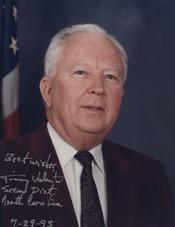
2,097 records where Rep. Valentine, Tim [D-NC-2] is listed as a sponsor, author, or other actor. Search with topics and years
United States · United States Congress · 30 June 1992
Designates October 1992 as Country Music Month.
United States · United States Congress · 24 June 1992
World University Games Commemorative Coin Act - Authorizes the minting and issuance of five dollar gold coins and one dollar silver coins (at no net cost to the Government) to commemorate American participation in the World University Games. Requires that all surcharges from the sale of such coins be paid to the Greater Buffalo Athletic Corporation to support amateur athletic programs, erect facilities for the use of such athletes, and to underwrite the cost of sponsoring the World University Games.
United States · United States Congress · 24 June 1992
Directs that, in the administration of any benefits program established by or under Federal law which requires the use of data obtained in the most recent decennial census, the 1990 adjusted census data be considered the official data for such census.
United States · United States Congress · 22 June 1992
Maritime Navigation Technology and Research Act of 1992 - Directs the Secretary of Transportation to issue regulations which require vessels operating in a U.S. harbor to use state-of-the-art navigation, communication, and collision avoidance equipment that is compatible with Coast Guard vessel traffic systems. Requires the Secretary to conduct research and development of vessel navigation technologies. Establishes the Maritime Navigation Research Advisory Committee to advise the Secretary on maritime research programs.
United States · United States Congress · 18 June 1992
Gulf of Mexico Environmental and Economic Restoration and Protection Act of 1992 - Expresses the sense of the Congress with respect to environmental restoration of the Gulf of Mexico. Establishes a program for protection and preservation of the economic and environmental resources of the Gulf, to be known as the Gulf of Mexico Program. Directs the Administrator of the Environmental Protection Agency (EPA) to establish a Gulf of Mexico Program Office within EPA. Establishes a Gulf of Mexico Executive Board to: (1) prepare and update a joint plan for the Federal, State, interstate, local, and nongovernmental development of economic, ecological, and aesthetic resources of the Gulf and protection of the ecosystem; (2) develop long-range schedules for the collection and analysis of data and for planning and completion of projects in the Gulf and surrounding areas; and (3) approve and fund studies of economic, ecological, and aesthetic resource problems in the Gulf and surrounding areas. Sets forth required contents of the plan and requires the Administrator to submit the plan to the Congress. Provides for State cost-sharing of Gulf restoration activities. Requires the Administrator to award grants for the conduct of research to develop baseline scientific data regarding environmental quality of the Gulf for use in evaluating and implementing the plan. Authorizes grants to be awarded to any Gulf State agency, non-profit research organization, or university which meets eligibility requirements. Sets forth grant proposal, application, and cost-sharing requirements. Authorizes and allocates appropriations.
United States · United States Congress · 18 June 1992
Designates the Federal building and U.S. courthouse located at the corner of College Avenue and Mountain Street in Fayetteville, Arkansas, as the John Paul Hammerschmidt Federal Building and United States Courthouse.
United States · United States Congress · 18 June 1992
Designates the Federal building located at 200 Federal Plaza in Paterson, New Jersey, as the Robert A. Roe Federal Building.
United States · United States Congress · 15 June 1992
Amends title II (Old Age, Survivors and Disability Insurance) of the Social Security Act to provide that a monthly benefit shall be paid to the recipient's surviving spouse for the month in which the recipient dies, subject to a reduction of 50 percent in the last monthly payment if the recipient dies during the first 15 days of such month.
United States · United States Congress · 11 June 1992
Amends the Federal Aviation Act of 1958 to require the Administrator of the Federal Aviation Administration, before assessing a civil penalty against any certificate-holding airmen and air carriers, to: (1) advise them of the charges or reasons relied upon for the Administrator's proposed action; and (2) provide them with an opportunity to answer such charges and be heard as to why the civil penalty should not be assessed. Authorizes such individuals to appeal such a penalty to the National Transportation Safety Board (NTSB). Provides for the judicial review of a NTSB order. Authorizes the NTSB to change an Administrator's order amending, modifying, or reversing a certificate to an order assessing a civil penalty.
United States · United States Congress · 10 June 1992
All-Soy Ink Printing Act of 1992 - Requires that all federally performed or procured printing be done with all-soy inks and pigment vehicles as soon as commercially cost competitive. Requires that all solicitations for printing and binding services made by the Government Printing Office encourage the use of ink with soy-based pigment vehicles.
United States · United States Congress · 9 June 1992
Amends the National Science Foundation Act of 1950 to authorize the National Science Foundation to foster the development and use of computer networks related to science and engineering research and education.
United States · United States Congress · 9 June 1992
Declares that the Congress acknowledges and appreciates the commitment, devotion, and sacrifices of present and former military families. Designates November 23, 1992, as National Military Families Recognition Day.
United States · United States Congress · 9 June 1992
Designates July 1992 as National Muscular Dystrophy Awareness Month.
United States · United States Congress · 3 June 1992
Medicare Communication Disorders and Services Amendments Act of 1992 - Amends title XVIII (Medicare) of the Social Security Act to provide expanded coverage of speech-language pathology and audiology services under the Medicare program. Excludes from program coverage procedures performed for selecting or fitting hearing aids.
United States · United States Congress · 28 May 1992
Amends the Foreign Assistance Act of 1961 to exclude construction and fire equipment from the definition of "excess defense articles" for purposes of restricting the transfer of such equipment to foreign countries.
United States · United States Congress · 28 May 1992
Animal Medicinal Drug Use Clarification Act of 1992 - Amends the Federal Food, Drug, and Cosmetic Act to allow, on order of a veterinarian: (1) a new animal drug approved for one use to be used for a different purpose, provided the use does not result in residues in food in violation of established safe levels for the drug; and (2) a new drug approved for human use to be used in non-food producing animals.
United States · United States Congress · 28 May 1992
Used Oil Recycling Act of 1992 - Amends the Solid Waste Disposal Act to prohibit the listing or identification of used oil destined for recycling, used oil to be burned for energy recovery, recycled oil, or affiliated material as hazardous wastes. Requires the Administrator of the Environmental Protection Agency to: (1) promulgate regulations for the management of used oil and to encourage recycling of such oil; and (2) take into account the effect of such regulatons on small businesses. Exempts from such regulations used oil generated, collected, or stored by an individual who removes oil from the engine of a motor vehicle, aircraft, household appliance, or item of domestic equipment if owned by such individual and used only for personal purposes. Sets forth regulation requirements for used oil generators, including to: (1) prohibit the storage of used oil in an underground tank unless it meets specified requirements of the Solid Waste Disposal Act; (2) prohibit the storage of used oil for more than 12 months; (3) make used oil in above ground tanks subject to the Spill Prevention and Countermeasure Control Plan requirements of the Federal Water Pollution Control Act; and (4) require owners or operators of such tanks or other used oil containers to notify the Administrator of releases of used oil in excess of 25 gallons and to clean up such releases and comply with closure or disposal requirements. Authorizes the transfer of used oil by generators only to: (1) a permitted used oil recycling facility or a burner of used oil for energy recovery that complies with specifed regulations; (2) a permitted hazardous waste management facility; or (3) a used oil transporter obligated by contract to deliver used oil to another such transporter or to one of the aforementioned facilities. Sets forth recordkeeping requirements for generators, transporters, and recyclers and requires records to be maintained for at least three years. Applies used oil storage and transfer requirements for generators to transporters, except permits transporters to store such oil for only 60 days before transferring it to another transporter or authorized facility. Requires transporters to: (1) comply with all requirements of the Secretary of Transportation for the shipping of used oil; (2) comply with financial responsibility requirements of the Hazardous Materials Transportation Act; and (3) have identification numbers provided by the Administrator. Sets forth regulation requirements for recyclers of used oil. Exempts from regulations used oil generated by: (1) petroleum refining or exploration, production or transportation facilities, or bulk terminals which is to be refined or processed along with normal process streams at a refining facility; and (2) a manufacturer or processor or by an electric or gas utility that is processed, reclaimed, or refined by such generator or its parent, subsidiary, or corporate affiliate, provided that the oil is reused by such entities and such activities meet certain storage, shipping, financial responsibility, contingency, and release detection requirements under this Act. Applies storage requirements similar to those for generators and transporters to recyclers, as well as requiring: (1) aboveground storage tanks and containers of used oil recyclers to comply with hazardous waste storage standards; (2) recyclers to maintain contingency plans to minimize unanticipated damage from used oil; (3) recyclers to comply with requirements for maintenance and operation of used oil recycling facilities and training of personnel; (4) detection of releases of used oil at recycling facilities and cleanup; (5) testing by recyclers, prior to processing, of all used oil received for levels of arsenic, cadmium, chromium, lead, halogens, polychlorinated biphenyls (PCBs), and other materials, as appropriate, and for the testing of fuel for such materials before it leaves the facility; (6) the separate storage of used oil contaminated with any hazardous waste for a specified time period; (7) financial responsibility equivalent to that required for hazardous waste facilities; and (8) class permits for recycling facilities. Requires the Administrator to conduct annual inspections of used oil recycling facilities to determine compliance with permit requirements. Makes a facility ineligible to apply for a permit if: (1) the facility has utilized any pit, pond, lagoon, or other surface impoundment for containing used oil; and (2) there has been a release from such impoundments which requires corrective action or is otherwise subject to post closure care requirements. Permits States to be authorized by the Administrator to carry out permit programs. Prohibits: (1) the placement of used oil in such impoundments or in any uncovered tank; (2) the mixing of used oil with a hazardous waste unless the mixture is managed as a hazardous waste; and (3) the use of used oil as a dust suppressant. Requires the Administrator to promulgate regulations for the closure of such impoundments and tanks containing used oil, to include requirements for: (1) corrective action or postclosure care; (2) allowable fuel specification levels for lead and halogens for the burning of used oil for energy recovery; and (3) lead levels for the burning of industrial specification used oil. Requires oil fuels failing to meet lead limitations to be burned in specified facilities. Directs the Administrator to implement education activities to inform the public about the hazards associated with the improper handling and disposal of used oil and the benefits derived from legitimate used oil recycling. Authorizes appropriations. Requires the Administrator to publish guidelines to assist State and local governments and other public service organizations in the development of used oil collection programs. Makes used oil generators who comply with this Act eligible for an exclusion from cost recovery authorities of the Comprehensive Environmental Response, Compensation and Liability Act. Directs the Administrator to propose regulations establishing guidelines for the procurement of used oil by Federal agencies and other governmental entities.
United States · United States Congress · 28 May 1992
Designates the week beginning October 4, 1992, as National Aviation Education Week.
United States · United States Congress · 28 May 1992
Designates July 2, 1992, as National Literacy Day.
United States · United States Congress · 28 May 1992
Designates the week beginning November 8, 1992, as National Women Veterans Recognition Week.
United States · United States Congress · 21 May 1992
Title I: General Provisions - National Competitiveness Act of 1992 - Sets forth the purposes and goals of this Act. Title II: Manufacturing - Manufacturing Technology and Extension Act of 1992 - Amends the Stevenson-Wydler Technology Innovation Act of 1980 to designate the Department of Commerce as the lead civilian Federal agency to work with U.S. industry, State and local governments, and private entities to enhance U.S. manufacturing capabilities. Establishes the Nationwide Network of Manufacturing Outreach Centers to assist U.S. manufacturers, especially small and medium-sized firms, to expand the use of technology and modern manufacturing processes. Provides for a related communications infrastructure and information clearinghouse. Authorizes appropriations. Establishes the Advanced Manufacturing Systems and Networking Projects program to create technology development programs to create advanced computer-integrated, electronically-networked manufacturing technologies and associated applications. Authorizes appropriations. Amends the National Institute of Standards and Technology Act to authorize the National Institute of Standards and Technology to establish local manufacturing offices. Eliminates the requirement that a Manufacturing Technology Center be financially self-supporting after six years of operation. Authorizes appropriations for existing and new centers. Requires the Director of the National Science Foundation (NSF) to expand the Engineering Research Centers program with emphasis on advanced manufacturing. Authorizes the establishment of up to five new Centers for such purpose. Authorizes appropriations. Title III: Critical Technologies - Subtitle A: Miscellaneous - Requires the Secretary of Commerce (Secretary) to report annually to the appropriate congressional committees regarding any executive branch international trade negotiations which might affect Federal research and development programs. Subtitle B: Council on Technology and Competitiveness - Establishes within the Executive Office of the President a Council on Technology and Competitiveness. Authorizes appropriations. Subtitle C: Advanced Technology Program - Directs the Secretary to submit to the Congress an expansion plan for the Advanced Technology program. Requires the establishment of at least two new critical technologies consortia. Authorizes appropriations. Subtitle D: Technology Commercialization Loans - Authorizes the Secretary to make technology commercialization loans. Authorizes appropriations. Subtitle E: Critical Technologies Development-Part I: General Provisions - Critical Technologies Development Act of 1992 - Directs the Under Secretary of Commerce for Technology (Under Secretary) to establish a critical technologies development advisory committee. Part II: Program Structure and Operation - Establishes a program of financing qualified business concerns through federally assisted licensees. Part III: Enforcement - Provides for license enforcement. Part IV: Miscellaneous - Authorizes the Under Secretary to issue and guarantee trust certificates for licensee preferred securities. Authorizes appropriations. Title IV: International Standardization - Amends the American Technology Preeminence Act of 1991 to expand the standards pilot program to promote the dissemination of U.S. technical standards abroad. Authorizes appropriations. Directs the Secretary to report to the Congress with regard to the appropriate Federal role in developing and promulgating domestic and global product and quality standards. Title V: Miscellaneous Provisions - Authorizes appropriations for: (1) the Office of the Under Secretary; (2) technology policy; (3) Japanese technical literature; (4) National Technical Information Service modernization, including a facilities study; and (5) specified activities within the National Institute of Standards and Technology. Prohibits the fraudulent use of "Made in America" labels. Provides for compliance with the Buy American Act. Prohibits the making of a Malcolm Baldrige Award within a category or subcategory if there are no qualifying enterprises in that category or subcategory. Title VI: Competitiveness Research, Data Collection, and Evaluation - Directs the Secretary to conduct a competitiveness research program. Authorizes appropriations.
United States · United States Congress · 21 May 1992
American Technology and Competitiveness Act - Title I: General Provisions - Sets forth the purposes and goals of this Act. Title II: Manufacturing - Manufacturing Technology and Extension Act of 1992 - Amends the Stevenson-Wydler Technology Innovation Act of 1980 to designate the Department of Commerce as the lead civilian Federal agency to work with U.S. industry, State and local governments, and private entities to enhance U.S. manufacturing capabilities. Establishes the Nationwide Network of Manufacturing Outreach Centers to assist U.S. manufacturers, especially small and medium-sized firms, to expand the use of technology and modern manufacturing processes. Provides for a related communications infrastructure and information clearinghouse. Authorizes appropriations. Establishes the Advanced Manufacturing Systems and Networking Projects program to create technology development programs to create advanced computer-integrated, electronically-networked manufacturing technologies and associated applications. Authorizes appropriations. Requires the Director of the National Science Foundation (NSF) to expand the Engineering Research Centers program with emphasis on advanced manufacturing. Authorizes the establishment of up to five new Centers for such purpose. Authorizes appropriations. Title III: Critical Technologies - Subtitle A: Miscellaneous - Requires the Secretary of Commerce (Secretary) to report annually to the appropriate congressional committees regarding any executive branch international trade negotiations which might affect Federal research and development programs. Subtitle B: Council on Technology and Competitiveness - Establishes within the Executive Office of the President a Council on Technology and Competitiveness. Authorizes appropriations. Subtitle C: Advanced Technology Program - Directs the Secretary to submit to the Congress an expansion plan for the Advanced Technology program. Requires the establishment of at least two new critical technologies consortia. Authorizes appropriations. Subtitle D: Technology Commercialization Loans - Authorizes the Secretary to make technology commercialization loans. Authorizes appropriations. Subtitle E: Critical Technologies Development-Part I: General Provisions - Critical Technologies Development Act of 1992 - Directs the Under Secretary of Commerce for Technology (Under Secretary) to establish a critical technologies development advisory committee. Part II: Program Structure and Operation - Establishes a program of financing qualified business concerns through federally assisted licensees. Part III: Enforcement - Provides for licensee enforcement. Part IV: Miscellaneous - Authorizes the Under Secretary to issue and guarantee trust certificates for licensee preferred securities. Authorizes appropriations. Title IV: International Standardization - Amends the American Technology Preeminence Act of 1991 to expand the standards pilot program to promote the dissemination of U.S. technical standards abroad. Authorizes appropriations. Directs the Secretary to report to the Congress with regard to the appropriate Federal role in developing and promulgating domestic and global product and quality standards. Title V: Miscellaneous Provisions - Authorizes appropriations for: (1) the Office of the Under Secretary; (2) technology policy; (3) Japanese technical literature; (4) National Technical Information Service modernization, including a facilities study; and (5) specified activities within the National Institute of Standards and Technology. Prohibits the fraudulent use of "Made in America" labels. Provides for compliance with the Buy American Act. Prohibits the making of a Malcolm Baldrige National Quality Award within a category or subcategory if there are no qualifying enterprises in that category or subcategory. Title VI: Competitiveness Research, Data Collection, and Evaluation - Directs the Secretary to conduct a competitiveness research program. Authorizes appropriations. Title VII: Education and Workforce Training - Subtitle A: American Industrial Quality and Training - American Industrial Quality and Training Act of 1992 - Authorizes the Secretary to make grants for workforce quality training partnerships. Authorizes appropriations. Authorizes the Secretary of Labor to make grants for youth technical apprenticeship programs. Directs such Secretary to establish a program information clearinghouse. Authorizes appropriations. Authorizes the Secretary of Education to make grants for statewide systems of technical training. Authorizes appropriations. Requires reports on U.S. industry worker training and on the applicability of total quality management to education. Authorizes appropriations. Subtitle B: Scientific and Technical Education - Scientific and Technical Education Act of 1992 - Requires NSF to: (1) carry out a program to assist associate-degree-granting colleges to provide education in advanced technology fields, with emphasis on the needs of nontraditional students; (2) establish up to ten scientific and technical education centers of excellence; (3) make grants to eligible college partnerships to assist associate students in mathematics, science, engineering, or technology make the transition to bachelor-degree-granting institutions; and (4) make grants to strengthen the relationships between associate-degree-colleges and secondary schools. Authorizes appropriations. Authorizes NSF to make grants for technology education teacher training. Authorizes appropriations. Subtitle C: Miscellaneous - Amends the Stevenson-Wydler Technology Innovation Act of 1980 to require the Secretary to report to the Congress on establishment of a Malcolm Baldrige National Quality Award for educational institutions. Directs the Secretary to establish in the Technology Administration the American Industrial Quality Foundation to further U.S. industrial competitiveness in the international marketplace. Authorizes appropriations. Amends the Academic Research Facilities Modernization Act of 1988 to authorize appropriations for the Academic Research Facilities Modernization program. Directs the Secretaries of Agriculture, of Defense, and of Energy, the Administrator of the National Aeronautics and Space Administration (NASA) and the Director of the National Institutes of Aeronautics and Space Health to each establish academic research facilities awards programs. Authorizes appropriations. Authorizes NASA, NSF, and the Department of Energy to establish a joint awards program in support of science and technology instructional equipment and facilities. Authorizes appropriations. Amends the National Science Foundation Act of 1950 to authorize NSF to foster the development of high performance computing. Amends the Excellence in Mathematics, Science, and Engineering Act of 1990 to authorize appropriations for grants to educational agencies for systematic reform of mathematics and science education. Title VIII: Tax and Investment Incentives - Investment Incentives Act of 1992 - Subtitle A: Tax and Investment Incentives - Part I: Research and Experimentation Tax Credit Made Permanent - Amends the Internal Revenue Service Code to make the research tax credit permanent. Part II: Capital Gain Provisions - Provides for: (1) the indexing of certain assets acquired on or after February 1, 1992, for purposes of determining gain; and (2) a 50 percent exclusion for gain of individuals from certain small business stock. Part III: Temporary Investment Incentives - Provides for: (1) a temporary expensing increase for small businesses; and (2) a special depreciation allowance for certain equipment acquired in 1992. Subtitle B: Revenue Provisions - Makes the high-income personal exemption phaseout permanent. Disallows the deduction for: (1) certain employee remuneration in excess of $1 million; and (2) club membership dues. Requires specified identifying information with regard to certain seller-provided financing. Extends temporarily the overall limitation on high-income taxpayer itemized deductions. Sets forth a mark-to-market accounting method for securities dealers. Increases the base tax rate on ozone-depleting chemicals. Title IX: National Security Reinvestment - Subtitle A: Advanced Manufacturing Equipment Leasing Corporations - Provides for the establishment of a pilot Advanced Manufacturing Equipment Leasing Corporation which shall: (1) expand the commercial market for advanced manufacturing equipment produced by eligible Department of Defense (DOD) contractors; and (2) provide such equipment through lease or sale to small and medium commercial businesses at less than market rates. Authorizes appropriations. Subtitle B: Science and Mathematics Educational Reinstatement - Directs NSF to establish and administer a fellowship program for teaching certification in science and mathematics for qualifying displaced or retiring military and defense support personnel. Funds the program through DOD. Authorizes appropriations. Subtitle C: National Security Retraining Fellowships - Directs NSF to establish and administer a fellowship program for retraining qualifying displaced or nonretiring military and defense support personnel with specialized defense-related expertise in science or engineering. Funds the program through DOD. Provides for the establishment of a related Engineer Reinvestment Panel. Authorizes appropriations. Subtitle D: Multiprogram Laboratory Conversion - Requires that within five years of enactment of this Act, ten percent of all Federal funding for research and development at (the Department of Energy) multiprogram laboratories shall be used for joint projects with private industry, including specified priority projects. Subtitle E: Research and Development Spending - Expresses the sense of the Congress that: (1) any budget reductions in DOD research and development should be balanced by equal increases in civilian research and development spending; and (2) defense and civilian research and development spending should be made approximately equal as soon as practicable. Subtitle F: Manufacturing Extension and Critical Technologies - Authorizes DOD appropriations for: (1) manufacturing extension programs; and (2) critical technology application centers.
United States · United States Congress · 21 May 1992
Designates February 21 through 27, 1993, as American Wine Appreciation Week. Commends the winegrape and fruit growers and vintners of the United States for the production of high quality agricultural products.
United States · United States Congress · 21 May 1992
Designates September 1992 as Childhood Cancer Month.
United States · United States Congress · 19 May 1992
Amends the Stevenson-Wydler Technology Innovation Act of 1980 to create a Malcolm Baldrige National Quality Award category for educational institutions. Directs the Secretary of Commerce to report to the Congress regarding award and application criteria for such category.
United States · United States Congress · 19 May 1992
Designates September 10, 1992, as National DARE (Drug Abuse Resistance Education) Day.
United States · United States Congress · 14 May 1992
Designates the week beginning February 14, 1993, as National Visiting Nurse Associations Week.
United States · United States Congress · 7 May 1992
Amends the Congressional Budget Act of 1974 to include conference reports in cost estimate analyses by the Congressional Budget Office of legislative impact on State and local governments. Requires concurrent resolutions on the budget to direct committees to include cost estimates with reconciliation legislation.
United States · United States Congress · 6 May 1992
Congratulates the residents of Jerusalem and the peopole of Israel on the 25th anniversary of the reunification of that city. Urges that: (1) Jerusalem remain an undivided city in which the rights of every ethnic and religious group are protected; and (2) the President and Secretary of State issue an unequivocal statement in support of such principle.
United States · United States Congress · 5 May 1992
Designates September 18, 1992, as National POW/MIA Recognition Day. Requires the POW/MIA flag to be flown on a flagstaff of the White House, the Departments of State, Defense, and Veterans Affairs, the Selective Service Commission, each national cemetery, and the National Vietnam Veterans Memorial on such day. Requires the flag to be flown on a flagstaff of each national cemetery and the National Vietnam Veterans Memorial on May 30, 1992 (Memorial Day), and on November 11, 1992 (Veterans Day). States that the flag shall be displayed as a symbol of national concern and commitment to resolving the fates of Americans still prisoner, missing, and unaccounted for.
United States · United States Congress · 29 April 1992
Designates October 4 through 10, 1992, as Mental Illness Awareness Week.
United States · United States Congress · 28 April 1992
Designates October 4 through 10, 1992, as National Customer Service Week.
United States · United States Congress · 9 April 1992
Federal Facilities Toxics Release Act - Amends the Emergency Planning and Community Right-To-Know Act to require Federal facilities that are subject to safety or chemical inventory reporting requirements under such Act or that manufacture or use a toxic chemical listed under such Act in excess of threshold amounts to comply with all Federal, State, and local requirements respecting emergency planning, notification, and reporting on substances covered by such Act. Waives sovereign immunity and the immunity of Federal employees for purposes of enforcement and injunctive relief. Authorizes the President to exempt a facility from requirements for one year if it is in the U.S. interest. Prohibits such an exemption due to lack of appropriations unless the President has specifically requested the appropriation as part of the budgetary process and the Congress failed to make it available. Authorizes additional exemptions for periods of up to one year. Permits the Administrator of the Environmental Protection Agency to commence administrative enforcement actions against Federal agencies pursuant to this Act. Authorizes appropriations. Directs the Administrator to study and report to the Congress on making chemicals used by Federal facilities subject to toxic chemical release form requirements under the Emergency Planning and Community Right-To-Know Act.
United States · United States Congress · 9 April 1992
Designates September 16, 1992, as National Occupational Therapy Day.
United States · United States Congress · 9 April 1992
Designates the second Sunday in October 1992 as National Children's Day.
United States · United States Congress · 8 April 1992
Designates October 24 through November 1, 1992, as National Red Ribbon Week for a Drug Free America. Recognize the hard work and dedication of those involved in combatting substance abuse.
United States · United States Congress · 8 April 1992
Designates April 26 through May 2, 1992, as National Crime Victims' Rights Week.
United States · United States Congress · 2 April 1992
Amends the Harmonized Tariff Schedule of the United States to: (1) reduce the current duty on pharmaceutical grade phospholipids; and (2) grant them, as well as pharmaceutical grade soybean oil, duty-free treatment if pharmaceutical products are granted duty-free status by an agreement negotiated as part of the Uruguay Round of the General Agreement on Tariffs and Trade which enters into force and effect with respect to the United States.
United States · United States Congress · 2 April 1992
Amends the Harmonized Tariff Schedule of the United States to suspend, through December 31, 1994, the duty on 1-acetoxyethyl ester of (6R-(6.a.,7.B.(Z)))-3-(((amino-carbonyl)oxy) methyl)-7-((2-furanyl (methoxyimino)acetyl) amino)-8-oxo-5-thia-1-azabicyclo (4.2.0) oct-2-ene-2-carboxylic acid in bulk and dosage forms (also known as cefuroxime axetil).
United States · United States Congress · 1 April 1992
Amends the Harmonized Tariff Schedule of the United States to suspend, through December 31, 1994, the duty on 1,2,3,9-tetrahydro-9-methyl-3-((2-methyimidazol-1-yl)methyl) carbazole-4-one hydrochloride dihydrate (ondansetron hydrochloride in bulk and dosage forms).
United States · United States Congress · 1 April 1992
Prohibits a Government motor vehicle or driver from being assigned to a Member of the House because he or she is a political party whip.
United States · United States Congress · 31 March 1992
Designates the week beginning October 25, 1992, as World Population Awareness Week.
United States · United States Congress · 26 March 1992
Designates August 15, 1992, as 82d Airborne Division 50th Anniversary Recognition Day.
United States · United States Congress · 24 March 1992
Federal Aviation Administration Research, Engineering, and Development Authorization Act of 1992 - Amends the Airport and Airway Improvement Act of 1982 to authorize FY 1993 appropriations for specified areas of airway improvement research, engineering and development, and demonstrations.
United States · United States Congress · 24 March 1992
Expresses the sense of the Congress that the Vatican should grant recognition to and establish diplomatic relations with Israel.
United States · United States Congress · 20 March 1992
Federal Travel Discosure Act of 1992 - Prohibits: (1) the obligation or expenditure of Federal funds for Government travel other than from amounts specifically appropriated by law for such purpose; and (2) any Federal entity from expending funds for the travel expenses of any individual employed by another Federal entity without being reimbursed by the individual or the travel account of the individual's employer. Directs the head of each executive department to designate a travel supervisor. Specifies the travel supervisors for the legislative and judicial branches. Requires all Government travel to be: (1) approved in advance by the appropriate travel supervisor; (2) accomplished by the most economical means conveniently possible; and (3) accomplished by U.S. commercial carrier wherever possible, unless the travel supervisor determines that an alternative means is more economical or necessary to achieve the goal of the mission. Requires all legislative branch foreign travel to be approved in advance by recorded vote of the committee (in the case of travel by a committee member or committee staff) or by the appropriate travel supervisor. Provides that advance approval shall not be required for travel which either does not require an individual to spend the night away from his or her principal residence or place of employment or which is undertaken under emergency circumstances as defined in written guidelines established by the appropriate travel supervisor. Requires each travel supervisor to establish written guidelines for Government travel and to submit quarterly reports with respect to such travel to the Administrator of General Services (for executive branch or independent agency travel), the Clerk of the House of Representatives or the Secretary of the Senate (for legislative branch travel), and the Director of the Administrative Office of the U.S. Courts (for judicial branch travel). Requires that such reports be made available for public inspection.
United States · United States Congress · 20 March 1992
Designates November 1992 as Dyslexia Awareness Month.
United States · United States Congress · 18 March 1992
Nuclear Reactor Licensing Act of 1992 - Amends the Atomic Energy Act of 1954 to prescribe guidelines for: (1) issuance by the Nuclear Regulatory Commission of nuclear reactor combined construction and operating licenses; and (2) post-construction hearings on such licenses. Provides for judicial review of final Commission orders affecting such licenses.
United States · United States Congress · 18 March 1992
Amends title XVIII (Medicare) of the Social Security Act to repeal provisions providing reduced Medicare reimbursements for new physicians.
United States · United States Congress · 18 March 1992
Amends the Harmonized Tariff Schedule of the United States to suspend, through December 31, 1994, the duty on (3-(2-(dimethylamino)ethyl)-N-methyl-1H-indole-5-methane-sulpho- nomide, succinate (1:1)) (sumatriptan succinate in bulk and dosage forms).