Bill· SS. 533 (119th)referred
National Right-to-Work Act
United States · United States Congress · 12 February 2025
The world's political record
Person
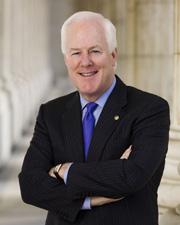
United States · Official source
4,950 records where Sen. Cornyn, John [R-TX] is listed as a sponsor, author, or other actor. Search with topics and years
United States · United States Congress · 12 February 2025
United States · United States Congress · 12 February 2025
Protecting Access for Hunters and Anglers Act of 2025 This bill bars the Fish and Wildlife Service (FWS), the Bureau of Land Management (BLM), and the Forest Service from prohibiting or regulating the use of lead ammunition or tackle on federal land or water. The bill makes exceptions for specified existing regulations and where the FWS, the BLM, or the Forest Service determines that a decline in wildlife population at the specific unit of federal land or water is primarily caused by the use of lead in ammunition or tackle, based on the field data from such unit, and the state approves the regulations.
United States · United States Congress · 12 February 2025
Combating Illicit Xylazine Act This bill regulates xylazine under the Controlled Substances Act (CSA). Xylazine, also known as tranq , is a nonopioid sedative and pain reliever that is approved for use in animals. Recently, the Drug Enforcement Administration (DEA) has reported an increase in trafficking of fentanyl mixed with xylazine. This bill adds xylazine, including its salts, isomers, and salts of isomers, to schedule III of the CSA. Schedule III controlled substances, including anabolic steroids, buprenorphine, and ketamine, have less potential for abuse than a schedule I or II substance, have a currently accepted medical use, and have low or moderate risk of dependence if abused. Under the bill, manufacturing, distributing, or dispensing xylazine, or possessing with intent to manufacture, distribute, or dispense xylazine for illicit use is subject to criminal penalties under the CSA. The bill also requires xylazine transactions to be tracked in the drug reporting system maintained by the DEA. The bill exempts from registration under the CSA persons and entities that possess xylazine (1) lawfully dispensed by a veterinarian or pharmacy and (2) for an animal or for use in certain animal-control or wildlife programs. The bill also exempts xylazine manufacturers from the CSA's physical security requirements. Finally, the bill requires the DEA, in coordination with the Department of Health and Human Services (HHS), to provide Congress with a report on how the agencies previously determined whether xylazine should be a controlled substance, including the full text of HHS's recommendations to the DEA for scheduling xylazine.
United States · United States Congress · 12 February 2025
United States-Israel Defense Partnership Act of 2025 This bill requires or authorizes certain actions to increase defense-related cooperation between the United States and Israel. Specifically, the bill requires the Department of Defense (DOD) to establish a cooperative program, with the concurrence of Israel's Ministry of Defense (MOD), to develop and deploy advanced technologies for countering unmanned systems that threaten the United States and Israel; establish in Israel an office of the Defense Innovation Unit (an organization that focuses on rapidly fielding and scaling commercial technology across the U.S. military); and seek to engage Israel's MOD on the ascension of Israel into the national technology and industrial base (currently defined in law as the persons and organizations engaged in research, development, production, integration, services, or information technology activities conducted within the United States, the United Kingdom, Australia, New Zealand, and Canada). The bill authorizes DOD, upon request of Israel's MOD, to jointly conduct research, development, test, and evaluation (RDT&E) of emerging technologies such as artificial intelligence and robotics to meet defense challenges. Additionally, the bill extends the authority for DOD to (1) carry out RDT&E on a joint basis with Israel to establish anti-tunnel and counter unmanned aerial systems capabilities through 2028, and (2) transfer defense articles intended for use as reserve stocks for Israel through January 1, 2029.
United States · United States Congress · 12 February 2025
United States · United States Congress · 12 February 2025
This resolution expresses the sense of the Senate that any NATO member country that does not meet its commitment to spend 2% of its gross domestic product on national defense should not be allowed to host certain NATO meetings that provide substantial economic benefits and international recognition, such as the NATO Summit and NATO Parliamentary Assembly sessions. The resolution also expresses that citizens of such countries should not be allowed to hold NATO leadership positions, such as Secretary General or military positions at the two-star level or above.
United States · United States Congress · 11 February 2025
United States · United States Congress · 11 February 2025
Financing Our Energy Future Act This bill allows a publicly traded partnership to derive income from certain clean energy-related activities and still be treated as a partnership for federal income tax purposes. As background, a publicly traded partnership is a partnership whose interests are traded on an established securities market (or readily tradable on a secondary market). A publicly traded partnership generally is treated as a corporation for federal income tax purposes unless 90% or more of such partnership’s gross income is qualifying income. Under current law, qualifying income includes interest and dividends; real property rents; gain from the sale (or disposition) of real property; income from certain activities related to minerals and natural resources, source carbon dioxide, and the transportation or storage of certain fuels; and gain from the sale (or disposition) of a capital asset or commodities. Under the bill, the qualifying income is expanded to include income derived from electric power (or thermal energy) generated from renewable energy sources (e.g., wind and solar energy), qualified gasification projects, or advanced nuclear facilities; accepting or processing open-loop biomass or municipal solid waste (by certain facilities); the storage of electric power or thermal energy using certain energy storage technology; the generation, storage, or distribution of electric power (or thermal energy) using combined heat and power system property; fuels that use certain carbon oxides as primary feedstock; certain renewable chemicals; transportation or storage of liquefied or compressed hydrogen; the conversion of renewable biomass; and certain carbon capture and sequestration facilities.
United States · United States Congress · 11 February 2025
Stopping Harmful Image Exploitation and Limiting Distribution Act of 2025 or the SHIELD Act of 2023 [ sic ] This bill establishes new federal criminal offenses related to the distribution of sexual exploitative content. First, the bill makes it a crime to knowingly mail or distribute (or intentionally threaten to mail or distribute) an intimate visual depiction of a recognizable adult engaged in sexual conduct. To constitute a crime, certain elements must be met, including that the distribution must be nonconsensual; the depiction is not a matter of public concern; and the distribution must be intended to cause harm or cause harm. A violator is subject to a fine, a prison term of up to two years, or both; mandatory restitution; and the forfeiture of material involved in the offense, property constituting or derived from the proceeds from the offense, and property used to commit or facilitate the offense. Second, the bill makes it a crime to knowingly mail or distribute (or intentionally threaten to mail or distribute) a visual depiction of a nude minor with intent to abuse, humiliate, harass, or degrade the minor, or to arouse or gratify the sexual desire of any person. A violator is subject to a fine, a prison term of up to three years, or both; mandatory restitution; and the forfeiture of material involved in the offense, property constituting or derived from the proceeds from the offense, and property used to commit or facilitate the offense.
United States · United States Congress · 6 February 2025
Advancing Innovation and Maintenance through Headquarters for Instruction, Growth, and High-tech training Act or the AIM HIGH Act This bill requires the Department of the Air Force to operate a Technical Training Center of Excellence. Among other duties, the center must (1) facilitate collaboration among all Air Force technical training installations; and (2) identify and promulgate best practices, standards, and benchmarks.
United States · United States Congress · 6 February 2025
This joint resolution proposes a constitutional amendment requiring the Supreme Court to consist of nine Justices.
United States · United States Congress · 6 February 2025
Veterans 2nd Amendment Protection Act of 2025 This bill prohibits the Department of Veterans Affairs (VA) from transmitting certain information to the National Instant Criminal Background Check System (NICS) utilized by licensed importers or dealers of firearms. Specifically, the bill prohibits the VA from transmitting personally identifying information of a veteran or a beneficiary to the NICS solely on the basis that such veteran or beneficiary has an appointed fiduciary to manage their benefits, unless there is an order or finding of a judicial authority that such veteran or beneficiary is a danger to themselves or others.
United States · United States Congress · 6 February 2025
Alternatives to Prevent Addiction In the Nation Act or the Alternatives to PAIN Act This bill reduces cost-sharing and prohibits the imposition of certain utilization requirements under the Medicare prescription drug benefit for certain non-opioid pain management drugs. Specifically, the bill requires such drugs to be covered without a deductible and to be placed on the lowest cost-sharing tier (if any). The bill also prohibits the imposition of prior authorization requirements (i.e., requiring prior approval from a plan) or step therapy requirements (i.e., requiring the use of alternative drugs before a drug is covered under a plan) with respect to such drugs.
United States · United States Congress · 6 February 2025
United States · United States Congress · 6 February 2025
This resolution supports the designation of Career and Technical Education Month to celebrate career and technical education across the United States.
United States · United States Congress · 5 February 2025
Love Lives On Act of 2025 This bill extends entitlement for various benefit programs and services for surviving spouses of deceased members of the Armed Forces or veterans. The bill provides that the remarriage of a surviving spouse must not bar the furnishing of dependency and indemnity compensation or special pension benefits to such spouse. Additionally, the Department of Defense may not terminate the payment of an annuity for a surviving spouse under the Survivor Benefit Plan solely because the surviving spouse remarries. The bill also expands the definition of a dependent under TRICARE to include a remarried widow or widower whose subsequent marriage has ended due to death, divorce, or annulment.
United States · United States Congress · 5 February 2025
Situational Awareness of Flying Elements in Orbit Act or the SAFE Orbit Act This bill provides statutory authority for the Traffic Coordination System for Space, which is being developed by the Office of Space Commerce to provide space situational awareness data and services to space operators. ( Space situational awareness means an understanding of the space operational environment and the identification, tracking, and prediction of the behavior of space objects and debris.) As an initial matter, the bill provides for the elevation of the Office of Space Commerce to a standalone bureau within the Department of Commerce. (The office currently sits within the National Oceanic and Atmospheric Administration.) The bill authorizes the bureau to acquire location tracking data, positional and orbit determination information, conjunction data messages, and other data, analytics, information, and services deemed necessary to avoid collisions in space. The bureau must disseminate this information at no charge (1) through a public database of space situational awareness information and services, including space traffic coordination; and (2) through the provision of basic situational awareness services to satellite operators. The bill also sets forth certain requirements for the collection and dissemination of such information, including that, to the extent practicable, the provision of service to satellite operators may not compete with private situational awareness products. Finally, the bill provides immunity for the United States government from any suit for a cause of action arising from the provision or receipt of space situational awareness services or information.
United States · United States Congress · 5 February 2025
Securing Trade and Resources for Advanced Technology, Economic Growth, and International Commerce in Minerals Act or STRATEGIC Minerals Act This bill authorizes actions to facilitate trade and increase U.S. access to critical minerals and rare earth elements (REEs). Under the bill, critical minerals are any mineral, element, substance, or material designated as critical by the U.S. Geological Survey (e.g., aluminum and cobalt). Additionally, the bill includes a group of 17 elements within the definition of REEs , including elements used in permanent magnets (e.g., dysprosium and neodymium). Specifically, the bill authorizes the President, acting through the Office of the U.S. Trade Representative, to (1) negotiate, enter into, and enforce a free trade agreement with a country or countries with respect to critical minerals and REEs when the President determines it is in the national interest; and (2) proclaim a modification or continuance of any existing duty, or continuance of existing duty-free or excise treatment, as the President determines necessary to carry out the agreement. The bill prohibits agreements with nonmarket economy countries that are designated as foreign countries of concern (e.g., China and Russia). The bill outlines procedures for congressional notification, consultation, and review of these trade agreements. The bill also expands the definition of domestic source under the Defense Production Act, thereby making certain businesses from countries that are party to free trade agreements under this bill eligible for financial incentives to increase production of critical components, critical technology items, materials, and industrial resources needed for U.S. national security.
United States · United States Congress · 5 February 2025
Space Commerce Advisory Committee Act This bill requires the Office of Space Commerce to establish a Commercial Space Activity Advisory Committee to provide information and recommendations on nongovernmental space activities and promoting a robust and innovative commercial space sector. Among other duties, the committee is directed to identify challenges to the U.S. commercial space sector and to review best practices for commercial space entities with respect to avoiding harmful contamination of the Moon and other celestial bodies and adverse impacts to the Earth’s environment from extraterrestrial matter. The committee must be comprised of representatives from varying fields with significant experience in the commercial space industry. The committee must terminate ten years after it is established.
United States · United States Congress · 4 February 2025
Promoting Resilient Buildings Act This bill increases flexibility for predisaster mitigation assistance for building code activities, prohibits using certain loan funds for building code activities, and establishes a pilot program to fund residential resilience retrofits. Under current law, the Federal Emergency Management Agency (FEMA) may provide predisaster hazard mitigation assistance to government entities for implementing the latest published editions of relevant building codes and standards. Also, FEMA must consider a government entity’s adoption of such building codes when determining whether to award it predisaster hazard mitigation assistance. The bill specifies that the building codes applicable in such instances are the two most recently published editions (i.e., either the current edition or the previous one). Also, currently, under FEMA's Safeguarding Tomorrow Revolving Loan Fund (STRLF) program, states and Indian tribal governments may provide loans to local governments for establishing and carrying out building codes and standards. The bill removes this authority, so STRLF loans may not be used for such building code-related activities. Additionally, the bill establishes a pilot program for FEMA to provide grants to government entities that then provide the funding to individuals for residential resilience retrofits. The retrofit projects must reduce risk to homes from local natural hazards and individuals must demonstrate financial need. To implement the pilot program, FEMA may use up to 10% of the funds FEMA provides annually for predisaster hazard mitigation assistance. The pilot program terminates at the end of FY2030.
United States · United States Congress · 4 February 2025
This joint resolution nullifies the Environmental Protection Agency (EPA) rule titled Waste Emissions Charge for Petroleum and Natural Gas Systems: Procedures for Facilitating Compliance, Including Netting and Exemptions and published on November 18, 2024. The rule outlines compliance requirements under the Methane Emissions Reduction Program. Under the program, the EPA collects an annual charge on emissions of methane and other greenhouse gases from entities in the oil and gas sector if their emissions exceed specified waste emissions thresholds.
United States · United States Congress · 4 February 2025
Fairness for Servicemembers and their Families Act of 2025 This bill requires the Department of Veterans Affairs (VA) to periodically review and report on the maximum coverage available under the Servicemembers' Group Life Insurance and Veterans' Group Life Insurance programs. Specifically, the VA must review such coverage amount every five years, taking into account the average percentage by which the Consumer Price Index for All Urban Consumers (CPI-U) increased in the five fiscal years preceding the review.
United States · United States Congress · 4 February 2025
Fair Access to Banking Act This bill places restrictions on certain banks, credit unions, and payment card networks if they refuse to do business with a person who complies with the law. Restrictions include prohibiting the use of electronic funds transfer systems and lending programs, termination of an institution's depository insurance, and specified civil penalties. Banks and other specified financial institutions are allowed to deny financial services to a person only if the denial is justified by a documented failure of that person to meet quantitative, impartial, risk-based standards established in advance by the institution. This justification may not be based upon reputational risks to the institution. The bill establishes the right for a person to bring a civil action for a violation of this bill.
United States · United States Congress · 3 February 2025
United States · United States Congress · 30 January 2025
Purple Heart Veterans Education Act of 2025 This bill authorizes certain Purple Heart recipients to elect to transfer to one or more eligible dependents (e.g., a spouse or child) unused portions of such recipients’ entitlement to Post-9/11 GI Bill educational assistance. This authority specifically applies to veterans who are awarded the Purple Heart for service in the Armed Forces occurring on or after September 11, 2001, and who have been discharged or released from active service. Under the bill, the total number of months of entitlement transferred by a Purple Heart recipient may not exceed 36 months. Additionally, the Purple Heart recipient may modify or revoke any unused portion of the transferred entitlement by submitting written notice. A transferred entitlement may not be treated as marital property or marital assets in divorce or other civil proceedings. The death of the Purple Heart recipient must not affect the use of the entitlement by the individual who receives the transferred entitlement. In the event of an overpayment of educational assistance, the Purple Heart recipient and the transferee of the entitlement must be held jointly and severally liable for the amount. The bill requires the VA and DOD to coordinate to facilitate the transfer of entitlements under the bill.
United States · United States Congress · 30 January 2025
Hindering Oppressive Nations from Obtaining Revenue Act or HONOR Act This bill prohibits a taxpayer from claiming the foreign tax credit (FTC) or an itemized tax deduction for taxes paid, accrued, or deemed paid to Russia. Under current law, a taxpayer may claim the FTC for income, war profits, and excess profits taxes (or taxes imposed in lieu of these taxes) paid, accrued, or deemed paid to a foreign country (and certain U.S. possessions) or an itemized tax deduction for such taxes, both subject to limitations. However, under current law, a taxpayer may not claim the FTC (but may claim an itemized tax deduction) for taxes paid to a foreign country if (1) the United States does not recognize the country’s government, (2) the United States severs or does not conduct diplomatic relations with the country, or (3) the country is designated by the Department of State as supporting international terrorist acts. (Currently, the FTC is disallowed for taxes paid, accrued, or deemed paid to Iran, North Korea, Sudan, and Syria.) Under the bill, a taxpayer may not claim the FTC for taxes paid, accrued, or deemed paid to Russia beginning 30 days after the date of enactment and until normal U.S. trade relations with Russia are restored (pursuant to requirements established by the Suspending Normal Trade Relations with Russia and Belarus Act). The bill also disallows an itemized tax deduction for taxes paid, accrued, or deemed to be paid to Russia (effective 90 days after the date of enactment).
United States · United States Congress · 30 January 2025
Halt All Lethal Trafficking of Fentanyl Act or the HALT Fentanyl Act This bill permanently places fentanyl-related substances as a class into schedule I of the Controlled Substances Act. A schedule I controlled substance is a drug, substance, or chemical that has a high potential for abuse; has no currently accepted medical value; and is subject to regulatory controls and administrative, civil, and criminal penalties under the Controlled Substances Act. Under the bill, offenses involving fentanyl-related substances are triggered by the same quantity thresholds and subject to the same penalties as offenses involving fentanyl analogues (e.g., offenses involving 100 grams or more trigger a 10-year mandatory minimum prison term). Additionally, the bill establishes a new, alternative registration process for certain schedule I research. The bill also makes several other changes to registration requirements for conducting research with controlled substances, including permitting a single registration for related research sites in certain circumstances, waiving the requirement for a new inspection in certain situations, and allowing a registered researcher to perform certain manufacturing activities with small quantities of a substance without obtaining a manufacturing registration. Finally, the bill expresses the sense that Congress agrees with the interpretation of the Controlled Substances Act in United States v. McCray , a 2018 case decided by the U.S. District Court for the Western District of New York. In that case, the court held that butyryl fentanyl, a controlled substance, can be considered an analogue of fentanyl even though, under the Controlled Substances Act, the term controlled substance analogue specifically excludes a controlled substance.
United States · United States Congress · 30 January 2025
Nancy Gardner Sewell Medicare Multi-Cancer Early Detection Screening Coverage Act This bill allows, beginning in 2028, for Medicare coverage and payment for multi-cancer early detection screening tests that are approved by the Food and Drug Administration and that are used to screen for cancer across many cancer types, if the Centers for Medicare & Medicaid Services determines such coverage is appropriate. Coverage is limited to those under a certain age (age 68 in 2028, increased by one year every year thereafter) and to one test every 11 months.
United States · United States Congress · 30 January 2025
African Diaspora Heritage Month Act of 2025 This bill requires the President to designate by proclamation African Diaspora Heritage Month. The proclamation shall be issued every year and urge the observation of African Diaspora Heritage Month by state and local governments.
United States · United States Congress · 30 January 2025
Silencers Help Us Save Hearing Act or the SHUSH Act This bill removes silencers from regulation under federal firearms laws. Specifically, it removes silencers from the list of firearms subject to regulation (i.e., registration and licensing requirements) under the National Firearms Act (NFA). Additionally, it excludes a muffler or silencer from the list of firearms subject to regulation (e.g., background check requirements) under the Gun Control Act of 1968 (GCA). Additionally, the bill does the following: preempts state or local laws that tax or regulate firearm silencers, specifies that a person who lawfully acquires or possesses a silencer under provisions of the GCA meets the registration and licensing requirements of the NFA, eliminates mandatory minimum prison terms for a crime of violence or drug trafficking offense in which a defendant uses or carries a firearm equipped with a silencer or muffler, and permits active and retired law enforcement officers to carry a concealed silencer. Finally, the bill excludes firearm mufflers and silencers from regulation by the Consumer Product Safety Commission. (Current law generally excludes firearms from regulation by the commission.)
United States · United States Congress · 29 January 2025
United States · United States Congress · 29 January 2025
Cattle Fever Tick Eradication Program Enhancement Act of 2025 This bill requires the Department of Agriculture (USDA) to enter into a contract to evaluate the Cattle Fever Tick Eradication Program. Under the program, the Animal and Plant Health Inspection Service works in coordination with the Texas Animal Health Commission to combat the spread of cattle fever ticks, which can spread a serious cattle disease called bovine babesiosis or cattle fever. Specifically, USDA must enter into a contract to review and report on the Cattle Fever Tick Eradication Program with a (1) land-grant college or university, or (2) non-land-grant college of agriculture. The review must include an evaluation of the program's (1) effectiveness with respect to preventing and reducing the spread of cattle fever ticks; and (2) benefits, and the burdens of compliance, to cattle producers. The review must also evaluate the treatment protocols developed and implemented under the program. Further, the review must evaluate the federal and state funds allocated to support the program for the most recent fiscal year.
United States · United States Congress · 29 January 2025
This resolution designates January 26-February 1, 2025, as National School Choice Week.
United States · United States Congress · 28 January 2025
Stop Illegal Reentry Act This bill increases criminal penalties for certain non-U.S. nationals ( aliens under federal law) who illegally reenter the United States after removal or exclusion. Generally, an individual who had been denied entry into or removed from the United States and who later enters or attempts to enter the United States without prior approval from the Department of Homeland Security shall be fined, imprisoned for up to five years, or both. Current law requires a fine, imprisonment for up to two years, or both, for such an individual. An individual who had been denied entry or removed three or more times and who later enters or attempts to enter the United States shall be fined, imprisoned for up to 10 years, or both. An individual who was convicted of an aggravated felony or convicted at least two times before removal or departure and who subsequently enters or tries to enter the United States shall be imprisoned at least 5 years and for up to 20 years and may also be fined. Currently, there is no minimum term of imprisonment for an individual who reenters after a conviction for an aggravated felony, and there are no criminal penalties for a reentering individual who had been convicted at least two times (other than the penalties for illegal reentry generally).
United States · United States Congress · 28 January 2025
Improving Veterans’ Experience Act of 2025 This bill establishes the Veterans Experience Office within the Department of Veterans Affairs (VA) to carry out the key customer experience initiatives of the VA relating to veterans’ and beneficiaries’ satisfaction with and usage of VA benefits and services. Additionally, the office must require the heads of other organizations and offices within the VA to report regularly on customer experience metrics, action plans, and other customer experience improvement efforts; collect veteran-derived data to determine satisfaction and for use in policymaking; provide strategic guidance and strategies to VA entities for engaging with veterans and beneficiaries; assess and advise the VA on the accuracy and helpfulness of websites and customer-facing information of the VA; and assess and advise the VA on the status and opportunities for improvement of the customer service efforts of the VA. The requirements of this bill terminate on September 30, 2028. The Government Accountability Office must analyze and report on the methodology, effectiveness, and implementation of the VA’s approach to improving veteran and beneficiary customer experience and satisfaction.
United States · United States Congress · 27 January 2025
Foreign Adversary Communications Transparency Act This bill requires the Federal Communications Commission (FCC) to annually publish a list of entities that hold a license or other authorization granted by the FCC and have ties to specified foreign countries. With respect to entities holding cable landing licenses (for the placement and operation of submarine communications cables) or other licenses granted via competitive auction, the FCC must publish a list of all such entities (1) in which a covered entity holds a specified voting or equity interest, or (2) that have been determined by a national security agency to be subject to the control of a covered entity. With respect to entities holding all other categories of FCC licenses or other authorizations, the FCC must first issue rules facilitating the collection of information on such licensees’ ownership structure. After that information is obtained, the FCC must add to the published list any such entity in which a covered entity holds a specified voting or equity interest. Under the bill, a covered entity is defined as an entity organized in China, Iran, North Korea, or Russia; a subsidiary of such an entity; or the government of China, Iran, North Korea, or Russia.
United States · United States Congress · 24 January 2025
Dignity for Aborted Children Act This bill establishes requirements for abortion providers with respect to the disposal of human fetal tissue from an abortion. Specifically, it requires abortion providers to obtain a patient's informed consent for one of two specified methods of disposition and to retain the corresponding documentation in the patient's file. First, patients may choose to retain possession of the tissue. A patient may choose to transfer the tissue to an entity that provides interment or cremation services. Second, patients may choose to release the tissue to the provider. Providers must ensure any tissue released to them is interred or cremated within seven days of the procedure in a manner consistent with state law regarding the disposal of human remains. Abortion providers must submit reports annually to the Department of Health and Human Services about these requirements and other specified information. The bill establishes civil penalties for violations of the requirement to retain documentation of informed consent, and it establishes criminal penalties for violations of the requirement regarding the disposal of human fetal tissue.
United States · United States Congress · 24 January 2025
Protecting Life in Foreign Assistance Act This bill prohibits the provision of funding for purposes outside the United States to certain foreign or domestic organizations that perform or promote abortions, furnish or develop items intended to procure abortions, or provide financial support for an entity that conducts such activities.
United States · United States Congress · 23 January 2025
Monetary Enhancement for Distinguished Active Legends Act of 2025 or the MEDAL Act of 2025 This bill increases the monthly special pension for living Medal of Honor recipients from $1,406.73 to $8,333.33 and establishes a rate of $1,406.73 for the monthly special pension for surviving spouses of Medal of Honor recipients. Both amounts must be adjusted annually for inflation.
United States · United States Congress · 23 January 2025
Main Street Tax Certainty Act This bill makes permanent the qualified business income (QBI) tax deduction. Under current law, individuals, estates, and trusts may deduct the lower of (1) 20% of QBI from a qualified business, qualified real estate investment trust dividends, and qualified publicly traded partnership income; or (2) 20% of taxable income less net capital gain. (Some limitations apply.) However, under current law, the QBI tax deduction expires after December 31, 2025.
United States · United States Congress · 23 January 2025
United States · United States Congress · 23 January 2025
Honoring Our Fallen Heroes Act of 2025 This bill extends death and disability benefits under the Public Safety Officers' Benefits Program (PSOB) to certain public safety officers who suffer from exposure-related cancer while on duty and their survivors. The PSOB program provides death, disability, and education benefits to public safety officers who are killed or injured in the line of duty and their survivors. The bill specifies that exposure to a carcinogen shall be presumed to constitute a personal injury in the line of duty if the exposure occurred while the officer was in the line of duty; the officer began serving as an officer not fewer than 5 years before the date of the diagnosis of an exposure-related cancer and the diagnosis occurred not more than 15 years after the last date of active service; and the exposure-related cancer directly and proximately resulted in the death or permanent and total disability of the officer. The Department of Justice's Bureau of Justice Assistance must periodically review the definition of exposure-related cance r and update the definition if appropriate based on medical evidence and in accordance with the requirements of a petition process.
United States · United States Congress · 23 January 2025
Acequia Communities Empowered by Qualifying Upgrades for Infrastructure Act This bill specifies that agricultural producers who rely on acequia systems are eligible to receive assistance under the Noninsured Crop Disaster Assistance Program for all losses suffered as a result of drought, flood, or other natural disasters. Acequias, or community ditches, are community-operated and -organized water irrigation systems. The bill also provides that a special use permit shall not be required on Department of Agriculture (USDA) or Department of the Interior land for the (1) presence or use of an acequia or the use of the acequia's water, or (2) routine maintenance and minor improvements conducted by a community user or governing body of an acequia. Further, USDA must submit a report to Congress on agricultural producers who rely on acequia systems.
United States · United States Congress · 22 January 2025
Ensuring Accurate and Complete Abortion Data Reporting Act of 2025 This bill requires states, as a condition of federal payment under Medicaid for family planning services, to report certain abortion data to the Centers for Disease Control and Prevention (CDC). (Currently, reporting is voluntary.) The CDC must develop standardized questions for states with respect to specified variables (e.g., maternal demographics and methods of abortion).
United States · United States Congress · 22 January 2025
No Taxpayer Funding for Abortion and Abortion Insurance Full Disclosure Act of 2025 This bill modifies provisions relating to federal funding for, and health insurance coverage of, abortions. Specifically, the bill prohibits the use of federal funds for abortions or for health coverage that includes abortions. Such restrictions extend to the use of funds in the budget of the District of Columbia. Additionally, abortions may not be provided in a federal health care facility or by a federal employee. Historically, language has been included in annual appropriations bills for the Department of Health and Human Services (HHS) that prohibits the use of federal funds for abortions—such language is commonly referred to as the Hyde Amendment. Similar language is also frequently included in appropriations bills for other federal agencies and the District of Columbia. The bill makes these restrictions permanent and extends the restrictions to all federal funds (rather than specific agencies). The bill's restrictions regarding the use of federal funds do not apply in cases of rape, incest, or where a physical disorder, injury, or illness endangers a woman's life unless an abortion is performed. The Hyde Amendment provides the same exceptions. The bill also prohibits qualified health plans from including coverage for abortions. Currently, qualified health plans may cover abortion, but the portion of the premium attributable to abortion coverage is not eligible for subsidies.
United States · United States Congress · 22 January 2025
PLO and PA Terror Payments Accountability Act of 2025 This bill requires the President to impose sanctions on foreign persons (individuals and entities) that are involved with the Palestinian Liberation Organization (PLO) or Palestinian Authority (PA) system of compensation supporting acts of terrorism. The bill defines this system of compensation as payments to an individual who (1) has been imprisoned for terrorist acts against Israeli or U.S. citizens after being fairly tried, (2) died while committing such terrorist acts, or (3) is a family member of such individuals. The definition also includes compensation for individuals imprisoned for terrorism where the level of compensation is based on the length of incarceration. Specifically, the President must impose visa- and property-blocking sanctions on any foreign person that has facilitated this compensation system, including PLO and PA officials as well as entities such as the Institute for the Care of the Families of the Martyrs and the Wounded. The President must also impose visa- and property-blocking sanctions on foreign persons who knowingly provide significant support to, or engage in significant transactions with, any of the aforementioned persons. The President must sanction foreign financial institutions that facilitate payments or benefits related to this compensation system by (1) prohibiting them from opening correspondent or payable-through accounts in the United States, and (2) prohibiting or imposing strict conditions on the maintenance of such accounts. The provisions of this bill shall terminate if the Department of State certifies that such compensation system has ceased.
United States · United States Congress · 22 January 2025
Protect Funding for Women's Health Care Act This bill prohibits federal funding of Planned Parenthood Federation of America or its affiliates, subsidiaries, successors, or clinics.
United States · United States Congress · 21 January 2025
Creating Obstructions Necessary to Address Illegal and Nefarious Entry Rapidly Act or CONTAINER Act This bill requires the Department of the Interior and the Forest Service to allow border states to place temporary, movable structures on federal lands adjacent to the U.S.-Canada and U.S.-Mexico borders without a special use authorization. Border states may place these structures on such lands for the purpose of securing the northern or southern border for a period of not more than one year. Interior and the Forest Service must approve extension requests in 90-day increments if U.S. Customs and Border Protection determines that operational control of the border area has not been achieved.
United States · United States Congress · 21 January 2025
Preventing Violence Against Women by Illegal Aliens Act This bill establishes certain criminal grounds for making non-U.S. nationals ( aliens under federal law) inadmissible and expands the crimes for which a non-U.S. national is deportable. First, the bill establishes that a non-U.S. national is inadmissible if the individual has admitted to or is convicted of acts constituting the essential elements of stalking, child abuse, child neglect, child abandonment, a sex offense, conspiracy to commit a sex offense, a violation of certain protection orders, or domestic violence (including physical or sexual abuse or a pattern of coercive behavior when it occurs within certain close relationships). Next, the bill establishes additional grounds for deportation. Under current law, a non-U.S. national is deportable for certain criminal convictions, including domestic violence, stalking, and child abuse. The bill makes any sex offense (including crimes against minors) or conspiracy to commit a sex offense a basis for deportation. The bill also expands the domestic violence crimes that make a non-U.S. national deportable to include physical or sexual abuse or a pattern of coercive behavior when it occurs within certain close relationships.
United States · United States Congress · 21 January 2025
Standing Against Houthi Aggression Act This bill requires (1) the Department of State to designate Ansarallah, the Iran-backed movement in Yemen also known as the Houthis, as a foreign terrorist organization; and (2) the President to impose property- and visa-blocking sanctions with respect to Ansarallah and any foreign person who is a member, agent, or affiliate of, or owned or controlled by, Ansarallah.