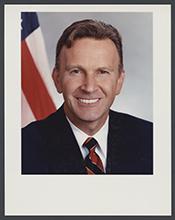
United States · United States Congress · 20 March 1997
United States Armed Forces in Bosnia Protection Act of 1997 - Prohibits any funds appropriated or otherwise available to the Department of Defense (DOD) or any other Federal department or agency from being obligated or expended for the deployment on the ground of U.S. armed forces in the territory of the Republic of Bosnia and Herzegovina after September 30, 1997. Provides exceptions: (1) for the deployment of troops to aid in troop withdrawal; or (2) if the President transmits to the Congress a request for a deployment extension for an additional 90 days after such deadline and a joint resolution is enacted approving such request. Outlines congressional procedures for the consideration of such request. Prohibits DOD or other Federal funds from being obligated or expended for: (1) the conduct of, or support for, any law enforcement activities in Bosnia and Herzegovina, with an exception for the training of law enforcement personnel or to prevent imminent loss of life; (2) any activity that may jeopardize the primary mission of the United Nations-led Stabilization Fore in preventing armed conflict there; (3) the transfer of refugees within the Republic that has a purpose of acquiring control by one Bosnian entity of territory allocated to another or that may expose U.S. armed forces to substantial risk; or (4) implementation of any decision to change the legal status of any territory within the Republic unless expressly agreed to by all signatories to the Dayton Peace Agreement. Requires a report from the President to the Congress on the ground deployment of U.S. forces in Bosnia and Herzegovina.
United States · United States Congress · 20 March 1997
Amends the Elementary and Secondary Education Act of 1965 (ESEA) to prohibit the use of ESEA funds to promote teaching or using dialects peculiar to a region or group within the U.S. population. Allows teachers, notwithstanding such prohibition, to: (1) be trained in, use, and teach foreign languages; and (2) communicate in their own modes of speech, if no special effort is made to teach or encourage students to communicate in such modes of speech.
United States · United States Congress · 20 March 1997
State Initiative Fairness Act - Prohibits a U.S. district court or judge thereof from granting any application for an interlocutory or permanent injunction restraining the enforcement, operation, or execution of a State law adopted by referendum upon the ground of unconstitutionality unless such application is heard and determined by a three-judge court. Requires, in any such case, the additional judges to be designated as soon as practicable and the court to expedite the consideration of the application for an injunction. Requires any appeal of a determination on such application to be to the Supreme Court.
United States · United States Congress · 20 March 1997
Methamphetamine Elimination Act - Authorizes appropriations to the Attorney General for FY 1998 through 2003 to make grants to the California Bureau of Narcotics Enforcement to implement the Bureau's methamphetamine strategy.
United States · United States Congress · 20 March 1997
Credit Union Membership Access Act - Amends the Federal Credit Union Act to limit Federal credit union membership to one or more groups each of which has a common bond within such group.
United States · United States Congress · 13 March 1997
Internet Tax Freedom Act - Prohibits a State or local government from imposing, assessing, or attempting to collect any tax or fee on the Internet or interactive computer services (ICs) or on their use. Preserves State and local taxing authority with respect to income, license, and sales taxes. Directs the Secretaries of the Treasury, Commerce, or State to: (1) undertake an examination of U.S. and international taxation of the Internet and ICs, as well as commerce conducted thereon; and (2) jointly submit to the President appropriate policy recommendations concerning such taxation. Directs the President to transmit to the appropriate congressional committees policy recommendations on the taxation of sales and other transactions effected on the Internet or through ICs. Requires all such recommendations to be consistent with policy statements of the Telecommunications Act of 1996. Amends the Communications Act of 1934 to state that the Federal Communications Commission or any equivalent State commission shall have no regulatory authority or jurisdiction with respect to charges paid by subscribers for ICs or information services transmitted through the Internet, except for the requirement that such services be provided at affordable rates to rural health care providers, schools, and libraries. Expresses the sense of the Congress that the President should seek bilateral and multilateral agreements through various international forums to establish that activity on the Internet and ICs be free from tariff and taxation.
United States · United States Congress · 11 March 1997
Constitutional Amendment - Requires that a bill to increase the internal revenue shall laws shall require for final adoption in each House the concurrence of two-thirds of the whole of the number of that House, unless the bill does not increase the internal revenue by more than a de minimis amount. Permits the waiver of such requirement, for up to two years, if there is a declaration of war or if the United States is engaged in a military conflict which causes an imminent and serious threat to national security and is so declared by a joint resolution which becomes law.
United States · United States Congress · 6 March 1997
Americorps Program Elimination Act - Amends the National and Community Service Act of 1990 to repeal the National Service Trust Program (Americorps) under which certain persons who perform national or community service receive stipends and educational awards for such service.
United States · United States Congress · 6 March 1997
Amends the Internal Revenue Code to repeal the post-1987 reduction in the State ceiling on private activity bonds. Provides, beginning in 1999, for cost-of-living adjustments in the State ceiling on such bonds.
United States · United States Congress · 6 March 1997
Calls for the Citizens' Stamp Advisory Committee to recommend and the Postal Service to issue a postage stamp to honor law enforcement officers killed in the line of duty.
United States · United States Congress · 5 March 1997
Amends the Internal Revenue Code to make permanent the credit for increasing research activities. Removes a restriction on electing the alternative incremental credit.
United States · United States Congress · 3 March 1997
Expresses the sense of the Congress that: (1) the Ten Commandments are a declaration of fundamental principles that are the cornerstones of a fair and just society; and (2) the public display of the Ten Commandments, including in government offices and courthouses, should be permitted.
United States · United States Congress · 27 February 1997
Social Security Preservation Act of 1997 - Amends title II (Old Age, Survivors and Disability Insurance) (OASDI) of the Social Security Act to require the Managing Trustee of the Board of Trustees of the Federal Old-Age and Survivors Insurance Trust Fund and the Federal Disability Insurance Trust Fund (trust funds) to ensure that the annual surplus of the trust funds is invested in: (1) marketable interest-bearing obligations of the United States or obligations guaranteed by the United States; or (2) certificates of deposit in insured depository institutions. Outlines provisions for determining the annual surplus of the trust funds. Prohibits disinvestment of trust fund amounts from public debt obligations, any refraining from making such investments, or any delay in making normal deposits in such trust funds for public debt limit-related purposes. Authorizes the sale of trust fund public debt obligations for the payment of cash benefits and administrative expenses, with conditions, including notification to each House of Congress and the Comptroller General at least three days in advance of such sale.
United States · United States Congress · 27 February 1997
Biomaterials Access Assurance Act of 1997 - Provides that, in any civil action, a biomaterials supplier (one who supplies components or raw materials used to manufacture implants) may raise any defense provided under this Act. Exempts a biomaterials supplier from liability for harm to a claimant caused by an implant, with exceptions in the case of a supplier who: (1) is a registered manufacturer of the implant; (2) is a seller of the implant and who held title to the implant at the time of sale (or is related by common ownership or control to such a seller); or (3) furnishes raw materials or components that fail to meet applicable contractual requirements or specifications. States that a supplier may be considered a manufacturer of an implant, for purposes of such civil actions, only if the supplier has registered with the Secretary of Health and Human Services and included the implant on a list of devices filed pursuant to the Federal Food, Drug, and Cosmetic Act. Requires claimant payment of attorney's fees if the court finds the claim to be without merit and frivolous.
United States · United States Congress · 13 February 1997
Truth in Employment Act of 1997 - Amends the National Labor Relations Act to provide that nothing in specified prohibitions against unfair labor practices shall be construed as requiring an employer to employ any person who seeks or has sought employment with the employer in furtherance of other employment or agency status.
United States · United States Congress · 13 February 1997
Calls upon the President to: (1) assert U.S. concern regarding violations by the German Government of the rights of members of minority religious groups (including Scientologists); (2) emphasize that the United States regards human rights practices of such Government, and in particular the treatment of U.S. citizens who are performing, doing business, or traveling in Germany, as a significant factor in enhancing the "pacta sunt servanda" good faith relations between the United States and Germany; (3) encourage the governments of other countries to appeal to the German Government and to cooperate with other governments and international organizations (including the United Nations and its agencies) in efforts to protect the rights of minority religious groups in Germany; (4) continue to document discrimination against religious minority groups by the German Government and German Federal and State officials in his annual reports to the Congress on human rights practices in Germany; and (5) report to the Congress on executive branch efforts to discourage discrimination against minority religious groups there.
United States · United States Congress · 12 February 1997
Security and Freedom Through Encryption (SAFE) Act - Amends the Federal criminal code to permit any person within any State, and any U.S. person in a foreign country, to use any encryption regardless of the encryption algorithm selected, encryption key length chosen, or implementation technique or medium used, with an exception for the unlawful use of encryption in furtherance of a criminal act. Allows any person within any State to sell in interstate commerce any encryption. Specifies that no person in lawful possession of a key to encrypted information may be required by Federal or State law to relinquish to another person control of that key, with an exception for access for law enforcement purposes. Sets penalties for the willful use of encryption in furtherance of the commission of a criminal offense. (Sec. 3) Amends the Export Administration Act of 1979 to grant the Secretary of Commerce exclusive authority to control exports of all hardware, software, and technology for information security (including encryption), except that which is specifically designed or modified for military use. Prohibits requiring any validated license (with limited exceptions pursuant to the Trading With The Enemy Act or the International Emergency Economic Powers Act) for the export or reexport of any: (1) software, including software with encryption capabilities that is generally available as is and that is designed for installation by the purchaser, or that is in the public domain for which copyright or other protection is not available or is available to the public because it is generally accessible to the public in any form; or (2) computing device solely because it incorporates or employs in any form software (including software with encryption capabilities) exempted from any requirement for a validated license under this section. Directs the Secretary to authorize the export or reexport of: (1) software with encryption capabilities for nonmilitary end-uses in any country to which exports of software of similar capability are permitted for use by financial institutions not controlled in fact by U.S. persons, unless there is substantial evidence that such software will be diverted to a military end-use or an end-use supporting international terrorism, modified for military or authorization that may be required under the Act; and (2) computer hardware with encryption capabilities if the Secretary determines that a product offering comparable security is commercially available outside the United States from a foreign supplier without effective restrictions.
United States · United States Congress · 12 February 1997
Constitutional Amendment - Requires the President to transmit to the Congress, before each fiscal year, a proposed statement of receipts and outlays for such fiscal year in which outlays (except those for repayment of debt principal) are not greater than receipts (except those derived from borrowing)(a proposed balanced budget). Requires the Congress to adopt, by law, a statement of receipts and outlays for such fiscal year in which outlays are not greater than receipts (a balanced budget). Authorizes the Congress to amend, by law, that balanced budget, provided revised outlays are not greater than revised receipts. Authorizes the Congress to provide in balanced budget for a specific excess of outlays over receipts by a vote directed solely to that subject in which two-thirds of the whole number of each House agree to such excess. Requires the Congress and the President to ensure that actual outlays do not exceed the outlays set forth in such balanced budget. Prohibits any increase in the limit on the debt of the United States, unless two-thirds roll call vote of each House provides by law for such an increase. Requires any bill that increases the internal revenue (except by a de minimis amount) to receive for final adoption the concurrence of two-thirds of each House. Permits the Congress to waive the requirements of this article when: (1) a declaration of war is in effect; or (2) the United States is engaged in military conflict which causes an imminent and serious threat to national security and is so declared by a joint resolution, adopted by a majority of each House, which becomes law. Makes any increase in the internal revenue enacted under such a waiver effective for only two years. Makes the internal revenue provisions of this Article effective upon ratification, and the remaining provisions effective on the later of FY 2002 or the second fiscal year beginning after ratification.
United States · United States Congress · 11 February 1997
TABLE OF CONTENTS: Title I: Commemorative Coins Title II: Circulating Coins Thomas Alva Edison Sesquicentennial Commemorative Coin Act - Title I: Commemorative Coins - Directs the Secretary of the Treasury to mint one-dollar silver coins emblematic of the inventions of Thomas Alva Edison in commemoration of the sesquicentennial of his birth. Directs the Secretary to conduct an open design competition for the design of the obverse and reverse of the coins. Terminates the authority to mint such coins after December 31, 1997. Requires that certain surcharges received from coin sales be distributed to specified entities. Title II: Circulating Coins - Amends Federal law to declare that half-dollar coins minted between specified dates shall have the same design as the commemorative coins minted under this Act.
United States · United States Congress · 11 February 1997
Designates the United States Post Office building located at 313 East Broadway in Glendale, California, as the Carlos J. Moorhead Post Office Building.
United States · United States Congress · 11 February 1997
Amends the Personal Responsibility and Work Opportunity Reconciliation Act of 1996 to provide an exception to food stamp and supplemental security income limited eligibility for totally and permanently disabled permanent resident aliens whose disability arose after U.S. admission.
United States · United States Congress · 6 February 1997
Amends the Clean Air Act to allow reformulated gasoline rules of States for which a certain waiver is in effect (permitting them to enforce State motor vehicle emissions standards) to apply in an ozone nonattainment area in lieu of Environmental Protection Agency-promulgated requirements if the State rules will achieve reductions in the aggregate mass of emissions of toxic air pollutants and the aggregate mass of emissions of ozone-forming compounds at least as great as would result from application of the Federal requirements.
United States · United States Congress · 5 February 1997
Copyright Term Extension Act of 1997 - Amends Federal copyright provisions regarding preemption of laws concerning duration of copyrights. Prohibits the annulment or limitation of rights or remedies under State laws with respect to sound recordings fixed before February 15, 1972, until February 15, 2067 (currently, 2047). Extends the duration of copyright in a work created on or after January 1, 1978, to the life of the author and 70 (currently, 50) years after the author's death. Makes the same extension with regard to joint works created on or after such date. Extends the duration of copyright in anonymous or pseudonymous works or works made for hire on or after such date to 95 (currently, 75) years from the year of the first publication, or 120 (currently, 100) years from the year of creation, whichever expires first. Makes conforming extensions with respect to provisions regarding the presumption of an author's death. Extends from December 31, 2027, to December 31, 2047, the duration of copyright in works published on or before December 31, 2012. Extends the duration of certain subsisting copyright renewals by a period of 20 years. Allows, during the last 20 years of any term of copyright of a published work, a library or archives to reproduce, distribute, display, or perform in facsimile or digital form a copy or phonorecord of such work for purposes of preservation, scholarship, or research after determining that none of the following conditions apply: (1) the work is subject to normal commercial exploitation; (2) a copy or phonorecord of the work can be obtained at a reasonable price; or (3) the copyright owner or its agent provides notice that either condition above applies. Provides that such exemption does not apply to any subsequent uses by users other than such library or archives.
United States · United States Congress · 5 February 1997
Bear Protection Act - Prohibits any person from: (1) importing bear viscera into, or exporting it from, the United States; or (2) selling bear viscera, bartering, offering it for sale or barter, purchasing, or possessing it with intent to sell or barter, transporting, acquiring, or receiving it in interstate or foreign commerce. Subjects persons who violate such prohibitions to specified penalties. Requires the Secretary of the Interior and the United States Trade Representative to discuss issues involving such trade with representatives of countries that are the leading importers, exporters, or consumers of such products. Requires the Secretary to report to the Congress on the progress of efforts to end illegal trade in bear viscera.
United States · United States Congress · 4 February 1997
Yosemite Restoration Act of 1997 - Authorizes appropriations to the Secretary of the Interior for the cleanup and repair of damages to Yosemite National Park facilities caused by heavy rains and flooding in December 1996 and January 1997.
United States · United States Congress · 4 February 1997
Amends the Internal Revenue Code to prohibit services provided by penal institution inmates from being treated as employment for unemployment compensation purposes.
United States · United States Congress · 9 January 1997
International Dolphin Conservation Program Act - Amends the Marine Mammal Protection Act of 1972 to allow authorizations for the incidental taking of marine mammals during commercial yellowfin tuna fishing. Removes provisions requiring that, for purse seine yellowfin fishing, the goal of reducing incidental kill to insignificant levels shall be satisfied by using the best safety techniques and equipment economically and technologically practicable. Modifies requirements regarding export to the United States of yellowfin tuna harvested with purse seine nets in the eastern tropical Pacific Ocean (ETPO). Exempts a U.S. citizen from the Act in specified circumstances. Changes requirements regarding the issuance of general permits for the taking of marine mammals. Mandates initiation of: (1) discussions regarding certain revisions to the Convention for the Establishment of an Inter-American Tropical Tuna Commission; (2) a revised schedule of annual contributions to the Commission; and (3) discussions with countries participating in the International Dolphin Conservation Program to identify alternative funding for the protection of marine species and the marine ecosystem. Amends the Dolphin Protection Consumer Information Act regarding the circumstances in which tuna products may be labeled "Dolphin Safe." Mandates implementing regulations, including regulations establishing a domestic and international tracking and verification program. (Sec. 5) Amends the Marine Mammal Protection Act of 1972 to declare that it is U.S. policy to support the International Dolphin Conservation Program and to ensure that the U.S. market does not act as an incentive to tuna harvesting that is not in compliance with the Program. Mandates regulations to authorize and govern the incidental taking of marine mammals in the ETPO. Authorizes emergency regulations. Requires undertaking or supporting scientific research to further the Program's goals. Repeals provisions relating to bans on imports from countries failing to implement a moratorium on purse seine harvesting. Replaces provisions concerning permits for taking dolphins with provisions authorizing issuance of a permit to a U.S. vessel authorizing participation in the Program. Prohibits U.S. vessels from operating in the ETPO yellowfin tuna fishery without such a permit. Authorizes permit sanctions. Modifies the list of prohibited acts. (Sec. 6) Amends the Tuna Conventions Act to modify the composition of the U.S. representation on the International Commission for the Scientific Investigation of Tuna and the Inter-American Tropical Tuna Commission. Modifies requirements regarding a related advisory committee. (Sec. 7) Declares that it is the sense of the Congress that each nation participating in the Program should contribute an equitable amount to Commission expenses.
United States · United States Congress · 9 January 1997
Subsidy Termination for Overdue Payments Act of 1997 - Prohibits a Federal agency or instrumentality from providing financial assistance, with specified exceptions, without certification that the applicant is: (1) not more than 60 days delinquent in the payment of a child support payment order; or (2) in compliance, if so delinquent, with an agreement regarding support collection with the person to whom payment is to be made or a State providing collection services to that person.
United States · United States Congress · 9 January 1997
TABLE OF CONTENTS: Title I: Retirement Savings Incentives Subtitle A: Restoration of IRA Deduction Subtitle B: Nondeductible Tax-Free IRAs Title II: Penalty-Free Distributions Savings and Investment Incentive Act of 1997 - Title I: Retirement Savings Incentives - Subtitle A: Restoration of IRA Deduction - Amends the Internal Revenue Code, with respect to the deduction for individual retirement accounts (IRAs), to increase the income limits applicable to active participants. Removes limitations on a spouse's participation. (Sec. 102) Provides an inflation adjustment for the deductible amount. (Sec. 103) Revises provisions concerning the allowance of certain coins and bullion as IRA investments. Subtitle B: Nondeductible Tax-Free IRAs - Permits individuals to establish IRA Plus accounts which shall be treated similarly to an IRA plan. Prohibits deductions for contributions to such accounts. Sets forth distribution rules (including the exclusion of qualified distributions from gross income). Title II: Penalty-Free Distributions - Permits distributions without penalty for qualified: (1) first home purchases; (2) higher education expenses; and (3) unemployed individuals.
United States · United States Congress · 9 January 1997
Expresses the sense of the Congress with respect to the significance of maintaining the health and stability of coral reef ecosystems by: (1) promoting comprehensive stewardship for coral reef ecosystems; (2) encouraging research and education on such ecosystems; and (3) improving the coordination of coral reef activities which take place within Federal agencies, academic institutions, nongovernmental organizations, and industry.
United States · United States Congress · 7 January 1997
Authorizes the President to present, on behalf of the Congress, a congressional gold medal to Francis Albert "Frank" Sinatra. Authorizes appropriations. Authorizes the Secretary of the Treasury to strike and sell bronze duplicates.
United States · United States Congress · 7 January 1997
Capital Gains Tax Reduction Act of 1997 - Amends the Internal Revenue Code to reduce the maximum capital gains tax rates for both individuals and corporations. Provides for the indexing of assets for determining gain or loss.
United States · United States Congress · 7 January 1997
Working Families Flexibility Act of 1997 - Amends the Fair Labor Standards Act of 1938 (FLSA) to provide for compensatory time for all employees. Allows an employee to receive, in lieu of monetary overtime compensation, compensatory time off at a rate not less than one and one-half hours for each hour of employment for which overtime compensation is required under the Act. Allows an employer to provide such compensatory time only: (1) pursuant to a collective bargaining agreement with employee representatives, or, where there is no recognized labor organization, pursuant to an agreement with the employee if such agreement was entered into knowingly and voluntarily; (2) if a private employee has affirmed, in a verifiable statement, the choice of receiving compensatory time in lieu of overtime pay; and (3) if the employee has not accrued compensatory time in excess of applicable limits. Sets forth special rules relating to public employees. Prohibits employer coercion of employees for the purpose of: (1) interfering with their right to choose whether to request compensatory time off in lieu of overtime pay; or (2) requiring them to use compensatory time. Limits to not more than 240 hours the amount of compensatory time an employee may accrue. Requires payment of compensation at the prescribed regular rate for: (1) compensatory time accrued but not used in a calendar year or other designated 12-month period; and (2) unused compensatory time upon termination of employment. Allows an employer to provide monetary compensation at any time after giving the employee at least 30 days notice, at the prescribed regular rate, for an employee's unused compensatory time in excess of 80 hours. Allows an employee to request in writing that monetary compensation be provided at the prescribed regular rate, at any time, for all compensatory time accrued and not yet used. Requires employers to permit employees to use compensatory time within a reasonable period after employees request its use, if such use does not unduly disrupt employers' operations. Makes private employers who violate specified provisions of this Act liable to the employee affected in the amount of the rate of compensation for each hour of compensatory time accrued by the employee, and in an additional equal amount as liquidated damages reduced by the amount of such rate of compensation for each hour of compensatory time used by such employee.
United States · United States Congress · 7 January 1997
National Right-to-Work Act - Amends the National Labor Relations Act and the Railway Labor Act to repeal those provisions that permit employers, pursuant to a collective bargaining agreement (union security agreement), to require employees to join a union as a condition of employment (including provisions permitting railroad carriers to require, pursuant to such an agreement, payroll deduction of union dues or fees as a condition of employment).
United States · United States Congress · 7 January 1997
Truth in Budgeting Act - Prohibits (subject to the Line Item Veto Act of 1996) the receipts and disbursements of the Highway Trust Fund, the Airport and Airway Trust Fund, the Inland Waterways Trust Fund, and the Harbor Maintenance Trust Fund from being counted as new budget authority, outlays, receipts, or deficit or surplus for purposes of the Federal budget as submitted by the President, the congressional budget, or the Balanced Budget and Emergency Deficit Control Act of 1985 (Gramm-Rudman-Hollings Act). Exempts such trust funds from any general statutory budget outlays limitation. Amends the Internal Revenue Code to limit the amount of interest that may be credited to such trust funds. Amends Federal transportation law to require the Secretary of Transportation to estimate annually: (1) what, but for this Act, would be at the close of the next fiscal year the amount of unfunded aviation authorizations; and (2) the net aviation receipts at the close of such year.
United States · United States Congress · 7 January 1997
Medicare Diabetes Education and Supplies Amendments of 1997 - Amends title XVIII (Medicare) of the Social Security Act to provide for Medicare coverage of diabetes outpatient self-management training services and blood-testing strips for individuals with diabetes.
United States · United States Congress · 7 January 1997
Constitutional Amendment - Prohibits outlays for a fiscal year (except those for repayment of debt principal) from exceeding total receipts (except those derived from borrowing) for that fiscal year unless the Congress, by a three-fifths roll call vote of each House, authorizes a specific excess of outlays over receipts. Requires a three-fifths roll call vote of each House to increase the public debt. Directs the President to submit a balanced budget to the Congress. Requires the approval of a majority of each House by roll call vote before any bill to increase revenue may become law. Authorizes the Congress to waive these provisions when: (1) a declaration of war is in effect; or (2) the United States is engaged in a military conflict which poses a threat to national security as declared by a joint resolution adopted by a majority of each House. Makes this article effective beginning with FY 2002 or with the second fiscal year beginning after its ratification, whichever is later.