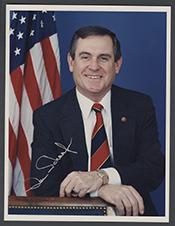
United States · United States Congress · 4 January 1995
Amends Federal transportation law to repeal specified authorities with respect to the National Railroad Passenger Corporation (AMTRAK), eliminating intercity rail passenger transportation (while retaining AMTRAK commuter services). (Sec. 3) Repeals a provision which provides for the judicial review of the discontinuance of a route, a train, or transportation, or the reduction in the frequency of transportation by AMTRAK. (Sec. 4) Authorizes appropriations in decreasing amounts over four fiscal years. (Sec. 5) Repeals specified laws that apply to AMTRAK operations, abolishing the Board of Directors. Declares that the United States relinquishes all rights held in any stock, note of indebtedness, or mortgage issued by or entered into with AMTRAK. (Sec. 6) Repeals: (1) certain provisions which require AMTRAK to make an agreement to avoid duplicating employee functions; (2) all authority for operation of the AMTRAK route system; and (3) all authority for the Northeast Corridor improvement program. (Sec. 8) Prohibits a rail carrier employee whose employment is terminated as a result of a discontinuance of intercity rail passenger service from receiving any wage continuation or severance benefit in excess of six months pay. Authorizes a rail carrier to require an employee whose position is eliminated as a result of such discontinuance to transfer to any vacant position for which he or she can be made qualified on any part of the rail carrier's system. (Sec. 9) Amends the Federal Employers' Liability Act (or Employers' Liability Act) to declare that it shall not apply to common carriers to the extent they provide rail passenger transportation.
United States · United States Congress · 4 January 1995
Freedom from Government Competition Act of 1995 - Requires Federal agencies to obtain all goods and services necessary for or beneficial to the accomplishment of their authorized functions by procurement from private sources, unless: (1) the goods or services are required by law to be produced or performed, respectively, by the agency; or (2) the head of the agency determines and certifies to the Congress that Government production, manufacture, or provision of a good or service is necessary for national defense, that a good or service is so inherently governmental in nature that it is in the public interest to require production or performance by a Government employee, or that there is no private source capable of providing the good or service. Requires the Director of the Office of Management and Budget to study and report to the Congress on: (1) agency activities which are inconsistent with such requirements; and (2) a schedule for transferring such activities to the private sector.
United States · United States Congress · 4 January 1995
Amends the Internal Revenue Code to allow the deduction for home office expenses if a portion of a dwelling unit is used as the sole fixed location of business for a taxpayer who has no other fixed location of business, regardless of: (1) the amount of time or type of work performed in such location; or (2) the proportion of the total income from the business attributable to such location.
United States · United States Congress · 4 January 1995
Constitutional Amendment - Requires the Congress, prior to each fiscal year, to adopt a statement in which total Federal outlays do not exceed total receipts, unless a three-fifths vote of both Houses authorizes a specific excess. Prohibits a bill to increase receipts from becoming law unless approved by a three-fifths majority in each House. Directs the President to submit a balanced budget. Sets a permanent limit on the amount of Federal public debt, prohibiting any increase unless legislation enacted by a three-fifths majority of both Houses become law. Requires roll call votes in the House and Senate under this amendment.
United States · United States Congress · 4 January 1995
TABLE OF CONTENTS: Title I: Social Security Earnings Test Title II: Repeal of Increase in Tax on Social Security Benefits Title III: Treatment of Long-Term Care Title IV: Senior Citizen Communities Senior Citizens' Equity Act - Title I: Social Security Earnings Test - Amends title II (Old-Age, Survivors and Disability Insurance) (OASDI) of the Social Security Act to increase the monthly exempt amount, under the earnings test, for individuals who have attained retirement age. Sets forth a schedule of monthly adjustments increasing from $1,250 for taxable year 1996 to $2,500 for taxable year 2000 (amounting, by the year 2000, to an annual exempt amount of $30,000 such individuals may earn before being subject to benefit reductions). Title II: Repeal of Increase in Tax on Social Security Benefits - Amends the Internal Revenue Code to schedule from 1996 through 2000 a reduction from 85 percent to 50 percent the amount of Social Security benefits on which beneficiaries earning more than $34,000 annually ($44,000 for couples) are liable for income tax. Title III: Treatment of Long-Term Care - Amends the Internal Revenue Code to treat a long-term care insurance contract as an accident or health insurance contract. (Sec. 301) Restricts the meaning of long-term care insurance contract to a guaranteed renewable contract without cash surrender value: (1) covering only qualified long-term care services and benefits incidental to such coverage; (2) excluding expenses for services or items reimbursable under Medicare (except where Medicare is a secondary payor); and (3) applying all premium refunds and all policyholder dividends or similar amounts to reduce future premiums or increase future benefits. Limits qualified long-term care services to necessary diagnostic, preventive, therapeutic, and rehabilitative services, as well as maintenance or personal care services prescribed by a licensed health care practitioner for a chronically ill individual in a qualified facility who is unable to perform (without substantial assistance from another individual) at least two activities of daily living (including walking or wheeling, dressing, toileting and bathing, transferring in and out of a bed or chair, and eating). Makes an individual's home a qualified facility if a licensed health care practitioner certifies that without home care the individual would have to be cared for in a State-licensed or Medicare- or Medicaid-certified nursing, rehabilitative, hospice, or adult day care facility. Treats as a separate contract subject to this Act, unless the Secretary provides otherwise in regulations, any rider on a life insurance contract that covers long-term care insurance. Includes in gross income the aggregate amount of benefits received under a long-term care insurance contract that exceeds $200 for any day (adjusted for inflation). Prescribes a one-year full preliminary term method as the method, in the case of any long-term care insurance contract, for computing reserves for the purposes of determining the taxable income of life insurance companies. Declares that a health care plan shall not be subjected to an excise tax for failure to satisfy continuation coverage requirements solely by reason of failing to provide coverage under any long-term care insurance contract. (Sec. 302) Excludes from gross income any benefits (not in excess of $200 per day) received under a long-term care insurance contract, including employer-provided coverage under such a contract. (Sec. 303) Allows an income tax deduction for qualified long-term care services, subject to specified limits. (Sec. 304) Treats as a nontaxable exchange the exchange of a contract of life insurance or an endowment or annuity contract for a long-term care insurance contract. (Sec. 305) Reduces any amounts includible in gross income by reason of distributions from individual retirement plans or 401(k) plans by the aggregate premiums paid by an individual for any long- term care insurance contract for the benefit of such individual or his or her spouse. (Sec. 306) Excludes from gross income accelerated death benefits paid from life insurance policies for individuals who are terminally ill or permanently confined to a nursing home. (Sec. 307) Provides for: (1) continuation of long-term care insurance policies existing before January 1, 1996, which meet State insurance requirements; and (2) nonrecognition of gain or loss in the exchange, before January 1, 1996, of existing policies for policies under this Act, except to the extent of any money or property received in addition to a long-term care insurance contract. Requires the Secretary of the Treasury to report to the Congress on the Department of the Treasury's interpretation of the tax treatment of contracts which provide long-term care services but which are not long-term care insurance contracts under this Act. Title IV: Senior Citizen Communities - Amends the Fair Housing Act with respect to the exemption for housing for older persons from the prohibition against discrimination based on familial status. Revises the definition of housing for older persons to repeal the requirement that such housing possess significant facilities and services specifically designed to meet the physical or social needs of older persons. (Sec. 402) Declares that an individual who engages in conduct with a reasonable good faith reliance on the existence of such exemption is not personally liable for money damages for a violation of such Act that the exemption would have vitiated. Presumes such good faith reliance of a person engaged in the business of residential real estate transactions if: (1) he or she has no actual knowledge that the facility or community is or will be ineligible for such exemption; and (2) the facility or community gives him or her a written certification stating its compliance with the requirements for such exemption.
United States · United States Congress · 4 January 1995
Constitutional Amendment - Provides that no person who has been elected to the Senate two times shall be eligible for election or appointment to the Senate. Provides that no person who has been elected to the House of Representatives six times shall be eligible for election to the House.
United States · United States Congress · 4 January 1995
Constitutional Amendment - Provides for staggered four-year terms for Members of the House of Representatives. Prohibits persons from being elected to the House more than four times or more than three times to four-year terms. Prohibits persons from being elected to the Senate more than twice.
United States · United States Congress · 4 January 1995
TABLE OF CONTENTS: Title I: Adoption Assistance Title II: Eldercare Assistance Title III: Child Protection Title IV: Family Privacy Protection Title V: Child Support Enforcement Family Reinforcement Act - Title I: Adoption Assistance - Amends the Internal Revenue Code to allow an income tax credit for up to $5,000 of qualified adoption expenses paid or incurred by the taxpayer during the taxable year. Sets forth a formula for reduction of such credit for taxpayers whose adjusted gross income exceeds $60,000. Denies such a credit for any expense for which a deduction or credit is allowable under another Code provision. (Sec. 101) Defines "qualified adoption expenses" as reasonable and necessary adoption fees, court costs, attorney's fees, and other lawful expenses directly related to legal adoption of a child, but not any expenses paid from any funds received under a Federal, State, or local program. Disqualifies for such a credit any expenses in connection with the adoption of a child of the taxpayer's spouse. Title II: Eldercare Assistance - Allows an individual taxpayer an income tax credit of $500 for each member of the household maintained by the taxpayer who: (1) is the taxpayer's, or taxpayer's spouse's, parent or stepparent; (2) is certified by a physician as unable to perform (without substantial assistance from another individual) at least two activities of daily living (bathing, dressing, toileting, transferring in and out of a bed or chair, and eating), or has a similar level of disability due to cognitive impairment; and (3) has the taxpayer's home as his or her principal place of abode for more than half the taxable year. Title III: Child Protection - Directs the United States Sentencing Commission to amend the sentencing guidelines with respect to the sexual exploitation and abuse of children to increase the offense level by two levels if a computer was used in the transportation or shipment of a visual depiction of the child. (Sec. 302) Establishes a mandatory minimum sentence of three years for transporting an individual under 18 years of age for prostitution purposes. (Sec. 303) Directs the United States Sentencing Commission to amend the sentencing guidelines with respect to the transporting of an individual under 18 years of age for prostitution purposes. Requires such guidelines to assure that an increase in the age of the child who is the victim of the offense does not result in a lighter punishment. (Sec. 304) Requires: (1) a minimum three-year imprisonment for sexual abuse of a minor; and (2) a minimum three-year to maximum 15- year imprisonment for sexual abuse of a ward. Title IV: Family Privacy Protection - Declares that no program or activity funded wholly or partially by any Federal department or agency shall require a minor to submit without written parental or guardian consent (or, if the minor is emancipated, without the minor's own prior consent) to a survey, analysis, or evaluation that reveals information concerning: (1) parental political affiliations; (2) potentially embarrassing mental or psychological problems; (3) sexual behavior or attitudes; (4) illegal, anti-social, self-incriminating, or demeaning behavior; (5) appraisals of other individuals with whom the minor has a familial relationship; (6) relationships legally recognized as privileged, such as those with lawyers, physicians, and clergy; (7) the minor's household income (except as required by law to determine eligibility for participation in a program or for receipt of program financial assistance); or (8) religious beliefs. Exempts from this prohibition tests intended to measure academic performance, except as they would require information listed in (1) through (6). Prescribes agency notice requirements. Title V: Child Support Enforcement - Amends the Federal judicial code to require the appropriate authorities of every State to enforce child support orders of another State without modification. (Sec. 502) Amends part D (Child Support and Establishment of Paternity) of title IV of the Social Security Act to require a specified designee of the Secretary of Health and Human Services to develop, in conjunction with State executive and judicial organizations, a uniform abstract of a child support order, for use by all State courts to record specified terms in each child support order. (Sec. 503) Directs States to enact procedures subjecting noncustodial parents with certain child support arrearages with respect to a child receiving Aid to Families With Dependent Children (AFDC) to civil penalties and job search and work program participation requirements until such arrearages are reduced by a specified percentage.
United States · United States Congress · 4 January 1995
TABLE OF CONTENTS: Title I: Findings, Policy, and Purposes Title II: Missile Defense Title III: Revitalization of National Security Commission Title IV: Command of United States Forces Title V: United Nations Title VI: Revitalization and Expansion of the North Atlantic Treaty Organization Title VII: Budget Firewalls National Security Revitalization Act - Title I: Findings, Policy, and Purposes - Sets forth as purposes of this Act: (1) to establish a commission to reassess U.S. military needs and reverse the decline in defense spending; (2) to commit to acceleration of the development and deployment of theater and national ballistic missile defense capabilities; (3) to restrict deployment of U.S. forces to missions that are in the national interest; (4) to maintain U.S. command of U.S. forces participating in United Nations (UN) peacekeeping operations and to reduce the cost to the United States of such operations; and (5) to reemphasize the U.S. commitment to the North Atlantic Treaty Organization (NATO). Title II: Missile Defense - Directs the Secretary of Defense (Secretary) to: (1) develop for deployment at the earliest possible date a cost- and operationally-effective antiballistic missile system to protect the United States against ballistic missile attacks; and (2) develop for expeditious deployment advanced theater missile defense systems. Requires a plan with respect to the deployment of such systems to be submitted to specified congressional committees within 60 days after enactment of this Act. Title III: Revitalization of National Security Commission - Establishes the Revitalization of National Security Commission to conduct a comprehensive review of the long-term U.S. national security needs. Requires an interim and final report from the Commission to designated congressional committees on its assessments and recommendations. Provides funding. Title IV: Command of United States Forces - Prohibits funds made available to the Department of Defense (DOD) from being obligated or expended for activities of any element of the armed forces that after the date of enactment of this Act is placed under the command or operational control of a foreign national acting on behalf of the UN for international peacekeeping or peace enforcement purposes. Waives such prohibition if the President, at least 15 days in advance, certifies to the Congress that such command or control is necessary to protect U.S. national security interests. Allows the President, in emergency situations, to allow such foreign command or control without the advance notification, but requires congressional notification within 48 hours after such action. Outlines certification requirements. Waives all such requirements when less than 50 members of U.S. armed forces are involved. Requires the President to submit to the Congress a memorandum of legal points and authorities explaining why the foreign placement of U.S. military personnel does not violate the Constitution. Excepts ongoing operations in Macedonia from the above requirements. (Sec. 402) Amends the United Nations Participation Act of 1945 (the Act) to require approval by the Congress, by law, of any presidential action taken which makes available to the UN Security Council, or a foreign national acting on behalf of the UN, U.S. armed forces for international peace and security activities. Provides exceptions: (l) in the case of presidential certifications, as above; and (2) when such action is authorized by law. Outlines certification requirements and provides an exception for: (1) actions requiring less than 50 U.S. military personnel; and (2) ongoing operations in Macedonia. Requires the President to submit to the Congress the same legal memorandum as required above. Title V: United Nations - Amends the Act to specifically limit the U.S. assessment for UN expenditures in support of international peacekeeping operations. Requires crediting for the United States by the UN for the costs of U.S. support for, or participation in, such activities. Directs the President to annually submit to designated congressional committees a report on the total amount of any fiscal year's national defense funds that are expended to support such activities. (Sec. 502) Codifies within the Act specified provisions of the Foreign Relations Authorization Act, Fiscal Years 1994 and 1995, concerning the required notification to the Congress of proposed UN peacekeeping activities. Requires within such notification a description of any uncovered U.S. assistance to or support for such activities. Defines a new UN peacekeeping operation as one to be expanded by more than 25 percent during the period covered, or one to be authorized to operate in a country in which it was not previously authorized. (Sec. 503) Requires presidential notification to designated congressional committees within 15 days: (1) after receipt by the United States of a billing request from the UN for the U.S. contribution toward UN peacekeeping activities; or (2) before the U.S. obligates funds for such contributions (except for emergencies, in which case notification is required within 48 hours of such obligation). (Sec. 504) Requires, in a report required under the Act, a description of the anticipated budget for the next fiscal year for U.S. participation in UN peacekeeping activities. (Sec. 506) Authorizes the Secretary, in emergency circumstances, to waive the requirement for reimbursement to the United States for in-kind contributions to UN peacekeeping activities. Requires appropriate notification to the designated congressional committees. Directs the Secretary of State to ensure that U.S. goods provided by DOD on a reimbursable basis for UN peacekeeping activities are reimbursed at the appropriate value. Directs the U.S. Permanent Representative to the UN to report to the designated congressional committees on all U.S. action taken to achieve such objectives. (Sec. 507) Prohibits appropriated funds from being used in any fiscal year to pay any U.S. assessed or voluntary contribution for UN peacekeeping activities until the Secretary certifies to the Congress that the UN has reimbursed DOD directly for all goods and services provided during the previous fiscal year for such activities. (Sec. 508) States that, beginning October 1, 1995, funds made available to DOD shall be available for UN peacekeeping activities or their related incremental costs only to the extent that the Congress has by law specifically made those funds available for such purpose. (Sec. 509) Codifies within the Act a specified provision which limits the use of funds authorized for Contributions for International Peacekeeping Activities for payment of the U.S. assessed contribution for a UN peacekeeping operation to 25 percent of the total amount of all assessed contributions for such operation. (Sec. 510) Prohibits funds from being obligated or expended for U.S. contributions to UN peacekeeping activities unless the Secretary of State determines and certifies to the designated congressional committees that U.S. manufacturers and suppliers are being given opportunities equal to foreign manufacturers and suppliers to provide equipment, material, and services for such activities. (Sec. 511) Withholds specified percentages of U.S. assessed and voluntary contributions toward UN peacekeeping activities until receipt by the Congress of a certification by the President that the UN, through its Office of Inspector General, has undertaken certain prescribed activities with respect to a financial and management accounting of UN peacekeeping activities. (Sec. 512) Authorizes the United States to provide intelligence to the UN only pursuant to a written agreement between the President and the UN's Secretary General specifying the types of and circumstances for such intelligence and the procedures to be observed by the UN with respect to access and disclosure of the intelligence. Requires advance notification (30 days) to the Congress before such an agreement will be considered effective. Provides exceptions. Title VI: Revitalization and Expansion of the North Atlantic Treaty Organization - NATO Revitalization and Expansion Act of 1995 - Declares that it should be U.S. policy: (1) to continue the commitment to an active leadership role in NATO; (2) to join with NATO allies to redefine the role of the alliance in the post-Cold War world, taking into account specified factors; (3) to affirm that NATO military planning should include joint military operations beyond the geographic bounds of the alliance under the North Atlantic Treaty when the shared interests of the United States and other member countries require such actions to defend vital interests; (4) that Poland, Hungary, the Czech Republic and Slovakia should be permitted to join NATO by January 10, 1999, as long as each such country meets specified standards and undertakes certain commitments; (5) that the United States and other NATO member nations should furnish appropriate assistance to enable such countries to achieve membership by such date; and (6) that other European countries, particularly the Baltic states and Ukraine, may be in a position to achieve NATO membership at a future date. (Sec. 604) Directs the President to establish a program to assist the transition to full NATO membership of Poland, Hungary, the Czech Republic, Slovakia, and any other European country emerging from communist domination that is designated by the President. Outlines types of assistance to be provided. Requires annual reports from the President to the appropriate congressional committees on the progress made in implementing this section. Title VII: Budget Firewalls - Expresses the sense of the Congress that so-called "budget firewalls" between defense and domestic discretionary spending should be established for each of FY 1996 through 1998.
United States · United States Congress · 4 January 1995
Taxpayer Debt Buy-Down Act - Amends the Internal Revenue Code to allow individuals with adjusted income tax liability to designate on their tax returns that a portion of such liability (not to exceed ten percent) be used to reduce the public debt. Establishes a Public Debt Reduction Trust Fund for the deposit of designated amounts. Makes amounts in such Trust Fund available only to pay at maturity, or to redeem or buy before maturity, any obligation of the Federal Government included in the public debt (other than an obligation of the Federal Old-Age and Survivors Insurance Trust Fund, the Civil Service Retirement and Disability Fund, or the Department of Defense Military Retirement Fund). Prohibits the reissuance of any obligation which is paid, redeemed, or bought with amounts from the Trust Fund. Amends the Balanced Budget and Emergency Deficit Control Act of 1985 (Gramm-Rudman-Hollings Act) to provide for the sequestration of amounts designated to the Trust Fund. Specifies accounts exempt from such sequestration. Includes aggregated amounts designated to the Trust Fund and amounts sequestered to reduce the public debt in sequestration preview and final reports.
United States · United States Congress · 4 January 1995
TABLE OF CONTENTS: Title I: Capital Gains Reform Title II: Neutral Cost Recovery Title III: Risk Assessment and Cost/Benefit Analysis for New Regulations Subtitle A: Risk Assessment and Communication Subtitle B: Analysis of Risk Reduction Benefits and Costs Subtitle C: Peer Review Title IV: Establishment of Federal Regulatory Budget Cost Control Title V: Strengthening of Paperwork Reduction Act Subtitle A: Authorization of Appropriations Subtitle B: Reducing the Burden of Federal Paperwork on the Public Subtitle C: Enhancing Government Responsibility and Accountability for Reducing the Burden of Federal Paperwork Subtitle D: Enhancing Agency Responsibility for Sharing and Disseminating Public Information Subtitle E: Additional Government Information Management Responsibility Subtitle F: Effective Dates Title VI: Strengthening Regulatory Flexibility Title VII: Regulatory Impact Analyses Title VIII: Protection Against Federal Regulatory Abuse Subtitle A: Citizens' Regulatory Bill of Rights Subtitle B: Private Sector Whistleblowers' Protection Title IX: Private Property Rights Protections and Compensation Title X: Establishment of Federal Mandate Budget Cost Control Title XI: Taxpayer Debt Buy-Down Title XII: Small Business Incentives Job Creation and Wage Enhancement Act of 1995 - Tit: I: Capital Gains Reform - Amends the Internal Revenue Code to allow a 50 percent income tax deduction for the net capital gain of both corporate and noncorporate taxpayers. (Sec. 1002) Requires indexing, based on the gross national product deflator, of the adjusted basis of certain assets (corporate stock and tangible property that is a capital asset or property used in a trade or business) that have been held for more than one year at the time of sale or other transfer, solely for the purpose of determining gain or loss. (Sec. 1003) Allows an itemized deduction for losses arising from the sale or exchange of a principal residence. Title: : Neutral Cost Recovery - Allows the depreciation deduction to be computed based on a neutral recovery basis for property placed in service after December 31, 1994. Title III: Risk Assessment and Cost/Benefit Analysis for New Regulations - Subtitle A: Risk Assessment and Communication - Risk Assessment and Communication Act of 1995 - Requires the head of each Federal agency to apply specified principles when preparing risk assessments in order to assure that such assessments and all of their components distinguish scientific findings from other considerations and are scientifically objective, unbiased, and inclusive of all relevant data. (Sec. 3105) Directs such agencies to comply with specified requirements (with respect to risk estimates, exposure scenarios, comparisons, and substitution risks) in characterizing risk in any risk assessment document, regulatory proposal or decision, report to the Congress, or other document which is made available to the public. (Sec. 3106) Requires the President to: (1) issue guidelines, subject to periodic review, consistent with such risk assessment and characterization principles; and (2) provide a format for summarizing risk assessment results. Requires each Federal agency to publish a plan (including procedures for receiving and considering new information and risk assessments from the public) to review and revise any risk assessment published before a certain date if significant new information or methodologies are available that could significantly alter the results of such risk assessment; and evaluate for the Congress certain categories of policy and value judgments. Subtitle B: Analysis of Risk Reduction Benefits and Costs - Directs the President to require each executive agency to prepare specified assessments for each major rule designed to protect human health, safety, or the environment it proposes or promulgates. (Sec. 3201) Requires for any proposed or promulgated rule: (1) assessments of incremental costs and incremental risk reduction or other benefits associated with each significant regulatory alternative (SRA) considered in connection with the rule; (2) comparisons to other selected risks of any human health, safety, or environmental risks addressed by an SRA; and (3) a statement of substitution risks and other human health risks potentially posed by the SRAs. Requires for each final rule: (1) an assessment of the costs and risk reduction or other benefits associated with it, plus a certification that this assessment is based on an objective and unbiased scientific and economic evaluation of all significant and relevant information provided by interested parties; and (2) certain other certifications, including one that no statute-allowed regulatory alternative would achieve an equivalent risk reduction. Requires the head of each agency, for each such major rule, to publish its assessment information in the Federal Register. Subtitle C: Peer Review - Requires: (1) the head of each Federal agency to develop a systematic program meeting specified requirements for peer review of risk and economic assessments used by the agency for regulatory programs addressing human health, safety, or the environment; (2) each Federal agency to provide for peer review of scientific and economic information used for, among other things, evaluating certain risk assessments; and (3) the Director of the Office of Management and Budget (OMB) to order that peer review be provided for any major risk or cost assessment that may have a significant impact on public policy decisions. (Sec. 3301) Requires: (1) each Federal agency head to write a response to all significant peer review comments; and (2) all peer review comments, conclusions, and agency responses to be available to the public and part of the administrative record for judicial review purposes. Directs the President to appoint National Peer Review Panels to review annually all agency risk and cost assessment practices for programs designed to protect human health, safety, or the environment. Title IV: Establishment of Federal Regulatory Budget Cost Control - Amends the Congressional Budget Act of 1974 to require the Office of Management and Budget (OMB) and the Congressional Budget Office (CBO) to jointly report to the President and the Congress on direct costs to the private sector of complying with Federal regulations. Requires such reports to be issued in five-year intervals. Provides for initial and subsequent annual reports to the President and the Congress on an aggregate regulatory baseline which is a project of the aggregate direct cost to the private sector of complying with Federal regulations for budget years and outyears. Requires a concurrent resolution on the budget to include reconciliation directives specifying changes: (1) in laws and regulations necessary to reduce, by specified percentages, such direct costs; and (2) in laws necessary to reduce, by specified percentages, personnel and administrative overhead and to achieve programmatic savings. Provides for the allocation of aggregate two-year regulatory authority among congressional committees. Requires the CBO to submit to the appropriate committees (except the Committees on Appropriations) an analysis of private sector regulatory costs for each public bill or resolution. (Sec. 4002) Requires the President's annual budget submissions to comply with reconciliation directives. (Sec. 4003) Amends the Regulatory Flexibility Act to require Federal agencies to prepare an analysis of the costs that will be incurred by small entities, other businesses, and individuals in complying with proposed agency rules. Title V: Strengthening of Paperwork Reduction Act - Paperwork Reduction Act of 1995 - Subtitle A: Authorization of Appropriations - Amends Federal law to authorize increased appropriations to the Office of Information and Regulatory Affairs (OIRA). Subtitle B: Reducing the Burden of Federal Paperwork on the Public - Amends Federal law to: (1) ensure coverage of all aspects of federally imposed paperwork burdens; and (2) revise provisions on assignment of tasks and deadlines, providing for Government-wide as well as individual agency goals of further reductions in such burdens by five percent increments each fiscal year for five fiscal years. Subtitle C: Enhancing Government Responsibility and Accountability for Reducing the Burden of Federal Paperwork - Amends Federal law with respect to the authority and functions of the OMB Director and public information collection activities, among other changes providing for: (1) procedures under which an agency must estimate the burden of compliance with any proposed collection of information; (2) expedited OMB review of proposed information collection requests; and (3) protection for whistleblowers of unauthorized paperwork burden. (Sec. 5306) Revises public participation requirements with regard to the review of information collections. (Sec. 5307) Provides that upon the request of an agency head, the Director shall approve a proposed change to an existing information collection request within 30 days after receiving it. Subtitle D: Enhancing Agency Responsibility for Sharing and Disseminating Public Information - Gives the Director additional specified functions related to agency dissemination and sharing of public information. (Sec. 5402) Delineates agency responsibilities for sharing and disseminating public information. (Sec. 5403) Abolishes the Federal Information Locator System, replacing it with systems for agency inventory of information dissemination products, available for public access by electronic means at no charge. Subtitle E: Additional Government Information Management Responsibility - Revises the statistical policy and coordination functions of the OMB Director. (Sec. 5503) Requires the Director's annual report to the Congress on Federal information policy coordination activities to include certain additional information, including listings of increases in paperwork burdens. (Sec. 5504) Includes as a new automatic data processing function of the Director developing and annually revising a five-year plan for meeting the automatic data processing equipment and other information technology needs of the Federal Government. Subtitle F: Effective Dates - Sets forth the effective dates for this title. Title VI: Strengthening Regulatory Flexibility - Amends Federal civil service law to repeal the ban on judicial review of regulatory flexibility analyses and other specified applications of such law to agency actions. (Sec. 6002) Requires consideration of direct and indirect effects of rules, as well as transmittal of proposed rules and initial regulatory flexibility analysis to the Chief Counsel for Advocacy of the Small Business Administration for possible reply in the form of a statement of opposition to the proposed rule. (Sec. 6004) Expresses the sense of the Congress that such official should be permitted to appear as amicus curiae in any action or case brought in a U.S. court for the purpose of reviewing a rule. Title VII: Regulatory Impact Analyses - Administrative Procedure Reform Act of 1995 - Amends Federal civil service law to: (1) provide for rulemaking notices for major rules, including a final Regulatory Impact Analysis; (2) add hearing requirements for proposed rules; (3) extend the comments period; and (4) require the head of an agency to publish in the Federal Register responses to comments received regarding the rule. (Sec. 7004) Provides for the general application of Executive Order 12291 (relating to Federal regulation requirements and regulatory impact analysis) to each agency, with each preliminary and final Regulatory Impact Analysis required for a rule under the Order containing specified information in lieu of the information currently required. (Sec. 7005) Prohibits an agency from adopting a major rule unless the final Regulatory Impact Analysis for the rule is approved by the OMB Director or by an individual designated by the Director for that purpose. (Sec. 7006) Prohibits, to the extent practicable, the head of an agency from publishing in the Federal Register any proposed major rule, summary of a proposed major rule, or Regulatory Impact Analysis unless the OMB Director certifies that, among other things, it: (1) is written in a reasonably simple and understandable manner and is easily readable; and (2) provides adequate notice of the content of the rule, summary, or Analysis to affected and interested persons that have some subject matter expertise. (Sec. 7007) Requires the OMB Director to report to the Congress analyses of rulemaking procedures of Federal agencies and their impact on the regulated public and regulatory process. Title VIII: Protection Against Federal Regulatory Abuse - Subtitle A: Citizens' Regulatory Bill of Rights - Grants certain regulatory rights, such as the right to have an attorney or accountant present, to any person who is the target of a Federal investigative or enforcement action upon the initiation of an inspection, investigation, or other official proceeding directed against that person, except in cases where to do so would substantially delay responding to an imminent danger to person or property or substantially or unreasonably impede a criminal investigation. Subtitle B: Private Sector Whistleblowers' Protection - Private Sector Whistleblowers' Protection Act of 1995 - Outlines protection against reprisal through specified prohibited regulatory practices for disclosure of information that any person subject to Federal or certain State regulation believes is indicative of waste, fraud, or abuse. (Sec. 8208) Provides that any person with reason to believe that an agency employee has engaged in a prohibited regulatory practice may request the Special Counsel to investigate. Title IX: Private Property Rights Protections and Compensation - Entitles a private property owner to receive compensation from the United States in accordance with specified guidelines for any agency infringement or deprivation of rights with regard to their property. Prescribes procedures for obtaining such compensation. Title X: Establishment of Federal Mandate Budget Cost Control - Amends the Congressional Budget Act of 1974 to set forth reporting requirements for OMB and CBO with respect to reducing the direct costs to States and local governments of complying with Federal mandates. Requires concurrent resolutions on the budget to provide for such reductions until such costs do not exceed three percent of the estimated gross domestic product for the same fiscal year as the costs will be incurred. Requires CBO to prepare an analysis of mandated costs for States and local governments for each public bill or resolution reported in the Congress (except those from Appropriations Committees). Requires a similar analysis in the President's annual budget submissions. (Sec. 10003) Requires initial regulatory flexibility analyses for proposed rules that establish or implement new Federal mandates to contain a description of the nature and amount of monetary costs to be incurred by State and local governments. Requires Federal agencies to prepare a cost estimate and cost/benefit analysis of such mandates that would cost State and local governments at least $10 million for a fiscal year. Title XI: Taxpayer Debt Buy-Down - Amends the Internal Revenue Code to allow every individual with adjusted income tax liability to designate on their tax returns that a portion of such liability (not to exceed ten percent) be used to reduce the public debt. (Sec. 11002) Establishes a Public Debt Reduction Trust Fund for the deposit of designated amounts. Makes amounts in such Trust Fund available only to pay at maturity, or to redeem or buy before maturity, any obligation of the Federal Government included in the public debt. Prohibits the reissuance of any obligation which is paid, redeemed, or bought with amounts from the Trust Fund. (Sec. 11003) Amends the Balanced Budget and Emergency Deficit Control Act of 1985 (Gramm-Rudman-Hollings Act) to provide for the sequestration of amounts designated to the Trust Fund. Specifies accounts exempt from such sequestration. Includes aggregated amounts designated to the Trust Fund and amounts sequestered to reduce the public debt in sequestration preview and final reports. Title XII: Small Business Incentives - Amends the Internal Revenue Code to increase the unified credit against the estate tax and the unified credit against the gift tax and provide a cost-of-living adjustment for such credits. (Sec. 12002) Increases the dollar limitation on the election to expense certain depreciable business assets. (Sec. 12003) Provides qualifications for a home office as a principal place of business for purposes of the deductibility of expenses.
United States · United States Congress · 4 January 1995
Line Item Veto Act - Grants the President legislative line item veto rescission authority. Authorizes the President to rescind all or part of any discretionary budget authority or veto any targeted tax benefit if the President determines that such rescission: (1) would help reduce the Federal budget deficit; (2) will not impair any essential Government functions; and (3) will not harm the national interest. Requires the President to notify the Congress of such a rescission or veto by special message after enactment of appropriations legislation providing such budget authority or a revenue Act containing a targeted tax benefit. Makes such a rescission effective unless the Congress enacts a rescission disapproval bill. Describes: (1) information to be included in the President's message; and (2) procedures to govern consideration of rescission disapproval legislation in the Senate and the House of Representatives.
United States · United States Congress · 4 January 1995
Constitutional Amendment - Prohibits outlays for a fiscal year (except those for repayment of debt principal) from exceeding total receipts (except those derived from borrowing) for that fiscal year unless the Congress, by a three-fifths roll call vote of each House, authorizes a specific excess of outlays over receipts. Requires a three-fifths roll call vote of each House to increase the public debt. Directs the President to submit a balanced budget to the Congress. Requires the approval of a majority of each House by roll call vote before any bill to increase revenue may become law. Waives these provisions when a declaration of war is in effect. Waives these provisions when the United States is engaged in a military conflict which poses a threat to national security as declared by a joint resolution adopted by a majority of each House.
United States · United States Congress · 4 January 1995
Congressional Accountability Act of 1995 - Applies, by a specified conditional date, provisions of the following laws to the legislative branch: (1) the Fair Labor Standards Act of 1938; (2) title VII of the Civil Rights Act of 1964; (3) the Americans With Disabilities Act of 1990; (4) the Age Discrimination in Employment Act of 1967; (5) titles I and V of the Family and Medical Leave Act of 1993; (6) the Occupational Safety and Health Act of 1970 (OSHA); (7) provisions relating to Federal labor management relations; (8) with the exception of the U.S. Capitol Police, the Employee Polygraph Protection Act of 1988; (9) the Worker Adjustment and Retraining Notification Act; and (10) the Rehabilitation Act of 1973. Requires that an action to abate a violation of OSHA for which a citation is received take place as soon as possible, but no later than the fiscal year after the citation is issued. (Sec. 4) Establishes in the legislative branch an Office of Compliance to study and report to the Congress on: (1) the application of such laws to the legislative branch; (2) an examination of the procedures used by the instrumentalities to enforce the application of such laws; and (3) a determination as to whether to direct an instrumentality to make improvements in its regulations and procedures so as to assure that they are as effective as those specified in this Act. Authorizes the Office's Board of Directors to direct an instrumentality that has no such procedures to adopt the requisite procedures. Requires the Board to issue regulations governing such applicability which shall be subject to congressional approval. Makes applicable to the legislative branch any provision of Federal law to the extent that it relates to terms and conditions of employment (including protection from discrimination in personnel actions, health and safety of employees, and family and medical leave). Directs the Office, on an ongoing basis, to: (1) determine which of such laws should apply to the legislative branch; (2) study the application to the legislative branch of laws enacted after enactment of this Act; and (3) issue regulations to apply such laws to the legislative branch subject to congressional approval. Sets forth House and Senate procedures for concurrent resolutions to disapprove such regulations. (Sec. 6) Requires the Office to: (1) carry out an education program for Members of Congress and other employing authorities of the legislative branch respecting the laws made applicable to them and a program to inform individuals of their rights under such laws and this Act; (2) publish statistics on the use of the Office by congressional employees; and (3) develop a system for the collection of demographic data on the composition of the congressional employees. Requires the Board to submit to the Congress annual reports on the information collected under such system. (Sec. 7) Sets forth procedure for consideration of alleged violations of the laws made applicable to the legislative branch consisting of the following steps: (1) counseling through the Office; (2) mediation with the Office; (3) a formal complaint and hearing by a board; (4) judicial review if a congressional employee is aggrieved by a dismissal, final decision, or an order by the hearing board or if a head of an employing office is aggrieved by a final decision or would be subject to an order issued by such board; and (5) as an alternative to steps 3 and 4, a civil action in a U.S. district court. (Sec. 14) Declares that any intimidation of, or reprisal against, any employee because of the exercise of a right under this Act constitutes an unlawful employment practice that may be remedied in the same manner as a violation of law made applicable to the legislative branch under this Act. (Sec. 15) Requires all counseling, mediation, and hearings and deliberations of a hearing board to be confidential. Permits the records of hearing boards to be made public if required for judicial review. Authorizes the House Committee on Standards of Official Conduct and the Senate Select Committee on Ethics to have access to the hearing of the hearing board only after the board has made a decision with respect to the matter. (Sec. 17) Provides that this Act shall not be construed to authorize enforcement by the executive branch of any of the laws made applicable to congressional employees under this Act. Limits a congressional employee to the judicial proceeding provided by this Act to redress prohibited practices. (Sec. 18) Requires the Office to study and report to the Congress on: (1) the ways that public access to information held by the Congress may be improved, streamlined, and made consistent between the House and the Senate; and (2) the application of the Freedom of Information Act and the Right to Privacy Act to the legislative branch.
United States · United States Congress · 4 January 1995
Expresses the sense of the Congress that the Constitution provides that all citizens have the right to keep and bear arms and that such right supersedes the power and authority of any government.
United States · United States Congress · 4 January 1995
Expresses the sense of the Congress that: (1) Taiwan deserves full participation, including a seat, in the United Nations (UN); and (2) the U.S. Government should immediately encourage the UN to establish an ad hoc committee for the purpose of studying membership for Taiwan in that organization and its related agencies.
United States · United States Congress · 22 September 1994
Amends the Omnibus Budget Reconciliation Act of 1990 to extend from three years to five years the period during which Medicare select policies may be issued.
United States · United States Congress · 19 September 1994
George Washington Boyhood Home Commemorative Coin Act of 1994 - Directs the Secretary of the Treasury to issue one-dollar silver coins emblematic of a profile of George Washington and a depiction of his xboyhood home. Declares that all surcharges received from coin sales shall be paid to the George Washington Boyhood Home Foundation.
United States · United States Congress · 21 August 1994
TABLE OF CONTENTS: Title I: Grants for Correctional Facilities Title II: State and Local Law Enforcement Grants Title III: Protection Against Sexually Violent Predators Title IV: Eliminating Excessive and Redundant Appeals Title V: Reform of 'Exclusionary Rule' Title VI: Truth-In-Sentencing Title VII: Prison Work Required; Luxuries Abolished Title VIII: Improving Border Controls Title IX: Enhanced Gun Penalties Title X: Violent Crime Reduction Trust Fund Title XI: Mandatory Life Imprisonment for Persons Convicted of Certain Felonies Back-To-Basics Crime Control Act of 1994 - Title I: Grants for Correctional Facilities - Directs the Attorney General to make grants to States to construct, expand, and improve prisons and jails. Authorizes specified sums to each State without conditions imposed by the Federal Government, except requirements to comply with this title and to use such funds exclusively for the construction of prisons and jails. Authorizes appropriations. Sets forth formulas for the distribution of funds in FY 1995 and in FY 1996 through 1999 based on violent crimes reported by the States to the Federal Bureau of Investigation (FBI). (Sec. 102) Specifies that 25 percent of total funds appropriated under this title shall be allocated to each eligible State according to a formula which takes into account the percentage change in the time to be served by persons convicted of violent crimes. Directs that States which have achieved a truth in sentencing standard of violent criminals serving 85 percent of prison time assessed receive the incentive funds, subject to specified requirements. Title II: State and Local Law Enforcement Grants - Requires the Attorney General to make grants to States to increase the number of law enforcement officers in service. Authorizes specified funds, without conditions imposed by the Federal Government (except that the funds be used exclusively to increase the number of law enforcement officers in service). Requires States to allocate 80 percent of their grants to local government for use by local law enforcement, as nearly as possible in proportion to the populations served by such local law enforcement agencies (LEAs). Title III: Protection Against Sexually Violent Predators - Directs the Attorney General to: (1) establish guidelines for State programs to require a sexually violent predator to register a current address with a designated State LEA upon being released from prison or being placed on parole or supervised release; and (2) approve each State program that complies with the guidelines. Makes States that do not implement and maintain such programs ineligible to receive ten percent of the funds that would otherwise be allocated to the State in drug control and system improvement grants under the Omnibus Crime Control and Safe Streets Act of 1968. Requires: (1) the determination that a person is, or is no longer, a sexually violent predator to be made by the sentencing court after receiving a report by a board of experts on sexual offenses; and (2) each State to establish a board composed of experts in the field of the behavior and treatment of sexual offenders. Sets forth provisions regarding: (1) notification regarding the duty of an offender to register and to provide any new address to a designated State LEA and of a State prison official to obtain specified information; (2) the transfer of information to the State LEA and to the FBI; (3) quarterly verification of the released offender's address; (4) penalties for failing to register and keep the registration current; (5) termination of the obligation to register; (6) community notification concerning a predator required to register; and (7) immunity for good faith conduct by LEAs, their employees, and State officials. Title IV: Eliminating Excessive and Redundant Appeals - Amends the Federal judicial code to establish a one-year statute of limitations for habeas corpus actions brought by State prisoners. Vests authority to issue certificates for probable cause for appeal of habeas corpus orders exclusively in the courts of appeals. Permits denial on the merits of habeas corpus writs notwithstanding the failure to exhaust State remedies. Establishes a two-year statute of limitations for Federal prisoners filing for collateral relief. (Sec. 406) Sets forth special habeas corpus procedures in capital cases brought by prisoners in State custody who are subject to a capital sentence. Makes such procedures contingent upon: (1) a State establishing by rule of its court of last resort or by statute a mechanism for the appointment, compensation, and payment of reasonable litigation expenses of competent counsel in State post convictions and sentences have been upheld on direct appeal to such court or have otherwise become final; and (2) such rule or statute providing standards of competency for the appointment of counsel. Provides for a mandatory stay of execution during the post-conviction review initiated pursuant to this title. Details conditions which will cause such stay to expire. Prohibits a Federal court from entering a stay of execution or granting relief in a capital case unless specified conditions are met. Sets forth lime limits for determining petitions. Authorizes the State or Government to enforce such time limits by applying to the court of appeals or the Supreme Court for a writ of mandamus. Title V: Reform of 'Exclusionary Rule' - Amends the Federal criminal code to prohibit the exclusion of evidence obtained as a result of a search or seizure, in a proceeding in a court of the United States, on the grounds that the search or seizure was in violation of the Fourth Amendment of the Constitution if it was carried out in circumstances justifying an objectively reasonable belief that it was in conformity with such amendment. Makes the fact that evidence was obtained pursuant to and within the scope of a warrant prima facie evidence of the existence of such circumstances. Prohibits the exclusion of evidence, in a proceeding in a U.S. court, on the ground that it was obtained in violation of a statute, administrative rule or regulation, or rule of procedure unless exclusion is expressly authorized by statute or by a rule prescribed by the Supreme Court pursuant to statutory authority. Title VI: Truth in Sentencing - Amends the Federal criminal code to permit the Bureau of Prisons to add, in its discretion, additional time to a prisoner's sentence of up to 15 percent of the prisoner's term for unsatisfactory behavior. Prohibits a sentence from being reduced for satisfactory behavior to a term less than the original sentence nominally imposed. Title VII: Prison Work Required; Luxuries Abolished - Directs the Attorney General to implement and enforce regulations which: (1) mandate prison work for all able-bodied inmates in Federal penal and correctional institutions; and (2) prohibit the Government provision in inmates' cells of television, radio, telephone, stereo, or similar amenities. (Sec. 702) Amends the Higher Education Act of 1965 to prohibit awards of Pell grants to prisoners in Federal or State penal institutions. Title VIII: Improving Border Controls - Authorizes appropriations. Authorizes and directs the Attorney General to use such funds to permit the commander of the Border Patrol to increase by at least 6,000 the number of border patrol agent positions above the number of such positions as July 1, 1994. (Sec. 802) Amends the Immigration and Nationality Act to provide for expedited deportation and exclusion of criminal aliens. Prohibits reentry of an alien into the United States during the minimum period of confinement to which the alien was sentenced. Authorizes the Attorney General to prescribe special regulations for the registration and fingerprinting of aliens on criminal probation or parole. Expands the definitions of "aggravated felony." (Sec. 805) Sets forth deportation procedures for certain criminal aliens who are not permanent residents. Grants a U.S. district court jurisdiction to enter a judicial order of deportation at the time of sentencing against an alien whose criminal conviction causes such alien to be deportable under provisions relating to conviction of an aggravated felony if requested prior to sentencing by the U.S. Attorney. (Sec. 807) Restricts defenses to deportation for certain criminal aliens. Enhances penalties for failing to depart or reentering after a final order of deportation. (Sec. 810) Authorizes appropriations for a criminal alien information system. Title IX: Enhanced Gun Penalties - Amends the Federal criminal code to enhance penalties imposed upon persons convicted of using or carrying a firearm during and in relation to the commission of a felony. (Sec. 902) Sets a mandatory minimum sentence for unlawful possession of a firearm by a convicted felon, fugitive from justice, addict or unlawful user of a controlled substance, or transferor or receiver of a stolen firearm. (Sec. 903) Increases the general penalty for violation of Federal firearms laws. Title X: Violent Crime Reduction Trust Fund - Establishes a Violent Crime Reduction Trust Fund as a separate account in the Treasury into which shall be transferred savings realized from implementation of provisions of the Federal Workforce Restructuring Act of 1994. Sets forth provisions regarding: (1) transfers into, and appropriations from, the Fund; (2) annual reporting requirements on the status of the Fund; and (3) allocation of sums in the Fund. Extends authorizations of appropriations for fiscal years for which the full amount authorized is not appropriated. Title XI: Mandatory Life Imprisonment for Persons Convicted of Certain Felonies - Amends the Federal criminal code to provide for mandatory life imprisonment for persons convicted in Federal court of a serious violent felony if: (1) the person has been convicted (and the conviction has become final) on separate prior occasions in a Federal or State court of two or more serious violent felonies, or one or more serious violent felonies and one or more serious drug offenses; and (2) each serious violent felony or serious drug offense used as a basis for sentencing under this title, other than the first, was committed after the defendant's conviction of the preceding serious violent felony or serious drug offense. Sets forth provisions regarding: (1) persons subject to the criminal jurisdiction of an Indian tribal government; and (2) resentencing upon the overturning of a prior conviction. (Sec. 1102) Prohibits the court from reducing the sentence of a defendant unless specified conditions are met, including that defendant is at least age 70, has served at least 30 years in prison for the offense or offenses for which the defendant is currently imprisoned, and a determination has been made by the Director of the Bureau of Prisons that the defendant is not a danger to the safety of any other person or the community.
United States · United States Congress · 5 August 1994
Smithsonian Institution Sesquicentennial Commemorative Coin Act - Directs the Secretary of the Treasury to issue five-dollar gold coins and one-dollar silver coins emblematic of the scientific, educational, and cultural significance of the Smithsonian Institution. Mandates that: (1) all but a certain portion of surcharges received from coin sales be paid by the Secretary to the Smithsonian Institution to support programming related to the 150th anniversary and general activities of the Smithsonian Institution; and (2) a certain portion of such surcharges be dedicated to supporting the operation and activities of the National Numismatic Collection at the National Museum of American History.
United States · United States Congress · 19 July 1994
Expresses the sense of the Congress that the United States should not undertake any military action against Haiti unless the President first certifies to the Congress that there exists a clear and present danger to the citizens of the United States and that U.S. interests require such action.
United States · United States Congress · 13 July 1994
Forest Fire and Pest Emergency Act - Declares that the reduction of natural fuels, on Federal lands within California that have been identified as extreme fire risk, constitutes an emergency action to prevent or to reduce risk to public health or safety or to serious resource loss for the duration of the drought there. Directs Federal agencies to work with State agencies to identify areas of extreme fire risk and take action to reduce natural fuels. Authorizes the use of emergency fire suppression funds to reduce natural fuels in such areas, provided reductions in the Sierra forests are consistent with the fuels management guidelines of the California Spotted Owl EA or subsequent EIS. Directs the Forest Service to prepare a budget request declaring an emergency in areas identified as requiring additional treatments due to drought or pest infestation on National forest lands. Directs Federal agencies to prepare, and submit to the Congress, a strategic fire plan and annual budget.
United States · United States Congress · 26 May 1994
Expresses the sense of the House of Representatives that for purposes of issuing final guidelines under title VII of the Civil Rights Act of 1964 relating to unlawful harassment in employment, the Equal Employment Opportunity Commission should exclude harassment based on religion.
United States · United States Congress · 25 May 1994
Authorizes the President to present, on behalf of the Congress, to the Lubavitcher rebbe, Rabbi Menachem Mendel Schneerson, a gold medal in recognition of his outstanding and enduring contributions toward world education, morality, and acts of charity. States that no appropriations are authorized to implement this Act. Declares that the medals struck pursuant to this Act are national medals.
United States · United States Congress · 25 May 1994
Juvenile Criminal Act of 1994 - Amends the Juvenile Justice and Delinquency Prevention Act of 1974 to include among the Act's: (1) findings that emphasis should be placed on identifying hardcore youths who should be transferred from the juvenile justice system to the adult criminal justice system; and (2) purposes to assist State and local governments in improving the identification of hardcore juvenile offenders and the removal of such offenders from the juvenile justice system. Requires State plans under the Act to provide: (1) specified funding for the establishment and maintenance of an effective system that requires the prosecution of at least those juveniles who are 14 years of age and older as adults, rather than in juvenile proceedings, for listed offenses (murder or attempted murder; robbery, battery, or rape while armed with a firearm; any other crime the State deems appropriate; and the fourth or subsequent occasion on which such juveniles engage in an activity for which adults could be imprisoned for a term exceeding one year) unless, on a case-by-case basis, the transfer of such juveniles for disposition in the juvenile justice system is determined under State law to be in the interest of justice; and (2) that the State ensure that whenever a juvenile is adjudicated in a juvenile proceeding to have engaged in such offenses that a record be kept relating to that adjudication, the juvenile be fingerprinted and photographed (with such fingerprints and photograph sent to the Federal Bureau of Investigation (FBI)), and the court in which the adjudication takes place transmit to the FBI information concerning the adjudication and disposition. Provides for a reduction of sums allotted to a State for a fiscal year by 16 2/3 percent for each of specified paragraphs of the Act with respect to which noncompliance occurs. (Current law provides for a reduction by 25 percent and doesn't include the requirements added by this Act in determining noncompliance.)
United States · United States Congress · 5 May 1994
Superfund Recycling Equity Act of 1994 - Amends the Comprehensive Environmental Response, Compensation, and Liability Act of 1980 to absolve persons (other than owners or operators) who arranged for the recycling of recyclable material from liability for environmental response actions. Deems transactions involving scrap paper, plastic, glass, textiles, or rubber (other than whole tires) to be arranging for recycling if the person who arranged the transaction demonstrates that the following criteria were met: (1) the recyclable material met a commercial specification grade and a market existed for the material; (2) a substantial portion of the material was made available for use as a feedstock for the manufacture of a new saleable product; (3) the material (or product made from the material) could have been a replacement for a virgin raw material; and (4) with respect to transactions occurring 90 days after this Act's enactment, the person exercised reasonable care to determine that the facility where the material would be managed by another was in compliance with Federal, State, or local environmental laws or regulations. Deems transactions involving scrap metal to be arranging for recycling if the person who arranged the transaction demonstrates that: (1) the criteria for scrap materials were met; (2) he/she complied with applicable standards regarding activities associated with the recycling of scrap metals; and (3) the scrap metal was not melted prior to the transaction. Deems transactions involving spent lead-acid or nickel-cadmium batteries to be arranging for recycling if the person involved demonstrates that: (1) the criteria for scrap materials were met; and (2) he/she complied with applicable standards regarding such batteries. Makes the exemptions from liability under this Act inapplicable if the person: (1) had an objectively reasonable basis to believe at the time of the recycling transaction that the recyclable material would not be recycled or would be burned as fuel or for energy recovery or incineration or that the consuming facility was not in compliance with Federal, State, or local environmental laws or regulations; (2) added hazardous substances to the material for purposes other than processing or recycling; or (3) failed to exercise reasonable care with respect to the management of the material. Makes such exemptions inapplicable if the recyclable material contained polychlorinated biphenyls in excess of 50 parts per million or any new Federal standard.
United States · United States Congress · 24 March 1994
Requires the Secretary of the Interior to offer to transfer all lands administered by the Bureau of Land Management (BLM) to the State in which such lands are located. Requires a State to accept or reject the total offer of all the lands. Makes the transfer effective on September 30, 1998. Requires each State receiving such lands to honor valid existing leases, permits, and mining claims. Restricts the transferred lands to public purpose use if they are not encumbered by a lease or permit. Reverts such lands to the United States if a State does not use them for public purposes. Exempts BLM lands from transfer under this Act if they are: (1) wilderness; (2) wilderness study areas; (3) areas of critical environmental concern; or (4) determined by the Secretary to be too costly for the United States to decontaminate.
United States · United States Congress · 24 March 1994
United States Botanic Garden Commemorative Coin Act of 1995 - Directs the Secretary of the Treasury to: (1) issue one-dollar silver coins to commemorate the 175th anniversary of the founding of the United States Botanic Garden; and (2) pay all surcharges received from such coin sales to the National Fund for the United States Botanic Garden.
United States · United States Congress · 16 March 1994
Deficit Reduction Lock Box Act of 1994 - Establishes the Deficit Reduction Trust Fund consisting of amounts contained in deficit reduction lock box provisions of appropriations Acts. Reduces discretionary spending limits by amounts transferred to the Fund. Amends the Congressional Budget Act of 1974 to require that amounts resulting from reduced spending under general appropriations bills be placed in the Fund. Requires the Congressional Budget Office to score all general appropriations measures as passed by the House and Senate and to publish such scorecard in the Congressional Record.
United States · United States Congress · 10 March 1994
Spending Reduction Enforcement Act of 1994 - Establishes the Spending Reduction Commission to propose cost savings and changes in law to achieve at least $65 billion of budget outlay reductions for the budget year and each outyear until a balanced budget is reached. Sets forth the procedure for implementation of the Commission's recommendations by the Office of Management and Budget, the President, and the Congress. Makes any budget outlay reductions permanent. Sets forth sequestration procedures if the full amount of required savings is not achieved by the end of a session of Congress.
United States · United States Congress · 3 March 1994
TABLE OF CONTENTS: Title I: Insurance Reform Subtitle A: Increased Availability and Continuity of Health Coverage for Employees and Their Families Subtitle B: Reform of Health Insurance Marketplace for Small Business Subtitle C: Preemption Subtitle D: Health Deduction Fairness Title II: Preventing Fraud and Abuse Subtitle A: Establishment of All-Payer Health Care Fraud and Abuse Control Program Subtitle B: Revisions to Current Sanctions for Fraud and Abuse Subtitle C: Administrative and Miscellaneous Provisions Subtitle D: Amendments to Criminal Law Title III: Malpractice Reform Subtitle A: Findings; Purpose; Definitions Subtitle B: Uniform Standards for Malpractice Claims Subtitle C: Requirements for State Alternative Dispute Resolution Systems (ADE) Title IV: Paperwork Reduction and Administrative Simplification Title V: Expanding Access/Preventive Care Subtitle A: Expanding Access Through Community Health Authorities Subtitle B: Expansion of Public Health Programs on Preventive Health Title VI: Antitrust Provisions Title VII: Prefunding Government Health Benefits for Certain Annuitants Health Reform Consensus Act of 1994 - Title I: Insurance Reform - Subtitle A: Increased Availability and Continuity of Health Coverage for Employees and Their Families - Requires each employer to make available to each eligible employee a group health plan under which: (1) coverage of each eligible individual with respect to such employee may be elected on an annual basis; (2) coverage is provided for at least the required coverage specified; and (3) employees may elect to have premiums collected through payroll deduction. Does not require employer contributions to the cost of coverage under such a plan. Provides for the exclusion of: (1) employers who have been employers for less than two years or who have no more than two eligible employees or no more than two eligible employees not covered under any group health plan; and (2) family members under specified circumstances. Specifies that a group health plan shall not be treated as failing to meet the requirements of this Act solely because a period of service by an eligible employee of not more than 60 days is required for coverage. Specifies that the required coverage is standard coverage, except that in the case of a small employer that has not contributed during the previous plan year to the cost of coverage for any eligible employee under any group health plan, the required coverage for the plan year is coverage under a standard plan and a catastrophic plan. Provides for a five-year transition for existing group health plans. (Sec. 1002) Sets forth provisions regarding: (1) compliance with applicable requirements through multiple employer health arrangements; and (2) coverage options under a State medical health allowance program. (Sec. 1011) Prohibits a group health plan from imposing (and an insurer from requiring an employer from imposing through a waiting period for coverage under a plan or similar requirement) a limitation or exclusion of benefits relating to treatment of a preexisting condition if: (1) the condition relates to a condition that was not diagnosed or treated within three months before the date of coverage under the plan; or (2) the limitation or exclusion extends over more than six month after the date of coverage, applies to an individual who, as of the date of birth, was covered under the plan, or relates to pregnancy. Specifies that, in the case of an individual who is eligible for coverage under a plan but for a waiting period imposed by the employer, the individual shall be treated as having been covered under the plan as of the earliest date of the beginning of the waiting period. (Sec. 1012) Requires each group health plan to waive any period applicable to a preexisting condition for similar benefits with respect to an individual to the extent that the individual, prior to enrollment in such plan, was covered for the condition under any other health plan. (Sec. 1013) Prohibits: (1) a multiemployer plan and an exempted multiple employer health plan from canceling or denying renewal of coverage under such a plan for an employer other than for nonpayment of contributions, fraud or other misrepresentation, noncompliance with plan provisions, failure to maintain minimum participation rates (in the case of a small employer) misuse of a provider network provision, or because the plan is ceasing to provide any coverage in a geographic area; (2) an insurer from canceling a health insurance plan or denying renewal of coverage other than as prescribed above; and (3) an insurer who terminates the offering of health insurance plans in an area from offering such a plan to any employer in the area until five years after the date of the termination. (Sec. 1021) Makes provisions of the Employee Retirement Income Security Act of 1974 applicable with respect to enforcement of this Act (by the Department of Labor). Imposes a civil penalty ($100 per day for each individual involved, subject to specified limitations) on the failure of an insurer to comply with the requirements of sections 1011 through 1013, unless the Secretary of Health and Human Services (Secretary) determines that the State has in effect a regulatory enforcement mechanism that provides adequate sanctions. Subtitle B: Reform of Health Insurance Marketplace for Small Business - Requires each insurer that makes available a health insurance plan to a small employer in a State to make available to each small employer in the State a standard plan and a catastrophic plan, with exceptions for health maintenance organizations (HMOs) and if a State provides for guaranteed availability (rather than guaranteed issue). Requires each insurer that offers a standard or catastrophic plan to a small employer in a State to accept: (1) every small employer in the State that applies for coverage; and (2) every eligible individual who applies for enrollment on a timely basis. Sets forth provision regarding: (1) special rules for HMOs; (2) timely enrollment requirements; and (3) enrollment of spouses and dependents. Makes such requirements inapplicable in a State that has provided (in accordance with specified standards) a mechanism under which each insurer offering a health insurance plan to a small employer in the State must participate in a program for assigning high-risk small employer groups (or individuals within such a group) among some or all such insurers, if the insurers comply. (Sec. 1102) Defines "health plan" as a health insurance plan that: (1) is designed to provide standard coverage with substantial cost-sharing or only catastrophic coverage; (2) meets applicable requirements relating to guaranteed issue; (3) meets specified consumer protection standards; and (4) meets any participation requirements with respect to an applicable reinsurance or allocation of risk mechanism. States that standard coverage includes: (1) inpatient and outpatient hospital care; (2) inpatient and outpatient physicians' services; (3) diagnostic tests; (4) specified preventive services; and (5) specified inpatient hospital care for mental disorders. Sets forth coverage scope, including that there be no limits on the amount, scope, or duration of items number one, two, and three in the preceding sentence. Sets forth exceptions. Sets forth limitations on deductibles, copayments and coinsurance, and out-of-pocket expenses. Defines a catastrophic benefits package. Provides for the determination of target actuarial values for standard and catastrophic coverage. (Sec. 1103) Directs the Secretary to request NAIC to develop model regulations that specify standards with respect to requirements: (1) that insurers make available health plans; (2) of guaranteed availability of health plans to small employers; (3) relating to limits on premiums and certain consumer protections; (4) relating to limitation of annual premium increases; and (5) for standard and catastrophic coverage. Requires the Secretary to review such standards and, if NAIC fails to specify standards meeting such requirements, to promulgate standards. Sets forth provisions regarding: (1) the application of health plan standards and consumer protection standards by the States; (2) the Federal role; and (3) consumer protection standards. (Sec. 1104) Sets forth provisions: (1) regarding limits on premiums and annual premium increases; and (2) requiring an insurer, at the time of offering a health insurance plan to a small employer, to fully disclose rating practices for health insurance plans, including rating practices for different populations and benefit designs. (Sec. 1106) Directs the Secretary to: (1) request NAIC to develop models for reinsurance or allocation of risk mechanisms for health insurance plans made available to small employers for whom an insurer is at risk of incurring high costs under the plan; and (2) review such models or specify models. Sets forth provisions regarding implementation of reinsurance or allocation of risk mechanisms by the States and the Federal role. (Sec. 1108) Directs the Secretary to establish an Office of Private Health Care Coverage. Requires the Office Director to submit to the Congress annual reports evaluating health care coverage reform. (Sec. 1109) Authorizes the Director to conduct: (1) research on the impact of this subtitle on the availability of affordable health coverage for employees and dependents in the small employers group health care coverage market and other specified topics; and (2) demonstration projects relating to such topics. Requires the Director to develop: (1) methods for measuring the relative health risks of eligible individuals in terms of the expected costs of providing benefits under health insurance plans and, in particular, health plans; (2) a model for equitably distributing health risks among insurers in the small employer health care coverage market. Authorizes appropriations. Subtitle C: Preemption - Prohibits: (1) State benefit mandates for group health plans; and (2) State or local law prohibitions against two or more employers obtaining coverage under an insured multiple employer health plan. (Sec. 1203) Preempts State restrictions concerning: (1) reimbursement rates or selective contracting; (2) differential financial incentives; and (3) utilization review methods. Directs the Comptroller General to conduct a study of the benefits and cost effectiveness of the use of managed care in the delivery of health services. (Sec. 1211) Amends the Employee Retirement Income Security Act of 1974 (ERISA) to allow a limited exemption under preemption rules for multiple employer plans providing health benefits subject to certain Federal standards. Relieves exempted multiple employer plans providing medical care benefits of certain restrictions on preemption of State law. Treats such plans as employee welfare benefit plans. Allows commencement of new arrangements only if such exemption is in effect or an application is pending and the Secretary of Labor determines that provisional protection is appropriate. Sets forth exemption procedures, eligibility requirements, and additional requirements applicable to exempted arrangements. Requires certain disclosures to participating employers, maintenance of reserves, and corrective actions. Provides for expiration, suspension, and revocation of exemptions, and for review of actions by the Secretary. (Sec. 1213) Revises provisions relating to scope of preemption rules, and to treatment of single employer arrangements and of certain collectively bargained arrangements. (Sec. 1215) Establishes special rules for employee leasing healthcare arrangements. Treats such arrangements as multiple employer welfare arrangements except when they are multiple employer health plans. (Sec. 1216) Sets forth enforcement provisions relating to multiple employer welfare arrangements and employee leasing health care arrangements. (Sec. 1217) Sets forth filing requirements for multiple employer welfare arrangements. (Sec. 1218) Provides for cooperation between Federal and State authorities in enforcing ERISA requirements for multiple employer welfare arrangements with the limited exemption. (Sec. 1221) Amends the Internal Revenue Code to eliminate the commonality of interest or geographic location requirement for tax exempt trust status for multiple employer health plans and insured multiple employer health plans if they meet certain requirements under ERISA and this Act. (Sec. 1231) Amends ERISA to direct the Secretary of Labor to prescribe an alternative method providing for a single annual report with respect to all employers who are covered under the same insured multiple employer health plan. (Sec. 1241) Provides for compliance with applicable coverage requirements through multiemployer plans and other multiple employer health arrangements. Subtitle D: Health Deduction Fairness - Amends the Internal Revenue Code to provide for a permanent extension and increase in the health insurance tax deduction for self-employed individuals. Title II: Preventing Fraud and Abuse - Subtitle A: Establishment of All-Payer Health Care Fraud and Abuse Control Program - Directs the Attorney General to establish a program to: (1) coordinate Federal, State, and local law enforcement programs to control health care fraud and abuse; (2) conduct investigations, audits, and inspections relating to the delivery of payment for health care; and (3) facilitate enforcement of provisions of the Social Security and other Acts applicable to health care fraud and abuse. Authorizes additional appropriations as necessary. (Sec. 2003) Establishes the Anti-Fraud and Abuse Trust Fund. Subtitle B: Revisions to Current Sanctions for Fraud and Abuse - Excludes from participation in Medicare and State health care programs any individual or entity convicted of: (1) fraud in connection the delivery of a health care item or service; or (2) a felony related to a controlled substance. (Sec. 2103) Subjects to a civil monetary penalty any individual or entity offering inducements to individuals to receive any service or supply from a particular provider. (Sec. 2104) Permits the imposition of intermediate sanctions in addition to the current option of termination, for Medicare health maintenance organizations. Subtitle C: Administrative and Miscellaneous Provisions - Directs the Secretary to establish a national health care fraud and abuse data collection program for the reporting of final adverse actions against health care providers, suppliers, or practitioners. Requires each government agency and health care plan to report to the Secretary any final adverse action taken against a health care provider, supplier, or practitioner. Subtitle D: Amendments to Criminal Law - Establishes a penalty of up to five years' imprisonment for knowingly: (1) defrauding any health care plan; or (2) fraudulently obtaining money or property in connection with the delivery of health care items, benefits, or services. Permits a payment of up to $10,000 to any person furnishing information relating to any such crime. Title III: Malpractice Reform - Subtitle A: Findings; Purpose; Definitions - Sets forth, for this title, findings, purposes, and definitions. Subtitle B: Uniform Standards for Malpractice Claims - Makes this subtitle applicable to any medical malpractice liability action brought in a Federal or State court and to any medical malpractice claim subject to an alternative dispute resolution system. (Sec. 3102) Prohibits bringing a medical malpractice liability action in either a State or Federal court unless there has been an initial resolution of the action under an alternative dispute resolution system. Directs the Attorney General to establish an alternative dispute resolution process for medical malpractice liability claims brought against the United States. (Sec. 3104) Sets limits on both noneconomic damages and punitive damages. (Sec. 3105) Provides for the periodic payment of future losses. (Sec. 3106) Limits attorney's fees. (Sec. 3108) Sets forth special provisions for certain obstetric services. Subtitle C: Requirements for State Alternative Dispute Resolution System (ADR) -Requires a State's alternative dispute resolution system, among other things to: (1) apply to all medical malpractice liability claims within the jurisdiction of the State's courts; (2) issue a written opinion resolving the dispute within six months of a defendant receiving notice; (3) qualify individuals who hear and resolve claims under the system; and (4) notify the appropriate State agency if there is a finding of malpractice, unless the provider contests the ADR decision. (Sec. 3202) Directs the Secretary to establish an Alternative Dispute Resolution Advisory Board in order to advise the Secretary regarding the establishment of State and Federal ADR systems. Provides for the certification of State ADR systems by the Board. Title IV: Paperwork Reduction and Administrative Simplification - Preempts State quill pen laws. (Sec. 4102) Provides for the confidentiality of electronic health care information. (Sec. 4003) Directs the Secretary to establish national goals for the health care industry concerning: (1) standardization for the electronic receipt and transmission of health plan information; (2) use of uniform health claims forms and identification numbers; (3) priority of insurers when benefits are payable under two or more health plans; and (4) availability of information among health plans when benefits are payable under two more plans. Requires the Secretary to promulgate requirements if the industry does not meet the goals. Provides for monetary penalties on any health plan that does not meet the Secretary's requirements. Title V: Expanding Access/Preventive Care - Subtitle A: Expanding Access Through Community Health Authorities - Amends title XIX (Medicaid) of the Social Security Act to direct the Secretary to operate a program under which States establish projects to demonstrate the effectiveness of various innovative health care delivery approaches through the operation of community health authorities. Requires a community health authority to be a nonprofit entity that: (1) serves a geographic area that includes those designated by the Public Health Service Act as medically underserved or as being in a health professions shortage area; (2) enrolls the Medicaid eligible; and (3) provides for the provision of at least preventive services, primary care services, inpatient and outpatient hospital services, and other services. (Sec. 5002) Authorizes the Secretary to make grants to migrant and community health centers for the development of health service networks to serve high impact areas, medically underserved areas, or medically underserved populations. Authorizes appropriations through FY 1999. Subtitle B: Expansion of Public Health Programs on Preventive Health - Authorizes appropriations, under the Public Health Service Act, for the following: (1) immunizations against vaccine-preventable diseases; (2) prevention, control, and elimination of tuberculosis; (3) lead poisoning prevention; (4) preventive health measures with respect to breast and cervical cancers; (5) the Office of Minority Health Disease Prevention and Health Promotion; and (6) the Office of Minority Health; and (7) the preventive health and health services block grant. Title VI: Antitrust Provisions - Directs the Attorney General to: (1) provide for the development and publication of explicit guidelines on the application of antitrust laws to the activities of health plans; and (2) establish a review process under which the administrator or sponsor of a health plan may submit a request to the Attorney General to obtain a prompt opinion from the Department of Justice on the plan's conformity with Federal antitrust laws. (Sec. 6002) Authorizes the issuance of a certificate of public advantage by the Attorney General to each eligible health care collaborative activity if there is a finding that the benefits that are likely to result from carrying out the activity outweigh any reduction in competition that is likely to result and such reduction is reasonably necessary. Title VII: Prefunding Government Health Benefits for Certain Annuitants - Requires certain executive branch agencies to prefund government health benefits contributors for their annuitants.
United States · United States Congress · 3 March 1994
TABLE OF CONTENTS: Title I: Committee on Agriculture Subtitle A: Administration Subtitle B: Commodity programs Subtitle C: Crop Insurance and Disaster Relief Subtitle D: Food Stamps Subtitle E: Agricultural Trade Subtitle F: Conservation Title II: Committee on Armed Services Subtitle A: General Program Reductions Subtitle B: National Defense Stockpile Title III: Committee on Banking, Finance and Urban Affairs Title IV: Committee on Education and Labor Title V: Committee on Energy and Commerce Title VI: Committee on Foreign Affairs Title VII: Committee on Government Operations Title VIII: Committee on the Judiciary Title IX: Committee on Merchant Marine and Fisheries Title X: Committee on Natural Resources Title XI: Committee on Post Office and Civil Service Title XII: Committee on Public Works and Transportation Title XIII: Committee on Science, Space, and Technology Title XIV: Committee on Small Business Title XV: Committee on Veterans' Affairs Title XVI: Committee on Way and Means Title XVII: Multiple Committee Jurisdiction Subtitle A: Benefits for Illegal Aliens Subtitle B: Economic Development Administration Sunset Subtitle C: Reductions in Spending Under Medicare Subtitle D: Economic Development and Disaster Assistance Subtitle E: International Trade Administration Assistance Subtitle F: Agricultural Export Bonus Program Title XVIII: Unfunded mandates Subtitle A: General Limitations Subtitle B: Commission on Unfunded Federal Mandates Subtitle C: State Mandate Estimates Title XIX: Legislative Branch Provisions Title XX: Enforcement Fiscal Responsibility Act of 1994 - Title I: Committee on Agriculture - Subtitle A: Administration - Consolidates the Agricultural Research Service, the Cooperative State Research Service, and the Extension Service of the Department of Agriculture. (Sec. 102) Reduces the number of specified farm agencies field offices. Subtitle B: Commodity Programs - Amends the Agricultural Act of 1949 to repeal nonrecourse loan authority for rice, cotton, feed grains, wheat, oilseeds, sugar, and other nonbasic commodities. (Sec. 112) Reduces target prices for wheat, feed grains, upland cotton, and rice (basic commodities). (Sec. 113) Eliminates the 0/85 and 50/85 conservation use programs. (Sec. 114) Reduces basic commodities payment acres. (Sec. 115) Eliminates the tobacco price support and marketing quota programs. (Sec. 116) Eliminates the peanut price support program. (Sec. 117) Eliminates the cotton price support and related programs. (Sec. 118) Eliminates the price support and related programs. Subtitle C: Crop Insurance and Disaster Relief - Repeals the Federal Crop Insurance Act. Directs the Secretary of Agriculture to implement an annual emergency crop loss assistance program. Authorizes appropriations. Subtitle D: Food Stamps - Amends the Food Stamp Act of 1977 to reduce State administrative reimbursement amounts. Subtitle E: Agricultural Trade - Discontinues the Foreign Agricultural Service's cooperator market development program. (Sec. 142) Amends the Agricultural Trade Act of 1978 to eliminate the export enhancement program. (Sec. 143) Reduces funding levels for short-term export credit guarantees. (Sec. 144) Eliminates the market promotion program. Subtitle F: Conservation - Amends the Food Security Act of 1985 to eliminate the conservation reserve program. Title II: Committee on Armed Services - Subtitle A: General Program Reductions - Directs the Secretary of Defense to prohibit the obligation of funds appropriated for a fiscal year after FY 1994 for procurement of the Trident II missile, except for necessary contract termination costs. (Sec. 202) Directs the Secretary of the Navy, by the end of FY 1995, to end the use of double crews on ballistic missile submarines and to reduce the operating tempo of such submarines so that only about one-third are at sea at any one time, with an exception for national security reasons. (Sec. 203) Requires: (1) an FY 1995 five percent reduction in the amount spent by the Government on intelligence activities; (2) cancellation of the Air Force Follow-on Early Warning System; (3) by the end of FY 1997 a reduction to no more than 100 cruisers, destroyers, and frigates in the active forces of the Navy; (4) a reduction in the rate of procurement of DDG-51 destroyers; (5) cancellation of construction of any new TAGOS-23 vessels and MHC mine-hunting vessels; (6) by the end of FY 1998 the elimination of four Army light divisions; (7) the cancellation of the Army tank upgrade program; (8) procurement of no more than 60 C-17 aircraft; (9) during FY 1995 a ten percent reduction in the amounts spent by the Department of Defense (DOD) for independent research and development; (10) the cancellation of the National Aerospace Plane program; (11) the termination of funding for SEMATECH; (12) the Secretaries of the military departments to utilize temporary early retirement authority for personnel within their departments; (13) by the end of FY 1998 a reduction in the number of officer personnel; (14) a reduction in drills for noncombat reserve units; and (15) a denial of unemployment benefits to individuals who voluntarily leave military service. (Sec. 219) Directs the Secretary to: (1) reduce the DOD civilian work force to 813,000 by the end of FY 1997; (2) downsize the amount expended on recruiting by 13 percent by the end of FY 1995; (3) reduce the number of DOD civilian personnel performing support functions at military installations; and (4) implement a one-year tour of duty for personnel assigned to duty in Europe (with exceptions) by the end of FY 1996. (Sec. 223) Directs the President to negotiate with Italy, Germany, the United Kingdom, and the Republic of Korea toward a greater assumption of (not less than 75 percent of annual costs) of the costs of stationing U.S. troops there. (Sec. 224) Directs the Secretary of Energy to sell the naval petroleum reserves. Subtitle B: National Defense Stockpile - Amends the National Defense Authorization Act for Fiscal Year 1994 and the National Defense Authorization Act for Fiscal Year 1993 to require (current law authorizes) the disposal of obsolete and excess materials in the National Defense Stockpile (NDS). Requires all proceeds from the sale of NDS materials to be placed in the Treasury and used to reduce the Federal deficit. Title III: Committee on Banking, Finance and Urban Affairs - Amends the Housing and Community Development Act of 1974 to eliminate the community development block grant program. (Sec. 302) Amends specified housing Acts to increase family rental contributions. (Sec. 303) Amends the United States Housing Act of 1937 to freeze public housing and section 8 Federal rental assistance levels at FY 1994 levels. (Sec. 304) Prohibits the Secretary of Housing and Urban Development from entering into new assistance agreements for construction of (non-Indian) public housing, housing for the elderly, and housing for persons with disabilities. Increases voucher authority and set-asides for housing for the elderly and persons with disabilities. (Sec. 305) Prohibits the Secretary from making special purpose grants. (Sec. 308) Amends the National Housing Act to terminate the Government National Mortgage Association. (Sec. 313) Repeals the Low-Income Housing Preservation and Resident Homeownership Act of 1990. (Sec. 315) Prohibits the Secretary from making or insuring any new rural rental housing loans under the Housing Act of 1949. (Sec. 316) Limits annual rural housing loan or loan guarantee amounts under such Act. (Sec. 317) Prohibits U.S. assistance to the International Development Association through FY 1999. (Sec. 318) Amends the Export-Import Bank Act of 1945 to authorize specified appropriations through FY 1999 for the Export-Import Bank of the United States. Title IV: Committee on Education and Labor - Repeals special programs for State assistance for vocational education support programs by community-based organizations and for consumer and homemaking education under the Carl D. Perkins Vocational and Applied Technology Act. (Sec. 402) Repeals the program of grants to States for public library construction and technology enhancement under the Library Services and Construction Act. Repeals the Follow Through Act and its Follow Through program. Repeals the law-related education program under the Elementary and Secondary Act of 1965 (ESEA). Repeals the law school clinical experience program under the Higher Education Act of 1965 (HEA). (Sec. 403) Repeals the State student incentive grant program under HEA. (Sec. 404) Repeals certain ESEA mathematics and science education programs (also known as the Dwight D. Eisenhower Mathematics and Science Education Act). (Sec. 405) Repeals the following campus-based student financial assistance programs under HEA: (1) supplemental educational opportunity grants; (2) work-study; and (3) Perkins direct loans. (Declares that the purpose is to permit one-half of the savings from terminating such programs to increase the amount available for the Pell grant program.) (Sec. 406) Repeals the Older Americans Community Service Employment Program under the Older Americans Act of 1965. (Sec. 407) Amends the National School Lunch Act to prohibit cash and commodity assistance for paid lunches for children in high income families. Increases assistance for reduced price lunches for children in lower-middle income families. Decreases assistance for meals or supplements for children in middle and high income families under the family or group day care home meal program. (Sec. 408) Repeals the Davis-Bacon Act (an Act which requires that the locally prevailing wage rate be paid to various classes of laborers and mechanics working under federally-financed or federally-assisted contracts for construction, alteration, and repair of public buildings or public works). (Sec. 409) Repeals the Service Contract Act of 1965. (Sec. 410) Amends the National Foundation on the Arts and the Humanities Act of 1965 to modify certain limitations on the use of Federal funds. Extends (sometimes in decreased amounts) the authorizations of appropriations for: (1) program grants by the National Endowment for the Arts (NEA) and the National Endowment for the Humanities (NEH); (2) funds to match non-Federal funds received by NEA and NEH; and (3) administration of NEA and NEH programs. Limits total appropriations authorized under such Act. Directs the Chairperson of the NEA to investigate and report to specified congressional officials on State compliance with the requirement that grants to States under such Act not be used to supplant non-Federal funds. Title V: Committee on Energy and Commerce - Amends title XIX (Medicaid) of the Social Security Act (SSA) to reduce to 45 percent the matching rate for administrative costs under the Medicaid program. (Sec. 502) Provides for the general termination of the Clean Coal Technology program. (Sec. 503) Amends the Public Health Service Act (PHSA) to: (1) provide for a reduced research budget for the National Institutes of Health; and (2) establish an authorization at unspecified levels through FY 1997 for programs for minority and disadvantaged students as exclusive PHSA title VII programs. (Sec. 504) Amends the International Travel Act of 1961 to abolish the U.S. Travel and Tourism Administration. (Sec. 505) Amends the Rail Passenger Service Act to authorize reduced appropriations for the National Railroad Passenger Corporation. Title VI: Committee on Foreign Affairs - Prohibits the aggregate amount of U.S. contributions to the United Nations and its agencies for calendar years after 1986 from exceeding an amount which bears the same ratio to the total budget of the United Nations as the total U.S. population bears to the total population of United Nations members. (Sec. 602) Repeals title I (trade and development assistance) and III (food for development program) of the Agricultural Trade Development and Assistance Act of 1954. (Sec. 603) Reduces outlays for the following programs incrementally for FY 1995 through 1999 such that FY 1999 outlays for: (1) the foreign military financing program are at least 20 percent less than those for FY 1994; and (2) the Economic Support Fund are 50 percent less than those for FY 1994. (Sec. 605) Requires the President, at the beginning of each fiscal year, to deobligate and return to the Treasury any foreign economic assistance funds that, as of the end of the preceding fiscal year, have been obligated for more than three years but have not been expended. Makes exceptions for funds for winding up program expenses. Waives such requirement in any case that the President reports to the appropriate congressional committees that the funds: (1) are being used for a construction project that requires more than three years to complete; or (2) have not been expended because of unforeseen circumstances. Title VII: Committee on Government Operations - Authorizes the Secretary of the Treasury to enter contracts to procure services for locating Federal amounts in dormant accounts in financial institutions. (Sec. 702) Limits the amount of Federal grant or contract funds for research and development (R and D) which an institution of higher education may use toward the indirect costs incurred. (Sec. 703) Provides for the sale of surplus Government-owned aircraft and motor vehicles. Places restrictions on the acquisition of aircraft and motor vehicles by the heads of covered Federal agencies. (Sec. 704) Limits the amounts that may be expended for specified overhead expenses by entities of the executive and judicial branches (except the Department of Defense and the U.S. Postal Service) through FY 1999. Title VIII: Committee on the Judiciary - Prohibits authorization of appropriations for the Legal Services Corporation. (Sec. 802) Amends the Omnibus Crime Control and Safe Streets Act of 1968 to lower the Federal share of funds for grants to States for criminal child support enforcement. Title IX: Committee on Merchant Marine and Fisheries - Requires the Secretary of Commerce to dispose of all ownership interest of the United States in the National Oceanic and Atmospheric Administration (NOAA) fleet, not acquire any new ownership interests, and obtain any new vessels for NOAA only through private sources. Terminates authority to make any new grants or contracts under the Coastal Zone Management Act of 1972 and National Sea Grant College Program Act. Title X: Committee on Natural Resources - Places a five year moratorium on the use of appropriated funds for new land acquisition by or for the Forest Service, National Park Service, U.S. Fish and Wildlife Service, or Bureau of Land Management, except acquisitions determined by the President to be vital to national security interests. (Sec. 1002) Repeals the Helium Act and provides for the sale of Federal property held in connection with that Act which is not required for other Federal purposes, as well as the sale of unneeded helium reserves held by the United States, with all funds received to be used to reduce the Federal debt. Title XI: Committee on Post Office and Civil Service - Amends Federal law to: (1) repeal provisions allowing the unlimited accumulation of annual leave by members of the Senior Executive Service; and (2) eliminate administratively uncontrollable overtime for supervisory law enforcement officers. (Sec. 1103) Requires the General Accounting Office to study and report to the Congress and the President on how increased agency flexibility in the appointment and separation of employees can be expected to result in higher levels of efficiency and productivity. Provides for limits on personnel costs in annual executive agency budgets over a six-year period. (Sec. 1104) Revises Civil Service and Federal Employees' Retirement System provisions relating to the: (1) maximum annuity allowable pursuant to cost-of-living adjustments (COLAs); and (2) accrual rate applicable for purposes of computing an annuity. (Sec. 1105) Sets limitations on COLA increases under Government retirement systems for FY 1995 through 1999. Amends the Omnibus Budget Reconciliation Act of 1993 and armed forces provisions to eliminate the delay in COLAs for Federal civilian and military retirees. Title XII: Committee on Public Works and Transportation - Prohibits the expenditure of Federal funds to construct, erect, or modify highway signs using metric system measurements (except in Puerto Rico) unless the Congress specifically authorizes such expenditure. (Sec. 1202) Amends the Federal Transit Act to decrease to or set at 50 percent the Federal share of costs for: (1) specified mass transit projects; (2) training of personnel in the transportation field; (3) establishment of university transportation centers and university research institutes; (4) acquisition of transportation equipment required by the Clean Air Act or the American with Disabilities Act of 1990; (5) nonurban transportation projects; (6) management oversight of transportation construction projects; (7) bicycle facilities; (8) a suspended light rail sytsem technology pilot project; and (9) establishment of a national transit institute. Eliminates grants for operating assistance for certain urban mass transit projects. Repeals Federal transportation assistance for: (1) mass transit projects to meet the needs of elderly persons and persons with disabilities; and (2) emergency operating expenses of the Consolidates Rail Corporation (CONRAIL), the National Railroad Passenger Corporation (AMTRAK), and other railroads. Eliminates Federal assistance for: (1) local transportation service in nonurban areas; and (2) user-side subsidies for intercity bus transportation. Eliminates the Federal share and the system vendor's share of operating costs for any deficit in the suspended light rail system technology pilot project. (Sec. 1203) Renders ineffective after FY 1994 the application to motor carriers of certain Federal transportation law and regulations. (Sec. 1204) Amends Federal law to terminate, as of October 1, 1995, the Interstate Commerce Commission (ICC) as an independent executive agency of the U.S. Government. Transfers, according to a plan developed by the Secretary of Transportation and submitted to the Congress, all duties and functions of the ICC to other Federal agencies. (Sec. 1205) Amends the Intermodal Surface Transportation Efficiency Act of 1991 to repeal the authorization of appropriations for FY 1995 through 1997 for: (1) certain highway demonstration projects; and (2) high cost of bridge projects. (Sec. 1206) Amends the Federal Aviation Act of 1958 to eliminate authorization of appropriations for FY 1995 through 1998 for the essential air service program. (Sec. 1207) Prohibits the Administrator of General Services through FY 1998 from obligating funds for construction or acquisition of new Federal buildings. (Sec. 1208) Directs the President to develop, and submit to the Congress, a plan for transferring all real property, facilities, and equipment of the Tennessee Valley Authority to appropriate public and private entities. (Sec. 1209) Repeals the Appalachian Regional Development Act of 1965. Terminates the Appalachian Regional Commission. (Sec. 1210) Amends the Airport and Airway Improvement Act of 1982 to limit the total amount appropriated from the Airport and Airway Trust Fund for FY 1995 through 1999 for grants for airport development and planning to no more than 75 of the amount appropriated for such grants from such fund for FY 1994. Title XIII: Committee on Science, Space, and Technology - Directs the National Aeronautics and Space Administration (NASA), with respect to its FY 1996 budget request to the Congress, to cancel one of the following programs: (1) the Advanced X-ray Astrophysics Facility; (2) the Cassini mission; or (3) the Earth Observation System. (Sec. 1302) Prohibits the Administrator of NASA from entering into any contract in furtherance of a space station program. (Sec. 1303) Makes ineligible to receive a grant from the National Institute of Standards and Technology (NIST) any individual with a taxable income over $120,000, and any corporation with a gross income in a taxable year of over $5 million. Title XIV: Committee on Small Business - Sets forth specified limits on FY 1995 through 1998 appropriations for direct and deferred participation loans under the Small Business Act and Small Business Investment Act of 1958. Terminates such credit programs as of October 1, 1998. Title XV: Committee on Veterans' Affairs - Entitles the United States to recover from a third party the reasonable cost of medical care and services provided (currently, provided before October 1, 1998) to a veteran for a non-service-connected disability for which the veteran would otherwise have been entitled to receive payment from the third party. Repeals the September 30, 1997, termination date before which the Secretary of Veterans Affairs is authorized to receive certain veteran's income verification from the Secretaries of the Treasury and Health and Human Services. (Sec. 1502) Directs the Secretary of Veterans Affairs to reduce the number of surgical and other acute care facilities of the Department of Veterans Affairs that have low rates of use or occupancy so that there are four percent fewer Department hospital beds at the end of FY 1999 as compared to the end of FY 1994. (Sec. 1503) Directs the Secretary to manage the Department's medical care system so as to achieve savings of $2.25 billion by the end of FY 1999 as compared to the end of FY 1994. Requires the Secretary to establish a prospective payment system in order to achieve such savings. (Sec. 1504) Authorizes the Secretary, during FY 1995 through 1998, to carry out a major construction project (MCP) only in a geographic area that does not contain underutilized non-Department facilities through which a contract could be entered. Requires the Secretary to revise projected expenditures for MCPs during such period in order to reduce such expenditures by ten percent. Title XVI: Committee on Ways and Means - Amends SSA title XX (Block Grants to States for Social Services) to provide for the consolidation of various specified social services programs, including the at-risk child care program under part A (Aid to Families with Dependent Children) (AFDC) of SSA title IV, into a single block grant program. (Sec. 1602) Amends SSA title IV part E (Federal Payments for Foster Care and Adoption Assistance) to limit the amount of Federal payments to States for child placement and administrative costs. (Sec. 1603) Amends SSA title XVI (Supplemental Security Income) (SSI) to provide for an unearned income exclusion under the SSI program. (Sec. 1604) Provides for reduced Federal reimbursement to States for administrative costs of State AFDC plans. (Sec. 1605) Amends SSA title II (Old Age, Survivors and Disability Insurance) (OASDI) to eliminate entitlement to child's insurance benefits of children of individuals who retire before attaining retirement age. (Sec. 1606) Requires that veterans' disability benefits be taken into account when determining reductions in social security old-age and disability benefits. (Sec. 1607) Amends the Internal Revenue Code (IRC) to establish additional requirements for the approval of State unemployment compensation laws by the Secretary of Labor. Includes among such requirements prohibitions on unemployment compensation payable to individuals with taxable incomes of over $120,000. (Sec. 1608) Terminates all general trade adjustment assistance under the Trade Act of 1974 after FY 1994, except the NAFTA Transitional Adjustment Assistance Program, which shall not terminate until the end of FY 1998 (as under current law). Title XVII: Multiple Committee Jurisdiction - Subtitle A: Benefits for Illegal Aliens - Prohibits, generally, the payment of direct Federal financial benefits, food stamps, and unemployment benefits to aliens who are not lawful permanent residents. Subtitle B: Economic Development Administration Sunset - Economic Development Administration Sunset Act - Abolishes the Economic Development Administration (EDA). Repeals the: (1) Public Works and Economic Development Act 1965; and (2) Local Public Works Capital Development and Investment Act of 1976. Authorizes the Secretary of Commerce to take appropriate action to conclude EDA affairs. Allows for the expenditure of EDA funds received before its termination. Allows the continued use of the Economic Development Revolving Fund to finish EDA business, but requires Fund termination upon certification by the Secretary that business is concluded. Authorizes appropriations. Subtitle C: Reductions in Spending Under Medicare - Provides for reduced payments under Medicare part A (Hospital Insurance) to hospitals for the indirect costs of medical education. (Sec. 1742) Eliminates Medicare part A payments to hospitals for enrollees' bad debts attributable to deductibles and copayments. (Sec. 1745) Provides for co-payments under Medicare part B (Supplementary Medical Insurance) for clinical diagnostic laboratory tests. (Sec. 1746) Increases the Medicare part B monthly premium beginning after December 1994. (Sec. 1751) Authorizes additional appropriations for FY 1994 through 1997 for peer review activities, enforcement of Medicare payment prohibitions, and other activities to reduce waste and fraud in the administration of Medicare. (Sec. 1752) Makes specified extensions with regard to Medicare as secondary payer. (Sec. 1753) Amends IRC and SSA to extend Medicare coverage of, and application of the hospital insurance tax to, all State and local government employees. Authorizes appropriations. Subtitle D: Economic Development and Disaster Assistance - Makes ineligible for specified Federal business development or disaster assistance: (1) individuals with taxable incomes over $120,000; and (2) corporations with taxable incomes over $5,000,000. Subtitle E: International Trade Administration Assistance - Make the same individuals and corporations described in Subtitle D ineligible for financial assistance from the International Trade Administration of the Department of Commerce. Subtitle F: Agricultural Export Bonus Program - Makes ineligible for agricultural commodities or cash payments under the export enhancement program of the Agricultural Trade Act of 1978 any individual with an annual taxable income exceeding $120,000 and any corporation with an annual gross income exceeding $5,000,000. Title XVIII: Unfunded Mandates - Subtitle A: General Limitations - Federal Mandate Relief Act of 1994 - Provides that any new requirement under a Federal statute or regulation that a State or local government conduct an activity shall apply to the government only if all funds necessary to pay the direct costs incurred in conducting the activity are provided by the Federal Government. Subtitle B: Commission on Unfunded Federal Mandates - Establishes the Commission on Unfunded Federal Mandates to: (1) investigate and review the role of unfunded Federal manadates in relations among local, State, and Federal governments; and (2) study and make recommendations to the Congress regarding the termination or suspension of unfunded Federal mandates. Authorizes appropriations. Subtitle C: State Mandate Estimates - Requires the Director of the congressional Budget Office (CBO) to submit to the House of Representatives or the Senate for each joint resolution and conference report an estimate of the costs of State and local government compliance with the legislation in question. (Makes generally conforming amendments to the Congressional Budget Act of 1974, which already requires, to the extent practicable, such estimates for every public bill and resolution, except those reported by the Committee on Appropriations of each House.) (Sec. 1822) Amends the Rules of the House of Representatives to add the same requirements under the Mandate Relief Act of 1993 with regard to committee report cost estimates and consideration of legislation for which a CBO estimate is required. Title XIX: Legislative Branch Provisions - Limits: (1) appropriations for official congressional mail costs for FY 1995 to 50 percent of the total appropriated for FY 1994; and (2) such appropriations beginning with FY 1996 to 103 percent of the total appropriated for the preceding fiscal year. (Sec. 1902) Repeals provisions of: (1) Federal law establishing the Joint Committee on Printing: (2) the Legislative Reorganization Act of 1946 establishing the Joint Committee of Congress on the Library; and (3) the Employment Act of 1946 establishing the Joint Economic Committee. Transfers all functions of the Joint Economic Committee to the appropriate House or Senate Committee on the Budget. (Sec. 1903) Limits: (1) funding for congressional committee staff for FY 1995 to 75 percent of the total appropriated for FY 1994; and (2) such funding beginning with FY 1996 to 103 percent of the total appropriated for the preceding fiscal year. (Sec. 1904) Repeals provisions of Federal law to eliminate payments of expenses for former Speakers of the House of Representatives. (Sec. 1905) Prohibits a Member of the House from hiring more than 16 full-time employees under the clerk hire allowance. (Sec. 1906) Limits: (1) funding for congressional committee staff for FY 1995 to 75 percent of the total appropriated for FY 1994; and (2) such funding beginning with FY 1996 to 103 percent of the total appropriated for the preceding fiscal year. (Sec. 1907) Amends the Legislative Reorganization Act of 1946 to establish the annual rates of pay of $100,000 for each Senator, Member of, and Delegate to, the House, and the Resident Commissioner from Puerto Rico $109,000 for the President pro tempore of the Senate, the majority and minority leaders of the Senate and the House, and $131,000 for the Speaker of the House, until adjusted by law. (Sec. 1908) Repeals provisions of the Technology Assessment Act of 1971 that established the Office of Technology Assessment. (Sec. 1909) Limits: (1) funding for the Congressional Budget Office and the Architect of the Capitol for FY 1995 to 90 percent of the total appropriated for each entity for FY 1994; and (2) such funding beginning with FY 1996 to 103 percent of the total appropriated for the preceding fiscal year. Title XX: Enforcement - Provides that none of the changes in direct spending and receipts resulting from this shall be reflected in Office of Management and Budget estimates of changes in outlays and receipts under the Balanced Budget and Emergency Deficit Control Act of 1985. Requires the Director of the Office of Management and Budget to make specified downward adjustments in the discretionary spending limits (new budget authority and outlays), as adjusted, set forth in the Congressional Budget Act of 1974 for FY 1995 through 1999.
United States · United States Congress · 24 February 1994
Amends title XVI (Supplemental Security Income) (SSI) of the Social Security Act (SSA) to terminate the eligibility of children under 16 for SSI by reason of disability. Amends SSA title XIX (Medicaid) to preserve the Medicaid eligibility of such disabled children who otherwise meet non-disability-related requirements for Medicaid eligibility.
United States · United States Congress · 23 February 1994
Private Property Owners Bill of Rights - Requires Federal agency heads to: (1) comply with applicable State and tribal government laws in implementing and enforcing the Endangered Species Act of 1973 (ESA) and the permitting program for dredged or filled material under the Federal Water Pollution Control Act (FWPCA); (2) administer and implement the Acts in a manner that least affects the private property owners' constitutional and other legal rights; (3) develop and implement rules and regulations for ensuring that such rights are protected when making any final decision that restricts the use of private property; (4) obtain the consent of the property owner and provide appropriate notice before entering privately-owned property in order to collect information on it; and (5) give the property owner an opportunity to review and dispute the data collected before using it to implement or enforce any of the Acts. Amends ESA and FWPCA to provide for administrative appeals of certain actions, including those related to the denial of permits and the imposition of administrative penalties. Entitles a private property owner deprived of 50 percent or more of the fair market value or the economically viable use of a portion of property as a consequence of a final qualified agency action to receive compensation upon request in accordance with specified guidelines. Amends ESA to require the Secretary of the Interior to notify all private property owners or lessees of property subject to a management agreement and provide an appropriate opportunity for their participation in such an agreement when the Secretary enters into it with any non-Federal person establishing restrictions on property use.